


Muddy vocals, muffled cymbals, and dull instruments often signal a serious imbalance in an audio system. When speakers lack the ability to render rapid upper frequencies, listeners miss the fine textures that give music depth and spatial realism. High notes require specialized components that move rapidly without flexing or distorting under acoustic stress. Without dedicated high-frequency drivers, standard speaker cones struggle to deliver the detail needed for realistic audio reproduction.
Learning what are tweeters in speakers clarifies how two-way and three-way audio systems reproduce balanced sound across the audible spectrum. Tweeters serve as the dedicated high-frequency drivers responsible for everything from vocal sibilance to crisp percussion strikes. Whether you are assembling custom door pods or setting up crisp component speaker systems in a car, matching the right high-frequency driver ensures clean output without ear fatigue. Selecting proper drivers also prevents amplifier strain and delivers an expansive, natural soundstage.

Pros
- Remarkably shallow 1.32-inch mounting depth simplifies tight custom installations
- Piercing volume and clarity easily balance out high-powered subwoofer setups
- Durable cast aluminum housing provides lasting build quality and heat resistance
- High motor sensitivity produces extreme loudness on moderate amplifier power
Cons
- Titanium diaphragms can sound overly bright if not properly tuned with an equalizer
- Requires custom fabrication or pods when upgrading standard factory locations
- Must be paired with proper high-pass crossovers to prevent low-frequency driver damage
Car audio enthusiasts striving for pro-audio SPL volume frequently run into a physical limitation: depth. Standard bullet super tweeters are notoriously deep and bulky, making clean custom door builds or pillar installations a logistical headache. The PRV Audio TW350Ti-4 Slim solves this dilemma by packing the ferocious output of a pro-grade 3.5-inch titanium bullet tweeter into an ultra-shallow chassis measuring just 1.32 inches deep.
Designed specifically for mobile audio builders, chime-and-bass builds, and daily drivers with robust aftermarket subwoofers, this tweeter pair supplies the high-frequency extension needed to balance out intense bass systems. If your midbass and subwoofers drown out the vocals, cymbals, and upper details, these PRV drivers act as the missing link, injecting massive acoustic presence into the front soundstage.
In practical installation, the shallow footprint saves hours of fiberglass and door card fabrication. Once wired to a dedicated amplifier channel with proper high-pass filtering, the TW350Ti-4 Slim drivers produce startlingly clear, assertive highs. Percussion, brass, and synthetic high notes cut right through heavy road noise and rumbling subwoofers, delivering sound pressure levels that stay clean without early breakup.
Ultimately, the PRV Audio TW350Ti-4 Slim super tweeter pair delivers an outstanding balance of raw acoustic power, compact packaging, and pro-audio reliability. For any builder facing restricted mounting depth who refuses to compromise on treble output, these bullet tweeters offer exceptional value and sonic impact.
The TW350Ti-4 Slim centers around a high-grade titanium diaphragm suspended on a Kapton voice coil former. This lightweight moving assembly delivers an exceptionally fast transient response, rendering ultra-crisp highs and expansive upper-midrange sparkle. Even in tracks with complex synthesizer layers or rapid hi-hat sequences, these tweeters maintain sharp distinction rather than smearing notes together.
Engineered for extreme efficiency, these 4-ohm tweeters project sound far into the cabin and beyond, making them an excellent choice for custom door builds and outdoor open-door demos. The aluminum bullet phase plug guides sound dispersal evenly, creating a focused, high-energy soundstage that effortlessly overcomes the low-end rumble of high-excursion subwoofers without requiring thousands of watts of amplification.
PRV Audio engineered the TW350Ti-4 Slim with longevity and space conservation at the forefront. Featuring a rugged cast aluminum faceplate and housing, the unit weighs only 1.14 pounds per speaker while resisting vibration and physical wear. Its defining achievement is the ultra-compact 1.32-inch mounting depth and 3.21-inch cutout diameter, allowing it to drop into tight door cards and compact fiberglass pods where ordinary compression drivers simply cannot fit.
Rated to handle up to 240 watts peak power per pair at a 4-ohm nominal impedance, these tweeters are straightforward to integrate into modern multichannel car amplifiers. Because bullet tweeters are highly sensitive and specialized for top-end reproduction, pairing them with an external active crossover or passive high-pass capacitors is mandatory to protect the titanium voice coil from damaging low-frequency signals.

Pros
- Significantly enhances treble detail and vocal intelligibility compared to stock paper-cone door speakers.
- Compact footprint allows flexible surface mounting in tight cabin spaces.
- Includes both adhesive pads and screws for simple, tool-friendly installation.
- Standard 4-ohm impedance works with virtually any car receiver or amplifier.
Cons
- Peak wattage rating is ambitious; requires high-pass filtering to avoid distortion under high power.
- ABS plastic housing lacks the premium feel of metallic or composite enclosures.
- Treble can sound bright or sharp without mild EQ adjustment on your head unit.
Factory vehicle audio systems frequently suffer from flat, recessed treble because automobile manufacturers rely on basic full-range paper cone speakers placed low in the door panels. The salbsever 4-piece dome tweeter kit targets this exact shortcoming, offering a direct route to crisp high-frequency reproduction without requiring a complete overhaul of your sound system.
By placing these compact tweeters higher inside the cabin, such as on the A-pillars or the upper corners of the dashboard, you immediately lift the soundstage. Dialogue, percussion, and acoustic details that were once buried beneath dashboard and footwell surfaces are brought forward, delivering a much more engaging listening environment for daily commutes.
In real-world listening, the neodymium magnet assembly provides snappy transient response and clear vocal separation. While these are entry-level audio components, they excel at restoring top-end energy. For optimal performance, pairing them with an inline capacitor or high-pass crossover keeps stray midrange frequencies from stressing the voice coils, ensuring cleaner reproduction at highway cruising volumes.
Ultimately, this 4-piece tweeter set is a cost-effective audio upgrade for DIY car owners looking to eliminate muddy sound. It delivers clear treble, hassle-free installation options, and enough acoustic energy to transform factory car audio on a modest budget.
The salbsever dome tweeters focus specifically on the upper registers of the audio spectrum, injecting much-needed sparkle and precision into the cabin. Cymbals, guitar harmonics, and upper vocal frequencies gain crisp articulation, effectively cutting through low-frequency road rumble and engine noise.
The dome design helps disperse high frequencies over a wide angle rather than beaming them in a tight, fatiguing line. This wide dispersion pattern ensures that both the driver and the passenger enjoy a cohesive acoustic image across the entire dashboard.
While the advertised 500-watt peak rating is an extreme ceiling, these tweeters are highly sensitive and match standard 12V car head units exceptionally well. Even at modest input power levels, they supply ample volume without requiring external amplification, though adding an inline high-pass filter will keep the highs sounding sweet and clean under harder driving.
Measuring a compact 1.5 by 1.5 inches with a slim 0.73-inch mounting depth, these tweeters fit discreetly into tight automotive spaces. The housing is crafted from durable ABS plastic, providing the heat resistance and structural toughness needed to withstand direct sunlight and cabin temperature swings.
Under the hood, neodymium magnet motors drive the dome assemblies, providing dependable magnetic flux in a lightweight housing. The drivers feature a standard 4-ohm impedance, making them compatible with virtually any factory wiring harness or aftermarket head unit on the market.
Installation is straightforward thanks to the included mounting accessories. Whether you choose to mount them with the provided screws or use the heavy-duty double-sided adhesive pads for a non-destructive install, you can position all four tweeters in under an hour.
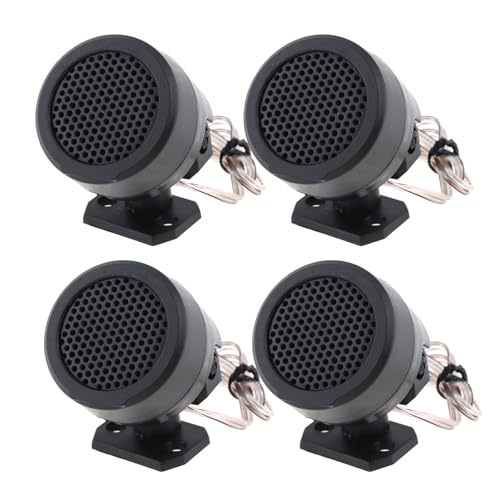
Pros
- Sturdy ABS material resists wear for durable car use
- Clear and delicate playback across music genres
- Simple screw-mount installation anywhere with 12V power
Cons
- Focuses on highs only, pair with subs for full-range sound
- Requires 12V DC power source, not plug-and-play for home AC
- Mini size limits output in very large vehicle interiors alone
The DriSentri TP-006A dome tweeters are a set of four mini speakers designed to boost high frequencies in car audio systems. Powered by 12V DC, they handle up to 500W for efficient, high-output performance without compromising clarity. Ideal for American car owners and truck enthusiasts looking to upgrade factory stereos on a budget.
These tweeters shine in real-world drives, delivering delicate highs that make pop tracks sparkle and rock guitars cut through. Their professional build with single or double buzzer options ensures versatile sound tuning. Easy to mount in doors, dashboards, or A-pillars, they integrate seamlessly into most vehicles.
While not a full-range solution, they excel at enhancing treble for immersive listening during commutes or road trips. The non-destructive sound quality preserves music fidelity across genres. Overall verdict: A smart, affordable pick for DIY audio upgrades that punches above its price.
Expect precise high-frequency reproduction with clear, detailed treble from the dome design. Single and double buzzer configurations allow tweaking for sharper or fuller highs, perfect for vocals and cymbals in cars. The 500W efficiency handles high volumes without breakup, maintaining delicacy even on demanding tracks.
Playback suits pop, classical, and rock, providing lossless quality in 12V setups. Wired connection ensures stable performance without dropouts, outperforming wireless in consistent power delivery. Pair with mids and subs for balanced car soundstages that fill cabins on highways.
Built from rugged ABS material, these tweeters resist daily wear, vibrations, and temperature swings in vehicles. Compact mini size measures just right for tight installs, weighing little for hassle-free mounting with supplied screws. No moving parts beyond the dome mean low maintenance.
Powered directly by 12V DC, they run continuously without battery drain issues, ideal for long drives. No charging needed; plug into car systems for instant, endless playback. This eliminates runtime worries, focusing energy on pure audio output.
Versatile placement in cars, garages, rooms, or living areas makes them multi-use. The sturdy construction supports home audio tweaks too, blending durability with everyday portability.

Pros
- Exceptional high-frequency sensitivity that easily cuts through loud road noise and deep subwoofer bass
- Ultra-shallow mounting profile makes custom pillar and door installations much easier
- Heavy-duty cast aluminum housing provides lasting structural durability
- Phenomenal output volume and value for pro-audio style automotive builds
Cons
- Requires inline capacitors or active high-pass crossovers to prevent low-frequency damage
- Aggressive sound signature may require equalization adjustments for listeners sensitive to sharp treble
- Not a direct factory replacement and typically requires custom hole fabrication
The PRV Audio TW350Ti-4 bullet tweeters are engineered specifically for car audio enthusiasts who want high-SPL, pro-audio sound clarity without remodeling their entire vehicle interior. Designed to cut clean treble through earth-shaking bass setups, these titanium super tweeters serve as the top-end powerhouse for custom automotive audio builds. Whether you are running high-output midbass drivers or multiple heavy subwoofers, these units bring missing sparkle and balance back into the acoustic mix.
In practical listening environments, the TW350Ti-4 pair delivers intense acoustic energy. Unlike standard silk-dome tweeters that can sound muffled when pushed to competing decibel levels, the titanium diaphragm produces crisp, articulate transients. Percussive cymbal crashes, brass overtones, and vocal harmonics slice through highway road noise effortlessly. However, because they are tailored for extreme sensitivity, proper crossover filtering and equalization are essential to prevent high-frequency fatigue during extended listening sessions.
Ultimately, the PRV Audio TW350Ti-4 provides an uncompromising combination of pro-audio loudness, compact engineering, and value. For enthusiasts building custom door panels or A-pillar speaker pods who refuse to let their highs get swallowed by booming subwoofers, this pair delivers the definition and forward presentation required to round out a high-energy car sound system.
Acoustically, the TW350Ti-4 thrives on ultra-fast transient response and expansive dispersion. The integrated bullet phase plug ensures precise directional projection, dispersing bright high-frequency energy throughout the vehicle cabin. Its titanium diaphragm produces an articulate, airy top end that makes complex percussion, synthesized leads, and vocal sibilance instantly legible even at deafening overall volume levels.
Efficiency is the core strength of these super tweeters. Running on a versatile 4-Ohm impedance with up to 240 Watts peak capacity, they produce exceptional decibel output with modest amplifier power. When paired with high-pass crossovers to shield the voice coils from low midrange frequencies, distortion remains exceptionally low across the upper treble spectrum, maintaining crystal-clear fidelity when driven hard.
Built to withstand the physical demands of high-vibration automotive installations, the TW350Ti-4 features a heavy-duty cast aluminum frame finished in sleek black. Despite measuring 3.5 by 3.5 inches at the faceplate, PRV Audio engineered this unit with a remarkably shallow mounting depth of just 1.93 inches. This compact profile drastically reduces clearance issues in cramped door panels or custom fiberglass pillars.
Operating at a standard 4-Ohm load, these tweeters seamlessly integrate with aftermarket amplifiers and standard multi-channel car audio processors. The rugged terminals ensure solid wiring integrity, preventing loose connections from heavy road vibrations. For optimal longevity and pristine sound, installers should pair them with proper high-pass filters or inline capacitors to safeguard the delicate titanium voice coil assemblies.
The Engineering, Anatomy, and Purpose of Speaker Tweeters
A tweeter is a specialized loudspeaker driver engineered specifically to produce the highest audible frequencies of sound. Human hearing generally spans from 20 Hz up to 20,000 Hz, and standard woofers cannot vibrate quickly enough to reproduce the upper portion of that range. By dedicating a lightweight diaphragm to handle frequencies typically starting between 2,000 Hz and 4,000 Hz, an audio system can produce crisp, articulate detail. Understanding the mechanics, placement, and electrical needs of these drivers ensures you build or upgrade a sound system that remains accurate at any volume.
The Acoustic Role and Frequency Range of Tweeter Units
Tweeters are responsible for reproducing sounds that define clarity, presence, and directionality in recorded audio. Elements like the chime of a triangle, the splash of a cymbal, and the subtle breath of a vocalist live predominantly in the upper treble spectrum. While a large woofer moves considerable volumes of air to create bass, a tweeter moves minuscule amounts of air at extraordinary speeds. This division of labor keeps low-frequency vibrations from distorting high-frequency reproduction across multi-driver enclosures.
Most audio equipment relies on tweeters to cover frequencies ranging from around 2,000 Hz up to 20,000 Hz, with some super tweeters reaching well beyond human hearing limits. Frequencies above 10,000 Hz add sparkle and spatial ambiance, giving the listener a feeling of open room acoustic space. If an audio system operates without a functioning tweeter, spoken voices sound distant and musical instruments blend together into a muddy wash. Introducing a properly matched high-frequency unit restores that missing separation and restores clarity to complex tracks.
Why Driver Size and Moving Mass Matter for High Notes
High-frequency sound waves have exceptionally short physical wavelengths that require rapid mechanical acceleration. A sound wave at 10,000 Hz measures barely over one inch in length, requiring a diaphragm that can oscillate ten thousand times each second without flexing. Large speaker cones are physically too heavy to reverse direction at that speed, resulting in sluggish movement and severe acoustic distortion. Tweeters solve this mechanical problem by utilizing tiny diaphragms, usually between 0.75 inches and 1.5 inches in diameter, that boast minimal moving mass.
Because the moving mass is so low, the voice coil requires only tiny excursions to displace the necessary air for crisp listening levels. A smaller diaphragm also broadens the acoustic dispersion pattern, preventing the high frequencies from beaming in a narrow laser-like line. Wider dispersion allows listeners off-axis to hear realistic detail rather than experiencing a dull sound signature outside the center seat. Managing this balance between compact physical size and wide acoustic radiation is fundamental to good speaker engineering.
The Essential Function of Crossover Networks
Tweeters cannot operate safely on a full-range electrical signal without immediate danger of catastrophic failure. Because bass notes carry tremendous electrical energy and demand long physical cone excursions, sending raw low-frequency signals into a delicate tweeter will melt its tiny voice coil within seconds. A crossover network functions as an electrical traffic controller, directing high frequencies to the tweeter while routing mid and low frequencies to heavier drivers. In traditional stereo loudspeakers, this crossover uses capacitors and inductors to establish a safe transition point.
The simplest protection method is a high-pass filter formed by an inline non-polarized capacitor that attenuates low frequencies before they reach the driver terminals. Many compact dome tweeters include built-in passive filters or discrete capacitors bundled in their wiring harnesses to facilitate direct connection to twelve-volt automotive stereo feeds. Higher-grade component systems use complex multi-order passive crossovers with steep slope roll-offs to protect drivers and minimize overlap between acoustic bands. Active crossovers handle this division before amplification, ensuring each discrete power amplifier channel sends only pure high-frequency signals to the tweeter.
Soft Dome Tweeters Versus Bullet Super Tweeters
Choosing between a soft dome tweeter and a bullet super tweeter depends heavily on the intended listening environment and desired output volume. Dome tweeters use a rounded, convex or concave diaphragm that radiates sound smoothly over a wide listening angle. These drivers are prized in home hi-fi systems and daily-driver vehicles because they produce a warm, smooth treble response that avoids listener fatigue. Their forgiving acoustic profile renders strings and vocals with subtle warmth, making them an ideal choice for enclosed, reflective cabins.
Bullet super tweeters, such as cast aluminum horn models with a central phase plug, take an entirely different acoustic approach. The machined bullet in the center acts as a mechanical phase equalizer, guiding acoustic energy out of the horn throat with extreme efficiency. These drivers generate intense sound pressure levels, making them standard equipment in pro audio concerts, open-bed trucks, and high-volume mobile audio competitions. However, bullet tweeters are highly directional, meaning their output must be aimed directly toward the listening area to avoid harsh off-axis drop-offs.
Diaphragm Materials and Structural Durability
The physical material used to construct a tweeter diaphragm directly dictates its stiffness, damping characteristics, and sonic signature. Silk and treated textile domes provide natural internal damping that smooths out harsh resonant peaks, producing a relaxed listening experience. Synthetic materials such as ABS plastic or mylar offer moisture resistance and cost efficiency, making them popular in budget-conscious compact multi-driver packs. These lightweight plastics perform reliably in varied automotive climates where heat and humidity cause standard paper or delicate fabrics to degrade over time.
Metallic diaphragms made from titanium or aluminum provide extreme rigidity, allowing them to track complex waveforms with lightning precision. Titanium diaphragms paired with heat-resistant Kapton voice coil formers handle substantial power without deforming during prolonged playback. Cast aluminum frames further reinforce heavy-duty bullet models by dissipating thermal energy away from the magnet motor structure. While metal diaphragms deliver crystalline sparkle and razor-sharp transients, poor amplification can reveal harsh ringing if the signal clips or lacks proper high-pass filtering.
Impedance, Power Ratings, and Sensitivity Matching
Integrating tweeters into an existing sound system requires careful attention to electrical impedance, continuous power handling, and overall sensitivity. Most mobile audio tweeters feature a standard four-ohm nominal impedance, which matches typical twelve-volt head units and multichannel car amplifiers. Connecting a driver with an impedance mismatch can cause the amplifier to overheat or deliver insufficient acoustic output. System designers must also distinguish between peak marketing wattage ratings and continuous thermal power handling to prevent accidental coil burnout.
Sensitivity ratings, measured in decibels per watt at one meter, determine how loudly a driver plays given a specific amount of input power. High-efficiency bullet tweeters often exceed one hundred decibels of sensitivity, meaning they generate massive volume from very little amplifier wattage. If high-efficiency tweeters are paired directly with low-sensitivity midrange cones, the high treble will completely drown out the rest of the music. Utilizing attenuating resistors or adjusting amplifier gain controls helps balance output levels across the entire frequency range.
Acoustic Placement and Soundstage Elevation
Because high frequencies travel in tight, directional paths, tweeter placement has a profound impact on the perceived soundstage height and depth. Woofers mounted low in door cards or near the floor can create an unnatural sensation where music feels pinned under the dashboard. Mounting tweeters higher up, such as on the vehicle A-pillars, sail panels, or upper dashboard, elevates the acoustic image to ear level. This strategic placement allows vocals and lead instruments to sound as though they are performing directly on top of the dash.
Reflective surfaces inside a listening space, such as glass windshields or bare drywall, can introduce phase cancellation and harsh acoustic peaks. Aiming tweeters on-axis toward the listener delivers the most direct sound energy with minimal boundary reflection interference. In contrast, slight off-axis angling can tame overly aggressive titanium horns, softening the sharpest highs before they reach your ears. Experimenting with temporary adhesive mounts before drilling permanent holes saves installers from locking in an undesirable acoustic sweet spot.
Mounting Depths and Physical Installation Strategies
Physical space limitations often dictate which tweeter form factor can fit into a specific enclosure or factory speaker location. Standard bullet tweeters frequently feature bulky magnet structures with mounting depths approaching two inches, which can hit window glass inside car doors. Ultra-shallow designs, such as slim titanium drivers measuring around 1.3 inches deep, solve this clearance problem without sacrificing high-output performance. Installers should always measure the internal cavity depth and clearance behind interior panels before purchasing custom high-output bullet drivers.
For simpler setups that avoid custom cutting, surface-mount mini dome tweeters offer versatile installation options. Many of these compact units include double-sided adhesive mounting pads and angled surface cups that attach directly to flat dashboard surfaces. When upgrading factory systems, replacing worn paper drivers with dedicated coaxial speakers or standalone modular tweeters provides an immediate upgrade in sound clarity. Securing mounting hardware firmly prevents annoying cabin rattles and keeps drivers from shifting during vehicle operation.
Troubleshooting Distortion, Clipping, and Blown Drivers
Tweeters are often the first components to fail when an audio system is operated past its linear output limits. A common misconception is that overpowering blows tweeters, but underpowered amplifiers driven into heavy clipping are frequently the real culprit. Clipping occurs when an amplifier attempts to produce more voltage than its power supply allows, squaring off the sine wave peaks. This clipped waveform pushes excessive high-frequency harmonic energy into the crossover and voice coil, generating rapid thermal buildup that melts the wire.
Diagnosing a dead tweeter begins with a simple resistance check using a digital multimeter across the disconnected driver terminals. A working four-ohm tweeter should typically read between three and four ohms of direct current resistance. If the multimeter shows infinite resistance or an open loop, the internal voice coil has burned through or severed its connection. Listening for scratching, buzzing, or muffled treble during playback will also reveal physical diaphragm tearing or voice coil rubbing within the magnetic gap.
Practical Guidelines for Selecting and Tuning Tweeter Upgrades
Upgrading your audio system with dedicated high-frequency drivers requires matching driver characteristics to your music taste, listening space, and power equipment. Casual listeners seeking balanced, non-fatiguing sound for acoustic, classical, or pop tracks typically prefer silk or synthetic dome tweeters. Enthusiasts building high-SPL vehicle systems or open-air festival rigs benefit far more from horn-loaded bullet drivers that can cut through wind and road noise. Ensuring your chosen model provides appropriate mounting hardware and manageable depth makes the physical build significantly smoother.
Once installed, taking time to tune your equalization curve will prevent treble harshness and protect your investment over the long term. Start by setting your amplifier gains properly with clean test tones to avoid introducing clipped signals into the signal chain. Cutting narrow equalization bands around five to eight kilohertz can eliminate annoying sibilance without sacrificing the open sparkle of the upper register. A thoughtful combination of proper crossover protection, smart aiming, and conservative gain settings guarantees crisp, engaging sound for years of reliable listening.
Investing the effort to understand what are tweeters in speakers transforms how you evaluate, assemble, and tune your audio gear. These compact drivers carry the vital responsibility of defining the clarity, spatial depth, and tonal realism of every soundtrack you play. By choosing diaphragms suited to your listening goals, respecting physical installation constraints, and protecting delicate voice coils with clean crossover signals, you create an articulate, dynamic acoustic performance in any room or vehicle.





Write Your Review
No reviews yet. Be the first to share your experience!