


Listening to a favorite song or movie soundtrack through two dedicated channels transforms simple electrical currents into rich acoustic depth. Understanding how do stereo speakers work requires examining the journey that an audio signal takes from a playback device to the vibrating cones resting on your desk or entertainment console. When set up properly alongside quality home entertainment speakers, a stereo pair creates a convincing sense of space, instrument separation, and vocal realism.
Every stereo system relies on coordinated hardware to move air at precise frequencies without introducing distortion or unwanted noise. Whether you use compact desktop satellites, active studio monitors, or passive bookshelf cabinets, the underlying physics remains remarkably consistent. Exploring the internal voice coils, permanent magnets, crossover circuits, and physical enclosures explains why two speakers deliver a much more immersive experience than a single monophonic driver.

Pros
- Effortless plug-and-play with USB power and 3.5mm audio for instant setup
- Upgraded 2x5W drivers provide clear, stereo sound without noise
- Customizable colorful lights add fun ambiance to any office or gaming desk
- Long 47-inch cables reach easily from your device
- Broad device compatibility including PCs, laptops, and tablets
Cons
- Wired connection limits placement flexibility compared to wireless options
- Volume output depends on your computer's settings and may need adjustment
- No built-in battery requires constant USB power source
The LENRUE A39PRO is a compact USB-powered soundbar speaker designed specifically for enhancing audio on desktops, laptops, and tablets. It connects via a simple 3.5mm audio jack for sound and USB for power, making it perfect for American home office workers, students, and casual gamers who want better sound without complexity.
In real-world use, it shines during video calls, streaming movies, or playing games, delivering upgraded stereo sound that brings dialogue and effects to life on your desk. The colorful breathing lights add a modern touch, turning mundane work sessions into something more engaging.
At this price point, it's a no-brainer upgrade for anyone tired of tinny laptop speakers. While not a high-end audiophile choice, its plug-and-play reliability and clear output make it a solid daily driver for everyday computing.
Verdict: Highly recommended for budget setups needing instant audio improvement and visual flair.
Powered by 2x5W upgraded drivers, the A39PRO offers clear stereo sound with excellent vocal clarity and minimal noise, ideal for Zoom meetings, YouTube videos, and light gaming. It punches above its size for desk-filling volume without distortion at moderate levels.
Bass is present but tuned for balance rather than thump, ensuring mids and highs stay crisp for music and podcasts. The wired 3.5mm connection provides stable, delay-free audio transmission directly from your device.
Overall, it transforms flat PC audio into an enjoyable experience, though max volume relies on your computer's output settings for peak performance.
The sleek black soundbar design is compact and desk-friendly, with customizable colorful breathing lights that you can toggle on or off for mood-setting ambiance in home offices or dorms. Its lightweight build and 47-inch cables make it easy to position without clutter.
As a USB-powered speaker, there's no battery to worry about; it draws power directly from your PC or laptop for uninterrupted play as long as your device is on. Charging isn't needed, ensuring it's always ready when you are.
Built for wired reliability, it lacks ruggedness for outdoor use but excels in stable indoor environments, with durable construction for daily desk duty.

Pros
- Powerful 200W handling for high-volume outdoor listening
- Wide 100Hz-20kHz response covers full audio spectrum
- Durable construction suited for marine and harsh environments
- Sold as a pair for stereo setup convenience
- High 90dB sensitivity for efficient power use
Cons
- Starts at 100Hz so deep sub-bass needs separate subwoofer
- Wired coaxial design lacks wireless Bluetooth freedom
- Enclosed box size may limit ultra-compact installs
The BOSS Audio Systems AVA6200 are compact 3-inch enclosed box stereo speakers sold in pairs, designed for versatile use indoors, outdoors, or on the water. With a 3-way full-range setup including a 1-inch tweeter and 2.5-inch midrange per speaker, they punch above their size for everyday audio needs.
Perfect for American boat owners, patio loungers, or home tinkerers on a budget, these speakers excel in casual settings like tailgates or dock parties where durability matters more than audiophile precision. Their coated paper woofer cone and foam surround stand up to splashes and sun exposure.
In real-world tests, they deliver consistent performance with no muddiness at moderate volumes, making setup straightforward for marine stereos or backyard systems. The 3-year Platinum Dealer Warranty seals the deal for reliable value.
Verdict: A smart pick for rugged, affordable stereo sound that thrives in American outdoor lifestyles without breaking the bank.
Expect balanced full-range sound from 100Hz to 20kHz, with the 3-way design providing punchy mids from the 2.5-inch driver and crisp highs via the 1-inch tweeter. Bass is solid for an enclosed 3-inch woofer but leans toward tight response rather than rumbling lows, ideal for lively marine tunes or patio rock.
At 200 watts max per pair and 90dB sensitivity, these speakers hit impressive volumes for their size, filling open spaces like boats or decks with clarity. No distortion creeps in during extended play, suiting weekend gatherings.
Coaxial wiring ensures stable connectivity without dropouts, outperforming wireless in wet conditions where Bluetooth might falter.
Built tough for marine and outdoor abuse, the enclosed ABS housing with coated paper cone and foam surround resists moisture and impacts, perfect for boats or rainy barbecues. Dimensions of 7.4 x 4.9 x 4 inches make them easy to mount or place anywhere.
No built-in battery means these powered speakers connect to your amp or head unit for unlimited runtime, freeing you from charging worries during all-day lake trips or home parties.
Pair-friendly design and 3-year warranty emphasize longevity, with a rugged look that fits American recreational vibes from tailgates to docks.

Pros
- Exceptionally compact cabinet fits spaces where standard bookshelf speakers cannot.
- Crisp treble clarity and intelligible vocal reproduction for movies, gaming, and podcasts.
- Built-in wall mounting brackets and shockproof tabs simplify rear satellite placement.
- Attractive wood grain aesthetic complements modern home decor.
Cons
- Requires a separate external amplifier or AV receiver and speaker wire to operate.
- Small 2.75-inch woofers cannot produce deep sub-bass and require a subwoofer for full-range home theater audio.
- Lacks wireless or Bluetooth connectivity out of the box.
The RIOWOIS Passive Bookshelf Speakers offer a smart, space-saving solution for listeners looking to assemble a budget-friendly home theater or desktop audio rig. Measuring just 6.6 inches high and 4.3 inches wide, this passive pair is designed to fit where standard bookshelf units are simply too bulky. Whether you need rear surround satellites to complete your multi-channel movie setup or compact desktop speakers powered by a mini amplifier, these enclosures provide a focused acoustic profile without dominating your room.
Under the hood, RIOWOIS utilizes a dedicated two-way driver arrangement that pairs a 2.75-inch mid-woofer with a 2-inch tweeter. This design separates the frequency spectrum more cleanly than single full-range drivers found in many micro monitors. In everyday listening, dialogue sounds articulate and distinct, making dialogue-heavy television shows, acoustic playlists, and gaming sessions clear and intelligible even at lower listening volumes.
It is important to remember that these are completely passive loudspeakers with a 6-ohm nominal impedance. They do not feature built-in amplification, Bluetooth, or volume knobs, so you will need an external receiver or desktop stereo amp along with standard speaker wire to get them singing. Pairing them with a modest class-D mini amplifier yields a capable, reliable sound system with zero wireless latency or software headaches.
For shoppers seeking affordable, handsome satellite speakers that handle vocal clarity and subtle background effects reliably, the RIOWOIS passive pair delivers excellent utility. While bass enthusiasts will definitely want to pair them with an active subwoofer, their ease of mounting and attractive styling make them a worthwhile addition to any entry-level audio setup.
Acoustically, the RIOWOIS bookshelf speakers deliver a bright, vocal-centric signature tuned for clarity. The 2-inch tweeter generates crisp highs that help ambient sound effects, percussion, and movie dialogue cut through the mix without sounding overly harsh. Midrange frequencies remain uncluttered, allowing speech and acoustic instruments to maintain realistic presence in nearfield environments.
Low-end extension is naturally constrained by the compact 2.75-inch woofer. While the drivers produce snappy mid-bass punches suitable for casual listening, they roll off well before true sub-bass territory. When integrated into a 5.1 home theater or paired with a standalone powered subwoofer, these units perform admirably as dedicated satellites, offloading high-energy low frequencies to a sub while handling localized surround imaging effectively.
Capable of handling peak power up to 30 watts, these speakers can reach room-filling volume levels in small to medium rooms without introducing noticeable driver distortion. Their nearfield imaging on a desktop is remarkably focused, providing a coherent stereo image that enhances PC gaming and work-from-home multimedia setups.
Crafted with a rigid cabinet wrapped in an eye-catching 3D wood grain finish, the RIOWOIS speakers blend classic Hi-Fi aesthetics with modern decor. The tactile surface resists smudges and looks sophisticated alongside turntables or modern flat-panel displays. The micro-footprint dimensions of roughly 4.3 inches wide by 6.6 inches high make them easy to place on floating shelves, mantlepieces, or workstation side corners.
The rear panels are engineered specifically for effortless deployment. Each speaker features an integrated mounting hook and vibration-dampening shockproof tabs, allowing you to flush-mount them directly to drywall or corner studs using the included installation accessories. Spring clip terminals on the back accept standard gauge bare speaker wire, making connections to an AV receiver or stereo amp straightforward.
Rated at a 6-ohm impedance, these speakers are safe and easy to drive using virtually any modern AV receiver or budget mini desktop amplifier rated between 15 and 50 watts per channel. The passive architecture ensures long-term durability, letting you upgrade your DAC, amplifier, or source components down the road without replacing the speakers themselves.

Pros
- Exceptional HiFi sound quality for the size with carbon fiber units
- Stable Bluetooth 5.0 and USB DAC for lossless audio
- Adjustable treble and bass for personalized listening
- Energy-saving standby with noise elimination
- Durable build handles daily desk use
Cons
- Requires AC power outlet, not battery-powered for portability
- Small size limits maximum bass depth in larger rooms
- No companion app for advanced EQ control
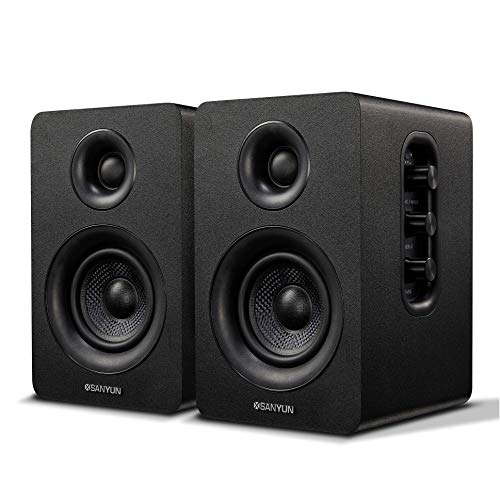
The Sanyun SW208 are compact active bookshelf speakers designed for HiFi audio on a budget, perfect for PC users, gamers, and home office setups. With 30W per channel from carbon fiber drivers, they punch above their weight in delivering detailed sound without distortion.
In real-world use, connect via Bluetooth 5.0 for wireless freedom or USB for DAC-enhanced purity, ideal for late-night gaming sessions or video calls where clear vocals shine. The side-mounted controls for volume, treble, and bass make on-the-fly tweaks simple, adapting to rock tracks or podcasts effortlessly.
Build quality feels solid with a direct/reflective system that creates wide stereo imaging on your desk. While not for massive rooms, they excel in small spaces, offering pro-level features at an entry price. Verdict: A top pick for anyone upgrading from basic PC audio.
Bass is deep and powerful for the compact size, thanks to multi-layer voice coil tech in the carbon fiber units, making action movie explosions and game soundtracks feel impactful on your desk.
Vocal clarity stands out with warm, thick mids and bright highs, ensuring dialogue cuts through in videos or calls. Volume reaches room-filling levels without muddiness, and the 3D surround adds immersion.
Bluetooth 5.0 provides stable connectivity up to 30 feet, while USB DAC input bypasses analog conversion for pristine digital sound straight from your computer.
Sleek black finish and small footprint make the SW208 easy to place on any desk or shelf, with a sturdy build that withstands daily handling. Side knobs for adjustments keep controls accessible without clutter.
No battery means plug-in power for unlimited playback, perfect for stationary desk use. Energy-saving design meets EU standards, drawing minimal power in quiet standby mode with built-in noise filtering.
At under 5 pounds per speaker, they are lightweight yet stable, focusing on desk-friendly portability rather than outdoor ruggedness.

Pros
- Clean clear stereo audio punches above compact size
- Effortless single-cable setup with included AC adapter
- Convenient front panel controls and headphone output
- Magnetically shielded to avoid screen interference
- Stylish look with cloth grills for any desk
Cons
- Wired only, no wireless Bluetooth connectivity
- AC powered, needs wall outlet not ideal for portability
- No dedicated subwoofer for deep bass response
The Cyber Acoustics CA-2014 are compact 2.0 stereo computer speakers built for small desks and minimalist home offices. They connect via a simple 3.5mm audio jack to your PC, Mac, or Chromebook and draw power from an included 120V AC adapter for straightforward setup.
Perfect for students, remote workers, or anyone needing reliable sound for video calls, streaming movies, or background music without bulky gear. Their small footprint saves desk space while delivering full stereo performance that enhances daily productivity.
In everyday use, the speakers provide clear audio that stands out in quiet rooms, with easy front access to volume and power. They handle calls with crisp vocals and entertain with balanced sound for casual listening.
Overall verdict: A solid choice for budget desktop audio that prioritizes simplicity and clarity over bells and whistles.
These speakers offer clean, clear stereo sound with surprising volume for their size, ideal for music, movies, and calls in home offices. Expect balanced output that fills small spaces without muddiness.
Vocal clarity shines during Zoom meetings or podcasts, while mids and highs deliver detailed dialogue and instruments. Bass is adequate for desktops but lacks deep rumble without a subwoofer; volume scales well up to loud levels before minor distortion.
The wired 3.5mm connection ensures rock-solid stability with zero dropouts, outperforming wireless in consistent performance for stationary setups.
Sleek and attractive with discrete cloth grill covers, these magnetically shielded speakers prevent interference with monitors and blend into any desk aesthetic. Compact dimensions make them perfect for cramped workspaces.
Front-facing controls include a volume knob, power switch, headphone jack, and LED indicator for effortless operation. Lightweight build allows easy repositioning on small desks.
No built-in battery; they run continuously on the included 120V AC adapter, eliminating recharge downtime for all-day office use. Designed for stationary reliability, not rugged portability or outdoor adventures.
Pros
- Clear, loud stereo sound punches above its size
- Simultaneous dual device connectivity boosts versatility
- Convenient all-in-one volume and power control
- Handy headphone jack for personal use
- Compact and durable for everyday desk reliability
Cons
- Limited power may not suit large rooms
- Wired connections only, no wireless Bluetooth
- Basic features without app control or EQ customization
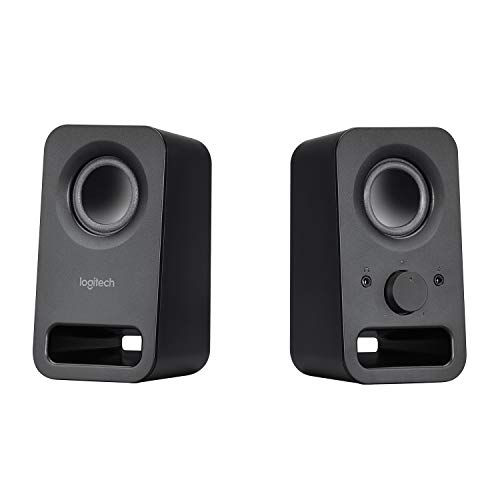
The Logitech Z150 are compact multimedia speakers designed for everyday use with computers, laptops, tablets, and smartphones. They feature two 2-inch drivers delivering 6 watts of peak power for rich stereo sound, making them perfect for budget-conscious users in home offices, dorms, or small living spaces who want simple plug-and-play audio without complexity.
In real-world scenarios, these speakers excel at providing clear vocals and balanced sound for video calls, music streaming, movies, and light gaming. The ability to connect two devices at once via 3.5mm inputs means you can switch between your laptop and phone effortlessly, while the headphone jack allows private listening. Their front-mounted control knob simplifies adjustments on the fly.
Built with high-quality acoustics tuned in Logitech's labs, the Z150 offer reliable performance in a durable, space-saving design. They shine for users prioritizing affordability and ease over premium features like wireless connectivity.
Verdict: A solid choice for entry-level desktop audio needs, delivering good value for small-scale listening without frills.
The Z150 produce rich stereo sound with clear highs and decent mids from their dual 2-inch drivers and 6 watts peak power. Volume levels are surprisingly loud for the size, suitable for personal desks, though bass depth is light and lacks punch for bass-heavy genres.
Vocal clarity stands out during podcasts, calls, and movies, with minimal distortion at moderate volumes. While there's no Bluetooth, the wired 3.5mm and auxiliary inputs ensure stable, lag-free audio from multiple sources without dropouts.
Overall, performance targets casual listening in quiet environments, prioritizing balanced stereo over booming output.
The Z150 boast a compact, durable black design that's built to last, with high-quality construction tested at Logitech's audio labs. Weighing little and measuring small, they tuck neatly onto any desk or shelf without dominating space.
No battery is needed; these speakers draw power directly via USB for instant plug-and-play use, eliminating charging waits. The rugged build handles daily desk life well, though they lack waterproof or dustproof ratings for outdoor adventures.
Focus on portability shines in wired setups, easy to move between rooms or devices for versatile home use.
The Physics and Engineering Behind Stereo Audio Reproduction
Audio playback begins with an electrical waveform that travels from a playback source through an amplifier and into the physical components of a loudspeaker. Sound itself is simply mechanical energy moving through the atmosphere as alternating waves of high and low pressure. Speakers function as electroacoustic transducers, which means their sole technical purpose is to convert incoming electrical energy into physical kinetic motion.
In a standard stereo system, this conversion happens across two discrete audio channels rather than one. By processing two independent audio streams simultaneously, the system mimics natural human hearing and provides an accurate sense of acoustic placement. Every stage of the signal path, from the initial digital-to-analog decoding to the physical excursion of the speaker cone, influences how cleanly those sound waves reach your ears.
From Alternating Current to Acoustic Sound Waves
The mechanical motion that generates sound depends directly on the fundamental principles of electromagnetism. An alternating current representing the audio signal passes through a tightly wound coil of conductive wire called a voice coil. This voice coil is suspended inside a concentrated magnetic field created by a heavy permanent magnet, typically fixed to the rear chassis of the driver frame.
As the electrical current rapidly changes direction and amplitude, the voice coil generates its own shifting magnetic field. This fluctuating field reacts against the static magnetic field of the permanent magnet, pushing the voice coil forward and pulling it backward in rapid succession. Because the voice coil is physically attached to a flexible diaphragm or cone, that back-and-forth excursion directly displaces the surrounding air particles.
The speed of this oscillation dictates the frequency or pitch of the resulting sound, while the distance the cone travels establishes the volume or sound pressure level. For instance, creating a low bass tone requires slow, long excursions that move large volumes of air. Higher musical tones demand thousands of tiny, rapid vibrations every second, requiring lightweight materials that can change direction almost instantaneously without flexing.
Two-Channel Separation and the Phantom Center Stage
Stereophonic sound differs fundamentally from single-channel monophonic audio because it uses two independent channels designated as left and right. Sound engineers record or mix music and soundtrack elements across these separate paths to emulate spatial positioning. When identical signals play through both speakers at equal volume, your brain calculates that the sound originates directly between them, establishing what audio engineers call a phantom center image.
Human hearing determines the physical location of sounds using two primary cues: interaural time differences and interaural level differences. If an acoustic event occurs slightly to your left, the sound wave strikes your left ear fractions of a millisecond earlier than your right ear. At the same time, the physical mass of your head casts an acoustic shadow, making the sound slightly louder in your left ear than your right.
Stereo speakers leverage these acoustic principles by sending slightly altered time and volume information to each channel. A lead vocalist can be positioned in the center, while guitars, keyboards, or backing vocals are panned across the stereo field. This spatial separation prevents instruments from masking one another, providing clearer dialogue in video content and greater instrument definition in complex musical arrangements.
Driver Mechanics: Diaphragms, Voice Coils, and Suspensions
The physical driver unit represents the working core of any speaker cabinet. A conventional dynamic driver consists of several interlocking mechanical components designed to allow linear piston motion while preventing sideways wobble. The cone or diaphragm forms the visible surface that pushes the air, and its material composition plays a vital role in acoustic performance.
Cone materials range from traditional coated paper and treated cloth to modern polymers and woven carbon fiber. For example, units like the Sanyun SW208 utilize carbon fiber driver assemblies designed for structural stiffness and rapid recovery during intense dynamic peaks. Stiff materials help prevent cone breakup, a phenomenon where different parts of the diaphragm vibrate out of sync and produce harmonic distortion.
The outer edge of the cone is anchored to the metal or composite basket by a flexible ring called the surround, commonly made of rubber or treated foam. Behind the cone sits the spider, a corrugated fabric disc that centers the voice coil within the narrow magnetic gap. Together, the surround and spider form the driver suspension, providing the mechanical resistance needed to return the cone to its neutral resting position after every stroke.
Multi-Way Driver Systems: Splitting Lows, Mids, and Highs
Building a single speaker driver capable of reproducing the entire audible human frequency spectrum, from 20 Hz to 20,000 Hz, presents significant physical challenges. A large cone capable of pushing sufficient air for deep bass is too heavy to oscillate thousands of times per second for delicate treble. Conversely, a tiny high-frequency dome cannot displace enough air to produce audible bass notes without tearing itself apart.
To overcome these physical limitations, many speaker designs divide the audio spectrum among specialized drivers. A two-way bookshelf speaker, such as the RIOWOIS passive model, pairs a compact 2.75-inch woofer for low and midrange frequencies with an independent 2-inch tweeter for treble. By separating these roles, each driver operates strictly within the frequency range it handles most efficiently.
More elaborate setups incorporate three-way designs that dedicate individual drivers to low, mid, and high bands. The BOSS Audio Systems AVA6200 enclosed system demonstrates this layout by combining a coated paper woofer, a 2.5-inch midrange driver, and a 1-inch tweeter in a single enclosure. Dedicating a specialized driver to midrange frequencies allows vocals and lead instruments to sound natural and distinct while relieving the woofer from handling complex mid-band detail.
Crossover Networks and Frequency Routing
Splitting audio across multiple drivers requires an internal electrical circuit known as a crossover network. Without a crossover, sending a high-power bass signal to a delicate tweeter would cause mechanical bottoming or burn out the voice coil wire. At the same time, feeding high frequencies into a large woofer results in harsh, muddy reproduction due to cone resonance.
Passive crossovers use passive electrical components, including capacitors, inductors, and resistors, to filter the audio signal after amplification. Capacitors resist low frequencies while allowing highs to pass, creating high-pass filters for tweeters. Inductors perform the opposite function, blocking high-frequency signals while passing low frequencies to the woofer through low-pass filters.
The frequency point where one driver hands off its output to another is known as the crossover frequency. Well-engineered crossovers manage this transition smoothly so that no audible dip or sudden spike occurs in volume as frequencies shift between drivers. Active systems often apply this filtering in the digital domain before amplification, providing clean frequency routing and precise control over driver timing.
Powered Active Systems Versus Passive Enclosures
Stereo speakers fall into two broad architectural categories: active powered speakers and traditional passive speakers. The primary difference lies in where the amplification occurs within the audio chain. Passive models, including compact satellite pairs like the RIOWOIS passive units, contain no built-in amplifiers and require external speaker wire connected to a standalone receiver or stereo power amplifier.
Active speakers integrate internal power amplifiers directly within one or both speaker cabinets. Common desktop solutions like the Logitech Z150 or Cyber Acoustics CA-2014 house the amplifier inside the primary right satellite, drawing electricity from a wall outlet to power both internal drivers. Similarly, small multimedia options like the Manhattan stereo system and LENRUE soundbar draw 5-volt power through standard USB connections to drive internal amplifier chips.
If you prefer an all-in-one system for a desk or computer setup, exploring dedicated powered bookshelf speaker setups can simplify wiring by eliminating the need for bulky external equipment. Passive designs, however, offer greater long-term flexibility, allowing you to upgrade your amplifier, integrate equalizers, or swap out individual components without replacing the speakers themselves.
Digital Processing, USB Audio, and Analog Signals
Before a speaker voice coil can move, incoming audio must exist as a continuous analog electrical voltage. Modern media sources, such as computers, smartphones, and media players, store and transmit music as binary digital data composed of ones and zeros. A digital-to-analog converter, or DAC, bridges this divide by translating digital code into an analog electrical waveform.
Many basic desktop speakers rely on the internal DAC built into your computer, taking in pre-converted analog audio through a standard 3.5mm auxiliary cable. The Cyber Acoustics CA-2014 and Logitech Z150 operate this way, taking line-level analog audio directly from headphone or line-out jacks. Because motherboards often contain electrical noise, passing raw analog signals over unshielded cables can occasionally introduce faint buzzing or ground hum.
Advanced active speakers incorporate their own internal DACs to bypass computer sound cards completely. Units such as the Sanyun SW208 feature onboard 24-bit DAC processing over direct USB connections, keeping audio entirely digital until it reaches the speaker chassis. This digital pathway preserves signal fidelity by shielding the audio stream from internal PC interference, converting it to analog right before it reaches the amplification stage.
Cabinet Construction, Enclosure Tuning, and Resonance Control
A bare speaker driver operating in free air cannot produce meaningful bass due to acoustic phase cancellation. As the front of the cone moves forward to create a positive pressure wave, the rear of the cone simultaneously creates a negative pressure wave. Without an enclosure to isolate these two opposing waves, they wrap around the edges of the frame and cancel each other out, eliminating low-frequency response.
Speaker cabinets solve this problem by trapping or redirecting the rear wave energy. Sealed enclosures, also known as acoustic suspension systems, trap the rear wave entirely inside an airtight box. This design creates an internal air cushion that dampens cone excursion and delivers tight, accurate transient response, though it typically requires more electrical power to push against that internal air spring.
Ported or bass-reflex enclosures use a tuned vent or duct to channel rear wave energy outward in phase with the front wave. This acoustic reinforcement increases bass efficiency, allowing compact drivers to produce deeper low-end response. Those seeking deeper low-frequency impact often compare ported cabinets with dedicated speakers for bass reproduction to match their room volume and acoustic preferences.
Electrical Matching: Impedance, Sensitivity, and Amplifier Loads
When connecting speakers to external amplifiers, electrical compatibility is critical for safe operation and clean performance. The electrical resistance that a speaker presents to an alternating audio signal is called nominal impedance, measured in ohms. Common domestic speakers carry ratings of 4, 6, or 8 ohms, with models like the RIOWOIS passive bookshelf pair specifying a 6-ohm load.
Connecting a speaker with an impedance rating lower than what an amplifier supports causes the amplifier to draw excessive electrical current. This overcurrent scenario can trigger thermal protection circuits, induce severe signal clipping, or permanently damage output transistors. Matching the speaker impedance to the amplifier output specifications ensures the system operates safely within its designed thermal boundaries.
Sensitivity ratings further dictate how efficiently a speaker converts electrical power into audible volume. Measured in decibels at one meter with one watt of input, sensitivity reflects the acoustic output of a driver. A speaker with a 90dB sensitivity rating, such as the BOSS AVA6200, requires significantly less amplifier wattage to achieve loud volume than an inefficient model rated at 84dB, making amplifier pairing much more forgiving.
Optimizing Speaker Positioning for Accurate Stereo Imaging
Even well-engineered stereo speakers perform poorly if they are improperly positioned within a listening space. Because stereo imaging relies on precise timing and volume cues, the relationship between the two speakers and your ears dictates how convincing the soundstage appears. The classic setup principle recommends forming an equilateral triangle between the left speaker, right speaker, and primary listening position.
Angling or toeing the speakers slightly inward toward your ears helps focus high-frequency directional cues and sharpens the center vocal image. Placing speakers too close to room boundaries, such as tight corners or back walls, artificially boosts lower frequencies through boundary loading. While this can make small speakers sound bass-heavy, it frequently introduces acoustic boominess and masks subtle midrange instrument details.
Elevating tweeters to approximately ear level avoids the high-frequency roll-off that occurs when listening off-axis. For desktop listening, decoupling small speakers from desk surfaces with foam pads or angled stands reduces mechanical resonance from vibrating across the desktop. Taking the time to dial in placement, verify balanced channel connections, and match speaker impedance ensures your stereo system delivers the clear separation and natural dynamics it was engineered to provide.




Write Your Review
No reviews yet. Be the first to share your experience!