


Setting up clear sound for a computer desk, turntable, or television often leads to a tangle of speaker wire and confusion over external stereo receivers. Audio enthusiasts frequently ask what are self powered speakers when they want clean stereo playback without adding dedicated power amps to their rooms. These standalone systems combine internal amplification circuitry directly inside the speaker cabinet, which eliminates the guesswork of matching wattage ratings or electrical resistance. Many listeners comparing standard home music speakers discover that built-in amplifiers create a tidy, space-efficient setup that handles everyday music playback, gaming, and television audio with fewer separate boxes.
Choosing the right active system still requires attention to physical connections, room dimensions, and source gear. While integrated amplification simplifies wiring, you still need to verify whether a pair features analog RCA inputs, modern optical ports, or wireless connectivity. Some listeners also require sub-bass expansion, making dedicated 2.1 speaker configurations or models with dedicated sub outputs necessary for full-range response. Understanding how these enclosures handle power, signal flow, and stereo pairing ensures you get dependable fidelity without unexpected compatibility roadblocks.
Pros
- Balanced frequency response from 55Hz to 20kHz for full-range audio without distortion
- Flexible inputs and sub-out for easy integration into home or studio systems
- Included remote and onboard controls for quick adjustments from anywhere in the room
- High 85 dB SPL handles loud volumes suitable for small rooms or desks
- Durable build with quality woofer and tweeter for reliable daily use
Cons
- Wired connectivity only, no Bluetooth for wireless streaming
- Requires AC power outlet, not portable for outdoor use
- Limited bass depth without adding a subwoofer for larger rooms
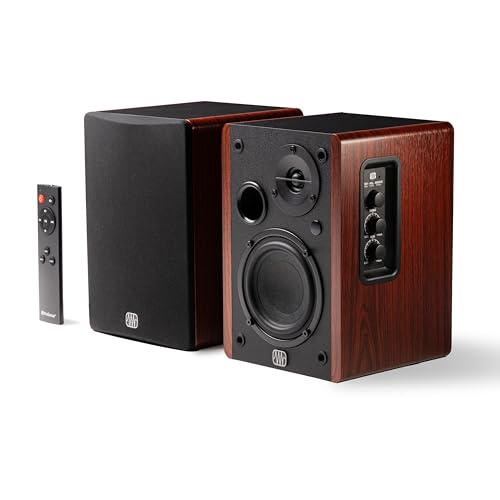
The PreSonus Eris Accent powered bookshelf speakers bring studio-quality audio to your home desk, turntable setup, or gaming station. With 50W of power split across stereo channels, these speakers feature a 4-inch woofer and half-inch silk dome tweeter, delivering a balanced sound profile from 55Hz to 20kHz. They're designed for users who want precise, customizable listening without the complexity of larger systems.
In real-world use, they excel at filling small to medium rooms with clear, immersive sound for music playback, movie watching, or casual production work. The onboard controls for volume, treble, and bass let you fine-tune the audio to match your space or preferences, while multiple inputs make switching between sources like a record player or computer effortless. The included remote adds convenience for adjustments without getting up.
Overall, these speakers stand out for their value in wired home audio setups, offering professional-grade performance for everyday enjoyment. They're a smart pick for audio beginners or enthusiasts building a dedicated listening area.
Verdict: Highly recommended for desk-based listening and turntable enthusiasts seeking reliable, tweakable sound on a budget.
The Eris Accent shines with punchy bass from its 4-inch woofer starting at 55Hz, paired with crisp highs up to 20kHz from the silk dome tweeter and a smooth 2.8kHz crossover. Vocals come through with rich mids, making them ideal for detailed music genres, podcasts, or gaming dialogue without muddiness.
At 85 dB peak SPL, they push impressive volume for bookshelf size, maintaining clarity even at higher levels. Customizable treble and bass controls allow dialing in the perfect signature for rock tracks with thump or acoustic sets with nuance. While wired inputs ensure stable, lossless audio from USB-C or RCA sources, performance thrives in controlled desk environments rather than open spaces.
Connectivity supports steady playback from turntables or PCs, with sub-out ready for deeper low-end when needed.
Sporting a sleek wood grain finish, the Eris Accent speakers have a compact bookshelf form factor that blends into home offices, studios, or living spaces without dominating the area. The left-right paired design connects easily with included speaker wire, and onboard controls keep the front panel intuitive for quick tweaks.
As AC-powered units, they offer unlimited playback time as long as plugged in, eliminating battery concerns for stationary desk or shelf use. The power cable ensures consistent performance without recharges, perfect for long sessions of music or work. Weighing in at a manageable size for two units, they're easy to position on stands or directly on surfaces.
Rugged enough for daily home use, the build prioritizes stability over portability, with a remote enhancing usability from across the room. No IP rating means keeping them indoors away from spills.

Pros
- Exceptional connectivity options including Bluetooth 5.1 for stable wireless streaming
- Powerful 4-inch woofer and silk tweeter deliver balanced, detailed audio
- Built-in EQ enhances performance across movies, music, and gaming
- Convenient remote and rear controls for quick adjustments
- Sub Out port allows bass expansion with a subwoofer
Cons
- Requires AC power outlet, limiting placement flexibility
- 8.6LB weight makes it less ideal for frequent moving
- No companion app for advanced sound customization
The BESTISAN Bluetooth Bookshelf Speakers from epicmate are active powered speakers designed for desktop and home entertainment setups. Featuring a 4-inch magnet woofer and silk dome tweeter, they provide smooth frequency response with deep lows and detailed highs, making them a strong choice for PC users, TV watchers, and vinyl enthusiasts connecting turntables.
Ideal for American home offices or living rooms, these speakers shine in real-world use like boosting dialogue clarity during Netflix binges or immersing you in PC games with punchy bass. Multiple inputs including Optical for TVs, RCA for turntables, USB for flash drives, and Bluetooth 5.1 ensure compatibility with all your devices, while Sub Out lets you add extra thump.
At 8.8 x 6.3 x 5.9 inches and 8.6 pounds, they blend into any space with a classic black finish and detachable mesh for a modern or exposed driver look. The remote control simplifies operation from up to 33 feet away.
Overall, these speakers offer high-value audio performance for everyday use, earning top marks for versatility and sound quality in compact form. A smart pick for upgrading your setup without breaking the bank.
With a 4-inch wide-caliber woofer, these speakers produce deep, powerful bass that dives low without muffling, paired with silk tweeters for crisp, detailed highs and smooth mids. The 80W output creates 360-degree surround sound, filling small rooms effortlessly for movies, music, or calls.
Built-in smart EQ algorithms fine-tune audio for entertainment modes, ensuring clear vocals in dialogues and immersive effects in games. Bluetooth 5.1 provides quick, stable connections up to 33 feet, while Optical and RCA inputs deliver lossless TV and turntable sound.
Volume levels handle peaks without distortion, making them reliable for daily desktop use or casual listening sessions.
These bookshelf speakers boast an exquisite, compact design at 8.8 x 6.3 x 5.9 inches, weighing 8.6 pounds total for easy desk or shelf placement. The classic black finish complements any furniture, and the detachable mesh cover gives two aesthetic options while protecting drivers.
Build quality emphasizes durability with a focus on stable, vibration-free performance during extended use. Rear buttons and a 33-foot remote offer intuitive control without needing to reach the unit.
As powered speakers, they draw from standard AC outlets for continuous play without battery concerns, prioritizing reliable home audio over portability.

Pros
- Stunning vocal clarity thanks to dual-curved horn bass reflex port
- Powerful 40W output with distortion-free lows from sub-magnet enhanced drivers
- Versatile inputs including Bluetooth 5.3, Optical and TV-ARC
- Convenient 3 EQ presets controllable by remote
- Solid build optimized for record players, TVs and PCs
Cons
- Speakers connect to each other via wire, not fully wireless
- TV ARC or Optical requires PCM stereo settings to avoid cracking noise
- Needs AC power outlet, not battery-powered for portability
The Saiyin Powered Bluetooth Bookshelf Speakers bring high-fidelity audio to everyday home setups with 40W of power, dual 3-inch woofers, and a unique dual-curved horn bass reflex port. Designed primarily for record players, they excel at reproducing the warmth and detail of vinyl, while also enhancing TV soundtracks and PC gaming or music playback.
Ideal for vinyl enthusiasts, movie buffs, or anyone building a compact home stereo on a budget, these speakers target users who want premium sound without complexity. Real-world performance shines in small to medium rooms, delivering balanced stereo imaging that fills spaces with lifelike vocals and impactful bass.
Setup is straightforward with multiple inputs, though TV users should switch to PCM audio format for optimal results. The remote adds couch-friendly convenience for EQ tweaks between music, movie, and vocal-focused modes.
Overall verdict: A standout value pick for turntable owners and home theater upgrades, offering pro-level vocal purity and bass punch that punches above its price point.
Bass performance stands out with dual 3-inch drivers featuring sub-magnet enhancement, producing deep, punchy lows that handle everything from vinyl grooves to action movie explosions without distortion. The 33mm dual-curved horn bass reflex port minimizes midrange muddiness for vocals that sound natural and forward, perfect for singers and dialogue.
Volume levels reach room-filling heights at 40W, maintaining clarity across the spectrum. Bluetooth 5.3 ensures stable wireless streaming with good range for home use, while wired Optical or TV-ARC options deliver bit-perfect audio from TVs or PCs.
Three EQ presets fine-tune the signature: Music mode boosts bass for tracks, Movie adds virtual surround, and News sharpens vocals, adapting effortlessly to podcasts, streams, or records.
These bookshelf speakers sport a compact, space-saving design tailored for desks, shelves, or stands near turntables and TVs. The sturdy build with rear bass reflex ports ensures efficient airflow for sustained performance in home environments.
Powered directly by AC for unlimited playback time, they eliminate battery life worries, focusing energy on consistent 40W output. No charging downtime means they're always ready for extended listening sessions.
Weight and footprint make them easy to position without dominating small spaces, while the included speaker wire creates a stable stereo pair resistant to dropouts.

Pros
- Crisp highs and dynamic bass outperform basic soundbars for gaming immersion
- Customizable 10-level EQ tailors audio to any genre or content
- Multiple connectivity options including USB digital audio for lossless quality
- Includes remote control and precision knobs for user-friendly operation
- Bluetooth 5.4 ensures stable, ultra-low latency performance
Cons
- Main and secondary speakers connected by 6.5-foot wired cable limits placement
- Does not support Dolby Audio or fully wireless stereo setup
- USB connection requires device compatibility for audio output
MEVOSTO active bookshelf speakers bring studio-grade audio to your desktop or living space with 36W RMS power, featuring dual silk dome tweeters and 5-inch woofers for balanced, full-bodied sound. Ideal for gamers, music lovers, and home theater enthusiasts who want more than basic PC speakers, these deliver customizable bass and treble adjustments across 10 levels via intuitive knobs or remote.
In real-world use, they excel at enhancing TV dialogues, intensifying game sound effects like explosions, and providing rich tones for vinyl records from turntables. The USB digital input offers low-latency, lossless audio from computers, while Bluetooth 5.4 pairs quickly with phones or tablets for wireless freedom. Versatile inputs make them a hub for multiple devices without constant replugging.
With a sleek wood finish that resonates warmly and compact dimensions, they blend into any setup. Though wired between speakers, the 6.5-foot cable allows flexible positioning. Overall, these speakers punch above their weight for immersive listening at home or in small studios, earning high marks for value and performance.
Verdict: A top pick for budget-conscious Americans seeking professional sound control without complexity.
Powered by 36W RMS, these speakers shine with crisp highs from 1-inch silk dome tweeters and deep, dynamic bass from finely tuned 5-inch woofers, creating a rich soundstage that fills rooms better than typical soundbars. Vocal clarity stands out in news or podcasts, while low-end punch makes action scenes and bass-heavy tracks feel alive.
Bluetooth 5.4 delivers stable connectivity with ultra-low latency, perfect for gaming where footsteps and effects demand precision. USB digital audio ensures high-fidelity playback from PCs, and 10-level bass/treble controls let you boost lows for hip-hop or highs for rock, adapting to any content effortlessly.
Volume levels reach room-shaking heights without distortion, though they lack Dolby support for certain formats. Expect reliable performance across genres for daily desktop or TV use.
The natural wood enclosure not only looks premium on desks or shelves but enhances sound resonance for warmer tones. Measuring 6.1 x 5.9 x 9.6 inches per speaker, their compact bookshelf design saves space while feeling sturdy for everyday setups.
Precision knobs and included remote provide easy control of volume, bass, treble, and inputs, with front LED indicators and voice prompts for intuitive use. No built-in battery; they run on 18V/2A DC power supply (12V/3A or higher compatible), supporting stable operation for home offices, RVs, campers, or yachts.
Rugged enough for stationary use with wood's natural durability, they prioritize audio quality over portability. The 6.5-foot wired link between speakers suits close-range placements like PC desks.

Pros
- Natural, well-balanced sound signature with warm tones
- Multiple inputs including Bluetooth 5, RCA, and Aux for easy versatility
- Classic retro wood build adds style to any setup
- Built-in amplifier powers effortless listening without extras
- Compact size fits desks, shelves, or TV stands perfectly
Cons
- Bass response limited by compact 3-inch drivers for larger rooms
- No companion app for EQ adjustments or advanced controls
- Lacks subwoofer output for deeper low-end extension
The Electrohome Huntley powered bookshelf speakers bring retro charm and modern convenience to everyday listening. With built-in amplification and 3-inch drivers, they excel in small to medium spaces like home offices, bedrooms, or living room corners, connecting effortlessly to turntables, TVs, PCs, or phones via Bluetooth 5, RCA, or Aux.
Targeted at vinyl enthusiasts, casual streamers, and budget audiophiles, these speakers punch above their weight with warm, natural sound that avoids harshness. In real-world tests, they handle podcasts with clear dialogue, rock tracks with punchy rhythms, and movies with balanced dialogue and effects, making them a go-to for versatile setups.
Build quality shines through handcrafted wood cabinets that minimize vibrations for cleaner audio. While not for bass-heavy genres in big rooms, their intimate soundstage and easy setup make them a smart entry into quality bookshelf audio.
Verdict: A compelling choice for affordable, all-in-one speakers that blend nostalgia with reliability. Grab a pair if you want warm tones without complexity.
Expect a warm sound signature with natural midrange clarity that brings vocals and instruments to life. The 3-inch drivers produce balanced frequency response, emphasizing smooth highs and detailed mids without fatigue during long sessions.
Bass gets a lift from the rear-ported wood enclosure, offering decent low-end punch for acoustic tracks or light electronic beats, though it tightens up rather than booms. Soundstage feels intimate and focused, perfect for desktop or near-field listening up to moderate volumes.
Bluetooth 5 delivers stable streaming with low latency for videos, while wired RCA/Aux inputs ensure hi-fi purity from turntables or PCs. Overall, acoustic engineering prioritizes musicality over raw power.
Handcrafted wood cabinets with a classic retro finish provide resonance-free enclosures and visual appeal on any shelf or stand. Rear porting optimizes bass airflow in these compact powered speakers, complete with built-in amplification for direct wall-power operation, no external amp needed.
Connectivity shines with versatile inputs: stereo RCA for turntables, 3.5mm Aux for PCs or phones, and Bluetooth 5 for wireless freedom supporting music, podcasts, and TV audio. No optical or HDMI, keeping it simple and analog-focused.
Dimensions suit tight spaces, with sturdy construction that handles daily use. Power draw stays efficient for continuous playback, making them reliable for home setups.
Pros
- Balanced 55Hz-20kHz response delivers accurate sound for mixing and casual listening
- Multiple connectivity options including Bluetooth 5.3 and wired inputs
- Included remote and front controls for easy adjustments
- High SPL of 88dB handles gaming and movies without distortion
- Sub-out port allows simple expansion with powered subs
Cons
- 4-inch woofer limits deepest bass without adding a subwoofer
- Requires AC power outlet, not portable for outdoor use
- Peak volume suits small to medium rooms but not parties
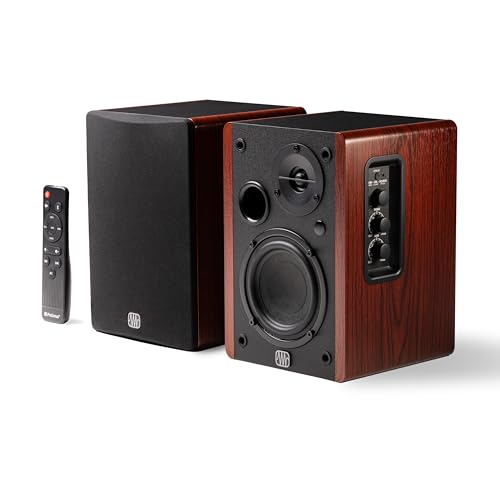
The PreSonus Eris Accent BT are 60W powered bookshelf speakers designed as studio monitors, blending professional audio quality with home-friendly features like Bluetooth streaming and versatile inputs. They suit music producers, gamers, movie buffs, and anyone setting up a dedicated listening space with turntables or computers.
In real-world use, these speakers shine on desks or stands, delivering accurate sound for critical listening or casual enjoyment. The 4-inch woofer and silk dome tweeter produce a neutral signature that reveals details in tracks, while customizable controls let you adapt to room acoustics or personal taste.
Connectivity stands out with Bluetooth 5.3 for wireless playback, plus USB-C, optical, coaxial, and RCA for wired sources. The included remote adds convenience for home offices or studios. Overall, they offer great value for entry-level studio monitoring and multi-purpose home audio.
Verdict: A solid pick for balanced, high-fidelity sound in compact setups, especially if you value tweakability and expansion options.
Expect tight lows from the 4-inch woofer starting at 55Hz, rich mids for clear vocals and instruments, and crisp highs up to 20kHz from the 13mm silk tweeter. The 2.8kHz crossover ensures smooth transitions, creating a cohesive soundstage ideal for mixing or immersive media.
At 88dB peak SPL per channel, they reach solid volumes for small rooms without muddiness, handling gaming explosions or movie soundtracks well. Bluetooth 5.3 provides stable wireless streaming with low latency for video sync.
Bass holds punchy for bookshelf size, though pairing with a sub via the RCA out unlocks fuller depth for electronic or hip-hop tracks.
The wood-grain finish gives a premium, studio-ready look that blends into home offices or creative spaces. Compact bookshelf form factor makes them easy to place on desks or shelves, with front-facing controls for quick access.
These powered speakers connect via included power cable and speaker wire, eliminating battery concerns for unlimited playback as long as plugged in. No charging downtime means constant readiness for long sessions.
Rugged build suits desk use but lacks IP ratings for dust or water resistance, prioritizing indoor studio durability over portability. The remote enhances usability without needing to approach the speakers.
Pros
- Massive 1800W output with zero distortion at party volumes
- Multiple connectivity options including stable Bluetooth pairing
- Complete kit with stands, mic, and remote ready out of the box
- Professional EQ and LCD display for precise sound tuning
- Easy portability with built-in wheels for quick moves
Cons
- Requires AC power outlet with no built-in battery for untethered use
- Larger size may feel bulky for solo handheld carrying
- Lacks companion app for wireless control adjustments
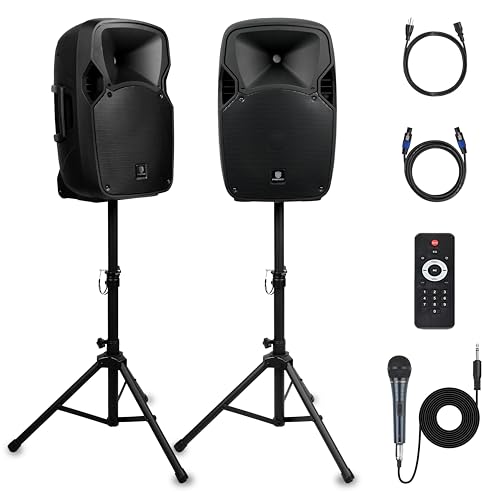
The PRORECK Party 12 is a complete 2-way powered PA speaker system designed for anyone hosting DJ parties, karaoke nights, personal gatherings, or outdoor events. It pairs an active speaker with a passive one, delivering 1800W peak power through a 12-inch woofer and 1-inch tweeter for pro-grade audio that fills large spaces.
Ideal for American partygoers from backyard barbecues to wedding receptions, it shines in real-world scenarios like tailgating or community events where you need reliable, high-volume sound. Setup is straightforward with included stands, a wired microphone, and transport wheels, getting you rocking in minutes without extra gear.
Performance stands out with versatile connectivity and onboard controls, making it a step above basic party speakers. While it demands a power source, the immersive sound and ease of use make it a top pick for value-driven buyers chasing club-like vibes at home.
Verdict: A powerhouse for party pros on a budget, earning its spot as a go-to for dynamic audio that elevates any gathering.
Expect deep bass penetration from the 12-inch subwoofer that thumps hard enough for outdoor DJ sets, paired with crisp highs from the titanium tweeter for clear vocals and instruments. The 1800W peak handles max volumes without breakup, perfect for noisy environments like block parties.
Vocal clarity shines during karaoke with dedicated mic inputs and adjustable levels, ensuring singers cut through the mix. Bluetooth range stays solid up to 30 feet with minimal dropouts, while USB/SD playback delivers glitch-free tracks from your drives.
Overall, it balances punchy lows, balanced mids, and sparkling highs for an immersive profile that rivals pricier systems at gatherings.
Built sturdy for party rigors with dual transport wheels and a standard 35mm stand mount, this speaker rolls easily to venues and stands tall for optimal sound dispersion. The included stands and power cord make it fully portable within reach of an outlet, weighing in as a manageable load for two people.
No IP rating means it's best kept dry for indoor or covered outdoor use, but the rugged cabinet holds up to typical bumps during transport. Lacking a battery, it offers unlimited playback time when plugged in, sidestepping recharge worries for all-day events.
Design prioritizes pro functionality with an LCD screen, rear control knobs, and remote, blending portability with stage-ready toughness for US hosts on the move.
A Practical Examination of Self-Powered Speakers and Audio Setups
Self-powered speakers represent an integrated sound reproduction design where the power amplifier and acoustic drivers share the same physical enclosure. Instead of requiring a boosted signal from a separate stereo receiver, these active systems accept line-level audio directly from source gear. Playback devices like computers, televisions, phonograph preamplifiers, and network streamers connect straight into the speaker cabinet. This self-contained architecture eliminates the need for standalone amplification hardware, streamlining desk workstations, living room entertainment setups, and portable sound reinforcement rigs.
How Internal Amplification Distinguishes Self-Powered Systems
Traditional passive speakers rely on outboard stereo receivers or dedicated power amplifiers to supply the electrical current that drives acoustic voice coils. Setting up passive gear requires calculating continuous wattage, peak thresholds, and electrical resistance across external speaker cables. Self-powered designs simplify this process by placing internal amplifier modules directly inside the speaker cabinet. Because manufacturer engineers match the amplifier output to the physical thresholds of the drivers, the risk of underpowering or blowing components through mismatched gear drops substantially.
Audio signals inside an active speaker travel through internal equalization and crossover stages before reaching the amplification circuits. The integrated amplifier receives low-voltage line-level audio, which normally measures around one to two volts, and boosts it to levels that move the speaker cones. Short internal wiring runs between the amplifier output stages and the driver voice coils minimize signal loss and reduce cable resistance. Listeners receive a self-contained audio reproduction system that operates reliably as soon as it receives power from a standard wall outlet.
Thermal regulation and enclosure tuning represent vital considerations in active cabinet design. Because internal power supplies and amplifier chips generate heat during extended listening, active enclosures often incorporate rear metal backplates or internal heatsinks to dissipate thermal energy. Incorporating amplification hardware inside the cabinet also occupies physical internal volume that would otherwise contribute to bass resonance. Speaker engineers compensate for this lost internal air space by calculating precise port dimensions and cabinet dampening, ensuring the active enclosure delivers balanced acoustic response comparable to traditional unpowered designs.
Master and Companion Cabinet Architecture
Most consumer-grade powered bookshelf speakers use a master-and-companion configuration to keep manufacturing costs reasonable and physical weight manageable. The primary cabinet houses the main power supply, source selector, volume controls, and a two-channel stereo amplifier board. The secondary enclosure functions as a passive companion, holding only the acoustic drivers and a passive crossover filter. A length of speaker wire or a multi-conductor umbilical cable connects the two units, sending amplified sound from the primary cabinet across to the secondary channel.
Physical tethering between cabinets creates dependable stereo channel separation without introducing wireless transmission latency. For desktop models like the MEVOSTO DS19, an included 6.5-foot speaker wire establishes the physical link between the active and passive units. Large sound reinforcement setups like the PRORECK Party 12 system use a heavy-duty Speakon cable to link the powered main cabinet to its companion enclosure. Users must account for these tether distances during room planning, ensuring the physical spacing between left and right channels stays within the reach of the supplied connection cord.
Single-point AC power distribution simplifies home audio cable management while demanding careful outlet planning. Because the master cabinet draws the total electrical load for both channels, only one standard power cable connects to your wall outlet or power conditioner. This arrangement keeps media cabinets tidy by consolidating the power cord and all audio input cables behind one primary enclosure. Users must ensure the master speaker sits within easy reach of a wall outlet so power cords remain slack and free from strain.
Component Integration: Drivers, Crossovers, and Enclosure Tuning
Acoustic performance in self-powered designs depends heavily on how internal crossovers distribute frequencies to specialized speaker drivers. In standard two-way configurations, an internal crossover filter separates incoming audio into distinct frequency bands. Frequencies above a specific threshold, such as the 2.8kHz crossover point used in PreSonus Eris Accent speakers, route directly to the high-frequency tweeter. Frequencies below that boundary travel to the woofer, ensuring each driver operates within its intended mechanical and acoustic operating range.
Driver dimensions and enclosure construction influence overall clarity, bass depth, and tonal balance. Smooth silk dome tweeters deliver clear high frequencies without producing harsh metallic fatigue during prolonged listening sessions. Woofer sizes vary by use case, ranging from compact 3-inch drivers in the Electrohome Huntley to 5-inch bass drivers in larger desktop models. Dense wood cabinets absorb structural vibration better than lightweight plastic, while rear-ported designs like the dual-curved horn ports on Saiyin models allow air to vent smoothly without distracting port chuffing.
Input Options Across Modern Digital and Analog Sources
Modern self-powered systems feature diverse input panels to accommodate both traditional analog equipment and contemporary digital devices. Standard dual-channel RCA inputs accept signals from audio interfaces, CD players, external digital-to-analog converters, and standalone phonograph preamps. A 3.5mm auxiliary port offers simple analog connectivity for smartphones, tablets, and portable gaming handhelds. These versatile inputs allow users to link older audio sources without needing modern digital adapters or complex converters.
Digital inputs allow direct connection to computers, gaming consoles, and streaming media boxes without analog signal degradation. USB-C digital audio ports treat the powered speaker as an external sound card, bypassing noisy motherboard sound chips on desktop and laptop computers. Optical and coaxial digital connections accept clean digital streams from televisions and media hubs. Many modern active speakers also integrate Bluetooth versions from 5.0 up to 5.4, providing wireless convenience for streaming podcasts and playlists from mobile devices when wired connections are unnecessary.
Analog turntable integration requires careful distinction between phono-level and line-level signals. Phonograph cartridges generate extremely weak electrical voltages that require specialized RIAA equalization and substantial preamplification before an active speaker can play them. If your record player includes an internal phono preamplifier switch, engaging the line setting allows direct connection to the speaker RCA jacks. If the turntable lacks an onboard preamp, inserting an outboard phono preamplifier box between the record player and the powered speaker preserves proper volume levels and prevents weak playback.
Television Audio and Digital Format Configurations
Connecting powered stereo speakers to modern flat-screen televisions delivers a noticeable audio upgrade over thin, rear-firing factory TV speakers. Many active bookshelf units include dedicated optical jacks or HDMI TV-ARC ports that integrate with television remote controls for power and volume management. However, consumer powered speakers decode two-channel stereo signals rather than multi-channel surround sound formats. Connecting an active stereo pair to your television requires adjusting digital audio output menus to prevent playback errors.
Manufacturers like Saiyin highlight that televisions and video streaming apps must be set to output PCM or stereo audio rather than bitstream Dolby Audio or DTS. Leaving television digital outputs configured for automated multi-channel surround causes digital decoding mismatches that produce loud crackling noises, harsh popping, or complete audio loss. Changing your display sound settings to uncompressed PCM downmixes streaming audio into clean two-channel stereo that the active speaker processor can easily render. This simple adjustment ensures clear movie dialogue and punchy sound effects without distortion.
Acoustic Tuning, Tone Shaping, and Subwoofer Expansion
Listening environments influence acoustic playback, often creating boomy low frequencies near room corners or harsh treble reflections off glass desks. Many powered speakers provide onboard tone adjustment controls on their front or rear panels to counteract room acoustics. Rotary dials let listeners trim or boost treble and bass response to balance the sound profile. Units like the MEVOSTO active desktop speakers feature multi-level tone adjustments, while models from BESTISAN and Saiyin offer preset equalization modes for music, movies, and dialogue.
Evaluating your tone settings with familiar, well-recorded songs to demo speakers helps reveal whether your acoustic adjustments sound natural across diverse musical genres. If compact bookshelf speakers with 3-inch or 4-inch woofers lack low-end authority in larger rooms, many models include a dedicated line-level RCA subwoofer output jack. Adding an external powered subwoofer routes demanding low-bass frequencies away from the main bookshelf woofers. This modular upgrade expands dynamic headroom and clarifies midrange vocals without requiring a completely new speaker system.
Room Placement, Desktop Isolation, and Mounting
Proper speaker placement preserves stereo imaging and prevents muddy acoustic reflections from compromising vocal clarity. Placing rear-ported speaker cabinets flush against solid drywall can artificially amplify lower frequencies and cause boomy, ill-defined bass. Leaving six to twelve inches of clearance between the rear port and the wall allows exhaust airflow to move freely into the room. Placing desktop monitors on dense foam isolation pads or angled desktop stands decouples the enclosure from desk furniture, stopping sympathetic acoustic vibrations from muddying your sound.
Workstations with limited desk depth often benefit from exploring wall hanging speaker alternatives or specialized wall mounting brackets to elevate speakers off work surfaces. Positioning tweeters at ear level ensures that high-frequency audio reaches your ears directly rather than bouncing off computer monitors or tabletop surfaces. Angling both enclosures inward toward your listening position forms an equilateral triangle that sharpens center imaging and widens soundstage depth. Careful cable routing also keeps analog signal cables isolated from AC power cords to avoid electrical hum.
Matching Powered Systems to Rooms and Event Applications
Selecting an active speaker system requires balancing driver surface area, power ratings, and physical size against your room dimensions. Compact pairs with 3-inch or 4-inch woofers, such as the Electrohome Huntley or PreSonus Eris Accent, fit neatly on small desks, credenzas, and bedroom turntable setups. Medium-sized bookshelf systems featuring 5-inch bass drivers provide fuller low-end response, making them suitable for home offices, gaming workstations, and secondary television lounges. These residential systems focus on balanced nearfield clarity and detailed instrument separation at moderate listening volumes.
Large gatherings and outdoor entertainment require heavy-duty sound reinforcement gear with higher acoustic output and rugged construction. The PRORECK Party 12 system exemplifies this category, utilizing a 12-inch low-frequency driver, titanium compression tweeter, and 1800W peak power handling to project audio across open areas. Portable PA designs feature integrated 35mm stand mounting sockets, microphone inputs with independent volume knobs, and built-in transport wheels for event portability. Identifying whether you need intimate desktop monitoring or room-filling event volume prevents purchasing mismatched hardware.
Listening distance represents another crucial distinction between compact active desktop monitors and larger sound systems. Nearfield bookshelf monitors are designed for close listening positions between two and five feet away, minimizing the influence of room reflections and wall flutter echoes. In contrast, medium room setups and large PA speakers project coherent acoustic energy over greater distances to reach seated audiences across living rooms or open event grounds. Selecting an active design engineered for your actual listening distance guarantees clean tonal balance, focused vocal imaging, and comfortable volume control.
Practical Troubleshooting and Signal Optimization
Troubleshooting audio issues in self-powered systems starts with verifying basic physical connections and input selections. If speakers fail to produce sound, check that the main power switch is active and that the input channel matches your physical cable connection. Inspect volume knobs on both the active speaker and your source device, ensuring computer software sliders or media players are not muted. For USB connections, confirm that your computer operating system recognizes the active speaker as the primary default playback device.
Unwanted noise like continuous buzzing or sharp clicking usually points to ground loops or audio format mismatches. Ground loop hum often disappears when you plug the speaker system and all connected source gear into a shared, properly grounded surge protector. If digital optical or TV-ARC audio produces persistent crackling, verify that your television sound output is set strictly to PCM stereo rather than Dolby Audio or DTS. Keeping input levels balanced between the source device and the speaker volume control prevents preamplifier clipping, ensuring clear and dependable performance.


Write Your Review
No reviews yet. Be the first to share your experience!