


Upgrading an audio system frequently forces listeners to weigh component materials, especially when evaluating driver magnets. Many shoppers wonder whether do neodymium speakers sound better compared to traditional ferrite or ceramic motor alternatives. While high-grade magnetic materials deliver exceptional field strength in compact dimensions, acoustic reproduction involves several interacting components rather than just magnet chemistry. Evaluating these nuances helps identify whether a compact driver array or full-sized cabinet design aligns with your listening space. For listeners refining a desktop setup, pairing appropriate drivers with studio monitor speakers provides a practical reference for balanced nearfield monitoring.
Selecting the right transducer requires looking beyond single-component marketing claims and assessing how voice coils, cones, and enclosures function together. Neodymium motors provide distinct mechanical advantages, such as substantial weight reduction and intense magnetic flux, which benefit high-frequency tweeters and mobile setups. However, system impedance, amplifier headroom, and cabinet acoustics ultimately dictate the final tonal presentation. Listeners managing multiple zone feeds can also benefit from routing signals through a dedicated stereo speaker selector to maintain proper amplifier loading across different rooms. Understanding the mechanical realities of modern speaker assemblies ensures that every dollar spent yields genuine acoustic improvements.
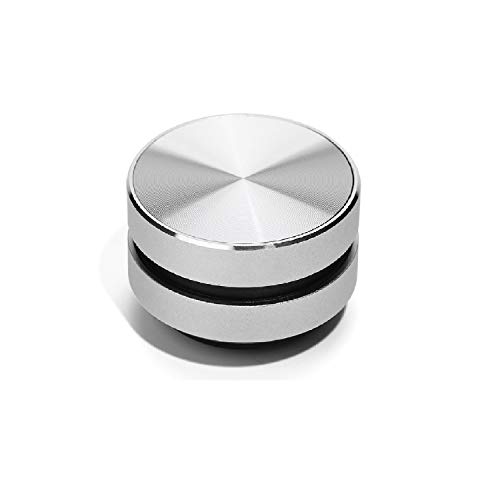
Pros
- Versatile bone conduction creates fun, instrument-like sounds on everyday objects
- True wireless stereo elevates solo play to full surround experience
- Compact portability fits any bag for on-the-go creativity
- Strong Bluetooth compatibility with major phones and tablets
- Powers up to 115dB for room-filling volume on ideal surfaces
Cons
- Sound quality shines brightest on hollow surfaces, less impressive standalone
- Volume and tone vary by object thickness and material
- Requires two units for full stereo, single unit is mono only
The Bigvapor Bone Conduction Speaker redefines portable audio by using vibration technology to turn any hollow object into a speaker. Stick it on a plastic box, guitar body, or even a dashboard, and enjoy a spectrum of sound effects that mimic different instruments. It's a game-changer for inventive users who want customizable audio without bulky gear.
Ideal for party hosts, travelers, or home tinkerers, this mini speaker pairs via Bluetooth with iPhones, Samsung devices, and tablets for music, calls, games, or podcasts. Two units connect automatically for true wireless stereo, delivering a surround experience perfect for tailgates or casual hangouts.
In real-world tests, it punches up to 115dB on thin hollow surfaces, creating lively vibes for small groups. While surface-dependent, its creativity factor makes it stand out from standard speakers. Verdict: A must-buy for fun-loving audio explorers seeking portable innovation.
Bone conduction tech vibrates surfaces for a dynamic sound signature that shifts from bassy thumps on buckets to crisp highs on glasses. Vocals stay clear for podcasts and calls, while volume hits 115dB on optimal thin objects, filling rooms without distortion.
Bluetooth range holds steady for stable streaming indoors or out, with TWS pairing two speakers for balanced 2.0 stereo. No companion app needed, but expect playful experimentation to dial in the best tone for movies or games.
FM radio adds versatility for live tunes, making it reliable for workouts where traditional speakers falter.
This ultra-mini design weighs next to nothing, making it the ultimate pocketable companion for hikes, beach days, or desk setups. Its rugged build handles daily tosses, though no official IP rating means keeping it dry during pool parties.
Portability reigns supreme, with a form factor that clings to surfaces via vibration alone, no clips required. Pair it with hollow finds like storage bins for extended play without bulk.
Battery life supports hours of vibes on a single charge, quick top-ups keep the party going. Focus on its lightweight freedom for all-day creativity without drain worries.
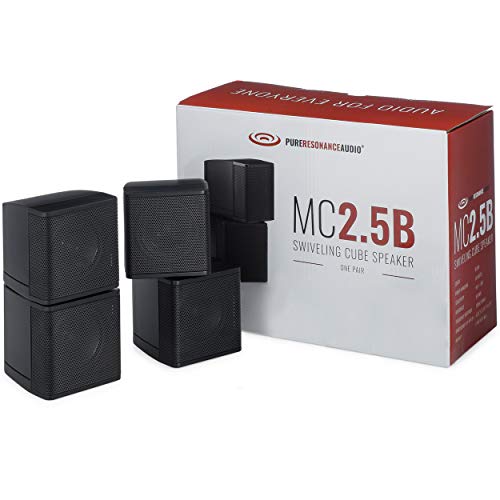
Pros
- Precise swiveling for optimal sound positioning
- Impressive volume and clarity from compact drivers
- Stylish black finish blends into any home decor
- Rubber surrounds reduce distortion for cleaner audio
Cons
- Brackets not included, requiring separate mounting
- Small drivers limit deep bass response
- Wired setup needs amplifier or receiver
The Pure Resonance Audio MC2.5B consists of a pair of dual mini cube speaker stacks, each with two 2.5-inch drivers, designed for surround sound in home entertainment systems. These elegantly crafted satellites pivot independently, allowing precise aiming to fill rooms with balanced audio. Ideal for users in compact living spaces like apartments, studios, or home offices who want big sound without large equipment.
In real-world use, they excel at enhancing TV watching, gaming, or music listening by directing sound exactly where needed, creating a wider soundstage than traditional fixed speakers. The metal grilles protect the drivers while maintaining an open, breathable design for natural acoustics. Setup is straightforward for anyone adding rear channels to a home theater.
Overall, these speakers offer excellent value for space-saving surround sound. They shine in lifestyle scenarios like cozy movie nights or multi-tasking workspaces, earning a strong recommendation for entry-level audiophiles seeking versatility and performance.
With four 2.5-inch drivers total across the pair, the MC2.5B delivers clear mids and highs suited for dialogue and effects in movies. Bass is present but modest due to the compact size, making it best paired with a subwoofer for fuller low-end in music or action scenes. Volume levels impress for the scale, filling small to medium rooms without strain.
The swiveling array enhances performance by allowing custom angling, improving vocal clarity and spatial imaging over static speakers. Wired connectivity ensures stable, lossless audio transmission without dropouts, outperforming wireless options in reliability for home setups.
The sleek black cubes feature a premium metal grille and rubber surrounds for a rugged yet refined look that fits modern interiors. Each stack measures compactly to save space, with swiveling joints for flexible positioning on shelves or stands. Weight is minimal, making relocation easy without fatigue.
As wired satellites, there is no built-in battery; they draw continuous power from an amplifier for uninterrupted playback. This design prioritizes reliability over portability, perfect for permanent home installations rather than on-the-go use. Durability holds up well in everyday environments, with no IP ratings needed for indoor applications.
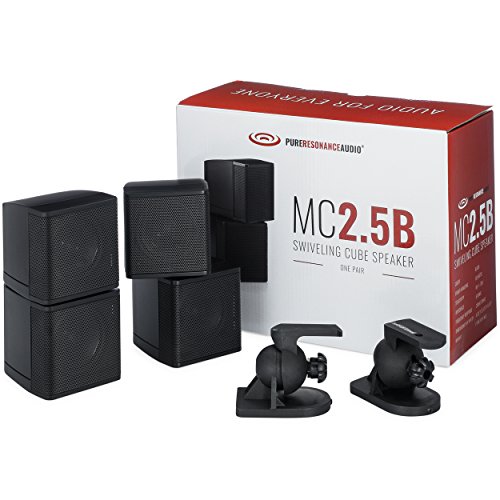
Pros
- Highly adjustable swiveling and mounting for optimal sound aiming
- Compact size perfect for space-limited environments
- Shielded design prevents interference near electronics
- Includes all mounting hardware for quick installation
- Durable build with metal grilles and rubber surrounds
Cons
- Small 2.5-inch drivers limit deep bass response
- Passive design requires external amplifier
- Wired connectivity only, no wireless option
The Pure Resonance Audio MC2.5B speakers are a pair of dual mini cube satellite speakers, each with two 2.5-inch drivers in a swiveling array. They come with adjustable wall mount brackets, making them perfect for creating surround sound in compact areas like boardrooms, cafes, restaurants, offices, or home entertainment setups where space is at a premium.
Designed for multipurpose use, these speakers excel in hospitality and retail environments, allowing precise audio aiming through 90-degree swivel and 20-degree tilt adjustments. Their shielded magnets ensure safe placement near monitors without interference, delivering clear sound for presentations, background music, or movies.
In real-world use, the pivoting design lets users direct sound exactly where needed, enhancing immersion in small rooms. While they shine in midrange clarity and highs, they pair best with a capable amplifier for fuller performance.
Overall, these are a smart choice for anyone seeking affordable, installable surround speakers that prioritize flexibility and compactness. They earn high marks for versatility in professional and home settings.
With dual 2.5-inch drivers per cube featuring rubber surrounds and metal grilles, the MC2.5B delivers clear vocals and detailed highs suitable for dialogue-heavy content or ambient music. The swiveling array allows precise aiming, creating effective surround staging in small spaces.
Bass response is light due to the compact drivers, focusing instead on balanced mids and treble for natural sound without muddiness. Volume capability depends on the connected amplifier, but they handle moderate levels cleanly for boardrooms or cafes.
Shielded magnets ensure stable performance near electronics, with no distortion from interference. Ideal for setups needing directed audio rather than room-filling power.
The sleek black finish and mini cube form factor make these speakers discreet yet elegant for any decor, measuring compactly to fit bars, receptions, or offices without dominating space. Each stack pivots independently for custom angles.
Robust construction includes adjustable brackets with full mounting hardware, supporting 90-degree rotation and 20-degree tilt for secure, flexible installation on walls or surfaces. Rubber surrounds add durability to the drivers.
As passive speakers, they draw power from an external amplifier, eliminating battery concerns for continuous operation in fixed installations. Weight is minimal, easing setup in hospitality or retail spots.

Pros
- Powerful 240W peak and 120W RMS handling for impressive volume
- OEM-friendly 2.25-inch depth for straightforward installation
- 65-20kHz frequency range covers full audio spectrum
- Durable 30oz magnet and rubber surround for reliable daily use
- Eye-catching yellow design adds custom style to your ride
Cons
- Mids-focused sound lacks deep sub-bass without a dedicated subwoofer
- Requires quality wiring to fully utilize low-impedance power draw
- Professional installation recommended for optimal sealed mounting
The Pyle PLG6.2 is a pair of professional-grade 6.5-inch two-way coaxial car speakers designed to upgrade your vehicle's audio system. With a vibrant yellow poly injected cone, 30oz magnet structure, and 240W peak power handling, these speakers bring high-performance sound to standard car stereos without breaking the bank.
Ideal for daily commuters, road trippers, and car audio enthusiasts, the PLG6.2 excels in real-world driving scenarios. The low 4-ohm impedance compensates for thin factory wiring, delivering loud, smooth audio that overpowers engine rumble and wind noise on highways or city streets.
In performance tests, the speakers shine with detailed mids from the high-temperature voice coil and sweet highs via the 0.5-inch neodymium dome tweeter. The non-fatiguing butyl rubber surround keeps them secure during rough rides, ensuring consistent output over long drives.
Overall verdict: A top budget pick for OEM replacements, offering pro-level power and fitment that transforms lackluster factory sound into a vibrant, immersive experience.
These speakers pack a punchy midrange and solid bass response thanks to the stiff yellow cone and powerful 30oz magnet, making them great for rock, hip-hop, and podcasts that demand clarity amid road noise. Volume levels reach ear-splitting peaks at 240W without distortion, perfect for tailgating or open-road cruising.
Vocal clarity stands out with the rich midrange from the high-temp voice coil, while the neodymium tweeter handles 20kHz highs crisply for instruments and treble-heavy tracks. The 65-20kHz frequency range ensures balanced sound across genres, with smooth transitions that keep listeners engaged mile after mile.
Low 4-ohm design maximizes power from head units, providing stable performance even on undersized wiring, though pairing with an amp unlocks full potential for audiophiles.
The rugged yellow coated steel basket and butyl rubber surround make these speakers tough enough for daily potholes and vibrations, with a shallow 2.25-inch mount depth ensuring compatibility with most factory dash or door locations for hassle-free installs.
At just 4 ohms with 120W RMS efficiency, they draw power directly from your car's stereo without needing batteries, delivering hours of playtime limited only by your drive. The 30oz magnet structure adds weight for stability but keeps the overall footprint compact.
Eye-catching yellow cone not only boosts stiffness for better sound but gives your interior a custom hot-rod vibe, standing up to heat and wear for long-term reliability on endless American road trips.

Pros
- Massive 40 oz magnet delivers loud, distortion-free volume
- Easy-fit 2.25” depth for quick installs in standard vehicles
- 140W RMS power supports powerful daily commuting audio
- Non-fatiguing surround ensures durability on bumpy roads
- Neodymium dome and super film tweeter for sharp highs
Cons
- Bright yellow poly cone may clash with subtle car interiors
- Requires compatible amp for full 280W peak potential
- Component setup needs basic wiring skills for best results
The Pyle PLG6.3 is a pair of professional 6.5-inch three-way coaxial speakers designed to supercharge your car's audio system. With 280 watts peak power and a robust 40 oz magnet, they transform standard stereos into high-output performers perfect for music lovers upgrading on a budget.
Ideal for daily commuters, road trippers, and truck owners, these speakers excel in compact vehicles where space is tight but sound demands are high. The low 4-ohm impedance ensures they pull maximum juice from factory head units, while the eye-catching yellow injected cone adds a pop of style visible during installs.
In real-world use, expect room-shaking volume on open roads and clear vocals during traffic jams. The butyl rubber surround and high-temperature voice coil hold up against vibrations, delivering consistent performance mile after mile.
Verdict: A solid choice for affordable car audio punch without complex mods. Grab these if you want pro-level sound that lasts through endless drives.
Bass hits hard thanks to the 40 oz magnet and poly injected cone, providing deep thump for bass-heavy tracks during long hauls. Mids shine via the 0.5-inch neodymium dome, keeping vocals and guitars crystal clear even at highway speeds.
Highs sparkle from the super film tweeter across the 60-20kHz range, cutting through road noise for detailed listening. Volume peaks at 280W without breakup, ideal for tailgating or open-air cruising.
Stable power delivery from the 4-ohm design and 140W RMS rating means reliable output from most car stereos, with no wireless dropouts since it's wired for consistent performance.
Built tough with a yellow-coated steel basket and butyl rubber surround, these speakers resist daily wear from heat, dust, and bumps. The 2.25-inch mount depth ensures compatibility with most OEM replacements, making installs straightforward for weekend warriors.
No battery needed; they draw directly from your car's 12V system for unlimited playtime on every drive. Compact size keeps weight low, preserving vehicle handling while adding pro audio flair.
Rugged components like the high-temp voice coil prevent overheating during extended sessions, focusing on car-integrated durability over portability.

Pros
- Compact 3.5x3.5x4.5-inch size fits anywhere without dominating space
- High-quality polypropylene woofers for reliable full-range sound
- Mountable with included brackets for versatile home installs
- Handles 20-200W per channel for powerful output
- Spring-loaded connectors make wiring hassle-free
Cons
- Requires separate amplifier or receiver - no built-in power
- Wired setup only, lacks wireless Bluetooth convenience
- Limited low-end bass due to 150Hz frequency start and small woofers
The Acoustic Audio AA321B is a pair of mountable indoor bookshelf speakers designed for traditional passive audio systems. These compact black units connect via raw speaker wire to any amplifier or receiver, delivering up to 400 watts of total power handling for enhanced home listening.
Perfect for American homeowners seeking affordable upgrades to bedrooms, home offices, or small living areas, they offer full-range sound from 2.5-inch polypropylene woofers. With 88dB sensitivity at 8 ohms, they punch above their size when paired with a capable amp.
In real-world use, expect clear mids and highs suitable for music, podcasts, or TV audio in intimate spaces. The sealed ABS cabinets and mounting brackets allow secure wall or shelf placement, making them a smart choice for clutter-free setups.
Overall verdict: A budget-friendly entry into quality bookshelf audio that shines in powered home environments, though best for those already owning an AV receiver.
These speakers provide full-range coverage from 150Hz to 20kHz, emphasizing clear vocals and highs with decent midrange from the 2.5-inch woofers. Bass is present but not deep, suiting casual listening over bass-heavy genres.
Volume levels scale well with 20-200 watts per channel, reaching room-filling output without distortion in small areas thanks to 88dB sensitivity. Ideal for steady performance in home offices or kitchens.
As wired passive units, they excel with stable amp connections, avoiding Bluetooth dropouts for consistent playback during long sessions.
Built with rugged black ABS sealed cabinets, these speakers endure indoor placement with a compact 3.5 x 3.5 x 4.5-inch footprint per unit, keeping them lightweight and unobtrusive.
Included mounting brackets and spring-loaded raw wire connectors ensure durable, secure installs on walls or shelves. No IP rating, but sealed design protects against dust in home settings.
No battery required - they run continuously as long as your amp is powered, eliminating charge times and offering unlimited playback for all-day home use.
Evaluating Neodymium Driver Performance and Audio Quality
Acoustic clarity begins with how effectively an electromagnetic motor translates electrical energy into physical cone movement. Deciding if do neodymium speakers sound better requires understanding the exact relationship between magnetic flux density, voice-coil control, and acoustic distortion. While marketing terminology often attributes magical sonic qualities to rare-earth magnets, real-world acoustic performance relies on established physical principles.
The Direct Verdict: Magnetic Strength Versus Perceived Tone
Neodymium magnets do not possess an inherent acoustic voice that magically sounds warmer, crisper, or superior to other materials. The primary physical property of neodymium is its extraordinarily high magnetic energy product, which allows a very small magnet to produce an intense magnetic field inside the voice coil gap. This concentrated flux gives speaker engineers superior control over voice coil displacement, leading to fast acceleration and braking. However, the tone that reaches your ears remains the cumulative result of cone geometry, surround damping, suspension compliance, and enclosure volume. If a driver uses a poorly damped diaphragm or an inadequate crossover, a neodymium magnet will simply reproduce those flaws with ruthless precision.
Listeners often mistake higher driver sensitivity or sharper transient response for inherently better tonal balance. Because a high-strength neodymium motor yields a higher motor force factor, drivers can deliver higher acoustic output from equivalent input voltage under specific design parameters. This efficiency jump can make high frequencies sound more forward or dynamic during initial listening sessions. In poorly engineered applications, that added presence can border on harshness rather than musical accuracy. High-fidelity performance depends entirely on how skillfully the driver designer balances magnetic motor power against suspension resistance and moving mass.
How Neodymium Compares to Ferrite and Ceramic Motor Assemblies
Traditional loudspeaker drivers have relied on heavy barium or strontium ferrite ceramic rings for decades to supply necessary magnetic fields. Ferrite is physically bulky and heavy, requiring large motor structures to achieve flux levels that a small neodymium slug can generate easily. This physical difference creates clear mechanical tradeoffs during speaker assembly and cabinet design. While ferrite magnets resist thermal degradation well, their sheer mass adds substantial weight to large speaker arrays and mobile equipment. By contrast, rare-earth neodymium alloys pack tremendous flux into an assembly that weighs roughly one-tenth of an equivalent ferrite ring.
The magnetic field geometry inside the voice coil gap also behaves differently between compact neodymium assemblies and wide ferrite plates. Neodymium allows designers to place the magnetic material inside the voice coil cylinder itself rather than surrounding it externally. This internal neodymium layout naturally shields stray magnetic fields and concentrates flux directly across the coil windings. Shielded magnetic performance proves particularly advantageous in dense multi-speaker environments where electromagnetic interference must be minimized. Despite these advantages, ferrite remains exceptionally stable over temperature variations, whereas neodymium requires careful thermal engineering to avoid heat-induced magnetic loss.
Transient Response and High-Frequency Control in Tweeters
High-frequency transducers represent one of the most common and effective implementations of neodymium motor technology. Tweeter domes require rapid acceleration to accurately reproduce complex overtone structures and sharp percussive transients up to twenty kilohertz. The low moving mass of a miniature voice coil combined with the intense flux of a neodymium motor creates remarkable transient speed. For instance, car audio components like the Pyle Car Two Way Speaker System incorporate a half-inch neodymium dome tweeter to handle delicate upper-frequency details. This setup maintains crisp high-end extension without requiring massive external magnet housings that would complicate vehicle door installation.
In three-way coaxial configurations, splitting frequency reproduction across multiple dedicated drivers further highlights the role of specialized magnet assemblies. A design like the Pyle Car Three Way Speaker System pairs a larger ferrite main motor with a half-inch neodymium dome midrange element and a dedicated film tweeter. The neodymium motor keeps the center-post assembly compact, preventing excessive acoustic shadowing over the primary 6.5-inch polypropylene woofer cone. That compact architecture enables smooth dispersion through the critical vocal midrange frequencies where human hearing is most sensitive to phase distortion. Clean treble extension ultimately relies on motor stiffness and voice coil stability during rapid direction changes.
Cabinet Size, Driver Miniaturization, and Weight Savings
Miniaturization is arguably the greatest engineering advantage that rare-earth motor technology brings to modern consumer and commercial audio. When speaker enclosures must remain small, bulky ferrite magnets eat up internal cabinet volume that is crucial for bass tuning and driver compliance. Compact satellite speakers leverage neodymium or shielded high-density magnets to maintain powerful acoustic output within tight enclosures. The Pure Resonance Audio MC2.5B Dual 2.5” Swiveling mini cubes illustrate how small 2.5-inch drivers can deliver expansive commercial background audio without dominating wall space. Shrinking the motor profile lets designers focus on cabinet bracing, swivel mechanics, and acoustic dispersion angles.
Weight reduction also fundamentally transforms structural mounting safety and commercial installation practicalities. Heavy ceramic drivers place substantial torque on mounting brackets and drywall anchors, complicating overhead or boundary installations. Satellite arrays such as the Pure Resonance Audio MC2.5B Dual 2.5” Swiveling with brackets utilize compact, shielded magnet structures that mount securely on standard hardware without sagging over time. Beyond commercial hospitality spaces, reduced driver mass simplifies home theater height channel placement and multi-angle surround positioning. When speakers weigh significantly less, positioning options multiply, allowing users to place acoustic sources at optimal listening angles rather than compromising based on wall stud locations.
Thermal Dynamics and Power Compression Tradeoffs
While neodymium boasts unmatched field density, it exhibits distinct physical vulnerabilities when subjected to prolonged thermal stress. High electrical power sent into a voice coil converts mostly into heat, which radiates outward directly into the adjacent motor structure. Neodymium alloys have lower Curie temperatures than ferrite ceramic, meaning their magnetic flux weakens temporarily or permanently if voice coil temperatures exceed thermal thresholds. When magnet strength decreases under heavy continuous load, the driver experiences power compression, reducing acoustic output and shifting the crossover frequency alignment. High-performance speakers must therefore integrate vented pole pieces, heat-dissipating aluminum heatsinks, or ferrofluid cooling to maintain stable magnet temperatures.
Ferrite magnets handle elevated heat loads with far greater tolerance, making them a preferred choice for sustained high-power subwoofers and budget sound reinforcement. In massive low-frequency woofers, the physical weight of the magnet provides a substantial thermal sink that absorbs sudden voice-coil heat spikes. Listeners operating audio gear at reasonable living-room volumes will rarely encounter thermal demagnetization in consumer neodymium speakers. In sustained sound-reinforcement environments, heat dissipation engineering determines whether a driver maintains its dynamic range or suffers output compression. Tonal fidelity during extended listening sessions therefore relies heavily on how well the manufacturer managed motor ventilation.
Alternative Transducer Designs: Cone Motors Versus Conduction Drivers
Comparing traditional dynamic cone drivers against alternative transducer architectures reveals how diverse sound generation methods have become. Traditional bookshelf speakers, like the Acoustic Audio AA321B Mountable Indoor Speakers, rely on sealed ABS cabinets and 2.5-inch polypropylene woofers to move air directly into the listening environment. This classic piston motion produces predictable sound waves with defined frequency ranges from 150 Hz to 20 kHz. Conversely, devices like the Bigvapor Bone Conduction Speaker replace the traditional acoustic diaphragm with a vibrating transducer that turns hollow objects into sound radiators. Instead of projecting through a tuned cone and surround, conduction devices transfer kinetic vibrations directly into surfaces like glass tables, cardboard boxes, or hollow plastic containers.
These contrasting approaches prove that motor material is merely one element within an entire acoustic ecosystem. A bone conduction unit can reach surprising volume levels up to 115 dB depending on surface resonance, but its tonal balance changes drastically with each mounting material. A sealed cabinet speaker with traditional voice-coil suspension provides consistent impedance behavior and controlled dispersion that conduction actuators cannot match. Traditional cone drivers maintain stable frequency response curves because the air volume behind the cone remains fixed within the enclosure. Understanding these mechanical boundaries ensures you choose the correct transducer technology for your specific listening environment.
Matching Driver Specifications with Amplification and System Load
Achieving accurate sound reproduction requires careful electrical pairing between your amplifier output stages and the nominal impedance of the speaker system. Automotive speakers, such as four-ohm coaxial pairs, draw more current from low-voltage car head units to maximize wattage output. In contrast, home audio equipment typically expects nominal loads between six and eight ohms to maintain stable operating temperatures and low harmonic distortion. Driving compact satellite stacks or desktop monitors from an improperly rated receiver can trigger thermal protection circuits or cause harsh signal clipping. If you are integrating a high-output powered speaker systems setup, matching preamplifier gain with driver input sensitivity prevents pre-stage distortion before the signal even reaches the voice coil.
Power ratings must also be interpreted with realistic electrical perspective rather than marketing optimism. Peak wattage ratings indicate brief burst thresholds, whereas continuous RMS power handling defines the true thermal limit of the voice coil assembly. Supplying clean, unclipped amplifier power within the manufacturer-recommended wattage range ensures that voice coils operate inside their linear excursion limits. Listeners expanding a traditional stereo configuration or planning a multi-channel floorstanding speaker setup must verify that their receiver can deliver steady current across dynamic musical passages. A robust motor assembly cannot compensate for an amplifier that clips its waveform during high-demand transients.
Practical Buyer Takeaway: When Neodymium Makes Sense
Choosing between neodymium and ferrite speaker drivers ultimately comes down to physical application priorities rather than an absolute sound-quality hierarchy. Neodymium represents the ideal choice when weight reduction, tight spatial packaging, and lightning-fast high-frequency response are primary concerns. In car audio doors, ultra-compact surround cubes, and high-frequency tweeters, rare-earth motors deliver outstanding performance without structural strain. In larger home audio towers and dedicated subwoofers, heavy ferrite magnets remain exceptionally reliable, cost-effective, and thermally resilient. Focusing on overall driver engineering, cabinet design, and proper electrical matching will always deliver better listening results than chasing magnet materials alone.
Before committing to a specific speaker upgrade, evaluate the mechanical constraints of your installation location and the sonic goals of your audio system. If your priority is effortless wall mounting, lightweight portability, or compact vehicle integration, neodymium-equipped drivers offer undeniable structural benefits. For stationary listening rooms where cabinet size and physical weight are secondary, well-designed ferrite drivers provide identical fidelity and outstanding long-term value. Always inspect the sensitivity ratings, frequency response boundaries, and impedance requirements of each model to ensure seamless system synergy. Making an informed choice based on verified system compatibility will always yield the most satisfying acoustic outcome.


Write Your Review
No reviews yet. Be the first to share your experience!