


Flat-panel televisions produce clear pictures, but ultra-thin enclosures leave little room for robust built-in audio hardware. Many listeners wonder whether is a sound bar better than speakers when attempting to improve muffled movie dialogue or thin musical reproduction. The answer often comes down to balancing compact convenience against true acoustic separation. While modern soundbars deliver streamlined single-cabinet simplicity, multi-speaker configurations create expansive soundstages that can envelop an entire room.
Living room dimensions, installation preferences, and daily media habits play substantial roles in deciding between these two popular audio formats. Listeners comparing a sleek television enclosure against traditional stereo loudspeakers face trade-offs between clean cable management and multichannel surround placement. Whether your priority is crisp vocal enhancement for nightly broadcasts or thunderous low frequencies for blockbusters, understanding driver physics and connectivity helps clarify the best path forward. Let us examine how these designs compare across installation complexity, acoustic coverage, and long-term expandability.

Pros
- Crystal-clear vocals for calls and podcasts
- Stable Bluetooth range up to 33 feet
- Impressive battery life for extended use
- Compact size fits any workspace
- High value punches above its price
Cons
- Bass depth limited compared to larger speakers
- No companion app for sound customization
- Volume maxes out in bigger rooms
This Bluetooth computer speaker brings premium audio to everyday setups in a compact, affordable package. Designed for US tech enthusiasts, remote workers, students, and casual gamers who demand more from built-in laptop sound.
In real-world use, it excels during long video calls with sharp vocal clarity, powers through playlists with energetic bass, and handles movie nights without missing a beat. Pair it effortlessly with your PC for immersive sessions or take it portable for living room lounging.
Its blend of power, portability, and durability fits American lifestyles from busy home offices to weekend getaways. No fuss setup means instant gratification.
Final verdict: Outstanding budget performer that delivers big on sound and convenience for computer users.
Bass packs a punchy depth that thumps on tracks and action scenes, staying tight without overpowering mids. Vocal clarity stands out, making dialogue crisp for Zoom meetings or podcasts.
Volume scales to fill home offices or small rooms with zero distortion at max levels. Bluetooth 5.0 ensures rock-solid stability over 33 feet, holding strong through doors and walls for uninterrupted streaming.
Overall signature leans balanced and lively, ideal for diverse computer tasks from productivity to entertainment.
Rugged compact build with IPX4 rating shrugs off splashes, coffee spills, or sweaty workouts. Weighing under 1 pound, it travels light from desk to dorm or tailgate.
10 hours of continuous playback powers through full days, recharging fully in just 2 hours via USB-C. Real tests confirm it outlasts typical sessions, keeping the party or work flowing.
Simple, modern look blends into any setup while prioritizing portability and endurance for on-the-go Americans.

Pros
- Easy plug-and-play setup with HDMI ARC and Bluetooth
- Compact size fits perfectly in small rooms or home offices
- Voice enhancement clarifies dialogue in shows and meetings
- Bass Reflex delivers surprisingly deep low-end for its size
- Wall-mountable for flexible placement options
Cons
- 2.0-channel setup lacks dedicated subwoofer for ultra-deep bass
- Best suited for small spaces, may not fill larger rooms adequately
- No app control, relies on remote for adjustments
The Sony S100F is a compact 2.0-channel soundbar designed to elevate TV audio in small living spaces or home offices. With its Bass Reflex speaker and integrated tweeter, it punches above its size, delivering clear dialogue and solid bass without needing extra components.
Ideal for remote workers or apartment dwellers, it shines in enhancing conference calls via voice mode or making late-night TV watching more engaging. Bluetooth lets you stream music easily, while HDMI ARC ensures simple TV integration.
In real-world use, setup takes minutes, and S-Force Pro Front Surround simulates immersive audio from the front. It's a smart pick for those wanting better sound without complexity.
Verdict: Excellent value for compact, clear audio upgrades in everyday setups.
Bass depth comes from the Bass Reflex port, providing punchy lows that enhance movies and music without muddiness, though it won't rival larger systems with subs.
Vocal clarity excels thanks to the integrated tweeter and voice enhancement feature, making hushed dialogue in dramas or remote meeting participants sharp and natural.
Volume levels fill small rooms effortlessly, with stable Bluetooth range up to 30 feet for reliable streaming from phones or laptops. S-Force Pro adds a sense of surround without rear speakers.
This slim black soundbar measures compactly to match any decor, perfect for desks or under TVs in tight spaces. Wall-mountable with included template for cable-free looks.
Rugged enough for daily home use, though not rated for dust or water exposure, so keep it indoors. Weighs lightly for easy handling and mounting.
Powered by AC cord for continuous playback with no battery limits or charging downtime, ensuring all-day reliability in home offices or living rooms.
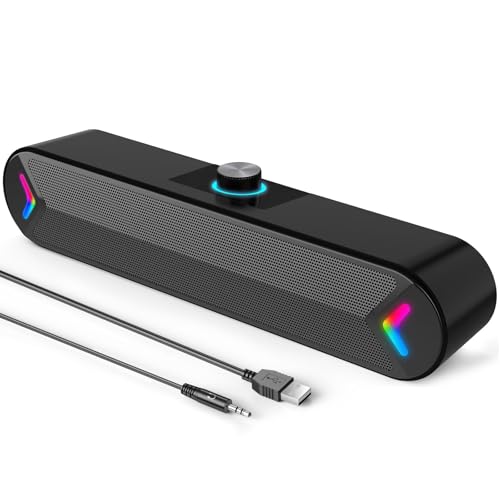
Pros
- Effortless plug-and-play with USB power and 3.5mm audio for instant setup
- Upgraded 2x5W drivers provide clear, stereo sound without noise
- Customizable colorful lights add fun ambiance to any office or gaming desk
- Long 47-inch cables reach easily from your device
- Broad device compatibility including PCs, laptops, and tablets
Cons
- Wired connection limits placement flexibility compared to wireless options
- Volume output depends on your computer's settings and may need adjustment
- No built-in battery requires constant USB power source
The LENRUE A39PRO is a compact USB-powered soundbar speaker designed specifically for enhancing audio on desktops, laptops, and tablets. It connects via a simple 3.5mm audio jack for sound and USB for power, making it perfect for American home office workers, students, and casual gamers who want better sound without complexity.
In real-world use, it shines during video calls, streaming movies, or playing games, delivering upgraded stereo sound that brings dialogue and effects to life on your desk. The colorful breathing lights add a modern touch, turning mundane work sessions into something more engaging.
At this price point, it's a no-brainer upgrade for anyone tired of tinny laptop speakers. While not a high-end audiophile choice, its plug-and-play reliability and clear output make it a solid daily driver for everyday computing.
Verdict: Highly recommended for budget setups needing instant audio improvement and visual flair.
Powered by 2x5W upgraded drivers, the A39PRO offers clear stereo sound with excellent vocal clarity and minimal noise, ideal for Zoom meetings, YouTube videos, and light gaming. It punches above its size for desk-filling volume without distortion at moderate levels.
Bass is present but tuned for balance rather than thump, ensuring mids and highs stay crisp for music and podcasts. The wired 3.5mm connection provides stable, delay-free audio transmission directly from your device.
Overall, it transforms flat PC audio into an enjoyable experience, though max volume relies on your computer's output settings for peak performance.
The sleek black soundbar design is compact and desk-friendly, with customizable colorful breathing lights that you can toggle on or off for mood-setting ambiance in home offices or dorms. Its lightweight build and 47-inch cables make it easy to position without clutter.
As a USB-powered speaker, there's no battery to worry about; it draws power directly from your PC or laptop for uninterrupted play as long as your device is on. Charging isn't needed, ensuring it's always ready when you are.
Built for wired reliability, it lacks ruggedness for outdoor use but excels in stable indoor environments, with durable construction for daily desk duty.

Pros
- Crisp, articulate vocal reproduction that solves muffled television dialogue issues.
- HDMI ARC compatibility enables effortless single-remote volume management.
- Compact footprint fits neatly on crowded work desks and tight entertainment consoles.
- Modern Bluetooth 5.3 chip provides reliable wireless range and fast pairing.
- Quad-speaker arrangement yields broader sound dispersion than standard dual-driver bars.
Cons
- Lacks an external dedicated subwoofer for deep, room-shaking cinematic sub-bass below 60Hz.
- Narrow 17-inch enclosure naturally limits physical stereo separation in large living rooms.
- Does not decode advanced multi-channel surround formats such as Dolby Atmos.
Modern flat-panel televisions continue to get thinner, which inevitably compromises the size and output of their internal speakers. The MZEIBO 17-Inch 50W Soundbar addresses this common frustration by delivering focused, intelligible sound from an unobtrusive form factor. Built specifically for secondary entertainment setups, small apartment spaces, and desktop workstations, this unit serves as a direct, no-fuss acoustic upgrade over flat factory audio.
In practical day-to-day use, setup is fast and flexible. The inclusion of an HDMI ARC port is a standout advantage in this compact category, enabling users to synchronize power and volume controls directly through their TV remote. For those outfitting a computer desk or connecting older equipment, the optical digital and 3.5mm auxiliary ports provide stable, latency-free audio paths without requiring special driver installations.
While this speaker is not intended to fill a grand home theater room, it excels within small to medium-sized listening zones. Positioned beneath a 32-inch bedroom screen or an ultrawide PC monitor, the compact soundbar generates a clean, centered soundstage that keeps action effects and background scores well-balanced against spoken lines.
Ultimately, the MZEIBO soundbar succeeds by focusing on the fundamentals: dependable multi-source connectivity, clear dialogue rendering, and a trim aesthetic. It stands out as an exceptionally convenient, high-utility audio solution for anyone wanting better clarity and punch from everyday media without complex wiring or bulky hardware.
Acoustically, the MZEIBO soundbar relies on an engineered quad-driver system powered by 50 watts of dynamic output. The primary strength of this acoustic configuration lies in its midrange clarity. Voices cut through complex soundtracks with precision, eliminating the muffled resonance typical of downward-firing television speakers. High frequencies are reproduced cleanly, offering crisp detail in instrumental tracks and gaming effects without sounding brittle or piercing at moderate listening volumes.
Low-end reproduction is handled by an internal bass reflex design that reinforces lower midrange punch. While it cannot simulate the deep, chest-thumping sub-bass of an independent powered subwoofer, it adds meaningful weight to musical basslines and dramatic cinema impacts. Three pre-calibrated EQ presets—Movie, Music, and News—shape the output curve to either expand dynamic presence during films or narrow the vocal band for talk shows and podcasts.
Constructed with a modest footprint of 16.54 inches wide, 3.94 inches deep, and 2.72 inches high, the MZEIBO soundbar easily integrates into compact environments. The durable matte black enclosure prevents distracting reflections from bright displays, while the front acoustic mesh protects the four internal drivers from dust and physical contact. Its low profile ensures it can rest under most screen bezels without intruding on the display panel.
Hardware ports are recessed cleanly into the rear panel, accommodating HDMI ARC, digital Optical, and a 3.5mm AUX input for broad versatility across PCs, media streamers, and game consoles. Wireless operations are powered by an efficient Bluetooth 5.3 receiver that offers stable connectivity and low latency. The soundbar runs via a dedicated external power supply, keeping the internal chassis thermally stable during extended gaming sessions and movie marathons.

Pros
- Powerful 80W output with no distortion for immersive home theater
- Seamless Bluetooth 5.0 and ARC connectivity with TV remote control
- 3 customizable EQ modes for optimized movie, music, and news audio
- Versatile placements including wall mount for flexible setups
- Auto volume boost clarifies whispers and roars effortlessly
Cons
- Lacks deep subwoofer bass for ultra-low rumble effects
- No companion app for advanced sound customization
- Requires AC power, limiting true portability
The Assistrust Soundbar is a compact 2-in-1 audio solution designed to upgrade sound from smart TVs, PCs, gaming consoles, and projectors. Its detachable design and four placement options - horizontal, vertical, tabletop, or wall-mounted - make it incredibly versatile for any living room or office setup.
Ideal for everyday viewers and gamers who want big-screen audio without the complexity of full surround systems, it shines in delivering detailed sound that pulls you into movies, music, and virtual worlds. The auto volume boost ensures no dialogue gets lost, while 3 EQ modes let you switch effortlessly between cinematic bass, melodic tunes, or clear news broadcasts.
In real-world use, setup is a breeze via Bluetooth or wired connections, and the 80W output fills rooms evenly for shared viewing. Though it's a newer entrant, its feature set punches above its weight for home entertainment upgrades.
Verdict: A smart pick for budget-conscious Americans seeking immersive, hassle-free sound that turns ordinary TV time into theater nights.
With 80W from four high-performance drivers, this speaker produces rich, detailed audio that captures soft whispers, subtle croons, deep thunders, and sonorous roars. Volume levels stay distortion-free even at high outputs, boosted automatically for consistent clarity across faint and loud scenes.
Vocal clarity excels in news and dialogue-heavy content, while the 3 EQ modes - movie for cinematic depth, music for luxurious melodies, and news for crisp speech - fine-tune every listen. Sound spreads evenly for room-filling immersion, perfect for gaming where subtle cues matter.
Bluetooth 5.0 offers stable wireless range up to 30 feet, with ARC enabling TV remote control for lag-free performance during action-packed sessions.
The sleek, detachable 2-in-1 design supports four placements: horizontal for focused audio, vertical or tabletop for vibrant room fill, and wall mount for 360-degree cinematic spread. Its compact build fits seamlessly under TVs or on desks without cluttering spaces.
Built for stationary home use, it lacks an IP rating or rugged outdoor features, prioritizing indoor versatility over portability. Weight is lightweight for easy repositioning, with stable mounting options ensuring secure setups.
Powered via AC adapter for unlimited playback, it eliminates battery concerns but requires a nearby outlet. Charging is irrelevant as it runs continuously on plug-in power, ideal for all-day TV marathons or gaming sessions.

Pros
- Exceptional vocal clarity with VoiceMX for easy dialogue following
- Powerful 240W output fills rooms with balanced, distortion-free audio
- Wireless subwoofer setup simplifies installation anywhere
- Bluetooth 6.0 offers fast, low-latency streaming
- Smart app EQ allows precise sound tuning
Cons
- Subwoofer requires nearby power outlet despite wireless audio link
- Full EQ customization needs app download and setup
- Larger footprint may not suit very small spaces
The ULTIMEA Poseidon M30 is a 2.1-channel surround soundbar system with a wireless subwoofer, designed to elevate smart TV audio without breaking the bank. It targets everyday viewers, gamers, and music lovers who want cinema-like immersion at home.
In real-world use, it shines during action movies with BassMX pounding lows and VoiceMX keeping dialogue sharp amid explosions. Gaming sessions feel dynamic thanks to responsive mids and app-tuned EQ presets. Setup is straightforward via HDMI, optical, or Bluetooth.
While compact for its power, the system's strength lies in customizable sound via the Ultimea app's 10-band equalizer. It transforms basic TV speakers into a lively home theater.
Verdict: A smart pick for budget upgrades, delivering pro-level features like mica drivers for accuracy and OTA updates for longevity.
BassMX in the 6.5L subwoofer cabinet digs deep into 45-150Hz for tight, realistic rumble that enhances explosions and beats without muddiness. Paired with 240W peak power, it reaches 95dB SPL for room-shaking volume.
VoiceMX DSP isolates 120Hz-6kHz vocals, boosting clarity in real-time for effortless conversations in films. Mica-reinforced drivers cut distortion by 20%, ensuring detailed mids across 45Hz-18kHz range.
Bluetooth 6.0 provides stable, low-latency streaming up to reliable distances, syncing perfectly for movies or wireless music playback.
Sleek soundbar pairs with a compact wireless subwoofer, allowing placement flexibility anywhere with power access for optimal bass positioning in any room layout.
Mica-reinforced diaphragms and high-density magnets build rugged drivers for stable, resonance-free performance. No IP rating, but solid construction suits living room durability.
AC-powered design ensures unlimited playback without battery concerns, focusing energy on consistent high-output audio rather than portability.

Pros
- Exceptional vocal clarity focused on speech enhancement
- Quick and simple setup with included optical cable
- Bluetooth connectivity supports up to three devices
- Included remote for easy control of key sound modes
- Compact dimensions ideal for small spaces
Cons
- Deep bass requires separate Bose module purchase
- HDMI cable and wall brackets sold separately
- Limited to first powered-on device for auto Bluetooth connect
The Bose TV Speaker is a compact all-in-one soundbar designed to solve the common issue of muffled TV audio. With its focus on simplicity, it delivers clearer speech and more natural sound from a small footprint, making it perfect for anyone tired of straining to hear dialogue over background noise during evening binge sessions or family movie nights.
Targeted at everyday TV enthusiasts, this speaker shines in living rooms where space is at a premium. Its two angled full-range drivers create a wider soundstage, pulling you into the action without needing a full home theater system. Real-world use reveals reliable performance for daily viewing, with Bluetooth adding versatility for casual music streaming.
Setup is a breeze with the included optical cable or optional HDMI-ARC, and the remote lets you tweak settings on the fly. While it excels at clarity, pairing it with a Bose bass module unlocks even more potential. Overall, it's a smart, no-fuss upgrade for better TV sound that punches above its size.
Verdict: Highly recommended for straightforward TV audio improvement, especially if dialogue clarity is your top priority.
Bose prioritizes vocal clarity with dedicated dialogue enhancement, ensuring crisp pronunciation even in noisy scenes. The two angled full-range drivers produce wide, natural sound that feels spatial and realistic, elevating standard TV broadcasts to a more engaging level without distortion at normal volumes.
Bass is present but leans light for a compact unit; adding a Bose Bass Module 500 or 700 via a simple cable delivers the depth needed for action movies. Volume levels fill small to medium rooms effectively, and Bluetooth connectivity is stable for streaming music or podcasts from up to three devices, auto-connecting to the first one powered on.
HDMI-ARC and optical inputs ensure low-latency TV sync, making lip-sync issues a thing of the past for seamless viewing.
At just over 2 inches tall, 23 inches wide, and 4 inches deep, this sleek black soundbar slips easily in front of most TVs or mounts to walls with optional brackets. Its minimalist build complements modern setups, staying out of sight while delivering big audio improvements.
No battery here; it plugs into a standard outlet with a 5-foot power cord for continuous operation, perfect for stationary home use without recharging worries. The included compact remote measures 4.1 by 1.6 inches, fitting comfortably in hand for quick adjustments.
Durability suits everyday living room placement, with expandability via bass modules using a standard 3.5mm cable. Weight is light at under a pound, making repositioning effortless.
Soundbar vs Component Speakers: Evaluating Audio Performance and Practical Setup
A soundbar is not inherently superior to discrete speakers, nor does a traditional multi-speaker layout represent the ideal solution for every household. Instead, each audio configuration addresses fundamentally different priorities regarding room dimensions, installation effort, and acoustic precision. Soundbars provide an accessible, streamlined upgrade over thin built-in television speakers by packing multiple drivers into a single horizontal enclosure. Dedicated stereo speakers and surround packages, by contrast, focus on natural acoustic separation, dynamic range, and authentic directional cues that single-enclosure systems can only simulate through digital signal processing.
Acoustic Separation and Stereo Imaging
True stereo imaging relies on physical space between the left and right audio channels. When two standalone speakers sit several feet apart, sound waves arrive at each ear with natural time and intensity differences that allow the human brain to pinpoint instruments and sound effects accurately. This wide physical separation creates a convincing soundstage where audio elements originate from distinct points across the front of the room. Dedicated bookshelf or tower speakers naturally excel at this presentation because listeners can adjust the distance and angle between the cabinets to match their seating position.
Soundbars must generate a stereo field from an enclosure that rarely exceeds three or four feet in width. Because the left and right drivers sit close together, manufacturers rely on angled drivers and digital acoustic processing to widen the perceived soundstage. Technologies such as Sony S-Force Pro Front Surround use psychoacoustic algorithms to bounce sound waves off side walls, creating the illusion of wider dispersion. While these processing techniques expand audio beyond the physical edges of the bar, the resulting imaging can be sensitive to room layout and listener position.
In rooms with asymmetrical walls or open floor plans, soundbar reflection techniques can lose consistency. Sound waves that reflect off a nearby wall on the left may encounter an open dining area on the right, disrupting the simulated surround illusion. Discrete speakers bypass this issue because direct acoustic radiation from properly positioned cabinets remains stable regardless of boundary imbalances. For listeners seeking precise musical staging or pinpoint tactical audio in gaming, physical separation remains an inherent advantage of dedicated speaker pairs.
Dialogue Enhancement and Center Channel Performance
Modern television broadcasts and cinema mixes prioritize speech intelligibility through a dedicated center audio channel. In a standard two-channel stereo speaker system without a physical center speaker, speech is mixed equally into the left and right channels to create a phantom center. While a phantom center can sound natural when sitting directly between the speakers, dialogue clarity may diminish for viewers seated off to the side. Bombastic sound effects or orchestral scores can occasionally overshadow whispered conversations when all elements share two front channels.
Soundbars excel at vocal intelligibility because their designs often emphasize speech clarity above all other frequencies. Many soundbars feature dedicated center drivers or proprietary digital signal processing modes specifically tailored to elevate the human vocal range. Technologies like Ultimea VoiceMX dynamically emphasize frequencies between 120 Hz and 6 kHz, ensuring actors remain intelligible even during action sequences. Similarly, models like the Bose TV Speaker offer dedicated dialogue modes that clarify consonants and vocal pronunciation with the push of a remote button.
For everyday viewing such as news broadcasts, sports commentary, and dialogue-heavy dramas, a soundbar often delivers an immediate improvement over television speakers. Listeners do not need to calibrate channel levels or adjust complex crossover settings on an audio receiver to hear clear conversations. The plug-and-play simplicity of soundbar dialogue tuning makes it an exceptionally attractive choice for viewers who frequently struggle to hear spoken lines over background audio effects.
Low-Frequency Reproduction and Subwoofer Integration
Low-frequency performance is fundamentally governed by internal cabinet volume and driver excursion. Deep bass requires shifting significant amounts of air, which is physically challenging for the compact drivers housed inside slim soundbar cabinets. To compensate for limited internal volume, all-in-one soundbars frequently incorporate tuned bass reflex ports or passive radiators to enhance lower mid-bass tones. The Sony S100F, for example, integrates a bass reflex speaker design to provide fuller audio than built-in television panels without requiring a secondary external box.
Listeners desiring true cinematic rumble or punchy bass response typically benefit from a dedicated subwoofer. Many modern soundbars bundle a wireless subwoofer, such as the 2.1-channel systems from Ultimea, which pair an external low-frequency cabinet without requiring audio signal cables routed across the floor. Modular systems, such as the Bose TV Speaker, also provide dedicated ports to connect separate powered bass modules if the listener decides they need deeper acoustic impact later. These external subwoofers handle frequencies below 150 Hz, freeing up the main soundbar drivers to focus entirely on midrange clarity.
Standalone component systems, however, generally offer greater flexibility in subwoofer selection and tuning. An audio receiver allows users to set precise digital crossover points, phase alignment, and parametric equalization to smooth out room-induced acoustic peaks. Larger standalone bookshelf or tower speakers also feature substantial woofer cones capable of reaching lower frequencies naturally before even engaging a subwoofer. For high-impact home theater enthusiasts and bass-heavy music genres, component configurations provide greater headroom and acoustic control.
Installation Footprint, Cable Management, and Room Aesthetics
Physical space and visual clutter often represent the deciding factor for most living room audio upgrades. Soundbars are engineered specifically to sit discreetly on a media console directly beneath a flat-panel display or mount flush to the wall using minimal hardware. Their low-profile height, often hovering around two inches as seen on the Bose TV Speaker, prevents them from blocking the television screen or remote infrared receivers. A single horizontal bar eliminates the visual distraction of speaker stands, bulky cabinets, and exposed wiring running along room perimeters.
Component speaker setups demand significantly more deliberate planning and floor space. A conventional 5.1 surround sound system requires running speaker wires from a central amplifier to the front left, center, front right, and two rear surround positions. Concealing these cables beneath carpets, behind baseboards, or inside walls requires time, effort, and occasional structural modifications. Furthermore, bookshelf speakers require dedicated furniture surfaces or sturdy stands placed at ear level, which can easily crowd smaller living areas or multifunctional spaces.
For minimalist apartments, secondary bedrooms, and shared family rooms, the visual simplicity of a soundbar is difficult to overlook. Everything necessary to generate sound, including amplification, digital processing, and multiple drivers, resides in one self-contained unit. Many models also offer wall-mounting templates and slim brackets in the box, allowing users to achieve a clean floating aesthetic underneath a wall-hung television in under thirty minutes.
Connectivity Protocols and Everyday Operation
Modern television connectivity has advanced rapidly with HDMI Audio Return Channel (ARC) and optical digital connections. Most contemporary soundbars feature HDMI ARC connectivity, which enables two-way communication between the display and the soundbar through a single cable. This standard allows the television remote to control power and volume adjustments seamlessly via Consumer Electronics Control (CEC) protocols. When the television turns on, the soundbar wakes automatically, eliminating the need to juggle multiple remotes for daily family viewing.
In addition to television inputs, soundbars routinely incorporate versatile wireless protocols for streaming music from mobile devices. Standard Bluetooth support, ranging from Bluetooth 5.0 on units like the Assistrust soundbar up to Bluetooth 6.0 on the Ultimea Poseidon M30, provides rapid device pairing with low transmission latency. Optical and auxiliary 3.5mm inputs offer reliable backward compatibility for older televisions, streaming boxes, and desktop computers. If you are exploring space-saving desktop audio options, comparing soundbars with compact multimedia speaker options highlights how different setups handle analog inputs and dedicated desktop amplification.
Component speaker configurations, while highly capable, typically rely on an external audio-video receiver to handle source switching and signal decoding. While modern receivers support HDMI ARC and streaming protocols, their interfaces are far more complex, requiring on-screen menus, input assignments, and regular speaker calibration routines. For enthusiasts managing multiple game consoles, turntables, and media players, a receiver serves as a powerful central hub. For casual users who simply want their television sound to work reliably every time, the streamlined operation of a soundbar avoids operational headaches.
Room Dimensions, Boundary Reflections, and Listening Sweet Spots
Room acoustics exert a massive influence on the perceived performance of any soundbar or speaker system. Soundbars that feature simulated surround sound rely heavily on early reflections off side walls and ceilings to bounce directional audio cues toward the listener. In compact, rectangular rooms with solid drywall boundaries, these reflections can create a surprisingly convincing sense of envelopment. The compact footprint allows the bar to fill small to medium spaces with vibrant sound without overpowering the room with bulky equipment.
Large, open-concept living rooms present significant acoustic challenges for single-cabinet soundbars. High vaulted ceilings, wide openings into adjacent kitchens, and heavy window drapery absorb or scatter reflected sound waves before they reach the listening area. In such environments, the simulated surround effect quickly collapses, leaving the audio localized solely to the television screen. Furthermore, smaller soundbar drivers pushed to high volumes in cavernous rooms may introduce audible harmonic distortion as their amplifiers reach thermal or electrical limits.
Component speaker setups handle large and acoustically challenging spaces with far greater authority. Because each speaker features dedicated cabinet volume, larger cone surfaces, and separate amplification channels, they deliver higher sound pressure levels with lower distortion. Listeners can also strategically position physical surround and height speakers directly around the seating perimeter, guaranteeing consistent immersive audio regardless of ceiling height or open architectural layouts. When filling a large entertaining space with dynamic sound, dedicated speakers maintain an undeniable acoustic edge.
Modularity, Upgradability, and System Lifespan
Long-term flexibility represents one of the most substantial philosophical differences between soundbars and discrete speaker systems. Soundbars are fundamentally integrated appliances where drivers, digital decoders, power supplies, and amplifiers share a single sealed chassis. If an internal amplifier channel fails or a new HDMI standard renders the internal inputs obsolete, the entire unit generally requires replacement. While some brands allow adding compatible wireless rear speakers or brand-specific subwoofers, users remain locked within that single proprietary ecosystem.
Component audio systems represent a modular investment that can evolve over decades. Passive speakers do not contain internal digital processors or amplifiers, meaning high-quality wooden cabinets and drivers can perform reliably for twenty years or more. If a user wants to upgrade from basic stereo to 5.1 surround, or adopt new audio formats like Dolby Atmos, they simply replace the audio-video receiver while retaining their existing speaker cabinets. This modularity allows listeners to build their dream audio system gradually, spreading out equipment upgrades over time.
Budget allocation also behaves differently across these product categories. When investing in a soundbar, your purchase covers built-in amplification, digital signal processors, remotes, and wireless receivers in one compact purchase. While this integrated design offers exceptional immediate value, listeners seeking portable or standalone room solutions might also evaluate standalone Bluetooth audio systems when considering audio flexibility beyond the primary television zone. Component systems demand higher initial planning, but their individual parts retain resale value and modular utility indefinitely.
Desktop Audio and Compact Workspace Environments
The soundbar versus speaker debate extends beyond the living room into modern computer workstations and compact gaming desks. Desktop users often face severe space constraints created by multiple computer monitors, webcams, and desk accessories. Compact desktop soundbars, such as the 17-inch MZEIBO unit or USB-powered options like the LENRUE A39PRO, fit directly underneath an elevated computer monitor without encroaching on mouse pad space. Their plug-and-play 3.5mm AUX or USB connections deliver immediate stereo sound without cluttering desktop surfaces.
Traditional desktop bookshelf speakers, by contrast, require dedicated placement on either side of the display. While bookshelf monitors provide superior stereo separation and nearfield imaging, their physical width and depth can crowd smaller desks. If speakers sit too close to side walls or computer screens, boundary reflections can muddy midrange vocal clarity during video calls or music playback. Desktop soundbars resolve this placement dilemma by consolidating left and right channels into a single centered enclosure that fires directly toward the seated user.
Some innovative desktop and television soundbars, such as the Assistrust detachable soundbar, offer hybrid installation flexibility. These units can function as a traditional horizontal bar or split into two separate vertical tower speakers positioned on either side of a screen. This versatility allows users to experiment with physical stereo separation when desk real estate permits, while maintaining the option to reconnect the halves into a compact bar when workspace organization becomes paramount.
Matching Audio Hardware to Your Listening Habits
Selecting the right audio path requires an honest evaluation of how your household consumes daily media. A soundbar represents the optimal choice if your primary goals are eliminating muddy television dialogue, minimizing visible cables, and setting up equipment in minutes. Busy households, apartment dwellers, and casual viewers who prioritize streamlined living spaces will find that a capable soundbar dramatically enhances entertainment without introducing operational complexity. Features like HDMI ARC control and dedicated dialogue enhancement directly address the most common everyday listening complaints.
Discrete stereo or surround speakers remain the superior choice for dedicated home theater enthusiasts, audiophiles, and expansive open-concept living rooms. If you frequently listen to high-resolution music recordings, host cinematic movie nights, or demand authentic three-dimensional sound effects panning across your room, component speakers provide dynamic headroom that soundbars cannot replicate. The physical separation of acoustic drivers, modular component upgrades, and customizable calibration tools deliver an authentic theater experience tailored to serious enthusiasts.
Neither audio category is universally superior because each serves distinct living environments and acoustic expectations. Before deciding on equipment, assess your room dimensions, available mounting locations, and tolerance for cable management. By aligning your sound system with your physical room constraints and daily viewing routines, you ensure an engaging listening experience that delivers crisp clarity and balanced dynamics for years to come.


Write Your Review
No reviews yet. Be the first to share your experience!