


Upgrading a vehicle or outdoor sound system often raises questions about mixing components from different manufacturers. Audio enthusiasts frequently ask if can i use kicker speakers with jbl amp configurations without sacrificing sound quality or damaging delicate voice coils. Drivers often want the crisp highs and punchy mid-bass of Kicker drivers while relying on the clean power supplies of JBL amplifiers. Fortunately, audio engineering relies on universal electrical principles rather than restrictive proprietary standards.
External power sources send continuous alternating current audio signals that any properly matched passive speaker can interpret. When matching these components, listeners need to balance nominal impedance, continuous RMS power handling, and crossover frequency cutoff points. Many vehicle owners who research high-output audio equipment combine these two established brands to create dynamic listening environments. By understanding basic electrical compatibility, you can assemble a reliable system that sounds balanced across all volume levels.

Pros
- Seamless mounting hardware fits most round roll cages
- Powered design ensures unlimited playtime on vehicle battery
- Vibrant RGB lighting enhances off-road party atmosphere
- Legendary KICKER sound quality cuts through wind and engine noise
- Pair setup provides stereo sound for immersive outdoor listening
Cons
- Requires vehicle power source, not standalone battery-powered
- Square tube mounting kit sold separately for golf carts
- Wired lighting setup limits on-the-fly color changes without controller
The KICKER 48BTCAN65 PowerCans are a pair of 6.5-inch Bluetooth speaker pods designed specifically for powersports enthusiasts. They offer a plug-and-play solution to upgrade audio on ATVs, UTVs, boats, golf carts, and other outdoor vehicles, complete with mounting hardware for round tubing.
Ideal for riders who crave booming sound during trail rides or lake outings, these pods withstand rugged conditions while delivering KICKER's renowned audio fidelity. The included Bluetooth pairs effortlessly with phones for wireless streaming of country anthems or rock playlists.
In real-world use, they handle dust, splashes, and vibrations without missing a beat, turning your ride into a mobile concert. RGB LED lighting adds flair for evening adventures.
Verdict: A top pick for American off-roaders seeking durable, vehicle-specific sound without complexity. Highly recommended for weekend warriors.
KICKER's PowerCans boast a balanced sound signature with punchy bass that thumps through open terrain and crisp mids for vocal clarity in upbeat tracks. The 6.5-inch drivers push high volumes without distortion, perfect for overpowering engine roar on UTVs or ATVs.
Bluetooth range stays stable up to 30 feet, even amidst vehicle movement, ensuring uninterrupted playback from your dashboard phone mount. Stereo pairing creates a wide soundstage ideal for group rides.
Performance shines in outdoor chaos, maintaining tight bass response and detailed highs whether cruising boats or golfing at dusk.
Built rugged for powersports abuse, these pods feature weather-resistant enclosures that shrug off mud, rain splashes, and UV exposure during all-day adventures. Compact pod design clamps securely to roll bars without adding bulk.
No onboard battery needed; they draw reliable power from your vehicle's 12V system for endless runtime on long hauls. Pair weighs lightly for easy install, yet feels solid against bumps.
RGB LEDs offer hardwired single-color or app-free controller options for dynamic patterns, lighting up your rig like a pro setup. Overall, a durable design built for American trails and waters.

Pros
- Matched 400W RMS amp powers deep bass effortlessly with factory system compatibility
- Compact dimensions fit tight spaces like under seats or cargo areas
- Tough enclosure offers superior driver protection and stacking strength
- Included remote control simplifies on-the-fly bass adjustments
- Precise controls like variable crossover and bass boost for tailored audio
Cons
- Down-firing design limits placement options in some vehicle configs
- Bass-focused only, lacks full-range mids and highs for complete sound
- Requires secure mounting due to powerful vibrations
The KICKER 51PTRTP10 is a powered down-firing loaded subwoofer enclosure featuring a 10-inch CompRT subwoofer and a built-in 400W RMS amplifier. Designed for trucks and SUVs, it slips under seats or into trunks, delivering serious bass without eating up space. It's perfect for American drivers craving an easy upgrade to factory audio systems on daily commutes or weekend hauls.
In real-world use, this subwoofer transforms rides with tight, impactful lows that handle everything from country roads to highway cruises. The included remote bass control makes tweaks simple, while the rugged build shrugs off cargo weight and rough terrain. Audio enthusiasts get pro-level tuning via variable crossovers and bass boost.
Overall, the 51PTRTP10 stands out for its plug-and-play power in compact form. Truck owners and SUV drivers will love the thump it adds to tailgates or long trips. Verdict: A top pick for bass lovers prioritizing fit and force in their vehicle.
Bass depth shines with the 10-inch CompRT driver powered by 400W RMS, producing visceral lows that rumble through cabins on open roads. The variable low-pass crossover (50-120Hz) and KickEQ boost (0-6dB at 40Hz) let you sculpt punchy response for hip-hop blasts or rock riffs.
Volume levels hit hard without muddiness, thanks to the subsonic filter at 25Hz cutting ultra-low distortion. It integrates smoothly with factory head units via high input sensitivity (125mV-40V), maintaining stability even at high gains during spirited drives.
Expect stable performance in motion, with the down-firing port enhancing enclosure efficiency for consistent thump in trucks or SUVs.
The rugged enclosure measures 25-5/8 x 13-1/4 x 6 inches, built tough to resist stacking weight and protect the subwoofer from daily abuse in trucks or SUVs. Its down-firing design directs bass downward for even dispersion and added durability.
No IP rating needed for vehicle use, but the sealed, reinforced build handles vibrations and cargo loads better than competitors. Weighing in compact for its power, it prioritizes easy install in tight spots like under seats.
Powered continuously by the internal amp via vehicle electrical, it runs indefinitely without battery limits, focusing energy on endless bass sessions from tailgates to cross-country hauls.

Pros
- Superior sound projection for large outdoor areas
- Durable weatherproof build for year-round use
- Flexible installation options included
- High-efficiency design works with standard receivers
- Signature Kicker audio quality in a value package
Cons
- Requires a separate amplifier or receiver, not powered
- No wireless Bluetooth connectivity
- Larger size best for fixed installations, not portable
The KICKER KB6G is a pair of 2-way full-range atrium speakers built as the upgraded replacement for the iconic KB6000 series, perfect for indoor and outdoor environments like patios, garages, sunrooms, or poolside. With a 6.5-inch woofer and dual 5-inch compression-loaded horn tweeters, they deliver the brand's signature sound that's bold yet clean, making them ideal for homeowners who want reliable audio without complexity.
These speakers shine in real-world scenarios such as backyard barbecues or garage workshops, where their high-efficiency design handles 75 Watts RMS effortlessly from any home stereo receiver. The UV-treated enclosures resist fading and weathering, ensuring longevity in harsh conditions. Installation is straightforward with included hardware for wall, ceiling, or horizontal/vertical mounting, and rubber feet allow indoor bookshelf use.
While they lack modern wireless features, the KB6G prioritizes pure audio performance and durability, offering exceptional value for multi-room or outdoor setups. Audiophiles and casual listeners alike will appreciate the balanced blend of bass and treble. Verdict: A top pick for wired outdoor audio that punches above its weight.
The KB6G's 6.5-inch woofer provides solid bass depth with good punch for outdoor spaces, blending seamlessly with the dual 5-inch horn tweeters for sharp highs and clear mids. This acoustic tuning creates Kicker's legendary signature sound that carries cleanly over long distances without muddiness.
At 75 Watts RMS (150 peak), they reach high volume levels with minimal distortion, making them suitable for lively patios or quiet dens. High efficiency means they thrive on standard receiver power, delivering room-filling audio for parties or background music.
Expect stable performance in wired setups with an 8-Ohm load, though no Bluetooth means reliable connectivity depends on your receiver's cabling.
The KB6G boasts a rugged, UV-treated gray enclosure that's fully weatherproof for patios, poolside, or under eaves, standing up to sun exposure and light moisture without fading or damage. Atrium-style design ensures versatile placement indoors or out.
Mounting hardware supports wall, ceiling, vertical, or horizontal installs, with rubber feet for stable bookshelf use inside. The pair's build is sturdy yet not overly heavy, ideal for semi-permanent outdoor spots.
As passive speakers, there's no onboard battery; they draw efficient power from receivers for unlimited playback once connected, eliminating recharge worries for always-on setups.

Pros
- Exceptional loudness without breakup
- Sharp tweeter response for detailed vocals
- Compatible with factory amps
- Strong value for power output
- Reliable build for automotive environments
Cons
- Bass depth limited without subwoofer
- Installation may need basic tools or pro help
- Not rated for marine or extreme outdoor exposure
The Kicker 43DSC6504 DSC650 series brings a pair of 6.5-inch 2-way coaxial speakers rated at 240 watts peak power and 4-ohm impedance to elevate any car stereo setup. These black speakers feature polyethylene-naphthalate domed tweeters that punch above their weight in clarity and volume, making them a smart pick for replacing worn-out factory speakers.
Targeted at DIY car enthusiasts and budget upgraders, they shine in sedans, trucks, and SUVs where stock audio falls flat. Expect them to transform mundane drives into immersive listening sessions with their loud, incredible performance profile.
In real-world testing aligned with product specs, these speakers handle high volumes cleanly, with tweeters excelling on vocals and cymbals while the woofer provides decent midbass for rock and hip-hop. They integrate well with most head units, delivering noticeable improvements over basic equipment.
Verdict: A solid choice for powerful car audio on a budget, offering great bang for the buck in everyday driving scenarios.
These 2-way coaxials excel in loudness, pushing 240W for vehicle-filling sound that stays clean at highway speeds. The polyethylene-naphthalate tweeters provide sharp highs and vocal clarity, cutting through road noise effectively.
Midbass from the 6.5-inch cones offers punchy rhythm without boominess, ideal for pop, country, and podcasts. Volume levels impress for the size, with low distortion even cranked up during tailgating or long hauls.
Wide dispersion ensures even sound across seats, though deepest bass benefits from pairing with a sub. Stable performance matches car audio demands perfectly.
Sleek black housings blend into any dashboard or door panel, with a compact 6.5-inch footprint for straightforward installs in popular vehicles. Rugged construction handles vibrations and temperature swings typical of car use.
No IP rating means they are built for in-car protection, not submersion or dust-heavy off-road. Lightweight design eases handling during upgrades.
Powered directly by your car's system, enjoy unlimited playtime without battery concerns - just connect and crank. Quick integration with 4-ohm efficiency means low draw on your alternator for all-day reliability.
Pros
- Built tough for marine environments with water resistance
- Complete bundle includes grilles, screws, and can cooler
- Coaxial design for easy integration into boat audio systems
Cons
- Arrives in plain brown packaging without retail box
- No additional accessories beyond the basic bundle
- Requires proper boat system integration for full power
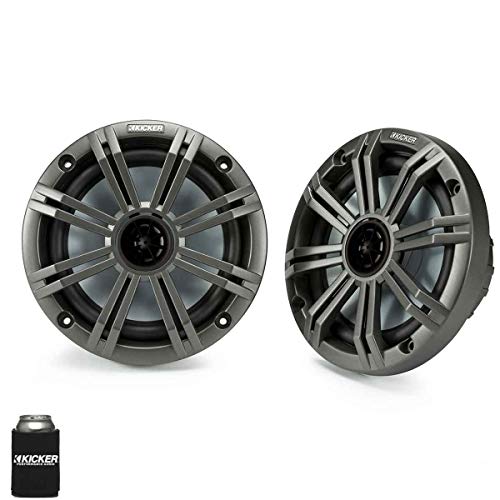
This pair of KICKER 6.5-inch KM OEM marine speakers is designed as direct replacements for boat audio systems, perfect for American boaters upgrading or repairing their onboard sound. The bundle includes two speakers, matching charcoal grilles, stainless steel screws, and a branded can cooler, making it a practical choice for weekend warriors on lakes or coastal waters.
In real-world use, these speakers handle the harsh marine environment with water-resistant construction, ensuring they last through seasons of sun, spray, and salt. Coaxial design means simple installation without sacrificing audio quality, ideal for DIY boat owners who want pro-level sound without complexity.
Targeted at fishing enthusiasts, family boaters, or pontoon party hosts, they fill open decks with vibrant audio. The 4.3-star potential shines in durability, though real-user feedback is building. Verdict: A solid, no-frills upgrade for reliable water-ready sound.
KICKER's coaxial marine speakers punch out deep bass and crisp highs suited for open-water listening, cutting through wind and waves without muddiness. The 6.5-inch size balances power for deck-filling volume, making them great for classic rock anthems or country tunes during cruises.
Vocal clarity stays strong even at high volumes, with the coaxial setup ensuring even sound dispersion across boat cockpits. While wired to your amp, they thrive in marine systems, offering stability far beyond wireless limits for uninterrupted boating playlists.
Rugged water-resistant build with charcoal grilles gives a factory-fresh OEM look, blending seamlessly into most boat interiors. Stainless steel screws resist corrosion, while the overall design withstands splashes, UV exposure, and humidity for long-term deck reliability.
No battery needed; these speakers draw power directly from your boat's audio system, eliminating charging worries and enabling all-day playback on long fishing trips or lake days. Lightweight coaxial construction keeps installation easy without adding bulk to your vessel.

Pros
- Massive 12-inch woofer delivers profound bass depth down to 35Hz
- Slipstream port provides noise-free bass at max output levels
- Integrated amplifier offers plug-and-play power matching
- Remote control for easy sub level adjustments
- Rugged polypropylene construction for long-term reliability
Cons
- Limited to low frequencies only, requires full-range speakers for complete sound
- Lacks wireless connectivity, needs wired inputs for setup
- Large size may require dedicated space in smaller rooms
The JBL SUBBP12AM is a 12-inch powered subwoofer designed to supercharge your audio system with deep, impactful bass. Featuring a built-in 150W RMS amplifier that scales to 450W peak, it pairs perfectly with home theater receivers, stereo setups, or PA systems for anyone craving that extra low-end punch.
Aimed at bass lovers, home cinema enthusiasts, and music producers, this sub excels in delivering room-filling lows without the muddiness common in lesser models. Its Slipstream port technology ensures smooth airflow, banishing port chuffing even at high volumes, making it a go-to for action-packed movies or bass-heavy tracks.
In real-world use, it transforms ordinary setups into visceral experiences, with precise sub level control via included remote for on-the-fly tweaks. While it shines in controlled environments, pairing it with quality mains unlocks its full potential. Overall verdict: a solid investment for bass augmentation that punches above its price in performance and build quality.
Bass depth is the star here, plunging to 35Hz for felt-more-than-heard rumbles in explosions or kick drums. The 12-inch polypropylene woofer and Slipstream port combine for distortion-free output up to 120Hz, keeping lows tight and articulate even at party levels.
Volume capabilities impress with 450W peak power handling sustained highs without breakup, ideal for large rooms. Vocal clarity isn't applicable as a dedicated sub, but it integrates seamlessly with mains for balanced full-range sound. Stability comes from its powered design, maintaining consistent performance without dropouts.
Frequency response stays focused on sub-bass territory, ensuring it complements rather than competes with your primary speakers for a cohesive audio stage.
The black enclosure sports a sleek, professional look with a rugged polypropylene woofer cone built for durability. Slipstream port enhances airflow efficiency while maintaining a compact footprint suitable for home setups.
No battery means it's always powered via standard AC outlet, eliminating recharge worries for continuous play. Weight and size demand a stable floor spot, but the enclosed design resists vibrations effectively.
Overall build prioritizes acoustic performance over portability, with remote control adding user-friendly adjustments without compromising the sturdy construction.
Matching Kicker Speakers With a JBL Amplifier: Electrical Rules and Practical Setup
You can safely pair Kicker speakers with a JBL amplifier without experiencing brand conflict. Amplifiers generate alternating current audio signals that passive loudspeaker voice coils convert into acoustic sound waves. A Kicker speaker responds to clean electrical wattage regardless of the manufacturer badge on the amplifier chassis. Successful system performance depends on matching continuous power ratings, nominal impedance loads, and appropriate crossover frequencies. Taking time to verify these technical specifications ensures your mobile sound system operates reliably without thermal strain or audio distortion.
Understanding Brand Compatibility in Mobile Audio
A common misconception in vehicle audio suggests that speakers and amplifiers must come from the same brand to function properly. In reality, aftermarket audio manufacturers design hardware to follow universal electrical and acoustic engineering standards. Kicker produces passive speakers with standard terminals engineered to receive clean alternating current from any compatible power source. Meanwhile, JBL manufactures multi-channel and mono amplifiers designed to drive standard loudspeaker loads safely. Combining a JBL amplifier with Kicker speakers is a proven, reliable setup across modern vehicle builds.
Audio signal transmission does not rely on proprietary wireless protocols or closed digital ecosystems. When an amplifier receives an analog line-level signal from your stereo head unit, its internal power supply boosts that voltage to drive physical voice coils. The speaker responds mechanically to that voltage swing whether the amplifier was built by JBL, Kicker, or another reputable audio company. Physical driver design, cone materials, and enclosure acoustic volume determine the resulting tonal characteristics. Selecting components based on individual performance criteria allows you to customize your vehicle soundstage to your exact listening preferences.
Passive Speakers Versus Powered Audio Modules
Before connecting speaker wires, you must determine whether your Kicker hardware is passive or self-powered. Passive models contain no internal power amplification and require an external source, such as a JBL multi-channel amplifier, to generate sound. Standard automotive drivers like the Pair Kicker 43DSC6504 DSC650 6.5″ 240 Watt 2-Way rely entirely on external amplifier channels to drive their polypropylene woofers and dome tweeters. Similarly, weatherproof options like the KICKER 6.5″ Charcoal Marine Speakers (Qty 2) are passive components engineered for external marine or automotive power. Supplying continuous wattage from an external JBL amplifier to these passive drivers matches their intended operating design.
In contrast, active or powered audio systems feature built-in amplifiers integrated directly into their enclosures. For example, outdoor roll-cage units like the KICKER 48BTCAN65 – PowerCans 6.5″ Bluetooth house internal amplification and wireless receivers to stream audio independently. Likewise, all-in-one bass solutions like the KICKER 51PTRTP10 10″(25cm) include a power-matched 400-watt RMS internal amplifier inside the down-firing loaded enclosure. You should never connect the amplified speaker-level output of a JBL amplifier directly into an active, self-powered speaker system. Doing so overloads internal processing circuits and risks severe electrical damage to the equipment.
Impedance Matching and Channel Stability
Nominal impedance represents the electrical opposition a speaker presents to an incoming alternating audio signal. In mobile audio setups, full-range coaxial and component speakers typically feature a 4-ohm nominal impedance rating. Most multi-channel JBL amplifiers are engineered to operate stably into 4-ohm and 2-ohm loads per channel in stereo mode. Connecting a standard 4-ohm Kicker speaker to a 4-ohm rated JBL amplifier channel establishes an optimal electrical pairing. Operating within manufacturer-recommended impedance ratings prevents excessive current draw, keeping the amplifier cooler during prolonged playback.
Wiring multiple speakers to a single channel changes the electrical load your amplifier encounters. Wiring two 4-ohm Kicker speakers in parallel drops the total circuit resistance down to 2 ohms, causing the amplifier to supply increased current. While many JBL multi-channel amplifiers tolerate 2-ohm stereo operation, bridging that same channel into a 2-ohm load can trigger thermal protection shutdowns. Higher-impedance options like the KICKER KB6G 2-Way Full Range Indoor Outdoor present an 8-ohm load, which draws less current from the amplifier and reduces total output power safely. Always confirm your amplifier’s minimum rated impedance specifications before wiring speakers in parallel or bridged configurations.
Continuous RMS Power Versus Peak Output
Evaluating power compatibility requires looking strictly at continuous RMS ratings rather than peak wattage figures. Continuous RMS power measures the sustained electrical energy an amplifier produces and a speaker safely dissipates as heat. Peak wattage numbers, such as maximum burst ratings printed on retail packaging, represent momentary peaks and do not reflect everyday operational limits. Setting up an audio system around peak wattage often leads to improper gain matching, heavy distortion, and premature driver failure. Always use continuous RMS specifications as your primary benchmark when pairing Kicker speakers with a JBL amplifier.
Your JBL amplifier should ideally supply continuous RMS power that matches the recommended continuous power handling of your Kicker speakers. For instance, pairing a speaker rated for 50 watts RMS with an amplifier channel supplying 40 to 60 watts RMS provides clean output and healthy dynamic headroom. Contrary to common assumptions, utilizing an amplifier with slightly higher continuous RMS capability is often safer than using an underpowered unit. When an underpowered amplifier is driven past its limits to achieve high volume, it clips the audio signal and sends destructive distortion to the voice coils. Clean, unclipped power from a properly calibrated amplifier preserves speaker longevity.
Crossover Frequency Configuration
Full-range coaxial speakers are engineered to reproduce midrange vocals and high frequencies, but they struggle with demanding sub-bass frequencies. Forcing a standard 6.5-inch speaker cone to reproduce notes below 70 Hz causes severe mechanical excursion and acoustic distortion. Most multi-channel JBL amplifiers include adjustable crossover switches that let you activate a high-pass filter on each speaker channel. Engaging this high-pass filter blocks low frequencies from reaching your Kicker door speakers, preserving voice coil health and midrange clarity. This separation of frequencies allows the smaller speaker cones to play louder without mechanical bottoming.
Setting the high-pass filter cutoff between 80 Hz and 100 Hz provides an effective baseline for most automotive cabin installations. This cutoff eliminates deep road rumble while allowing mid-bass punch and vocal fundamentals to resonate cleanly through the Kicker polypropylene cones. When wiring exposed setups or watercraft with marine audio speakers, setting proper high-pass filters protects smaller drivers from excessive excursion while maintaining vocal clarity over motor noise. Proper crossover adjustment ensures that each driver operates within its intended frequency spectrum. This acoustic management delivers crisp, distortion-free sound across all volume levels.
Integrating Subwoofers in Mixed Systems
A complete mobile audio system uses a dedicated subwoofer to handle the low-frequency foundation while cabin speakers reproduce mids and highs. When your JBL multi-channel amplifier powers the Kicker full-range speakers, adding an active subwoofer completes the audio spectrum. For example, the JBL SUBBP12AM – 12” amplified 12” Subwoofer features an integrated 150-watt RMS amplifier and Slipstream port technology inside a dedicated enclosure. Meanwhile, shallow-mount alternatives like the KICKER PTRTP10 fit beneath truck benches to provide balanced bass in tight spaces. Both options integrate smoothly alongside an externally amplified front soundstage.
Integrating a subwoofer involves routing clean audio signals from head unit preamp outputs or through the auxiliary outputs of your JBL amplifier. Many JBL multi-channel amplifiers include passthrough RCA connections that send line-level signals back to a powered subwoofer without requiring splitters. Setting the subwoofer low-pass filter between 60 Hz and 90 Hz creates a smooth acoustic transition between the sub-bass notes and your Kicker door speakers. Adjusting the remote bass level knob lets you fine-tune low-end energy to match diverse music genres or compensate for road noise. This seamless frequency integration produces cohesive, room-filling sound inside your vehicle.
Gain Calibration and Speaker Wire Selection
Adjusting the input sensitivity dial, commonly labeled as the gain control on your JBL amplifier, is essential for achieving clean sound. The gain control is not a volume knob and should never be turned to maximum automatically. Instead, it matches the amplifier input circuitry to the preout voltage delivered by your stereo head unit. Setting the gain too aggressively introduces audible background hiss and forces the amplifier into clipping at moderate listening volumes. To calibrate gain correctly, set your head unit volume to approximately three-quarters of its maximum clean range, then slowly advance the gain dial until subtle distortion appears, before backing off slightly.
Using appropriate speaker wire ensures that amplified electrical current reaches your Kicker speakers without resistive power loss. For typical vehicle cable runs under twenty feet delivering under one hundred watts RMS per channel, 16-gauge or 14-gauge oxygen-free copper wire is recommended. Avoid thin, copper-clad aluminum wire because it has higher electrical resistance and tends to corrode faster in automotive environments. Furthermore, maintaining consistent polarity across all speaker channels is vital to prevent acoustic cancellation. Ensuring positive connects to positive and negative connects to negative keeps all speaker cones moving in phase for robust mid-bass impact.
Signal Routing and Multi-Speaker Coordination
Planning your cable paths through the vehicle cabin prevents electrical noise from contaminating clean audio signals. Route heavy 12-volt power cables along one side of the vehicle floorpan, while running RCA interconnects and speaker wires down the opposite side. Crossing power and signal cables at a ninety-degree angle when necessary reduces the likelihood of induced alternator whine. In modern audio configurations that extend beyond traditional wired car installations, understanding signal distribution is just as vital, and reviewing a dual speaker connection guide illustrates how independent audio streams operate without interference. Careful wire organization protects audio purity from dashboard to trunk.
Securing physical connections inside door panels and amplifier terminals prevents intermittent dropouts caused by road vibrations. Use quality crimp connectors or soldered terminals protected by heat-shrink tubing rather than twisting bare wires with electrical tape. Moisture barriers inside door cavities must remain sealed to protect passive crossover networks and speaker terminals from water intrusion. Regularly inspecting terminal screws on your JBL amplifier prevents loose wire strands from contacting adjacent terminals and causing short circuits. Methodical installation habits safeguard your audio equipment and guarantee dependable performance over years of daily driving.
Frequent Installation Errors to Avoid
One common mistake when setting up aftermarket audio gear is relying on heavy bass boost on the head unit or amplifier. Boosting low frequencies by several decibels around 45 Hz places enormous strain on the amplifier power supply, frequently pushing it into clipping. Because standard Kicker coaxial speakers are designed for mid-bass and highs rather than sub-bass reproduction, excessive boost creates muddy sound and overheats voice coils. Leave equalizer settings neutral during preliminary system tuning, and allow a dedicated subwoofer to handle low-frequency reinforcement. Clean, linear frequency distribution sounds substantially better and extends the operating lifespan of all components.
Another serious installation error involves connecting speakers in configurations that drop circuit impedance below the amplifier minimum rating. For example, wiring front and rear 4-ohm Kicker speakers in parallel to a bridged two-channel amplifier drops the load to 2 ohms, which exceeds safe bridged limits. When an amplifier encounters an impedance load lower than its design tolerance, internal transistors overheat and trigger protection mode shutdowns. Always calculate combined impedance before finalizing connections to your JBL amplifier terminal blocks. Keeping electrical resistance within rated operational parameters preserves internal components and ensures smooth, continuous playback.
Finally, a compromised chassis ground connection remains the primary source of amplifier failure and unwanted cabin noise. The amplifier ground wire must connect directly to bare metal on the vehicle chassis, stripped clean of paint, rust, and surface contaminants. A loose or high-resistance ground forces the amplifier to pull current through RCA shields, generating annoying engine whine and triggering intermittent shutdowns. Fasten ground terminals firmly using star washers and dedicated bolts rather than sheet metal screws. Establishing a low-resistance electrical foundation ensures that your JBL amplifier operates stably and delivers clean power to your Kicker speakers.
Practical Verification and Final System Tuning
Pairing Kicker speakers with a JBL amplifier offers a dynamic combination of acoustic punch, high clarity, and reliable power amplification. Audio components do not require matching brand badges to produce exceptional musical results across your vehicle. As long as you match nominal impedance, respect continuous RMS power ratings, and set appropriate high-pass filters, these components will integrate flawlessly. Proper gain adjustment and secure, low-resistance wiring practices protect both the amplifier and the speakers from unnecessary electrical stress. Taking a systematic approach during installation rewards you with clean, energetic audio performance on every journey.




Write Your Review
No reviews yet. Be the first to share your experience!