


Setting up a two-channel stereo system transforms music listening by creating a believable three-dimensional acoustic stage across your room. However, placing cabinets without confirming Which Is The Left Speaker On Hifi can invert the intended acoustic image and misplace instruments across the sound field. In any standard high-fidelity audio environment, channel orientation is defined strictly from the vantage point of the seated listener looking forward toward the speakers. When you sit in the central listening position facing the front equipment, the speaker directly to your physical left is the left channel.
Connecting these components correctly preserves the recording engineer’s deliberate mixing decisions, ranging from orchestral section arrangements to centered vocal tracks. Many listeners upgrading from multi-channel speaker setups or simple single-chassis wireless units wonder if physical cabinets are inherently designated as left or right at the factory. While passive pairs often feature identical internal wiring, active systems and asymmetrical driver designs present specific requirements for channel assignment. Getting this fundamental physical orientation right from the initial setup prevents stereo phase confusion and ensures your amplifier routes signals to their proper acoustic positions.
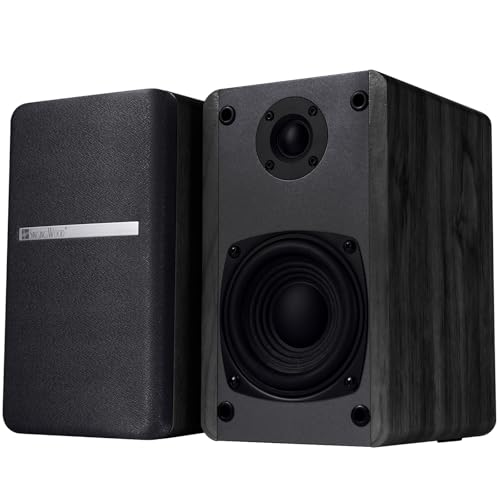
Pros
- Smooth, non-fatiguing high frequencies thanks to the 0.75-inch silk dome tweeter.
- Sturdy MDF wood cabinet effectively controls distortion and resonance.
- Pre-installed keyhole mounting brackets allow for versatile wall placement.
- Compact footprint makes it easy to integrate into tight desk or shelf spaces.
Cons
- Requires a separate stereo amplifier or AV receiver to operate.
- Compact 4-inch woofers cannot replicate deep sub-bass without an external subwoofer.
- Speaker wire and mounting hardware screws are not included in the package.
The SINGING WOOD T25 Passive Bookshelf Speakers are an attractive entry point for audio enthusiasts building a modular sound system. Unlike all-in-one powered speakers that lock you into built-in amplification, these true passive speakers give you the flexibility to choose your own amplifier or AV receiver. This makes them exceptionally versatile for powering a dedicated vinyl turntable station, upgrading bedroom audio, or serving as dependable satellite speakers in a multi-channel home theater setup.
In real-world listening tests, the T25 showcases remarkable acoustic balance for its modest cabinet size. Vocals, acoustic instruments, and dialogue project cleanly without the muffled, boxy tone often heard in budget plastic enclosures. The stereo imaging is distinct and wide, allowing listeners to easily pinpoint instrument placement whether sitting directly in front of a desktop monitor or relaxing across the living room.
While they are not intended to deliver floor-shaking sub-bass on their own, the low end remains tight and rhythmic without overwhelming the midrange. When paired with an active subwoofer, these speakers form the foundation of a surprisingly formidable hi-fi setup. For apartment dwellers, office workers, and aspiring audiophiles looking to maximize value per dollar, the T25 stands out as a reliable and capable audio solution.
The acoustic architecture of the SINGING WOOD T25 relies on a proven two-way driver configuration. The standout component is the 0.75-inch silk dome tweeter, which produces crisp, airy high frequencies without the harsh sibilance or ear fatigue associated with cheap metallic tweeters. Guitar strums, cymbal hits, and female vocals retain their natural texture, creating an open and welcoming soundstage across a wide variety of music genres.
Anchoring the lower end is a 4-inch dynamic woofer tuned to deliver punchy, responsive mid-bass. While the physical dimensions of the enclosure limit ultra-low sub-bass response, the mid-bass response remains agile, giving kick drums and bass guitars adequate presence without bleeding into dialogue clarity. Driven by a clean external amplifier providing between 20 and 60 watts per channel, the T25 effortlessly fills small to medium rooms with lively, distortion-free sound.
Crafted from medium-density fiberboard (MDF), the cabinets of the T25 are designed specifically to minimize acoustic resonance and eliminate cabinet rattle during louder playback sessions. The exterior is wrapped in a classic black wood grain veneer that easily matches modern entertainment centers, vinyl console tables, and office workbenches. With dimensions of 7 by 5 by 9 inches and a combined weight of 9 pounds, these speakers offer a compact footprint that fits seamlessly onto crowded bookshelves.
As passive speakers, the hardware interface on the rear panel consists of standard spring clips or binding posts ready to receive traditional speaker wire runs directly from your receiver, integrated amplifier, or mini desktop amp. Additionally, SINGING WOOD integrates heavy-duty keyhole mounting brackets onto the back of each enclosure, giving you the immediate option to wall mount the pair for an elevated surround sound installation without buying secondary mounting hardware.
Understanding Stereo Channel Orientation and Left Speaker Identification in Hi-Fi Audio
Establishing proper channel orientation forms the bedrock of accurate two-channel audio reproduction. Whenever someone asks Which Is The Left Speaker On Hifi, the answer always relies on the listener’s perspective rather than the perspective of the electronics facing the room. Sitting in your primary listening chair while facing forward establishes the reference frame for every stereo recording. When you look forward toward your equipment rack or media console, the speaker situated to your physical left must receive the left audio channel from your amplifier.
Mixing engineers craft albums and soundtracks under this universal spatial rule to place instruments, sound effects, and vocals across a three-dimensional acoustic panorama. If your system reverses these channels, orchestral strings recorded on the conductor’s left will emanate from your right side instead. Understanding this orientation prevents subtle imaging flaws and ensures your audio hardware reproduces recordings exactly as intended in modern home listening environments.
The Listener Perspective Rule: Defining Left and Right in Stereo Systems
Audio engineering standards universally define stereo channels from the vantage point of the seated listener looking directly forward. This perspective is frequently referred to as the sweet spot, where the listener sits equidistant between the two front speakers. Confusion occasionally occurs when users stand behind their equipment rack or inspect the front grilles while facing their sofa. From behind the speakers looking outward, left and right naturally invert, which can easily lead to crossed wiring during initial assembly.
To avoid channel inversion, always orient your audio setup while seated in your normal listening position. Imagine an imaginary centerline extending directly from your nose straight toward the space between the two cabinets. The loudspeaker positioned on the left side of that dividing axis is designated as the left stereo channel. Every source component, preamplifier stage, and power amplifier channel labeled Left corresponds strictly to this physical location in your listening room.
This rule applies universally across every domestic audio format, ranging from dedicated two-channel stereo systems to multi-channel surround sound configurations. In a conventional home theater layout, the left front channel occupies the exact same relative spot as the left speaker in a music setup. Keeping this standardized perspective clear in your mind eliminates guesswork whenever you reroute cables or rearrange furniture.
Amplifier and Receiver Output Channels: Tracing the Signal Path
Modern integrated amplifiers and stereo receivers clearly label their output terminals to ensure correct physical connections. When examining the rear panel of your amplification equipment, you will typically find terminal pairs grouped by channel designation. The left speaker output block corresponds directly to the speaker placed on your left side as you face the system. Connecting the left amplifier terminals to the physical left speaker completes the primary signal path for all left-channel audio information.
Rear panel layouts can introduce confusion because terminals are viewed from behind the electronics chassis. If your amplifier faces into the room, its rear-panel Left speaker terminals will physically align toward your right hand as you lean over the top panel. Taking the time to read the stamped labels rather than relying on hand orientation prevents accidental cross-channel wiring mistakes. Using stereo speaker switch boxes or external switching accessories also requires following these channel markings diligently from input to output.
Tracing the audio path backwards to the source equipment is equally vital for preserving channel accuracy. Turntables, CD players, digital-to-analog converters, and network streamers send dedicated stereo channels through analog interconnects. If the source cables are swapped at the receiver inputs, the entire downstream system will deliver reversed sound even if your speaker cables are attached properly. Verifying the input routing ensures that the physical left channel delivers the true left acoustic signal.
Physical Speaker Design: Are Left and Right Cabinets Truly Different?
A common inquiry among audio enthusiasts is whether physical speaker enclosures are manufactured specifically for left or right placement. In many conventional passive designs, such as the SINGING WOOD T25 Passive Bookshelf Speakers (Pair), both cabinets are physically identical. These passive models feature centered 4-inch woofers and vertically aligned 0.75-inch silk dome tweeters housed in symmetrical MDF wooden enclosures. Because the physical driver layout is identical on both units, either cabinet can function as the left speaker depending entirely on which wire you connect to it.
Certain specialized loudspeakers feature mirrored driver layouts that designate specific left and right cabinets. In these asymmetrical configurations, the high-frequency tweeter or the bass-reflex port may be offset toward one side of the front baffle. Manufacturers mirror these drivers so that the tweeters can be positioned either inboard or outboard relative to the room boundaries. When speakers feature mirrored drivers, the rear serial plate or terminal cup usually bears an explicit L or R stamp to guide proper room placement.
Setting up asymmetrical speakers with their designated orientation optimizes acoustic dispersion and reduces early sidewall reflections. If you use symmetrical bookshelf speakers, placing them on dedicated bookshelf speaker stands allows you to swap cabinets freely without affecting high-frequency timing. Inspecting the front baffle and rear terminal plate will instantly tell you whether your speakers require dedicated placement or offer interchangeable cabinet assignment.
Active Versus Passive Stereo Speakers: Where Amplification Changes Orientation
The distinction between active and passive speaker architecture plays a significant role in identifying the left channel. Passive speakers require external amplification from a standalone receiver or integrated amplifier and contain no internal power supplies. Because both passive cabinets simply accept speaker-level signals from an external amplifier, neither cabinet possesses built-in master controls. You simply decide which enclosure sits on the left side of your room and connect the corresponding left amplifier speaker wire to its binding posts.
Powered and active stereo speaker pairs operate under a fundamentally different physical architecture. In many consumer powered systems, one master cabinet houses the internal stereo amplifier, volume potentiometer, input selector, and power cord connection. The secondary cabinet functions as a passive slave unit that receives amplified audio through an umbilical speaker wire. Manufacturers often designate this primary amplified cabinet as either the fixed right speaker or the fixed left speaker.
Placing an active master cabinet on the wrong side of your desk or media console can inadvertently reverse your stereo channels. Some modern powered monitors feature a rear-panel switch allowing users to assign the powered cabinet to either the left or right acoustic role. If your active model lacks this assignment switch, you must position the master cabinet strictly according to the manufacturer’s designated channel label to maintain accurate stereo playback.
Cable Color Coding and Terminal Polarity: RCA and Speaker Wire Connections
Color coding serves as an indispensable visual guide throughout the entire audio signal chain. For analog line-level interconnects, the consumer audio industry relies on standardized color conventions established by the Consumer Electronics Association. In standard RCA cable configurations, white or black plugs always represent the left channel, while red plugs represent the right channel. Remembering the simple audio adage that red means right prevents confusing interconnect routing behind crowded equipment cabinets.
While RCA colors distinguish left channels from right channels, speaker wire connections introduce an additional layer of polarity markings. Each speaker channel utilizes a positive terminal and a negative terminal, usually colored red and black respectively. Connecting positive to positive and negative to negative ensures that the drivers in both cabinets move outward in phase with incoming electrical signals. If you wire the left speaker out of phase relative to the right speaker, bass response diminishes and center imaging dissolves into a hollow acoustic haze.
High-quality speaker cables feature colored tracer lines, ribbing, or printed text along one conductor to help you maintain consistent polarity. When wiring your left speaker, designate the marked conductor as positive and attach it to the red terminal on both the amplifier and the speaker cabinet. Doing so guarantees that both channel orientation and acoustic phase remain pristine across your entire listening space.
The Acoustic Importance of Proper Left-Right Soundstage Imaging
High-fidelity audio reproduction relies on the psychoacoustic principles of interaural time difference and interaural level difference. When sound originates from your left side, sound waves reach your left ear slightly earlier and at a marginally higher sound pressure level than your right ear. Recording and mastering engineers manipulate these time and level cues across two discrete channels to create the illusion of physical space. A properly configured stereo soundstage allows your brain to localize individual vocalists, drum kits, and ambient reflections between the two cabinets.
Inverting the stereo channels distorts this intended acoustic geometry and conflicts with established performance layouts. For instance, classical symphonies are traditionally staged with high-register violins seated on the left and low-register cellos or double basses positioned on the right. Playing a symphonic recording through reversed channels forces the orchestral layout backwards, defying acoustic conventions that trained listeners expect. In popular music, stereo drum mixes often place the hi-hat and ride cymbal according to a drummer perspective or audience perspective that depends on correct channel alignment.
Film and television soundtracks suffer even more noticeably when stereo front channels are swapped. On-screen visual action, such as a vehicle driving across the frame from left to right, becomes jarringly disconnected when its engine roar moves from right to left. Preserving the integrity of the left audio channel guarantees that what your eyes observe matches what your auditory cortex perceives.
Practical Verification Methods: Testing Channel Placement and Balance
Verifying your stereo channel orientation takes only a few moments once your physical connections are complete. The simplest verification method involves utilizing the physical balance knob or digital balance control on your amplifier or preamplifier. Rotate the balance knob fully toward the Left position while playing music with rich dynamic content. Sound should output entirely from the speaker standing to your physical left while the right cabinet goes completely silent.
If rotating the balance control to the Left causes sound to emerge from your right cabinet, your channels are crossed somewhere along the path. Another dependable testing procedure uses specialized stereo channel identification audio tracks, which are readily available on streaming services, calibration compact discs, or vinyl test records. These utility tracks feature a recorded voice speaking the phrase left channel exclusively through the left signal path. If the spoken voice emanates from the opposite speaker, you have immediate confirmation that channel routing requires correction.
Playing a centered monophonic track provides a secondary check for proper channel balance and driver phase. In a well-aligned stereo system, a mono vocal should appear to emanate from a phantom center point suspended directly between both speakers. If the soundstage appears diffuse, lacks distinct central focus, or seems to cling unnaturally to the edges of the room, re-check both your channel assignments and speaker wire polarities.
Troubleshooting Inverted Stereo Channels and Setup Mistakes
When a channel test indicates that your left and right speakers are reversed, systematic troubleshooting helps isolate the error quickly. Begin your inspection at the primary audio source, checking whether the white and red RCA cables match the labeled source jacks. A swapped interconnect pair between a turntable preamp, DAC, or streaming box and your receiver is the most frequent culprit behind inverted stereo sound. Ensure that the white plug connects the source Left output directly to the receiver Left input.
If all line-level interconnects match their respective color codes, turn your attention to the speaker wire runs at the amplifier outputs. Examine whether the wire originating from the amplifier’s left channel terminals leads directly to the physical left speaker cabinet. In complex installations involving wall plates, cable sleeves, or run lengths routed through furniture, wires can easily get tangled and transposed. Labeling each cable end with colored tape or pre-printed wire markers during installation prevents these cross-wiring errors.
Ensure your receiver or playback software has not engaged any digital channel-swapping, surround simulation, or mono downmixing features. Some modern operating systems and media players offer channel matrixing or accessibility options that alter standard stereo output. Verifying that software outputs remain in default two-channel stereo ensures your hardware setup functions properly. Taking these orderly steps confirms that your left speaker operates in true stereo fidelity, anchoring your soundstage for years of immersive listening.



Write Your Review
No reviews yet. Be the first to share your experience!