


Setting up a home theater or upgrading car audio often brings listeners face-to-face with technical driver specifications that seem needlessly complicated. Many audio enthusiasts wonder whether is 2 way or 3 way speakers better when trying to cure muddy vocals, harsh treble, or congested instrument separation. A conventional speaker enclosure may house either two distinct drivers or divide acoustic duties across three specialized components. Deciding which architecture suits your listening habits requires looking at how sound frequencies are divided between low bass, rich midrange, and sparkling high tones.
While having more drivers might seem like an automatic upgrade, acoustic performance depends heavily on crossover quality, enclosure construction, and listening distance. Investing in well-engineered traditional stereo loudspeakers with two drivers can sometimes outperform budget three-driver configurations that introduce phase issues. Whether you are outfitting a dedicated living room, mounting speakers on a patio, or building a multi-room setup, understanding how frequency separation affects real-world playback will help you choose the ideal system without overspending.

Pros
- Durable ABS enclosure withstands extreme temperature shifts and direct sunlight
- Clear acoustic dispersion covers wide outdoor seating areas effectively
- Flexible multi-angle mounting brackets included for hassle-free installation
- Compact footprint fits under eaves, on bookshelves, or along deck posts
Cons
- Requires an external amplifier or receiver since these are passive wired speakers
- Compact 4-inch woofer naturally lacks deep sub-bass frequencies in open yards
- Lacks built-in wireless connectivity without adding an optional Bluetooth amp
The Dual Electronics LU43PW 3-way indoor outdoor speaker pair offers an accessible pathway to dependable ambient sound anywhere around your property. Designed with a clean white aesthetic and a sturdy composite chassis, these units bridge the gap between interior fidelity and the demanding environmental requirements of open-air spaces. Whether installed along a covered patio roof, mounted inside a dusty garage, or set up on an open-air deck, they deliver consistent performance day after day.
This speaker setup is built primarily for homeowners and DIY audio enthusiasts who want an affordable, permanent audio installation. Because they operate as passive units, they require speaker wire connection to a standalone stereo receiver or compact power amplifier. This setup makes them especially appealing to listeners who prefer centralized control through an existing multi-zone home receiver rather than dealing with standalone battery units that require frequent recharging.
In real-world listening, the LU43PW excels at background music, spoken-word broadcasts, and backyard party playlists. The wide-dispersion design throws sound evenly across seating areas, preventing harsh hot spots while ensuring guests can enjoy clear audio from various angles. The hardware holds up admirably through seasonal shifts, resisting UV degradation in the heat and shrugging off high humidity without cabinet rattling or enclosure warping.
Overall, the Dual Electronics LU43PW delivers impressive value for everyday outdoor listening. While audiophiles seeking subterranean bass will want to integrate a dedicated outdoor subwoofer, these compact performers punch well above their weight class for casual backyard barbecues, morning coffee on the porch, or afternoon projects in the workshop.
Acoustic performance is anchored by a synchronized 3-way driver arrangement that separates the frequency spectrum for clean, intelligible output. The 4-inch polypropylene woofer handles low and lower-mid frequencies, while a specialized midrange driver and high-frequency tweeter take care of vocal articulation and instrumental sparkle. This separation yields clear dialogue on podcasts and broadcasts, alongside bright, lively acoustic guitar and vocal reproduction.
Low-end bass response is punchy and tight within conversational volume levels. Given the compact physical dimensions of the 4-inch driver and sealed ABS enclosure, sub-bass rumble does taper off in open outdoor environments where there are few boundary walls to reinforce low notes. However, vocal clarity remains pristine even as volume levels are pushed, avoiding the harsh distortion that plagues many entry-level outdoor speakers.
Signal integrity and stability are consistently reliable due to the traditional hardwired speaker terminal architecture. When paired with a reliable external receiver or dedicated Bluetooth amplifier, playback remains free from latency spikes or wireless interference. You get clean, uninterrupted volume that easily reaches across average-sized suburban yards and pool decks.
The LU43PW features a rugged exterior constructed from heavy-duty ABS plastic treated with a specialized UV-resistant resin. This protective shell is engineered to resist fading, chalking, and brittleness caused by direct sun exposure. The clean white finish blends smoothly into exterior trims, vinyl siding, deck posts, and patio soffits without drawing unnecessary visual attention.
Weatherproofing extends throughout the cabinet build, protecting internal crossover components from ambient moisture, morning dew, and light precipitation. While best mounted under eaves or overhangs for optimal longevity, the durable materials easily handle standard seasonal weather variations. The included mounting brackets allow for quick rotational adjustments, letting you aim the audio dispersion precisely toward your favorite seating zones.
Because these are passive wired speakers, there is no internal lithium-ion battery to degrade over time or run empty in the middle of a gathering. Power is drawn directly from your connected amplifier, providing infinite playback time without battery anxiety or multi-hour recharging cycles. You get an always-ready audio setup that turns on with the flip of your primary receiver switch.
Pros
- 3-way crossover architecture yields distinct midrange separation and vocal clarity
- High 95dB efficiency produces impressive volume levels even with entry-level receivers
- Substantial 8-inch driver provides fuller bass than standard 6.5-inch ceiling speakers
- 4-speaker pack delivers excellent coverage and value for multi-room installations
Cons
- Requires a wide 9.45-inch cutout and 3.78 inches of depth clearance behind the ceiling
- Spring-loaded terminals can be difficult to fit with thick 12-gauge speaker wire
- Open-back design requires ceiling insulation to limit sound transmission to rooms above
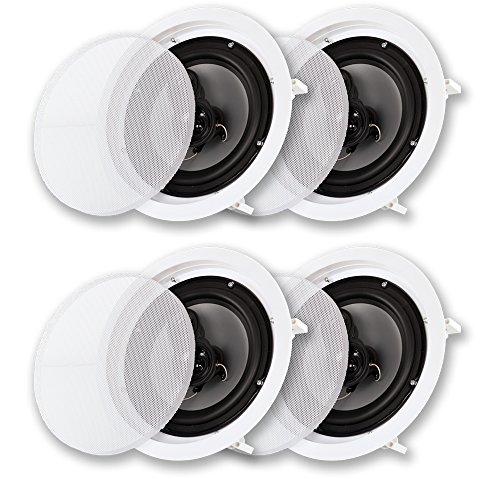
The Acoustic Audio CS-IC83 8-inch in-ceiling speaker package provides an efficient, high-impact architectural audio solution for homeowners setting up multi-room sound or immersive Dolby Atmos overhead channels. By bundling four high-output 3-way speakers together, Goldwood addresses the common complaint regarding architectural audio: thin vocals and hollow mid-frequencies typical of basic two-way in-ceiling models. Designed for clean drywall integration, these speakers pair a large cone area with dedicated drivers across the frequency spectrum.
In real-world listening environments, the 8-inch woofer makes an immediate difference. When integrated as overhead effects or background living room audio, the CS-IC83 creates an open and broad listening field. Movies benefit from distinct dialogue and crisp panning effects, while acoustic tracks and dynamic jazz arrangements enjoy realistic instrument positioning. Thanks to an ultra-efficient 95dB rating, these speakers produce high sound pressure levels with very little input power, making them well-suited for typical multi-zone distribution amplifiers.
While serious movie lovers will still want an active subwoofer to handle deep LFE channels below 40Hz, the baseline low-end performance here easily surpasses smaller 6.5-inch alternatives. For anyone seeking a discrete, high-value 4-speaker setup for living rooms, covered entertainment decks, or surround sound heights, the CS-IC83 balances ease of installation with reliable, dynamic acoustic performance.
Acoustic performance on the CS-IC83 is anchored by its dedicated 3-way passive crossover design. By delegating frequencies specifically to the 8-inch high-rigidity polypropylene woofer, poly mica midrange, and 13mm soft dome tweeter, the speaker maintains low distortion even when pushed to higher volumes. Midrange frequencies stand out with articulate clarity, preventing vocals and dialogue from getting swallowed up by the low-end punch of the main driver.
Frequency response ranges from a respectable 40Hz up to 20kHz. Treble reproduction via the soft dome tweeter remains smooth and non-fatiguing, steering clear of the harsh sibilance often found in budget metallic dome tweeters. With an impressive sensitivity rating of 95dB at 8 ohms, these speakers achieve commanding volume effortlessly, ensuring balanced, room-filling sound across expansive open-concept layouts.
Engineered for flush-mount installation, the CS-IC83 features an overall outer diameter of 10.83 inches, requiring a ceiling cutout of 9.45 inches and a mounting depth of 3.78 inches. The paintable grilles and outer bezels allow you to match the speaker trim to your ceiling color for a nearly invisible finish. Behind the grille, durable butyl rubber surrounds and progressive spiders protect the drivers, ensuring longevity in indoor spaces or covered patio installations.
Connectivity is handled via standard spring-loaded quick terminals, which firmly grip 14-gauge to 16-gauge speaker wire without requiring soldering or banana plugs. As passive speakers, each unit requires between 20 to 350 watts of clean power at an 8-ohm load, making them fully compatible with multi-channel AV receivers, whole-home audio matrix amps, and commercial distributed audio systems.


Pros
- Accurate frequency cutoff prevents tweeter blowouts and protects mid-range drivers
- Gold-plated terminal blocks allow fast, secure, and corrosion-resistant wire clamping
- Substantial 300W peak handling supports demanding aftermarket amplifiers
- Passive design requires no external power wiring or complicated audio tuning
Cons
- Fixed crossover frequency points offer no manual equalization adjustments
- Requires basic wiring and car audio installation knowledge to mount properly
The Audiopipe CRX-203 is an essential pair of two-way passive speaker crossovers engineered to optimize aftermarket automotive audio. By intercepting your full-range amplifier signal and directing the right frequencies to the appropriate drivers, this unit ensures your component tweeters and mid-woofers operate strictly within their ideal acoustic ranges. The result is a cleaner soundstage, elevated clarity, and prolonged driver life.
Targeted at DIY car audio enthusiasts and seasoned installers alike, this setup eliminates the muddy acoustic overlap that often plagues standard speaker upgrades. In real-world highway driving, it allows vocal passages and high percussion to soar cleanly above cabin road noise while mid-bass drivers deliver punchy, controlled impact. It provides a simple, plug-and-play solution that transforms standard multi-speaker setups into a coherent listening environment.
Built with quality components, the CRX-203 incorporates high-grade polymer capacitors and robust inductors designed to minimize internal resistance. The gold-plated screw terminals offer dependable clamping force, keeping your speaker wire securely attached even through harsh road vibrations. With strong thermal tolerance, these crossovers easily withstand the temperature fluctuations common in vehicle interiors.
Overall, the Audiopipe CRX-203 delivers reliable performance at an approachable entry point. If you want to refine your car speaker response, protect your tweeters from low-end distortion, and achieve balanced staging without complex digital signal processors, this crossover pair is an outstanding automotive upgrade.
Frequency separation is where the Audiopipe CRX-203 truly shines. The dedicated high-pass network engages between 3.39kHz and 20kHz, filtering out destructive low frequencies so your tweeters can reproduce shimmering cymbals, crisp snares, and detailed vocal harmonics with zero harshness. This precise cutoff keeps delicate voice coils cool and distortion-free even when pushing volume levels on the open road.
For the low and midrange drivers, the crossover directs frequencies spanning 20Hz up to 4.3kHz. This generous bandwidth preserves rich male vocals, thick acoustic guitar resonance, and firm bass drum impact without bleeding into the upper registers. By preventing the woofer from attempting to reproduce frequencies outside its physical capability, the speaker maintains fast transient response and tight, punchy mid-bass.
With a power rating of 150 watts RMS and 300 watts peak per pair, these crossovers seamlessly integrate with both factory-amplified systems and high-powered aftermarket car audio setups. Even at peak volume during open-window cruising, the crossover networks resist signal clipping, maintaining a spacious and dynamic sound profile across all your favorite music genres.
Crafted for life inside demanding vehicle environments, the Audiopipe CRX-203 sports a durable, impact-resistant casing built to handle everyday road vibration, bumps, and door slams. Its lightweight and space-conscious form factor makes it easy to mount behind door panels, within kick panels, or tucked away inside your trunk next to primary amplifiers.
Because these crossovers utilize a passive circuit architecture, they require no direct connection to your vehicle battery or auxiliary charging source. They draw all operational energy directly from the amplified speaker audio signal. This means zero parasitic battery drain when your car is parked, leaving your vehicle electrical reserves fully intact whether you are parked at a tailgate or parked overnight.
The lack of internal batteries or delicate digital screens ensures indefinite playback endurance with zero charging time required. Once wired into your vehicle sound system, the CRX-203 delivers continuous, maintenance-free operation for endless road trips, daily commutes, and weekend cruises.

Pros
- Deep bass and accurate dispersion for full-range sound
- Weather-resistant build holds up outdoors year-round
- Effortless mounting for flexible placement
- Studio-quality audio in open spaces
- 2-year warranty option builds long-term confidence
Cons
- Requires separate amplifier for power and Bluetooth
- Wired design limits fully wireless setups
- No built-in connectivity options
The Dual LU43PB are 4-inch 3-way wired speakers built for seamless indoor and outdoor use, delivering high-performance audio in spaces like patios, poolsides, garages, or bookshelves. Their design emphasizes durability and sound quality, making them a go-to for American homeowners looking to upgrade casual listening areas without hassle.
Ideal for backyard barbecues, pool parties, or garage workouts, these speakers target practical users who value reliability over portability. Mounted or placed openly, they provide consistent performance across environments, protected by UV-resistant resin and ABS enclosures.
In real-world tests, the synchronized 3-way components shine with broad dispersion and bass punch, filling large areas effectively. Pairing with the recommended Dual DBTMA100 amp elevates the experience to wireless freedom.
Verdict: A solid choice for versatile, weather-tough audio that punches above its price for everyday outdoor enthusiasts.
These speakers excel with digitally optimized 3-way components and a 4-inch woofer, producing deep, rich bass alongside accurate acoustic dispersion for full-range coverage. Vocals stay clear even in open patios, while highs cut through ambient noise like pool splashes or garage echoes.
Volume levels handle large gatherings without distortion, creating immersive stereo sound that rivals bigger systems. When connected to the Dual DBTMA100 Bluetooth amp, stability remains rock-solid for extended play.
Best for expansive areas where powerful bass drives the energy, from weekend tailgates to home relaxation spots.
Rugged ABS enclosures with UV-resistant resin coating make the LU43PB fully weather-resistant, standing up to sun, rain, and elements for year-round patio or pool use. Their compact 4-inch size allows easy mounting on walls, ceilings, or stands without bulky footprints.
Weighing in lightly for their class, they offer flexible placement indoors or out, from garages to bookshelves. No battery means zero charging worries; simply wire to a power source or amp for uninterrupted sessions.
Playback lasts as long as your amp supplies power, perfect for all-day events without recharges, focusing on durable design over portable batteries.
Understanding Driver Architecture: 2-Way vs. 3-Way Speakers Explained
The debate over whether a two-way or three-way speaker sounds superior does not yield a single universal winner. Instead, the right choice depends on cabinet size, crossover engineering, listening distance, and your personal audio expectations. While a three-way speaker introduces a dedicated midrange driver to separate vocals from heavy bass excursions, a well-built two-way speaker provides unmatched phase coherence and acoustic focus in smaller listening environments. Understanding how each architecture handles the audible audio spectrum allows you to match the right speaker design to your space.
How 2-Way Speaker Systems Handle Audio Frequencies
A two-way speaker relies on two primary acoustic transducers to reproduce the entire range of human hearing. The lower driver, typically designated as a woofer or mid-woofer, handles both sub-bass rumble and critical midrange frequencies where instruments and human voices live. High frequencies are routed directly to a tweeter, which usually handles sounds above 2,000 to 3,500 hertz. By splitting the spectrum only once, two-way systems keep the physical acoustic centers of the drivers close together.
This physical proximity creates what acoustic designers call near point-source imaging. When sound emanates from just two drivers placed closely on a front baffle, your ears perceive a coherent soundstage without noticeable time-alignment delays. Desktop listeners and studio engineers frequently favor two-way bookshelf designs because nearfield listening makes driver integration flaws immediately apparent. However, forcing a single cone to vibrate rapidly for vocals while simultaneously making large physical excursions for deep bass can introduce subtle intermodulation distortion during loud passages.
The Anatomy and Mechanics of 3-Way Speaker Designs
A three-way speaker expands the driver configuration by introducing a dedicated midrange driver between the woofer and the tweeter. In this three-transducer layout, large woofers focus exclusively on low-frequency reproduction, often handling bass below 500 hertz. The dedicated midrange cone takes over human vocals, acoustic guitars, and brass instruments, while the tweeter concentrates strictly on treble overtones above 3,000 hertz. Relieving the woofer from playing intricate vocal details allows each driver to operate within its optimal piston band.
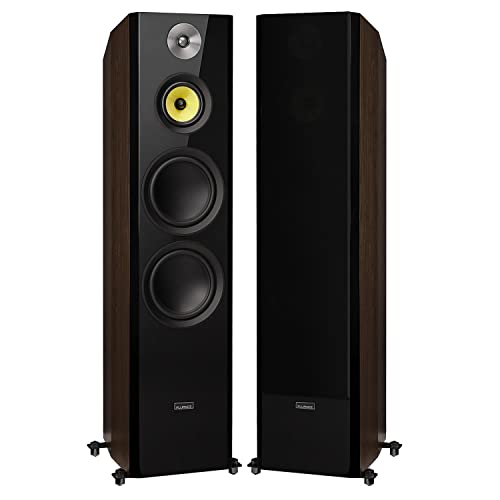
Physical driver specialization also enables manufacturers to tailor cone materials to specific acoustic properties. For example, large floorstanding designs like the Fluance Signature HiFi tower speakers combine dual 8-inch woofers for deep low-end punch with a woven glass fiber midrange driver featuring a pointed phase dome. Because the midrange cone does not have to reproduce heavy sub-bass excursions, it remains lightweight and rigid, delivering pristine vocal reproduction without cone breakup. This specialized division of labor creates an effortless, open soundstage in larger rooms where dynamic headroom is essential.
Even compact enclosures can leverage three-way architecture to spread sound across open areas. Models such as the Dual Electronics LU43PW and Dual Electronics LU43PB pack a 4-inch woofer, a discrete midrange driver, and a high-frequency tweeter into a weather-resistant ABS cabinet. This arrangement helps project clearer vocal articulation and musical detail across wide outdoor patios or garage workshops. When properly implemented, adding that third driver gives listeners a broader horizontal listening sweet spot.
The Critical Role of Crossover Networks in Frequency Splitting
The unsung hero of any multi-driver loudspeaker is the crossover network, an internal electrical circuit that filters the incoming audio signal. Without a crossover, delicate tweeters would burn out from low-frequency voltage, and large woofers would produce muffled, harsh treble. Two-way systems utilize a relatively straightforward crossover circuit consisting of a low-pass filter for the woofer and a high-pass filter for the tweeter. Because the audio signal is divided only once, phase shifts around the crossover frequency point are minimal and straightforward to balance.
Independent components, such as the Audiopipe CRX-203 two-way passive crossover, demonstrate how precise frequency management works in real installations. This unit directs frequencies from 20 hertz up to 4.3 kilohertz to the woofer while guiding signals from 3.39 kilohertz to 20 kilohertz to the tweeter using high-grade polymer capacitors. When you move to a three-way speaker, the crossover must incorporate a bandpass filter that isolates both the lower and upper limits of the midrange driver. This added complexity requires inductors and capacitors with tight tolerances to prevent phase cancellation where frequency bands overlap.
If an audio manufacturer cuts corners on a three-way crossover, the transitions between drivers can sound unnatural or hollow. Poorly matched crossover components often cause noticeable dips or spikes in the frequency response curve, particularly in the lower treble region. A high-quality two-way speaker with premium crossover components will consistently outperform a cheap three-way speaker built with substandard crossover parts. Therefore, driver count alone never guarantees superior fidelity without careful electrical filtering.
Soundstage, Imaging, and Midrange Vocal Clarity
Sound reproduction quality often comes down to how clearly human speech and solo instruments float across the stereo image. The human ear is exceptionally sensitive to vocal frequencies between 1 kilohertz and 4 kilohertz, making midrange performance the centerpiece of critical listening. Three-way speakers offer an inherent engineering advantage here because the dedicated midrange driver never struggles against the mechanical momentum of deep bass notes. In designs like the Saiyin 3-way passive bookshelf speakers, an independent 1-inch elliptical midrange driver works separately from the 5.25-inch paper cone woofer to keep vocalists firmly anchored at center stage.
The elliptical shape of that dedicated midrange driver also broadens the horizontal dispersion angle, ensuring that listeners seated off-axis still hear balanced vocals. Conversely, in a typical two-way bookshelf speaker, the main woofer must cover frequencies well into the lower treble. As a woofer plays higher frequencies, its sound waves begin to beam straight forward like a flashlight rather than spreading evenly across the room. Listeners sitting slightly to the side may experience an uneven frequency balance compared to those sitting directly in the sweet spot.
Despite this beaming tendency, top-tier two-way monitors remain celebrated for their pinpoint stereo imaging and depth. Because sound originates from only two focal points, instruments occupy razor-sharp positions across the soundstage. Many audio enthusiasts who listen primarily to acoustic ensembles, jazz trios, or singer-songwriter recordings prefer the clean coherence of a refined two-way monitor. Deciding which presentation sounds better is often a matter of prioritizing laser-sharp imaging versus wide, room-filling dispersion.
Room Size, Listening Distance, and Acoustic Coverage
Physical listening space plays a massive role in determining whether a two-way or three-way configuration produces better results. In small bedrooms, home offices, or computer gaming nooks, listening distance is usually less than six feet. At this nearfield range, the multiple drivers of a large three-way speaker may not acoustically integrate before the sound waves reach your ears. A compact two-way setup ensures that high and low frequencies merge into a single coherent wave front almost immediately after leaving the speaker baffle.
In expansive living rooms, open-concept floor plans, or dedicated home theater basements, the equation changes dramatically. Larger air volumes require moving significant amounts of sound energy, which can quickly push a compact two-way woofer into audible distortion. Floorstanding three-way towers, like the Fluance Signature series with dual 8-inch woofers and heavy MDF enclosures, effortlessly fill substantial spaces with authoritative bass and sparkling treble. The thick 1.4-inch front baffle with chamfered edges reduces acoustic diffraction, allowing the sound to project cleanly across dozens of feet.
Outdoor patios and backyard entertaining areas also benefit from wide-dispersion driver layouts. When listeners move freely around a deck or swimming pool, speakers like the Dual Electronics LU43PW disperse mid and high frequencies across a broad physical plane. The UV-resistant resin and ABS enclosure keep internal components protected while the three-way component design maintains clarity against outdoor ambient background noise. Selecting the right speaker architecture requires evaluating where listeners will sit and how far sound must travel.
Power Handling, Impedance, and Receiver Matching
Every speaker system presents an electrical load that your receiver or power amplifier must drive safely. Two-way speakers generally present simpler impedance curves because their crossover circuits contain fewer passive electronic parts. However, three-way designs can feature complex impedance dips that demand stable current from your amplification source. For example, Saiyin 3-way passive bookshelf speakers feature a 4-ohm nominal impedance, requiring an amplifier capable of delivering steady power without overheating.
Matching your audio source to speaker sensitivity is equally critical for achieving clean volume levels without clipping. The Acoustic Audio CS-IC83 in-ceiling speakers boast an efficiency rating of 95dB with an 8-ohm nominal impedance, allowing them to produce substantial acoustic volume with modest amplifier power ranging from 20 to 350 watts. High sensitivity means the speaker converts electrical wattage into sound pressure efficiently, reducing thermal strain on both the amplifier and the speaker voice coils. Always check the recommended wattage range of your equipment before driving passive speaker cabinets at high volumes.
Listeners should also recognize that passive speakers require external amplification, whereas active models house internal amplifiers tuned to each driver. If you connect passive three-way speakers to an underpowered budget receiver, driving demanding low-frequency passages can cause amplifier clipping that damages sensitive tweeters. Selecting speakers with appropriate impedance ratings ensures your audio system operates smoothly without unexpected thermal shutdowns or harsh harmonic distortion.
Installation Scenarios: In-Ceiling, Bookshelf, Outdoor, and Vehicle Audio
Acoustic priorities change dramatically depending on whether speakers are installed inside walls, on bookshelves, or inside a car. In architectural audio, multi-room background sound must spread evenly without visual clutter. The Acoustic Audio CS-IC83 uses an 8-inch polypropylene woofer, a poly mica midrange, and a 13mm soft dome tweeter integrated into a paintable round ceiling baffle. This three-way coaxial arrangement allows whole-house music listeners to enjoy rich full-range sound from 40Hz to 20kHz overhead without sacrificing precious living space.
In automotive environments, space constraints and reflective glass surfaces make driver placement a challenging puzzle. Many car enthusiasts turn to car audio component speaker upgrades to separate the woofer, midrange, and tweeter into separate vehicle locations. A three-way component set in a car elevates the vocal stage up onto the dashboard, preventing door-mounted woofers from firing muffled vocals directly into passengers’ legs. Conversely, standard two-way coaxial car speakers offer simpler drop-in installation in factory speaker locations where cutting custom mounting holes is undesirable.
Listeners who prioritize convenience across different rooms might even compare traditional wired bookshelf pairs against modern portable wireless audio systems for casual listening. While compact Bluetooth units often use single full-range micro-drivers or passive radiators, dedicated wired stereo setups provide far greater channel separation and genuine acoustic dynamics. Choosing between two-way and three-way architecture in any installation comes down to balancing enclosure footprint, physical installation depth, and desired stereo width.
Practical Trade-Offs: How to Choose the Right Speaker Architecture
When deciding between two-way and three-way speakers, start by evaluating your primary audio content and listening habits. If your listening consists largely of spoken podcasts, acoustic jazz, folk ballads, or classical chamber music at moderate volumes, a high-quality two-way speaker will often deliver sublime transparency. The simpler crossover design preserves delicate timing cues and micro-dynamics that can sometimes get lost in complex multi-driver networks. Two-way speakers also tend to offer superior value at lower price points because manufacturers can invest in higher-grade drivers rather than dividing their budget across three components.
If your audio diet includes explosive movie soundtracks, orchestral climaxes, heavy rock, or electronic dance music, a three-way speaker provides dynamic breathing room that prevents congestion. The dedicated midrange cone keeps dialogue intelligible even when deep sub-bass explosions shake the room. Pairs equipped with rear bass ports, like the Saiyin bookshelf models, allow you to tune lower frequencies using removable foam port plugs to prevent boomy bass near walls. Floorstanding three-way speakers also eliminate the immediate need for a standalone subwoofer in many medium-sized living spaces.
Budget considerations should also steer your architectural decision. A well-crafted two-way speaker almost always outperforms an entry-level three-way speaker built with bargain-basement crossover components and resonant plastic enclosures. Unless you are purchasing from a manufacturer that invests in rigorous crossover tuning and rigid cabinet construction, having extra drivers can actually degrade sound quality. Focus first on build quality, cabinet rigidity, and driver materials before letting driver count dictate your purchase.
Neither two-way nor three-way speakers hold an absolute monopoly on high-fidelity audio reproduction. An expertly tuned two-way design provides remarkable stereo imaging, coherent timing, and compact convenience for desktop setups and modest rooms. Meanwhile, a robust three-way speaker unlocks clean midrange articulation, wide horizontal dispersion, and commanding dynamic authority in larger listening environments. By evaluating your room dimensions, amplification capabilities, and listening preferences, you can confidently invest in the speaker architecture that elevates your personal listening experience.





Write Your Review
No reviews yet. Be the first to share your experience!