


Traditional wired audio equipment often delivers fantastic acoustic warmth, but cable clutter restricts where you can place your equipment around the home or patio. Many listeners hesitate to replace durable audio hardware simply to gain streaming convenience from modern smartphones or tablets. Understanding how to make a regular speaker wireless allows you to bridge the gap between classic analog fidelity and modern cord-free playback. By integrating compact wireless receivers or leveraging auxiliary connections on classic systems like wired bookshelf speaker systems, you can modernize your favorite sound hardware without unnecessary expense.
The conversion process depends heavily on whether your existing setup uses self-powered cabinets or passive drivers driven by an external stereo amplifier. Adding an external Bluetooth adapter, utilizing a compact line-in receiver, or adopting multi-format portable sound units can transform how you access playlists across everyday living spaces. Modern wireless audio standards deliver strong connection stability and clear audio fidelity without requiring complicated wiring modifications. Taking the time to evaluate input ports, power sources, and pairing methods ensures your converted audio system operates reliably for everyday listening.

Pros
- Exceptionally lightweight and travel-friendly footprint under 10 ounces
- Strong wireless connection and fast pairing via Bluetooth 5.0
- Versatile offline playback options with USB and micro SD card slots
- Clear vocal reproduction perfect for podcasts and voice calls
Cons
- Lacks a 3.5mm auxiliary audio input for legacy wired devices
- Compact physical enclosure naturally limits true deep sub-bass
- No official IPX waterproof rating for harsh weather or poolside splashes
The LENRUE Soundmate enters the portable audio landscape as a straightforward, grab-and-go wireless speaker designed for listeners prioritizing convenience, compactness, and battery life over bulky hardware. Built for students, commuters, and casual home listeners, this diminutive soundbar-style speaker punches above its weight class by prioritizing vocal clarity and daily reliability.
In everyday use, the Soundmate excels during common tasks such as playing background music in home offices, streaming podcasts during morning routines, or providing tunes around a picnic table. The setup process is quick and frictionless thanks to Bluetooth 5.0, maintaining a stable wireless link with iPhone, iPad, and Android devices across typical household distances. Additionally, the ability to pair two units in TWS mode gives users an easy, accessible way to build a discrete stereo soundfield.
While audio purists will quickly notice that the compact physical enclosure prevents earth-shattering sub-bass, the speaker intentionally emphasizes crisp upper frequencies and speech intelligibility. Whether you are following a cooking tutorial or listening to daily news broadcasts, spoken words come through distinctly without muffle or boxiness.
Ultimately, the LENRUE Soundmate hits a sweet spot for anyone seeking an accessible travel companion or a low-profile desk speaker. It eliminates unnecessary frills while retaining essential daily utilities like onboard media card reading and hands-free speakerphone capabilities, earning a solid spot in any minimalist gear bag.
Acoustically, the LENRUE Soundmate relies on an active high-output micro-driver paired alongside an enhanced passive bass diaphragm. This combination allows the compact cabinet to produce a balanced, vocal-centric sound signature. Midrange frequencies remain clean and articulate, ensuring that pop vocals, acoustic guitars, and voice tracks stand out prominently without being overpowered by low-end rumble.
Because physical volume displacement is limited by its miniature profile, sub-bass reproduction rolls off significantly below 100Hz. However, the passive radiator compensates admirably by accentuating punchy upper-bass rhythms, preventing drum beats and basslines from sounding completely hollow. At moderate listening levels, distortion remains well-controlled, while pushing the volume toward its upper limits maintains crisp highs without causing harsh sibilance.
When paired with a second unit via True Wireless Stereo (TWS), the Soundmate transforms from a focused mono source into a broader soundstage. This setup widens sound distribution considerably, making it far more capable of filling small bedrooms, dorms, or personal patio areas with immersive background music.
Measuring roughly 6.3 inches wide and weighing barely 0.57 pounds, the LENRUE Soundmate is engineered for effortless mobility. The chassis is finished in a clean matte black aesthetic that looks discrete on desks, nightstands, and kitchen counters. Raised physical control buttons along the exterior provide tactile feedback for volume adjustments, track skipping, and answering calls on the fly.
Connectivity centers around Bluetooth 5.0 for low-latency streaming and efficient power consumption. In addition to wireless streaming, LENRUE includes hardware slots for both USB flash drives and micro SD (TF) cards up to 32GB, allowing listeners to play their curated music libraries without depending on a paired smartphone. Note that this model intentionally omits a 3.5mm auxiliary jack, relying entirely on digital media interfaces.
Power management is another strong suit, featuring an internal rechargeable lithium-ion battery engineered to provide anywhere from 12 to 24 hours of playback, depending on your volume levels and audio source. This extensive endurance makes it a dependable companion for day-long outings, road trips, or work shifts where power outlets are out of reach.
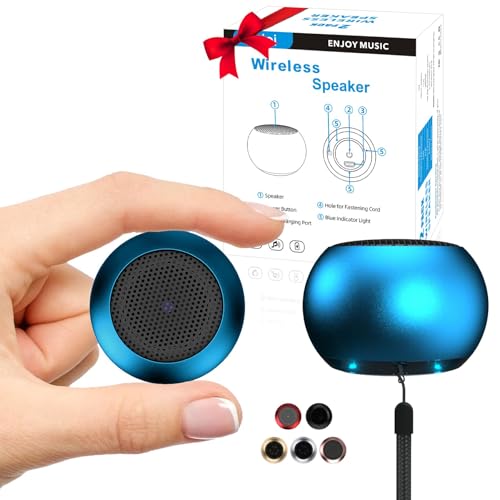

Pros
- Impressive volume and bass from compact size
- Stable 100ft Bluetooth connection
- Lightweight and easy to carry anywhere
- Long-lasting 14-hour battery
- Versatile with mic and AUX input
Cons
- Bass lacks depth of larger speakers
- Splashproof but not fully submersible
- No app for sound customization
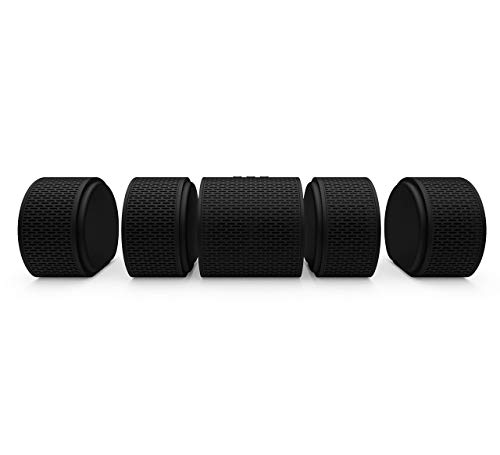
Pros
- Magnetic auto-sync makes splitting and recombining effortless with zero app setup
- Genuine physical stereo soundstaging across up to five separate satellite placements
- Sleek and lightweight cylindrical body travels easily between rooms or outdoor patios
- IPX4 splash-resistant build safely handles bathroom humidity and outdoor mist
Cons
- Frequency response bottoms out around 88Hz, lacking deep sub-bass impact
- IPX4 rating protects against water splashes but cannot withstand full submersion
- Individual satellite outputs are modest when dispersed across large, open outdoor spaces
The Hover-1 Air Audio redefines versatile home audio with an inventive pull-apart architecture that transforms from a single sound cylinder into five distinct satellite speakers. Engineered for apartment dwellers, patio entertainers, and everyday listeners, it removes the clutter of typical multi-room audio installations. Instead of configuring complicated Wi-Fi mesh networks or syncing third-party mobile applications, this speaker relies on integrated magnetic contacts that link the satellites together instantly.
In real-world use, this modular construction changes how you experience casual background audio and dinner music. You can keep the unit assembled as a centralized 24-watt soundbar for a focused soundstage, or detach the magnetic units and scatter them around your kitchen, living room, and deck to keep the tunes playing seamlessly as you move around. The lack of software friction is refreshing, allowing any standard Bluetooth playback source to broadcast simultaneously across all separated modules without lag or dropped connections.
While individual satellite modules are tuned for ambient coverage rather than high-decibel outdoor parties, their ability to create true spatial separation is remarkably effective indoors. If you love clever engineering, minimal setup times, and adaptable soundscapes for social gatherings, the Air Audio delivers unmatched versatility that standard single-enclosure speakers simply cannot replicate.
When unified into a single chassis, the speaker combines its drivers to generate 24 watts of power, producing a well-balanced acoustic signature focused on clear mids and clean highs. The AirBase driver operates across an 88Hz to 17kHz frequency range, providing crisp vocal articulation for podcasts and acoustic tracks. While you will not feel bone-rattling sub-bass on heavy electronic or hip-hop tracks, the low-end remains tight and punchy without distorting upper-register details at medium-to-high volumes.
The true performance standout is the channel separation. By physically pulling the magnetized satellites apart, you achieve authentic physical stereo staging that artificial digital signal processing cannot mimic. Bluetooth wireless transmission remains stable throughout typical indoor footprints, maintaining synchronization across the dispersed satellites without audio drift or annoying echo effects.
Sporting a minimalist cylindrical silhouette finished in sleek black, the speaker measures 12.5 inches in length and weighs a manageable 2.6 pounds. Built with IPX4 water resistance, the chassis safely shrugs off errant water drops, bathroom humidity during hot showers, and surprise rain drizzles on the patio. Its magnetic docking mechanisms are surprisingly robust, snapping together with a tactile, satisfying click that feels engineered to survive repeated daily use.
Charging and power distribution are simplified via internal contacts when the device is assembled as one column. USB charging ensures you can easily juice up the entire array from standard power banks or wall adapters. For weekend hangouts or moving from room to room through a normal workday, the battery supply provides reliable cord-free playback, though keeping the satellites docked together maximizes overall stamina for all five internal cells.
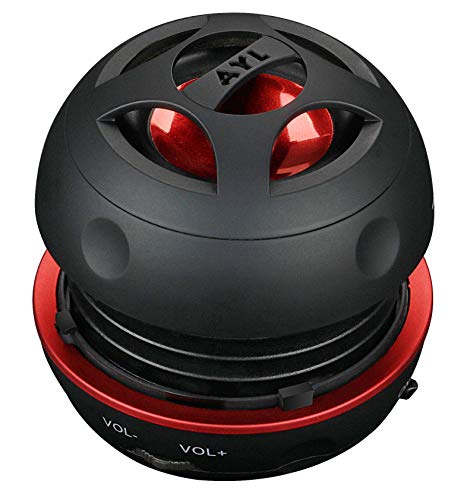
Pros
- Exceptional portability at just 3 ounces for effortless carrying
- Surprisingly loud 3W output with clear, high-fidelity sound
- Up to 10 hours of playback on a single charge
- Simple plug-and-play setup with universal 3.5mm aux compatibility
- Reliable USB charging and 3-year manufacturer warranty
Cons
- Wired aux connection limits wireless freedom
- Mini size means limited bass depth for bass-heavy music
- No waterproofing for outdoor use near water
The AYL Mini Speaker System is a compact, wired portable speaker designed for users who need reliable audio boost without complexity. Weighing just 3 ounces, it connects via 3.5mm aux to laptops, iPhones, iPads, MP3 players, and more, making it perfect for students, travelers, and remote workers seeking affordable sound enhancement on a budget.
In real-world use, it shines during work calls, casual listening sessions, or weekend trips where Bluetooth isn't needed. The built-in amplifier pushes 3W of clear, loud sound that punches above its size, ideal for small rooms or personal spaces like desks and hotel rooms.
With up to 10 hours of battery life at medium volume and simple USB recharging, it fits seamlessly into mobile lifestyles. Backed by a 3-year warranty, this speaker delivers consistent performance for everyday portable needs.
Verdict: A solid choice for wired audio fans wanting portability and value, though it skips wireless features for simplicity and reliability.
Engineered for clarity, the AYL mini speaker produces high-fidelity audio with crisp vocals and detailed mids, making it great for podcasts, audiobooks, and light music listening. The 3W output delivers surprisingly loud volume without distortion at moderate levels, filling small spaces like offices or cars effectively.
Bass response is light due to the compact size, favoring balanced sound over deep thumps, which suits acoustic tracks or spoken word better than heavy beats. Volume scales well for personal use, ensuring clear playback even in mildly noisy environments.
As a wired aux speaker, it offers stable, lossless audio transmission with no dropouts, outperforming wireless options in reliability for close-range setups.
The sleek black design is ultra-compact and lightweight at 3 ounces, with a simple plug-in form factor that prioritizes portability over ruggedness. No IP rating means it's best for indoor or dry outdoor use, like picnics or travel, rather than wet environments.
Built-in rechargeable lithium battery provides up to 10 hours of continuous play at medium volume with random music, perfect for all-day desk sessions or long commutes. Charging takes a few hours via the included USB cable, compatible with laptops or adapters.
Overall build feels sturdy for daily pocket carry, emphasizing ease and endurance for mobile users who value lightweight reliability.

Pros
- Powerful 24W output with DSP for distortion-free sound at high volumes
- Exceptional 30-hour battery life on a single charge
- Seamless Bluetooth 5.3 pairing and stable long-range connectivity
- IPX7 waterproofing handles rain, splashes, and submersion
- Dual pairing for true stereo surround sound
Cons
- RGB lights may feel gimmicky for serious listening sessions
- No companion app for EQ customization or firmware updates
- Compact size limits maximum bass depth compared to larger models
The Ortizan Portable Bluetooth Speaker (1st Gen) is a rugged, feature-packed option for on-the-go audio enthusiasts. With 24W of power from dual 12W drivers, advanced DSP, and passive radiators, it punches above its weight in delivering balanced sound suitable for casual listening anywhere.
Targeted at party-goers, beach lovers, and gift buyers, it's ideal for men and women seeking an affordable, durable speaker for home, outdoors, or travel. Real-world tests show it excels in open spaces, maintaining clarity during hikes or poolside hangs, with TWS pairing enhancing the experience for stereo setups.
Performance shines in bass-heavy tracks and podcasts alike, though it lacks app control. Battery life impressively hits 30 hours at moderate volumes, outlasting most competitors. Overall verdict: a top value pick for versatile, waterproof portability - highly recommended for summer adventures.
Expect deep, boosted bass from the dual passive radiators, paired with crisp treble and detailed mids thanks to the 24W stereo drivers and digital signal processor. This tuning favors energetic playback, revealing punchy lows in EDM or hip-hop while keeping vocals clear in rock or pop.
Soundstage widens impressively with TWS pairing, mimicking surround sound for movies or groups. It handles high volumes without muddiness, maintaining composure up to 65dB, though extreme highs can sharpen slightly at max output.
Bluetooth 5.3 ensures low-latency streaming, with stable connections over 66 feet, making it reliable for playlists from phones, TVs, or laptops.
Built tough with IPX7 waterproofing, this cylindrical speaker (3 x 3 x 6.69 inches, 1.28 lbs) withstands submersion up to 3 feet for 30 minutes, plus dust and splashes - perfect for showers, camping, or boats. The rugged exterior includes RGB LED lights that pulse to the beat, doubling as a night light.
Connectivity covers Bluetooth 5.3, AUX jack, TF card slot, and built-in HD mic for hands-free calls. No HDMI or optical, but wireless focus keeps it simple. Power via Type-C, with 30-hour playtime at moderate levels.
Compact and lightweight, it fits in a backpack easily, with intuitive buttons for play/pause and pairing. Package includes cable and guide for quick setup.
Everything You Need to Know About Converting Regular Speakers to Wireless Audio
Converting a traditional sound setup into a modern streaming station is one of the most rewarding audio projects you can undertake. Many people assume that enjoying wireless music requires replacing perfectly functional speakers with brand-new equipment. In reality, adding wireless functionality to standard speakers simply requires matching the right wireless receiver or amplifier to your existing hardware architecture. Whether you want to revitalize classic desktop cabinets, outdoor patio drivers, or vintage stereo setups, understanding your hardware connections makes the transition smooth and straightforward.
Distinguishing Between Active and Passive Speaker Architectures
Before purchasing any conversion equipment, you must determine whether your existing speakers are active or passive. Active speakers, also known as powered speakers, feature internal power amplification and plug directly into an electrical wall outlet. These units typically include rear input panels featuring standard 3.5mm auxiliary jacks, stereo RCA sockets, or optical connections. Because active cabinets already possess the necessary internal power to drive the speaker cones, they only require an external audio signal from a compact wireless receiver.
Passive speakers do not contain internal amplifiers and rely entirely on external power supplied through traditional speaker wire. You can identify passive speakers by their rear spring clips or binding posts, which connect to the red and black output terminals of a separate stereo receiver. Connecting a standard line-level Bluetooth dongle directly to passive speaker binding posts will not produce audible sound because the audio signal lacks amplification. Converting passive cabinets requires a dedicated wireless amplifier receiver that can process the incoming Bluetooth stream while providing sufficient wattage to drive the speaker voice coils.
Connecting Bluetooth Receivers to Powered Speakers
Adding Bluetooth streaming to powered active speakers represents the simplest conversion method available for home audio. You begin by selecting a dedicated Bluetooth audio receiver equipped with standard analog line outputs. Most receivers feature either a 3.5mm stereo headphone-style jack or dual stereo RCA connectors on their chassis. You connect an audio patch cable from the receiver output directly into the corresponding auxiliary line-in port on your powered speaker cabinet.
Once the physical audio cable is connected, you must supply power to the wireless receiver using its included adapter or a standard USB power brick. Most modern adapters power on automatically and enter discovery mode, which is indicated by a flashing status light. You then access the Bluetooth settings on your mobile device, locate the receiver name, and confirm the pairing handshake. After pairing, adjust your source device volume to roughly eighty percent before adjusting the physical volume knob on your speaker to prevent audio distortion.
Converting Passive Cabinets with Wireless Amplifier Receivers
Modern class D mini amplifiers provide an affordable and compact solution for bringing vintage passive speakers into the wireless era. These compact desktop units integrate both a digital Bluetooth receiver and a multi-channel power amplifier within a single small enclosure. To wire this setup, strip roughly half an inch of protective insulation from each conductor of your standard two-conductor speaker wire. Insert the bare copper strands firmly into the amplifier binding posts, ensuring positive red terminals connect to positive speaker terminals and negative black terminals connect to negative terminals.
Maintaining correct acoustic polarity between both channels ensures your stereo image remains balanced and produces proper bass response. Reversed speaker wiring causes destructive phase cancellation, resulting in thin, hollow vocals and noticeably weakened low frequencies. You should also check the nominal impedance rating printed on the rear label of your passive speakers, which is typically four or eight ohms. Verify that your wireless mini amplifier supports that impedance load to prevent thermal overload and keep the amplifier circuitry operating within safe limits.
Managing Bluetooth Pairing Sequences and LED Status Indicators
Screenless Bluetooth adapters and wireless speakers communicate their operational states almost entirely through multi-colored status LED indicator lights. When you first power on a wireless receiver, a rapid blue flashing light typically indicates that the unit is actively broadcasting its discovery signal. Pressing and holding the primary pairing button for three to five seconds is standard procedure on most headless hardware to force discovery mode. Once a successful wireless handshake occurs with your smartphone, the LED indicator usually transitions to a solid blue illumination.
Interpreting warning codes can save significant troubleshooting time when connections unexpectedly drop or fail to establish. A slow, intermittent blue blink often means the receiver is powered on but searching for its last paired host device rather than accepting new connections. If an unwanted secondary tablet or household smartphone connects automatically, the receiver becomes invisible to new broadcast scans. Clearing this connection deadlock requires pressing and holding the reset or pairing button until the LED flashes rapidly, wiping the internal memory cache and opening the unit for a fresh connection.
Eliminating Ground Loop Hum and Audio Interference
One of the most frequent frustrations encountered when converting regular speakers is an annoying background buzzing or humming noise. This electrical interference typically stems from a ground loop, which occurs when a USB-powered Bluetooth adapter and the powered speaker share a common electrical ground. The difference in electrical ground potential creates unwanted circulating currents that travel directly through the analog audio cable shield and into your speaker amplifier. The resulting sixty-cycle hum becomes especially noticeable during quiet passages of music or when audio playback pauses.
Resolving ground loop issues requires breaking the shared electrical connection between your components. The simplest fix involves inserting an inexpensive inline ground loop isolator between the wireless receiver audio output and the speaker input jack. These compact passive isolators use internal audio transformers to transfer sound signals magnetically while blocking stray direct current loops completely. Alternatively, you can eliminate the problem entirely by powering your Bluetooth receiver from an isolated wall power brick rather than using a USB port located directly on the speaker cabinet.
Audio Codecs, Transmission Range, and Latency Considerations
Wireless audio quality and synchronization depend heavily on the underlying Bluetooth transmission codecs supported by your hardware. Standard Subband Codec, commonly known as SBC, is supported universally across all devices but introduces noticeable audio compression and transmission latency. If you use your converted speaker system primarily to listen to music, standard codec latency of one hundred to two hundred milliseconds remains virtually undetectable. However, watching movies or gaming through high-latency connections creates irritating lip-sync errors where actor mouth movements precede the dialogue.
Selecting receivers that support advanced codecs like aptX Low Latency or AAC can significantly reduce transmission delay when streaming from compatible devices. Transmission range also impacts performance, as typical consumer Bluetooth transmitters maintain stable line-of-sight signals up to thirty feet. Interior household obstacles like drywall partitions, metal furniture, and competing 2.4 gigahertz Wi-Fi networks can degrade signal integrity and cause playback stuttering. Keeping your streaming phone within clear line of sight helps preserve steady data streams and avoids sudden connection dropouts.
Setting Up Dual Speaker Stereo and Multi-Channel Formats
Configuring two separate speakers to play in synchronized stereo sound creates a far wider acoustic soundstage than a single mono enclosure. When upgrading legacy speakers, many audio enthusiasts explore dual speaker stereo configurations to achieve realistic spatial depth across their listening space. Traditional stereo conversion feeds the left and right audio channels from a single stereo receiver into two distinct speaker cabinets via balanced speaker wire runs. This physical separation allows each ear to perceive localized instruments and vocal staging exactly as originally recorded in the sound studio.
Modern digital alternatives also offer wireless stereo pairing, often referred to as True Wireless Stereo or TWS. In a TWS configuration, a primary wireless unit receives a stereo Bluetooth signal from your phone, decodes the stream, and wirelessly relays the opposite audio channel to a secondary matched speaker. This approach eliminates the physical interconnect wire entirely while maintaining proper stereo channel separation. Whether using hardwired speaker wire or synchronized digital links, establishing true stereo channels dramatically improves audio immersion compared to simple mono sound.
Electrical Safety, Parasitic Standby Draw, and Power Management
Leaving converted audio systems permanently powered creates continuous standby electrical consumption, often termed parasitic vampire draw. While a compact Bluetooth receiver consumes only a few watts during active streaming, its power adapter continues to pull current even when silent. In setups where wireless mini amplifiers remain switched on indefinitely, idle power dissipation can warm the amplifier casing and waste energy over time. Connecting your converted audio hardware to a switched power strip allows you to cut power to both the amplifier and the receiver simultaneously with one switch.
Electrical safety also demands careful attention to cable routing and heat dissipation around speaker cabinets. Never bundle high-voltage AC power cords tightly alongside low-voltage audio signal cables, as electromagnetic induction can introduce unwanted line noise. Ensure that external amplifiers receive adequate airflow on all sides, avoiding tight enclosures or unventilated bookshelves that trap rising heat. Inspecting wire insulation periodically prevents short circuits that could damage amplifier output transistors or pose fire risks in residential listening environments.
When to Convert Legacy Hardware Versus Purchasing Portable Wireless Speakers
Converting traditional speakers is an excellent choice when you already own high-quality acoustic cabinets with superior wooden construction and balanced frequency response. Preserving premium vintage drivers keeps capable hardware out of landfills while delivering sound depth that compact modern enclosures struggle to replicate. However, conversion projects can become cumbersome if you require mobility, weather resistance, or simple battery operation for outdoor tailgating and camping. In situations demanding durable water resistance and cordless flexibility, investing in standalone portable Bluetooth units often proves far more practical.
Modern portable speakers feature integrated rechargeable batteries, ruggedized rubberized bumpers, and certified ingress protection ratings such as IPX7 waterproof construction that survive sudden rainstorms and splash exposure. Legacy home speakers lack weatherproofing and can suffer irreversible driver damage if exposed to moisture, high humidity, or direct sunlight. If your goal is everyday living room or office listening, converting existing wired cabinets delivers unmatched acoustic value. Conversely, outdoor recreation, jobsite tasks, and patio gatherings benefit from purpose-built wireless hardware designed specifically to withstand harsh outdoor elements.
Operational Diagnostic and Audio Troubleshooting Checklist
When your converted wireless speaker setup fails to produce sound, working through a structured diagnostic process quickly pinpoints the underlying problem. Start by verifying basic power delivery to all connected hardware, ensuring that power switches are engaged and status LEDs display active illumination. Next, inspect your mobile device to confirm that media audio routing is active and that device volume is not set to mute. If the audio path appears active on your phone screen but remains completely silent, check the physical line-in selector on your powered speaker cabinet.
Physical connections can also degrade over time due to dust buildup or slight plug misalignment inside 3.5mm and RCA audio sockets. Disconnecting and firmly reseating all analog patch cables removes surface oxidation and ensures solid metal-to-metal contact. If persistent audio dropouts occur during streaming, move your broadcasting phone closer to the receiver to rule out physical line-of-sight obstructions. Cycling power on both your phone and the wireless receiver clears volatile memory buffers, restoring dependable wireless streaming for your revitalized regular speakers.




Write Your Review
No reviews yet. Be the first to share your experience!