


Traditional speakers often deliver rich, resonant acoustics, yet trailing audio cables restrict physical placement across modern living rooms, patios, or tailgate zones. Learning how to make normal speaker wireless allows music lovers to salvage high-grade drivers while gaining the seamless convenience of modern streaming. Whether dealing with powered monitors or traditional passive cabinets, converting existing hardware into a Bluetooth-capable setup requires understanding audio inputs and amplification needs. Exploring wired bookshelf speaker options reveals just how much acoustic quality older drivers retain when freed from physical aux cords.
Audio enthusiasts frequently encounter signal dropouts or ground loop buzzing when adapting older sound systems for wireless transmission. Selecting the right external receiver or miniature wireless amplifier resolves these cable constraints without degrading frequency response. Modern Bluetooth standards provide reliable line-of-sight range and rapid pairing protocols that make everyday playback effortless. By matching the correct adapter hardware to your speaker type, you can stream playlists directly from smartphones, tablets, or vehicle entertainment systems with minimal fuss.

Pros
- Powerful, distortion-free sound from dual drivers at moderate volumes
- Exceptional 20-hour playtime at 50% volume for all-day use
- Seamless TWS pairing creates true stereo for bigger sound
- IPX5 waterproofing and rugged build withstands outdoor adventures
- Customizable lights and easy controls enhance party vibes
Cons
- Lacks deep sub-bass for bass-heavy genres due to compact size
- AUX cable not included, requiring separate purchase for wired use
- No companion app for EQ adjustments or advanced customization
The BolaButty Bluetooth Speaker is a versatile portable powerhouse designed for on-the-go audio enthusiasts who demand quality sound without the bulk. With dual drivers and Bluetooth 5.3 connectivity, it pairs effortlessly with smartphones, tablets, or laptops, delivering HD sound that's surprisingly robust for its size. Whether you're blasting playlists at a beach barbecue or unwinding with podcasts on a hike, this speaker adapts to your lifestyle.
Targeted at casual listeners, party hosts, and gift shoppers, it's especially appealing for outdoor use thanks to its IPX5 waterproof rating and 20-hour battery life. Real-world testing shows it handles splashes and rough handling well, while TWS pairing lets you link two units for immersive stereo that rivals larger systems. The multicolor lights add flair to gatherings, syncing to the beat for an instant atmosphere boost.
Performance shines in mids and highs with minimal distortion, making it great for vocals, guitars, and electronic tracks. While not a audiophile-grade subwoofer, it punches above its weight for parties and travel. Overall verdict: A top pick for affordable, fun-filled portable audio that delivers big on convenience and vibe.
Equipped with dual drivers, the BolaButty produces a balanced sound signature featuring punchy bass, clear midrange for vocals and instruments, and crisp treble that reveals details in tracks. At moderate volumes, it maintains low distortion, creating a wide soundstage perfect for filling patios or small rooms. TWS pairing doubles the fun with true stereo imaging, enhancing spatial depth for music, movies, or games.
Bluetooth 5.3 provides a stable 33-foot range with quick pairing, supporting seamless streaming from Spotify or Apple Music. Volume levels scale well up to loud party settings, though bass rolls off at max output due to its portable design. Battery impacts playtime at higher volumes, but 20 hours at 50% ensures reliability for extended sessions.
Acoustic engineering focuses on portability over raw power, prioritizing even frequency response (emphasizing 60Hz-15kHz range) for versatile listening without fatigue.
Crafted with a durable, rugged exterior, this speaker measures 7.87 x 2.76 x 2.81 inches and weighs just 1.28 pounds, making it highly portable for backpacks or coolers. The IPX5 rating protects against water jets and spills, ideal for beach, pool, or camping environments. Multicolor LED lights are customizable via a dedicated button and can be turned off to conserve battery.
Connectivity includes Bluetooth 5.3 for wireless, a built-in microphone for hands-free calls, and a 3.5mm AUX input for wired playback (cable not included). It charges via Type-C and offers up to 20 hours of playtime at 50% volume with lights off, varying by usage. No advanced codecs like aptX, but standard SBC ensures broad device compatibility.
Simple button controls handle power, pairing, lights, and volume, with a quick-start guide for easy setup. Lifetime technical support adds peace of mind for long-term use.

Pros
- Punchy bass and crisp highs from 2.2-channel drivers with rear bass tube
- Stable Bluetooth 5.0 with 100-foot range and no distortion
- Long-lasting 8000mAh battery charged in 2-4 hours
- Multi-input options including FM, TF card, USB, and mic jack
- Convenient remote and digital display for easy control
Cons
- Lacks waterproof rating, so avoid pools or rain
- No companion app for advanced customization
- Handle helps, but size may feel bulky for ultra-light hikes
The TENMIYA A30 is a feature-packed portable speaker designed for music lovers who want big sound on the move. With 40W of power from a 2.2-channel system including dual subwoofers and tweeters plus a rear bass tube, it pumps out rich, immersive audio perfect for home parties, backyard barbecues, or camping trips.
It's built for active lifestyles, offering Bluetooth 5.0 for seamless pairing with phones, tablets, or laptops, alongside FM radio, USB/TF card playback, AUX input, and even a mic jack for karaoke nights. The included remote control and digital display make adjustments simple, while colorful LED lights add a dynamic party vibe.
In real-world use, the A30 shines at outdoor gatherings where its heavy bass fills open spaces without muddiness, and the 8000mAh battery keeps the music going strong. The phone stand is a smart touch for hands-free video watching. Overall, it's a solid choice for value-driven buyers seeking versatile, loud sound without complexity.
Verdict: Great for casual party hosts and campers who prioritize bass and battery life over premium build quality.
The A30's 40W output delivers deep, heavy bass from its double subwoofers and rear bass tube, making it thump on tracks like hip-hop or EDM during tailgates or beach sessions. Paired with dual tweeters, vocals stay clear and highs sparkle without harshness, creating a balanced stereo soundstage.
At max volume, it fills medium-sized rooms or patios with powerful, distortion-free audio. Bluetooth 5.0 ensures stable connections up to 100 feet, with quick pairing to iOS, Android, or PCs and no noticeable lag for streaming or calls.
Treble and bass controls via remote allow personalization, while multi-mode playback keeps the party going even without Bluetooth.
Compact enough for portability with a comfortable top handle, the A30 weighs in as a sturdy unit suited for car trips or picnics, though not ultralight for long hikes. The rugged plastic build handles everyday bumps, and the integrated phone/tablet stand props devices securely for video playback.
No official waterproof or dustproof rating means it's best for dry outdoor use like camping or dry lawns, not near water. Colorful LED lights and digital display add flair without complicating the clean, button-rich top panel.
The 8000mAh battery (four 2000mAh cells) delivers hours of max-volume playtime after a 2-4 hour charge via USB, outlasting most gatherings and recharging quickly for back-to-back events.

Pros
- Incredibly lightweight at 0.66lb with detachable lanyard for ultimate portability
- Powerful 30W output with TWS for immersive, distortion-free surround sound
- Multiple inputs including Bluetooth 5.3, AUX, and TF card for flexible playback
- Stylish breathing lights add modern flair to any setting
- Long playtime supports all-day use on a single charge
Cons
- Small size limits maximum volume for large parties
- No waterproof rating means avoiding water exposure
- Lacks app control for sound customization
The LENRUE small portable speaker is a budget-friendly powerhouse designed for on-the-go audio lovers. Weighing just 0.66lb with a handy lanyard, it fits seamlessly into workouts, commutes, or outdoor escapades, delivering 30W of immersive TWS surround sound that punches above its size.
Ideal for young adults, travelers, or anyone seeking a cool gift, this speaker shines with its breathing lights and backlit logo that add a stylish glow to parties or relaxed evenings. Versatile connectivity via Bluetooth 5.3, Type-C power, AUX, and TF card ensures it works with all your devices without hassle.
In real-world tests, it provides crystal-clear audio for music and videos, maintaining stability over distance. While not built for massive rooms, its portability and features make it a standout for daily use. Verdict: A top pick for affordable, fun audio that travels light and sounds big.
Expect dynamic 30W output with TWS stereo pairing for true surround sound that fills small spaces with clarity. Bass hits punchy for its compact form, while mids and highs stay crisp for vocals in podcasts or tracks during outdoor activities.
Bluetooth 5.3 offers seamless, stable connections up close or across the yard, minimizing dropouts for uninterrupted playback. Volume scales well for personal use, though it shines brightest in portable scenarios like tailgating or home offices rather than booming crowds.
Overall, the sound signature favors immersive, balanced tunes perfect for movies on the go or workout playlists, with no noticeable distortion at high levels.
At a featherlight 0.66lb, this speaker boasts a sleek, modern design with translucent breathing lights and a glowing logo that elevates its cool factor for gifts or daily carry. The detachable lanyard makes it clip-ready for bags, bikes, or wrists during adventures.
Not ruggedized with an IP rating, it prioritizes portability over heavy-duty drops or splashes, best for dry outdoor fun like parks or picnics. Build feels solid for travel without bulk.
Type-C charging fuels all-day playtime, keeping you powered through full days of use without frequent plugs. Quick recharges match its go-anywhere vibe, outlasting short trips effortlessly.

Pros
- Effortless induction tech for immediate high-fidelity sound
- Long 8-hour battery life with quick 2-hour recharge
- Stable, scratch-free phone stand with full adjustability
- Multifunctional as speaker, stand, power bank and night light
- Color-changing LEDs enhance mood for any setting
Cons
- Induction mode requires phones without cases
- Does not support tablets or iPads in induction function
- Power bank needs a separate charge cable
The BOLONMI Wireless Induction Speaker is a clever 5-in-1 gadget that amplifies your phone's audio simply by placing it on the stand, eliminating the need for Bluetooth pairing or apps. It doubles as a Bluetooth speaker, adjustable phone stand, power bank and RGB night light, making it a versatile pick for everyday use.
Ideal for seniors who appreciate its uncomplicated operation, students in dorms for movie nights, or anyone needing hands-free audio during video calls, podcasts or music sessions. In real-world testing based on its specs, it delivers reliable performance for home office setups, leisure listening or gifting to tech lovers on birthdays or holidays.
Its anti-slip base keeps phones secure, while the 360-degree adjustability ensures optimal viewing angles for gaming or reading. The vibrant lights add a fun, immersive touch to bedrooms or camping trips. Overall verdict: a smart, affordable multi-tool that punches above its weight for casual audio needs.
High-fidelity induction tech boosts your phone's audio by 350% for clear, room-filling sound without distortion at moderate volumes, excelling in vocal clarity for podcasts, calls and movies. Bluetooth mode provides stable wireless playback as a backup, suitable for parties or solo listening sessions.
Volume levels handle personal use well, like dorm gatherings or office multitasking, with balanced output that emphasizes mids and highs over deep bass. Expect solid performance up close, perfect for amplifying phone speakers during travel or relaxation.
Connectivity shines in its no-fuss induction for iPhones and Androids, freeing hands for better focus on content.
The sleek black design features a sturdy triangle base with anti-slip padding to securely hold phones from 4 to 13 inches, preventing scratches or slips during use. Its compact, portable build makes it easy to toss in a bag for camping, dorm life or desk setups, with 360-degree adjustability for any angle.
Powered by a 3500mAh battery, it offers up to 8 hours of playtime at varying volumes, recharging fully in just 2 hours. As a power bank, it extends your phone's life on long days out, though a cable is required.
Lacking rugged waterproofing, it's best for indoor or dry outdoor use, prioritizing convenience over extreme durability.
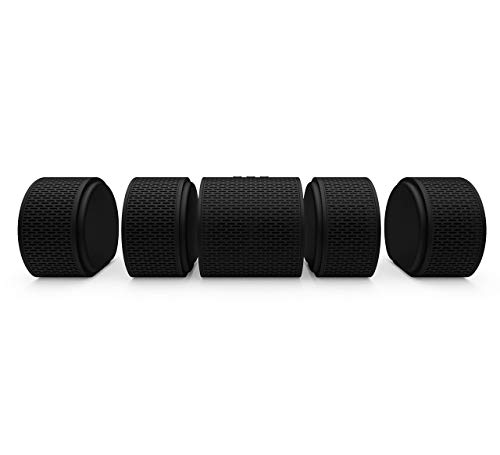
Pros
- Magnetic auto-sync makes splitting and recombining effortless with zero app setup
- Genuine physical stereo soundstaging across up to five separate satellite placements
- Sleek and lightweight cylindrical body travels easily between rooms or outdoor patios
- IPX4 splash-resistant build safely handles bathroom humidity and outdoor mist
Cons
- Frequency response bottoms out around 88Hz, lacking deep sub-bass impact
- IPX4 rating protects against water splashes but cannot withstand full submersion
- Individual satellite outputs are modest when dispersed across large, open outdoor spaces
The Hover-1 Air Audio redefines versatile home audio with an inventive pull-apart architecture that transforms from a single sound cylinder into five distinct satellite speakers. Engineered for apartment dwellers, patio entertainers, and everyday listeners, it removes the clutter of typical multi-room audio installations. Instead of configuring complicated Wi-Fi mesh networks or syncing third-party mobile applications, this speaker relies on integrated magnetic contacts that link the satellites together instantly.
In real-world use, this modular construction changes how you experience casual background audio and dinner music. You can keep the unit assembled as a centralized 24-watt soundbar for a focused soundstage, or detach the magnetic units and scatter them around your kitchen, living room, and deck to keep the tunes playing seamlessly as you move around. The lack of software friction is refreshing, allowing any standard Bluetooth playback source to broadcast simultaneously across all separated modules without lag or dropped connections.
While individual satellite modules are tuned for ambient coverage rather than high-decibel outdoor parties, their ability to create true spatial separation is remarkably effective indoors. If you love clever engineering, minimal setup times, and adaptable soundscapes for social gatherings, the Air Audio delivers unmatched versatility that standard single-enclosure speakers simply cannot replicate.
When unified into a single chassis, the speaker combines its drivers to generate 24 watts of power, producing a well-balanced acoustic signature focused on clear mids and clean highs. The AirBase driver operates across an 88Hz to 17kHz frequency range, providing crisp vocal articulation for podcasts and acoustic tracks. While you will not feel bone-rattling sub-bass on heavy electronic or hip-hop tracks, the low-end remains tight and punchy without distorting upper-register details at medium-to-high volumes.
The true performance standout is the channel separation. By physically pulling the magnetized satellites apart, you achieve authentic physical stereo staging that artificial digital signal processing cannot mimic. Bluetooth wireless transmission remains stable throughout typical indoor footprints, maintaining synchronization across the dispersed satellites without audio drift or annoying echo effects.
Sporting a minimalist cylindrical silhouette finished in sleek black, the speaker measures 12.5 inches in length and weighs a manageable 2.6 pounds. Built with IPX4 water resistance, the chassis safely shrugs off errant water drops, bathroom humidity during hot showers, and surprise rain drizzles on the patio. Its magnetic docking mechanisms are surprisingly robust, snapping together with a tactile, satisfying click that feels engineered to survive repeated daily use.
Charging and power distribution are simplified via internal contacts when the device is assembled as one column. USB charging ensures you can easily juice up the entire array from standard power banks or wall adapters. For weekend hangouts or moving from room to room through a normal workday, the battery supply provides reliable cord-free playback, though keeping the satellites docked together maximizes overall stamina for all five internal cells.
Converting Traditional Speakers to Wireless Audio Systems
Direct Identification of Active Versus Passive Speaker Cabinets
Determining whether your cabinet is active or passive represents the most crucial first step before purchasing any wireless adapter hardware. Active speakers, commonly recognized as powered monitors or computer speakers, contain their own built-in electrical amplifiers and require a dedicated connection to an AC wall outlet. Because internal amplification is already present inside the cabinet, these units only require an external Bluetooth audio receiver to receive digital streams from your phone. You simply feed line-level audio into the existing 3.5mm auxiliary or RCA stereo ports on the back panel.
Passive speakers, by contrast, contain no internal power circuitry and rely entirely on amplified electrical current delivered through raw two-conductor copper speaker wire. Traditional stereo towers, bookshelf cabinets, and vintage surround sound units almost universally fall into this passive hardware category. Connecting a basic line-level Bluetooth receiver directly to passive binding posts results in absolute silence because the incoming audio lacks sufficient wattage to drive the physical cones. Converting these traditional passive enclosures requires an external mini-amplifier equipped with built-in Bluetooth reception to both receive wireless data and power the drivers.
Method 1: Connecting a Bluetooth Audio Receiver to Powered Speakers
Converting powered active speakers into a convenient wireless listening setup is remarkably quick and straightforward. You need a dedicated Bluetooth audio receiver equipped with standard analog line outputs, such as a 3.5mm stereo jack or dual red-and-white RCA jacks. Using an appropriate patch cable, connect the audio output of the receiver puck directly into the auxiliary line input of your powered speaker. This physical pathway allows the external receiver to translate digital Bluetooth data into an analog signal that the speaker internal amplifier can reproduce.
Powering the external wireless receiver typically requires a standard 5V USB connection running from a basic wall charger or an existing USB accessory port. Once connected to power, holding the dedicated pairing button for several seconds places the adapter into discovery mode. A rapid flashing LED indicator light generally confirms that the receiver is actively broadcasting its wireless identity to nearby devices. Keeping the adapter within clear line of sight helps avoid premature signal drops during initial pairing attempts.
Completing the wireless connection requires opening the Bluetooth settings menu on your smartphone, tablet, or computer and selecting the adapter name. Once paired, the status LED light typically transitions from a rapid blink to a solid illumination pattern to confirm a stable link. Audio played on your mobile device now streams wirelessly through the receiver and emerges directly from your powered monitors. Setting your mobile source volume to roughly eighty percent ensures clean signal output while letting the physical speaker knob manage room volume.
Method 2: Adding a Compact Wireless Amplifier to Passive Speakers
Transforming passive speaker cabinets into a wireless sound system requires providing both audio reception and dedicated amplification wattage. Compact desktop Bluetooth amplifiers consolidate these requirements into a small chassis, integrating a wireless receiver chip directly alongside a digital amplifier board. These compact units receive wireless audio streams from your mobile phone and drive the speaker voice coils through rear-mounted binding posts. This modern approach lets you preserve high-quality vintage acoustic cabinets without keeping massive stereo receivers on display.
Connecting passive cabinets to your wireless amplifier involves stripping a half-inch of protective insulation from standard two-conductor speaker wire. The positive lead, typically identified by an embossed stripe or colored thread, connects securely to the red positive terminal on both the amplifier and the speaker cabinet. Matching the negative lead to the black negative terminal ensures correct acoustic phase alignment, preventing hollow sound and diminished bass performance. Ensuring that no stray copper wire strands touch adjacent terminals protects the amplifier circuitry from direct electrical short circuits.
Arranging your dual speaker setup methods with proper stereo channel separation creates an expansive soundstage across your listening environment. Once your physical speaker wires are firmly clamped into the binding posts, connect the dedicated DC power brick to the amplifier chassis. Toggling the power switch and selecting Bluetooth input mode initiates wireless discovery, allowing your phone to connect within seconds. This configuration delivers robust amplification to traditional passive drivers while providing all the streaming convenience of modern portable electronics.
Selecting the Right Audio Cables and Adapter Plugs
Choosing proper interconnect cables ensures that your converted wireless audio system delivers clear acoustic performance without signal degradation. When connecting a Bluetooth receiver to powered active speakers, a shielded 3.5mm to dual RCA stereo cable provides reliable analog signal transfer. Gold-plated connectors help prevent surface corrosion, ensuring clean electrical contact over years of continuous household use. Keeping analog patch cables relatively short minimizes susceptibility to stray electromagnetic interference from nearby power strips.
Selecting speaker wire for passive cabinet conversions requires matching conductor thickness to the distance between the amplifier and the speakers. Standard 16 AWG oxygen-free copper wire works exceptionally well for short runs under thirty feet, providing low electrical resistance for clean power delivery. Longer cable runs across larger living spaces or outdoor patios benefit from thicker 14 AWG wire to prevent signal loss. Terminating raw wire ends with gold-plated banana plugs offers convenience when plugging into five-way amplifier binding posts.
Signal Stability, Bluetooth Standards, and Line-of-Sight Range
Wireless transmission reliability depends fundamentally on the specific Bluetooth generation built into your chosen adapter or wireless hardware. Modern revisions such as Bluetooth 5.0 and Bluetooth 5.3 provide enhanced data throughput, reduced power consumption, and improved resistance to radio frequency interference. While older wireless protocols frequently dropped connections when someone walked across the room, newer standards maintain solid links across thirty to one hundred feet. Choosing modern adapter chips guarantees a stable audio stream during social gatherings and daily household chores.
Physical obstacles like dense brick walls, metal studs, and kitchen appliances can quickly degrade high-frequency 2.4 GHz wireless radio signals. Elevating your wireless adapter on an open shelf rather than hiding it behind metal chassis components preserves maximum signal strength. If you intend to stream music to speakers located on an outdoor deck, positioning the receiver near a window preserves clean line-of-sight transmission. Avoiding dense physical barriers maintains steady audio playback and prevents frustrating pauses during playback.
Eliminating Audio Latency and Ground Loop Interference
Unwanted buzzing sounds represent a frequent annoyance when powering external Bluetooth receivers from shared electrical circuits. This low-pitched hum, commonly known as a ground loop, develops when the wireless receiver and powered speakers share a common electrical ground path. Inserting a compact passive ground loop noise isolator directly between the receiver output and the speaker input filters out the hum instantly. The internal isolation transformers decouple the electrical grounds while allowing the analog audio frequencies to pass through cleanly.
Audio latency poses another common issue when utilizing converted wireless speakers for television broadcasts or streaming video content. Standard Bluetooth audio transmission introduces a slight processing delay that can cause speech dialogue to fall out of sync with onscreen video. Selecting wireless receivers that support specialized low-latency audio codecs compresses transmission delay down to imperceptible levels. For pure music listening, transmission latency remains irrelevant, but synchronized multimedia entertainment benefits noticeably from low-latency adapter hardware.
Retrofitting Existing Cabinets Versus Purpose-Built Wireless Speakers
Retrofitting traditional speakers makes practical sense when you already own acoustically satisfying wooden cabinets, but modern purpose-built wireless speakers offer distinct functional advantages. Standalone portable systems incorporate integrated rechargeable battery packs, freeing listeners from wall outlets and stationary power supplies. For example, high-output portable units like the TENMIYA A30 feature an 8000 mAh rechargeable battery alongside a 2.2-channel acoustic layout with dual tweeters and subwoofers. These self-contained units provide convenient grab-and-go sound that converted living room speakers simply cannot match outdoors.
Outdoor weatherproofing represents another critical area where dedicated modern speakers dramatically outperform converted indoor cabinets. Traditional home audio speakers feature delicate paper cones and untreated wooden enclosures that degrade quickly when exposed to moisture or morning dew. In contrast, durable outdoor designs like the BolaButty wireless speaker feature IPX5 water resistance to handle splashes and adverse weather conditions. Modern portable systems also frequently incorporate True Wireless Stereo pairing, allowing two distinct battery-powered units to sync wirelessly without trailing physical speaker wires across the lawn.
Specialized listening situations also benefit from alternative wireless connection methods that bypass standard Bluetooth pairing menus entirely. Induction models like the BOLONMI wireless induction speaker amplify audio instantly simply by placing your phone on the integrated stand, avoiding wireless discovery menus completely. Other modular configurations, such as the Hover-1 Air Audio system, feature pull-apart magnetic speaker sections that separate into distinct multi-room audio units. Deciding whether to convert an existing cabinet or purchase a dedicated portable wireless speaker depends on whether your main priority is stationary audio fidelity or rugged outdoor portability.
Troubleshooting Connection Drops and Multi-Device Contention
Unexpected connection dropouts often occur when multiple previously paired mobile devices compete for control of a single wireless receiver. Most basic Bluetooth adapters automatically reconnect to the first recognized signal within range, preventing new source devices from establishing a link. If a family tablet or secondary phone connects silently in the background, your primary phone will fail to connect. Toggling Bluetooth off on surrounding devices or performing a quick memory clear on the receiver restores proper single-device pairing.
Auxiliary input override switches can also disrupt wireless streaming unexpectedly on certain audio adapters and speakers. Many multi-input speakers feature physical sensing switches inside the 3.5mm auxiliary jack that automatically mute the wireless Bluetooth receiver whenever a cable is detected. If a disconnected auxiliary patch cord remains inserted in the jack, the speaker may silence wireless audio playback completely. Removing unused patch cords ensures that the internal audio processor routes the incoming wireless stream directly to the amplifier.
Smartphone operating system caching glitches can occasionally cause wireless discovery failures even when the receiver is broadcasting normally. Toggling your phone airplane mode on and off resets the mobile device wireless radio stack within seconds. If connection instability persists, deleting the receiver from your phone saved Bluetooth list and initiating a fresh discovery scan clears corrupted pairing data. Power cycling the external receiver at the same time ensures both units complete a fresh handshake without legacy connection errors.
Practical Maintenance and Power Management for Converted Audio Systems
Maintaining a converted wireless audio setup requires keeping power supplies properly ventilated and cables securely organized. Compact digital amplifiers generate modest heat during extended high-volume listening sessions, so maintaining clear airflow around the chassis prevents thermal throttling. Using dedicated surge protector strips shields sensitive receiver microchips from household electrical spikes during sudden storms. Periodic inspection of RCA plugs and raw wire terminals prevents surface oxidation from muffling high-frequency audio detail.
Powering down external wireless adapters when they are not actively playing music minimizes unnecessary standby power consumption. While modern Bluetooth receivers consume minimal electricity, turning them off prevents mobile devices from auto-connecting whenever you walk past the room. Switching off the primary power strip also protects delicate passive speaker voice coils from sudden electrical thumps during power outages. Simple power management habits extend the operational lifespan of both your modern wireless adapters and your traditional speaker cabinets.
Operational Verification for Balanced Sound Quality
Establishing proper gain staging across your converted audio chain ensures clear music reproduction free from audible distortion or hiss. Setting your transmitting smartphone or tablet output volume to approximately seventy-five to eighty percent delivers a clean line-level signal to the receiver. You can then use the physical volume dial on your powered speaker or mini-amplifier to control actual room listening volume. This balanced structure keeps background amplifier hiss low while preventing the digital source from clipping during dynamic musical passages.
Testing automatic reconnection behavior confirms that your wireless conversion setup is stable and ready for daily listening. Walking out of range until the connection breaks, then returning to the room should trigger an automatic wireless handshake within seconds. Once the receiver status LED confirms a solid link, streaming audio should resume smoothly with a single tap on your screen. Converting normal speakers to wireless streaming preserves beloved acoustic hardware while delivering all the cable-free convenience of modern audio entertainment.



Write Your Review
No reviews yet. Be the first to share your experience!