


Setting up a home audio desk, entertainment center, or stereo listening station often brings up practical questions about signal paths and required audio components. Listeners upgrading from traditional component systems frequently wonder whether do active speakers need a preamp to deliver balanced, room-filling sound. Because active speakers contain internal power amplifiers matched directly to their drivers, they operate differently from passive cabinets that depend on a separate audio receiver.
For most standard playback sources like media players, digital converters, and computers, active cabinets accept normal line-level signals directly without an external preamplification box. However, specific configurations, such as connecting an analog vinyl turntable or managing multiple sources, introduce distinct hardware requirements. Exploring modern powered loudspeaker options shows how integrated amplification has streamlined modern listening systems while eliminating the need for bulky equipment stacks.
Pros
- Broad connectivity suite including optical, RCA, 3.5mm AUX, and Bluetooth
- Acoustically tuned wooden cabinets minimize distortion and vibration
- Clear dialogue reproduction with detailed midrange clarity
- Simple plug-and-play active setup requires no external amplifier
Cons
- Lacks a dedicated subwoofer output for extreme sub-bass expansion
- 4-inch drivers naturally roll off in deep sub-bass registers below 50Hz
- Bluetooth connectivity utilizes standard SBC audio codecs
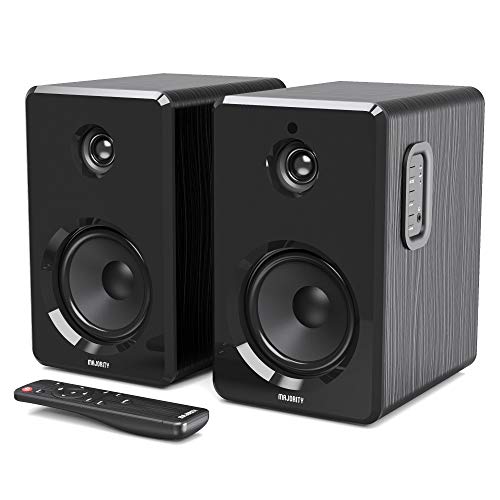
The Majority D40 Active Bookshelf Speakers represent an accessible yet capable entry point into dedicated stereo sound. Engineered in Cambridge, UK, this powered 2.0 speaker pair eliminates the need for bulky external receivers, packing robust amplification directly into the primary unit. Whether positioned beside a desktop monitor, nestled into an entertainment center, or wired to a vinyl turntable, the D40 focuses on clean utility and direct audio fidelity.
In everyday use, the D40 shines by resolving one of the biggest issues in modern entertainment: flat, muffled audio from built-in monitor and television speakers. Dialogue in movies and podcasts comes through with distinct separation, while background instrumentation remains crisp. Gamers and home office professionals will appreciate the instant plug-and-play integration, switching effortlessly between a hardwired optical connection from a PC and a quick Bluetooth pairing with a smartphone.
While low-frequency enthusiasts will find the bass constrained by the physical limits of 4-inch drivers, the system never sounds thin or hollow. The sound profile remains warm and approachable across various musical genres, from acoustic arrangements to electronic pop. For shoppers looking to bypass flimsy soundbars and step into true stereo imaging with expansive connectivity options, the Majority D40 stands out as a dependable, value-driven sound solution.
Acoustically, the Majority D40 relies on a balanced two-way design anchored by a 4-inch bass driver in each cabinet. Delivering up to 60 watts of total amplified output, the pair generates enough acoustic pressure to fill bedrooms, dorms, and standard home offices with vibrant audio. High frequencies are smooth and avoid the harsh sibilance common in low-cost active monitors, ensuring listener fatigue stays low during extended listening sessions.
Midrange reproduction is the true strength of these speakers, providing vocalists and spoken dialogue with commendable presence and body. Bass output is punchy and nimble, handling kick drums and basslines with decent rhythm and timing. True sub-bass rumble is naturally tempered by the compact cabinet volume, but the low-end performance remains tight and musical rather than muddy, producing a cohesive soundstage that single-box speakers cannot duplicate.
The Majority D40 speakers feature a classic studio monitor aesthetic crafted with dense wooden enclosures finished in sleek matte black. Measuring roughly 5.4 inches wide by 7.1 inches deep and 8.8 inches high, the cabinets occupy minimal surface area while maintaining the structural rigidity needed to prevent internal standing waves and unwanted vibrations. The left passive monitor connects directly to the right active master unit using the included speaker cable.
Hardware flexibility is exceptionally broad for a speaker of this class. The rear panel provides an optical input for digital TV connections, stereo RCA jacks, and a 3.5mm AUX input. For standalone playback, dedicated USB and SD card slots decode MP3 files directly. Wireless streaming is handled via dependable Bluetooth, while everyday operations are managed through either the side-mounted control buttons or the included wireless remote control.

Pros
- Plug-and-play vinyl setup thanks to the built-in phono stage and dedicated ground post
- Remarkable vocal clarity and stereo imaging for compact desktop or bookshelf placement
- Extensive physical and wireless connectivity including dual optical inputs and aptX Bluetooth
- Subwoofer output allows seamless integration with a powered sub for low-end expansion
Cons
- Compact 4-inch woofers roll off sub-bass, requiring an external subwoofer for deep low-end rumble
- Gloss black finish easily shows dust, smudges, and fingerprints
- Infrared remote sensor has a somewhat narrow reception angle
The Kanto YU4 powered bookshelf speakers are engineered to serve as a versatile acoustic hub for music lovers who demand high fidelity in a compact footprint. Designed specifically for vinyl record collectors, desktop audiophiles, and living room listeners alike, these active monitors eliminate the clutter of separate stereo receivers by packing Class D amplification and premium acoustic components directly inside the cabinet.
Setup is remarkably straightforward regardless of your audio sources. Vinyl enthusiasts will appreciate the built-in phono preamplifier, which allows direct connection to any turntable lacking an integrated preamp via standard RCA cables and a grounding lug. For modern digital workflows, dual optical inputs simplify connections to gaming consoles or flat-screen televisions, while aptX Bluetooth ensures high-resolution streaming from smartphones and laptops.
In real-world testing, the YU4 demonstrates an agile, transparent sonic presentation. Instruments and vocals sit prominently in the mix with impressive separation, avoiding the muffled or boomy characteristics common in mass-market computer speakers. While the compact physical cabinet limits visceral low-frequency sub-bass impact, the bass remains articulate, fast, and musical across jazz, rock, and electronic genres.
Ultimately, the Kanto YU4 stands out as a polished, all-in-one stereo solution. It expertly bridges the gap between retro analog vinyl playback and modern digital streaming, delivering an expressive, hi-fi listening experience tailored to bedrooms, offices, and small living spaces.
Acoustic performance in the Kanto YU4 is driven by custom 4-inch Kevlar woofers paired with 1-inch silk dome tweeters, powered by an internal Class D amplifier delivering 140 watts of peak power (70 watts RMS total). The Kevlar composition offers exceptional rigidity and damping, allowing the woofer to maintain linear motion without breakup, resulting in accurate mid-bass impact and exceptionally clean vocal reproduction.
The high frequencies are smooth and detailed, courtesy of the silk dome tweeters. High-hat strikes, acoustic guitar plucks, and vocal sibilants are reproduced with crisp sparkle that avoids the harshness or listening fatigue often associated with metal dome alternatives. The frequency response remains tight and cohesive down to roughly 60 Hz. While it will not replicate bone-shaking subterranean bass on its own, Kanto thoughtfully included a dedicated active subwoofer output with an automatic low-pass filter to easily augment the bottom octave.
Soundstage projection and stereo imaging are standout highlights. When positioned properly on desktop stands or speaker pads, the YU4 throws a wide, coherent sound field with pinpoint instrument localization. Even at higher volume levels, the amplifier holds distortion to a bare minimum, effortlessly filling small to medium rooms with dynamic, room-filling sound.
Constructed from acoustic-grade MDF, the cabinets are engineered to minimize internal resonance and eliminate unwanted coloration. Measuring 5.5 inches wide, 7.5 inches deep, and 8.7 inches high, each speaker presents a clean, minimalist profile that fits naturally on study desks, media consoles, or dedicated speaker stands. The gloss black finish provides an elegant, modern aesthetic that complements contemporary interior decor.
Hardware versatility is one of the YU4's strongest assets. The rear panel of the active master speaker features a switchable RCA line/phono input with a ground terminal, a 3.5mm stereo auxiliary jack, and two optical TOSLINK inputs capable of handling 24-bit/96kHz digital signals. Wireless connectivity is powered by Bluetooth with Qualcomm aptX codec support for lower latency and superior streaming bitrates. A convenient 5V USB charging port is also included to keep source devices powered during extended sessions.
Operational hardware includes an intuitive front-panel control knob that toggles power, switches inputs, and adjusts volume. The system also features automatic standby and power-up modes to conserve energy when no audio signal is detected. The included infrared remote control grants granular command over balance settings as well as dedicated bass and treble tone controls, enabling quick acoustic tailoring to match any room environment.

Pros
- Transparent lossless audio performance
- High-end ALPS A50K potentiometer for precise control
- Superior US CMC-816U gold RCA connectors
- Stylish full aluminum build
- Easy plug-and-play compatibility
Cons
- No built-in gain limits use to high-output sources
- RCA inputs and outputs only, no digital connectivity
- Basic design lacks remote or extra features
The Nobsound High Precision Passive Preamp is a no-frills volume controller crafted for audiophiles prioritizing audio purity in HiFi systems. It connects between high-output sources like DACs, CD players, or PC sound cards and active speakers or power amplifiers, using only standard RCA inputs and outputs with a single volume knob.
This preamp suits dedicated listeners building clean signal chains, avoiding active circuits that could color sound. Its passive nature ensures it works best with sources that already provide ample signal strength, making it ideal for refined home audio setups where every detail matters.
In real-world use, it shines by delivering uncompromised sound straight from the source, with the ALPS potentiometer offering smooth, accurate adjustments free of stepping or imbalance. The gold-plated RCA terminals maintain signal integrity, resulting in detailed, fatigue-free listening sessions.
Overall, the Nobsound stands out for its focus on essentials, providing exceptional value for those chasing transparent HiFi performance without gimmicks. Verdict: a must-have upgrade for pure audio paths.
The passive design guarantees lossless audio transmission, passing your source's signal without any added noise, gain, or distortion for a completely neutral sound signature that lets your equipment's true character shine through.
The high-quality ALPS A50K dual potentiometer delivers precise, smooth volume control across the full range, maintaining balance between channels even at low levels and ensuring optimal dynamics without harshness.
With superior RCA terminals minimizing losses, expect crystal-clear highs, articulate mids, and controlled bass response as captured by your DAC or player, supporting high-volume listening without fatigue or imbalance.
Housed in a premium CNC-machined full aluminum alloy chassis, this preamp offers a sleek, professional aesthetic that elevates any HiFi rack while providing solid durability against everyday handling.
Its compact, lightweight form factor enhances portability, allowing easy repositioning in tight spaces or transport between systems without bulk or hassle.
Fully passive with no power requirements, it eliminates battery concerns entirely, offering infinite runtime without charging and unmatched reliability for continuous HiFi operation.
Understanding Active Speaker Architecture and Preamplifier Requirements
Active speaker systems simplify home audio setups by housing internal power amplification directly inside the speaker cabinet. For most listening environments, the answer to whether do active speakers need a preamp is generally no when connecting standard line-level audio components. Devices like computers, media streamers, CD players, television optical ports, and mobile devices already provide sufficient signal voltage for internal amplifiers. Still, specific playback sources and physical control preferences introduce notable exceptions that determine whether adding external hardware makes sense for your setup.
How Built-in Amplification Handles Line-Level Signals
Traditional component audio systems separate playback into three distinct stages: source playback, preamplification, and power amplification. A standalone preamplifier manages input switching, volume regulation, and signal buffering before sending line-level voltage to an external power amplifier. In an active speaker, internal circuit boards handle these tasks before directing sound to the drivers. Because active designs frequently incorporate dedicated crossovers for each driver, incoming line signals are routed cleanly without passive crossover signal loss.
Standard consumer audio sources output nominal line-level voltage between zero point three volts and two volts. The Majority D40 Active Bookshelf Speakers illustrate this approach by integrating internal amplification rated at sixty watts total sound output alongside diverse inputs. When a source connects through the RCA, optical, or auxiliary jacks, the internal circuit amplifies the signal to drive the four-inch bass drivers directly. Adding an external preamplifier between a line-level device and this type of powered speaker is redundant.
Listeners looking for straightforward desktop audio often discover that self-powered monitors eliminate bulky component stacks. When integrating desktop Bluetooth speakers for computer setups, direct cabling or wireless pairing delivers full dynamic range without intermediary hardware. Eliminating extra boxes from the signal path reduces the likelihood of background hum or cable-induced electrical interference. Direct connection remains the standard recommended approach for active speakers unless a specific input voltage deficiency exists.
The Critical Exception: Turntables and Phono Preamp Requirements
The most prominent exception to the general rule involves vinyl records and turntable audio playback. Turntable phono cartridges produce a tiny electrical signal measured in millivolts, which is far too weak for standard line inputs. In addition, vinyl records are pressed with attenuated low frequencies and boosted high frequencies according to the standardized RIAA equalization curve. A dedicated phono preamplifier is necessary to apply the corrective equalization curve and amplify the delicate phono voltage to line-level strength.
Connecting a basic turntable lacking an internal phono stage to a standard auxiliary input produces faint, tinny audio devoid of bass. Active speakers that feature dedicated phono stages solve this problem internally without requiring separate component boxes on your shelf. For instance, the Kanto YU4GB Powered Speakers with Bluetooth include a built-in phono preamplifier alongside a physical selector switch that alternates between phono and line inputs. When set to phono mode, the speaker internally amplifies the cartridge voltage for direct turntable playback.
Conversely, if an active speaker only provides standard line inputs, the user must verify whether their turntable houses an internal phono preamplifier or purchase an external phono box. Connecting a turntable with an enabled phono preamp into a speaker input that also has an active phono stage results in severe distortion and potential overload. Managing this distinction between phono-level signals and standard line-level signals represents the most common reason listeners research preamplifiers for powered speakers.
When a Volume Controller or Passive Preamp Makes Practical Sense
While active speakers do not need an active preamp for electrical gain, an external passive preamplifier or volume controller provides valuable ergonomic benefits. Many dedicated studio monitors place their primary volume knobs on the rear panel of each independent cabinet. Reaching behind two separate speakers to balance levels during everyday listening quickly becomes tedious. A compact passive preamplifier placed on the desktop solves this issue by providing a single master volume control right at your fingertips.
Unlike active preamplifiers, passive units do not plug into a wall outlet and do not add voltage gain or coloration to the audio path. The Nobsound High Precision Passive Preamp Volume serves as an example of this category, utilizing an ALPS dual potentiometer to deliver smooth volume adjustments without requiring an internal power supply. This type of passive volume control sits between a high-output audio source and the active speaker input. The passive device attenuates the signal losslessly without introducing hiss.
Passive preamps also offer physical durability and stable channel tracking across lower listening levels. Equipped with quality RCA connectors and aluminum chassis construction, these controllers help listeners bypass noisy digital volume sliders inside operating systems. Reducing audio levels digitally inside computer software can occasionally compromise dynamic resolution at whisper-quiet volumes. A tactile analog volume controller preserves maximum bit depth from your converter while giving you immediate physical control over speaker output.
Input Types and Source Switching on Modern Powered Systems
Modern active speakers increasingly function as complete sound hubs by integrating multiple wired and wireless input options. In traditional audio systems, an external preamplifier served primarily as an input selector box allowing users to switch between multiple sources. Modern powered speakers frequently eliminate this need by offering integrated selector buttons or wireless remote controls. With onboard digital and analog switching, a single pair of speakers can handle multiple household entertainment sources simultaneously.
Active speakers often combine optical digital connections for television audio, analog RCA inputs for legacy players, and three point five millimeter jacks for portable devices. The Majority D40 demonstrates this input versatility by supporting optical, RCA, USB playback, and Bluetooth wireless streaming within a single powered wooden enclosure. Users can connect a television through the optical port while leaving a media player wired to the analog terminals. A listener can toggle between these sources using the included handheld remote control without needing an external routing switcher.
Wireless connectivity further reduces the necessity for outboard switching components. The inclusion of Bluetooth on powered monitors like the Kanto YU4GB allows smartphones and tablets to stream directly to the speakers using advanced audio codecs. For listeners who enjoy diverse multimedia sources throughout the home, exploring budget-friendly wireless speakers highlights how digital receivers and amplifiers are now routinely consolidated into compact enclosures. When an active speaker natively accommodates your preferred input types, adding an outboard preamplifier simply adds unnecessary cable clutter.
Proper Gain Staging to Prevent Distortion and Background Hiss
Gain staging refers to the process of managing relative audio levels at each sequential point in an audio signal chain. Understanding gain staging is vital when determining whether to place any preamplification equipment in front of active speakers. Every active component in an audio system introduces a tiny amount of inherent electrical noise known as the noise floor. When you cascade multiple active preamplifiers together unnecessarily, you amplify that background noise along with the music, resulting in audible hiss during quiet passages.
Feeding an already amplified, high-level signal into an active speaker’s sensitive analog input can cause the input stage to become saturated and clip. Clipping generates harsh, fatiguing harmonic distortion that robs music of its detail and can stress speaker drivers at high volumes. To maintain clean audio, the primary source device should output a clean, standard line-level voltage while the active speaker handles final amplification. If an active external preamplifier is used, its output volume must be calibrated carefully to avoid overdriving the speaker.
Achieving the cleanest signal-to-noise ratio usually involves setting digital software volume sliders near eighty to one hundred percent and using the speaker’s physical volume control for adjustments. This practice ensures the digital-to-analog converter operates with maximum signal resolution and minimal quantization artifacts. When an external passive volume control like the Nobsound unit is introduced, keep the speaker’s internal amplifier set to a moderate level that prevents resting hiss. Adjusting the passive attenuator provides smooth volume swings without introducing extra electronic gain stages.
Step-by-Step Audio Connection and Verification Sequence
Connecting an active speaker system correctly ensures reliable sound reproduction and protects sensitive audio components from transient electrical pops. Begin by ensuring that the power switches on both the active speakers and your source devices are set to the off position. Placing the power switch in the off position prevents unexpected static bursts or voltage spikes that can occur when inserting audio plugs into live jacks. Position the speakers on a stable desk, stand, or shelf, paying attention to rear port clearance.
Next, inspect the output jacks of your source component and select the appropriate shielded interconnect cables. If connecting a standard line-level device, run quality RCA or three point five millimeter cables from the source output to the corresponding input on the active master speaker. For vinyl enthusiasts utilizing a turntable, verify whether the turntable or speaker switch is set to phono or line mode before connecting cables. If using an external volume controller, run source outputs into the controller and connect controller outputs to speaker inputs.
Once all interconnect cables and the speaker wire between left and right channels are firmly seated, connect the power cables to an electrical outlet. Before powering on the hardware, turn the master volume knob on the active speaker or external controller fully counter-clockwise to zero. Power on your source device first, allow it to stabilize, and then switch on the active speakers. Begin audio playback on the source, select the corresponding input mode on the speaker, and slowly raise the volume knob to confirm clean stereo reproduction.
Troubleshooting Low Volume, Buzz, and Signal Mismatches
When an active speaker setup produces unexpected sound issues, a systematic troubleshooting approach quickly isolates the underlying cause. If you experience unexpectedly low volume where sound remains quiet despite turning the speaker up, check the source output configuration first. Turntables connected to standard line inputs without an active phono stage produce very low volume and lack bass. If your speaker features an integrated phono switch, such as the setting on the Kanto YU4GB, verify that the switch is toggled to phono for direct turntable connection.
If the audio exhibits a low-frequency hum or buzzing sound, you may be encountering an electrical ground loop. Ground loops typically arise when source devices and powered speakers are plugged into separate wall outlets with slight differences in ground potential. Plugging all interconnected audio equipment into the same quality surge protector or power strip frequently eliminates grounding hum. For turntables, ensure the separate grounding spade wire is securely fastened to the grounding post on the phono preamp or speaker chassis.
Distorted audio at moderate listening volumes points toward an input overload or an improper connection type. Never plug a speaker-level output from an external power amplifier or receiver into an active speaker’s line-level inputs. Doing so delivers excessive electrical voltage that can severely damage internal amplifier circuitry and distort sound reproduction. If Bluetooth audio cuts out or sounds compressed, inspect physical distance, clear line-of-sight obstructions, and confirm that your mobile device has battery-saver audio limits disabled.
Deciding Whether Your Current Setup Needs Extra Hardware
Evaluating your listening environment and source components helps determine whether your active speaker system requires any additional gear. For straightforward setups consisting of a computer, television, gaming console, or streaming box, active speakers provide everything needed in a self-contained package. Models like the Majority D40 prove that a single powered stereo pair can manage multiple digital and analog sources effortlessly without external assistance. If your primary goal is uncomplicated multimedia playback, you can connect your sources directly and enjoy dynamic, room-filling sound.
Conversely, you should invest in an external preamplifier or specialized controller only when specific functional gaps exist in your playback chain. If you spin vinyl on a turntable that lacks an internal preamp and your active speakers lack a built-in phono stage, a dedicated phono preamplifier is an essential purchase. If you use powered studio monitors with awkward rear-mounted volume dials, a passive desktop controller provides valuable physical convenience without degrading audio fidelity. If you need to switch between half a dozen legacy analog sources, an outboard preamplifier or input selector switch offers needed connectivity.
Matching your source requirements directly against the built-in capabilities of your active speakers prevents spending money on redundant equipment. Modern powered speaker engineering has consolidated amplification, equalization, and source selection into remarkably capable, user-friendly cabinets. Taking stock of your input types, verifying signal voltages, and confirming control access ensures you achieve pristine audio performance with minimal complexity.




Write Your Review
No reviews yet. Be the first to share your experience!