


Setting up an immersive surround sound system often leads home theater owners to wonder whether can any speakers be used for dolby atmos or if dedicated hardware is mandatory. Traditional surround setups rely on listener-level placement, but modern three-dimensional audio formats introduce an overhead soundstage that fundamentally changes how audio channels distribute sound. While traditional stereo loudspeakers focus on direct horizontal radiation toward the listening position, height-based soundtracks require specific acoustic delivery to replicate overhead sound effects properly. Understanding the role of your audio equipment helps prevent costly mistakes while building an expansive home cinema environment.
The reality of three-dimensional audio involves two distinct components: the processing power inside your multi-channel audio receiver and the physical dispersion behavior of your height drivers. Standard passive speakers can indeed reproduce overhead signal tracks when mounted directly to a ceiling or positioned high on a wall as height channels. However, attempting to use standard bookshelf models as upward-firing bounce modules without specialized filtering creates phase issues and muddy sound. Taking time to evaluate channel routing, amplifier power, and driver orientation ensures you achieve convincing spatial immersion across every movie scene.

Pros
- Exceptional clarity and dynamics from hybrid Tractrix horn technology
- Versatile setup for both Dolby Atmos elevation and surround duties
- Durable, premium build with cerametallic woofers resisting cone breakup
- Precise on-wall mounting for perfect height channel placement
- High sensitivity for efficient pairing with most AV receivers
Cons
- Requires a compatible AV receiver for power and processing
- Keyhole mounting limits options without additional hardware
- Best results demand careful room calibration for Atmos effects
The Klipsch RP-500SA are a pair of premium Dolby Atmos-enabled surround speakers designed to elevate your home theater experience. Featuring 1-inch titanium LTS vented tweeters with hybrid Tractrix horns and 5.25-inch spun copper cerametallic woofers, they deliver the brand's signature lively sound with precise imaging and dynamic range.
Perfect for cinephiles and gamers wanting true overhead sound effects in compatible systems, these speakers shine in multi-channel setups. The switchable crossover allows flexible use as elevation modules for Atmos or traditional surrounds, making them versatile for various room sizes.
In real-world performance, they excel at creating a three-dimensional soundstage, with explosive effects raining down during action scenes and clear dialogue anchoring the mix. While they need an AV receiver to thrive, their efficiency ensures compatibility with everyday amps.
Verdict: A top choice for immersive home audio, offering pro-level detail and impact that transforms ordinary viewing into blockbuster events.
Expect vibrant, detailed highs from the titanium tweeters paired with Tractrix horns, providing wide dispersion and low distortion for crystal-clear vocals and sparkling effects. The cerametallic woofers deliver tight, articulate bass that punches without boominess, ideal for explosive soundtracks.
Volume levels scale effortlessly up to 75-watt handling, filling medium rooms with authority. In Dolby Atmos mode, the switchable crossover ensures seamless integration, placing sounds precisely above the listener for rain, helicopters, or debris in movies.
Performance stability comes from the efficient design, maintaining composure at high volumes without fatigue, though optimal results require a quality receiver for processing and power.
Sleek ebony finish with premium scratch-resistant coating ensures durability in home environments, resisting fingerprints and wear for a high-end look that complements any setup.
Compact design with keyhole mounts allows simple on-wall installation at ear-height or ceiling level, optimizing Atmos elevation without stands. Weighing in at a manageable size for pairs, they blend discreetly yet command presence.
As passive speakers, there's no onboard battery; they draw power from your AV receiver, offering unlimited playback tied to your system's capabilities and eliminating recharge worries for marathon sessions.

Pros
- Clear, undistorted full-range sound from 3.94-inch drivers
- Versatile wall-mounting and compact form factor
- Seamless compatibility with Sony home theater systems
Cons
- Requires compatible Sony AV receiver for power and integration
- Small drivers limit deep bass response
- Best used as height channel add-ons, not standalone mains
The Sony SS-CSEM2 speakers are a pair of Dolby Atmos enabled upfiring height speakers from the 2025 CS series, designed to add vertical sound dimensions to your home theater. With 3.94-inch full-range drivers and reinforced cellular cones, they bounce audio off the ceiling for realistic overhead effects like rain or helicopters in movies.
These are perfect for audio enthusiasts upgrading to immersive Dolby Atmos systems, especially those with Sony AV receivers and matching CS speakers like the SSCS5M2 or SSCS3M2. Their compact, versatile build allows easy placement above your main speakers or on walls, enhancing surround sound without cluttering your space.
In real-world use, they deliver precise height information with minimal distortion, making action scenes and music more engaging. Setup is straightforward with Sony gear, though they rely on your receiver for amplification.
Overall verdict: A smart choice for Sony loyalists building a future-proof home cinema, offering premium sound elevation at a focused price point.
The SS-CSEM2 excels in height channel duties, using upfiring drivers to reflect Dolby Atmos sound accurately from above. The full-range 3.94-inch speakers provide clear vocals and effects with good separation, while the reinforced cellular cone maintains undistorted audio even at moderate volumes.
Bass is light as expected from compact height speakers, focusing instead on midrange clarity and precise spatial imaging for immersive overhead audio. Volume levels scale well within home theater contexts, pairing best with Sony receivers for stable, wired performance without Bluetooth dropouts.
Ideal for movies and gaming where height cues matter, they enhance the soundstage without overpowering mains.
Compact and wall-mountable, the SS-CSEM2 pair measures small enough for discreet placement, with versatile options to angle toward your listening area. Premium componentry gives a sturdy, professional feel suited for permanent home setups.
No battery is needed as these passive speakers draw power from your AV receiver, ensuring reliable, always-on performance without charging concerns. Their lightweight design simplifies installation above doorways or shelves.
Rugged enough for indoor use, they prioritize clean aesthetics and easy integration over portability.
Pros
- Creates true immersive soundstage for cinematic experiences
- Easy wall or stand mounting with standard threaded inserts
- High-quality aluminum dome tweeter for crisp highs
- Solid build quality at a budget-friendly price
- Fully compatible with Atmos-enabled AV receivers
Cons
- Requires wired connection via binding posts to a receiver
- Limited bass depth due to compact 3-inch woofers
- No built-in amplification, needs external power
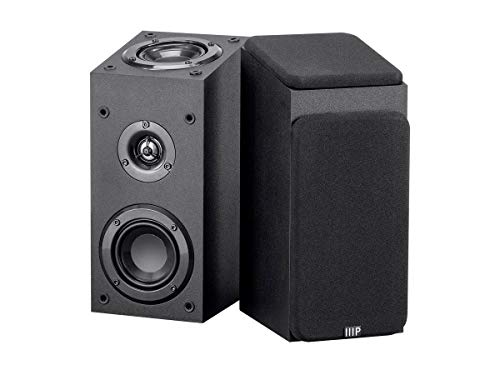
Monoprice Premium Immersive Satellite Speakers are a pair of compact satellites designed to add height channels to your home theater system. Featuring upward-firing 3-inch polypropylene drivers, they bounce sound off your ceiling to simulate overhead effects, fully compatible with Dolby Atmos receivers. No need for complex in-ceiling installations; just mount them and connect.
Ideal for American homeowners upgrading their surround sound setups for movie nights or gaming marathons. At 4.5 x 10.5 x 5.3 inches and just 2.9 pounds each, they blend seamlessly into any room decor. The 3/4-inch aluminum dome tweeter pairs with the woofers for detailed highs and balanced mids.
In real-world use, they transform flat soundtracks into dynamic 3D experiences, making explosions and rain feel overhead. While best with a powerful AV receiver, their 100W power handling and 88dB sensitivity deliver punchy performance. Monoprice's quality control ensures reliability.
Verdict: A smart, affordable choice for immersive home audio without permanent mods. Grab this pair to level up your entertainment space.
These speakers excel in creating an immersive soundfield with their dedicated height drivers, projecting audio upward for ceiling-reflected effects that mimic Dolby Atmos height channels. The 3-inch polypropylene woofers provide solid midbass punch, while the 3/4-inch aluminum dome tweeter delivers clear, sparkling highs for dialogue and effects.
With 100W input power handling and 88dB sensitivity at 8-ohm impedance, they reach high volumes without distortion when paired with a capable receiver. Vocals stay intelligible even in busy scenes, and the 3D imaging makes action films thrilling. Binding post connectors ensure secure, low-loss wired performance.
Best for home theaters where precise surround integration matters; they add depth to soundtracks without overpowering mains.
Sleek black finish and compact dimensions (4.5 x 10.5 x 5.3 inches) make these satellites easy to position on shelves or walls. Universal 1/4"-20 threaded inserts allow versatile mounting with standard brackets or stands, perfect for custom home setups.
At only 2.9 pounds each, they are lightweight yet ruggedly built with Monoprice's strict quality standards. No IP rating as they are indoor speakers, but durable construction handles regular use. As passive speakers, no battery is needed; they draw power directly from your AV receiver.
Setup is straightforward with binding posts for gold-plated banana plugs or bare wire, ensuring long-term reliability backed by warranty.

Pros
- Exceptional height elevation for Dolby Atmos immersion
- Dynamically balanced 4-inch woofer enhances effects clarity
- Built-in keyhole slots for simple wall mounting
- High-resolution audio ready for detailed soundstages
- Seamless integration with Polk Monitor XT series
Cons
- Requires a compatible multi-channel AV receiver
- Wired setup limits wireless flexibility
- Optimized as part of a full surround system
The Polk Monitor XT90 is a pair of height channel speakers designed to bring Dolby Atmos and DTS:X 3D audio to your home theater. These compact units sit atop bookshelf or floor-standing speakers, or mount on walls, adding overhead sound effects that make explosions, rain, and aircraft flyovers feel lifelike.
Perfect for movie lovers, gamers, and music fans wanting immersive audio without a full ceiling install. They pair best with Polk's Monitor XT series for timbre-matched performance, creating a cohesive surround system on a budget.
In real-world use, the 4-inch woofers punch above their size, delivering clear height cues that transform standard content into spatial experiences. Setup is straightforward with any 7-channel AV receiver supporting Atmos formats.
Verdict: A smart, affordable way to unlock 3D sound's potential, earning high marks for value and integration in home setups.
The XT90 excels in height channel duties, with its dynamically balanced 4-inch woofer providing precise overhead effects. Bass response focuses on impactful FX rather than deep sub-bass, complementing a dedicated subwoofer for full-range home theater.
Vocal clarity shines in Atmos soundtracks, pulling dialogue and ambient details from above for a wide, enveloping stage. Volume handles peaks without distortion, maintaining composure in dynamic scenes.
Compatibility with Dolby Atmos, DTS:X, and Virtual:X ensures stable performance across receivers, delivering high-res audio that rivals pricier options.
Polk's Monitor XT90 boasts premium build quality with a sleek midnight black finish that fits modern decor. The compact size allows flexible placement on top of MXT20 bookshelves or MXT60/70 towers, or via keyhole slots for wall mounting.
Rugged construction handles everyday home use, with 4-8 Ohm compatibility for efficient power draw from standard amplifiers. No battery needed as passive speakers rely on receiver power for reliable, endless playback.
Lightweight design simplifies installation, focusing on aesthetics and integration over portability for stationary home theater bliss.

Pros
- Exceptional detail and power from Tractrix horn and LTS tweeter
- Rigid IMG woofers provide punchy bass without distortion
- High efficiency excels in home theater surround setups
- Durable, stylish design with scratch-resistant finish
Cons
- Requires an AV receiver or amp for power, not standalone
- Focused on surrounds, best paired with front towers for full system
- Limited deep bass as dedicated Atmos height channels
The Klipsch R-41SA is a pair of powerful Dolby Atmos-enabled surround speakers designed to transform your home theater. Mounted above or behind your listening position, they create immersive sound from all directions, including overhead effects that make movies and music feel alive.
Ideal for audio enthusiasts building a high-end setup, these speakers shine when added to existing monitor or tower fronts. Their Tractrix horn and LTS tweeter deliver the clarity and dynamics of live performances, while the IMG woofer handles lows with precision. In real-world use, they excel in spacious living rooms, pulling you into action scenes or orchestral swells.
With a contemporary black finish and magnetic grilles, they integrate seamlessly into modern decor. Though they demand a capable AV receiver, the payoff is a hemisphere of detailed, emotional sound that rivals pricier systems.
Verdict: A top pick for upgrading to Atmos on a budget, offering pro-level performance for cinematic nights at home.
Powered by the 90x90 Tractrix horn, the R-41SA speakers produce clean, natural sound with outstanding detail across highs and mids. The LTS aluminum tweeter with Kapton suspension ensures minimal distortion, making vocals crystal clear and instruments vivid even at high volumes.
The spun copper IMG woofers deliver impressive low-frequency response for surrounds, providing punchy bass reinforcement without cone breakup. With 50W continuous and 100W peak handling, they maintain composure in dynamic home theater scenes, filling rooms with immersive Dolby Atmos height effects.
Paired with a quality receiver, expect stable, wired performance that outperforms basic surrounds in clarity and power, perfect for explosive movie soundtracks and detailed music playback.
These speakers boast a sleek, contemporary appearance with exposed fasteners and low-profile magnetic grilles for a polished look. The MDF cabinets feature scratch-resistant textured wood grain vinyl, ensuring durability and seamless integration into any living room decor.
Reinforced construction minimizes vibration for pure sonic accuracy. As passive home speakers, they rely on your AV receiver for power, with no onboard battery, allowing continuous operation during long movie marathons without recharging worries.
Compact and wall-mountable, they weigh in lightly for easy installation, prioritizing rugged build quality over portability for reliable long-term home use.
Dolby Atmos Speaker Requirements and Soundstage Mechanics
The direct answer to whether can any speakers be used for dolby atmos depends entirely on how and where those speakers are installed within your listening space. Any conventional passive speaker can reproduce an overhead audio track if it is physically mounted on the ceiling or high on a wall and driven by an Atmos-capable receiver. However, standard speakers cannot simply be placed flat on top of your main towers to bounce sound off the ceiling, because upward-firing playback requires specific directional characteristics and acoustic filtering. Decoding happens in the receiver rather than the speaker cabinet, meaning that proper signal routing and physical positioning dictate your overall audio performance.
Physical Ceiling Placement Versus Upward-Firing Sound Reflection
In-ceiling and on-wall elevation speakers provide the most direct pathway for overhead audio. When mounted overhead, sound waves travel directly from the driver cone down to the primary listening position without needing to bounce off any reflective surfaces. This direct line of sight eliminates concerns regarding ceiling texture, room height variations, or surface absorption. Because standard speakers naturally project audio directly forward, ceiling-mounted units reproduce discrete sound effects with exceptional clarity.
Upward-firing speakers operate under a completely different acoustic principle by aiming sound at an angle toward a flat ceiling. The ceiling acts as an acoustic mirror, reflecting the audio downward so that listeners perceive the sound as originating from above. Standard box speakers lack the directional narrowness required for this task, causing too much sound to leak forward into the listening area. Dedicated upward-firing modules prevent this issue by incorporating a directional baffle and an integrated electronic crossover designed to shape audio frequencies specifically for reflection.
Why AV Receiver Decoding Dictates Your Channel Setup
A common point of confusion is assuming that a speaker itself contains proprietary processing hardware for three-dimensional sound formats. In reality, passive speakers only convert electrical audio signals into physical sound waves through driver movement. All spatial object decoding, channel separation, and audio steering happen exclusively inside an audio video receiver or dedicated preamplifier processor. Without an Atmos-enabled receiver capable of decoding object-based metadata, height speakers cannot receive dedicated overhead audio content.
An entry-level immersive system typically requires at least a seven-channel receiver configured in a 5.1.2 arrangement. In this configuration, five traditional bed channels provide ear-level sound, one subwoofer channel handles low-frequency effects, and two channels drive overhead height audio. Unlike compact multimedia speaker setups that handle basic two-channel stereo feeds, an object-based system requires precise channel mapping within the receiver setup menu. Expanding to four height channels in a 5.1.4 or 7.1.4 layout requires nine or eleven amplified channels to maintain seamless three-dimensional movement.
The Critical Role of Dolby Elevation Crossover Filters
The human ear localizes sound height through subtle frequency alterations caused by the physical shape of the outer ear, known as head-related transfer functions. Upward-firing speaker modules incorporate a specialized passive crossover circuit commonly called an elevation filter. This circuit introduces a precise notch filter in the frequency spectrum that mimics how our ears perceive sound coming from overhead. Without this specific equalization curve, your brain easily detects that the sound is coming from the top of your tower speakers rather than the ceiling above.
Standard bookshelf or satellite speakers do not contain this proprietary crossover network inside their enclosures. If you point a conventional speaker toward the ceiling, the full frequency spectrum radiates upward without the corrective filter, resulting in diffuse and unconvincing spatial effects. Much like balancing crossovers in component speaker setups, aligning height channels requires strict adherence to proper frequency filtering. This acoustic reality explains why specialized elevation modules provide far superior reflection performance compared to makeshift speaker arrangements.
Examining Dedicated Upward-Firing and Elevation Hardware
Several manufacturers produce dedicated elevation speakers designed to address both upward-firing reflection and direct-radiating wall mounting. For instance, the Klipsch RP-500SA Dolby Atmos Surround Sound features a built-in switchable crossover that toggles between an elevation mode and a standard surround mode. This crossover switch allows listeners to use the speaker as an upfiring module on top of a tower or as a wall-mounted height speaker with flat frequency response. Its 1-inch titanium LTS vented tweeter and Tractrix horn ensure controlled dispersion, while the 5.25-inch spun copper cerametallic woofer delivers balanced midrange punch.
Other dedicated solutions focus on compact footprints and seamless matching with existing speaker families. The Sony CS Speakers, SS-CSEM2 Dolby Atmos Enabled pair utilizes a 3.94-inch full-range driver with a reinforced cellular cone to deliver clean, undistorted sound. Because it supports wall mounting as well as upward-firing placement, it adapts easily to varying room architectures. Similarly, the Polk Monitor XT90 Hi-Res Height Speaker Pair incorporates a 4-inch dynamically balanced woofer and operates comfortably with 4-ohm and 8-ohm receivers, making it an accessible addition for standard multi-channel amplifiers.
Driver Dispersion and Cabinet Engineering in Height Channels
Dispersion control is one of the most vital technical factors when evaluating height audio reproduction. The Klipsch R-41SA Powerful Detailed Home Speaker Set utilizes a 90 by 90 Tractrix horn paired with an aluminum LTS tweeter to tightly control where sound waves travel. Controlled directivity minimizes unwanted wall reflections and ensures the acoustic energy focuses directly toward the ceiling surface. Its spun copper injection-molded graphite woofer and reinforced MDF cabinet further reduce enclosure resonance, preventing unwanted coloration from distorting delicate overhead effects.
Compact satellite designs also leverage focused driver arrangements to achieve convincing overhead spatial rendering. The Monoprice Premium Immersive Satellite Speakers pair includes a dedicated upward-firing 3-inch polypropylene immersion driver alongside a front-firing 3-inch woofer and 3/4-inch aluminum dome tweeter. With an 8-ohm impedance rating and standard binding post connectors, these compact enclosures easily integrate into secondary listening zones. The included threaded insert mounts and modest footprint make placement straightforward on tight entertainment stands or shelves.
Using Existing Bookshelf or Satellite Speakers as Height Channels
If you already own spare bookshelf or compact satellite speakers, you can successfully integrate them into an immersive layout without buying dedicated Atmos modules. The key requirement is physical positioning: you must mount these speakers high on the wall or directly on the ceiling aiming toward your seating area. When configured as front height, rear height, or top middle channels in your receiver settings, standard speakers perform remarkably well. In this direct-radiating setup, the receiver applies the correct channel routing without needing a specialized upfiring elevation filter.
Mounting existing speakers overhead requires strict adherence to structural safety and secure anchoring. Bookshelf speakers with rear keyhole slots or threaded mounting inserts can be secured to wall studs or reinforced brackets rated for the cabinet weight. Never attempt to suspend heavy wooden cabinets from drywall anchors alone, as vibration over time can loosen mounting hardware. If your current speakers lack mounting points, purpose-built adjustable speaker wall clamps provide a secure clamping mechanism without requiring modifications to the cabinet exterior.
Tonal Matching, Impedance Compatibility, and Amplifier Power
Maintaining tonal consistency across your entire speaker layout is essential for believable three-dimensional audio panning. When an audio object moves from the front left speaker up to the ceiling and back down to the surround channels, sudden shifts in timbre break the illusion of spatial continuity. Ideally, your height speakers should share similar driver materials and acoustic voicing with your main front soundstage. Matching cone materials, such as paired polypropylene or aluminum dome tweeters, ensures consistent sound character throughout dynamic movie mixes.
Electrical compatibility is equally important to protect your receiver and preserve dynamic headroom. Most modern height modules and satellite speakers feature nominal impedance ratings between 4 ohms and 8 ohms, which align with standard multi-channel home theater receivers. Verifying that your amplifier supports your chosen speaker impedance prevents overheating and unexpected protection shut-offs during high-volume playback. Furthermore, height channels typically consume less continuous power than main stereo channels, allowing modest power ratings to produce ample sound pressure in typical domestic living rooms.
Room Acoustics and Ceiling Architecture Limitations
Upward-firing bounce speakers are highly sensitive to the physical architecture and acoustic properties of your ceiling. The optimal ceiling for upfiring modules is a flat, smooth drywall surface between 7.5 and 12 feet in height. Smooth plaster or drywall reflects high-frequency sound waves efficiently toward the listening position, preserving spatial cues. If your ceiling features acoustic drop tiles, exposed wooden beams, rough popcorn texturing, or cathedral vaulting, sound waves will scatter or absorb rather than reflecting downward cleanly.
Rooms with non-reflective or irregularly angled ceilings will rarely achieve satisfactory results with upward-firing speakers. In these acoustic environments, installing physical in-ceiling speakers or on-wall height channels is the only reliable way to experience overhead audio. Direct-firing elevation speakers bypass the reflective surface entirely, sending audio directly into the listening area regardless of ceiling slope or texture. Taking time to assess your room dimensions and ceiling composition before purchasing equipment will save both time and frustration.
Receiver Calibration, Distance Settings, and Channel Levels
Once physical speaker installation is complete, running your receiver automated room calibration software is critical for optimal performance. Systems like Audyssey, YPAO, MCACC, or Dirac Live measure test tones to calculate exact speaker distances, crossover points, and relative volume levels. For upward-firing speakers, the receiver must calculate the total bounce distance from the speaker to the ceiling and down to your ears. This extended travel distance requires a specific millisecond delay so that overhead sound arrives in perfect synchronization with your ear-level speakers.
Calibration tools also allow you to adjust the height channel volume levels manually if sound effects feel too quiet. Because upward reflection involves natural acoustic attenuation, adding one or two decibels to the height channels can help bring out subtle environmental sounds like falling rain or passing aircraft. Setting the appropriate crossover frequency in the receiver bass management menu is equally vital. Most height speakers perform best when crossed over around 80 Hz to 120 Hz, redirecting demanding sub-bass frequencies to your powered subwoofer.
Practical Takeaways for Assembling an Immersive Soundstage
Building a convincing spatial audio setup does not require buying the most expensive gear on the market, but it does require choosing the right tool for your specific room layout. If you have a flat, standard drywall ceiling and want to avoid running cables up the walls, dedicated upward-firing modules like the Polk Monitor XT90, Sony SS-CSEM2, or Klipsch R-41SA provide a clean and effective solution. Their engineered dispersion angles and integrated elevation filters deliver reflected spatial cues without intrusive wall mounting.
Conversely, if your room features irregular ceiling heights or you already possess capable satellite speakers, wall-mounted elevation placement yields pristine, uncompromised immersion. Models equipped with switchable crossover modes, such as the Klipsch RP-500SA, offer maximum flexibility by letting you experiment with upward-firing reflection before deciding whether to mount them permanently on the wall. By matching your equipment choices to your room architecture and calibrating your receiver accurately, you can enjoy a truly captivating three-dimensional soundstage in your own home.


Write Your Review
No reviews yet. Be the first to share your experience!