


Overhead audio installations often face unique acoustic challenges, including hollow drywall cavities, reflective floor surfaces, and off-axis listening angles. Many listeners notice that flush-mounted architectural drivers produce thin mid-bass or muffled vocal clarity compared to traditional cabinet systems. Learning how to make ceiling speakers sound better requires addressing both the physical cavity behind the drywall and the receiver settings driving the audio signal. Choosing quality hardware such as three-way drivers or models with directional tweeters creates a solid foundation, but acoustic treatment remains just as vital.
Small physical adjustments and careful system calibration can significantly elevate overhead listening performance without requiring a complete system tear-out. Simple enhancements like dampening empty ceiling bays, directing pivoting tweeters toward the primary seating area, and setting crossover filters help restore balanced frequency response. Testing your audio balance using dedicated songs to demo speakers allows you to identify muddy frequencies or uneven treble dispersion. By taking a systematic approach to placement, insulation, and receiver equalization, you can transform weak background sound into an engaging listening experience.
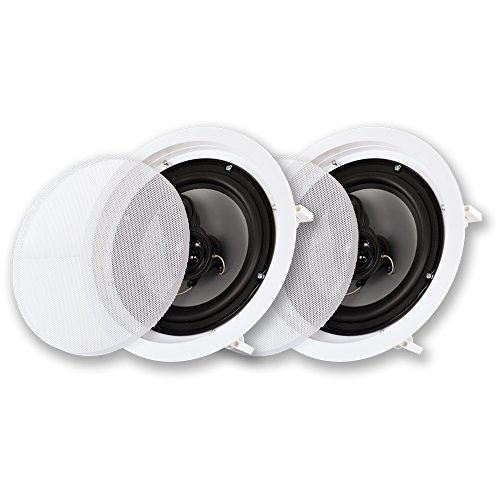
Pros
- Wide 40Hz-20kHz response captures full audio spectrum
- Handles 20-350W power for distortion-free high volumes
- 95dB sensitivity excels in multi-speaker systems
- Discreet design with paintable finishes blends perfectly
Cons
- Requires amplifier and receiver for operation
- Ceiling cutout and mounting needed for installation
- Wired setup lacks wireless convenience
The Acoustic Audio CSic83 is a pair of 8-inch 3-way in-ceiling speakers crafted for seamless home audio integration. With robust polypropylene woofers, poly mica midranges, and soft dome tweeters, they deliver full-range sound perfect for hidden installations.
Ideal for home theater buffs, multi-room music lovers, or outdoor loungers wanting patio and pool vibes without visible speakers. These handle everything from cinematic blasts to background tunes across living spaces or entertainment areas.
In real-world use, the 40Hz-20kHz frequency response brings punchy lows for action scenes and detailed highs for dialogue clarity. High efficiency ensures they keep up in surround setups without overpowering the room.
Overall verdict: A smart pick for value-driven custom audio, offering pro-level fidelity once installed. Great for anyone upgrading to immersive sound without bulky floorstanders.
Bass dives to 40Hz courtesy of high-rigidity 8-inch woofers with butyl surrounds, delivering room-shaking depth for movies and bass-heavy tracks without muddiness.
Vocal clarity shines through poly mica midranges, while 13mm dome tweeters handle highs up to 20kHz for sparkling details in music or podcasts. 3-way passive crossovers ensure smooth transitions and greater fidelity across volumes.
95dB efficiency and 8-ohm impedance support powerful output up to 350W per speaker, maintaining stability at high levels for lively home theaters or party patios.
Sleek, low-profile design with 10.83-inch overall size and just 3.78-inch mounting depth fits standard ceilings effortlessly. Paintable grills and frames let you match any interior or exterior decor.
Built tough with progressive spiders and rubber surrounds for durability in home or semi-outdoor spots like decks and patios. Spring-loaded terminals make wiring straightforward during install.
No battery needed; these passive speakers thrive on continuous power from your amp, running all-day sessions for poolsides or multi-room audio without recharges.
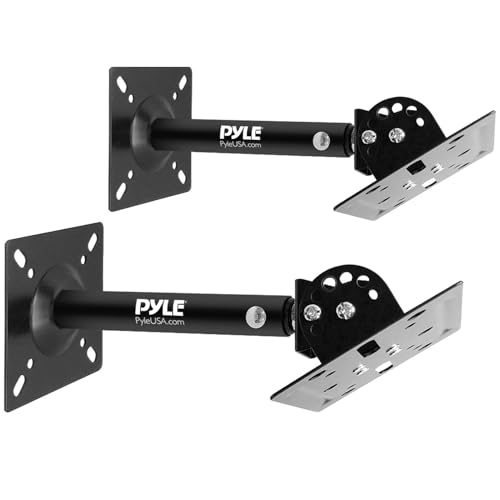
Pros
- Easy universal compatibility with standard speakers
- Precise swivel and tilt adjustments optimize audio angles
- Exceptional 75 lbs load capacity for heavy speakers
- Telescopic arm allows perfect placement flexibility
- Built-to-last steel construction resists wear
Cons
- Requires basic tools for secure installation
- Fixed black finish limits color options
- Max 75 lbs capacity may not suit ultra-heavy speakers
The Pyle Universal Speaker Mounting Brackets are a pair of heavy-duty mounts designed for ceiling or wall installation of bookshelf and satellite speakers. They offer universal compatibility, making them perfect for home surround sound systems, studios, or theaters where precise positioning enhances audio immersion.
Ideal for American homeowners upgrading their entertainment spaces, these brackets feature a retractable telescopic arm and adjustable swivel tilt, allowing users to direct sound exactly where needed. Whether elevating rear surrounds or angling fronts, they transform ordinary setups into professional-grade experiences.
In real-world use, the mounts deliver unwavering stability, preventing sagging or vibration that muddies sound. The 75 lbs max load handles most standard speakers effortlessly, while the rugged steel build promises longevity.
Overall verdict: A smart, affordable choice for anyone serious about audio quality. These mounts elevate your system without complexity, earning high marks for reliability and ease.
These mounts excel in optimizing sound direction through 0 to 90-degree swivel and tilt adjustments, ensuring speakers project audio precisely toward listeners for immersive surround sound in home theaters.
With the retractable arm, you achieve custom angles that enhance bass response and vocal clarity by positioning speakers at ear level or overhead without distortion from poor placement. Volume levels remain clean as vibrations are minimized by secure locking.
Bluetooth or wired speaker performance benefits from stable mounting, offering consistent range and projection ideal for movie nights or music sessions.
Crafted from heavy-duty steel with a rugged black finish, these mounts boast superior durability for long-term use in home or studio environments, resisting rust and wear.
The 13.4-inch max extendable arm and compact design make them lightweight yet robust, supporting up to 75 lbs each for versatile wall or ceiling setups without sagging.
As passive accessories, no battery is required, eliminating charging concerns and focusing purely on reliable, maintenance-free design for everyday audio lifestyles.

Pros
- Extremely small footprint requires minimal ceiling cutouts and shallow depth clearance.
- Crisp, intelligible midrange ideal for spoken audio, podcasts, and ambient background music.
- Quick and intuitive spring-clip installation requires minimal tooling.
- Clean, minimalist trim blends inconspicuously into residential ceilings.
Cons
- Lacks sub-bass reproduction below 120Hz, requiring a separate subwoofer for full low-end impact.
- Passive design demands an external amplifier or AV receiver to power the pair.
- Modest 12W peak handling limits output to small or medium spaces rather than high-volume listening.
The Diinpaul 2-Inch Small Ceiling Speaker pair provides an ultra-low-profile audio solution for listeners who want architectural sound without cutting oversized holes in their ceilings. Designed specifically for tight installations in kitchens, hallways, bathrooms, and bedrooms, this compact pair offers an unobtrusive way to distribute background music or fill in ambient surround channels in smaller entertainment spaces.
In real-world listening, these micro architectural speakers excel at midrange clarity. Dialogue from podcasts, vocal-centric acoustic tracks, and ambient background effects come through with commendable intelligibility. Because these are passive speakers, pairing them with an appropriately matched low-wattage amplifier or multi-zone receiver unlocks dependable, consistent coverage across your chosen listening zone.
Naturally, due to their miniature 2-inch driver dimensions, these units are not built to rattle the walls or output thumping sub-bass frequencies. When used within their intended limits as ambient or secondary surround speakers, however, they perform reliably without distortion or harshness.
For budget-conscious homeowners and DIY audio enthusiasts wanting hidden audio with the simplest installation process possible, the Diinpaul ceiling speakers represent an outstanding, discreet entry point into whole-home architectural sound.
Engineered with a 2-inch full-range driver, the Diinpaul ceiling speakers feature an operational frequency range of 120Hz to 20,000Hz. Acoustic tuning leans toward crisp highs and articulate mids, ensuring speech clarity and smooth instrumental reproduction. While frequencies below 120Hz naturally roll off due to driver size, pairing these with a powered subwoofer easily completes the bottom-end spectrum for a rich, full-range home audio setup.
With a maximum power handling of 12W, these speakers provide ample volume for casual day-to-day listening and atmospheric sound reinforcement. The soundstage dispersion is surprisingly wide for such a tiny cone, spreading ambient sound smoothly across compact dining spaces, walk-in closets, and study nooks without creating harsh directional hotspots.
The Diinpaul speakers feature an ultra-slim chassis measuring approximately 3.3 inches in diameter and only 1.77 inches deep. This micro footprint requires minimal overhead clearance, making them an ideal pick for installations where ductwork, electrical conduit, or shallow joist spacing prohibits traditional 6.5-inch or 8-inch architectural models. The clean white trim and grille integrate flush into standard residential drywall ceilings.
Installation is exceptionally straightforward thanks to the integrated dual spring-arm mechanism. After cutting the appropriate diameter opening, you simply fold the spring clips upward, insert the unit into the cutout, and allow the tension arms to pull the speaker tightly against the ceiling surface. As passive speakers, they feature standard wire connection terminals and require speaker wire running to an outboard amplifier, multi-room receiver, or zone controller.

Pros
- Clear full-range reproduction with silk dome tweeters
- Integrated mounting hardware and cut-out template for simple setup
- Adjustable treble switch for personalized audio tuning
- Durable ABS construction with urethane-coated grills
- Wide frequency response from 45Hz to 20kHz
Cons
- Requires wall or ceiling cutouts for installation
- Wired setup needs external amplifier
- Fixed power handling may limit ultra-high volume use
The Pyle 6.5-inch in-wall or in-ceiling speakers come as a pair, designed for high-quality stereo audio in home theaters, offices, or studios. With 250W peak power and a two-way design featuring a poly cone woofer and pivoting silk dome tweeter, they deliver balanced sound without taking up floor space.
Ideal for homeowners or installers seeking a clean, custom look, these speakers mount flush with stain-resistant grills that blend into any decor. The included cut-out template makes precise installation straightforward, even for DIY projects.
In real-world use, they shine in multi-room setups or surround sound systems, providing rich stereo reproduction that enhances movie nights or background music. While they require an external amp, the easy terminals ensure reliable connections.
Overall verdict: A solid choice for budget-conscious audiophiles wanting professional-grade sound in a discreet package.
These speakers boast a 45Hz-20kHz frequency response, with the 6.5-inch poly cone woofer handling solid mid-bass for impactful movie effects and music rhythms. The 1-inch silk dome tweeter pivots to focus highs, ensuring vocal clarity and detailed treble across the listening area.
At 125W RMS and 250W peak, they push high volume levels without distortion in medium-sized rooms, making them perfect for home theater immersion. The adjustable treble control (+3dB, 0, -3dB) lets you tweak for brighter or warmer sound based on room acoustics.
With 4-8 ohm impedance, they pair well with most receivers for stable, full-range stereo performance.
Built from sturdy ABS plastic with urethane film-laminated cloth grills, these speakers resist stains and fingerprints for long-lasting appeal in high-traffic areas. The flush mount design measures 9.37 inches total diameter with an 8.07-inch cutout, sitting just 3.34 inches deep once installed.
Weighing lightly for their size, the pair supports easy handling during installs on walls or ceilings. No battery is needed as passive speakers; they draw power directly from your amplifier for continuous play without recharging worries.
Rugged enough for custom home installs, they prioritize seamless integration over portability, delivering reliable performance in fixed setups.
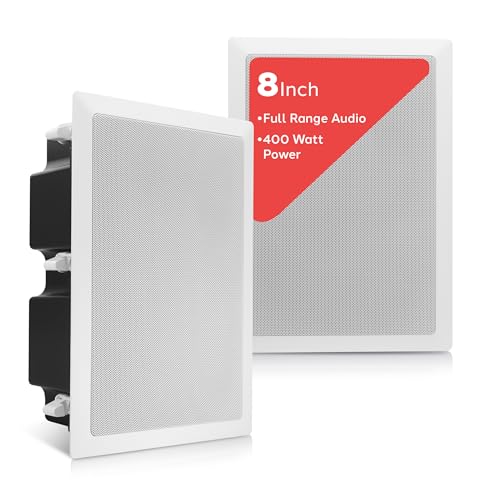
Pros
- Powerful 400W handling for high-volume playback
- Wide 50Hz-20kHz frequency response for balanced audio
- Easy flush installation in pre-cut openings
- 1-inch titanium tweeter for clear highs
Cons
- Requires cutting holes for installation
- Wired connection only, no wireless option
- Best with external amplifier for full power
The Pyle PDIW87 is a pair of enclosed 8-inch in-ceiling or in-wall speakers designed for seamless integration into home audio systems. With 400W peak power and a full-range 50Hz-20kHz response, they deliver deep bass and clear highs via long-throw woofers and titanium dome tweeters.
Perfect for homeowners upgrading to surround sound, these speakers suit living rooms, offices, or custom installs where discreet audio is key. They pair easily with standard receivers thanks to 4-8 Ohm impedance, producing rich sound for movies, music, or background ambiance.
In real-world use, the vented enclosure provides punchy bass without muddiness, and the flush design keeps walls clean. While installation needs basic tools for cutouts, the result is professional-grade audio at a budget price.
Verdict: A solid choice for value-driven buyers wanting powerful, hidden speakers that elevate everyday listening without visible clutter.
Expect deep bass from the 8-inch woofers starting at 50Hz, paired with crisp highs from 1-inch titanium tweeters up to 20kHz, creating a full stereo soundstage. The 400W power handling ensures room-filling volume for action movies or parties without breakup.
Vocal clarity shines in music and dialogue, thanks to the vented design that tightens low-end response. Impedance flexibility (4-8 Ohms) allows stable performance across amps, delivering consistent output for home surround setups.
Great for multi-room audio where balanced frequency response matters more than portability.
The compact flush-mount design fits standard pre-cut openings, with a stylish white grille that blends into ceilings or walls for a sleek, professional finish. Enclosed build protects internals for reliable long-term use in home or office environments.
No battery needed; it draws power directly from your receiver or amp for continuous playback. Weighing in at a manageable size for installers, the rugged enclosure handles everyday vibrations without issues.
Ideal for permanent setups where durability and invisibility trump portability.
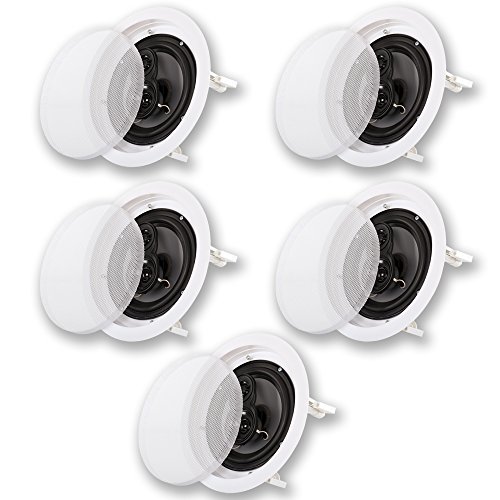
Pros
- Full-range frequency response from 40Hz-20kHz for balanced audio
- Simple spring-loaded wire connections speed up setup
- Durable ABS construction withstands everyday use
- High 95dB sensitivity maximizes output from any amp
- Compact 3.78-inch depth fits most ceilings
Cons
- Requires cutting precise 9.45-inch holes in ceiling
- Needs separate home receiver or amp for power
- Wired setup lacks wireless convenience
The Acoustic Audio CS-IC83 is a 5-pack of 8-inch 3-way in-ceiling speakers designed for seamless integration into home audio systems. With flush-mount design and pressure-lock mounting, they provide a clean, invisible look perfect for modern living rooms or dedicated theaters.
Ideal for homeowners or DIY enthusiasts upgrading to surround sound without bulky floorstanders, these speakers excel in whole-house audio or business installs. Their 8-inch poly cone woofers, poly mica midranges, and soft dome tweeters ensure detailed playback across genres.
In real-world use, they pair well with standard receivers, delivering wide dispersion that fills rooms evenly. The paintable grills allow customization to match decor, enhancing aesthetics.
Verdict: A solid choice for value-driven home theater builds, offering pro-level sound at an entry price point with straightforward installation.
Powered by 3-way passive crossovers, the CS-IC83 delivers deep bass down to 40Hz from the rigid 8-inch woofer, punchy mids via poly mica drivers, and crisp highs from 13mm tweeters up to 20kHz. This setup provides balanced, full-range audio for immersive movie watching or music listening.
At 95dB sensitivity and 8-ohm impedance, they handle 10-350W per channel with clarity and minimal distortion, reaching high volumes suitable for large rooms. Wide sound dispersion ensures even coverage without hot spots.
Performance shines when driven by a quality amp, offering fidelity rivaling pricier options for home setups.
Built with durable ABS housings and grills, these speakers feature a slim 3.78-inch mounting depth and 10.83-inch overall diameter, fitting standard 9.45-inch ceiling cutouts. Spring-loaded raw wire connections make wiring straightforward.
Pressure-lock clamps secure tightly to drywall, while removable, paintable grills allow perfect decor matching. No battery needed; they draw continuous power from your receiver or amp for unlimited playback.
Rugged construction suits permanent installs, with CL3-rated wire compatibility for safe in-wall runs. Lightweight design simplifies handling during setup.
Practical Methods on How To Make Ceiling Speakers Sound Better
Achieving high-fidelity sound from in-ceiling drivers requires addressing the unique physics of flush architectural installations. Because standard open-back ceiling speakers share an unsealed space with attic or floor framing, uncontrolled rear sound waves often degrade bass definition and muddy midrange vocals. Learning how to make ceiling speakers sound better begins by treating the acoustic environment inside the ceiling cavity, managing mechanical vibrations against drywall, and setting proper crossover thresholds on your amplifier. Fine-tuning driver orientation and utilizing tone calibration switches also helps direct essential high frequencies straight toward your seating area rather than scattering them across the floor. Taking the time to optimize these acoustic factors transforms ordinary background speakers into a responsive, balanced audio system.
Treating the Ceiling Cavity with Backer Enclosures and Insulation
Most flush-mount models operate as infinite baffle designs, meaning they rely on the drywall cutout and the open ceiling cavity to function as their speaker cabinet. When an open-back speaker fires, sound waves radiating from the rear of the cone enter the joist bay, reflecting off framing members and creating acoustic cancellation. Adding dense acoustic insulation, such as mineral wool or fiberglass batts, behind the speaker absorbs these wandering reflections and dampens hollow air resonances. Leaving a few inches of clearance around the rear magnet prevents heat buildup while significantly tightening low-end punch. This simple acoustic barrier also keeps loose dust from settling directly onto the speaker voice coil over time.
Dedicated backer boxes offer an even more reliable solution by providing a rigid, calculated enclosure volume for each driver. Enclosed architectural designs, such as the Pyle Ceiling Wall Mount Enclosed Speaker, feature an integrated rear cabinet with a vented chamber designed specifically to manage internal pressure. This sealed construction blocks sound leakage into upper rooms while ensuring predictable bass reproduction regardless of joist spacing. If your existing speakers feature open frames, installing retrofit speaker hoods or rigid acoustic boxes behind the drywall produces a noticeable improvement in overall tonal balance. The consistent air spring provided by an enclosure keeps the woofer cone moving in a linear, controlled manner.
Aiming High Frequencies toward Primary Listening Areas
High-frequency audio waves travel in narrow, directional beams, whereas low frequencies radiate omnidirectionally throughout the room. When a standard tweeter points straight down toward an unoccupied rug or hardwood floor, listeners seated several feet away only receive reflected, dull sound. Models equipped with pivoting hardware, such as the Pyle 6.5” In-Wall / In-Ceiling Speakers, allow you to manually tilt the silk dome tweeter directly toward primary seating positions. Directing the tweeter toward ear level restores crisp treble details, improves vocal intelligibility in home theater dialogue, and broadens the sweet spot. Taking advantage of this directional feature helps bridge the physical gap between ceiling height and seated ear level.
Commercial settings or rooms with drop ceilings sometimes present structural hurdles that prevent flush mounting at the proper acoustic angle. In these specialized setups, adjustable hardware like the Pyle Universal Speaker Mounting Bracket provides multi-angle swivel tilt and telescopic extension to aim satellite enclosures precisely where needed. Brackets capable of ninety-degree articulation ensure that sound reaches listeners directly rather than bouncing repeatedly off reflective ceiling tiles. Proper aiming minimizes phase cancellation and delivers sharp imaging that flush installations often struggle to achieve on their own. Securing satellite speakers at deliberate angles also preserves clarity across open floor plans.
Integrating Subwoofers and Configuring Crossover Filters
Ceiling drivers are rarely built to handle deep sub-bass frequencies at high volume levels without introducing unwanted distortion. Even large eight-inch drivers experience cone strain and intermodulation distortion when forced to reproduce low-frequency home theater effects alongside delicate vocal passages. Diverting frequencies below eighty hertz away from your ceiling drivers and routing them to a dedicated powered subwoofer immediately cleans up mid-range performance. This frequency handoff relieves the architectural speakers from heavy excursion demands, allowing the voice coils to operate cooler and with far greater clarity. Removing sub-bass stress also reduces the likelihood of buzzing nearby drywall seams during action movie soundtracks.
Compact drivers face even stricter acoustic boundaries due to their physical cone size. Ultra-compact units like the Diinpaul 2 Inch Small Ceiling Speakers, which feature a manufacturer-stated frequency response starting at one hundred twenty hertz, must never receive deep bass signals. Setting a high-pass crossover filter at one hundred twenty or one hundred fifty hertz in your receiver protects tiny full-range cones from bottoming out. When paired with a properly calibrated subwoofer, these miniature speakers deliver clean background coverage without buzzing or clipping under normal listening loads. Matching driver capabilities with correct receiver crossover points preserves both sound quality and driver longevity.
Fine-Tuning Hardware Equalization and Tone Switches
Room boundary interactions can cause ceiling speakers to sound overly bright or unexpectedly muted depending on flooring materials and furnishings. Rooms with extensive hardwood flooring, bare drywall, and large windows reflect high frequencies aggressively, often creating harsh sibilance. Conversely, rooms with thick carpeting, upholstered furniture, and drapery tend to soak up treble energy rapidly. Some architectural models incorporate built-in treble attenuation switches, providing plus three, neutral, or minus three decibel adjustments directly on the front baffle. Using these integrated switches gives you immediate control over top-end energy before audio signals ever leave the driver.
Setting an integrated treble switch to minus three decibels softens piercing highs in lively, reflective spaces without requiring complex receiver equalization. In heavily damped media rooms, boosting the switch to plus three decibels compensates for acoustic absorption and restores missing sparkle to brass instruments and vocal overtones. Multi-driver configurations, such as the Acoustic Audio CSic83 in Ceiling 8″ Speaker Pair 3, complement these adjustments through dedicated poly mica midranges and separate soft dome tweeters. Dividing frequencies across three distinct driver stages ensures balanced fidelity that two-way designs cannot always replicate. Dedicated midrange drivers handle speech and vocal warmth, freeing the tweeter to focus solely on high-frequency sparkle.
Optimizing Amplifier Power and Receiver Calibration
Underpowering in-ceiling speakers remains a widespread cause of muddy sound, dynamic compression, and premature distortion. Passive architectural speakers rely completely on external amplification, requiring clean wattage that aligns with their specified handling range and nominal impedance. Driving speakers with a low-power receiver pushed to its volume limits introduces harmonic clipping, which can overheat voice coils and degrade sound quality. Pairing high-sensitivity drivers with a robust amplifier ensures that musical peaks remain clean, open, and effortless even during dynamic film scenes. Ample amplifier headroom also preserves transient attack on percussion strikes and string plucks.
Modern audio-video receivers also include digital room correction software capable of measuring acoustic reflections and acoustic delays. Running an automated calibration cycle with an included measurement microphone helps the processor calculate speaker distance, level matching, and room resonance peaks. While in-ceiling sound distribution functions differently from traditional stereo loudspeakers, room correction filters smooth out uneven ceiling reflections. After running automated software, listeners should manually review crossover settings to ensure the receiver has not mistakenly classified compact architectural drivers as large, full-range units. Verifying speaker distances manually guarantees that audio arriving from overhead channels syncs perfectly with your primary display.
Sealing Cutouts and Eliminating Mechanical Drywall Rattles
Vibrations traveling between the speaker chassis and ceiling drywall can mimic severe driver distortion during bass-heavy playback. When dog-leg mounting clamps are fastened unevenly, tiny air gaps form around the perimeter of the outer mounting flange. Air escaping through these unsealed seams produces whistling noises and diminishes acoustic pressure within the listening space. Applying thin closed-cell foam weatherstripping tape along the back edge of the speaker frame creates an airtight seal against textured drywall. This compliant foam gasket compresses smoothly, preventing unwanted air leaks while damping direct chassis vibration transfer into the ceiling board.
Careful clamp tensioning is equally critical during installation to prevent warpage of the ABS plastic frame. Tightening dog-leg screws firmly until the mounting brackets grip the drywall securely prevents buzzing without bowing the outer rim. For multi-speaker arrays like the Acoustic Audio by Goldwood CS-IC83 8” 3-Way system, verifying mechanical stability at every cutout ensures uniform acoustic response throughout the entire room. If nearby drywall seams or recessed light housings vibrate during bass passages, applying silicone dampening pads or tightening trim rings resolves the extraneous noise quickly. Taking a few minutes to silence sympathetic ceiling rattles ensures you only hear pure audio from the drivers.
Managing Boundary Proximity and Room Placement
Placing in-ceiling speakers too close to adjoining side walls causes boundary loading, which unnaturally amplifies lower midrange frequencies and creates boomy sound. Installing drivers at least two to three feet away from room boundaries prevents bass frequencies from artificially reinforcing against corners. When ceiling architecture forces drivers into tight corners, lowering receiver equalization bands around one hundred to two hundred hertz helps counteract boundary bloom. Maintaining symmetrical spacing relative to the primary listening position also preserves balanced left-right stereo separation. Careful placement planning prevents unnatural acoustic emphasis before any digital signal processing is applied.
Rooms intended for whole-home background music benefit from broader sound dispersion rather than laser-focused directional staging. Spacing speakers evenly across the ceiling plane creates smooth ambient coverage that prevents volume hot spots as people move around the room. In multi-channel home theater setups, height speakers should align closely with standard surround recommendations for overhead angle and separation. Balancing physical boundary distances with proper room layout ensures that your overhead speakers complement existing floor-level components seamlessly. Even ambient listening zones gain significant clarity when ceiling drivers are distributed thoughtfully across the listening environment.
Establishing a Methodical Verification Routine
Confirming the success of your acoustic and hardware adjustments requires testing the setup with familiar, well-recorded reference material. Playing high-quality audio tracks with known acoustic bass lines, solo acoustic guitar, and clear lead vocals highlights subtle improvements in frequency separation. Listen carefully from your standard seating position to verify that vocals sound centered and free from nasal hollow resonances. Checking individual speaker channels using pink noise sweeps also reveals whether any specific driver suffers from phase misalignment or loose mounting hardware. Taking notes during listening tests helps pinpoint remaining acoustic hotspots that may require minor parametric equalizer adjustments.
Taking a systematic approach to each variable ensures you solve acoustic limitations without spending money on unnecessary equipment upgrades. Adjusting cavity insulation, setting clean receiver crossover thresholds, and aiming pivoting tweeters produces immediate, noticeable improvements in clarity and tonal balance. Periodic checks of mounting hardware and wire connections keep the system performing reliably for years of immersive listening. With properly treated boundaries and calibrated receiver settings, your overhead speakers can deliver the dynamic, balanced performance your home deserves. Consistent verification confirms that every mechanical and electrical adjustment works together in harmony.



Write Your Review
No reviews yet. Be the first to share your experience!