


Commuting with muddy audio or crackling factory equipment can quickly ruin an otherwise smooth drive. Many drivers wondering how to choose best car speakers are caught between completely replacing built-in door units or adding convenient wireless speakerphone accessories to handle calls and media. Factory automotive systems often rely on basic paper cones that degrade over time under temperature swings and moisture exposure. Upgrading to durable aftermarket drivers or modern audio kits can restore tonal clarity, vocal intelligibility, and overall volume without introducing harsh distortion.
Finding the right solution starts with identifying your vehicle’s physical mounting depth, wiring configuration, and exact listening goals. While some drivers prefer integrated coaxial replacements for balanced cabin sound, others prioritize quick-mounting visor audio gear that delivers safe hands-free calling and navigation prompts. Exploring dedicated door speakers designed for balanced response can provide a strong foundation for full-range audio upgrades. Matching your budget with clear physical fitment and realistic power expectations ensures you enjoy clean sound for daily driving.

Pros
- Exceptional call clarity and volume with dual 3W stereo speakers
- Seamless auto power on/off via motion sensor
- Supports dual phone connections for versatile use
- Impressive 35-hour talk time and 55-day standby
- Easy one-button voice assistant activation
Cons
- Bluetooth signal can interfere with in-car GPS or Wi-Fi devices
- Optimized for calls over high-fidelity music playback
- Requires clear line of sight to phone within 10 meters
The Lavales speaker is a compact Bluetooth car kit designed to clip onto your sun visor, transforming any vehicle into a handsfree calling hub. It supports Siri and Google Voice Assistant with a single button press, letting you handle calls, music, texts, and GPS directions without taking your eyes off the road. Perfect for daily commuters, road trippers, or parents shuttling kids, it prioritizes safety by enabling voice commands on iOS or Android devices.
In real-world use, it shines during highway drives where ambient noise is high. The built-in noise reduction and echo cancellation ensure both you and the caller hear clearly, even with windows down or traffic roaring. Multi-point connectivity means you can pair two phones, switching seamlessly between work calls and personal music playlists.
Setup is a breeze: pair via Bluetooth 5.3, clip it on, and the motion sensor handles the rest, auto-connecting when you open the door. With generous battery life, it stays ready for weeks. Overall, this speaker earns top marks for making drives safer and more enjoyable, a must-have for any driver tired of fumbling with phones.
Engineered for conversations on the go, the Lavales speaker uses 40mm drivers and dual 3-watt stereo speakers to deliver loud, crystal clear audio that cuts through highway noise. CVC 8.0 technology eliminates echo and background clamor, ensuring vocal clarity for both parties during calls. Volume levels stay distortion-free even at max, making it reliable for group conference calls or loud environments.
Bluetooth 5.3 provides stable connectivity with a 10-meter range, as long as there's no metal obstruction or interference. It handles music streaming decently for podcasts or playlists, though it's tuned primarily for speech intelligibility rather than deep bass or immersive highs. Multi-point pairing supports two devices without dropouts, ideal for family cars.
Sleek and unobtrusive, this lightweight speaker features a magnetic visor clip for secure, tool-free installation in seconds. The motion sensor detects your approach for auto power-on, and it shuts off when you walk away, preventing battery drain. Its compact form fits any car interior without blocking views, doubling as a conference table speaker or portable music player outside the vehicle.
Battery performance impresses with 35 hours of talk time, 40 hours of music playback, and up to 55 days on standby, perfect for forgetting about chargers during multi-day trips. Bluetooth 5.3 keeps power consumption low, and a full charge takes just a few hours. While not ruggedized for outdoors, its durable build handles daily car vibrations and temperature swings reliably.
Pros
- Exceptional call clarity from built-in noise-reducing microphone
- High-definition sound with strong vocal emphasis despite compact size
- Long 22-hour battery supports all-day drives
- Automatic reconnect and power management via motion sensor
- Versatile 2-in-1 speaker and FM transmitter functionality
Cons
- FM transmission may face interference in urban areas with many stations
- Lacks waterproofing for outdoor use beyond the car
- No companion app for advanced customization
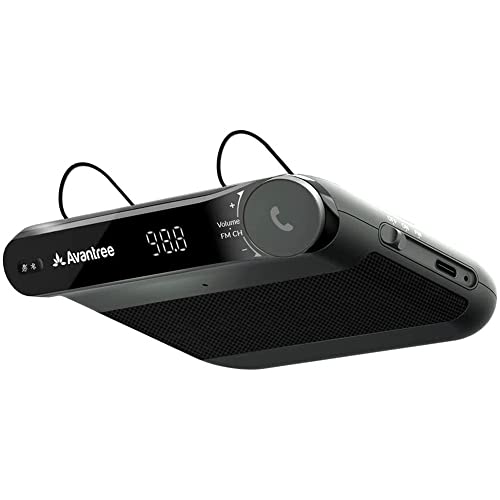
The Avantree Roadtrip is a 2-in-1 car speaker and FM transmitter designed for American drivers who want to stream phone audio to their vehicle's stereo without wires. It excels at hands-free calls, navigation directions, and music playback, making it perfect for commuters, road trippers, and families on long drives.
In real-world use, it powers on automatically when you enter the car via its motion sensor, reconnects to your phone instantly, and delivers clear audio through dual 3W speakers. The built-in mic ensures your voice cuts through road noise, while the FM mode broadcasts to any car radio for full-volume enjoyment.
Its rotary dial simplifies volume control and voice assistant access, reducing distractions. With 22 hours of playtime, it handles multi-day trips reliably. Overall verdict: a must-have for safer, louder drives - highly recommended for tech-savvy US motorists.
The Roadtrip punches above its size with dual 3W speakers providing high-definition audio focused on vocal clarity and detailed highs, ideal for calls, podcasts, and GPS voices. Bass is present but tuned for car cabins rather than deep thumps, ensuring balanced output without muddiness.
Volume reaches car-filling levels without distortion, and the noise-reducing mic delivers crisp transmission even on highways. Bluetooth connectivity is stable up to 30 feet, with quick pairing, while FM transmission offers reliable streaming to your car's radio in open areas.
Performance shines for hands-free use, making it a top pick for daily drives where clear communication trumps party bass.
Compact and car-optimized, the Roadtrip features a rugged clip-on design that mounts securely to sun visors or dashboards, weighing little for easy portability between vehicles. Its intuitive rotary dial and simple buttons prioritize driver safety with minimal glances needed.
The 22-hour battery life supports weekend road trips, powering off automatically when you leave to save juice, and reactivating via motion sensor on return. Charging takes a few hours via USB, keeping it ready for daily commutes.
No IP rating means it's best kept in the car, but its durable build handles vibrations and temperature swings on US highways effortlessly.

Pros
- Powerful 300W output punches above weight for stock upgrades
- Piezo tweeter and polyimide dome midrange ensure clear vocals
- 4-ohm impedance matches most factory head units seamlessly
- Stamped basket adds rigidity for vibration-free performance
Cons
- Frequency starts at 100 Hz, so lacks deep thumping bass
- Professional installation recommended for optimal safety
- Piezo tweeters can sound harsh at high volumes
The BOSS Audio Systems CH6530 Chaos Series are 6.5-inch 3-way coaxial speakers sold as a pair, designed specifically for car door installations. They feature a poly injection cone, rubber surround, and piezo tweeter for full-range audio that transforms lackluster factory sound into something lively and engaging.
Perfect for daily drivers, weekend cruisers, or budget upgraders who want more power without breaking the bank, these speakers excel in compact vehicles where space is tight. Their 300-watt max power handles everything from talk radio to classic rock, making long commutes enjoyable.
In real-world use, they mount with a 2.1-inch depth and 5.5-inch hole, fitting most sedans and trucks. Paired with a basic amp, they deliver punchy performance that rivals pricier options. Overall verdict: a solid entry-level upgrade for anyone tired of tinny doorspeakers.
With a 100 Hz to 18 kHz frequency response, these speakers provide balanced full-range sound, emphasizing mids and highs over rumbling lows. The 1-inch polyimide dome midrange keeps vocals clear during calls or podcasts, while the 0.50-inch piezo tweeter adds sparkle to cymbals and leads.
At 90 dB sensitivity and 4 ohms, they reach high volumes effortlessly from factory head units, ideal for open-road blasting. The 1-inch voice coil handles sustained play without distortion, though bass depth is moderate for cars without subs.
Stable performance shines in dynamic tracks, making them great for tailgating prep or daily drives where clarity trumps boom.
Built tough with a stamped steel basket, poly cone, and rubber surround, these speakers withstand road vibrations and temperature swings in car doors. At 6.6 x 6.6 x 2.4 inches and just 1.3 lbs per pair, they are compact and easy to handle during installs.
Mounting is straightforward with 2.1-inch depth and 5.5-inch hole diameter, suiting most vehicles without mods. No IP rating, but the sealed design resists interior dust and moisture common in daily drivers.
As wired car speakers, there is no battery; they draw power directly from your vehicle's system for unlimited runtime on the go, perfect for cross-country hauls.

Pros
- Superior weather resistance for marine and outdoor use
- Clear distortion-free sound at high volumes
- Easy mounting with included hardware
- Strong value for durable construction
- Wide frequency response for versatile music
Cons
- Requires external amplifier for full power
- Limited deep bass from small 3.5-inch drivers
- No wireless Bluetooth option

Pros
- Massive power output fills cars with loud, style-driven sound
- Simple mounting straps and wires for hassle-free setup
- Compensates weak factory wiring for crisp audio
- Enhances any car stereo with overhead projection
- Budget-friendly boost to highs and mids
Cons
- Limited deep bass without dedicated subwoofer
- Piezo drivers can sound bright or harsh at max volume
- Wired setup requires tapping into car audio system
The Pyle PLTWVS is a pair of high-powered sun visor speakers designed to supercharge your car's audio without breaking the bank. Mounting easily to your sun visor with included straps and wires, they project sound off the windshield for a tuned, immersive cabin experience. Ideal for daily drivers, road trippers, and budget audiophiles who want louder playback from their existing stereo.
In real-world use, these 6-way speakers shine during long highway hauls or city commutes, delivering elevated highs and mids that cut through road noise. The 200W peak power lets you crank favorites without distortion, while the 4-ohm impedance plays nice with factory wiring. No need for pro installs; setup takes minutes.
While they excel at adding sparkle and volume, pair them with a sub for fuller bass. Overall, the Pyle PLTWVS offers unbeatable value for transforming dull car sound into a lively soundtrack, earning high marks for affordability and fun factor.
Expect explosive volume and sharp highs from the dual 40mm piezo tweeters and four 60mm midrange drivers, covering 2.5kHz-20kHz for treble-focused clarity. Vocals pop during podcasts or rock tracks, with impressive mid-bass response that adds energy without booming lows.
At full tilt, 200W peak / 100W RMS pushes room-filling levels in your car, reflecting off the windshield for even coverage. The 90dB sensitivity and 4-ohm match reduces strain on amps, keeping sound crisp even on undersized wires. Stable wired connection means no dropouts, just consistent power.
Best for upbeat genres like pop or country where highs dominate; it elevates stock systems but shines brightest with balanced sources.
Sleek black housings blend into any car interior, with lightweight build perfect for overhead sun visor mounting. Includes all hardware and wires for plug-and-play, ensuring secure fit that withstands daily vibrations and opens/closes.
No battery needed; draws power directly from your car stereo for unlimited runtime on every drive. Compact 60mm mids and 40mm tweeters keep the profile low, avoiding driver distractions while maximizing projection.
Rugged enough for American roads, the straps hold firm through bumps, making it a set-it-and-forget-it upgrade for tailgates or cross-country trips.

Pros
- Seamless auto-reconnect detects movement and connects instantly when you enter
- Exceptional 35-hour talk time minimizes the need for frequent recharges
- Multipoint pairing enables effortless switching between work and personal phones
- Clean, distortion-free vocal reproduction for podcasts and hands-free calls
Cons
- Lacks sub-bass response, making it unsuitable for serious music listening
- Modest 5W output may struggle against loud highway wind if windows are open
- Lightweight plastic casing prioritizes utility over luxury materials
The 1Mii CarEcho MK02 addresses a universal headache for drivers of older vehicles: adding modern wireless convenience without the expense or hassle of replacing the factory stereo. Designed to clip directly to your sun visor, this specialized hands-free speakerphone handles voice calls, turns from your navigation app, and casual spoken-word audio with zero installation drama. It is tailored for commuters, rideshare drivers, and daily errand runners who need to stay connected and drive safely.
Where the CarEcho MK02 truly excels is in its daily convenience features. Thanks to integrated motion sensing, the unit automatically powers on and re-establishes a Bluetooth link the moment you open your car door. You never have to remember to turn it on before driving away. When you reach your destination and step away, it enters a deep sleep state to preserve power. Tactile buttons on the front panel allow you to answer calls, adjust volume, or summon your phone's voice assistant completely by touch.
Call quality and wireless reliability are strong points, aided by the updated Bluetooth 6.0 chipset. The multipoint dual-connection feature lets you pair two phones simultaneously, ensuring you never miss a critical call whether it rings on your personal handset or your work phone. While it is openly not intended for audiophile-grade music playback, it fulfills its core promise of clear speech reproduction and effortless communication.
For drivers seeking an affordable, non-permanent way to bring hands-free calling and GPS audio into an older car, the 1Mii CarEcho MK02 is an outstanding companion. It delivers long-lasting battery life, smart automation, and reliable performance right where you need it.
The acoustic profile of the 1Mii CarEcho MK02 is tailored specifically for the human voice. Driven by a 5W dynamic speaker, the frequency tuning deliberately cuts off muddy sub-bass to keep mid-band dialogue crisp and forward. This vocal-centric equalization ensures that caller voices, spoken navigation directions, and podcasts easily cut through background cabin noise, low tire hum, and moderate engine rumble.
High frequencies are tuned smoothly to prevent irritating sibilance during phone conversations, resulting in natural vocal timbres without harshness. While the speakerphone supports media streaming, listeners should note that it lacks the low-end depth and wide dynamic range needed for high-fidelity music tracks. However, for hands-free conversations and audiobooks, it remains clear, articulate, and free of audible distortion across its entire volume band.
The 1Mii CarEcho MK02 features a slim, purposeful design built for automotive environments. Measuring 4.47 by 2.63 inches with a thickness of just 0.7 inches, it clips seamlessly onto any standard sun visor using a durable, tensioned clip. The lightweight matte-black chassis avoids windshield glare and blends discreetly into modern and classic vehicle interiors alike, keeping buttons within effortless arm reach.
Internally, the device is powered by an efficient Bluetooth 6.0 architecture that enables simultaneous dual-device pairing and quick reconnect speeds. The internal rechargeable battery is a highlight of the hardware package, offering up to 35 hours of active call time and up to 90 days of standby efficiency. Topping up the battery is simple via a standard USB charging port, making it easy to power up using standard in-car 12V adapters.

Pros
- Stable Bluetooth 5.3 with automatic reconnection for hassle-free pairing
- Strong battery life supports full-day drives without recharging
- Simple visor clip and magnetic base for secure, instant setup
- Voice assistant support enhances driving safety
- TF card playback adds flexibility for music on the go
Cons
- Not suited for fast charging; use normal plug to avoid IC damage
- Designed primarily for car visor mounting, less versatile outdoors
- Lacks waterproof rating, best kept dry during use
The AGPTEK Car Speaker is a compact hands-free solution that clips to your sun visor, perfect for American drivers juggling calls, GPS navigation, and music on busy commutes or family road trips. With Bluetooth 5.3, it connects instantly to your phone, delivering clear audio without tying up your hands, making it a must-have for staying legal and safe behind the wheel.
In real-world use, it shines during long highway drives, where the noise-canceling mic cuts through road noise for crisp conversations, and the speaker provides enjoyable music playback via Bluetooth or TF card. Double-click to activate Siri or Google Assistant for hands-free replies to texts or route guidance, keeping your focus on the road.
Its portability extends beyond the car to home or office setups, though it excels in vehicles. Battery life holds up for extended journeys, and the straightforward design appeals to busy parents, professionals, and anyone prioritizing safety. Overall, this affordable speaker earns high marks for practical, everyday driving enhancements.
Expect clear vocal clarity and solid call quality from the 3W microphone with advanced noise reduction and echo cancellation, ideal for open-road conversations or urban traffic. Music playback offers pleasant sound without distortion at moderate volumes, suitable for background tunes during drives rather than audiophile listening.
Bluetooth 5.3 ensures stable connectivity up to a reliable range inside the car, with automatic shut-off and reconnection for seamless transitions. Double-tap activation for Siri or Google Assistant integrates smoothly, handling calls, SMS, and navigation prompts without lag, enhancing overall performance for hands-free operation.
The sleek black design features a magnetic back clip for effortless attachment to car sun visors, with a portable form factor that also works at home or the office. Its lightweight build prioritizes convenience over ruggedness, making it easy to toss in a bag for travel.
Battery performance impresses with 9-10 hours of music playback or 16 hours of hands-free talk time after just 2 hours of charging via the included cable. For best results, stick to standard plugs to preserve longevity on those cross-country family hauls.
Key Considerations for Selecting Car Speakers and Audio Kits
Choosing the right audio setup for your vehicle requires balancing sound clarity, physical installation requirements, and functional everyday convenience. Drivers frequently struggle to decide whether they should replace worn factory door units with aftermarket coaxial speakers or opt for portable visor-mounted Bluetooth speakerphones. The right choice depends on your daily commute, whether you prioritize rich musical detail across all seats or simply need loud voice guidance and clear hands-free calls. Clarifying your primary listening goals before purchasing any hardware will save time, effort, and installation headaches.
Distinguishing In-Door Replacements From Visor Hands-Free Audio
Standard car speakers mount directly inside door panels, rear decks, or dashboard corners to provide complete acoustic coverage throughout the vehicle interior. Models such as the BOSS Audio Systems CH6530 Chaos Series drop into factory door cavities to disperse sound across the entire cabin using multidriver coaxial layouts. These units run off the vehicle’s head unit or an external amplifier, requiring physical disassembly of the door panels for wiring. Because they rely on the vehicle’s electrical system and factory wiring harness, they represent a permanent audio upgrade intended for high-fidelity music playback.
Visor-mounted speakerphones take a completely different approach by focusing on immediate convenience, driver safety, and portable voice communication. Devices like the Lavales Bluetooth 5.3 Car Speaker and the 1Mii CarEcho MK02 clip directly to your sun visor with magnetic brackets, operating on rechargeable batteries without touching vehicle wiring. These units feature integrated microphones and small 3-watt to 5-watt drivers optimized for human vocal clarity rather than deep sub-bass reproduction. If your main frustration is an older factory radio lacking wireless smartphone pairing, a visor kit provides hands-free operation without invasive installation.
Physical Fitment, Mounting Depth, and Cavity Dimensions
Physical dimensions are the most critical factor when replacing factory door speakers because vehicle interiors provide strictly limited internal clearance. A driver might purchase a standard 6.5-inch speaker only to discover the mounting depth hits the window glass when rolled down. The BOSS Audio Systems CH6530, for example, specifies a mounting depth of 2.1 inches and requires a 5.5-inch mounting hole cutout. Checking your car’s exact door cavity depth against manufacturer specifications prevents costly fitment errors and avoids the need for custom spacer rings.
Mounting hole patterns and basket designs also vary across vehicle makes and factory speaker brackets. Many vehicles use proprietary three-hole or four-hole plastic adapter brackets that do not align with universal stamped steel baskets without aftermarket adapters. You must inspect whether your factory grilles sit flush against the door trim or if protruding aftermarket tweeter domes might collide with door panels. Taking accurate measurements of your existing factory housing before ordering replacement drivers ensures your new hardware seats cleanly behind stock interior panels.
Alternative mounting styles offer unique placement flexibility when door panels cannot easily accommodate new components. The Pyle PLTWVS system utilizes sun visor mounting straps to position dual high-frequency projection units directly overhead. This orientation reflects upper frequencies off the front windshield, lifting the acoustic soundstage higher in the cabin without cutting into door cards. While overhead strap mounting bypasses complex panel removal, you must verify that the mounting straps do not interfere with mirror vanity covers or sun visor movement.
Driver Architecture: Understanding Coaxial and Multi-Way Systems
Coaxial speakers combine multiple specialized drivers onto a single physical chassis to cover a wide frequency spectrum from a single mounting hole. In a three-way design like the BOSS Audio Systems CH6530, a primary cone handles mid-bass, a one-inch polyimide dome handles midrange vocals, and a half-inch piezo tweeter reproduces high treble. Splitting the audio signal among dedicated drivers produces crisper highs and clearer instrument separation than basic single-cone factory speakers. This integrated layout allows straightforward replacement without drilling separate holes for external tweeters.
Frequency response ranges published by manufacturers illustrate the tonal boundaries a speaker is engineered to reproduce. Full-range door drivers often span from approximately 100 Hz up to 18 kHz, ensuring balanced warmth through the vocal range and crisp cymbal definition. In contrast, specialized add-on arrays like the Pyle PLTWVS operate from 2.5 kHz to 20 kHz using quad 60mm midranges and dual 40mm piezo tweeters. These high-frequency units complement existing door woofers rather than producing standalone bass, adding presence to an otherwise dull factory stereo.
Cone materials and suspension surrounds dictate both acoustic character and long-term durability in harsh vehicle environments. Automotive doors experience extreme temperature shifts, direct sunlight, and moisture seepage during heavy rainstorms. Polypropylene injection cones paired with resilient rubber surrounds resist moisture absorption far better than untreated paper cones found in factory assemblies. Stamped steel baskets provide rigid structural support, keeping the internal voice coil properly aligned inside the magnetic gap during heavy bass excursion.
Electrical Matching: Impedance, Sensitivity, and Power Handling
Nominal impedance measures the electrical resistance a speaker presents to an audio amplifier or factory head unit. Most automotive aftermarket speakers, including those from BOSS Audio Systems and Pyle, feature a standard 4-ohm impedance rating. Matching the 4-ohm specification prevents overworking the internal amplifiers found in factory radios and aftermarket head units. Connecting a speaker with mismatched impedance can lead to diminished output, excessive heat buildup, or premature amplifier shutdown when listening at higher volume levels.
Sensitivity ratings tell you how efficiently a speaker converts electrical wattage into acoustic volume. A speaker rated at 90 dB sensitivity produces substantial volume with modest amplifier power, making it ideal for stock head units that output only 10 to 15 watts RMS per channel. Lower sensitivity speakers often demand high-powered outboard amplifiers to sound dynamic and clear. Choosing high-efficiency drivers ensures you get clean, lively reproduction without driving your factory radio into harsh electrical clipping.
Power handling specifications require careful interpretation because marketing materials frequently emphasize peak wattage over continuous thermal capacity. While a speaker pair might advertise 200 or 300 watts of peak power, continuous RMS wattage defines what the voice coil can dissipate continuously. Running a speaker well above its continuous thermal rating causes thermal distortion and eventually burns out delicate voice coil windings. Matching your head unit’s RMS output cleanly to the speaker’s continuous power threshold yields stable, long-lasting performance.
Evaluating Wireless Hands-Free Speakerphone Features
Visor-mounted wireless kits solve modern connectivity challenges for vehicles that lack integrated Bluetooth receivers. Upgraded wireless standards such as Bluetooth 5.3 in the Lavales and AGPTEK kits, or Bluetooth 6.0 in the 1Mii CarEcho MK02, ensure stable transmission with reduced latency. Faster pairing protocols maintain a dependable link with your smartphone while lowering battery consumption during extended road trips. Multi-point pairing lets two mobile phones connect simultaneously, enabling seamless switching between personal and business lines without manual re-pairing.
Microphone engineering and background noise cancellation directly determine call clarity inside a noisy automotive cabin. Highway driving introduces constant wind, tire friction, and engine rumble that can easily overwhelm basic speakerphone microphones. The Lavales kit integrates Qualcomm CVC 8.0 echo cancellation algorithms to suppress ambient cabin noise and isolate the driver’s voice. High-performance noise processing ensures the person on the other end hears spoken dialogue clearly even when traveling at highway speeds with the air conditioning running.
Audio playback flexibility varies across standalone visor products, with some models offering alternative playback sources alongside Bluetooth streaming. The AGPTEK Car Speaker includes a built-in TF card slot, allowing drivers to play MP3 audio files directly without draining smartphone battery life. Meanwhile, the Avantree Roadtrip features a built-in FM transmitter that broadcasts streaming phone audio straight to your vehicle’s factory FM radio. Drivers interested in versatile wireless audio options can also look into standalone wireless speakers to compare battery runtimes, portability, and overall acoustic output.
Convenience and Power Management for Daily Commutes
Intelligent power automation eliminates the need to remember to turn your wireless visor speaker on and off every trip. Models like the Avantree Roadtrip, Lavales MK02, and 1Mii CarEcho utilize integrated motion sensors that wake the unit automatically when the vehicle door opens. As soon as you enter the car, the device powers up, re-establishes Bluetooth communication, and prepares for incoming calls. When you park and walk away, the device detects the broken smartphone connection and enters a low-power sleep mode.
Dedicated voice command integration allows complete hands-free operation without taking your hands off the steering wheel. Pressing a prominent button or rotary dial on units like the Avantree Roadtrip instantly summons Apple Siri or Google Assistant. Drivers can dictate text messages, request turn-by-turn navigation, or select musical playlists using simple voice commands. This seamless voice assistant integration helps motorists comply with hands-free driving laws while minimizing dangerous visual distractions on congested roadways.
Rechargeable internal batteries dictate how frequently you must bring a visor unit inside or run a charging cable across the dashboard. The 1Mii CarEcho MK02 and Lavales models list up to 35 hours of active talk time and standby periods reaching 55 to 90 days. The AGPTEK unit delivers roughly 16 hours of hands-free conversation and up to 10 hours of continuous music playback on a full charge. Manufacturer instructions advise using standard charging adapters rather than high-voltage fast chargers to preserve the internal charging circuitry over time.
Installation Guidelines, Wiring Safety, and Physical Placement
Installing replacement door speakers requires careful mechanical preparation to avoid damaging door panels, retainers, and internal moisture barriers. Always disconnect the vehicle’s negative battery terminal before cutting, splicing, or unplugging audio wires to prevent electrical shorts. Use plastic pry tools to unclip door cards gently without cracking delicate plastic retention pins. Once the door card is free, inspect the factory weather seal to ensure rain runoff inside the door cavity cannot drip directly onto the new speaker terminals.
Speaker wiring polarity must remain consistent across all channels to avoid acoustic phase cancellation in the cabin. Connecting positive to negative on one side while wiring the opposite side correctly causes low-frequency bass waves to cancel each other out. After crimping secure spade terminals onto your factory speaker leads, test balance and fader controls before snapping door panels back into place. Ensuring tight screw mounting against the door frame stops unwanted vibrations, buzzes, and air leaks during bass-heavy musical passages.
Placing visor-mounted kits requires equal attention to vehicle safety equipment and driver ergonomics. Always attach visor clips securely to avoid creating a flying hazard in the event of an abrupt stop or collision. Ensure the clip position does not obstruct side-curtain airbag deployment channels along the vehicle’s A-pillar or roofline. Keeping the microphone pointed toward the driver’s seat and within normal reach of the volume dial provides optimal voice pick-up without compromising roadway visibility.
Aligning Your Speaker Selection With Everyday Driving Demands
Determining the best audio hardware ultimately comes down to diagnosing what your current vehicle setup lacks most. If your factory speakers buzz, distort at modest volume, or deliver muffled sound, dropping in 4-ohm coaxial units like the BOSS Audio CH6530 restores dynamic range across the vehicle. If your factory speakers sound acceptable but your dashboard stereo lacks modern wireless calling, a visor speakerphone like the Avantree Roadtrip or Lavales kit upgrades your vehicle in seconds. Matching your upgrade path to your mechanical comfort level and daily driving habits guarantees reliable audio performance on every journey.





Write Your Review
No reviews yet. Be the first to share your experience!