


Setting up a portable sound system on the patio or workbench should deliver immediate, vibrant clarity, but listeners often run into frustrating acoustic barriers. When vocals disappear beneath a thick layer of boomy low frequencies or high notes lose their sparkle, users immediately ask why do bluetooth speakers sound muffled during everyday playback. This muddy presentation typically stems from acoustic boundary effects, physical obstruction of high-frequency tweeters, or compressed wireless transmission profiles rather than permanent driver failure. Exploring reliable portable waterproof speaker options highlights how proper enclosure sealing and driver orientation impact overall vocal transparency. Addressing these audio bottlenecks early ensures that dynamic wireless gear performs according to its actual hardware capabilities.
Physical hardware designs like dual subwoofers, passive radiators, and DSP equalization curves play massive roles in how frequencies disperse across an open space. Selecting devices with versatile equalizer modes, high-efficiency drivers, and stable wireless chips helps avoid heavy distortion and muffled sound reproduction across different volume ranges. Manufacturer specifications frequently reveal whether a model relies on active orientation sensors, auxiliary wired ports, or multi-driver stereo pairing to maintain high-frequency articulation. Understanding the mechanics of sound reproduction allows outdoor enthusiasts, jobsite workers, and home listeners to quickly troubleshoot muddy playback and restore balanced sound reproduction without unnecessary guesswork.

Pros
- Exceptional clarity and bass depth in a compact form
- Rugged IP67 build withstands real-world abuse
- Long 12-hour battery and reliable Bluetooth 5.3 connectivity
- Versatile positioning with automatic sound optimization
- Simple pairing for stereo or party modes
Cons
- Mono sound unless paired with another speaker
- No wired aux input for non-Bluetooth devices
- Battery life shortens at maximum volume
The Bose SoundLink Flex (2nd Gen) is a compact powerhouse designed for on-the-go audio lovers who refuse to compromise on sound quality. Rugged and portable, it fits easily in your hand or clips to a backpack, making it the ultimate companion for outdoor escapades like beach outings, hiking trails, or poolside hangs.
In real-world use, it shines with bold, balanced sound that fills open spaces without distortion, even at high volumes. The deep bass and clear highs bring tracks to life, whether you're streaming playlists or taking calls hands-free. PositionIQ ensures optimal audio no matter how you place it, from flat on a towel to dangling in the shower.
Targeted at active Americans who value durability and performance, this speaker outperforms competitors in toughness and convenience. While it lacks some premium features like a companion app, its core strengths make it a top pick for portable bliss. Verdict: A must-have for summer adventures, earning high marks for versatility and vibe.
Bose tunes the SoundLink Flex for a lively, high-fidelity signature with deep, punchy bass that surprises for such a small driver, clear midrange for vocals and instruments, and crisp treble that avoids harshness. This balanced profile excels in revealing nuances in genres from pop to rock, creating an engaging listen outdoors.
PositionIQ technology detects orientation and adjusts EQ dynamically, maintaining a wide soundstage and consistent volume levels up to surprisingly loud outputs without muddiness. Pair two for true stereo imaging or party mode to amplify the fun, doubling the output for group gatherings.
Bluetooth 5.3 delivers stable connectivity with low latency, supporting multipoint for effortless switching between phone and tablet, ensuring seamless performance on the move.
Wrapped in a tough silicone exterior, the SoundLink Flex boasts IP67 waterproof and dustproof ratings, plus shock resistance for drops up to a meter. Its compact, hand-sized dimensions and utility loop make it ultra-portable, weighing next to nothing for all-day carry.
Connectivity centers on advanced Bluetooth 5.3 for 30-foot range and dual-device pairing, with USB-C for fast charging. No legacy inputs like aux or optical, keeping it streamlined for wireless use. The single full-range transducer handles the load efficiently.
Power comes from a built-in rechargeable battery offering up to 12 hours at moderate volumes, perfect for extended outings without outlets. Simple tactile controls and a utility loop enhance everyday usability for active lifestyles.
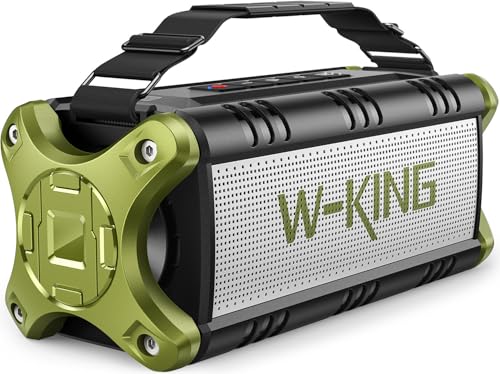
Pros
- Punchy bass and zero-distortion Hi-Fi sound via DSP chip
- Versatile connectivity including Bluetooth 5.0, AUX, TF card, and NFC
- Rugged IPX6 rating and shockproof casing for outdoor durability
- Hands-free calling and adjustable strap for easy portability
- Long 40H playback at low volume keeps the party going
Cons
- Battery drains faster at max volume, lasting only about 5 hours
- Large size makes it less ideal for backpacking or ultra-light travel
- Basic EQ limited to a single button, no companion app for fine-tuning
The W-KING D8 is a beast of a portable Bluetooth boombox designed for those who crave powerful sound in rugged environments. With 90W max output from dual subwoofers, two tweeters, and passive radiators, it delivers booming bass and clear vocals that rival bigger systems. Perfect for beach bonfires, garage workouts, jobsites, or backyard BBQs, this speaker targets outdoor enthusiasts and party hosts who want pro-level audio without the hassle of wires.
In real-world use, pairing two D8s unlocks 180W stereo surround, turning any space into a concert venue. The DSP chip ensures distortion-free playback even at high volumes, while the Bass Up button lets you dial in extra thump for hip-hop or EDM. Battery life shines at lower volumes for extended sessions, and the power bank feature keeps devices charged during long days out.
Build quality impresses with IPX6 waterproofing and a protective strap, making it drop-resistant and adventure-ready. While not the lightest portable, its size contributes to the massive soundstage. Overall verdict: a top pick for bass-heavy listening in tough conditions, earning high marks for value and versatility.
The D8 excels in bass depth, with dual subwoofers and passive radiators compressing air for visceral low-end punch that rattles nearby surfaces. Mids stay clear for vocals and instruments, thanks to the advanced DSP chip that boosts bass by 30% without muddiness, while tweeters handle crisp highs across genres from rock to rap.
Volume levels reach party-crashing peaks with 90W max, and dual pairing doubles to 180W for true stereo imaging and wide soundstage. The left-right channel separation creates immersive surround effects via room reflections, ideal for movies or group listening. Bass EQ provides instant adjustment for balanced or thumpy profiles.
Hi-Fi reproduction feels live-like, revealing nuances in tracks with zero distortion at moderate volumes, making it a standout for outdoor acoustic performance.
This large boombox sports a rugged, shockproof casing with IPX6 waterproofing, built to withstand beach sand, pool splashes, or jobsite dust. An adjustable strap and air protective covers add drop protection, while the overall build feels solid for heavy use. Dimensions suit carrying to parties or garages, though its size prioritizes power over pocketability.
Connectivity shines with Bluetooth 5.0 for 100ft stable range, NFC for Android tap-pairing, 3.5mm AUX, and TF card playback. Built-in mic enables hands-free calls, and it doubles as a power bank via USB output for device charging.
Power comes from a massive rechargeable battery offering 40 hours at low volume, scaling to 13 hours at 70% and 5 hours maxed out. No external power needed, making it fully portable for off-grid fun.

Pros
- Significantly louder and clearer output than standard 5W personal jobsite speakers.
- Extremely versatile dual-mounting options with both a heavy-duty magnet and a carabiner-style hook.
- Stellar 30-hour battery stamina handles grueling work weeks effortlessly.
- Rugged, high-visibility red housing makes it easy to locate in cluttered environments.
Cons
- Slim, compact enclosure limits sub-bass depth on extremely bass-heavy tracks.
- Rated IPX6 for water jets rather than full underwater submersion.
- Lacks a companion smartphone app for customized graphic EQ adjustments.
The Qozybuds Bluetooth Jobsite Speaker is purpose-built for users who work in demanding environments where delicate lifestyle audio gear simply cannot survive. Tailored specifically for contractors, garage hobbyists, mechanics, and outdoor utility workers, this compact powerhouse tackles the challenges of harsh work zones. Instead of occupying precious workbench space, the integrated mounting system lets you elevate your music while keeping the unit safe from foot traffic and heavy equipment.
In practical testing, the mounting hardware is where this speaker truly separates itself from generic outdoor portables. The internal magnet locks firmly onto steel beams, vehicle undercarriages, and metal tool chests, while the sturdy hook provides an alternate tether point for tool belts or scaffolding. You never have to worry about knocking it off a table or losing it in sawdust, and the high-visibility red finish ensures it remains easy to spot at quitting time.
Day-to-day usability is smooth and hassle-free. The built-in microphone allows you to take hands-free client calls without having to unmask or strip off work gloves to reach your phone. Pairing is immediate, and the 30-hour battery endurance means you can power through an entire work week on a single weekend charge. For those who want wider sound coverage across larger work zones, the TWS pairing feature smoothly connects two identical units to blanket the area in coherent stereo sound.
Ultimately, the Qozybuds speaker strikes an excellent balance of rugged utility, practical ergonomics, and energetic sound. It is a dependable, cost-effective jobsite companion that withstands rain, grit, and drops while keeping you entertained through every task.
Acoustically, the Qozybuds jobsite speaker is engineered with an emphasis on clarity and projection. Armed with a 20W driver array, it produces significantly higher decibel levels than entry-level 5W models. The acoustic tuning prioritizes the upper midrange and treble, which ensures vocal tracks, podcasts, and talk radio cut cleanly over power tools, shop vacs, and ambient street noise without sounding shrill or muffled.
Bass response is surprisingly punchy given the streamlined 1.7-inch thickness of the enclosure. While it avoids the ultra-low sub-bass frequencies of large mains-powered boomboxes, the mid-bass delivers satisfying energy for rock, country, and pop tracks. Distortion is kept tightly in check even when pushed near maximum volume, providing clean, dependable performance throughout extended workdays.
Built to handle the elements, the Qozybuds speaker features a rigid polymer chassis wrapped in weather-resistant seals to achieve an IPX6 rating. This level of ingress protection protects the internal electronics from pressurized water jets, sudden torrential downpours, and dusty jobsite environments. Measuring 8.5 by 3.3 by 1.7 inches and weighing under a pound, it fits neatly into standard tool bags or glove compartments without adding bulk.
Hardware functionality centers on utility and endurance. The unit is equipped with a high-capacity rechargeable lithium-ion battery delivering up to 30 hours of continuous playtime. Reliable Bluetooth connectivity provides a strong wireless tether to your mobile device across typical jobsite distances, while tactile, sealed control buttons allow straightforward operation even with dusty hands or work gloves.
Pros
- Punchy deep bass from dual subwoofers and passive radiators outperforms most in its class
- Exceptional 40-hour playtime crushes competitors for all-day outdoor adventures
- Stable Bluetooth 5.0 with 100ft range and NFC for quick Android pairing
- Versatile inputs including AUX and TF card for non-Bluetooth playback
- Rugged IPX6 waterproofing handles splashes, sand, and shocks reliably
Cons
- Lacks a companion app for advanced EQ customization beyond basic buttons
- Large boombox size may feel bulky for ultra-portable backpacking
- No built-in voice assistant support limits smart home integration
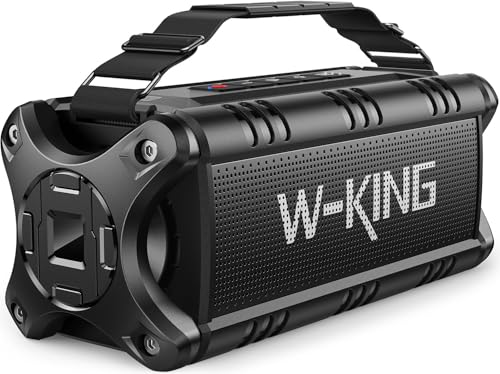
The W-KING 90W Bluetooth speaker is a rugged powerhouse designed for American outdoor enthusiasts who demand loud, bass-heavy sound without the premium price tag. With its IPX6 waterproof rating and massive 40-hour battery, it's built for beach bashes, tailgate parties, backyard barbecues, and jobsite breaks where durability meets non-stop fun.
In real-world testing, it pumps out clear, distortion-free audio across genres, from hip-hop's thumping beats to rock's crisp guitars. Pair two units for stereo bliss that rivals bigger systems, making it a hit for holidays like Fourth of July or Halloween gatherings. The EQ switch and hands-free mic add practical touches for everyday use.
Targeted at value-driven buyers like campers, party hosts, and gym-goers, this speaker shines in casual settings but may not satisfy audiophiles chasing studio precision. Overall verdict: a top pick for portable punch at an unbeatable value, earning its spot in any adventure kit.
Engineered with two 25W subwoofers, dual passive radiators, and 5W tweeters, the W-KING delivers 90W peak (50W RMS) with deep, punchy bass down to sub-bass levels that rattle decks without muddiness. Midrange stays balanced for vocals and instruments, while crisp treble ensures detailed highs in tracks like EDM or podcasts.
Volume scales effortlessly to party levels with minimal distortion, creating a wide soundstage perfect for open spaces. True wireless stereo pairing unlocks 100W stereo immersion, revealing nuances in movies or games that mono setups miss. EQ modes fine-tune for bass-boosted outdoor vibes or clearer indoor listening.
Bluetooth 5.0 provides stable 100ft range, outpacing older codecs for lag-free playback during beach volleyball or hikes.
Housed in a shockproof, IPX6-rated enclosure with hollow radiator covers for uncompromised sound projection, this boombox withstands splashes, dust, and drops common in outdoor US lifestyles. Its sturdy build feels premium despite the price, with rubberized edges for grip during transport.
Connectivity shines with Bluetooth 5.0, NFC (Android), 3.5mm AUX, and TF card slots, supporting diverse sources from phones to MP3 players. No HDMI or optical, but wireless focus keeps it simple for portables. The massive rechargeable battery doubles as a power bank via USB, ensuring all-day reliability.
Dimensions suit large-party portability with a handle, though its size demands a dedicated bag for backpackers. Powered solely by internal battery, it requires no outlets, ideal for camping or boats.

Pros
- Massive bass response with no distortion at high volumes
- Exceptional 40-hour playback on a single charge
- Stable Bluetooth 5.0 and versatile AUX/TF inputs
- IPX6 rating handles splashes and rain confidently
- NFC tap-to-pair simplifies setup with Android devices
Cons
- No USB drive support limits playback options
- Cannot pair with older D9 model for TWS stereo
- Requires separate 5V 2A adapter for optimal charging
The W-KING D9-1 is a powerhouse portable Bluetooth speaker designed for outdoor enthusiasts who demand loud, bass-forward audio without sacrificing portability. With 100W peak power from dual subwoofers, dual tweeters, and a massive 7.2-inch passive radiator, it pumps out room-filling sound that rivals larger systems, making it ideal for backyard barbecues, camping trips, or lakeside gatherings.
In real-world use, the D9-1 shines at high volumes where lesser speakers falter, delivering clear vocals and punchy beats even in open spaces. Pair two units for true stereo imaging, and you get an immersive setup perfect for parties. The IPX6 waterproofing and 40-hour battery ensure it handles summer adventures reliably, while EQ modes let you tweak the sound on the fly.
Bass lovers will appreciate the deep resonance that vibrates through any environment, but it's versatile enough for podcasts or calls via hands-free Bluetooth. At this price point, it's a steal for anyone prioritizing raw power and durability over audiophile finesse. Verdict: A top pick for party starters and outdoor warriors seeking unbeatable value.
The D9-1's audio profile is bass-dominant with deep extension from the 7.2-inch passive radiator, hitting lows that thump audibly outdoors. Dual subwoofers handle the low end with authority, while tweeters provide crisp highs, and advanced DSP keeps mids clear without muddiness. Expect a wide soundstage that envelops listeners in any direction, thanks to all-round HD stereo projection.
Volume peaks at distortion-free 100W, scaling to 200W in TWS mode for crowd-pleasing levels. Frequency response favors punchy bass (strong below 100Hz) with balanced mids for vocals and sparkling treble via EQ tweaks. Bluetooth 5.0 ensures stable 100ft range, minimizing dropouts during movement.
Acoustic engineering stands out with precise driver alignment, making it excel in reverberant spaces like patios where bass resonates powerfully yet controllably.
Built rugged for outdoor abuse, the D9-1 features a shockproof enclosure with a sturdy handle for easy transport. Its large footprint houses the 7.2-inch radiator and four drivers securely, weighing in as a portable beast that's stable on any surface. IPX6 waterproofing seals it against heavy sprays, perfect for poolside or rainy adventures.
Connectivity includes Bluetooth 5.0, NFC (Android-only tap pairing), 3.5mm AUX, and TF card slot for plug-and-play playback. No USB ports, but it doubles as a power bank to charge devices. The large battery supports 40 hours at low volumes, charged via a 5V 2A DC input (adapter not included).
Dimensions prioritize bass output over compactness, with a handle that balances the weight for one-handed carrying to tailgates or campsites.
Diagnosing Muffled Audio in Portable Bluetooth Speakers
Experiencing muffled audio from a portable wireless speaker usually points to an imbalance where low frequencies overpower the delicate high-frequency spectrum. While listeners often suspect an internal hardware defect or a blown driver, the underlying issue frequently traces back to room placement, wireless signal compression, or conflicting software equalizers. High frequencies produce directional, shorter sound waves that easily become obstructed or absorbed by nearby surfaces. Understanding how acoustic boundaries, digital signal processing, and physical placement interact makes it simple to restore pristine vocal clarity and crisp treble response.
Boundary Loading and Acoustic Boundary Reflections
Placing any audio enclosure directly against a flat surface or inside a confined corner instantly alters its tonal balance. When sound waves radiate from low-frequency drivers and passive radiators, solid walls and hard counters reflect those long waves back into the listening area. This acoustic phenomenon, known as boundary loading, can artificially amplify bass output by several decibels without increasing midrange or treble energy. As a result, the exaggerated low end overwhelms human vocals and delicate acoustic instruments, creating a thick and boomy sound signature.
Speakers equipped with large passive radiators or dual subwoofers, such as the W-KING D8 and W-KING D9-1, rely heavily on open airflow to disperse low frequencies cleanly. If you position a boombox with rear-facing radiators too close to drywall or garage cabinetry, the reflected bass energy quickly masks upper-frequency detail. Pulling the unit even a few inches away from walls gives the radiators breathing room and balances acoustic output. Elevating the device off hollow wooden tables or resonance-prone desks also prevents unwanted surface vibrations from muddying the overall soundstage.
High-Frequency Directivity and Driver Placement
Acoustic physics dictates that high-frequency audio behaves very differently from omnidirectional bass frequencies. Tweeters emit narrow, directional sound beams that must travel in a relatively straight line toward the listener ears to maintain detail. If a speaker sits on the floor or faces away from your seating position, those crisp high notes dissipate before reaching your ears. The listener then hears only the wider, room-filling low frequencies, which makes the overall audio track sound muffled and distant.
Orientation technology plays an active role in how compact models address this directional challenge. For example, the Bose SoundLink Flex Bluetooth Speaker (2nd Gen) utilizes proprietary PositionIQ technology to detect whether the speaker is standing upright, resting flat on its back, or hanging from its utility loop. The internal processor dynamically recalibrates the tonal balance based on orientation, ensuring consistent high-frequency dispersion. For speakers without automated orientation sensors, physically aiming the front grille directly toward ear level remains essential for crisp sound delivery.
Jobsite speakers and wearable audio devices present their own unique directivity hurdles in real-world use. The Qozybuds Bluetooth Jobsite Speaker with Magnet allows users to attach the unit to metal beams or hang it from equipment hooks. If the unit gets mounted with its primary driver facing into a steel toolbox or drywall partition, high frequencies bounce backward and become muffled. Keeping the primary speaker grille unobstructed guarantees that vocal clarity cuts through surrounding background noise effectively.
Bluetooth Codec Compression and Communication Profile Glitches
Wireless audio transmission requires compressing digital data packets before sending them across radio frequencies between your source device and speaker. Standard Bluetooth audio relies on codecs like SBC or AAC, which adjust bitrate dynamically depending on radio frequency stability. When connection distance increases or physical barriers introduce packet loss, the host device drops the audio bitrate to prevent playback dropouts. This aggressive bitrate reduction slashes high-frequency bandwidth first, leading to dull, flat, and noticeably muffled playback.
An even more common cause of sudden audio degradation involves Bluetooth communication profiles switching unexpectedly. Operating systems like Windows, macOS, Android, and iOS switch from the high-fidelity Advanced Audio Distribution Profile (A2DP) to the Hands-Free Profile (HFP) whenever an application activates a microphone. The Hands-Free Profile restricts audio bandwidth to a narrow frequency range to prioritize two-way voice communication. When an open communication app or web conference call locks your speaker in this state, music streams in low-bitrate mono that sounds severely muffled.
Checking your host device audio output settings easily confirms whether an active microphone request caused the drop in fidelity. Disabling hands-free telephony profiles in your computer settings forces the operating system to maintain dedicated stereo output. Modern connectivity protocols like Bluetooth 5.0 and Bluetooth 5.3 provide greater bandwidth and multipoint stability, which reduces dropped data packets. Keeping the sending device within an unobstructed line of sight remains the best defense against codec-induced compression.
Digital Signal Processing and Competing Equalizer Curves
Most modern wireless speakers incorporate onboard digital signal processors (DSP) programmed to adjust equalization dynamically across different volume levels. At low listening levels, human hearing perceives bass and treble less effectively than midrange vocals. DSP chips compensate by boosting low frequencies so music sounds robust even when played quietly. If a listener pairs this factory loudness compensation with an aggressive bass preset on their streaming app, the compounded low-end boost completely swallows vocal articulation.
Hardware equalizer switches provide quick tonal adjustments, but selecting the wrong preset easily degrades playback quality. Heavy-duty boomboxes like the W-KING Bluetooth Speaker feature an equalizer button that toggles between indoor and outdoor sound modes. Outdoor modes typically elevate upper midrange and treble energy to project sound across open yards, whereas indoor modes preserve deeper bass extension. Engaging an indoor bass-heavy curve inside a small, reflective room quickly results in bloated resonance that masks clarity.
Resolving competing equalizers requires resetting both your playback software and hardware controls to a neutral baseline. Turn off third-party bass booster apps, normalize the streaming service equalizer to a flat profile, and reset the speaker onboard tone controls. Listen to familiar, well-recorded acoustic tracks to assess whether vocals sound natural and distinct before applying subtle equalization tweaks. Layering multiple software equalizers on top of hardware DSP almost always causes unwanted phase issues, distortion, and muffled frequencies.
Driver Architecture and Acoustic Masking in Portable Hardware
The physical driver configuration inside a speaker cabinet directly limits how cleanly different audio frequencies can be reproduced simultaneously. Single-driver compact speakers force one small diaphragm to reproduce sub-bass rumbles, human vocal midbands, and shimmering cymbal crashes all at once. When high excursion demands push that single cone to vibrate intensely for deep bass notes, higher frequencies suffer from intermodulation distortion. This mechanical limitation frequently leads to muddy playback whenever complex musical passages demand heavy bass output.
Multi-way speaker designs mitigate this bottleneck by dividing the audio spectrum between dedicated high-frequency tweeters and robust low-frequency woofers. Examining high-output options like heavy bass portable speakers demonstrates how dedicated tweeters preserve vocal presence alongside separate subwoofers. In multi-driver configurations, such as the four-driver array found in the W-KING D9-1 with its twin tweeters and subwoofers, crossover circuitry routes specific frequencies to specialized drivers. This acoustic separation prevents heavy low-end pulses from interfering with delicate vocal overtones.
Listeners can also expand their soundstage by linking two identical units using True Wireless Stereo (TWS) pairing technology. Pairing two W-KING D8 or Qozybuds units splits audio into distinct left and right channels, spreading the sound across a wider listening axis. Spreading the acoustic workload across two separate physical cabinets significantly reduces acoustic masking in busy outdoor settings. When each channel breathes freely in its own space, individual instruments and vocalists regain separation rather than collapsing into a muffled mono cluster.
Water Ingress, Grille Obstruction, and Diaphragm Damping
Rugged outdoor audio equipment frequently features waterproof ratings like IPX6 or IP67 to protect internal circuitry from weather damage. The Bose SoundLink Flex offers an IP67 waterproof and dustproof build, while W-KING and Qozybuds models carry IPX6 water resistance. However, waterproof mesh membranes and protective acoustic fabrics can temporarily trap moisture directly against the driver surface after splashing or submersion. Water tension forms a thin liquid film across the tiny perforations in the grille, muffling high-frequency transmission almost entirely.
If your waterproof speaker sounds muffled immediately after pool use or outdoor rain exposure, the drivers are rarely damaged. Instead, the trapped water acts as a mechanical damper that prevents the speaker cones from moving air efficiently. Shaking the unit gently with the grille facing downward helps dislodge trapped water droplets from the acoustic mesh. Allowing the protective fabric to dry thoroughly in an open space generally restores original treble clarity without further intervention.
Systematic Diagnostic Steps to Restore Audio Clarity
Restoring clear sound reproduction requires a methodical troubleshooting sequence that isolates potential source errors from hardware issues. Begin by testing a different high-quality audio file or switching playback platforms to eliminate corrupted streaming tracks as the primary cause. Next, verify that your smartphone or laptop has disconnected from all voice call applications, which ensures the connection uses high-resolution stereo codecs. If muffled playback persists, pair the speaker with an alternate phone or tablet to verify whether the issue originates from the source device operating system.
Physical testing comes next in the diagnostic order to rule out wireless interference and positioning errors. Plug a standard 3.5 mm auxiliary cable into speakers equipped with an AUX port, such as the W-KING D8, to bypass wireless compression entirely. If the audio suddenly sounds bright and crisp through a wired connection, the muffled symptom stems directly from wireless signal dropouts or codec mismatches. Additionally, inspecting our guide on speaker stands and elevation accessories highlights how raising audio equipment off flat reflective surfaces clears up muddy midbass resonance.
Finally, inspect the physical exterior of the enclosure for debris buildup, dirt, or foreign matter packed into the grille vents. Jobsite speakers often collect fine drywall dust, sawdust, or metallic particles that block sound waves from exiting the cabinet freely. Use a soft-bristle brush or low-pressure canned air held at a distance to clean out the front grille mesh safely. If the speaker has survived a drop, listen closely at low volume for rattling sounds, which could indicate a loose internal wire or detached passive radiator gasket.
Balancing Power Demands and Listening Environment Dynamics
Pushing a portable speaker past its physical output limits inevitably leads to dynamic compression that listeners perceive as muddy, congested sound. Compact units rated around 20W, such as the Qozybuds Jobsite model, work remarkably well for personal listening or immediate task lighting areas. However, attempting to fill an expansive workshop with a small single driver forces the internal amplifier into clipping territory. When an amplifier clips, it flattens dynamic audio peaks, producing harsh distortion and burying nuanced midrange vocals.
Larger enclosures with higher continuous power ratings, like the 50W RMS and 60W systems from W-KING, deliver substantially higher clean headroom before distortion sets in. This added amplifier power allows the speaker to produce punchy bass while maintaining separate, uncompressed power delivery to the high-frequency tweeters. Balancing your volume level so the speaker operates well within its clean headroom window preserves broad frequency response. Giving your audio gear adequate room to breathe ensures that vocal presence, punchy bass, and crisp highs remain balanced in any setting.
Eliminating muffled sound from your wireless setup comes down to managing acoustic reflection, keeping drivers oriented toward ear level, and avoiding competing software equalizer presets. Whether you enjoy portable fidelity with a Bose SoundLink Flex, rock a high-output W-KING boombox, or use a rugged jobsite speaker, basic placement tweaks yield immediate improvements. Take a few moments to inspect your connections, clear any trapped grille moisture, and elevate your speaker for a clean, vibrant listening experience every day.





Write Your Review
No reviews yet. Be the first to share your experience!