


Every audio source produces a faint electrical current that cannot move a speaker cone on its own. Whether a signal originates from a smartphone, a television, an instrument, or a media player, that raw audio output lacks the electrical voltage and current required to produce audible sound. Clarifying what is the use of amplifier in speakers reveals how audio hardware boosts this weak line-level current into a robust signal capable of driving physical components. Without amplification, audio playback remains trapped at imperceptible levels, unable to create the air pressure shifts our ears recognize as music, speech, or rhythm.
An amplifier does much more than simply make audio louder for everyday listening. Modern audio engineering relies on clean amplification stages to maintain signal fidelity, prevent harsh distortion, and provide precise control over dynamic frequency ranges. Whether you are assembling a home theater setup, connecting home entertainment speakers, or setting up dedicated rehearsal gear, matching your amplification to your drivers is essential for balanced acoustic performance. Understanding how this power transformation functions helps you select compatible components, avoid audio clipping, and protect delicate speaker drivers from premature electrical damage.
Pros
- Strong bass response from 6.5-inch woofer enhances drum and low-end tones
- Crisp treble from 2-inch tweeter ensures vocal and high-frequency clarity
- Seamless Bluetooth and USB connectivity for easy music playback
- Multipurpose design works with drums, keyboards, and other gear
- Compact size makes it easy to move for practice anywhere
Cons
- Requires power outlet as no built-in battery for true cordless use
- 20W output best for personal practice, not large venues or bands
- Limited accessories beyond the included noise-reduction cable
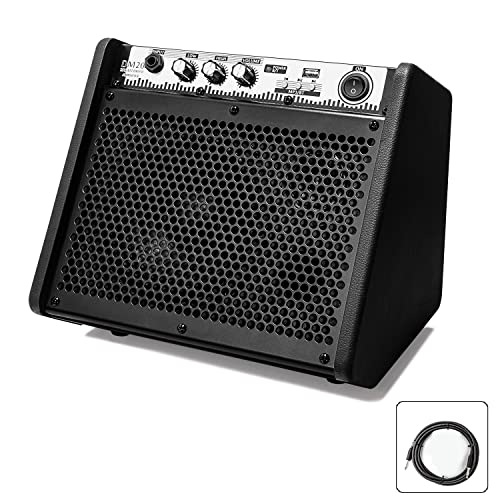
The Coolmusic DM20 is a 20W Bluetooth personal monitor amplifier designed as a compact speaker for electronic drums, keyboards, and other instruments. It stands out with its dual-speaker setup, including a 6.5-inch woofer for deep bass and a 2-inch tweeter for sharp treble, making it a go-to choice for musicians practicing at home or in lessons.
Targeted at drummers and keyboardists, this speaker excels in real-world scenarios like family jam sessions or individual skill-building. Connect your e-drum via the included noise-reduction cable for clean, feedback-free sound, or pair via Bluetooth to add backing tracks from your phone. The USB interface adds flexibility by letting you plug in a drive for MP3 playback.
In performance tests, it delivers balanced audio that punches above its size, ideal for monitoring without overwhelming volume. While not suited for gigs, its portability shines for daily use. Overall verdict: a smart, affordable pick for aspiring musicians seeking reliable practice amplification.
The DM20's sound profile features punchy bass from the 6.5-inch woofer, perfect for electronic drum kicks and keyboard lows, paired with clear treble from the 2-inch tweeter that brings out cymbals and vocals sharply. At 20W, it reaches room-filling volumes without distortion in small spaces, making practice sessions feel professional.
Bluetooth connectivity is stable up to 30 feet, allowing lag-free streaming of background music from phones or tablets. USB playback handles various formats smoothly, ensuring consistent performance across inputs. It's tailored for monitoring, so expect focused, accurate reproduction over party-boom effects.
This speaker boasts a sleek black portable design, small enough to carry in one hand and lightweight for easy transport to lessons or practice spots. Its rugged build handles everyday home use, though it lacks IP ratings for water or dust resistance, so keep it indoors.
Power comes via AC adapter, not a built-in battery, enabling unlimited playback time when plugged in, with quick setup for stationary sessions. No charging downtime means it's always ready, prioritizing reliability over cordless freedom for musicians focused on consistent monitoring.

Pros
- Seamless dual-mode playback with stable Bluetooth 5.3 connectivity
- Versatile 5-in-1 design combines speaker, stand, charger, and lights
- Secure non-slip grips hold phones steady at any angle
- Long battery life supports extended use without frequent recharges
Cons
- No waterproof rating, so avoid use near water or outdoors in rain
- Induction mode may vary by phone model compatibility
- Best for small spaces, not ideal for large parties needing max volume
The AIKELA Induction Speaker is a clever 5-in-1 gadget that serves as a wireless speaker, phone stand, charger, power bank, and LED light show. It shines in everyday scenarios like propping up your phone for recipe videos in the kitchen, hands-free calls in the home office, or background music while working. The induction mode lets you drop your iPhone or Android right on top for instant sound without fumbling for Bluetooth connections.
In real-world testing based on its specs, it delivers reliable performance for casual listening and multitasking. The rotatable stand adjusts to perfect angles, keeping your device secure with silicone grips. It's compact enough to toss in a bag for travel yet sturdy for desk use, making it a practical pick for busy Americans juggling work and home life.
Music lovers appreciate the balanced sound profile, while gift shoppers love its appeal for birthdays or holidays. Overall verdict: a smart, affordable upgrade for anyone tired of tangled cables and weak phone speakers. Highly recommended for tech-savvy users seeking convenience without complexity.
Expect deep bass that punches through for tracks with low-end drive, paired with tight mids and crystal-clear highs for vocals and instruments. Volume levels handle small rooms effortlessly, making it great for personal listening during video calls or cooking sessions without distortion at moderate settings.
Bluetooth 5.3 ensures stable connections up close, with induction mode offering lag-free playback by simply placing your phone on the stand. This dual approach breaks Bluetooth limitations, ideal for quick switches between devices in busy kitchens or offices.
While not stadium-loud, the sound signature suits lifestyle use like podcasts, playlists, or Zoom meetings, delivering crisp audio that enhances daily routines.
The sleek black design is lightweight and portable, slipping easily into bags for on-the-go use, with a stable base that grips desks or counters. The 360-degree rotating stand offers flexible positioning, and non-slip silicone ensures your phone stays put during long sessions. No rugged IP rating means it's best for indoor lifestyles, avoiding splashes or dust-heavy environments.
Battery life hits up to 8 hours of playback after a quick 2-hour Type-C charge, supporting all-day home office shifts or weekend vibes. It doubles as a power bank to top up your phone in emergencies, adding real travel value without bulk.
Overall, the build prioritizes everyday portability over extreme durability, perfect for urban commuters or homebodies who value convenience and style.
Understanding the Role of an Amplifier in Speaker Systems
The primary use of an amplifier in a speaker system is to boost low-voltage electrical audio signals to a level strong enough to physically move speaker cones. Sources like phones, digital players, and instruments produce tiny signals measured in fractions of a volt. A speaker cone needs substantial wattage and current to create audible acoustic pressure waves. Amplifiers bridge this physical gap by multiplying the incoming signal while preserving the original musical waveform.
Converting Weak Audio Signals into Physical Sound Waves
Audio playback begins with electronic data that represents recorded or synthesized sound. Media players convert this data into an alternating electrical current called a line-level signal. While this signal carries complete pitch and timing information, it lacks physical power. Routing line-level audio directly into a raw speaker driver produces almost no sound because the tiny current cannot move the mechanical assembly.
Speaker drivers rely on electromagnetic force to produce sound. Inside a dynamic driver, a lightweight voice coil sits within the magnetic field of a stationary magnet. When amplified current flows through the coil, it creates an alternating magnetic field that pushes and pulls against the magnet. This mechanical motion forces the speaker cone back and forth, displacing surrounding air to create sound waves.
The amplifier acts as the electrical engine powering this physical excursion. Increasing voltage and current gives the voice coil enough energy to overcome mechanical resistance from the cone suspension. Without this boost, speaker cones cannot displace enough air volume to fill a room. Amplification is therefore the critical link turning electronic signal data into audible acoustic energy.
Preamp Versus Power Amp: Two Stages of Amplification
Audio amplification involves two distinct operational stages known as preamplification and power amplification. The preamplifier receives delicate signals from microphones, musical instruments, or digital players. Its role is to boost these tiny voltages up to a standardized line level, usually around one or two volts. During this stage, the preamp also manages volume attenuation, input switching, and tone equalization.
The power amplifier stage takes over once the signal reaches a clean line level. Rather than handling subtle tone adjustments, the power amp focuses on delivering substantial wattage and electrical current. It multiplies the incoming voltage and supplies the amperage required to drive low-impedance speaker loads. Isolating this high-current stage protects sensitive control circuits from thermal stress and electrical noise.
Many home systems combine both stages into a single chassis called an integrated amplifier or stereo receiver. Standalone instrument monitors and powered speakers also house these stages together internally. In professional installations, engineers often keep preamplifiers and power amplifiers in separate chassis. This physical separation prevents noise interference and provides flexibility when matching power output to custom speaker cabinets.
Active Versus Passive Speakers: Where Does the Amplifier Live?
Every dynamic speaker requires amplification, but the location of the amplifier defines whether a speaker is active or passive. Passive speakers contain no internal power amplifiers and rely entirely on external receivers or power amps. Speaker cables deliver amplified signals directly to internal crossover networks that divide frequencies among tweeters and woofers. Audio enthusiasts often choose passive models because they allow separate component upgrades over time.
Active speakers integrate the amplification circuitry directly inside the speaker enclosure. Line-level signals route into built-in amplifiers that are precisely matched to the specific drivers. Looking at modern Bluetooth stereo speakers highlights how built-in amplification creates simple plug-and-play systems without bulky external boxes. Dedicated internal amplifiers also allow manufacturers to install electronic limiters that protect drivers from dangerous distortion.
Deciding between active and passive speakers depends on your available space and personal setup preferences. Active speakers minimize desktop clutter by reducing cabling to a simple power cord and audio input. Passive systems provide greater long-term flexibility to swap amplifiers as room sizes or listening needs expand. Both configurations rely on identical power principles, differing primarily in cabinet packaging and component integration.
Driver Control and Damping: Moving Cones with Precision
An effective amplifier does more than push a speaker cone forward; it must stop the cone when the signal ends. When an electrical pulse stops, mechanical inertia causes the cone to keep vibrating like a spring. This lingering motion creates cone ringing, resulting in boomy bass and muffled musical detail. A capable amplifier prevents this unwanted vibration through an electrical property known as damping factor.
Damping works because a moving voice coil within a magnetic field generates reverse electrical energy called back electromotive force. A quality amplifier has very low internal output impedance, functioning as an electrical brake against this reverse current. This electrical resistance quickly absorbs kinetic energy from the rebounding cone, stopping unwanted oscillations immediately. The cone halts precisely when the audio waveform commands it to stop.
High damping control produces tight bass notes, sharp percussion strikes, and clear vocal reproduction. Without sufficient damping, low-frequency notes blur together and overwhelm subtle midrange details. Selecting an amplifier with solid driver control keeps heavy woofers behaving predictably during complex musical passages. Controlling driver momentum is just as important for clean sound as raw wattage output.
Matching Power Ratings and Impedance Safely
Selecting an amplifier requires understanding electrical impedance and continuous power ratings. Impedance, measured in ohms, represents the electrical resistance a speaker presents to an incoming current. Most consumer home speakers carry nominal ratings of four, six, or eight ohms. Lower impedance draws more electrical current from the amplifier, requiring robust power supplies and output transistors to prevent thermal overloads.
Connecting four-ohm speakers to an amplifier rated strictly for eight ohms can cause dangerous overheating. High-impedance speakers connected to low-impedance amplifiers operate safely, though maximum volume output will be slightly lower. Checking manufacturer documentation confirms whether an amplifier can safely drive your speaker load across the audible spectrum. Proper electrical matching prevents damaged voice coils and blown amplifier channels.
Continuous power, listed as root-mean-square wattage, measures the sustained clean output an amplifier delivers without distorting. Peak power ratings sound impressive in marketing materials, but they only reflect brief output bursts lasting milliseconds. Evaluating root-mean-square figures gives a realistic picture of room-filling volume and clean sound capability. Always match amplifier output to the recommended power range printed on your speaker cabinet.
Headroom and Clipping: Why Clean Power Protects Speakers
Many listeners believe that high-powered amplifiers are the most common cause of blown speaker drivers. In practice, underpowered amplifiers pushed beyond their clean limits destroy far more drivers through amplifier clipping. When an amplifier lacks voltage reserve to reproduce sudden volume peaks, it shears off the waveform peaks. This flattens smooth sound waves into distorted square waves that deliver harsh direct current into speaker voice coils.
Clipping creates intense high-frequency harmonics that funnel straight into delicate tweeters, rapidly overheating their fine voice coils. Pushing a low-wattage amplifier to extreme volumes often destroys speakers faster than using a powerful, clean amplifier. Maintaining dynamic headroom ensures that musical transients pass through cleanly without waveform flattening. Connecting capable amplification to speakers with balanced sound preserves acoustic clarity and keeps drivers operating within safe thermal limits.
Headroom provides a safety buffer between typical listening levels and the absolute maximum output of an amplifier. This extra power reserve allows drum strikes, orchestral crescendos, and movie explosions to reproduce with natural dynamics. Systems with ample headroom sound open, effortless, and easy on the ears during long listening sessions. Clean power delivery protects speaker investments while preserving dynamic audio fidelity.
Real-World Applications: From Compact Desk Audio to Instrument Monitors
Amplifier designs vary widely depending on the listening task and physical environment. In personal audio setups, compact engineering integrates small amplifier circuits directly with modern source connections. For example, the Induction Speaker with Phone Stand 5 in 1 shows how miniature amplification can boost mobile phone sound through magnetic induction or Bluetooth 5.3 wireless links. This compact device pairs a rechargeable battery, rotating stand, and internal drivers to amplify mobile audio conveniently on a desk.
Musicians and performers require specialized amplification built to withstand broad dynamic swings and percussive transients. The Coolmusic DM20 20W Bluetooth Personal Monitor illustrates this approach by pairing an internal 20W amplifier with a 6.5-inch woofer and 2-inch tweeter. Engineered for electronic drums, keyboards, and practice sessions, this monitor uses separate drivers and dedicated power to reproduce instrument dynamics cleanly. Features like Bluetooth connectivity, USB playback, and noise-reduction cabling highlight how integrated amplifiers serve specific performance needs.
Comparing these products shows that amplifier engineering reflects specific user priorities and acoustic demands. A portable desk speaker emphasizes space-saving integration, battery runtime, and multi-function convenience for casual listening. A dedicated instrument monitor focuses on clean power handling, multi-frequency driver separation, and versatile input connections. Both devices demonstrate that effective amplification is essential for converting electrical signals into audible, controlled acoustic energy.
Diagnosing Common Amplifier and Speaker Signal Problems
Troubleshooting audio issues begins by isolating whether distortion originates in the source, the amplifier, or the speaker drivers. If sound turns harsh or raspy at elevated volumes, the amplifier is likely exceeding its clean power limits. Lowering source volume or master gain helps identify whether distortion stems from clipping or a torn speaker cone. Managing source levels prevents sending an overloaded signal into the input stage.
A continuous low-frequency hum that persists across all volume settings usually indicates a ground loop in the electrical wiring. Ground loops happen when interconnected audio gear shares uneven electrical grounding potentials, introducing mains noise into audio paths. Plugging all connected equipment into the same power strip often eliminates this annoying hum. Inspecting audio interconnects for frayed shielding or corroded connectors is another safe step that resolves signal noise.
Sudden silence from speaker channels often points to triggered protective circuits rather than blown internal components. Modern amplifiers include thermal sensors and short-circuit protection that disconnect speaker terminals when operating conditions become dangerous. Turning off the amplifier, unplugging power, and checking for stray speaker wire strands touching the metal chassis can resolve short circuits. Ensuring proper ventilation around the amplifier allows thermal switches to cool and reset normally.
Practical Guidelines for Optimizing Your Audio Signal Chain
Achieving clean sound from your speakers requires careful attention to proper gain staging across your audio chain. Gain staging involves adjusting output levels on each connected device so components operate within their cleanest dynamic range. Setting source volume between seventy and eighty percent preserves high signal-to-noise ratios without causing digital distortion. You can then use your amplifier master volume control to set comfortable room listening levels.
Physical cable management and amplifier placement also directly affect sound quality and hardware longevity. Use quality copper speaker cables with appropriate thickness to minimize resistive power loss across room runs. Route audio cables away from high-voltage household power cords to prevent electromagnetic interference from bleeding into your speakers. Providing adequate space around your amplifier chassis prevents heat buildup, ensuring stable performance and long component life.
An amplifier serves as the indispensable powerhouse behind any speaker, transforming fragile electronic signals into dynamic sound waves. Understanding how amplification controls cone movement, provides dynamic headroom, and prevents damaging clipping helps you build reliable sound systems. Matching component impedances, allowing adequate cooling, and maintaining clean signal paths ensures balanced, distortion-free listening across any room or practice space.




Write Your Review
No reviews yet. Be the first to share your experience!