
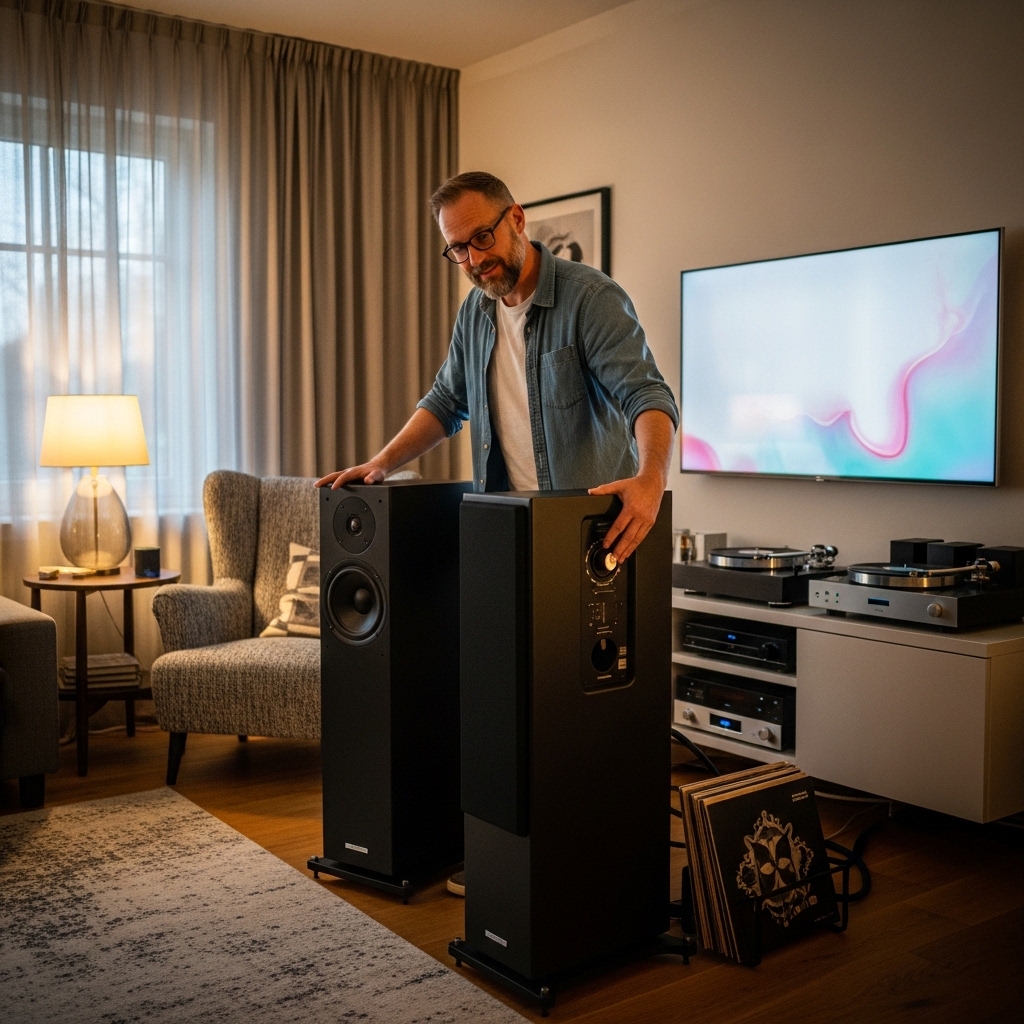

Setting up a dedicated home stereo or media space often brings listeners face to face with equipment choices that feel surprisingly complicated. Anyone exploring standalone audio hardware will inevitably ask, %what are passive speakers% and why do they lack built-in power cords or volume dials? Unlike self-contained desk units, these traditional audio enclosures contain only drivers and internal crossover circuitry, meaning they depend entirely on an external receiver or amplifier to generate sound. Understanding this fundamental architecture is essential before buying equipment, as pairing them incorrectly can lead to weak output or distorted playback. Many music enthusiasts still favor this approach because connecting to traditional stereo loudspeakers allows complete freedom to upgrade amplification components over time.
While modern powered monitors offer plug-and-play simplicity, passive cabinets remain the backbone of custom listening rooms and surround-sound home theaters. Because passive units do not house heavy internal amplification hardware or digital processing boards, manufacturers can dedicate cabinet volume and budget entirely to driver engineering and acoustic damping. The result is often exceptional acoustic balance, reliable physical construction, and long service life across decades of use. Deciding whether a passive configuration fits your listening habits requires examining how audio signals travel from your source device, through amplification hardware, and into your room.


Pros
- Crisp high-frequency reproduction via dedicated silk horn tweeters
- Space-saving form factor with pre-installed wall-mounting hooks
- Acoustically damped wood cabinet limits unwanted resonance
- Includes basic speaker wire to jumpstart your audio setup
Cons
- Requires a standalone amplifier or AV receiver to operate
- Bass drops off below 60Hz, making an active subwoofer necessary for deep low-end rumble
- Lacks modern integrated wireless connectivity such as Bluetooth or Wi-Fi
The Elimavi Passive Bookshelf Speakers offer an accessible gateway into component stereo listening, geared toward audio enthusiasts who prefer the flexibility of choosing their own amplification. Whether you are assembling your first dedicated turntable setup or outfitting a secondary media room with satellite audio, this stereo pair provides a classic two-way layout without the digital obsolescence that often accompanies all-in-one active monitors.
In practical listening environments like bedrooms, home offices, and small living rooms, these speakers reveal their primary strength: vocal articulation and acoustic balance. Driven by a standard stereo receiver, the 4-inch woofers handle dialogue, rhythm sections, and classic vinyl pressings with reassuring poise, while the silk horn tweeters disperse upper-register energy smoothly across your listening space.
Setup is straightforward for anyone familiar with traditional Hi-Fi hardware. With the included wire and rear-mounted hardware, you can easily position them on a desk or mount them on studs to create a clean, floating stereo image. Their compact dimensions make them particularly well suited for small-scale desktop nearfield monitoring or home theater rear surround duty.
For listeners who value modularity and straightforward analog architecture, the Elimavi pair provides solid performance. While bass lovers will eventually want to integrate a powered subwoofer for full-frequency impact, these cabinets serve as an honest and adaptable foundation for everyday music and media listening.
Across the frequency spectrum, the Elimavi speakers exhibit a lively, mid-focused acoustic presentation spanning a rated 60Hz to 20kHz range. The silk horn tweeter is the standout acoustic element, dispersing treble evenly across your listening axis to highlight guitar picking, cymbals, and vocal textures without deteriorating into the harsh, metallic sibilance common in budget speakers.
Mid-bass performance from the 4-inch woofer is fast and punchy. Kick drums and bass guitars come through with clear rhythmic timing rather than bloated low-end drone. While physical limits naturally prevent these compact boxes from reproducing subterranean sub-bass frequencies below 60Hz, the driver damping ensures rapid transient recovery, keeping complex instrumental tracks distinct and uncluttered.
When set up in a traditional equilateral triangle configuration, these speakers produce an impressively coherent soundstage. The stereo imaging separates instruments neatly across the left and right channels while pinning the central vocal phantom image securely in the middle, resulting in an engaging and dimensional listening experience.
Crafted from dense wood composite with a classic black veneer, the Elimavi cabinets are engineered to mitigate unwanted vibrations that cause acoustic smearing. Measuring 6.1 by 5.11 by 8.66 inches, they boast a minimal physical footprint that tucks neatly into tight shelving, apartment work desks, or standard speaker stands.
A thoughtful addition to the rear panel is the integrated metal hanging hardware. This built-in hook setup simplifies wall mounting, making these speakers a convenient choice for background music in cafes, small dining areas, or elevation channels in a budget surround-sound theater setup.
Because these are traditional passive speakers, they contain no onboard power, battery, or digital decoding hardware. They require connection to an external amplifier or receiver delivering speaker-level output. Standard terminal connections on the back facilitate quick hookup using the included speaker cable or your own preferred speaker wire.
Pros
- Exceptional treble detail from high-quality silk dome tweeters
- Balanced bass response enhanced by reflex port and 4-inch drivers
- Convenient built-in wall-mount for flexible home theater placement
- Low 6-ohm impedance ensures compatibility with standard amps
- Attractive wood finish complements modern home decor
Cons
- Requires separate amplifier or receiver - no built-in power
- Wired connection only, lacks wireless Bluetooth convenience
- Bass depth fully depends on amp quality and power output
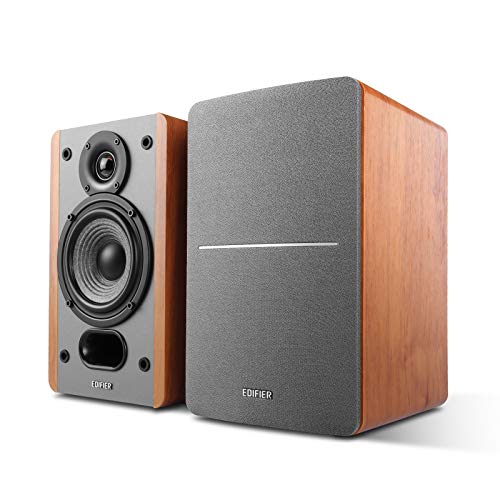
The Edifier P12 are passive bookshelf speakers designed for users who want high-fidelity audio without built-in amplification. This pair features 19mm silk dome tweeters for precise highs and 4-inch drivers with a bass reflex port for natural, balanced sound. Ideal for audiophiles building a custom setup, they shine as rear surrounds in home theaters or mains on a desktop when paired with an amplifier.
In real-world use, connect them to your receiver via included speaker wires, and they fill rooms with immersive audio for music or movies. The wood enclosure adds a premium aesthetic, while the built-in wall-mount brackets make installation straightforward for surround sound systems. They handle detailed playback well, reproducing vocals and instruments with clarity.
Targeted at budget-savvy listeners who prioritize sound quality over convenience, the P12 excel in controlled environments like living rooms or offices. Their 6-ohm impedance ensures broad amp compatibility. Verdict: A smart choice for wired audio enthusiasts seeking value-packed passive speakers that punch above their price.
The Edifier P12 deliver a balanced sound signature with silk dome tweeters providing exceptional treble detail, capturing cymbals, hi-hats, and high vocals with finesse. The 4-inch bass drivers, aided by a rear reflex port, produce natural low-end extension suitable for rock, jazz, or movie soundtracks, avoiding muddiness in mids.
Volume levels scale impressively with amplifier power, filling medium rooms without distortion when driven properly. Vocal clarity stands out, making dialogue in films sharp and engaging. Performance hinges on your amp choice, rewarding quality sources with immersive, room-filling audio.
As passive speakers, they offer stable, wired connectivity with no dropouts, outperforming wireless options in fidelity for critical listening sessions.
The Edifier P12 boast a sleek wood finish that blends seamlessly into home decor, with a compact bookshelf form factor perfect for shelves or stands. Built-in wall-mount brackets allow secure hanging as rear speakers, saving floor space and enabling true surround setups without extra hardware.
Build quality feels solid, with the enclosure tuned for resonance-free sound. At 6-ohm impedance, they pair efficiently with amps, drawing power as needed for sustained performance. No battery means unlimited playback - simply keep your amplifier powered for all-day listening without recharges.
Rugged enough for indoor use, they resist everyday knocks better than plastic rivals, though not rated for outdoor exposure. Weight supports stable mounting, prioritizing audio purity over portability.

Pros
- Compact size packs powerful full-range sound without dominating space
- Effortless wall-mounting with adjustable brackets for perfect surround angles
- Waterproof sealing option enables reliable indoor-outdoor versatility
- Dual bass ports deliver deeper bass than typical bookshelf speakers this size
- Shockproof design minimizes vibrations for cleaner audio playback
Cons
- Requires separate amplifier or receiver to operate, no built-in power
- Speaker wires not included, adding to setup cost
- Bass depth limited by small size compared to larger floorstanders


Pros
- Exceptionally compact cabinet fits spaces where standard bookshelf speakers cannot.
- Crisp treble clarity and intelligible vocal reproduction for movies, gaming, and podcasts.
- Built-in wall mounting brackets and shockproof tabs simplify rear satellite placement.
- Attractive wood grain aesthetic complements modern home decor.
Cons
- Requires a separate external amplifier or AV receiver and speaker wire to operate.
- Small 2.75-inch woofers cannot produce deep sub-bass and require a subwoofer for full-range home theater audio.
- Lacks wireless or Bluetooth connectivity out of the box.
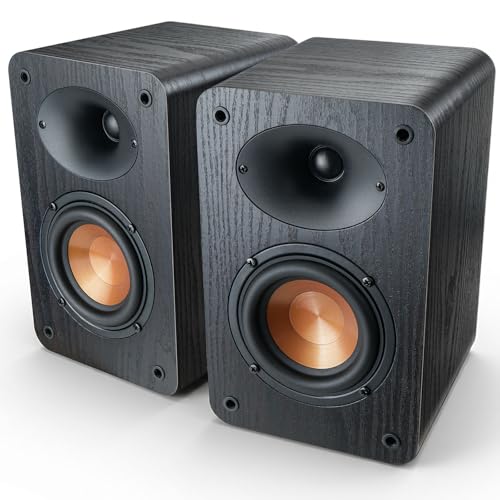
The RIOWOIS Passive Bookshelf Speakers offer a smart, space-saving solution for listeners looking to assemble a budget-friendly home theater or desktop audio rig. Measuring just 6.6 inches high and 4.3 inches wide, this passive pair is designed to fit where standard bookshelf units are simply too bulky. Whether you need rear surround satellites to complete your multi-channel movie setup or compact desktop speakers powered by a mini amplifier, these enclosures provide a focused acoustic profile without dominating your room.
Under the hood, RIOWOIS utilizes a dedicated two-way driver arrangement that pairs a 2.75-inch mid-woofer with a 2-inch tweeter. This design separates the frequency spectrum more cleanly than single full-range drivers found in many micro monitors. In everyday listening, dialogue sounds articulate and distinct, making dialogue-heavy television shows, acoustic playlists, and gaming sessions clear and intelligible even at lower listening volumes.
It is important to remember that these are completely passive loudspeakers with a 6-ohm nominal impedance. They do not feature built-in amplification, Bluetooth, or volume knobs, so you will need an external receiver or desktop stereo amp along with standard speaker wire to get them singing. Pairing them with a modest class-D mini amplifier yields a capable, reliable sound system with zero wireless latency or software headaches.
For shoppers seeking affordable, handsome satellite speakers that handle vocal clarity and subtle background effects reliably, the RIOWOIS passive pair delivers excellent utility. While bass enthusiasts will definitely want to pair them with an active subwoofer, their ease of mounting and attractive styling make them a worthwhile addition to any entry-level audio setup.
Acoustically, the RIOWOIS bookshelf speakers deliver a bright, vocal-centric signature tuned for clarity. The 2-inch tweeter generates crisp highs that help ambient sound effects, percussion, and movie dialogue cut through the mix without sounding overly harsh. Midrange frequencies remain uncluttered, allowing speech and acoustic instruments to maintain realistic presence in nearfield environments.
Low-end extension is naturally constrained by the compact 2.75-inch woofer. While the drivers produce snappy mid-bass punches suitable for casual listening, they roll off well before true sub-bass territory. When integrated into a 5.1 home theater or paired with a standalone powered subwoofer, these units perform admirably as dedicated satellites, offloading high-energy low frequencies to a sub while handling localized surround imaging effectively.
Capable of handling peak power up to 30 watts, these speakers can reach room-filling volume levels in small to medium rooms without introducing noticeable driver distortion. Their nearfield imaging on a desktop is remarkably focused, providing a coherent stereo image that enhances PC gaming and work-from-home multimedia setups.
Crafted with a rigid cabinet wrapped in an eye-catching 3D wood grain finish, the RIOWOIS speakers blend classic Hi-Fi aesthetics with modern decor. The tactile surface resists smudges and looks sophisticated alongside turntables or modern flat-panel displays. The micro-footprint dimensions of roughly 4.3 inches wide by 6.6 inches high make them easy to place on floating shelves, mantlepieces, or workstation side corners.
The rear panels are engineered specifically for effortless deployment. Each speaker features an integrated mounting hook and vibration-dampening shockproof tabs, allowing you to flush-mount them directly to drywall or corner studs using the included installation accessories. Spring clip terminals on the back accept standard gauge bare speaker wire, making connections to an AV receiver or stereo amp straightforward.
Rated at a 6-ohm impedance, these speakers are safe and easy to drive using virtually any modern AV receiver or budget mini desktop amplifier rated between 15 and 50 watts per channel. The passive architecture ensures long-term durability, letting you upgrade your DAC, amplifier, or source components down the road without replacing the speakers themselves.
Understanding Passive Speaker Architecture and Audio System Design
Passive speakers are acoustic loudspeakers that do not contain internal power amplifiers. They rely on an incoming amplified electrical signal sent through speaker wire from an external receiver or amplifier. Inside the cabinet, that electrical energy passes through an analog crossover network that directs specific frequency ranges to the drivers. Because there is no internal power plug, passive speakers remain inert until connected to an external audio power source.
How Passive Speakers Process Amplified Audio Signals
Sound reproduction in a passive speaker begins when an audio source sends a line-level signal to an external amplifier or receiver. The amplifier strengthens this low-voltage signal into a high-current stream capable of driving physical mechanical components. This amplified current travels down copper speaker wire and enters the cabinet through binding posts or spring terminals on the rear panel.
Once inside the enclosure, the electrical signal encounters an analog crossover circuit assembled from passive components like capacitors, inductors, and resistors. This network divides the incoming frequency spectrum so that delicate tweeters receive high frequencies, while larger woofers handle lower bass tones. The divided current then activates the driver voice coils, causing the speaker cones to vibrate and project balanced sound waves into your room.
Key Architectural Differences Between Passive and Active Cabinets
Choosing between audio designs requires understanding how passive cabinets differ structurally from active alternatives. Active speakers house dedicated internal amplifiers, digital-to-analog converters, and volume controls directly inside the enclosure, requiring a wall power outlet. In contrast, passive enclosures remain completely unpowered, containing only the acoustic drivers, internal wiring, crossover board, and cabinet dampening materials. This fundamental difference means passive cabinets dedicate their entire internal volume strictly to driver resonance and air displacement.
Modular flexibility is one of the most prominent practical advantages of an unpowered speaker setup. If you decide to upgrade to a higher-wattage amplifier or add modern streaming features, your speakers remain completely relevant. Unlike all-in-one powered systems where a single electronic failure can disable the entire unit, passive cabinets allow every component in the audio chain to be replaced independently. Listeners who transition away from standalone powered Bluetooth speakers often discover that passive systems offer superior longevity and customizable tone.
Passive systems also eliminate the internal thermal stress that compact powered monitors frequently endure. Amplifiers generate substantial heat during prolonged playback, and sealing an amplifier circuit board inside an acoustic enclosure can expose components to elevated temperatures. By housing the power supply and amplification stages in a ventilated external chassis, passive cabinets run cooler and face fewer electronic degradation risks over time.
Matching Amplifiers and Receivers to Passive Enclosures
Safe and effective operation of passive speakers depends entirely on proper electrical matching between the external amplifier and the speaker cabinet. The most critical metric to verify is nominal impedance, which represents electrical resistance and is measured in ohms. Common bookshelf speakers typically feature impedance ratings of 4 ohms, 6 ohms, or 8 ohms across their operating band. An amplifier must be explicitly rated to handle the chosen load, as connecting low-impedance 4-ohm speakers to an amplifier rated only for 8 ohms can cause overheating or protective shutdown.
Power handling ratings also demand careful evaluation when selecting equipment. Manufacturers provide continuous wattage ratings (often designated as RMS) alongside peak power figures, representing the thermal limits of the speaker voice coils. For instance, compact bookshelf models may list continuous ratings between 15 watts and 50 watts, with peak handling reaching higher thresholds during dynamic bursts. Pairing speakers with an amplifier that delivers adequate clean power within the recommended range prevents audible distortion and protects delicate tweeters.
Amplifier clipping occurs when an underpowered amplifier is pushed beyond its maximum clean output capability to reach high listening volumes. When pushed into clipping, the amplifier truncates the audio waveform, creating direct-current square waves filled with harsh harmonic distortion. This sustained electrical energy travels directly into the delicate silk dome tweeter, potentially burning out the voice coil within minutes. Using an amplifier with comfortable headroom allows musical peaks to resolve cleanly without risking driver damage.
Driver Configurations: Full-Range, Two-Way, and Three-Way Enclosures
The mechanical configuration of drivers inside a passive enclosure directly dictates how effectively it reproduces various musical frequencies. Single full-range designs utilize a solitary driver, typically measuring around three inches, to handle the entire audible spectrum from low bass up to high treble. While full-range drivers provide pinpoint imaging and eliminate crossover phase shifts, they naturally struggle to reproduce deep bass and sparkling treble simultaneously. These compact enclosures often excel as satellite channels in surround-sound setups or nearfield desk monitors.
Two-way passive speakers resolve these bandwidth limitations by splitting the audio spectrum between two specialized drivers. A dedicated woofer, typically measuring between 2.75 inches and 4 inches in compact bookshelf units, reproduces lower frequencies and midrange tones. Above it, a separate high-frequency driver, such as a silk dome or horn-loaded tweeter, focuses exclusively on upper harmonics and treble. This division allows each driver cone to operate within its optimal physical dispersion band, resulting in cleaner dialogue clarity and improved instrument separation.
Three-way enclosures represent an even more specialized approach to acoustic frequency division. In a true three-way configuration, a dedicated woofer handles low-end bass, an independent midrange driver reproduces vocals, and a silk dome tweeter resolves high frequencies. Dividing the spectrum into three distinct frequency bands prevents intense bass excursions from muddying vocal clarity. Similar engineering principles are found in specialized multi-driver component speakers, where isolating individual frequency bands yields a much wider and more stable horizontal soundstage.
Speaker Wire, Terminals, and Connection Methods
Transmitting an amplified audio signal from a receiver to a passive speaker cabinet requires appropriate speaker cabling and secure physical terminations. Rear connection terminals on passive speakers typically consist of spring-loaded wire clips or threaded binding posts made of zinc alloy or gold-plated brass. Threaded binding posts offer superior connection stability, allowing users to connect bare wire, spade connectors, or standard banana plugs. Banana plugs provide quick, secure disconnects that protect delicate copper wire strands from fraying or shorting out against adjacent metal components.
Selecting the right speaker wire gauge is another important consideration for preserving audio fidelity over distance. American Wire Gauge (AWG) numbers represent wire thickness inversely, meaning lower numbers denote thicker copper conductors. For short desktop cable runs under ten feet, standard 16-gauge speaker wire offers more than enough conductive capacity with negligible resistance. When running speaker cables over longer distances to surround-sound positions or across large living rooms, stepping up to 14-gauge or 12-gauge wire minimizes resistance and maintains full bass damping factors.
Maintaining proper electrical polarity during installation is vital for balanced stereo imaging and accurate acoustic response. Speaker cables and cabinet terminals are labeled with positive (red) and negative (black) markings that must correspond exactly between the amplifier output and the speaker input. If one speaker is accidentally wired out of phase with reversed polarity, the acoustic cones will move in opposite directions simultaneously. This phase cancellation causes bass frequencies to disappear almost entirely, leaving the stereo soundstage sounding diffuse, hollow, and detached.
Acoustic Enclosure Designs, Port Tuning, and Room Placement
Cabinet construction and port architecture dramatically influence the low-frequency performance of any passive speaker enclosure. Many compact bookshelf designs feature bass reflex enclosures with tuned cylindrical ports on the rear or front baffle. As the woofer cone moves backward into the cabinet, air pressure escapes through the port tube, reinforcing low-frequency sound waves and extending bass response down toward 60Hz or 48Hz. In contrast, sealed acoustic suspension cabinets offer tighter transient speed but require significantly more amplifier power to generate comparable bass volume.
Positioning a rear-ported passive speaker directly against an interior wall causes acoustic boundary reinforcement that can produce boomy, uncontrolled bass. Because bass energy radiates spherically, proximity to room boundaries artificially amplifies lower frequencies at the expense of midrange vocal definition. Many manufacturers provide removable acoustic foam plugs, often referred to as port bungs, that can be inserted into the reflex opening. Inserting these dense foam cylinders restricts cabinet airflow, transforming the enclosure into a semi-sealed box that tames unwanted room resonance when placement on a tight bookshelf is unavoidable.
Mounting passive speakers on walls or sturdy stands requires careful attention to physical vibration decoupling and listening height. Integrated rear mounting brackets and keyhole slots allow compact satellite cabinets to be hung directly on drywall anchors or wall studs. However, placing uninsulated wood cabinets against hard vertical surfaces can transmit unwanted mechanical vibrations into the wall structure. Using integrated foam padding tabs or rubber isolation bumpers between the cabinet back and the wall surface decouples mechanical energy, ensuring clear sound reproduction without wall rattle.
Practical Troubleshooting for Passive Speaker Systems
Diagnosing an issue in a passive audio setup requires systematically isolating components along the physical signal path. If a speaker produces no sound whatsoever, the failure rarely originates inside the passive cabinet itself, as crossover circuits have no active electronic switches to trip. Begin by verifying that the external receiver or amplifier is powered on, set to the correct input channel, and assigned to the active speaker output terminals. Next, inspect the rear binding posts on both the amplifier and the speaker to ensure copper wire conductors are clamped tightly and have not slipped out of contact.
When sound output is present but lacks bass weight or sounds localized inside the listener’s head, an acoustic phase mismatch is the most probable culprit. Trace the positive and negative conductors on your speaker cable from the amplifier outputs directly to the corresponding terminals on each cabinet. Even a single crossed wire channel will cause severe acoustic cancellation in the bass and lower-midrange regions. Swapping the reversed wires back to their matching red-to-red and black-to-black configuration immediately restores solid bass impact and locks the vocal image firmly into the center of the soundstage.
Audible crackling, rasping, or harsh distortion during loud musical passages suggests either an amplifier clipping problem or mechanical voice coil damage. If the distortion occurs equally across both channels at elevated volumes, the external amplifier is likely running out of clean voltage swing and clipping its output stages. Lowering the volume should immediately clear the distortion if the amplifier is simply being overdriven. If the rasping sound persists from one specific speaker even at low volume, gently pressing the woofer cone straight back can detect friction, where a scratching sensation indicates a warped voice coil that requires replacement.
Evaluating Passive Speakers for Your Listening Space
Determining whether passive speakers fit your audio goals depends on your room size, available equipment, and preferred listening habits. In smaller spaces, such as bedrooms, private offices, or personal desktop workstations, compact two-way bookshelf enclosures provide exceptional vocal clarity and stereo separation without dominating valuable desk space. Because passive speakers rely on external power, you can pair them with compact desktop Class-D amplifiers that hide neatly beneath a computer monitor or behind a turntable. This creates an elegant audio setup that delivers genuine high-fidelity sound without cluttering your desk with bulky components.
Sensitivity ratings, listed in decibels (dB SPL) at one watt of power measured at one meter, indicate how efficiently a passive speaker converts electrical energy into acoustic volume. Models with sensitivity ratings around 85 dB require moderate amplifier power to achieve room-filling sound, making them ideal for small to medium listening environments. If you intend to use passive enclosures as surround-sound satellite speakers in a multi-channel home theater, verify that your multi-channel AV receiver provides adequate clean power across all active channels. Selecting matching driver materials across your front and rear channels ensures smooth acoustic transitions as cinematic sound effects pan across the room.
Investing in passive speakers provides an enduring foundation for custom high-fidelity audio listening. By separating acoustic driver engineering from digital connectivity and amplification circuitry, passive cabinets remain immune to software obsolescence and wireless protocol changes. Whether you are assembling a classic vinyl turntable station, mounting satellite speakers for movie surround sound, or building a dedicated stereo music rig, passive designs deliver outstanding modularity, mechanical durability, and long-term acoustic enjoyment.




Write Your Review
No reviews yet. Be the first to share your experience!