


Many audio enthusiasts transition away from basic all-in-one soundbars when seeking greater sonic realism and flexible room coverage. Exploring a %what are passive speakers guide% helps clarify why certain loudspeaker cabinets cannot produce sound without separate external electronics. Unlike self-powered units that plug directly into a standard wall outlet, passive models rely entirely on an external amplifier or receiver to receive both audio signals and operational current. Reviewing traditional stereo loudspeakers offers helpful perspective on how modular components interact to create expansive soundstages across home listening environments.
Choosing passive gear provides complete authority over the entire listening chain, from source inputs down to individual cabinet connections. Listeners can tailor their system by selecting dedicated power units, matching specific nominal impedance loads, and running custom lengths of speaker wire. While this modular approach requires careful attention to amplifier output ratings and physical room placement, it prevents the obsolescence common to self-contained electronics. Understanding how passive speaker cabinets function allows anyone to assemble a durable entertainment setup tailored to stereo music, desktop listening, or multichannel home theater audio.

Pros
- Crisp high-frequency reproduction via dedicated silk horn tweeters
- Space-saving form factor with pre-installed wall-mounting hooks
- Acoustically damped wood cabinet limits unwanted resonance
- Includes basic speaker wire to jumpstart your audio setup
Cons
- Requires a standalone amplifier or AV receiver to operate
- Bass drops off below 60Hz, making an active subwoofer necessary for deep low-end rumble
- Lacks modern integrated wireless connectivity such as Bluetooth or Wi-Fi
The Elimavi Passive Bookshelf Speakers offer an accessible gateway into component stereo listening, geared toward audio enthusiasts who prefer the flexibility of choosing their own amplification. Whether you are assembling your first dedicated turntable setup or outfitting a secondary media room with satellite audio, this stereo pair provides a classic two-way layout without the digital obsolescence that often accompanies all-in-one active monitors.
In practical listening environments like bedrooms, home offices, and small living rooms, these speakers reveal their primary strength: vocal articulation and acoustic balance. Driven by a standard stereo receiver, the 4-inch woofers handle dialogue, rhythm sections, and classic vinyl pressings with reassuring poise, while the silk horn tweeters disperse upper-register energy smoothly across your listening space.
Setup is straightforward for anyone familiar with traditional Hi-Fi hardware. With the included wire and rear-mounted hardware, you can easily position them on a desk or mount them on studs to create a clean, floating stereo image. Their compact dimensions make them particularly well suited for small-scale desktop nearfield monitoring or home theater rear surround duty.
For listeners who value modularity and straightforward analog architecture, the Elimavi pair provides solid performance. While bass lovers will eventually want to integrate a powered subwoofer for full-frequency impact, these cabinets serve as an honest and adaptable foundation for everyday music and media listening.
Across the frequency spectrum, the Elimavi speakers exhibit a lively, mid-focused acoustic presentation spanning a rated 60Hz to 20kHz range. The silk horn tweeter is the standout acoustic element, dispersing treble evenly across your listening axis to highlight guitar picking, cymbals, and vocal textures without deteriorating into the harsh, metallic sibilance common in budget speakers.
Mid-bass performance from the 4-inch woofer is fast and punchy. Kick drums and bass guitars come through with clear rhythmic timing rather than bloated low-end drone. While physical limits naturally prevent these compact boxes from reproducing subterranean sub-bass frequencies below 60Hz, the driver damping ensures rapid transient recovery, keeping complex instrumental tracks distinct and uncluttered.
When set up in a traditional equilateral triangle configuration, these speakers produce an impressively coherent soundstage. The stereo imaging separates instruments neatly across the left and right channels while pinning the central vocal phantom image securely in the middle, resulting in an engaging and dimensional listening experience.
Crafted from dense wood composite with a classic black veneer, the Elimavi cabinets are engineered to mitigate unwanted vibrations that cause acoustic smearing. Measuring 6.1 by 5.11 by 8.66 inches, they boast a minimal physical footprint that tucks neatly into tight shelving, apartment work desks, or standard speaker stands.
A thoughtful addition to the rear panel is the integrated metal hanging hardware. This built-in hook setup simplifies wall mounting, making these speakers a convenient choice for background music in cafes, small dining areas, or elevation channels in a budget surround-sound theater setup.
Because these are traditional passive speakers, they contain no onboard power, battery, or digital decoding hardware. They require connection to an external amplifier or receiver delivering speaker-level output. Standard terminal connections on the back facilitate quick hookup using the included speaker cable or your own preferred speaker wire.
Pros
- Exceptional treble detail from high-quality silk dome tweeters
- Balanced bass response enhanced by reflex port and 4-inch drivers
- Convenient built-in wall-mount for flexible home theater placement
- Low 6-ohm impedance ensures compatibility with standard amps
- Attractive wood finish complements modern home decor
Cons
- Requires separate amplifier or receiver - no built-in power
- Wired connection only, lacks wireless Bluetooth convenience
- Bass depth fully depends on amp quality and power output
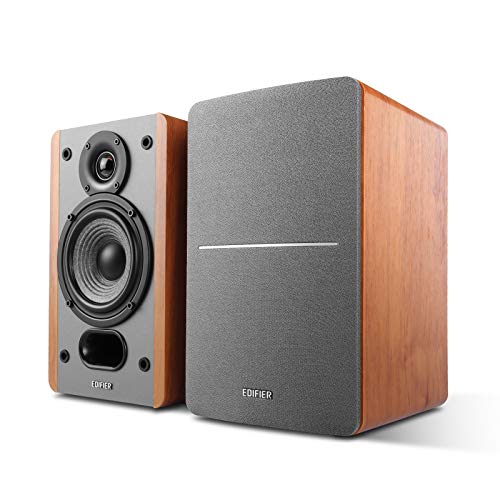
The Edifier P12 are passive bookshelf speakers designed for users who want high-fidelity audio without built-in amplification. This pair features 19mm silk dome tweeters for precise highs and 4-inch drivers with a bass reflex port for natural, balanced sound. Ideal for audiophiles building a custom setup, they shine as rear surrounds in home theaters or mains on a desktop when paired with an amplifier.
In real-world use, connect them to your receiver via included speaker wires, and they fill rooms with immersive audio for music or movies. The wood enclosure adds a premium aesthetic, while the built-in wall-mount brackets make installation straightforward for surround sound systems. They handle detailed playback well, reproducing vocals and instruments with clarity.
Targeted at budget-savvy listeners who prioritize sound quality over convenience, the P12 excel in controlled environments like living rooms or offices. Their 6-ohm impedance ensures broad amp compatibility. Verdict: A smart choice for wired audio enthusiasts seeking value-packed passive speakers that punch above their price.
The Edifier P12 deliver a balanced sound signature with silk dome tweeters providing exceptional treble detail, capturing cymbals, hi-hats, and high vocals with finesse. The 4-inch bass drivers, aided by a rear reflex port, produce natural low-end extension suitable for rock, jazz, or movie soundtracks, avoiding muddiness in mids.
Volume levels scale impressively with amplifier power, filling medium rooms without distortion when driven properly. Vocal clarity stands out, making dialogue in films sharp and engaging. Performance hinges on your amp choice, rewarding quality sources with immersive, room-filling audio.
As passive speakers, they offer stable, wired connectivity with no dropouts, outperforming wireless options in fidelity for critical listening sessions.
The Edifier P12 boast a sleek wood finish that blends seamlessly into home decor, with a compact bookshelf form factor perfect for shelves or stands. Built-in wall-mount brackets allow secure hanging as rear speakers, saving floor space and enabling true surround setups without extra hardware.
Build quality feels solid, with the enclosure tuned for resonance-free sound. At 6-ohm impedance, they pair efficiently with amps, drawing power as needed for sustained performance. No battery means unlimited playback - simply keep your amplifier powered for all-day listening without recharges.
Rugged enough for indoor use, they resist everyday knocks better than plastic rivals, though not rated for outdoor exposure. Weight supports stable mounting, prioritizing audio purity over portability.

Pros
- Compact size packs powerful full-range sound without dominating space
- Effortless wall-mounting with adjustable brackets for perfect surround angles
- Waterproof sealing option enables reliable indoor-outdoor versatility
- Dual bass ports deliver deeper bass than typical bookshelf speakers this size
- Shockproof design minimizes vibrations for cleaner audio playback
Cons
- Requires separate amplifier or receiver to operate, no built-in power
- Speaker wires not included, adding to setup cost
- Bass depth limited by small size compared to larger floorstanders

Pros
- Impressive power output at entry-level price
- Stable Bluetooth with no dropouts for smooth streaming
- Intuitive bass and treble controls for personalized sound
- Versatile for indoor or outdoor passive speaker setups
Cons
- Requires separate passive speakers to function
- Limited to Bluetooth and RCA inputs only
- No remote control or app for adjustments
The Fosi Audio BT20A is a compact Bluetooth stereo amplifier designed to breathe new life into passive speakers, delivering 100W x2 of Class D power for home audio enthusiasts on a budget. Ideal for anyone powering bookshelf, ceiling, or garage speakers without breaking the bank, it supports setups in living rooms, offices, patios, or workshops.
In real-world use, setup is a breeze with one-touch power and simple RCA or Bluetooth connections. Stream music from your phone effortlessly, and tweak bass and treble to match your room or taste. It handles small venues or multi-speaker home systems with clear, distortion-free audio at high volumes.
Who it's for: DIY audio fans wanting affordable power without complexity. Verdict: A no-frills powerhouse that punches above its weight, perfect for upgrading everyday passive speakers into a vibrant sound system.
Expect powerful, clean amplification with 100W x2 output that fills rooms with impressive volume and minimal distortion. Adjustable bass delivers punchy lows for music or movies, while treble controls ensure crisp highs and vocal clarity tailored to your speakers.
Bluetooth connectivity is rock-solid, streaming crystal-clear audio from phones without delays or dropouts, even across decent ranges in home environments. RCA inputs add flexibility for wired sources, maintaining high-fidelity sound for diverse playback.
Overall, it shines in dynamic range and customization, making it great for everything from casual listening to lively garage sessions.
The all-black, one-piece Class D design is sleek and durable, fitting neatly on shelves or benches while complementing modern home decor. Its mini footprint makes it highly portable for moving between rooms, offices, or patios.
Built tough for everyday use, it withstands regular handling in garages or casual outdoor spots, though not submersible. Weight is light enough for easy placement without permanent mounting.
Plug-in power means unlimited playback without battery worries, just reliable AC operation for non-stop audio whenever you need it.


Pros
- Exceptionally compact cabinet fits spaces where standard bookshelf speakers cannot.
- Crisp treble clarity and intelligible vocal reproduction for movies, gaming, and podcasts.
- Built-in wall mounting brackets and shockproof tabs simplify rear satellite placement.
- Attractive wood grain aesthetic complements modern home decor.
Cons
- Requires a separate external amplifier or AV receiver and speaker wire to operate.
- Small 2.75-inch woofers cannot produce deep sub-bass and require a subwoofer for full-range home theater audio.
- Lacks wireless or Bluetooth connectivity out of the box.
The RIOWOIS Passive Bookshelf Speakers offer a smart, space-saving solution for listeners looking to assemble a budget-friendly home theater or desktop audio rig. Measuring just 6.6 inches high and 4.3 inches wide, this passive pair is designed to fit where standard bookshelf units are simply too bulky. Whether you need rear surround satellites to complete your multi-channel movie setup or compact desktop speakers powered by a mini amplifier, these enclosures provide a focused acoustic profile without dominating your room.
Under the hood, RIOWOIS utilizes a dedicated two-way driver arrangement that pairs a 2.75-inch mid-woofer with a 2-inch tweeter. This design separates the frequency spectrum more cleanly than single full-range drivers found in many micro monitors. In everyday listening, dialogue sounds articulate and distinct, making dialogue-heavy television shows, acoustic playlists, and gaming sessions clear and intelligible even at lower listening volumes.
It is important to remember that these are completely passive loudspeakers with a 6-ohm nominal impedance. They do not feature built-in amplification, Bluetooth, or volume knobs, so you will need an external receiver or desktop stereo amp along with standard speaker wire to get them singing. Pairing them with a modest class-D mini amplifier yields a capable, reliable sound system with zero wireless latency or software headaches.
For shoppers seeking affordable, handsome satellite speakers that handle vocal clarity and subtle background effects reliably, the RIOWOIS passive pair delivers excellent utility. While bass enthusiasts will definitely want to pair them with an active subwoofer, their ease of mounting and attractive styling make them a worthwhile addition to any entry-level audio setup.
Acoustically, the RIOWOIS bookshelf speakers deliver a bright, vocal-centric signature tuned for clarity. The 2-inch tweeter generates crisp highs that help ambient sound effects, percussion, and movie dialogue cut through the mix without sounding overly harsh. Midrange frequencies remain uncluttered, allowing speech and acoustic instruments to maintain realistic presence in nearfield environments.
Low-end extension is naturally constrained by the compact 2.75-inch woofer. While the drivers produce snappy mid-bass punches suitable for casual listening, they roll off well before true sub-bass territory. When integrated into a 5.1 home theater or paired with a standalone powered subwoofer, these units perform admirably as dedicated satellites, offloading high-energy low frequencies to a sub while handling localized surround imaging effectively.
Capable of handling peak power up to 30 watts, these speakers can reach room-filling volume levels in small to medium rooms without introducing noticeable driver distortion. Their nearfield imaging on a desktop is remarkably focused, providing a coherent stereo image that enhances PC gaming and work-from-home multimedia setups.
Crafted with a rigid cabinet wrapped in an eye-catching 3D wood grain finish, the RIOWOIS speakers blend classic Hi-Fi aesthetics with modern decor. The tactile surface resists smudges and looks sophisticated alongside turntables or modern flat-panel displays. The micro-footprint dimensions of roughly 4.3 inches wide by 6.6 inches high make them easy to place on floating shelves, mantlepieces, or workstation side corners.
The rear panels are engineered specifically for effortless deployment. Each speaker features an integrated mounting hook and vibration-dampening shockproof tabs, allowing you to flush-mount them directly to drywall or corner studs using the included installation accessories. Spring clip terminals on the back accept standard gauge bare speaker wire, making connections to an AV receiver or stereo amp straightforward.
Rated at a 6-ohm impedance, these speakers are safe and easy to drive using virtually any modern AV receiver or budget mini desktop amplifier rated between 15 and 50 watts per channel. The passive architecture ensures long-term durability, letting you upgrade your DAC, amplifier, or source components down the road without replacing the speakers themselves.

Everything You Need to Know About Passive Speaker Systems
Passive speakers form the backbone of traditional high-fidelity audio by separating acoustic drivers from active amplification circuits. Rather than containing internal power supplies or built-in digital processing chips, these enclosures rely entirely on an external amplifier or receiver to drive their moving components. This architectural separation grants listeners exceptional flexibility when configuring home theater spaces or two-channel listening rooms. Grasping how passive drivers, crossover networks, and amplification hardware work together ensures you can build an audio system that sounds balanced and functions reliably.
Core Operating Principles of Passive Speaker Hardware
Every passive loudspeaker operates as an electromechanical transducer designed to convert an amplified electrical signal into acoustic sound waves. When audio signals leave a source component like a turntable, media streamer, or television, those signals carry minimal electrical voltage. An external amplifier takes that weak line-level signal and multiplies its voltage and current to drive the speaker cone. Without that external amplification stage, a passive speaker remains completely silent because it lacks internal mains power to move its voice coils.
Inside the cabinet, the incoming amplified signal passes through a passive crossover network composed of capacitors, inductors, and resistors. This electrical circuit divides the frequency spectrum into distinct bands so that low-frequency energy travels to the woofer while delicate high frequencies reach the tweeter. Because this crossover operates without mains electricity, it relies entirely on the electrical current delivered through the speaker wire. High-grade cabinet construction, such as the dense wood enclosures found on the Elimavi Passive Bookshelf Speakers, further helps absorb unwanted mechanical resonance as drivers vibrate.
Passive Versus Active Speakers: Key Engineering Differences
The fundamental distinction between passive and active speaker designs centers on where signal amplification takes place. Active speakers integrate dedicated amplifiers, power supplies, and digital-to-analog converters directly inside the speaker cabinet. While active models offer simple plug-and-play convenience, a failure within an internal amplifier circuit can render the entire speaker unusable. Passive speakers eliminate that vulnerability by isolating the moving acoustic drivers from heat-generating amplifier electronics, significantly extending cabinet lifespan.
Listeners who value long-term upgrades often favor passive designs because components can be replaced independently over time. If a user desires new streaming features or extra HDMI connections, upgrading the external receiver accomplishes that without replacing functioning speaker cabinets. In contrast, self-contained units like compact portable Bluetooth speakers permanently fuse digital receivers, batteries, and amplification modules into one sealed chassis. Passive systems isolate these elements, giving listeners total freedom to adapt their systems as personal audio preferences evolve.
Electrical Specifications: Impedance, Sensitivity, and Power
Nominal impedance represents the electrical resistance a passive speaker presents to an amplifier, typically measured in ohms. Common speaker ratings fall between 4 ohms and 8 ohms, and matching this rating to your amplifier specifications is essential for safe operation. For instance, the Edifier P12 Passive Bookshelf Speaker and the RIOWOIS Passive Bookshelf Speakers for Home feature a 6-ohm nominal impedance, which provides a friendly load for most modern stereo receivers. Lower-impedance loads, such as the 4-ohm rating on the S.M.S.L SMSL Bookshelf Speakers Passive Stereo, draw greater electrical current and require an amplifier capable of stable low-impedance delivery.
Sensitivity ratings indicate how efficiently a speaker converts electrical wattage into sound pressure level, measured in decibels at a distance of one meter with one watt of input. A speaker with an 88 dB sensitivity rating, such as the Tabebuia model from S.M.S.L, requires substantially less power to achieve moderate room volume than a speaker rated at 85 dB, like the Saiyin 3-Way Passive Bookshelf Speakers 5.25inch. Every three-decibel increase in sensitivity effectively halves the amplifier wattage required to reach the same listening volume. Checking sensitivity numbers helps listeners determine whether a modest desktop amplifier will suffice or if a heavier power unit is necessary.
Continuous power handling specifies the wattage range a speaker can safely absorb over extended listening sessions without suffering thermal or mechanical damage. Manufacturer ratings often specify a recommended range, such as 5 to 50 watts per channel for the Saiyin 3-way pair, or power handling up to 100 watts per channel for larger bookshelf models. Underpowering a speaker with an amplifier pushed past its clean operating threshold causes harmonic clipping, which damages delicate tweeters far more frequently than clean high-wattage power. Selecting an amplifier with sufficient headroom ensures effortless dynamic playback during loud musical passages and movie soundtracks.
Choosing Amplification: Mini Amplifiers and AV Receivers
Selecting the right drive unit depends entirely on the intended listening environment and source equipment. Modern Class D desktop amplifiers, such as the Fosi Audio BT20A Bluetooth Stereo Amplifier, deliver clean power in an exceptionally compact footprint suitable for offices, bedrooms, and workshops. With up to 100 watts per channel maximum output, integrated bass and treble tone controls, and dual RCA and wireless streaming inputs, these mini units easily power standard bookshelf pairs. Their compact size makes them ideal for secondary listening stations where a bulky home theater receiver would prove impractical.
Full-sized audio-video receivers remain the standard choice for multichannel surround setups and complex home media hubs. These larger receivers incorporate surround decoding for center, surround, and overhead channels alongside integrated switching for game consoles, streaming boxes, and television displays. They also provide dedicated calibration software to correct room acoustic anomalies and set individual channel delays. Whether you deploy a compact Class D amplifier on a desk or a multi-zone receiver in a media room, passive speakers rely on these units to dictate total volume and audio clarity.
Driver Configurations and Internal Crossover Networks
Passive speaker cabinets employ different driver configurations to reproduce the audible frequency spectrum from deep bass to delicate treble. Entry-level or ultra-compact cabinets, such as the Saiyin Passive Bookshelf Speakers for Home Theater, rely on a single 3-inch full-range driver engineered to handle all frequencies simultaneously. While a full-range driver eliminates complex crossover components and provides clear vocal projection in small spaces, it naturally faces physical limits when reproducing deep sub-bass and airy high frequencies together. Compact satellite designs prioritize midrange intelligibility over low-end slam, making them efficient choices for rear surround channels.
Two-way bookshelf speakers represent the most widespread passive configuration in modern listening setups. These designs pair a dedicated mid-bass woofer with a smaller high-frequency tweeter, dividing acoustic duties through a two-way crossover network. The Edifier P12 utilizes a 4-inch bass driver paired with a 19mm silk dome tweeter, while the RIOWOIS pair combines a 2.75-inch woofer with a 2-inch tweeter. Separating lower midrange thump from crisp treble allows each specialized driver to operate within its ideal mechanical range, delivering cleaner separation and lower distortion during complex musical passages.
True three-way passive designs introduce a third dedicated driver to handle vocal midrange frequencies independently from the woofer and tweeter. The Saiyin 3-way bookshelf model demonstrates this approach by utilizing a 5.25-inch paper cone woofer for low frequencies down to 48Hz, an independent 1-inch elliptical midrange driver, and a 20mm silk dome tweeter. Isolating vocal reproduction into an independent driver prevents heavy bass excursions from modulating subtle vocal nuances. This separation creates an expansive horizontal soundstage where dialogue, instruments, and rhythm sections remain distinctly intelligible across the listening area.
Cabinet Architecture: Ports, Bungs, and Isolation Spikes
Enclosure physics play a decisive role in shaping how a passive speaker reproduces lower audio frequencies. Many compact cabinets incorporate a bass reflex port, which uses acoustic air resonance to reinforce low-frequency output without demanding additional amplifier current. The S.M.S.L Tabebuia features a bottom-firing bass port paired with an asymmetric internal cabinet design that minimizes internal standing waves. Enclosures with tuned ports allow compact desktop models to produce punchy mid-bass response that would otherwise require much larger cabinet dimensions.
Managing bass port airflow is critical when placing speakers near room boundaries like walls or bookshelves. To give listeners tuning flexibility, the Saiyin 5.25-inch bookshelf speakers include removable foam port plugs that insert directly into the bass reflex tube. Inserting these bungs restricts airflow to reduce boomy bass buildup when cabinets sit close to rear walls, while removing them restores full bass extension in open rooms. The S.M.S.L pair includes adjustable isolation spikes, which decouple the cabinet from furniture to prevent vibrations from muddying lower acoustic details.
Speaker Wire, Terminals, and Clean Signal Connections
Because passive speakers lack internal wireless circuitry, physical speaker cable forms the vital link between amplifier outputs and cabinet terminals. Standard multi-strand copper wire in 16-gauge or 14-gauge thicknesses provides adequate current delivery for typical home runs under fifty feet. Many passive pairs, such as the Saiyin 3-way speakers, feature gold-plated binding posts that support banana plugs, spade lugs, or bare copper wire. Securing these connections firmly prevents accidental disconnects and ensures minimal electrical contact resistance between the amplifier stages and speaker voice coils.
Maintaining correct electrical polarity is essential whenever you wire passive loudspeakers into a sound system. Every speaker cable channel features marked positive and negative leads that must correspond precisely to the positive and negative binding posts on the amplifier. Reversing polarity on one channel causes acoustic phase cancellation, resulting in weak bass response and a diffuse, hollow stereo image. Unlike dedicated computer speakers for music that often rely on standard USB or 3.5mm headphone cables, passive systems require careful manual wire termination.
Room Placement and Acoustic Boundary Tuning
Physical placement within a room drastically influences the tonal balance and stereo imaging of any passive loudspeaker system. Placing speakers directly against a solid back wall or in room corners artificially amplifies lower frequencies, frequently introducing muddy resonance. Manufacturer recommendations, such as the placement guide provided with the S.M.S.L Tabebuia, suggest keeping cabinets between 5 and 65 centimeters from boundary walls and spacing stereo pairs 65 to 150 centimeters apart. Angling the speakers slightly inward toward the primary listening position, known as toe-in, sharpens center imaging and clarifies vocal localization.
Wall mounting offers an effective solution when desk space or floor area is limited. Several passive models, including the Edifier P12, Elimavi bookshelf pair, and RIOWOIS satellite speakers, feature integrated rear mounting hooks designed for simple wall installation. The compact Saiyin surround speakers include dedicated mounting brackets capable of 170 degrees of horizontal and vertical rotation, complete with vibration-absorbing tabs. When mounting passive units on walls, running speaker wire through discrete raceways or behind drywall maintains a clean aesthetic while keeping connections mechanically secure.
Diagnosing Common Passive Speaker Setup and Audio Issues
When a passive speaker setup fails to produce sound, troubleshooting should always begin with safe, reversible physical inspections. Verify that the amplifier is powered on, set to the correct active input channel, and not muted by protection circuitry. Inspect the speaker wire at both ends to ensure bare copper strands are not touching adjacent terminals or metal chassis parts, as stray strands can trigger amplifier short-circuit safeguards. Swapping speaker channels from left to right at the amplifier output quickly isolates whether an audio issue stems from the source channel or the speaker cabinet itself.
Audible distortion during playback usually indicates either amplifier clipping or physical driver damage. If music sounds harsh and scratchy at elevated volumes, the amplifier is likely running out of clean voltage headroom, sending clipped waveforms into the crossover network. Reducing the master volume or backing off aggressive bass equalization curves usually restores clean sound immediately. If rattling noises persist even at low listening levels, inspect the speaker grilles and cabinet mounting hardware to confirm that loose mechanical brackets are not buzzing against the enclosure.
Long-Term System Planning and Modular Ownership
Investing in passive audio components provides an adaptable foundation that evolves alongside your entertainment needs. A pair of passive bookshelf speakers might begin their service life as desktop stereo monitors powered by a mini desktop amplifier. Later, those same cabinets can seamlessly transition into rear surround satellites for a multichannel living room theater when you upgrade your main space. Because passive enclosures do not rely on proprietary wireless standards or onboard firmware updates, they remain fully functional across decades of equipment cycles.
Building a customized passive speaker setup requires understanding your available room dimensions, target volume levels, and listening priorities. By selecting well-constructed cabinets with appropriate driver configurations and matching them to clean external power, listeners achieve superior audio clarity and dependable performance. Whether outfitting an office with compact satellite speakers or assembling a dedicated high-fidelity music room with precision three-way monitors, passive audio gear delivers timeless acoustic control. Take time to verify amplifier compatibility and secure wiring connections, and your audio system will deliver rewarding playback for years to come.







Write Your Review
No reviews yet. Be the first to share your experience!