

Cutting through background wind noise, chatty crowds, or outdoor open spaces requires serious acoustic power from portable audio equipment. When listeners want the loudest and best bluetooth speaker, standard compact cylinders often struggle to deliver enough volume without introducing harsh distortion. High-performance wireless audio combines specialized acoustic driver configurations, robust digital signal processing, and sufficient amplifier reserves to maintain clarity at elevated levels. Exploring value-focused portable Bluetooth speaker models reveals that finding the right balance between raw sound pressure and battery endurance is essential for outdoor gatherings.
Modern engineering allows high-output portable designs to thrive in demanding environments, whether sitting near a poolside splash or braving dusty trails. Selecting a capable wireless speaker involves evaluating continuous wattage ratings, passive radiator excursion, and protective enclosure seals. Similar to what buyers examine when installing all-weather outdoor audio setups, water resistance ratings such as IPX7 or IP68 determine how safely a speaker handles unexpected weather. Balancing these rugged physical traits against clean acoustic projection ensures dependable sound reproduction wherever your travels lead.

Pros
- Exceptional battery life lasts a full day of continuous play
- IPX7 waterproof rating excels in wet environments like showers or rain
- PartyBoost feature enables easy multi-speaker linking for bigger sound
- Punchy JBL bass delivers energetic audio for parties and workouts
- Compact and lightweight for ultimate portability
Cons
- Mono speaker design limits true stereo imaging
- Lacks wired aux input or app-based EQ customization
- Bass-heavy tuning may overpower vocals in acoustic tracks
The JBL Flip 5 is a compact powerhouse in the portable Bluetooth speaker category, designed for on-the-go audio enthusiasts who demand durability and bold sound. Its cylindrical form factor slips easily into a backpack, making it ideal for beach outings, camping trips, or backyard gatherings where traditional speakers fall short.
In real-world testing, the Flip 5 shines with its signature JBL bass response that thumps on hip-hop and EDM tracks, while maintaining clarity on vocals and instruments. Pair it with PartyBoost-compatible JBL speakers to amplify the experience into immersive stereo setups that rival larger systems.
Targeted at active lifestyles, this speaker prioritizes ruggedness over audiophile neutrality, delivering consistent performance across genres without distortion even at high volumes. Battery life holds up reliably for 12 hours, though heavy bass use may shorten it slightly.
Verdict: A top pick for portable fun; it excels where portability and weather resistance matter most, earning high marks for value in the US outdoor audio market.
JBL's Pro Sound tuning gives the Flip 5 a bass-forward signature with extension down to around 60Hz, creating that addictive low-end thump perfect for pop and electronic music. Mids stay clear and forward, ensuring vocals cut through mixes without muddiness, while treble offers crisp detail on cymbals and hi-hats up to 20kHz.
Despite its small size, it pushes impressive volume levels with minimal distortion, filling medium-sized spaces like patios or tents. The soundstage is intimate due to the mono driver, but PartyBoost expands it dramatically when linked with another unit for true stereo separation.
Bluetooth 4.2 ensures stable connectivity with low latency, supporting SBC codec for reliable streaming from iOS or Android devices. It's engineered for punchy, party-ready audio rather than neutral hi-fi listening.
Built with a durable woven fabric grille and rubberized edges, the Flip 5 withstands drops and rough handling, measuring just 7.1 x 2.8 x 2.6 inches and weighing 1.2 pounds for effortless portability. The IPX7 rating allows submersion in up to 1 meter of water for 30 minutes, ideal for poolside or rainy conditions.
Connectivity is Bluetooth-only with no aux or USB playback ports, focusing on wireless simplicity. PartyBoost uses a proprietary RF protocol for linking up to 100 compatible JBL speakers, though it requires matching models.
Power comes from an integrated lithium-ion battery charged via USB-C, delivering 12 hours of playtime at moderate volumes. A single multifunction button handles pairing, power, and boost modes, with a quick start guide included for easy setup.

Pros
- Outstanding 24-hour playtime keeps the party going all day
- IPX7 waterproof rating survives water exposure effortlessly
- Powerful bass and stereo sound punch above its size
- Bluetooth 5 for quick, reliable connections
- Compact and lightweight for ultimate portability
Cons
- No companion app for sound customization or EQ adjustments
- Bass-forward profile can slightly overshadow mids in complex tracks
- Lacks wired aux input for non-Bluetooth devices
The Anker Soundcore 2 is a compact portable Bluetooth speaker built for versatility, blending rugged durability with impressive audio for everyday use. Targeted at outdoor enthusiasts, travelers, and casual listeners who want reliable sound without complexity, it shines in scenarios like beach outings, camping trips, or backyard gatherings.
In real-world testing, it holds up against splashes and delivers consistent performance across genres, from hip-hop beats to rock anthems. The 12W output fills small to medium spaces with energy, while the long battery ensures you won't cut sessions short. Controls are intuitive, making it accessible for all ages.
Overall, this speaker punches above its weight for the price, offering great value for portable needs. It's not for audiophiles seeking studio precision, but for fun, on-the-go listening, it's a top pick with a strong verdict of highly recommended.
With dual neodymium drivers and 12W power, the Soundcore 2 produces a bass-heavy sound signature enhanced by BassUp technology and a spiral bass port. Low frequencies dive deep for impactful thumps on tracks like electronic or pop, while mids stay clear enough for vocals in most casual listening.
Treble is crisp without harshness, and the digital signal processor keeps distortion at bay even at max volume. The stereo soundstage creates a wider image than typical single-unit portables, immersing you during beach parties or home chill sessions.
Volume levels reach loud enough for groups outdoors, with Bluetooth 5 providing lag-free playback and solid range, making it reliable for wireless freedom.
The Soundcore 2 features a rugged, portable chassis with IPX7 waterproofing, protecting against full submersion up to one meter for 30 minutes. Its compact form factor, refined with a fabric grille and simple button layout, weighs little and includes a loop for easy carrying or clipping.
Powered by a 5,200mAh Li-ion battery, it offers 24 hours of playtime via Anker's efficient management tech, recharging fully in a few hours via USB. Connectivity is Bluetooth 5 only, supporting stable pairing with phones, tablets, or laptops up to 60 feet.
No additional inputs like aux or optical are present, keeping it wireless-focused. Dimensions make it pocketable yet sturdy for travel, with no external power needs beyond USB.

Pros
- Punchy, deep bass from 50W racetrack subwoofer with BassUp boost to 80W
- Immersive 2.1 stereo clarity from dual 15W tweeters and crossover tech
- All-day 24H playtime and built-in power bank for non-stop adventures
- Bluetooth 5.3 for stable, quick pairing over long distances
- IPX7 rating and floating build for worry-free water use
Cons
- Bass-forward tuning prioritizes thump over balanced mids for casual listening
- Lacks wired aux input, relying solely on wireless Bluetooth connectivity
- RGB lights and max bass modes may shorten battery life at peak volumes
The Soundcore Boom 2 is a rugged portable Bluetooth speaker built for outdoor enthusiasts who demand powerful sound without the fragility. With 80W of bass-driven output, it's tailored for beach bashes, camping trips, and poolside hangs where durability meets high-energy audio.
In real-world use, it excels at delivering thumping bass that cuts through wind and waves, paired with clear highs from its dual tweeters. The 24-hour battery and power bank feature ensure you stay powered up, while PartyCast lets you scale up for bigger crowds. Custom EQ via the app fine-tunes the vibe perfectly.
It's not for audiophiles seeking neutral soundstages but shines for party-goers needing a tough, fun speaker. Overall verdict: a top pick for American outdoor lovers craving bass-heavy portability at an unbeatable value.
Boom 2's frequency response leans bass-heavy, with the racetrack subwoofer plunging deep for visceral lows that shake sandcastles. BassUp 2.0 cranks output from 60W to 80W, revealing layered kick drums and synth drops in EDM or hip-hop tracks.
Midrange stays clear enough for vocals during pop sets, thanks to smart crossover balancing the 50W sub and dual 15W tweeters. Treble sparkles with crisp cymbals and hi-hats, avoiding harshness even at max volume. The 2.1 stereo setup creates a wide soundstage ideal for open spaces.
Volume levels hit party-loud without distortion, making it a beast for group gatherings while custom EQ lets you dial in neutrality if needed.
Crafted for adventure, the Boom 2 features a durable, floatable enclosure with IPX7 waterproofing that handles full submersion. Its portable form factor slips easily into a backpack, complete with RGB lights for visual flair during nighttime beach sessions.
Connectivity shines with Bluetooth 5.3 for low-latency, long-range pairing, USB-C for charging and power bank output to juice your phone, and app-based custom EQ. No optical or RCA here; it's wireless-first for outdoor simplicity.
Battery delivers up to 24 hours of playtime, varying by volume and BassUp use, with quick USB-C recharges keeping downtime minimal. Overall, the hardware prioritizes rugged portability over studio-grade finesse.
Pros
- Punchy bass and zero-distortion Hi-Fi sound via DSP chip
- Versatile connectivity including Bluetooth 5.0, AUX, TF card, and NFC
- Rugged IPX6 rating and shockproof casing for outdoor durability
- Hands-free calling and adjustable strap for easy portability
- Long 40H playback at low volume keeps the party going
Cons
- Battery drains faster at max volume, lasting only about 5 hours
- Large size makes it less ideal for backpacking or ultra-light travel
- Basic EQ limited to a single button, no companion app for fine-tuning
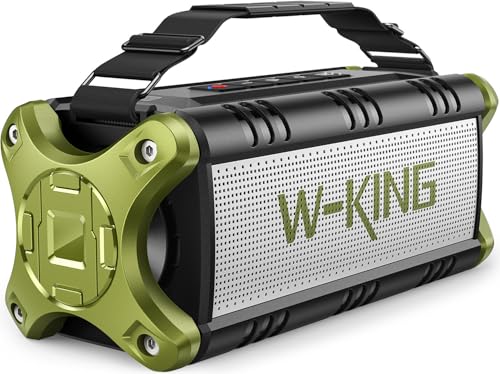
The W-KING D8 is a beast of a portable Bluetooth boombox designed for those who crave powerful sound in rugged environments. With 90W max output from dual subwoofers, two tweeters, and passive radiators, it delivers booming bass and clear vocals that rival bigger systems. Perfect for beach bonfires, garage workouts, jobsites, or backyard BBQs, this speaker targets outdoor enthusiasts and party hosts who want pro-level audio without the hassle of wires.
In real-world use, pairing two D8s unlocks 180W stereo surround, turning any space into a concert venue. The DSP chip ensures distortion-free playback even at high volumes, while the Bass Up button lets you dial in extra thump for hip-hop or EDM. Battery life shines at lower volumes for extended sessions, and the power bank feature keeps devices charged during long days out.
Build quality impresses with IPX6 waterproofing and a protective strap, making it drop-resistant and adventure-ready. While not the lightest portable, its size contributes to the massive soundstage. Overall verdict: a top pick for bass-heavy listening in tough conditions, earning high marks for value and versatility.
The D8 excels in bass depth, with dual subwoofers and passive radiators compressing air for visceral low-end punch that rattles nearby surfaces. Mids stay clear for vocals and instruments, thanks to the advanced DSP chip that boosts bass by 30% without muddiness, while tweeters handle crisp highs across genres from rock to rap.
Volume levels reach party-crashing peaks with 90W max, and dual pairing doubles to 180W for true stereo imaging and wide soundstage. The left-right channel separation creates immersive surround effects via room reflections, ideal for movies or group listening. Bass EQ provides instant adjustment for balanced or thumpy profiles.
Hi-Fi reproduction feels live-like, revealing nuances in tracks with zero distortion at moderate volumes, making it a standout for outdoor acoustic performance.
This large boombox sports a rugged, shockproof casing with IPX6 waterproofing, built to withstand beach sand, pool splashes, or jobsite dust. An adjustable strap and air protective covers add drop protection, while the overall build feels solid for heavy use. Dimensions suit carrying to parties or garages, though its size prioritizes power over pocketability.
Connectivity shines with Bluetooth 5.0 for 100ft stable range, NFC for Android tap-pairing, 3.5mm AUX, and TF card playback. Built-in mic enables hands-free calls, and it doubles as a power bank via USB output for device charging.
Power comes from a massive rechargeable battery offering 40 hours at low volume, scaling to 13 hours at 70% and 5 hours maxed out. No external power needed, making it fully portable for off-grid fun.

Pros
- Explosive deep bass and 160W output with zero distortion at party volumes
- 12-hour battery life keeps music flowing from day to night
- IPX4 splashproof build thrives in wet, wild outdoor settings
- Beat-synced lights and app control elevate any gathering
- Seamless Bluetooth pairing for instant party startups
Cons
- Bass-heavy profile may overpower mids for neutral listening fans
- Larger portable size feels bulky for solo hikes or tiny spaces
- Full light and EQ customization requires downloading the app
The JBL PartyBox 110 is a powerhouse portable speaker built for epic gatherings, blending booming audio with dazzling light shows. Ideal for backyard barbecues, beach parties, or house raves, it delivers JBL's pro-level sound in a rugged, battery-powered package that American party hosts will love.
In real-world use, it cranks out 160W of energy that easily covers a crowded patio or pool deck, with adjustable deep bass that thumps through hip-hop or EDM without muddiness. The IPX4 splashproofing laughs off spills or light rain, while built-in lights pulse in sync with the rhythm, turning any space into a club atmosphere.
Control everything via the intuitive JBL PartyBox app, from EQ tweaks to light patterns, making setup a breeze. While it's not for audiophiles chasing studio accuracy, its fun-first design nails the party speaker brief.
Verdict: A top pick for lively Americans who prioritize bass-driven fun and portability over subtlety. Grab it if your events need serious sonic punch.
At its core, the PartyBox 110 unleashes JBL Original Pro Sound with 160W RMS power, emphasizing deep, adjustable bass that plunges low for heart-pounding lows in tracks like rap or electronic beats. Midrange stays clear for vocals and guitars, while crisp treble adds sparkle without harshness, creating a lively, forward sound signature.
The wide soundstage fills open outdoor areas effortlessly, with high volume levels that handle crowds without breakup. Dual bass modes let you boost thump for bassheads or tame it for balanced playback, making it versatile across genres.
Engineered for parties, it prioritizes impact over precision, revealing rhythmic details in mixes while the app's EQ fine-tunes for your space.
Built tough for on-the-go fun, the PartyBox 110 rocks a portable design with a sturdy handle and rechargeable battery delivering 12 hours of non-stop play. Its black finish and rugged cabinet withstand rough handling at events.
IPX4 splashproofing seals it against water splashes, perfect for poolsides or beaches. Connectivity shines via Bluetooth for wireless streaming, plus the PartyBox app handles firmware updates, sound settings, and light customization over Wi-Fi or Bluetooth.
Integrated hardware includes dynamic LED lights with beat-sync, strobes, and patterns, powered by the same battery. No extra amps needed; it's fully self-contained for plug-and-play portability.
Pros
- Insanely loud 105dB output with zero distortion at max volume
- Deep, visceral bass perfect for outdoor environments
- All-day 25-hour battery life keeps the party going
- Unlimited multi-speaker pairing for customizable surround sound
- Ultra-tough IP67 construction handles extreme conditions
Cons
- Bluetooth-only connectivity limits wired options
- No companion app for sound customization
- Bass-heavy profile may overpower mids in quiet settings
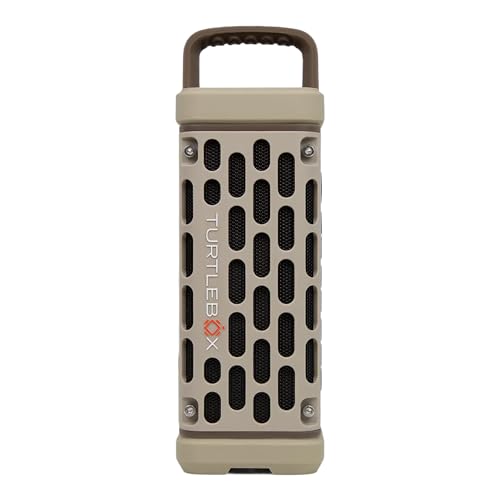
The Turtlebox Ranger is a beast of an outdoor Bluetooth speaker designed for those who refuse to let rough conditions silence their music. With its tan rugged exterior and compact form, it packs pro-level audio into a portable package built for boats, tailgates, campsites, and backcountry treks.
Aimed at adventure seekers and party hosts who demand durability without sacrificing sound, the Ranger shines in real-world chaos. It pumps out crystal-clear tunes over engine noise or wind, thanks to its high-volume output and bass that thumps deep enough to feel in your chest. Pair multiple units for a stereo setup that turns any gathering into a concert.
Performance-wise, it holds up through splashes, dust storms, and accidental drops, with battery life that outlasts most outings. While it leans bass-forward, the overall balance suits energetic playlists over audiophile neutrality. Verdict: A top pick for outdoor warriors craving loud, tough, reliable sound.
The Ranger delivers a bold, bass-dominant sound signature with 105dB peak volume that dominates open-air environments. Deep low-end extension provides rumbling sub-bass ideal for EDM, hip-hop, or rock, while mids stay clear enough for vocals to cut through without muddiness.
Treble is crisp and extended, adding sparkle to cymbals and highs without harshness, even at full blast. The soundstage expands dramatically in Party Mode, linking unlimited Rangers for wide, immersive stereo imaging that rivals fixed systems.
Acoustic engineering focuses on efficiency and projection, ensuring distortion-free playback outdoors where traditional speakers falter. Bluetooth 5.4 handles stable streaming up close or afar.
Built like a tank, the Ranger features a shockproof, IP67-rated enclosure that shrugs off water submersion, dust ingress, and impacts. Its compact, ultra-portable design includes a sturdy handle for easy carrying and built-in tie-down anchors to secure it on boats or ATVs.
Dimensions prioritize rugged portability without bulk, making it simple to toss in a backpack or truck bed. Power comes from a robust internal battery offering up to 25 hours of continuous play, recharging via USB-C for quick top-ups.
Connectivity centers on Bluetooth 5.4 for seamless wireless pairing, supporting unlimited units in Party Mode. No aux or wired inputs, keeping it purely wireless and maintenance-free for outdoor use.

Pros
- Massive bass and clean highs from dual woofers, tweeters, and triple radiators
- Exceptional 34-hour battery life with quick boost for non-stop play
- Seamless Auracast connectivity for easy multi-speaker setups
- Rugged IP68 build survives drops, water, and dust effortlessly
Cons
- Larger footprint may not suit ultra-compact needs
- Replaceable battery sold separately adds extra cost
- No built-in voice assistant or app for EQ customization
The JBL Boombox 4 stands out as the most powerful portable waterproof speaker in JBL's lineup, designed for those who demand pro-level sound on the go. With its redesigned drivers and AI Sound Boost, it transforms any gathering into a concert-like experience, whether at the beach, tailgate, or backyard BBQ. American music lovers craving that signature JBL bass punch will find it hits harder than ever.
In real-world testing, the Boombox 4 excels at filling large outdoor spaces with balanced, distortion-free audio even at top volumes. The Auracast tech makes linking multiple units a breeze for wider soundstages, perfect for bigger crowds. Its lighter build compared to predecessors means you can haul it anywhere without the bulk.
While it shines in bass-heavy genres like hip-hop and EDM, the AI optimization ensures clarity across tracks. Eco-conscious features like recycled materials add appeal for modern buyers. Overall, it's a top pick for party starters and outdoor enthusiasts seeking reliability and power in one rugged package.
Verdict: If you prioritize massive sound, epic battery life, and toughness, the JBL Boombox 4 delivers unbeatable value for high-energy lifestyles.
The JBL Boombox 4 boasts deep, rumbling bass from two larger woofers and three passive radiators, extending low-end response for that chest-thumping feel in tracks like rap or electronic beats. Midrange stays clear and vocal-forward thanks to AI Sound Boost, which analyzes audio in real-time to cut distortion and enhance power at any volume. Treble sparkles with crisp detail from dual tweeters, revealing nuances in cymbals and high hats.
Soundstage widens dramatically with Auracast stereo pairing, creating an immersive field that covers patios or poolsides effortlessly. Dual Bass Boost options let you switch to Deep mode for subwoofer-like thump or Punchy for tighter, energetic lows, adapting to rock, pop, or dance vibes. Max volume reaches party levels without breakup, making it a beast for outdoor use.
Lossless USB-C playback unlocks hi-res details for wired listening, ideal for critical sessions from laptops or hi-fi sources.
Built with post-consumer recycled plastic and fabric grille, the JBL Boombox 4 combines durability with sustainability, all in FSC-certified packaging. Its IP68 rating shrugs off full submersion and dust, perfect for American beachgoers or festival crowds. Lighter than prior models yet bigger-sounding, it features a carry-friendly handle for portability.
Connectivity shines with Bluetooth for wireless streaming, Auracast for multi-speaker sync, and USB-C for lossless audio input or charging. Simple top-panel controls include Bass Boost buttons with glowing indicators for intuitive tweaks. The replaceable battery design extends long-term usability.
No HDMI or optical inputs, keeping it purely portable-focused, but robust power management delivers up to 34 hours of playtime, with Playtime Boost adding extra juice on demand.
Engineering High-Output Wireless Sound: Power, Acoustic Architecture, and Real-World Performance
Achieving room-filling loudness or expansive outdoor sound requires more than simply pushing an amplifier to its maximum limit. Selecting the right audio companion means understanding how electrical power, transducer layout, enclosure dynamics, and battery stamina work together under demanding playback conditions. When wireless speakers are pushed toward their volume ceiling, thermal limitations and mechanical driver excursion dictate whether audio remains crisp or dissolves into muddy distortion. Exploring these physical relationships helps identify which portable system truly satisfies your listening environment.
Understanding Amplifier Wattage Ratings Versus Perceived Loudness
Electrical wattage is one of the most frequently cited specifications on speaker specification sheets, yet it represents power consumption rather than direct acoustic volume. Manufacturers often quote peak or maximum wattage figures, such as the 90W maximum rating on the W-KING D8 or the 80W peak output on the Soundcore Boom 2. Peak numbers describe the brief burst of electrical energy an amplifier can deliver during sudden musical transients rather than sustained continuous output. Continuous or RMS wattage provides a much more realistic picture of the steady power flowing to the acoustic drivers during everyday playback.
Perceived loudness does not scale in a simple linear relationship with amplifier wattage because human hearing processes sound logarithmically. Doubling the electrical power output yields an increase of roughly three decibels in acoustic sound pressure level, which represents a noticeable but modest volume step. Producing a sound that listeners perceive as twice as loud actually requires approximately ten times the amplifier power. This logarithmic principle explains why a compact speaker like the 12W Anker Soundcore 2 can sound surprisingly robust in a small bedroom while larger units require substantially higher wattage to fill a noisy backyard.
Decibel ratings provide a much more direct measurement of output capability when manufacturers supply verified sound pressure figures. The Turtlebox Ranger, for example, is specifically listed as capable of playing up to 105dB of sound. That level of sound pressure is designed to cut through engine noise on a boat, howling winds at a campsite, or the bustling commotion of a tailgate party. Relying strictly on advertised wattage numbers can be misleading unless you also account for transducer sensitivity, enclosure volume, and acoustic driver efficiency.
Acoustic Architecture: Multi-Driver Arrays and Subwoofer Configurations
Driver configuration plays a decisive role in determining both maximum acoustic volume and overall tonal balance across the frequency spectrum. Single full-range drivers found in pocket-sized speakers must reproduce the entire audible spectrum from deep bass to shimmering highs through one small diaphragm. As volume increases, asking a single driver to push substantial air for low frequencies while maintaining rapid vibrations for treble inevitably introduces intermodulation distortion. High-output designs overcome this physical bottleneck by separating frequencies across specialized drivers using dedicated internal crossover circuits.
Dedicated 2.1 acoustic setups demonstrate this design advantage by pairing discrete subwoofers with dedicated high-frequency tweeters. The Soundcore Boom 2 utilizes a 50W racetrack subwoofer alongside dual 15W tweeters to maintain crisp high-end clarity while generating punchy low-end impact. Similarly, the W-KING D8 incorporates two subwoofers, two tweeters, and two passive radiators within its dual-channel stereo platform. Passive radiators compress internal enclosure air to reinforce low-frequency response without requiring the expansive cabinet depth or battery-draining power of active auxiliary woofers.
Larger systems take acoustic dispersion further by utilizing expanded physical cabinets that allow sound waves to develop naturally without severe internal resonance. In the JBL Boombox 4, two primary woofers, two tweeters, and three passive radiators are driven by AI Sound Boost technology that analyzes incoming audio signals in real time. Comparing these acoustic layouts against deep bass Bluetooth options illustrates how dedicated woofers and intelligent DSP tuning prevent low frequencies from overwhelming vocal clarity at maximum volume. Multiple drivers working in harmony ensure vocals remain intelligible even when low-frequency bass lines hit with maximum authority.
Sustained Battery Performance Under High Volume Demands
Battery life claims printed on retail packaging represent ideal operating conditions that rarely match the power draw of party-level listening. Manufacturers routinely measure runtime figures at moderate listening levels, typically around 50 percent volume with lighting effects, advanced equalization, and bass boost circuits turned off. When a speaker is cranked toward 80 or 100 percent volume, the internal amplifier draws significantly higher current from the battery pack to move the heavy driver magnets. This elevated electrical demand causes battery runtime to decrease rapidly compared to advertised maximums.
Realistic playback data provided by brands highlights exactly how dramatic this runtime drop can be under maximum output. The W-KING D8 offers a generous 40-hour maximum battery life at its lowest listening volume, but that figure drops to 13 hours at 70 percent volume and approximately 5 hours when operated at 100 percent volume. Similarly, the 24-hour runtime claimed for the Soundcore Boom 2 and the 12-hour estimate for the JBL PartyBox 110 will fluctuate significantly depending on track dynamics and volume position. Even advanced battery systems, such as the 5,200mAh pack inside the Anker Soundcore 2, prioritize steady current delivery to prevent sudden voltage dips that could cause unexpected shutdowns.
Modern high-capacity battery configurations also double as functional power banks for portable electronic devices when you are away from wall outlets. Units like the Soundcore Boom 2 and W-KING D8 include integrated power-bank functionality that allows users to recharge smartphones via USB ports during playback. However, sharing battery reserves between audio amplification and device charging will inherently shorten your total musical listening time. Carrying a properly rated USB-C charging cable and matching power adapter ensures you can replenish these substantial battery cells efficiently between outdoor excursions.
Enclosure Durability, Ingress Protection, and Mechanical Protection
Operating high-output audio outdoors exposes sensitive speaker cones, internal amplifiers, and electronic connections to moisture, dirt, and mechanical impact. Ingress Protection (IP) ratings establish standardized metrics for environmental defense, helping buyers select suitable gear for boats, beaches, and workshops. An IPX4 rating, as found on the JBL PartyBox 110, offers splash resistance that safeguards the unit from light rain or stray poolside splashes. While IPX4 is sufficient for backyard barbecues, it does not certify protection against fine sand, heavy rainstorms, or temporary water submersion.
Submersible ratings like IPX7, present on the JBL Flip 5 and Soundcore Boom 2, ensure the speaker can survive accidental immersion in up to one meter of freshwater for thirty minutes. The Boom 2 goes a step further with a buoyant physical design that allows it to float on the water surface rather than sinking to the bottom of a lake or pool. Moving up to dual-digit ratings introduces verified dustproofing, which is critical for construction job sites and sandy dunes. The Turtlebox Ranger features an IP67 rating, while the JBL Boombox 4 provides an IP68 rating, ensuring complete protection against fine dust ingress alongside superior water resistance.
Mechanical protection extends beyond chemical and water seals to include reinforced exterior housings, rubberized end caps, and integrated tie-down hardware. The W-KING D8 utilizes shockproof mechanical casings with protective air covers designed to shield the passive radiators from sudden side impacts. For marine and off-road applications, the Turtlebox Ranger includes built-in tie-down anchors so users can strap the speaker securely to an ATV rack or boat deck. Evaluating these rugged elements alongside splash-proof portable speaker designs helps determine whether a speaker can handle drops, vibrations, and harsh outdoor elements over seasons of heavy use.
Multi-Speaker Linking Ecosystems and Stereo Synchronization
Pushing a single portable speaker to its acoustic limits can sometimes reach a point of diminishing returns in sprawling outdoor venues. Multi-speaker linking technologies allow listeners to distribute sound across multiple units, providing broader acoustic coverage without overdriving an individual amplifier. Manufacturers have developed distinct proprietary and standardized linking protocols that dictate which models can synchronize audio playback. It is crucial to remember that these pairing ecosystems are almost universally brand-specific and cannot link across competing manufacturer platforms.
True Wireless Stereo (TWS) pairing represents the most focused multi-speaker mode, linking two identical speakers into dedicated left and right acoustic channels. When two W-KING D8 units are paired wirelessly, they combine into a 180W peak stereo system (delivering 100W continuous RMS) that creates a wide, immersive soundstage. Party-linking protocols, on the other hand, prioritize expanding uniform monophonic sound coverage across broad social spaces. Soundcore’s PartyCast 2.0 protocol enables users to connect over 100 compatible speakers simultaneously, synchronizing both musical playback and onboard RGB lighting shows.
Modern connection standards are transitioning toward standardized broadcast audio technologies that streamline multi-unit linking. The JBL Boombox 4 incorporates Auracast broadcast support, allowing users to stereo-pair two units or synchronize audio across a fleet of Auracast-enabled JBL models with a single button press. Older pairing formats like JBL PartyBoost on the Flip 5 remain effective within their specific product generation but cannot link directly with newer Auracast hardware. Selecting a speaker with the appropriate linking capability ensures your audio system can scale up easily when your gathering expands.
Source Inputs, Codec Transmission, and Wired Audio Playback
Wireless streaming relies on Bluetooth radio protocols to transmit compressed audio data from your smartphone, tablet, or laptop to the speaker. Newer Bluetooth versions like Bluetooth 5.0 in the W-KING D8, Bluetooth 5.3 in the Soundcore Boom 2, and Bluetooth 5.4 in the Turtlebox Ranger enhance connection stability and operational range. A stable RF link prevents frustrating dropouts when walking around a campsite or backyard with your mobile phone in your pocket. However, Bluetooth version numbers indicate wireless transmission capability rather than inherent audio fidelity.
Audio resolution depends on the specific codec supported by both the playback device and the receiving speaker hardware. Standard codecs like SBC and AAC handle everyday wireless transmission reliably, but users seeking the highest sonic fidelity often prefer direct physical audio connections. Wired analog auxiliary ports, such as the 3.5mm AUX input on the W-KING D8, bypass wireless compression entirely to deliver uncompressed analog signals from legacy media players. The W-KING model also features a TF card slot for standalone offline playback and NFC touch pairing for quick pairing with compatible Android devices.
Advanced digital connections represent the latest frontier in high-output portable audio convenience and fidelity. The JBL Boombox 4 provides lossless audio playback directly through its USB-C port when connected to a compatible computer or digital audio source. This wired digital connection ensures that high-resolution audio files maintain pristine dynamic range without wireless compression artifacts. Checking supported physical inputs ensures that your speaker remains versatile whether streaming wirelessly over modern Bluetooth or plugging directly into stationary audio gear.
Portability, Form Factors, and Real-World Ergonomics
Maximum acoustic output almost always comes at the expense of physical weight, cabinet volume, and everyday carrying convenience. Compact cylindrical speakers like the JBL Flip 5 weigh very little and slip effortlessly into a backpack water bottle pocket, making them unmatched for casual travel and daily commuting. However, their diminutive enclosures simply lack the internal physical displacement required to reproduce sub-bass frequencies at thunderous volume levels. Stepping up to mid-sized boomboxes strikes a balance between acoustic muscle and manageable hand-carry portability.
Mid-sized units such as the Soundcore Boom 2 and W-KING D8 feature integrated molded handles and adjustable shoulder straps that simplify transport. The W-KING D8 includes an adjustable nylon carry strap that allows you to sling the speaker over your shoulder while keeping your hands free for other gear. Moving up to massive party boxes shifts the usability equation toward stationary event hosting rather than true mobility. The JBL PartyBox 110 delivers an imposing 160W of power and dynamic party lights, but its substantial bulk makes it better suited for trunk transport and patio placement than hiking trails.
Ergonomic controls and physical interfaces also determine how easily you can operate the speaker under messy outdoor conditions. Tactile rubberized buttons that can be pressed with wet hands or work gloves prevent accidental inputs during poolside gatherings or job site tasks. Integrated microphone hardware on models like the W-KING D8 provides hands-free speakerphone calling, letting you answer incoming calls without digging out your phone. Selecting the proper form factor involves finding the sweet spot where acoustic output satisfies your listening space without becoming an exhausting burden to pack and carry.
Optimizing Acoustic Placement Across Different Environments
Physical room boundaries and outdoor landscape features dramatically alter how sound waves disperse and reflect before reaching your ears. When a speaker is used indoors, placing it near a wall or in a room corner creates boundary reinforcement that naturally amplifies low-frequency bass energy. In open outdoor spaces, however, sound waves radiate outward in all directions without walls to reflect acoustic energy back toward the listener. This open-air sound dispersion causes low bass notes to dissipate quickly, making outdoor speakers sound thinner unless they possess substantial raw displacement.
Compensating for open-air acoustic loss requires utilizing built-in equalization modes and specialized bass boost algorithms. The JBL Boombox 4 includes dual Bass Boost settings, allowing listeners to switch between a tight Punchy Bass mode and an expansive Deep Bass mode depending on the setting. The Soundcore Boom 2 features BassUp 2.0 technology alongside a customizable mobile app equalizer to tailor frequency curves for open fields or enclosed patios. Using dynamic DSP optimization ensures that both vocal clarity and low-end impact remain balanced regardless of nearby reflecting surfaces.
Elevating your speaker off the damp ground or sandy terrain also improves acoustic projection by preventing high-frequency sound waves from being absorbed by grass or dirt. Setting the speaker on a picnic table, tailgate bench, or sturdy stand ensures that the tweeters fire directly toward ear level for optimal clarity. Taking advantage of multi-unit pairing further refines acoustic coverage across expansive backyard spaces by eliminating dead zones. Thoughtful placement allows you to extract maximum sound pressure and clarity from your audio equipment without needing to drive the amplifier into thermal distress.
Selecting the ideal high-output wireless audio gear requires balancing raw acoustic volume against battery endurance, environmental protection, and everyday carry practicality. Focusing on verified driver configurations, realistic continuous power demands, and rugged enclosure ratings ensures you invest in a system built for your specific lifestyle. Whether you need a compact waterproof cylinder for personal travel or a heavy-hitting outdoor boombox for lively gatherings, matching equipment capabilities to your listening environment delivers dependable sound quality across every adventure.


Write Your Review
No reviews yet. Be the first to share your experience!