


Crafting custom acoustic enclosures allows music lovers to tailor both aesthetic beauty and acoustic performance to their exact listening space. Whether you are assembling a simple desktop sound project or experimenting with custom cabinetry, understanding how to make wooden speakers opens the door to personalized sound reproduction. Natural wood and composite materials offer distinct resonance qualities that dramatically influence tonal warmth, clarity, and overall volume. Learning the basics of driver placement, internal air volume, and basic electronics can help you avoid common audio pitfalls like unwanted vibrations or muffled dialogue. If you enjoy experimenting with audio builds, exploring Bluetooth stereo speaker setups provides great context on how factory cabinets manage channel separation and power delivery.
Many beginners start with pre-cut wooden project kits before moving on to full-scale workshop carpentry. High-density wood panels, reliable amplifier boards, and properly matched speaker drivers create the foundation of a successful homemade build. Small construction errors, such as loose joints or unsealed seams, can quickly degrade bass output and introduce harsh rattles. Taking the time to plan your cabinet dimensions, signal wiring, and damping materials ensures that your finished project delivers rich, balanced audio. Exploring larger home entertainment audio systems also reveals how professional cabinet volume and porting choices optimize acoustic efficiency across different listening environments.
Pros
- Completely solderless design makes assembly safe and accessible for all skill levels
- Remarkably clear vocal reproduction for podcasts, audiobooks, and low-complexity music
- Natural laser-cut wooden chassis looks attractive and serves as a customizable canvas
- Fast and dependable Bluetooth pairing with modern smartphones and tablets
Cons
- Limited low-end sub-bass due to the micro driver size and unsealed mini enclosure
- Moderate output volume is best kept to nearfield listening within a small room
- Runs on disposable batteries rather than an integrated USB-rechargeable pack
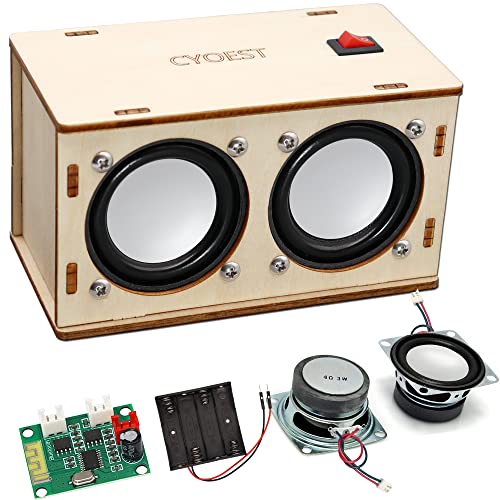
The CYOEST DIY Bluetooth Speaker Kit bridges the gap between science education and consumer electronics, offering curious listeners a firsthand look at audio reproduction mechanics. Rather than unboxing a pre-molded speaker, users assemble the structural frame, mount the full-range transducer, and wire the wireless receiver board themselves. It serves as an engaging weekend project for tech-inclined teens, families, and classroom STEM environments seeking a tactile entry into practical acoustics.
Assembly is remarkably straightforward thanks to the fully solderless architecture. Every component, from the battery harness to the mini speaker driver, connects via pre-crimped terminals and secure pressure fits. The laser-cut wooden panels interlock cleanly with minimal effort, eliminating the need for specialized workshop tools. The step-by-step guidance ensures that builders of any experience level can progress from loose parts to a functional playback device in under an hour.
In real-world use, the speaker performs admirably for nearfield, low-volume listening. Once paired via Bluetooth to a phone or tablet, it becomes a quirky desk companion capable of streaming daily playlists, study background tracks, or audiobooks. While it will not replace an audiophile-grade shelf monitor, the tactile satisfaction of hearing audio emanate from a speaker you assembled with your own hands delivers an experience standard commercial units cannot match.
Ultimately, the CYOEST kit represents exceptional value for hobbyists and young makers. It demystifies speaker engineering while functioning as a genuine wireless audio device. For parents, teachers, and gift buyers searching for an educational gift that remains useful after the build is finished, this project is an easy recommendation.
Acoustically, the CYOEST speaker is voiced with an articulate midrange emphasis. Because the single full-range micro-driver handles the entire audible spectrum without an active crossover, human speech, acoustic guitars, and piano fundamentals are projected forward with surprising intelligibility. Spoken-word media, educational podcasts, and audiobooks come through clean and distortion-free at standard desk listening volumes.
As expected with a compact, lightweight wooden cabinet, the lower frequency extension is modest. Deep bass drops and heavy sub-bass thumps roll off early due to the small cone displacement and compact baffle volume. However, the upper bass and lower midrange retain enough warmth to prevent acoustic tracks and classic rock from sounding overly tinny or hollow.
Volume output is engineered for personal nearfield listening rather than filling expansive open-concept living rooms. When kept within three to five feet of the listener, the driver maintains clean acoustic separation without clipping the small onboard amplifier. The natural acoustic damping of the wooden housing also prevents the high-frequency harshness frequently encountered in miniature plastic novelty speakers.
The exterior housing is constructed from natural, precision laser-cut composite wood panels measuring approximately 5.1 by 2.4 by 2.8 inches. Weighing just over half a pound when fully assembled, the chassis remains stable on smooth surfaces while staying light enough to transport easily in a backpack. The bare wood finish provides an appealing retro-industrial maker aesthetic that can also be painted or personalized.
Under the hood, the kit incorporates an integrated Bluetooth receiver circuit board, a compact circular transducer, an internal switch, and a modular battery compartment. The wireless module pairs seamlessly over standard Bluetooth protocols, maintaining a reliable wireless connection up to thirty feet line-of-sight from any compatible mobile device or laptop.
Power is supplied by an external multi-cell battery box designed for easy replacement. By relying on straightforward DC battery power rather than a fixed internal lithium cell, the system eliminates complicated charging circuitry and avoids battery degradation over prolonged periods of storage.
Practical Blueprint for Crafting Custom Wooden Speakers
Building a wooden speaker requires selecting stable enclosure materials, planning internal air volume, installing matched speaker drivers, and sealing joints completely to prevent acoustic phase cancellation. Whether crafting from raw lumber or assembling a modular STEM electronics project, audio performance relies on rigidity, airtight construction, and clean electrical connections. Taking a methodical approach ensures that your handcrafted speaker delivers clear frequencies across the entire audible spectrum.
Choosing the Right Lumber and Composite Materials
The choice of cabinet material dictates how much unwanted vibration reaches the outside world. Medium-density fiberboard, commonly known as MDF, remains the industry standard for custom speaker builds because its uniform density prevents structural resonances. Unlike solid wood, MDF lacks directional grain lines, which ensures consistent acoustic damping throughout the entire cabinet body. Builders seeking a natural wood aesthetic often apply real wood veneer over an MDF core to blend visual beauty with acoustic neutrality.
Baltic birch plywood serves as another exceptional material for handmade audio cabinets. High-grade birch contains multiple void-free plies that provide tremendous mechanical rigidity while maintaining lighter overall weight than composite boards. While solid hardwoods like walnut, maple, or oak look stunning, they expand and contract with humidity changes over time. Natural wood movement can stress glued joints, break acoustic seals, and cause structural air leaks that degrade audio quality.
Cabinet wall thickness plays a direct role in suppressing cabinet wall flex under heavy bass loads. Enclosures intended for desktop listening typically use half-inch thick panels to keep the footprint compact and manageable. Larger cabinets handling powerful woofers generally benefit from three-quarter-inch panels or internal cross-bracing to prevent low-frequency panel resonance. Selecting the correct thickness prevents the wooden box from acting like a secondary soundboard that colors the audio.
Understanding Enclosure Acoustics and Internal Volume
Speaker enclosures exist primarily to isolate the sound wave emitted from the rear of the driver cone from the wave coming off the front. When these opposing sound waves meet, they cancel each other out, resulting in almost complete loss of bass reproduction. A sealed enclosure traps the rear wave entirely, acting as an air spring that provides tight transient response and excellent driver control. Sealed boxes forgive minor construction variations, making them ideal for initial woodworking and audio experiments.
Ported enclosures, also known as bass-reflex designs, use a tuned hollow tube to redirect rear sound waves forward in phase with the front wave. This acoustic tuning increases bass output at specific low frequencies without requiring additional amplifier power. Calculating the exact port diameter and length requires knowing the mechanical parameters of your specific driver model. Studying how manufacturers configure speakers engineered for deep bass reproduction demonstrates how enclosure tuning and port dimensions work in harmony to extend low-end extension safely.
Internal cabinet volume must match the mechanical characteristics of the speaker driver being installed. An enclosure that is too small restricts cone movement, causing choked bass and an artificial peak in the lower midrange. Conversely, an oversized cabinet allows excessive cone excursion, which can cause voice coil bottoming and mechanical distortion. Using proven enclosure volume calculators helps you establish the correct internal cubic space before cutting your panels.
Essential Electronic Components and Signal Paths
Every functional speaker requires a coordinated chain of audio components to convert recorded electrical signals into audible sound waves. At the core sits the speaker driver, which uses a permanent magnet and copper voice coil to move a suspended diaphragm. Compact DIY projects frequently utilize full-range drivers, which reproduce low, mid, and high frequencies from a single cone assembly. Multi-way systems divide frequencies using a passive crossover network that sends bass to a woofer and treble to a dedicated tweeter.
Modern handmade builds often incorporate an integrated Class-D amplifier module equipped with wireless connectivity. Class-D boards generate very little waste heat while delivering clean power from compact circuit boards, making them ideal for tight wooden enclosures. When selecting an amplifier board, verify that its rated output wattage and impedance support match your drivers. Driving a 4-ohm speaker with an amplifier designed strictly for 8-ohm loads can cause overheating and trigger thermal protection circuits.
Power delivery represents another key architectural choice when planning your wooden audio enclosure. Stationary desktop speakers typically draw clean direct current from an external regulated wall adapter. Portable designs require rechargeable lithium battery packs paired with dedicated protection and charging boards. Installing a safe power switch and status indicator LED allows you to manage battery depletion and monitor active connections easily.
Assembling Beginner Solderless Wooden Speaker Kits
Beginners hesitant to operate power saws or soldering irons often discover that pre-cut project kits offer an accessible starting point. Products like the Teen Boy Gifts -DIY Bluetooth Speaker Kit -STEM from CYOEST provide precision laser-cut wooden panels designed for snap-fit or screw assembly. These educational kits introduce aspiring builders to electronics and acoustics without requiring workshop machinery. Clear instructions allow hobbyists to concentrate on assembly precision and circuit flow rather than lumber milling.
Putting together a modular wooden kit begins by mounting the speaker driver securely to the pre-cut front wooden baffle. Solderless wire connectors link the driver terminals directly to the pre-assembled Bluetooth amplifier circuit board. The kit includes dedicated battery housing and pre-cut wooden side plates that fasten together using small screws. Taking care during this phase ensures that delicate wires remain unpinched while panels are tightened into place.
Hands-on kits serve as an engaging family STEM activity that bridges theoretical science and tangible audio engineering. Builders observe firsthand how electrical signals flow through circuit paths to energize the speaker magnet and voice coil. Because no high-temperature soldering tools are required, younger builders can safely construct a working sound box under basic adult supervision. The resulting wooden Bluetooth box demonstrates that basic electronic principles can yield functional, entertaining audio.
Precision Cutting and Joinery for Custom Cabinets
Builders fabricating custom wooden speakers from sheet goods must prioritize straight cuts and square corners. Using a fine-tooth saw blade minimizes tear-out on plywood veneers and prevents chipping along fragile MDF edges. Miter joints create clean exterior corners that hide raw board edges, creating a sleek modern presentation. Simple butt joints reinforced with internal wooden corner cleats provide exceptional strength for beginners working with basic hand or circular saws.
Standard PVA wood glue forms a chemical bond that is actually stronger than the cellular structure of wood itself. When assembling your panels, apply an even bead of glue along every mating surface and clamp the assembly firmly. Clamping pressure must remain steady until the adhesive cures completely according to manufacturer instructions. Wipe away excess glue squeeze-out immediately with a damp rag to prevent blotchy patches during final wood staining.
Cutting circular driver openings in the front baffle requires careful marking and steady tool handling. A handheld router fitted with a circle-cutting jig yields perfectly round holes with recessed rabbets for flush driver mounting. Alternatively, a jigsaw guided along a scribed circle can cut acceptable openings if you work slowly. Sanding the inner rim smooth ensures that the speaker frame seats flat against the wood without binding.
Creating an Airtight Acoustic Seal
Acoustic isolation fails completely if air escapes through tiny structural gaps between cabinet panels. High internal air pressure generated by a moving woofer will force air through microscopic seams, producing audible whistling or chuffing noises. Applying a continuous bead of silicone caulk or flexible acrylic sealant along all internal interior seams permanently cures panel leaks. Allow the sealant to cure fully before mounting any electronics, as outgassing vapors can harm synthetic driver surrounds.
The interface between the speaker driver frame and the wooden front baffle also demands an airtight barrier. Mounting a bare metal driver frame directly against raw wood almost always leaves tiny perimeter gaps. Installing closed-cell foam speaker gasket tape around the driver cutout creates a compliant, compression-tight boundary. Tighten driver mounting screws evenly in a crisscross pattern to compress the gasket without bending the metal speaker basket.
Removable back panels or access plates require equal sealing attention to maintain cabinet acoustic pressure. If you design a removable rear panel for servicing batteries and circuit boards, line the contact rim with dense weatherstripping foam. Secure the panel using threaded machine inserts and bolts rather than coarse wood screws that loosen after repeated use. Consistent perimeter pressure keeps the rear enclosure sealed against severe internal air turbulence.
Proper Wiring Technique and Component Protection
Clean electrical wiring prevents background hums, audio distortion, and dangerous short circuits inside wooden enclosures. Use stranded copper audio wire of appropriate gauge, ensuring adequate current handling between the amplifier and driver terminals. Stripping wire ends neatly prevents stray copper strands from bridging positive and negative terminals on compact circuit boards. Soldered connections should be protected with heat-shrink tubing to create durable, insulated joints that resist mechanical fatigue.
Maintaining strict electrical polarity is critical when wiring dual speaker drivers for stereo playback. Connecting positive amplifier terminals to positive driver tabs ensures that both diaphragms push outward simultaneously on dynamic audio peaks. Reversing polarity on one channel puts the stereo drivers out of phase, resulting in hollow mid-frequency vocals and cancelled bass. Label your wires clearly with red and black markers before final cabinet closing to eliminate connection confusion.
Loose internal wiring can produce maddening buzzing noises when vibrating against cabinet walls during heavy bass passages. Anchor all wiring harnesses to interior wood surfaces using adhesive cable clips or small drops of hot melt glue. Ensure that internal cables maintain gentle slack without resting against sharp component edges or warm amplifier heatsinks. Clean cable routing improves interior airflow and simplifies any future maintenance checks.
Internal Damping and Sound Wave Absorption
Untreated interior surfaces in a wooden box reflect high-frequency and midrange sound waves back into the rear of the speaker cone. These delayed reflections pass back through the thin cone material, creating muddy midrange and harsh acoustic peaks. Lining the interior cabinet walls with acoustic foam or bonded polyfill absorbs these stray reflections effectively. Sound damping turns chaotic internal sound reflections into negligible thermal energy.
Adding lightweight damping fibers also changes the apparent acoustic volume of a sealed wooden speaker cabinet. As sound waves pass through polyfill fibers, air compression shifts from an adiabatic process to an isothermal process, slowing wave propagation. This physical effect makes the speaker driver behave as though it were mounted in a cabinet up to fifteen percent larger. Builders must avoid packing damping material too densely, which restricts cone movement and strangles bass.
Observing the construction choices found in modern portable speaker acoustic designs illustrates how balanced acoustic damping prevents harsh enclosure resonance in compact builds. Leave an open breathing zone directly behind the magnet assembly and driver pole vents to permit cooling airflow. If building a bass-reflex cabinet, keep damping fibers several inches away from the internal port opening to avoid blocking high-velocity air movement.
Diagnosing and Eliminating Audio Anomalies
Initial listening tests occasionally expose unexpected buzzing, rattles, or distortion that require systematic troubleshooting. A rhythmic buzzing sound synchronized with deep bass notes usually points to a loose mounting screw, unglued brace, or vibrating battery pack. Pressing firmly on different cabinet joints while playing test tones helps isolate the physical source of cabinet vibration. Applying additional silicone or tightening loose hardware usually resolves structural rattles quickly.
Muffled sound or unexpectedly low audio output often stems from source signal issues or impedance mismatches rather than speaker defects. Verify that your playback device has its media volume set properly and that any software equalizer settings remain flat. Inspect wiring polarities across all drivers to confirm that opposing channels are not canceling out stereo frequency response. If dialogue remains unclear, inspect the front grille fabric to verify it allows acoustic transparency without muffling high frequencies.
Intermittent Bluetooth audio drops or buzzing static frequently trace back to power supply instability or radio-frequency shielding issues. Running Bluetooth amplifier boards on low battery voltages introduces harmonic distortion and unexpected wireless disconnects. Ensure that internal Bluetooth antennas are positioned away from large metal driver magnets and dense power wiring. Supplying clean, regulated power protects delicate audio processing chips and maintains stable wireless streaming.
Wood Finishing, Thermal Safety, and Long-Term Care
Applying a quality wood finish protects your handcrafted enclosure from environmental moisture while highlighting natural grain patterns. Sand the exterior wood panels progressively through fine grits, finishing with 220-grit sandpaper for an exceptionally smooth texture. Penetrating wood finishes like Danish oil, boiled linseed oil, or wipe-on polyurethane enhance natural luster without obscuring wood figure. Several thin coats offer superior moisture resistance compared to a single thick coat that may run or pool.
Enclosed wooden speakers containing integrated amplifiers require sensible thermal management to ensure reliable electronic longevity. Class-D amplifier boards operate efficiently, but sustained high-volume playback still produces heat on output transistors. Avoid wrapping electronic amplifier modules in acoustic polyfill or placing them in completely unventilated micro-chambers. If designing high-power desktop units, installing a discrete aluminum rear plate serves as both a mounting surface and a passive heatsink.
Proper storage and handling preserve both the structural integrity and acoustic performance of wooden audio gear over many years. Keep homemade speakers away from direct heating vents, high-humidity window sills, and continuous direct sunlight. Drastic temperature and humidity fluctuations can cause wooden seams to separate, compromising airtight seals and ruining low-frequency output. Routine dusting and occasional conditioning with furniture oil keep custom wood enclosures looking and sounding their best.
Crafting custom wooden sound systems unites practical woodworking skills with rewarding audio principles. By carefully selecting your cabinet lumber, calculating internal air volume, sealing every seam, and wiring your components with clean polarity, you create an audio system tailored to your exact listening space. Verifying electrical connections and testing with diverse musical genres allows you to dial in acoustic damping for optimal performance. Whether building from raw workshop materials or assembling an educational wooden kit, constructing your own speakers delivers pride and engaging sound for years to come.


Write Your Review
No reviews yet. Be the first to share your experience!