


Starting an audio setup often brings up confusing questions about how music signals travel from a source device out to your ears. Grasping how do amplifiers and speakers work is essential for anyone building a home stereo, connecting a television, or assembling a desktop listening station. An audio system relies on a continuous chain where small electrical signals transform into powerful voltages and finally into physical sound waves. Whether pairing an external receiver with traditional stereo loudspeakers or using an integrated desktop unit, knowing this signal path prevents costly equipment mismatches and helps eliminate frustrating distortion.
Amplifiers act as the electrical engine of the system by taking line-level audio and multiplying its voltage and current without altering the waveform shape. Speakers then function as electroacoustic transducers, receiving that robust electrical current and converting it into physical vibrations through a voice coil and magnet assembly. When these components are properly balanced in terms of power handling and impedance, audio sounds dynamic, clear, and full. Understanding this fundamental relationship makes it simple to troubleshoot weak volume, configure tone controls accurately, and choose compatible hardware that matches your listening space.

Pros
- Exceptional battery life lasts through full workdays
- Stable headset mic stays secure during active use
- Easy aux connectivity for music playback
- Lightweight and portable with versatile strap
- Powerful volume ideal for classrooms or small groups
Cons
- No Bluetooth connectivity, relies on wired aux input
- Compact size limits maximum volume for very large crowds
- Battery charging requires wall adapter downtime
The Pyle Portable PA Speaker is a compact voice amplifier designed for professionals who rely on clear communication, like teachers, tour guides, and meeting leaders. It combines a 50W speaker with an adjustable headset microphone and waistband strap, making it easy to carry and use hands-free.
In real-world scenarios, it excels at projecting voices without straining vocal cords, perfect for classroom lectures, guided tours, or presentations. The 3.5mm aux jack adds versatility for playing audio from phones or MP3 players during breaks or events.
With its rechargeable battery offering over 8 hours of playtime, this speaker keeps you going through long days. Overall, it's a reliable, budget-friendly tool that delivers professional-grade amplification in a portable package, earning high marks for everyday professional use.
This speaker shines in vocal clarity thanks to its 100-13kHz frequency response and 53dB sensitivity, ensuring voices cut through noise in classrooms or outdoor tours. The 50W output provides ample volume for small to medium groups without distortion.
While optimized for speech over deep bass, it handles announcements and light music via aux input effectively. Users appreciate the rotary volume control for precise adjustments during dynamic settings like meetings or guiding.
Ideal for voice-heavy tasks, it maintains stable performance without dropouts, making it a solid choice for clear, fatigue-free amplification.
The lightweight, compact build with waistband clips and neck strap offers ultimate portability for active users. It attaches securely to belts or worn comfortably, weighing little for all-day carry during tours or classes.
A 7.4V 1600mAh rechargeable lithium battery delivers 8+ hours of runtime, perfect for extended sessions. Recharging is straightforward via the included adapter, typically taking a few hours for a full top-up.
Though not ruggedized for extreme conditions, its simple, durable design withstands daily professional use reliably.
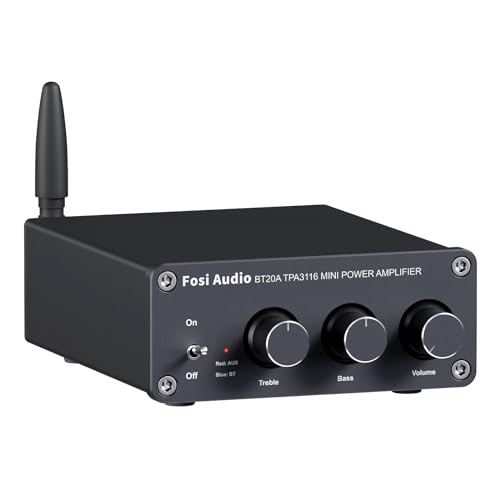
Pros
- Impressive power output at entry-level price
- Stable Bluetooth with no dropouts for smooth streaming
- Intuitive bass and treble controls for personalized sound
- Versatile for indoor or outdoor passive speaker setups
Cons
- Requires separate passive speakers to function
- Limited to Bluetooth and RCA inputs only
- No remote control or app for adjustments
The Fosi Audio BT20A is a compact Bluetooth stereo amplifier designed to breathe new life into passive speakers, delivering 100W x2 of Class D power for home audio enthusiasts on a budget. Ideal for anyone powering bookshelf, ceiling, or garage speakers without breaking the bank, it supports setups in living rooms, offices, patios, or workshops.
In real-world use, setup is a breeze with one-touch power and simple RCA or Bluetooth connections. Stream music from your phone effortlessly, and tweak bass and treble to match your room or taste. It handles small venues or multi-speaker home systems with clear, distortion-free audio at high volumes.
Who it's for: DIY audio fans wanting affordable power without complexity. Verdict: A no-frills powerhouse that punches above its weight, perfect for upgrading everyday passive speakers into a vibrant sound system.
Expect powerful, clean amplification with 100W x2 output that fills rooms with impressive volume and minimal distortion. Adjustable bass delivers punchy lows for music or movies, while treble controls ensure crisp highs and vocal clarity tailored to your speakers.
Bluetooth connectivity is rock-solid, streaming crystal-clear audio from phones without delays or dropouts, even across decent ranges in home environments. RCA inputs add flexibility for wired sources, maintaining high-fidelity sound for diverse playback.
Overall, it shines in dynamic range and customization, making it great for everything from casual listening to lively garage sessions.
The all-black, one-piece Class D design is sleek and durable, fitting neatly on shelves or benches while complementing modern home decor. Its mini footprint makes it highly portable for moving between rooms, offices, or patios.
Built tough for everyday use, it withstands regular handling in garages or casual outdoor spots, though not submersible. Weight is light enough for easy placement without permanent mounting.
Plug-in power means unlimited playback without battery worries, just reliable AC operation for non-stop audio whenever you need it.

The Science and Engineering Behind Amplifiers and Speakers
At its core, every audio system exists to reproduce acoustic pressure waves that human ears interpret as speech, instruments, and environmental sounds. Recorded media stores these sounds as microvolt-level electrical waveforms or digital code that cannot move a speaker cone on their own. Amplifiers provide the necessary electrical muscle, while speakers serve as the electromechanical motors that push air into motion. Understanding how these two distinct components collaborate allows listeners to assemble reliable sound systems, prevent equipment damage, and achieve optimal acoustic performance across various environments.
The Audio Signal Journey from Source to Ear
The process of sound reproduction begins when an audio source generates a tiny, low-voltage electrical signal known as line level. This source can be an analog phonograph preamp, a digital media streamer, a smartphone output, or a microphone. Because this initial signal usually measures only a fraction of a volt, it possesses insufficient current to drive mechanical speaker components. Sending this fragile voltage directly to a speaker voice coil would produce either total silence or a faint whisper buried in background noise.
An amplifier sits directly between the line-level source and the speaker terminals to bridge this electrical gap. It takes the incoming waveform and magnifies both its voltage and current while maintaining its original shape and timing. Once magnified, the electrical current travels down speaker wire to the loudspeaker terminals as a high-level audio signal. The speaker then translates this alternating current into mechanical oscillations, displacing adjacent air molecules to create sound waves that match the original recording.
Inside the Amplifier: Preamp and Power Stages Explained
A standard audio amplifier typically combines two distinct operational sections into a single chassis or separates them into standalone units. The first section is the preamplifier, which handles input selection, initial voltage leveling, and tone adjustments. Preamp circuits accept various sources such as auxiliary inputs or wireless receivers and bring them up to a uniform operating voltage. Preamplifiers also house volume attenuators, balance controls, and equalization circuits for tailoring bass and treble frequencies to user preference.
After the preamplifier conditions the audio signal, it passes the waveform directly to the power amplifier stage. This power stage draws substantial electrical energy from an internal or external power supply and multiplies the signal current. Power transistors or vacuum tubes modulate this incoming power reserve, mirroring the delicate fluctuations of the input audio wave. The result is a high-power output capable of driving heavy voice coils through magnetic fields without collapsing the signal voltage.
Amplifier Topologies: Class D Solid-State Versus Vacuum Tube Circuitry
Amplifiers accomplish their signal multiplication using different electronic designs, commonly referred to as amplifier classes or topologies. Modern desktop and mini audio components frequently utilize Class D switching designs, exemplified by compact units such as the Fosi Audio BT20A Bluetooth Stereo Amplifier. Unlike traditional analog amplifiers that dissipate significant energy as heat, Class D circuits switch output transistors rapidly between fully on and fully off states. This pulse-width modulation achieves exceptional energy efficiency, allowing small chassis enclosures to generate substantial wattage without requiring massive heatsinks.
Traditional audio equipment and specialized musical instrument gear often rely on linear Class A, Class AB, or vacuum tube circuits. Tube amplifiers utilize heated thermionic valves inside evacuated glass envelopes to control electron flow and amplify audio waveforms. Enthusiasts and musicians who explore repair guides such as How to Service Your Own Tube Amp appreciate the harmonic warmth and gradual soft-clipping characteristics unique to vacuum tube circuits. While tube topologies operate at higher internal voltages and generate noticeable heat, their distinct electrical response remains highly prized in specialized listening and performance settings.
How Loudspeaker Transducers Convert Electrical Energy into Sound Waves
A speaker is fundamentally an electroacoustic transducer that relies on electromagnetism to convert electrical currents into physical motion. Inside a dynamic driver, a tightly wound coil of fine wire, known as the voice coil, sits suspended within the magnetic gap of a permanent magnet. When the amplifier sends an alternating audio current through the voice coil, the current generates a fluctuating magnetic field around the wire. This newly generated magnetic field interacts directly with the static field of the permanent magnet, causing the coil to push forward and pull backward in rapid succession.
The moving voice coil connects directly to a flexible cone or dome diaphragm, commonly constructed from paper, polypropylene, aluminum, or composite weaves. As the voice coil oscillates, the diaphragm pushes against surrounding air molecules, creating alternating bands of compression and rarefaction. These pressure waves radiate outward into the room and strike the human eardrum, where the brain decodes the pressure fluctuations as audible frequencies. Higher audio frequencies require rapid, short vibrations best handled by small tweeters, while lower bass frequencies demand larger cone excursion to displace greater volumes of air.
In sophisticated setups, audio systems split incoming electrical frequencies so that dedicated drivers handle specific ranges. Passive crossover networks use capacitors and inductors to route treble frequencies to tweeters and low frequencies to woofers. Audio builders seeking high resolution often examine multi-driver component speakers to understand how separating frequency bands reduces distortion and preserves vocal clarity. By distributing the acoustic workload across specialized drivers, each transducer operates within its ideal physical and mechanical limits.
Passive Speakers Versus Powered All-in-One Systems
The physical relationship between amplifiers and speakers generally falls into two distinct categories: passive configurations and powered configurations. Distinct passive speakers contain only the acoustic drivers and internal crossover networks, requiring an external standalone amplifier or stereo receiver to produce sound. This separation grants audio enthusiasts complete freedom to mix and match amplifiers, upgrade power stages independently, and customize their source gear. However, passive setups demand dedicated speaker cables and careful consideration of electrical matching between components.
In contrast, powered or active systems integrate the amplification hardware directly into the speaker enclosure. Portable public address devices, such as the Pyle Portable PA Speaker and Voice Amplifier, combine an internal microphone preamp, power amplifier, rechargeable battery, and dynamic speaker driver into a unified wearable package. Similarly, modern desktop studio monitors and compact portable Bluetooth speakers house matched internal amplifiers specifically calibrated for their built-in drivers. This integrated design simplifies cable management, eliminates guesswork regarding amplifier power matching, and optimizes system portability for mobile or space-conscious users.
Electrical Matching: Impedance, Power Handling, and Sensitivity
Connecting an external amplifier to a passive speaker requires an understanding of electrical impedance, which measures the speaker voice coil opposition to alternating current. Measured in ohms, nominal speaker impedance typically ranges between four and eight ohms for consumer home audio equipment. An amplifier must be rated to operate safely into the specific load impedance presented by the connected speakers. Connecting a low-impedance four-ohm speaker to an amplifier designed solely for eight-ohm loads can cause the amplifier to draw excessive current, leading to thermal shutdown or component failure.
Power handling and amplifier wattage ratings represent another critical area of compatibility. Speakers are rated for continuous root-mean-square power handling, indicating how much sustained electrical energy their voice coils can absorb without overheating. Supplying an amplifier with adequate clean wattage is vital because underpowered amplifiers driven into extreme volume levels produce clipped waveforms that rapidly destroy delicate tweeters. Clean power within the speaker recommended manufacturer range ensures the driver maintains controlled excursion and dynamic headroom during sudden musical peaks.
Meanwhile, sensitivity ratings determine how efficiently a loudspeaker converts electrical wattage into acoustic decibels. A speaker with a sensitivity rating of ninety decibels measured at one watt and one meter requires substantially less amplifier power to produce room-filling volume than a speaker rated at eighty-four decibels. For every three-decibel increase in acoustic volume, an amplifier must double its electrical power output. Factoring in sensitivity allows audio buyers to select amplifiers that deliver satisfactory sound pressure levels without straining the power supply.
Connecting Sources: Analog Inputs, Digital Feeds, and Wireless Streaming
Modern amplifiers support diverse connection methods to accommodate varying audio sources and playback equipment. Analog stereo RCA inputs remain the standard for connecting CD players, external digital converters, and pre-amplified turntables. A standard three-and-a-half millimeter auxiliary input provides straightforward wired connectivity for portable audio players, laptops, and mobile communication equipment. Maintaining clean, shielded analog patch cables prevents external electromagnetic interference from introducing hum or high-frequency buzz into the initial amplification stage.
Wireless transmission options have expanded convenience across both desktop and home entertainment systems. Bluetooth connectivity allows phones and tablets to stream digital audio directly to an amplifier receiver without physical cables. Inside the amplifier chassis, an integrated digital-to-analog converter processes the wireless bitstream back into a continuous electrical wave before sending it to the power stage. While wireless streaming adds immense practical convenience, high-resolution critical listening setups often prefer direct wired analog or optical connections to eliminate potential digital compression artifacts.
Troubleshooting Signal Problems: Clipping, Ground Loops, and Distortion
Audio distortion usually stems from identifiable bottlenecks along the signal path rather than spontaneous driver failure. Severe amplifier clipping occurs when an audio signal demands more output voltage than the internal power supply can deliver. Instead of producing a smooth sine wave, the amplifier truncates the peaks and valleys into harsh square waves. This flattened waveform delivers continuous direct current to the voice coil, generating extreme thermal stress that can melt coil adhesives and burn delicate voice coil windings.
Unwanted background noise often presents as low-frequency ground loop hum or high-frequency hiss. Distinct ground loops occur when multiple connected audio components share different electrical ground potentials, causing stray currents to flow through signal cable shields. Separating audio cables from power cords, plugging equipment into a common AC circuit, or using isolation transformers typically resolves these grounding discrepancies. Hiss, on the other hand, frequently arises from poor input gain staging, such as setting source volume extremely low while driving the master amplifier knob to maximum gain.
Mechanical distortion in speakers can also indicate physical misalignment or driver fatigue. Rubbing voice coils produce a scratchy, raspy sound when the cone moves, signaling that the coil former is warped or scraping against the magnet gap. Loose mounting screws, damaged surround foam, or air leaks around terminal cups can create rattles that mimic electronic distortion. Inspecting physical cabinet seals and verifying that cables make solid contact with binding posts often restores pristine sound without requiring replacement components.
Practical Setup Strategies for Clean, Balanced Sound
Achieving clean sound from your amplifier and speaker pairing depends heavily on thoughtful physical placement and room interaction. Placing speakers too close to room corners or reflective rear walls artificially reinforces bass frequencies, causing lower notes to sound muddy and boomy. Positioning drivers at ear level on sturdy stands or isolated desktop pads decouples cabinet vibrations from furniture and sharpens stereo imaging. Experimenting with slight toe-in toward your primary listening position helps focus the acoustic soundstage and improves dialogue clarity.
Cable selection and terminal maintenance also play a meaningful role in long-term signal integrity. Using adequate gauge copper speaker wire reduces electrical resistance across long runs between the amplifier and speaker terminals. Stripping wires cleanly, avoiding stray strands that could bridge positive and negative binding posts, and tightening connections securely prevents short circuits that could trip amplifier protection circuits. Routine inspections of cable jacks and periodic volume pot cleaning help ensure your audio hardware delivers dependable, transparent reproduction for years to come.
Ultimately, the synergy between an amplifier and a loudspeaker defines how accurately your audio system translates electrical recordings into living, breathing sound. By matching amplifier output power to speaker sensitivity, respecting nominal impedance loads, and maintaining clean signal pathways, listeners can experience dynamic and distortion-free playback. Whether you operate a compact personal voice amplifier, a modern solid-state desktop receiver, or a vintage vacuum tube rig, understanding these fundamental principles ensures your equipment performs at its absolute best.


Write Your Review
No reviews yet. Be the first to share your experience!