


Installing height channels for immersive three-dimensional audio often feels intimidating when cutting holes into finished drywall or fishing speaker wire through a ceiling is out of the question. Home theater enthusiasts frequently look for alternatives that provide overhead audio cues without requiring invasive structural modifications. A common question among audio enthusiasts planning a multichannel upgrade is whether do upward firing speakers work effectively enough to justify skipping physical in-ceiling hardware. Upward-firing elevation modules and integrated satellite speakers aim to solve this dilemma by bouncing sound off the ceiling directly back toward the primary listening position.
While traditional physical overhead drivers produce the most precise overhead imaging, ceiling-bounce modules offer a practical middle ground for apartments, rental homes, and multi-purpose living spaces. Listeners who already utilize front towers, bookshelf monitors, or wall hanging speakers can often add elevation modules on top of existing cabinets to expand into spatial formats like Dolby Atmos. However, the perceived success of this approach relies heavily on architectural variables, including ceiling material, room height, listening distance, and proper receiver calibration. Examining how sound wave dispersion behaves in domestic rooms helps clarify what these specialized drivers can realistically achieve.
Pros
- Creates true immersive soundstage for cinematic experiences
- Easy wall or stand mounting with standard threaded inserts
- High-quality aluminum dome tweeter for crisp highs
- Solid build quality at a budget-friendly price
- Fully compatible with Atmos-enabled AV receivers
Cons
- Requires wired connection via binding posts to a receiver
- Limited bass depth due to compact 3-inch woofers
- No built-in amplification, needs external power
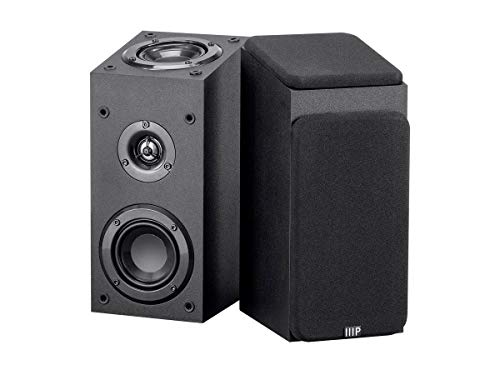
Monoprice Premium Immersive Satellite Speakers are a pair of compact satellites designed to add height channels to your home theater system. Featuring upward-firing 3-inch polypropylene drivers, they bounce sound off your ceiling to simulate overhead effects, fully compatible with Dolby Atmos receivers. No need for complex in-ceiling installations; just mount them and connect.
Ideal for American homeowners upgrading their surround sound setups for movie nights or gaming marathons. At 4.5 x 10.5 x 5.3 inches and just 2.9 pounds each, they blend seamlessly into any room decor. The 3/4-inch aluminum dome tweeter pairs with the woofers for detailed highs and balanced mids.
In real-world use, they transform flat soundtracks into dynamic 3D experiences, making explosions and rain feel overhead. While best with a powerful AV receiver, their 100W power handling and 88dB sensitivity deliver punchy performance. Monoprice's quality control ensures reliability.
Verdict: A smart, affordable choice for immersive home audio without permanent mods. Grab this pair to level up your entertainment space.
These speakers excel in creating an immersive soundfield with their dedicated height drivers, projecting audio upward for ceiling-reflected effects that mimic Dolby Atmos height channels. The 3-inch polypropylene woofers provide solid midbass punch, while the 3/4-inch aluminum dome tweeter delivers clear, sparkling highs for dialogue and effects.
With 100W input power handling and 88dB sensitivity at 8-ohm impedance, they reach high volumes without distortion when paired with a capable receiver. Vocals stay intelligible even in busy scenes, and the 3D imaging makes action films thrilling. Binding post connectors ensure secure, low-loss wired performance.
Best for home theaters where precise surround integration matters; they add depth to soundtracks without overpowering mains.
Sleek black finish and compact dimensions (4.5 x 10.5 x 5.3 inches) make these satellites easy to position on shelves or walls. Universal 1/4"-20 threaded inserts allow versatile mounting with standard brackets or stands, perfect for custom home setups.
At only 2.9 pounds each, they are lightweight yet ruggedly built with Monoprice's strict quality standards. No IP rating as they are indoor speakers, but durable construction handles regular use. As passive speakers, no battery is needed; they draw power directly from your AV receiver.
Setup is straightforward with binding posts for gold-plated banana plugs or bare wire, ensuring long-term reliability backed by warranty.
The Mechanics, Performance, and Setup of Upward-Firing Audio
The direct answer to whether upward-firing speakers work is yes, but their effectiveness depends almost entirely on room acoustics and proper calibration. Unlike conventional front channels that push sound waves straight toward the listener, elevation modules fire acoustic energy upward at an angle between twenty and thirty degrees. The audio waves travel to the ceiling, reflect off the rigid boundary, and bounce downward to simulate overhead sound sources. When installed under appropriate conditions, listeners perceive distinct ambient height effects such as falling rain, aircraft flyovers, and subtle atmospheric reverberation.
How Sound Wave Reflection Creates Overhead Audio
Upward-firing speakers rely on the physical principle of specular acoustic reflection. Sound behaves similarly to light striking a mirror, reflecting at an angle equal to its arrival angle. Dedicated elevation modules utilize directional driver cones to focus sound into a tight acoustic beam. This targeted beam travels diagonally toward the ceiling rather than dispersing broadly across the room.
To enhance the illusion that sound originates from above, manufacturers incorporate psychoacoustic filtering into the signal path. Human ears detect vertical sound localization through frequency response alterations caused by the outer ear, known as head-related transfer functions. Spatial audio processors apply high-frequency boosts and notch filters to mimic these biological cues. This specialized equalization tricks the human brain into interpreting reflected waves as arriving from an elevated position.
Unlike traditional home music speakers engineered for wide horizontal dispersion, elevation channels focus energy upward to prevent direct sound transmission to the listener. If too much sound travels directly from the cone to the listening area, the brain immediately pinpoints the physical cabinet. Quality elevation drivers prevent this localization error by using deep cabinet bezels, recessed baffles, or acoustic foam dampening. These physical dampening measures absorb stray horizontal energy while permitting the primary directional beam to project cleanly upward.
The Critical Role of Ceiling Height, Angle, and Texture
Room architecture acts as an active physical component in any reflected audio setup. For upward-firing drivers to function effectively, the ceiling must be flat, level, and constructed from an acoustically reflective material such as standard drywall, plaster, or dense hardwood. Flat surfaces allow acoustic energy to bounce cleanly downward at a predictable angle into the primary seating area. If the ceiling possesses a steep vault or cathedral slope, sound waves bounce away toward opposite walls instead of descending toward the listener.
Ceiling height also defines the boundaries of realistic height perception. Most audio format guidelines suggest a ceiling height between seven and a half feet and twelve feet, with eight to ten feet representing the ideal range. Ceilings lower than seven feet do not allow sufficient physical distance for the sound beam to expand and develop a convincing spatial sense. Conversely, ceilings exceeding twelve feet cause excessive signal loss before the sound completes the round trip down to ear level.
Surface texture presents another major obstacle to convincing height reproduction. Smooth painted drywall and finished wood reflect mid-range and high-frequency sound waves with minimal diffusion. In contrast, heavy popcorn texturing, acoustic plaster, suspended drop-ceiling tiles, and exposed acoustic insulation absorb or scatter the directional beam. When sound strikes an absorbent boundary, acoustic energy dissipates diffusely across the room, eliminating the directional cues necessary for overhead audio imaging.
Upward-Firing Modules Compared to Direct In-Ceiling Speakers
Direct in-ceiling speakers remain the benchmark for spatial audio precision because they place physical drivers directly over the listener. When a helicopter pans overhead on a movie soundtrack, an in-ceiling driver delivers direct acoustic pressure straight down to the seating area. This physical orientation provides sharp sound object localization, dynamic clarity, and complete immunity to ceiling surface textures. Listeners seeking reference-level performance typically favor in-ceiling installations when room construction permits structural modifications.
Despite the performance advantages of direct overhead speakers, physical installation is often impractical or prohibited. Renters, residents of multi-story buildings, and homeowners with finished living spaces cannot easily cut holes and run speaker wiring through structural barriers. Upward-firing speakers eliminate these construction challenges by integrating height drivers directly into front or surround satellite enclosures. Setting up an elevation system requires nothing more than placing modules on top of existing cabinets or mounting them on nearby walls.
The subjective listening experience also reveals subtle differences in acoustic presentation between the two approaches. In-ceiling speakers produce discrete, pinpoint overhead effects that feel immediate and localized. Upward-firing speakers, by contrast, tend to create a more diffuse, atmospheric sense of vertical space. Many listeners find this broader soundstage remarkably pleasing for ambient rain, wind, and room reverberation, even if it lacks the razor-sharp object positioning of flush-mounted architectural speakers.
Examining Driver Architecture in Compact Satellite Designs
Dedicated spatial audio satellites demonstrate how specialized driver engineering accommodates multichannel home theater demands within compact enclosures. For example, the Monoprice Premium Immersive Satellite Speakers combine front-firing elements with an integrated upward-firing driver in one cabinet. The front section utilizes a three-quarter-inch aluminum dome tweeter and a three-inch polypropylene woofer for standard surround channels. Positioned on the angled top surface is an additional three-inch polypropylene driver dedicated exclusively to the height channel.
Managing two independent channels inside a single cabinet requires separate physical connections on the rear panel. Quality immersive satellite units provide distinct sets of binding posts for the main driver array and the elevation driver. This physical separation allows users to route standard channel amplification to the front drivers while connecting height outputs to the upward-firing cone. The compact dimensions of four and a half by ten and a half by five point three inches allow the cabinets to fit onto shelves, consoles, or stands.
Power handling and electrical efficiency also dictate how well compact elevation satellites integrate with home audio electronics. The Monoprice satellite speakers feature an eight-ohm nominal impedance and a sensitivity rating of eighty-eight decibels, with power handling specified up to one hundred watts. These electrical specifications allow standard multi-channel AV receivers to drive both the primary and height channels effectively without overloading the amplifier section. Universal one-quarter-inch by twenty threaded inserts on the rear panel provide flexible mounting options for wall brackets when shelf placement is unavailable.
AV Receiver Configuration and Calibration Settings
Connecting elevation speakers to an audio-video receiver is only the first step in achieving functional height audio. Modern multichannel receivers require users to specify the physical speaker configuration in the setup menu. Listeners must designate height outputs as Dolby Atmos enabled or upward-firing elevation channels rather than traditional in-ceiling or front-presence speakers. Selecting the correct speaker profile tells the internal digital signal processor to apply the psychoacoustic frequency curve tailored for ceiling reflection.
Accurate distance and delay measurements are vital for synchronizing reflected overhead audio with direct sound waves. During speaker setup, users input both the distance from the speaker to the listener and the distance to the ceiling. Because reflected sound travels a longer path to the ceiling and back, the receiver introduces microsecond delays to the main channels. This time-alignment ensures that direct cues from front speakers and reflected cues from height channels arrive at the listener simultaneously.
Automated acoustic calibration software, including Audyssey, YPAO, and Dirac Live, plays a major role in fine-tuning elevation channels. Running the calibration microphone at multiple seating positions allows the receiver to detect room boundaries and calculate reflection losses. Receivers frequently increase upward-firing channel levels by two to four decibels to compensate for energy lost during ceiling reflection. Users can also manually inspect crossover settings, which are typically set between one hundred and twenty and one hundred and fifty hertz for small three-inch elevation woofers.
Physical Placement, Angle Alignment, and Room Geometry
The physical position of upward-firing speakers relative to the listener directly determines where the reflected sound beam lands in the room. In a standard setup, elevation modules sit on top of the front left and front right speakers, aimed slightly upward and inward. The distance between the speakers and seating must balance the fixed launch angle of the drivers with ceiling height. If listeners sit too close to the front speakers, the reflected beam will overshoot the seating area and land behind the listener.
Placing elevation modules at appropriate ear-level heights prevents direct acoustic contamination. The bottom of the elevation cabinet should ideally sit at or slightly above the seated listener’s ear height. Positioning upward-firing drivers significantly below ear level allows direct sound from the angled driver to reach the listener’s ears before the reflected beam completes its journey. Keeping the drivers at roughly thirty-six to forty-eight inches off the floor helps preserve the illusion that sound arrives solely from overhead.
Rear or surround elevation placement can further enhance spatial immersion in larger setups. Adding a second pair of upward-firing modules on the surround channels creates a four-channel height layer, surrounding the listener in a full three-dimensional audio hemisphere. When incorporating rear elevation speakers, identical placement principles apply regarding boundary reflections and listening distances. Ensuring that both front and rear height channels bounce off matching flat ceiling areas maintains tonal balance and seamless spatial panning throughout the room.
Verifying Height Effects and Troubleshooting Weak Spatial Cues
Evaluating the performance of an elevation system requires clean multichannel source material rather than standard stereo tracks. Many modern streaming films and physical disc releases feature dedicated spatial audio soundtracks with dynamic overhead channel activity. Listeners can evaluate vertical imaging and acoustic balance by running dynamic tracks to demo speaker systems alongside specialized film scenes featuring heavy rainstorms or helicopter sequences. Listening critically during dynamic sequences helps confirm whether sound appears to originate from above or remains anchored at the front speaker cabinets.
When height channels sound weak or indistinct, the underlying issue usually stems from room acoustics or source settings rather than defective hardware. A common diagnostic step involves verifying that the AV receiver is receiving a true bitstream Dolby Atmos or DTS:X audio signal from the player. Many streaming devices, game consoles, and Blu-ray players default to two-channel PCM or legacy multichannel formats unless configured for bitstream audio pass-through. If the receiver display does not show the spatial audio logo, the elevation drivers will reproduce generic matrixed surround information.
Another frequent issue involves improper level matching after running automated room calibration. Automated calibration microphones sometimes miscalculate the volume of reflected channels due to room reverberation. If height effects remain imperceptible during active movie scenes, increasing the elevation channel trim levels by two to three decibels in the receiver menu often reveals missing spatial cues. Listeners should also verify that ceiling fans, light fixtures, or hanging plants are not physically obstructing the sound beam path between the cabinet and the ceiling.
Practical Buyer Considerations for Elevation Audio
Choosing between standalone upward-firing add-on modules and integrated satellite speakers depends on existing equipment and available space. Integrated satellite units, like the Monoprice immersive models, provide an all-in-one solution that houses both surround and height channels in a single compact enclosure. This unified design saves shelf space and eliminates the visual clutter of stacking separate add-on modules on top of existing speaker cabinets. Conversely, standalone add-on toppers allow owners of existing bookshelf or floor-standing speakers to add elevation capability without replacing primary speakers.
Amplification requirements represent another crucial practical consideration before purchasing elevation hardware. Passive elevation speakers require dedicated amplifier channels on the host AV receiver. A standard five-channel receiver cannot power a five-point-one-point-two spatial audio system; the setup requires a seven-channel or nine-channel receiver capable of decoding and amplifying discrete height outputs. Buyers must verify that their receiver includes spare amplifier channels and dedicated height binding posts before investing in passive elevation speakers.
Cabinet construction, mounting versatility, and room aesthetics also influence long-term satisfaction. Compact satellite speakers featuring sturdy composite enclosures and universal threaded mounting inserts offer significant placement flexibility in smaller rooms. Lightweight cabinets weighing under three pounds can be safely mounted on wall brackets or elevated stands to optimize driver angles. Inspecting connection terminal quality, such as sturdy binding posts that accept bare wire or banana plugs, ensures reliable signal transfer and straightforward cable management during setup.
Upward-firing speakers deliver an effective, practical solution for experiencing multidimensional spatial audio without invasive ceiling surgery. When paired with flat reflective ceilings, proper placement geometry, and meticulous receiver calibration, these specialized drivers produce an engaging sense of atmospheric height that transforms home entertainment. Careful assessment of your room architecture, ceiling surfaces, and receiver capabilities ensures that upward-firing speakers achieve their full acoustic potential in your listening space.


Write Your Review
No reviews yet. Be the first to share your experience!