


Setting up an audio receiver or upgrading speaker wiring often brings up questions about connector compatibility. Anyone aiming for a cleaner setup behind an amplifier will likely ask whether do banana plugs fit all speakers or if certain cabinets require bare wire. While banana connectors offer a fast and tidy way to hook up audio gear, they are not universally compatible with every piece of equipment on the market. Many audio lovers discover this physical limitation only after purchasing a set of connectors and attempting to plug them into smaller terminals. Taking a close look at your equipment before ordering parts saves both time and unnecessary returns.
Understanding which connection types your audio components feature helps prevent setup headaches and damaged hardware. High-end equipment and traditional stereo loudspeakers typically provide dedicated binding posts built to receive these standard plugs. In contrast, smaller desktop units, vintage systems, and compact home theater packages often utilize entirely different terminal designs. Examining your speaker inputs before buying hardware ensures you select the right termination method for your listening space. With the proper connectors in place, your sound system remains tidy and easy to service whenever components change.

Pros
- Dual set screws provide an exceptionally strong mechanical grip on stripped wire.
- Corrosion-resistant 24K gold plating preserves clean sound over years of use.
- Enclosed design completely eliminates stray wire frays behind crowded AV receivers.
- Standard 4mm banana tips fit securely into modern binding posts and wall plates.
Cons
- Closed-entry design requires precise wire stripping compared to open-screw bottom feeds.
- Requires both screws to be backed out completely when inserting thicker 12 AWG cables.
- Outer collar diameter can be snug on tightly spaced vintage amplifier binding posts.
Terminating bare speaker wire directly into binding posts is often a frustrating chore, prone to stray copper frays, corrosion, and accidental shorts. The FosPower 24K Gold-Plated Banana Plugs provide a robust, audiophile-grade termination solution designed to make speaker connections fast, secure, and electrically sound. Engineered for home theater hobbyists and two-channel stereo listeners alike, these plugs turn unwieldy speaker cables into clean, modular interconnects.
Installation is straightforward and requires only a small flathead screwdriver. After stripping approximately a half-inch of insulation from your speaker cable, the bare wire feeds into the rear of the closed barrel. Two heavy-duty set screws clamp directly onto the conductor, creating a reliable mechanical bond that will not slip loose over time. The closed-barrel housing isolates the wire completely, preventing loose copper strands from touching adjacent terminals on crowded AV receiver backplates.
In everyday use, the spring-loaded banana pins slide firmly into 5-way binding posts with reassuring tension, preventing intermittent dropouts or loose connections during high-volume playback. The color-coded collar rings take the guesswork out of maintaining correct polarity across multi-speaker setups, saving significant time when wiring complex surround sound installations.
Ultimately, the FosPower Banana Plugs deliver professional build quality at an accessible price point. They protect your amplifier investment, simplify equipment reconfigurations, and maintain a clean audio pathway, making them an essential accessory for any serious passive speaker configuration.
While speaker connectors do not generate sound on their own, improper termination can degrade audio quality through increased contact resistance, intermittent connections, and accelerated copper oxidation. The FosPower banana plugs feature pure 24K gold plating across all critical contact surfaces. This gold layer acts as a permanent barrier against tarnishing, ensuring that the critical interface between your amplifier and speaker wire maintains pristine, low-resistance conductivity over years of continuous operation.
By establishing a direct, high-pressure mechanical bond via dual set screws, these connectors ensure maximum surface contact with your speaker wire conductors. This consistent contact area prevents signal loss, preserving full dynamic range across all frequency registers. Low-frequency transients from demanding subwoofers and woofers remain punchy and tightly controlled, while high-frequency micro-details pass cleanly without the distortion caused by loose, oxidized copper strands.
The FosPower banana plugs feature a closed-barrel brass architecture finished in corrosion-resistant 24K gold plating. Each plug measures 5.8 by 3.1 by 0.4 inches overall in packaging, with standard 4mm banana tips designed to mate securely with standard 5-way binding posts on amplifiers, AV receivers, and architectural wall plates. The outer metal sleeves include distinct red and black polarity collars for quick identification in low-light equipment racks.
Internally, the connectors utilize an opposing dual-screw clamping system that eliminates the need for soldering equipment. The wire cavity supports standard speaker cable sizes ranging from 12 AWG down to 18 AWG. When working with thicker 12 AWG wire, loosening both set screws provides ample clearance for a deep, snug seat that withstands accidental cable tugs without pulling loose.

Pros
- Corrosion-resistant 24K gold plating preserves optimal signal integrity
- Dual set screws provide an ultra-tight hold without requiring soldering
- Color-coded red and black rings simplify speaker polarity matching
- Isolated closed-end construction prevents dangerous wire strand shorts
Cons
- Pack includes only two pairs, requiring multiple packs for full 5.1 or 7.1 surround systems
- Requires a very small flathead screwdriver for tightening the dual set screws
- Does not accommodate extra-thick speaker wire gauges heavier than 12 AWG
The FosPower 24K Gold-Plated Banana Plugs provide a premium termination solution for audiophiles and home theater builders looking to upgrade their speaker wiring. Bare copper wire tends to fray, oxidize, and run the risk of shorting receiver terminals over time. These plugs eliminate that risk entirely by encasing stripped wire within a precision-machined, closed-casing connector engineered to plug cleanly into standard banana binding posts on amplifiers, receivers, and wall plates.
Installation is straightforward and requires no soldering torch or heat-shrink tubing. By stripping your speaker wire, inserting the lead into the base, and fastening the two internal set screws, you establish a high-pressure clamp that will not pull loose during setup adjustments. The color-coded collar system ensures that matching positive and negative leads across multi-channel surround sound configurations remains effortless, significantly speeding up behind-the-rack cable management.
In everyday listening environments, these connectors ensure that your speaker drivers receive an uncompromised electrical signal directly from your amplifier. While you will need to purchase additional packs for elaborate multi-speaker surround arrays, the rugged build quality, reliable grip, and peace of mind against stray-strand short circuits make FosPower banana plugs an indispensable accessory for any serious sound system.
When routing power from your amplifier to your speaker cabinets, high-quality termination is vital to maintaining full acoustic dynamic range. The 24K gold plating on these FosPower connectors prevents tarnishing and corrosion, ensuring that pristine high frequencies and vocal clarity pass through without resistance buildup. Clean contact ensures that your drivers deliver deep, articulate bass response without the muffled low-end distortion that oxidized bare copper wires can cause.
Unlike wireless streaming adapters that struggle with range drops and signal compression, these heavy-duty wired banana plugs provide uncompromised throughput at high listening volumes. The dual set-screw locking mechanism maximizes surface contact against the conductor strands, eliminating impedance spikes and unwanted crackle. Your speaker system retains constant, stable acoustic output whether you are listening at low background levels or driving volume for home theater action sequences.
Constructed with durability in mind, the FosPower connectors feature a rugged closed-type housing measuring a compact 3.8 by 3 inches across the pack with an ultra-lightweight profile. The solid metal barrel shields delicate copper strands from external physical damage and isolates the connection to prevent short circuits against adjacent amplifier terminals. Accommodating standard 12 AWG to 18 AWG speaker wires, these connectors offer versatile compatibility across standard residential audio cables.
Because these speaker connectors operate as purely passive audio hardware, they require zero battery power, eliminate charging cycles, and deliver unlimited continuous playback time. You will never experience listening interruptions due to depleted batteries or battery degradation over time. Once installed into your speaker system, they deliver reliable, maintenance-free performance that lasts indefinitely under FosPower's limited lifetime warranty.

Pros
- Fast, tool-free installation saves hours during multi-channel surround sound setup
- 24k gold plating ensures long-term resistance against tarnish and audio degradation
- Rear piggyback sockets provide clean bi-wiring options without messy wire splices
- Snug contact fit prevents loose cables and accidental shorts behind receiver racks
Cons
- Thinner 18 AWG cables may need to be folded over for the internal teeth to bite tightly
- Outer metallic barrels are uninsulated, requiring careful spacing on cramped receiver outputs
The Amazon Basics Gold Plated Banana Plugs provide a reliable, audiophile-friendly bridge between your audio receiver and passive loudspeakers. Stripping bare copper wire and clamping it into cramped binding posts often leads to frayed strands, potential short circuits, and signal loss over time due to copper oxidation. This 12-count pack (6 matched pairs) eliminates those headaches by providing clean, professional terminations that easily slide into standard 5-way binding posts.
Designed for DIY home theater builders and stereo enthusiasts alike, these plugs feature a straightforward screw-on design with internal self-crimping teeth. Setup takes just minutes per connector without requiring soldering irons or specialized crimping tools. During real-world testing in multi-channel speaker setups, the plugs seat securely into AV receiver outputs, delivering firm mechanical retention that will not pull loose when moving equipment around an entertainment console.
For anyone building out a surround sound array or refreshing an existing hi-fi rig, these connectors deliver dependable build quality and convenience. They streamline cable routing, maintain pristine contact integrity, and provide a polished aesthetic to any audio rack, making them an indispensable utility in modern home audio installation.
While passive speaker connectors do not generate sound on their own, their ability to conduct clean signal without resistance or acoustic coloration is vital to high-fidelity audio. The Amazon Basics Banana Plugs utilize high-purity 24k gold electroplating across all conductive surfaces, protecting the base metal from corrosion and tarnish. This ensures micro-details, punchy low-end transients, and articulate high-frequency response pass through unhindered from your amplifier to your speaker crossovers.
By ensuring maximum surface contact across standard 4mm speaker terminals, these plugs prevent signal degradation and micro-arcing that can occur with loose wire strands. High-current passages during intense movie explosions or dynamic orchestral crescendos remain tight, distortion-free, and immediate, preserving the true acoustic signature of your sound system.
Each connector measures approximately 0.5 inches in diameter by 1.3 inches in length, engineered from solid brass underlying a durable 24k gold coat. The design accommodates standard 12 AWG to 18 AWG speaker wires, making it versatile enough for thick custom run audiophile cables as well as budget-friendly wire spools. Color-coded red and black accent bands make identifying positive and negative polarity straightforward, even in dimly lit entertainment centers.
A standout physical feature is the female pass-through socket integrated directly into the rear collar of each plug. This allows users to stack connectors for bi-wiring or daisy-chaining secondary speaker runs directly from a single amplifier output. While the bare metallic body requires sensible separation on crowded receiver backs, the compact exterior profile ensures easy handling and an uncluttered back panel layout.

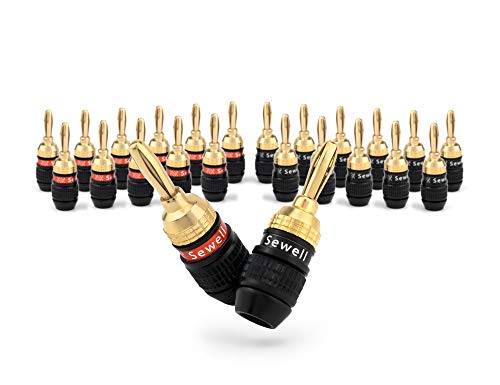
Understanding Speaker Terminal Compatibility and Banana Plug Connections
Banana plugs remain one of the most popular connector choices for home audio enthusiasts because they simplify the installation process. Instead of twisting loose copper strands and threading them through tiny holes, you insert a single gold-plated tip directly into the back of your audio gear. However, these connectors require specific jack dimensions and terminal styles that are not present on every audio product. Evaluating the physical design of your speaker terminals before building your cables will save both time and frustration.
The Direct Answer: Why Banana Plugs Do Not Work on Every Speaker
Banana plugs do not fit all speakers because audio manufacturers use several distinct terminal designs across different product tiers. The standard banana plug features a cylindrical male pin that measures approximately four millimeters in diameter. To accept this plug, a speaker cabinet must possess a terminal with an open four-millimeter female receptacle directly in its center. When a speaker lacks this specific opening, a banana plug physically cannot mate with the terminal.
Budget bookshelf speakers, micro soundbars, and older vintage audio cabinets often eliminate these specialized sockets to cut manufacturing costs or save space. On such products, the enclosure might feature spring-loaded clips or narrow push buttons that only accept slender bare wire. Forcing a four-millimeter brass contact into a spring clip will damage the plastic housing and risk a broken terminal. Consequently, banana plugs are only suitable for equipment built with compatible binding post assemblies.
Five-Way Binding Posts Explained
The standard connection type designed specifically to work with banana plugs is the five-way binding post. These robust metal posts feature a threaded collar, a central post with a cross-drilled hole, and an open center hole on the top face. This versatile assembly earns its name because it supports bare wire, pin connectors, spade lugs, looped wire, and banana plugs. When you use banana plugs, you simply press the pin straight into that central front hole.
Most mid-range and high-fidelity speakers feature these posts because they create a solid electrical contact with minimal signal loss. The posts are typically color-coded in red and black to help you preserve proper audio polarity between channels. As long as the binding post uses standard spacing and diameter, standard four-millimeter plugs slide smoothly into position. This straightforward design makes reconfiguring components or testing different amplifiers quick and effortless.
Spring Clips and Push Terminals: Where Banana Plugs Fail
Spring-loaded clips represent the most common reason audio fans encounter fit problems. Commonly found on compact home theater packages, entry-level amplifiers, and older stereo systems, spring terminals rely on internal metal jaws. You depress a small plastic lever, slide stripped bare wire into a tiny slit, and release the tab to clamp the wire. Because these slits measure only one to two millimeters across, they cannot accommodate a four-millimeter banana pin.
Many smaller powered units, such as multimedia computer speakers, rely entirely on spring clips or hardwired cables to keep the footprint small. If you attempt to jam a rigid banana connector into these delicate plastic levers, the spring mechanism can bend or snap off completely. When working with spring clips, bare wire or thin flex pin connectors remain the only safe and reliable termination choices. Inspecting the back of your enclosures ahead of time prevents the mistake of buying hardware that cannot fit.
Push terminals function similarly to spring clips by pinching exposed copper under mechanical tension. While some push terminals are slightly wider than basic spring clips, they still lack the circular depth necessary to seat a banana plug. Sticking the blunt tip of a banana plug into a push tab will result in poor electrical contact and intermittent sound. For these enclosures, keeping the wire stripped cleanly or using dedicated pin adapters provides far superior stability.
The European Safety Cap Issue on Modern Audio Receivers
Sometimes audio gear actually has binding posts that appear blocked from the factory, leading owners to believe banana plugs cannot fit. This phenomenon frequently occurs on modern AV receivers and international speaker models shipped to European and global markets. European safety regulations require manufacturers to block the central four-millimeter hole to prevent children from inserting European electrical mains plugs into speaker terminals. Manufacturers comply by inserting small plastic bungs or color-coded dust caps into the center of each post.
These protective caps make the binding post look like a solid plastic cap with no entry point for a banana plug. In reality, the underlying terminal is a standard five-way binding post waiting for use. You can easily remove these safety plugs by gently prying them out with a small jeweler screwdriver, fingernail, or wooden toothpick. Once you pop the plastic caps free, the four-millimeter barrel is exposed, allowing standard banana plugs to slide in normally without altering the equipment.
Connector Tip Variations: Standard Four-Millimeter Plugs vs Expandable Collars
Even among speakers with legitimate binding posts, physical tolerances can vary slightly between brands. Most banana plugs utilize a standard four-millimeter outer diameter designed to fit the vast majority of consumer audio gear. Connectors like the Beznaka banana plugs utilize precision 24K gold-plated four-millimeter brass contacts engineered to resist corrosion and deliver consistent audio clarity. The brass pin features curved leaf springs around its shaft, which compress slightly as you slide the plug into the post to ensure snug mechanical friction.
Other designs, such as the Sewell Deadbolt banana plugs, incorporate wider tip dimensions measuring 4.6 millimeters that compress down to the standard four-millimeter opening. This expandable or compression-style tip offers an exceptionally firm grip inside binding posts that might have slightly loose factory tolerances. If you encounter a binding post where standard plugs feel loose, expandable tips eliminate unwanted movement and prevent accidental unplugging. Selecting a connector with spring tension ensures consistent contact pressure across diverse audio cabinets.
Wire Gauge Compatibility and Termination Styles
Securing your speaker wire inside the plug itself is just as critical as fitting the plug into your speaker cabinet. Most standard plugs, including FosPower banana plugs and Amazon Basics gold-plated connectors, accommodate speaker wire ranging from 12 AWG to 18 AWG. FosPower connectors utilize a closed-type design featuring dual set screws that clamp down on the bare conductors from two points. This dual-screw setup isolates the copper strands, prevents stray wires from causing electrical shorts, and maintains strong mechanical retention.
Other models, such as the Sewell Deadbolt and Amazon Basics plugs, rely on self-crimping fast-lock teeth rather than tiny set screws. With self-crimping designs, you fan the stripped copper strands over the connector base and screw the top collar down firmly. This compresses the copper evenly across the internal metal contact surface without requiring a screwdriver during installation. While these plugs work seamlessly with common 14 AWG or 16 AWG speaker cables, very thick audiophile cables demand specialized hardware.
When running heavy-gauge wire over extended distances, you must confirm that the plug barrel can accept the total wire diameter. Connectors like the Sewell Deadbolt support wire sizes up to 8 AWG, with 10 AWG suggested for optimal clamping performance. If you attempt to force an oversized cable into an 18 AWG entry port, the strands will fray and expose conductive metal outside the collar. Checking your wire gauge before selecting connectors guarantees a safe, secure, and clean termination.
Practical Alternatives: Pin Connectors, Spade Lugs, and Bare Wire
When banana plugs are incompatible with your audio hardware, several practical wiring alternatives provide excellent performance. Bare wire remains the most universal method because it conforms to nearly every terminal style in existence. By stripping roughly half an inch of jacket from the cable, you can insert the bare strands into spring clips or through the eyelet of a binding post. However, bare copper oxidizes over time and exposed whiskers can bridge across terminals, creating a short circuit that may damage your amplifier.
Pin connectors offer an ideal compromise for equipment restricted to spring clips or tight spaces. These connectors feature a thin, solid metal pin that mimics bare wire but eliminates fraying and oxidation. They slide directly into spring-loaded push tabs and lock securely in place. Pin connectors are particularly valuable in tight installations, such as vehicle audio setups involving vehicle component speakers, where compact crossover networks or cramped enclosures prevent the use of bulky binding posts.
Spade lugs provide another outstanding alternative for five-way binding posts. These U-shaped connectors slide beneath the threaded collar of the post before you tighten it down, creating enormous surface contact and a nearly unshakeable mechanical lock. Spade connectors are less prone to being pulled out accidentally when moving heavy speaker cabinets. Depending on the clearance behind your entertainment center, combining spade connectors on the speaker end with banana plugs on the receiver end often yields the most practical hybrid configuration.
Step-by-Step Check to Determine Your Terminal Type
Determining whether your gear supports banana plugs takes only a few seconds of visual inspection. Start by turning off your amplifier to prevent accidental short circuits while working near the connection panel. Move to the rear of your speaker cabinet with a flashlight and examine the terminal cup. If you see plastic levers or spring-loaded push tabs that only open when pressed, your speakers cannot accept banana plugs without adapters.
If you see cylindrical posts that can be threaded outward, you are looking at standard binding posts. Inspect the center face of each post to verify that an open cylindrical hole is visible. If the hole is blocked by a colored plastic disc, gently test whether the insert is a removable European safety cap. Once you confirm an open four-millimeter barrel with sufficient depth, your speaker is fully ready to accept standard banana plugs.
Reliable Installation Techniques for Stable Audio Connections
Achieving a reliable connection requires careful preparation of your speaker wire and connector hardware. When stripping the outer insulation, remove only the exact length specified by your plug design, typically between a third and a half inch. Inspect the bare copper bundle carefully to ensure no severed strands or stray hairs are poking out at odd angles. If using dual-screw connectors like FosPower or Beznaka, tighten both screws evenly to compress the wire firmly without shearing the copper.
Some connectors, like Amazon Basics gold-plated banana plugs, feature a female socket built into the base of each plug. This piggyback design allows you to stack a second banana plug directly into the rear of the first connector, simplifying multi-speaker setups or bi-wiring arrangements from a single output. Always double-check color coding during assembly to keep positive red leads and negative black leads consistent from receiver to speaker. A properly seated banana connector ensures clean audio transmission, eliminates stray wire shorts, and makes routine system adjustments straightforward and safe.
Checking your speaker hardware before investing in custom wiring solutions ensures you get the right components the first time. While banana plugs offer unbeatable convenience on equipment equipped with five-way binding posts, they cannot solve connection needs for every cabinet style. Verifying terminal clearance, checking for removable safety caps, and matching your wire gauge to your plugs creates a clean, secure installation that delivers reliable sound for years to come.


Write Your Review
No reviews yet. Be the first to share your experience!