


Building a reliable sound system often begins with a fundamental decision regarding how your audio signal is amplified and processed. Listeners evaluating home theater equipment, desktop monitoring systems, or multiroom setups frequently ask whether do active speakers sound better than passive systems in everyday listening environments. The debate between these two architectures involves distinct engineering philosophies, component pairings, and signal paths that directly shape how music and dialogue are reproduced.
Active speaker designs combine dedicated internal amplifiers with matched acoustic drivers, eliminating the guesswork of pairing external hardware. In contrast, traditional stereo loudspeakers follow a passive design that requires a standalone amplifier or AV receiver to deliver the necessary wattage to the speaker cabinets. Understanding how each approach handles signal division, power distribution, and room acoustics will help you choose the right setup for your specific audio goals.

Pros
- Punchy, room-filling bass response with the push of a dedicated button
- IPX6 water-resistant build withstands tough outdoor conditions and splashes
- Wireless stereo pairing doubles overall volume and creates true stereo separation
- Engaging multi-color LED light show adds party ambiance to any setting
Cons
- IPX6 rating protects against high-pressure water streams but cannot be fully submerged
- High treble frequencies can sound slightly harsh at near-maximum volume levels
- Lacks a dedicated companion smartphone app for custom graphic EQ adjustments
The DOSS SoundBox Pro is engineered for music fans who demand energetic, room-filling sound without carrying a bulky boombox. Nestled right in the sweet spot of portable audio, this speaker balances convenience, durability, and bold sound engineering. Whether you are relaxing in a dorm room or soundtracking a patio cookout, it provides a versatile and entertaining listening experience right out of the box.
Built primarily for active lifestyles, students, and outdoor adventurers, the SoundBox Pro stands out by delivering punchy audio that outperforms its modest footprint. The onboard Active Extra Bass function ensures that electronic, hip-hop, and rock tracks hit with satisfying authority. Meanwhile, tactile buttons across the top chassis provide immediate control over playback, pairing, and lighting modes without demanding that you unlock your smartphone.
In everyday use, the speaker shines as a dependable workhorse. Bluetooth connectivity establishes quickly and maintains a reliable signal across typical household and campsite distances. For larger spaces, the wireless stereo pairing feature allows you to link a second SoundBox Pro unit, immediately expanding the soundstage into a legitimate two-channel stereo setup that comfortably entertains a crowd.
Ultimately, the DOSS SoundBox Pro proves that a budget-friendly portable speaker can sound substantial and look lively at the same time. With solid water resistance, dynamic lighting effects, and impressive acoustic performance, it easily earns its place as a reliable daily audio companion.
Acoustically, the SoundBox Pro leverages dual full-range drivers complemented by dual opposing passive radiators. This setup produces a balanced 20W stereo presentation with focused mid-bass and surprisingly articulate vocal reproduction. When you engage the Active Extra Bass mode, the speaker pushes the lower registers forward, giving basslines and kick drums a noticeable thud without completely burying the midrange.
The midrange tuning remains clean and present, ensuring acoustic guitars, podcast dialogues, and pop vocals retain clarity. At moderate listening levels, the highs are crisp and snappy, providing enough detail for casual listening. As you push the volume toward its upper ceiling, the internal digital signal processing helps tame extreme distortion, though treble notes can show slight roll-off under maximum strain.
Sound projection is expansive for a speaker measuring less than eight inches long. It projects audio forward with good horizontal dispersion, easily cutting through ambient outdoor chatter. For listeners seeking an immersive stereo image, pairing two units creates genuine left-right acoustic separation that dramatically widens the listening sweet spot.
The DOSS SoundBox Pro features a modern, streamlined silhouette with smooth contours and a tactile matte finish. Measuring approximately 7.74 by 2.94 by 2.95 inches and weighing just 1.32 pounds, the unit rests securely on any flat surface thanks to rubberized base feet. The front metal grille protects the sensitive acoustic drivers while allowing the integrated perimeter LEDs to shine through brightly.
Hardware resilience is a major highlight, anchored by an IPX6 water resistance rating. This level of ingress protection safeguards the internal electronics from heavy water splashes, rainstorms, and accidental drink spills, making it an excellent choice for poolside lounging, boat trips, and shower listening. The rear input ports are secured beneath a thick silicone flap to ensure water stays out.
Connectivity options include standard Bluetooth streaming as well as a 3.5mm auxiliary input for legacy devices. The dynamic lighting system offers six distinct colors and three illumination patterns that pulse in sync with your rhythm, though you can easily toggle the lights off to conserve battery power during extended outdoor sessions.

Pros
- Seamless Bluetooth pairing with all modern devices
- Universal mounting brackets for easy wall or ceiling install
- Weatherproof enclosure handles moisture and elements
- Built-in bass reflex vent boosts low-end response
- Includes 11.5-foot speaker wire and power adapter
Cons
- Requires nearby AC outlet as it's not battery-powered
- Passive speaker needs wiring to active unit limiting placement flexibility
- 3.5-inch drivers may struggle in very large open outdoor spaces
The Pyle PDWR42BBT is a dual-speaker system featuring one active Bluetooth-powered unit and one passive companion, both with 3.5-inch 3-way drivers in weatherproof enclosures. Designed for fixed installations, it's perfect for patios, poolsides, decks, or even indoor spaces like garages where durable audio is needed.
Homeowners and outdoor entertainers will love how it turns any backyard into a party zone. Mount them horizontally or vertically on walls or ceilings, and enjoy 200W of power streaming wirelessly from your phone or via AUX from other devices. Real-world use shines during summer cookouts or pool hangs, where the rustproof grills fend off splashes and weather.
Performance holds up well for mid-sized areas, with balanced sound that doesn't distort at high volumes. While not portable, the plug-and-play setup with included brackets and wire makes it a hassle-free upgrade over basic indoor speakers. Verdict: Excellent value for reliable outdoor audio that survives the elements.
The 3-way design shines with a 3.5-inch aluminum subwoofer for punchy bass, 1.75-inch midrange for vocal clarity, and 1-inch dome tweeter for crisp highs, all enhanced by a bass reflex vent. Volume reaches party levels without muddiness, ideal for filling patios during tailgates or gatherings.
Bluetooth connectivity is stable up to 30 feet, pairing quickly with iPhones, Androids, or tablets. AUX input ensures backup options for wired sources like laptops. Overall, it delivers lively, distortion-free sound suited for outdoor lifestyles, though large open yards might need multiples for even coverage.
Rugged heavy-duty grills and rustproof cabinets make these speakers tough against weather, moisture, and corrosion, perfect for poolside or rainy patios. At 3.5 inches, they're compact yet sturdy, with universal brackets for secure wall, corner, or ceiling mounts in any orientation.
No built-in battery means continuous playback via the included DC 12V adapter plugged into a 120V outlet, eliminating recharge worries for all-day events. Weight is manageable for DIY installs, and the 11.5-foot wire connects the pair easily. Drawback: Placement is tied to power access, but that's the trade-off for unlimited runtime outdoors.

Pros
- Active and passive setup eliminates the need for an external receiver or amplifier.
- Rear rotary tone knobs make fine-tuning bass and treble quick and simple.
- Included adjustable brackets make wall or ceiling installation fast and flexible.
- Impressive maximum volume output easily cuts through background shop and garage noise.
Cons
- Cabinets are not waterproof and must remain protected from direct rain and moisture.
- Compact 5.25-inch drivers cannot reproduce sub-bass frequencies below roughly 60Hz.
- Requires running speaker wire between the primary powered unit and the companion passive speaker.
The Pyle PDWR53BTBK is an all-in-one stereo speaker system engineered for versatile mounting in spaces where conventional desktop or floorstanding speakers would get in the way. By integrating a digital amplifier, Bluetooth receiver, and physical controls into a single master speaker that powers a matching passive companion, this system delivers true two-channel stereo separation without the bulk or expense of a standalone receiver.
Designed primarily for garages, home workshops, studios, and covered outdoor decks, this pair makes setting up a dedicated audio zone straightforward. Mounting the cabinets high on a wall or ceiling beam keeps your counters and workbenches clear, while quick Bluetooth pairing allows anyone to stream playlists or podcasts directly from a smartphone or tablet in seconds.
During daily use, the system proves remarkably convenient thanks to its audio-sensing auto-standby feature. The amplifier wakes up when audio is fed into the system and powers down into a low-draw idle state when playback stops. If you prefer a hardwired source, the built-in RCA and 3.5mm inputs offer reliable plug-and-play operation for laptops, TVs, or auxiliary sound interfaces.
While this system is not voiced for high-end critical studio monitoring, it represents exceptional functional value for day-to-day listening. It combines clean build quality, practical mounting versatility, and punchy sound output into an understated black package that blends into almost any indoor or sheltered environment.
The acoustic architecture of the PDWR53BTBK utilizes a two-way design, pairing a 5.25-inch polymer mid-bass driver with a 0.5-inch Mylar dome tweeter in each cabinet. The overall tuning is energetic and forward-leaning, pushing spoken vocals and lead instruments to the front of the mix. The dedicated rear treble rotary control allows you to smooth out high frequencies in rooms with hard, reflective surfaces like concrete garage floors.
Mid-bass performance is punchy and tight, lending rhythm and drive to rock, hip-hop, and pop tracks. Because the sealed enclosures are tuned for clarity and efficiency rather than deep sub-bass reproduction, frequencies in the sub-60Hz territory are rolled off. The built-in 300-watt peak amplifier provides ample headroom to power through noisy garage tools or outdoor social gatherings without severe distortion at higher volumes.
Each enclosure measures 7.2 by 6.5 by 9.6 inches and weighs approximately 5 pounds, giving the speakers a sturdy feel without making wall mounting cumbersome. The rugged ABS polymer housing is built to withstand dusty workshops and indoor temperature fluctuations. However, because these units do not carry a waterproof IP rating, they must be installed under roof eaves or inside covered porches rather than exposed directly to rain and water.
Hardware connectivity is centralized on the master unit's rear panel. Here you will find the AC power socket, spring-clip speaker terminals to connect the secondary passive speaker, and rotary knobs for master volume, bass, and treble adjustments. External wired options include stereo RCA jacks, a 3.5mm auxiliary input, and a pass-through loop output that enables daisy-chaining to additional powered audio gear.
Pros
- Massive 300W output with no distortion at high volumes
- Stable Bluetooth pairs quickly with phones or tablets
- Durable weather-resistant enclosures for year-round use
- Impressive bass response elevates outdoor listening
- Simple installation with gold-plated binding posts
Cons
- Requires nearby power outlet as no built-in battery
- Wall-mount design lacks portability for on-the-go use
- No companion app for EQ tweaks or advanced controls
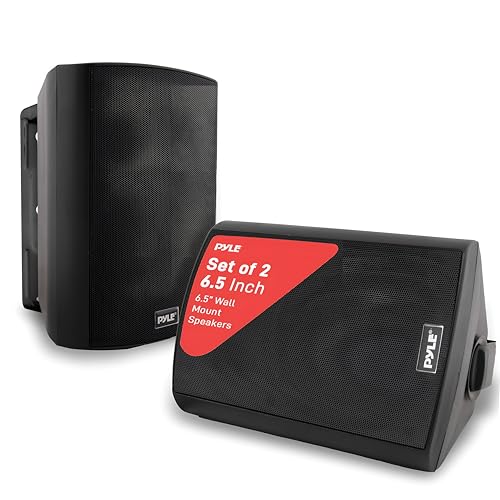
The Pyle 6.5-inch wall mount speaker system is a rugged pair of Bluetooth-enabled audio projectors built for indoor and outdoor spaces. With a built-in digital amplifier delivering 300W peak power, it transforms patios, decks, poolsides, or garages into vibrant sound zones. Homeowners and outdoor enthusiasts will appreciate its no-fuss setup and ability to handle everyday weather without skipping a beat.
In real-world use, these speakers excel at filling medium to large areas with balanced stereo sound. Stream playlists from your phone via Bluetooth from over 30 feet away, or plug in via aux for wired reliability. The 6.25-inch subwoofers provide deep bass that cuts through ambient noise, while 1-inch tweeters ensure clear vocals and highs, making it great for barbecues, workouts, or casual gatherings.
Installation is straightforward with included mounting hardware, and the black finish blends into most surroundings. While not portable, its fixed positioning ensures consistent, high-volume performance without battery worries. Overall verdict: a solid choice for durable, powerful outdoor audio that punches above its price for lifestyle setups.
Bass depth comes from the 6.25-inch long-throw subwoofers, delivering impressive low-end thump ideal for bass-driven tracks at pool parties or tailgates. Paired with 1-inch polymer dome tweeters, vocals stay clear and detailed, avoiding muddiness even at max volume. The 300W peak (30W RMS per speaker) handles loud playback without clipping, perfect for open-air spaces.
Bluetooth range exceeds 30 feet with stable connectivity to iPhones, Androids, or tablets, minimizing dropouts during movement. Volume levels scale smoothly for intimate decks or full-yard blasts, with stereo imaging creating an immersive surround effect. Aux inputs add versatility for non-Bluetooth sources like TVs.
The PP mica cabinet with rubber surrounds and marine-grade water-resistant construction shrugs off splashes, humidity, and extreme temperatures, making it rugged for poolsides or rainy patios. At 6.5 inches, the compact wall-mount design saves space while projecting sound widely, with gold-plated binding posts for secure connections.
No built-in battery means unlimited playback when plugged into a standard outlet, eliminating recharge downtime for all-day events. Weighing in as a sturdy pair, they mount easily on walls or eaves without sagging. This powered setup prioritizes reliability over portability, suiting fixed outdoor installations perfectly.

Pros
- Powerful 200W output with balanced 3-way audio design
- Easy Bluetooth pairing with all modern devices
- Universal mounting brackets simplify installation
- Weatherproof enclosure for reliable outdoor performance
- Includes long speaker wire and power adapter
Cons
- Requires AC power outlet nearby, not battery-powered
- Fixed wall-mount design lacks portability
- 3.5-inch drivers limit deepest bass response
The Pyle PDWR42WBT is a dual-speaker system featuring one active and one passive 3.5-inch 3-way unit, designed for wall or ceiling mounting in outdoor or indoor settings like patios, poolsides, or backyards. It packs 200 watts of power into a weatherproof package, making it ideal for American homeowners who want high-quality audio without the hassle of portable gear.
In real-world use, these speakers shine during summer gatherings, delivering steady Bluetooth streaming from smartphones or tablets, plus AUX compatibility for wired sources. The rustproof grills and heavy-duty cabinets hold up against moisture and elements, while the included mounting hardware allows flexible horizontal or vertical placement.
Performance stands out with its bass reflex vent enhancing low-end response for lively parties, and the wide dispersion midrange keeps vocals crisp even at higher volumes. Though best for semi-permanent installs, it offers great value for fixed outdoor audio needs.
Verdict: A solid choice for patio enthusiasts seeking durable, powerful sound without battery worries - perfect if you prioritize weather resistance and easy setup over mobility.
The 3-way design includes a 3.5-inch aluminum subwoofer with 24 oz magnet for punchy bass via the reflex vent, paired with 1.75-inch midrange cones for clear vocals and 1-inch dome tweeters for sparkling highs. At 200W, it reaches party-level volumes without muddiness, ideal for open patios.
Bluetooth connectivity ensures stable wireless streaming up to typical household ranges, working seamlessly with iPhones, Androids, or laptops. AUX input adds reliability for direct connections during events.
Overall, expect balanced outdoor sound with good bass depth for its size, though not rivaling larger floorstanders - excels in clarity and projection for backyard use.
Built with rustproof heavy-duty grill cabinets, these weatherproof speakers resist moisture, UV, and corrosion, making them tough for pool areas or rainy patios. The compact 3.5-inch size fits discreetly when mounted horizontally, vertically, or in corners using included brackets.
No battery here - it's AC-powered via the included adapter and 11.5-foot speaker wire, offering unlimited playback as long as plugged in, perfect for always-on outdoor zones without recharging downtime.
Weighty enclosure provides stability, though installation needs a nearby outlet. Rugged design prioritizes longevity over portability, suiting permanent backyard setups.

Pros
- Exceptional input versatility including digital optical and coaxial connections rarely found at this price point
- Dedicated active subwoofer output provides effortless low-end enhancement for compact bookshelf monitors
- Responsive physical bass and treble dials offer fast, personalized acoustic fine-tuning
- Compact footprint fits neatly onto crowded computer desks, entertainment stands, or workshop shelves
Cons
- Included infrared remote control requires a direct line of sight to function reliably
- Continuous 60W per channel output may struggle to power demanding, low-sensitivity floorstanding speakers
- Integrated FM radio tuner performance depends heavily on local broadcast signal strength
The Romicta BT-398A stereo audio amplifier receiver offers a practical, space-saving solution designed to bring life to passive speakers and subwoofers. Upgraded from traditional mini-amplifiers, this unit bridges the gap between modern digital playback and classic stereo speaker setups. Whether reviving a pair of vintage bookshelf speakers or upgrading flat-screen television audio, this receiver serves as a highly capable and accessible central processor.
Designed with everyday versatility in mind, the BT-398A suits apartment residents, home office workers, and audio hobbyists who want quality sound without the clutter of a massive AV cabinet. Its Bluetooth 5.0 capability ensures fast and stable wireless pairing from mobile devices, while modern TV owners will appreciate the dedicated optical and coaxial ports for crisp, lag-free digital sound transfer.
Everyday operation is simple and user-friendly, highlighted by tactile control dials and a clear front LED display screen. The addition of two microphone inputs creates an instant entertainment station for casual home karaoke nights without requiring outboard mixer gear. While the remote control provides convenient volume and track adjustments from across the room, the front controls offer reassuringly firm feedback for dialing in your sound.
Ultimately, the Romicta BT-398A balances power, functionality, and clean playback in a remarkably compact unit. It stands out as a dependable entry point for listeners wanting robust stereo amplification and flexible inputs without an intimidating price tag or complicated setup process.
When paired with quality passive bookshelf speakers, the Romicta BT-398A delivers a lively and balanced acoustic presentation. Midrange frequencies remain clean and prominent, ensuring spoken dialogue, vocal tracks, and acoustic instruments come through with pleasing clarity. The dedicated treble adjustment knob allows users to tame harsh high frequencies or introduce extra air and shimmer, depending on speaker characteristics and listening preferences.
Low-end delivery is both punchy and adaptable. With 60 watts RMS continuous power per channel, it drives mid-bass drivers cleanly at moderate-to-high volumes without early clipping. The key sonic advantage lies in its active subwoofer output, which diverts deep sub-bass frequencies away from small desktop monitors to an active sub, producing room-filling resonance for modern movie soundtracks and bass-heavy music genres.
The BT-398A features an efficient, compact black chassis that weighs just over three pounds, allowing it to tuck neatly into tight spaces such as TV consoles, computer desks, or garage shelves. The front fascia hosts a logical arrangement of controls, including rotary knobs for master volume, bass, treble, and microphone levels, alongside an illuminated digital display indicating the active input source and playback track.
Hardware flexibility is a defining strength of this receiver. The back panel features gold-plated speaker terminal posts, digital optical and coaxial inputs, analog stereo RCA inputs, and the dedicated active subwoofer port. On the front, users have access to dual 1/4-inch microphone jacks, a 3.5mm AUX jack, and USB/SD media slots, making it fully prepared for legacy analog devices, thumb drives, and modern digital streaming devices alike.
Pros
- Impressive bass from 10-inch subwoofers and titanium tweeters
- Wide range of connectivity options including Bluetooth and XLR
- All necessary accessories provided for quick deployment
- Digital LCD and rotary controls for easy audio customization
- Rugged build suited for heavy-duty indoor and outdoor use
Cons
- Power cable limited to 4.9 feet restricts placement flexibility
- Heavy-duty design may feel bulky for ultra-portable needs
- Requires AC power outlet without built-in battery
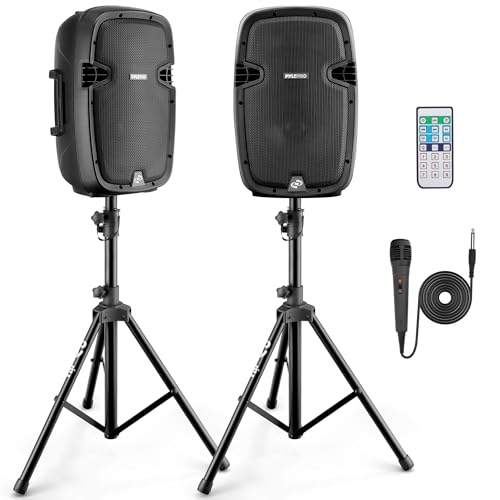
The Pyle PPHP1049KT is a high-powered portable PA system designed for event hosts, DJs, and karaoke enthusiasts who need reliable loud sound for indoor gatherings or outdoor parties. This active and passive speaker pair offers 1000W peak power, making it suitable for filling medium to large spaces with clear stereo audio.
Standout features include Bluetooth for wireless streaming from mobile devices, plus USB/SD card readers for direct MP3 playback, AUX, SpeakOn, and XLR mic inputs. The 10-inch subwoofers deliver punchy bass while 1-inch titanium tweeters ensure crisp highs, providing balanced performance that rivals more expensive systems in real-world use like backyard events or small venues.
Build quality emphasizes durability with a heavy-duty chassis, 35mm pole mounts, and included telescoping stands for elevated setup. The rear control panel with LCD display, rotary dials for EQ adjustments, and wireless remote add professional convenience, allowing quick tweaks to master volume, mic levels, treble, and bass on the fly.
Potential drawbacks include the short 4.9-foot power cable, which may require an extension for flexible positioning, and its substantial size that prioritizes power over lightweight portability. Without a battery, it relies on AC power, limiting fully mobile applications.
Overall, the Pyle PPHP1049KT excels as a value-packed, ready-to-use PA solution for anyone needing powerful, versatile sound without complexity. It earns strong recommendation for budget-conscious users prioritizing performance and accessories.
Power Output: 1000W peak / 500W RMS
Drivers: 10-inch subwoofers, 1-inch tweeters with titanium diaphragm
Connectivity: Bluetooth, USB/SD MP3 reader, 3.5mm AUX, 1/4-inch SpeakOn, XLR mic input
Includes: 2 stands, microphone, remote control, power cable (4.9 ft), 35mm mounts
Controls: LCD display, rotary dials for volume, mic, treble, bass EQ
Evaluating Audio Fidelity: Do Active Speakers Sound Better Than Passive?
Active speakers do not automatically sound better by definition, but they possess significant acoustic and electrical advantages at most budget and mid-tier listening tiers. By placing dedicated amplifier channels directly before or after active crossovers, active systems eliminate the insertion losses and phase distortion commonly found in passive component networks. High-end passive systems can match or surpass these results, yet achieving comparable performance typically requires careful component selection and significantly higher expenditure.
Audio clarity depends on total system harmony rather than just the enclosure topology. When an engineer designs an active monitor, the amplifier power output, driver impedance curve, and cabinet volume are tuned as an integrated unit. Passive systems place that responsibility on the listener, who must match the amplifier wattage and impedance ratings correctly to prevent distortion or thin bass response.
The Architecture of Active and Passive Signal Paths
The physical path that an audio signal travels highlights the fundamental engineering difference between these two speaker formats. In a traditional passive system, an audio source feeds an analog signal to a preamplifier and power amplifier, which boosts the electrical voltage before sending it through a speaker cable. Once inside the passive cabinet, the boosted signal encounters a passive crossover network composed of heavy copper inductors, capacitors, and resistors that divide frequencies between the woofer and tweeter.
Active speakers flip this signal architecture by positioning the crossover network before the power amplification stage. The incoming low-level audio signal passes through an active analog filter or a digital signal processor operating at line level, where frequencies are split with mathematical precision. Each driver, whether it is a silk dome tweeter or a polymer cone woofer, receives power from its own dedicated amplifier channel matched to its specific impedance and sensitivity requirements.
This architectural divergence creates measurable differences in electrical efficiency and signal purity. Passive crossovers consume a noticeable portion of amplifier energy as waste heat, which can lead to dynamic compression during loud listening sessions. Active line-level crossovers operate without driving heavy electrical loads, preserving dynamic range and reducing harmonic distortion across the entire frequency spectrum.
Crossover Networks and Driver Control Mechanics
Crossover networks serve as the traffic controller of any multi-driver loudspeaker, determining which frequencies reach the tweeter, midrange, or woofer. In a passive design, crossover components must tolerate high currents and voltages, which introduces physical compromises such as electromagnetic interference between inductors and shifting crossover points as components heat up. These shifts can create subtle dips or peaks around the crossover frequency, muddying vocal clarity and soundstage imaging.
Active crossovers eliminate these thermal and magnetic compromises by filtering signals before amplification occurs. Modern active designs often utilize digital signal processing to implement steep crossover slopes that prevent drivers from producing frequencies outside their optimal operating range. This steep attenuation keeps tweeters from distorting on lower midrange energy and keeps woofers from producing harsh breakup modes at higher frequencies.
Driver control also benefits directly from the elimination of speaker-level crossover components. The damping factor of an amplifier represents its ability to control unwanted cone motion immediately after an electrical impulse stops. By connecting the amplifier output directly to the voice coil without intervening inductors and resistors, active speakers maintain superior driver damping, resulting in tighter bass transients and faster recovery from heavy drum hits.
Powered Versus True Active Systems
Audio shoppers often encounter confusion because marketing materials frequently use the terms powered and active interchangeably. A true active speaker contains individual amplifier channels for each acoustic driver, along with an active crossover that splits the audio signal prior to amplification. Studio monitors and premium multi-driver active monitors represent the classic standard of this true bi-amplified or tri-amplified architecture.
In contrast, many popular home and commercial speaker pairs operate as powered master-slave configurations. In this setup, one enclosure houses a single stereo amplifier and a conventional passive crossover, sending amplified audio across standard speaker wire to an unpowered companion unit. Several wall-mount speaker systems use this active-passive master configuration to provide convenient Bluetooth streaming while minimizing the need for secondary wall power outlets.
While master-slave powered systems may not offer the isolated multi-amp benefits of true active monitors, they still deliver significant convenience advantages over separate component stacks. They allow listeners to enjoy integrated wireless streaming and aux inputs without placing a bulky receiver on a shelf. Recognizing whether a speaker is true active or powered master-slave helps set realistic expectations regarding stereo imaging and transient speed.
Amplifier Matching and Power Headroom
Pairing an external amplifier with passive speakers requires careful consideration of impedance, continuous wattage, and peak headroom. If an amplifier lacks sufficient current reserves, driving low-impedance passive loads can induce clipping, which generates harsh harmonic distortion that risks damaging delicate tweeter voice coils. Conversely, an oversized amplifier operated carelessly can thermally overpower voice coils during continuous high-volume playback.
Active speaker designs eliminate the danger of component mismatching because manufacturers pair the internal amplifiers specifically to the thermal and mechanical limits of the drivers. Integrated protection limiters and soft-clipping circuits monitor output levels in real time, preventing driver damage while squeezing maximum clean volume from compact enclosures. Listeners who want great sound without studying impedance curves often find this built-in optimization particularly appealing.
However, separate stereo amplifiers and receivers provide flexible control options that active designs rarely match. Multi-input stereo amplifiers equipped with optical inputs, coaxial inputs, and subwoofer outputs allow users to drive diverse passive speaker pairs while fine-tuning treble, bass, and balance manually. This versatility lets listeners tailor sound profiles to their specific preferences and easily swap speakers as their audio taste evolves.
Cabinet Resonance, Internal Heat, and Component Longevity
Housing electronic circuitry inside an acoustic enclosure introduces unique mechanical and thermal challenges that affect long-term reliability. Active speakers contain power transformers, amplifier boards, and digital processing chips that generate heat inside an airtight wooden or polymer cabinet. Over many years of regular use, prolonged heat exposure and physical vibrations from bass drivers can degrade electrolytic capacitors and solder joints.
Passive speakers feature far simpler internal construction, consisting primarily of acoustic damping material, internal bracing, drivers, and passive crossover boards. Because they lack heat-generating power supplies and sensitive microchips inside the cabinet, quality passive speakers often last for decades without significant maintenance. When an external receiver or amplifier eventually fails or becomes technologically outdated, replacing it leaves the passive speakers completely intact and ready for service.
Active speaker owners also face distinct repair hurdles if an internal board malfunctions after the warranty period expires. In many compact or sealed designs, sourcing proprietary replacement circuit boards can be difficult or costly compared to swapping a standard external amplifier. Buyers who prioritize generational longevity and simple long-term repairs frequently lean toward passive speakers for this exact reason.
Cable Runs, Placement, and Installation Flexibility
System wiring represents one of the most critical practical distinctions between active and passive setups in home and outdoor environments. Active speakers require an electrical outlet near every speaker location, along with an audio signal cable or wireless connection. Running mains electrical power to high wall corners, outdoor patio eaves, or ceiling positions can complicate installation and increase mounting labor substantially.
Passive speakers simplify remote placement because they require only standard two-conductor speaker wire routed from a central amplifier. Long speaker wire runs carry amplified audio signals with minimal vulnerability to electromagnetic interference or radio frequency noise. This characteristic makes passive speakers the standard choice for multiroom architectural audio, distributed background music, and weather-exposed outdoor entertainment zones.
Wireless active speakers address cable clutter by receiving audio streams over Bluetooth or local networks, making them ideal for casual living spaces and temporary outdoor gatherings. For listeners who want portable sound for patios or travel, compact Bluetooth speakers offer unmatched physical convenience without requiring any permanent wiring. However, for fixed installations spanning multiple rooms or large backyard areas, passive speaker wire remains far more adaptable.
Acoustic Tuning, Room Interaction, and Critical Listening
Room boundaries, wall reflections, and speaker positioning frequently exert a far greater influence on final audio quality than the choice between active and passive crossovers. A poorly positioned active monitor will sound boomy if placed directly into an untreated corner, just as a premium passive tower will suffer from phase cancellation if placed incorrectly. Evaluating sound performance requires playing diverse, well-recorded tracks used to demo speakers to observe how clean bass definition and vocal separation hold up across different room environments.
Active speakers often feature onboard boundary equalization switches or rotary tone knobs that allow listeners to compensate for room placement. Trimming low frequencies when a speaker sits against a wall helps prevent boundary reinforcement from overpowering midrange instruments and vocal clarity. These simple rear-panel adjustments provide immediate acoustic correction without requiring outboard equalizers or complex receiver calibration routines.
Passive systems rely on the processing capabilities of the upstream receiver or integrated amplifier to correct for room acoustic anomalies. Modern receivers often include sophisticated microphone-based room correction software that measures acoustic reflections and adjusts frequency response digitally. While external calibration can yield exceptional results, it requires initial setup effort and familiarity with menu navigation that some listeners prefer to avoid.
Determining the Best Audio Solution for Your Needs
Choosing between active and passive speakers ultimately depends on your space constraints, desired upgrade flexibility, and personal listening habits. If you value a clean desktop aesthetic, minimal clutter, and cohesive driver integration right out of the box, an active or powered speaker system provides immediate high-fidelity performance. Desktop audio producers, video editors, and apartment dwellers often benefit enormously from the space-saving efficiency and precision tuning of active enclosures.
If you plan to build an expansive home theater, enjoy experimenting with different amplifiers and preamps, or need to run audio across multiple rooms, passive speakers offer unmatched long-term value. Their modular nature ensures that your investment in physical speaker cabinets remains secure even as digital audio formats, wireless protocols, and receiver technologies evolve over time. By matching your listening priorities with the appropriate speaker topology, you can create an audio environment that delivers clear, engaging sound for years to come.


Write Your Review
No reviews yet. Be the first to share your experience!