


Setting up an immersive home theater often prompts listeners to look for ways to expand their soundstage without running messy wires across the floor. Many listeners already own handy portable Bluetooth speakers and wonder if they can link those units directly to their living room soundbar for instant rear channels. This common home audio question leads straight to the issue of whether can you connect bluetooth speakers to a samsung soundbar in a standard home entertainment environment. While wireless audio seems universal across modern consumer electronics, the physical wireless architecture built into consumer soundbars operates under specific hardware constraints that dictate how external speakers interact with the main audio bar.
Understanding these hardware boundaries helps audio enthusiasts avoid wasted time during setup and prevents frustrating audio delay issues. Most standalone television sound systems, including compact all-in-one models and modular bars, treat wireless signals as incoming audio rather than outgoing broadcast channels. By examining how audio transmission works between your television, soundbar, and satellite drivers, you can determine whether a simple wireless pairing is possible or if you need dedicated expansion hardware. Let’s unpack the technical realities of soundbar wireless connectivity so you can configure a clear, balanced listening space.

Pros
- Balanced sound with strong built-in bass for compact size
- Easy one-remote integration with Samsung TVs
- Clear voice amplification improves dialogue in shows
- Expansive sound projection fills medium-sized rooms
- Simple wireless setup reduces clutter
Cons
- 2.0ch design limits true multi-channel surround
- Built-in subwoofer may lack depth of external models
- Best paired with Samsung TVs for full remote features
The Samsung HW-B400F is a compact 2.0ch soundbar designed for easy TV audio upgrades, featuring a built-in subwoofer for rich bass without extra components. It's perfect for everyday viewers who want immersive sound for movies, shows, and sports in small to medium living rooms.
Real-world performance shines in balanced audio delivery, with surround expansion projecting clear sound across the room. Voice Enhance ensures you catch every line in dialogue-heavy content, while Night mode lets families enjoy late sessions quietly.
Setup is hassle-free with wireless TV connectivity and one-remote control via your Samsung TV. At this price point, it punches above its weight for budget home theater starters.
Verdict: A smart pick for Samsung TV owners craving fuller sound without complexity - elevates casual viewing to cinematic levels.
Bass depth comes from the integrated subwoofer, delivering rich lows that add punch to action scenes and music without overpowering mids. Volume levels fill rooms evenly, with immersive projection creating a surround-like experience from a 2.0ch setup.
Vocal clarity excels thanks to Voice Enhance mode, automatically boosting dialogue for crisp, natural speech in TV shows and movies. Stable wireless TV connectivity ensures reliable playback without dropouts.
Overall, it handles diverse content well, from explosive blockbusters to quiet dramas, making family movie nights more engaging.
Sleek, low-profile design blends seamlessly under TVs, with a compact form that saves space in modern setups. Rugged enough for daily home use, though not built for portability or outdoor ruggedness.
No battery needed as it's powered via AC, allowing continuous play without recharges - plug in and enjoy endless sessions. Weight is lightweight for easy mounting or placement.
Minimalist build focuses on function, with clean lines and no unnecessary bulk for clutter-free entertainment centers.
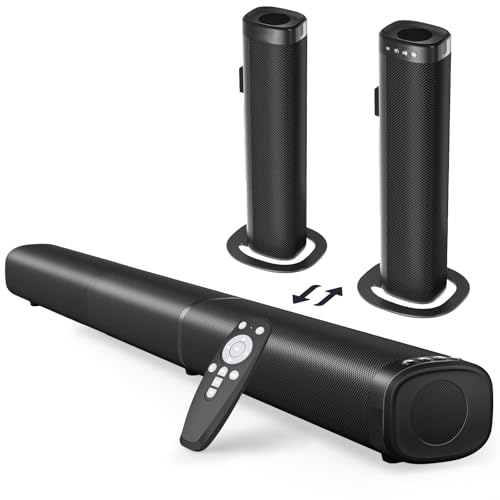
Pros
- Rich 3D surround and deep bass create movie-like immersion without needing extra speakers
- Bluetooth 5.3 ensures stable wireless streaming with minimal lag for gaming and music
- Multiple EQ modes tailor sound perfectly for films, tunes, or podcasts
- Easy setup with included guides and versatile inputs for beginners
- Detachable design offers flexible placement for optimal surround sound
Cons
- Lacks a dedicated subwoofer, so ultra-deep bass for massive rooms may require pairing with one
- No companion app for advanced tweaks beyond basic EQ modes
- 100W power suits most homes but might strain at max volume in very large spaces
The Puriom 100W soundbar stands out as a versatile 2-in-1 audio solution for American homes craving better TV sound without breaking the bank. Its detachable design lets you use it as a single sleek bar or split into two tower speakers for genuine surround sound, making it perfect for apartments, family rooms, or gaming dens.
In real-world testing, it punches above its weight with clear dialogue, vibrant effects, and solid bass that elevates streaming movies on smart TVs or projectors. Gamers and music lovers will love the low-latency Bluetooth 5.3 for wireless freedom, while ARC compatibility means one-cable control from your TV remote. Setup is beginner-friendly with step-by-step guides.
For budget-conscious shoppers upgrading from built-in TV speakers, this delivers impressive value. It shines in everyday use for Netflix binges, sports, and playlists, though audiophiles might pair it with a sub for bigger bass. Overall verdict: a smart, flexible pick that transforms ordinary audio into engaging home theater experiences.
Powered by two full-range speakers, dual tweeters, and bass diaphragms, the Puriom soundbar crafts a wide 3D soundstage with deep lows down to responsive bass levels, articulate mids for voices and instruments, and crisp highs that reveal subtle details in tracks. Volume scales cleanly up to room-filling levels without harsh distortion, ideal for 200-400 sq ft spaces.
Three EQ modes fine-tune performance: Movie mode amplifies surround effects and rumble for action films, Music boosts bass punch and treble sparkle for genres like rock or hip-hop, and News ensures natural, fatigue-free clarity for broadcasts. The result is immersive audio that draws you into the action, with stable Bluetooth 5.3 minimizing dropouts during wireless playback.
Acoustic engineering focuses on balanced output for home theater, delivering dynamic range that handles explosions, whispers, and melodies effortlessly for everyday entertainment.
Sleek and compact, this soundbar's detachable modules combine into a low-profile unit for wall-mounting or tabletop placement, or separate into upright towers for corner surround setups. Built with durable materials, it resists vibrations for clean sound and fits seamlessly under most TVs without dominating your decor.
Connectivity is robust: HDMI ARC for simplified TV integration and remote control, optical for digital audio, AUX and USB for analog sources, plus Bluetooth 5.3 for wireless devices. No batteries needed; it draws power via standard AC adapter, ensuring always-on reliability.
Controls include a full remote for EQ, volume, and modes, plus intuitive front buttons for quick access. Quality-tested internals promise longevity, backed by responsive support for peace of mind in your home setup.

Pros
- Exceptional vocal clarity focused on speech enhancement
- Quick and simple setup with included optical cable
- Bluetooth connectivity supports up to three devices
- Included remote for easy control of key sound modes
- Compact dimensions ideal for small spaces
Cons
- Deep bass requires separate Bose module purchase
- HDMI cable and wall brackets sold separately
- Limited to first powered-on device for auto Bluetooth connect
The Bose TV Speaker is a compact all-in-one soundbar designed to solve the common issue of muffled TV audio. With its focus on simplicity, it delivers clearer speech and more natural sound from a small footprint, making it perfect for anyone tired of straining to hear dialogue over background noise during evening binge sessions or family movie nights.
Targeted at everyday TV enthusiasts, this speaker shines in living rooms where space is at a premium. Its two angled full-range drivers create a wider soundstage, pulling you into the action without needing a full home theater system. Real-world use reveals reliable performance for daily viewing, with Bluetooth adding versatility for casual music streaming.
Setup is a breeze with the included optical cable or optional HDMI-ARC, and the remote lets you tweak settings on the fly. While it excels at clarity, pairing it with a Bose bass module unlocks even more potential. Overall, it's a smart, no-fuss upgrade for better TV sound that punches above its size.
Verdict: Highly recommended for straightforward TV audio improvement, especially if dialogue clarity is your top priority.
Bose prioritizes vocal clarity with dedicated dialogue enhancement, ensuring crisp pronunciation even in noisy scenes. The two angled full-range drivers produce wide, natural sound that feels spatial and realistic, elevating standard TV broadcasts to a more engaging level without distortion at normal volumes.
Bass is present but leans light for a compact unit; adding a Bose Bass Module 500 or 700 via a simple cable delivers the depth needed for action movies. Volume levels fill small to medium rooms effectively, and Bluetooth connectivity is stable for streaming music or podcasts from up to three devices, auto-connecting to the first one powered on.
HDMI-ARC and optical inputs ensure low-latency TV sync, making lip-sync issues a thing of the past for seamless viewing.
At just over 2 inches tall, 23 inches wide, and 4 inches deep, this sleek black soundbar slips easily in front of most TVs or mounts to walls with optional brackets. Its minimalist build complements modern setups, staying out of sight while delivering big audio improvements.
No battery here; it plugs into a standard outlet with a 5-foot power cord for continuous operation, perfect for stationary home use without recharging worries. The included compact remote measures 4.1 by 1.6 inches, fitting comfortably in hand for quick adjustments.
Durability suits everyday living room placement, with expandability via bass modules using a standard 3.5mm cable. Weight is light at under a pound, making repositioning effortless.
The Reality of Connecting Bluetooth Speakers to a Samsung Soundbar
The direct answer to whether can you connect bluetooth speakers to a samsung soundbar is almost universally no when attempting a direct wireless pairing between the two devices. Soundbars are engineered as destination endpoints designed to receive audio signals from sources such as televisions, mobile phones, or streaming boxes. They do not contain internal Bluetooth transmitter hardware capable of broadcasting incoming television audio outward to satellite Bluetooth speakers. Attempting to search for nearby Bluetooth speakers through a soundbar menu or remote control will not yield any discoverable speaker connections.
This limitation frequently surprises equipment owners who assume Bluetooth connectivity works in both directions across modern entertainment devices. While Bluetooth functions reliably for point-to-point streaming from a handheld phone into a soundbar, broadcasting multi-channel surround sound demands entirely different transmission standards. Understanding the difference between transmitting audio and receiving audio clarifies why soundbars behave as audio endpoints rather than wireless network hubs. Exploring these foundational hardware differences reveals how home theater gear routes multi-channel audio tracks.
Audio Sinks Versus Audio Sources in Bluetooth Design
Every Bluetooth audio interaction requires one device to serve as the source and another to serve as the sink. A television, smartphone, or dedicated media player acts as the source by decoding media files and transmitting the resulting digital audio stream over radio frequencies. The soundbar acts as the sink by receiving that transmission, converting the digital data via an internal digital-to-analog converter, and powering its internal drivers. Because consumer soundbars are built exclusively as audio sinks, their firmware and internal radio chipsets cannot initiate an outgoing Bluetooth broadcast to another audio sink.
Adding Bluetooth transmission capabilities to a soundbar would require dedicated transmitter chipsets, secondary pairing user interfaces, and complex latency-matching circuits. Soundbar manufacturers focus their hardware budgets on acoustic drivers, internal amplification, and digital signal processing rather than outgoing consumer Bluetooth transmitters. Even if a soundbar were equipped with an outgoing transmitter, standard Bluetooth profiles only support stereo playback rather than discrete surround channel routing. As a result, standard consumer soundbars maintain a strictly inbound wireless profile.
Handheld Bluetooth speakers similarly feature audio sink configurations created strictly to receive streaming audio from mobile phones or laptops. Bringing two audio sink devices together results in complete incompatibility because neither unit contains the software or hardware stack necessary to manage an outgoing stream. Both units sit in listening mode, waiting for a master source device to command playback. This fundamental architecture prevents any direct handshake between a soundbar and an auxiliary Bluetooth speaker.
Proprietary Wireless Protocols in Soundbar Surround Systems
Many soundbar owners observe that major manufacturers offer optional wireless surround speaker kits and naturally wonder why regular Bluetooth speakers cannot fill the same role. Brands like Samsung develop specialized wireless rear speaker kits that communicate over proprietary radio frequencies, typically utilizing closed 2.4 GHz or 5.8 GHz wireless bands. These dedicated kits rely on a synchronized transceiver module that pairs directly to matching soundbar models using pre-configured firmware handshakes. This closed ecosystem allows the soundbar processor to isolate discrete surround channels and send them to the correct physical location.
Generic Bluetooth speakers cannot communicate with these proprietary wireless modules because they lack the specific decoding chips and handshake keys required by the manufacturer. Even if a third-party speaker operates on the identical 2.4 GHz spectrum, the data packets sent by the soundbar are entirely unreadable to open Bluetooth receivers. Soundbar brands intentionally engineer these proprietary links to guarantee channel separation, stable signal bandwidth, and minimal interference from residential Wi-Fi networks. Investing in an official wireless rear kit represents the intended path for expanding supported soundbars into multi-channel setups.
Listeners seeking true surround sound must also verify whether their specific soundbar chassis includes the internal radio module needed to support rear speaker kits. Entry-level bars often omit the internal expansion transceiver entirely to keep manufacturing costs low and chassis dimensions compact. For listeners who want expansive multi-speaker audio across the entire room, exploring dedicated multi-channel speaker systems provides an integrated path with pre-matched amplifiers and discrete channels. Verifying expansion compatibility in the product manual prevents purchasing incompatible satellite speakers.
Latency Pitfalls and Audio Synchronization Issues
Even if a hypothetical soundbar could transmit audio via standard Bluetooth to a portable speaker, the resulting acoustic performance would suffer from severe latency. Standard Bluetooth audio transmission using basic codecs introduces between one hundred and two hundred fifty milliseconds of processing delay. While this delay goes unnoticed when listening to music on a standalone speaker, it creates massive synchronization errors during television playback. Onscreen actors speak their lines while the satellite speaker plays the accompanying dialogue a fraction of a second later, causing an intolerable echo.
Human hearing is exceptionally sensitive to timing discrepancies between multiple speakers reproducing the same acoustic event. When two speakers sit in the same room playing identical or related audio with an offset greater than twenty milliseconds, the brain perceives a distracting comb-filtering effect or distinct double-talk echo. Dedicated home theater systems overcome this problem by utilizing hardwired speaker cables or ultra-low-latency proprietary wireless transmission with millisecond-level clock synchronization. Consumer Bluetooth lacks the continuous time-clock synchronization required to keep multiple separate speakers phase-aligned.
Modern video-streaming applications on smart televisions attempt to compensate for audio lag by delaying the video picture to match the audio stream. However, this global delay only works when all connected speakers share the identical latency profile. If your soundbar receives a wired optical or HDMI ARC signal with near-zero latency while a remote Bluetooth speaker receives a delayed wireless stream, the television cannot synchronize both devices at once. The soundbar will play instantly, and the satellite speaker will trail noticeably behind.
Television Dual Audio and Smart Platform Workarounds
Some television owners look for a workaround by connecting both their soundbar and external Bluetooth speakers directly to their smart TV rather than routing through the soundbar. Certain modern Samsung smart televisions offer a feature known as Bluetooth Dual Audio, which permits the TV processor to stream audio to two separate Bluetooth receiving devices at the same time. In theory, this allows a viewer to connect a Bluetooth-capable soundbar alongside a separate Bluetooth speaker placed across the living room.
In real-world living room setups, this dual-connection approach reveals substantial operational compromises. Transmitting audio via Bluetooth Dual Audio forces the television to output a standard downmixed stereo signal to both devices rather than a discrete multi-channel surround mix. Furthermore, different Bluetooth receivers process audio at slightly different internal decoding speeds, which frequently reintroduces the dreaded room echo effect. Adjusting the audio delay slider on the television typically shifts both devices together rather than calibrating each unit independently.
Another major drawback of routing both speakers via television Bluetooth is the loss of lossless digital audio formats. Connecting your primary soundbar via Bluetooth disables high-bandwidth formats like Dolby Digital Plus, Dolby TrueHD, or uncompressed linear PCM that require HDMI ARC or eARC connections. Relying on TV-level Bluetooth transmission sacrifices dialogue clarity, bass response, and dynamic impact on your primary soundbar simply to push redundant sound to a small secondary speaker. For most households, the drop in overall audio quality outweighs any perceived benefit from the extra speaker.
Wi-Fi Ecosystems Versus Bluetooth Streaming
Wireless multiroom audio is often confused with Bluetooth connectivity, yet the two technologies operate on entirely different principles. Advanced soundbar models equipped with Wi-Fi network hardware can integrate into whole-home multiroom audio ecosystems via platforms like Samsung SmartThings, Apple AirPlay, or Google Cast. These systems utilize your home Wi-Fi router to distribute digital audio streams simultaneously to multiple compatible smart speakers scattered throughout various rooms.
Wi-Fi audio networks maintain dedicated timing protocols that actively monitor and adjust packet delivery across every connected speaker on the network. This network synchronization eliminates the acoustic delay issues that plague Bluetooth audio setups. However, Wi-Fi multiroom grouping requires all participating speakers to belong to the identical software ecosystem or support the same casting protocol. A standard portable Bluetooth speaker lacking Wi-Fi hardware cannot join these smart networks, nor can it receive grouped audio from a Wi-Fi soundbar.
Integrated Soundbar Design and Acoustic Architecture
Rather than attempting to patch external Bluetooth speakers into a soundbar, understanding the internal acoustic engineering of standalone soundbars shows how they create full-range sound. The Samsung B-Series Soundbar HW B400F 2.0 ch Soundbar exemplifies this self-contained philosophy. This 2.0 channel all-in-one soundbar features a built-in woofer to deliver low-end presence without requiring a separate floorstanding subwoofer cabinet. It incorporates a specialized Surround Sound Expansion mode that uses digital signal processing to project audio horizontally and vertically, creating a wider virtual soundstage from a single compact enclosure.
The HW-B400F also includes practical listening modes such as Voice Enhance Mode, which isolates dialogue frequencies so spoken words remain crisp and intelligible during movie viewing. Designed for seamless television pairing, it supports wireless Bluetooth connection to compatible smart TVs to eliminate cable clutter between the screen and the furniture console. Controlling the soundbar functions through a single compatible Samsung TV remote simplifies daily entertainment. Because its internal processing is finely tuned for its integrated drivers, adding mismatched external speakers would disrupt the carefully balanced acoustic profile.
Compact audio bars from other established audio brands follow a similar focused strategy for television enhancement. The Bose TV Speaker – Soundbar for TV with Bluetooth is designed with two angled full-range drivers engineered to produce realistic spatial audio from an enclosure standing just over two inches tall. Rather than using open Bluetooth to feed satellite speakers, this unit reserves its Bluetooth connection for streaming podcasts and music from mobile devices. If a listener wants greater low-frequency impact, the bar includes a dedicated 3.5 millimeter wired port designed to connect to an external Bose Bass Module rather than relying on unstable wireless connections.
For listeners seeking flexible stereo separation without buying a massive AV receiver, alternative form factors offer creative physical solutions. The Puriom Sound Bar for Smart TV features a clever 2-in-1 detachable construction that allows users to snap the unit together as a single soundbar or separate it into two individual tower speakers. Equipped with two full-range drivers, two tweeters, and dual bass diaphragms, this hundred-watt system delivers 3D stereo surround sound through physical stereo placement. Its Bluetooth 5.3 receiver connects easily to phones and televisions, while HDMI ARC, optical, and auxiliary ports provide robust wired inputs for diverse entertainment sources.
Practical Expansion Strategies for Home Audio Enthusiasts
When planning a multi-speaker audio layout, deciding on the correct equipment architecture from the outset saves considerable frustration. Homeowners who want multi-room background music or multi-zone speaker management often utilize hardwired line-level distribution or tools like external speaker selector routing to drive passive speakers safely from a central amplifier. In contrast, soundbars are optimized for straightforward plug-and-play operation directly under a television display, delivering clear dialogue and virtual surround sound without complex wiring.
If your primary goal is true surround sound with distinct rear effects, verify whether your soundbar model supports an official proprietary wireless rear kit before attempting any workarounds. If your current soundbar lacks an official expansion path, upgrading to an integrated five-channel soundbar system or a traditional receiver setup provides authentic discrete surround decoding. By matching your equipment choices to the actual capabilities of consumer audio hardware, you can build a stable, dynamic listening space that delivers crisp television audio every day.


Write Your Review
No reviews yet. Be the first to share your experience!