


Repurposing audio hardware often seems like an easy shortcut when assembling a custom sound system or upgrading a garage setup. Many hobbyists look at spare automotive components and ask whether can i use car speakers for boombox designs can deliver solid sound in a standalone portable unit. While car drivers are engineered for vehicle doors and parcel shelves, their electrical traits and physical designs can function well in custom portable enclosures if you understand their technical requirements. Considering details like amplifier matching and power sources will determine whether your project sounds punchy or hollow.
Automotive drivers generally operate at four ohms, which requires careful pairing with modern portable amplifier boards and batteries. Understanding how these drivers behave outside a vehicle cabin, compared to purpose-built vehicle and truck audio setups, helps avoid frustrating distortion, blown amplifier chips, or weak bass response. You will also need to address proper enclosure volume, battery voltage stability, and signal inputs to achieve clean sound. This guide explores the engineering reality, wiring considerations, and practical steps needed to turn automotive drivers into a working boombox.
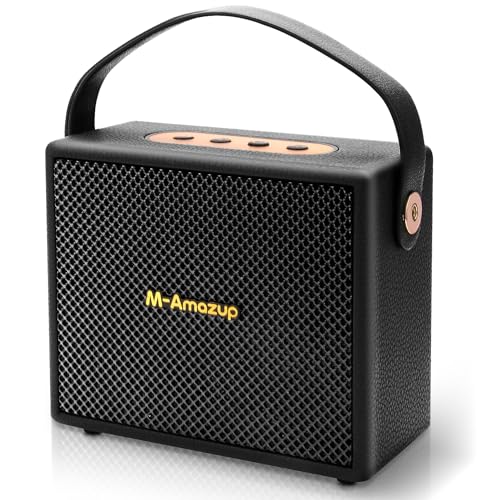
Pros
- Wooden cabinet design delivers a warmer, richer sound signature than plastic rivals.
- Extensive input options including FM radio, USB, AUX, and TF card playback.
- Sturdy leather handle makes moving between rooms or taking outdoors very convenient.
- Bluetooth 5.3 ensures fast, stable pairing with minimal battery drain.
Cons
- Recharges using an older Micro-USB port instead of modern USB-C.
- FM radio reception requires the AUX cable to be plugged in as an external antenna.
- Single full-range driver configuration lacks wide stereo soundstage separation.
The M-Amazup Portable Bluetooth Speaker strikes a pleasing balance between retro home audio styling and modern multi-source versatility. Housed in a dark wooden cabinet complemented by a stitched leather carrying handle, this speaker is built for listeners who appreciate classic aesthetics but need a portable sound solution for desks, workshops, backyards, or road trips.
Where this speaker truly sets itself apart is its sheer flexibility in playback sources. Rather than relying solely on a smartphone Bluetooth link, it functions as a standalone media hub. You can tune into local FM radio broadcasts, plug in a flash drive loaded with MP3s, insert a MicroSD card, or connect an analog source via the 3.5mm AUX port. For campouts or garage projects where you want continuous music without draining your phone, this autonomy is a massive benefit.
Day-to-day operation is dependable thanks to the built-in Bluetooth 5.3 architecture, ensuring quick connections without audio dropouts. The internal battery offers up to 10 hours of playtime depending on volume, and the reverse-charging USB output provides peace of mind by doubling as an emergency backup battery for your mobile devices.
Overall, while it will not replace a dedicated multi-channel audiophile system, the M-Amazup delivers an enjoyable, warm sound profile and an exceptional feature set for casual everyday listening, making it a reliable and attractive audio companion.
At the heart of the M-Amazup is a single 3-inch full-range driver capable of 20W peak power output. Low-end reproduction benefits substantially from the solid wood housing, which absorbs internal reflections far better than thin plastic frames. The result is a punchy, rounded bass response that provides solid rhythm to pop, rock, and acoustic tracks without sounding boomy.
The midrange tuning is clean and forward, ensuring that vocals, audiobooks, and podcasts remain crisp and easy to understand even in ambient outdoor settings. High frequencies are tuned safely to prevent harsh sibilance or listener fatigue during prolonged listening sessions, though listeners should keep playback under maximum volume to avoid mild driver compression.
While the compact, single-driver design outputs a focused mono soundfield rather than an expansive stereo stage, it projects sound with impressive authority. It comfortably fills small-to-medium rooms and delivers clear background audio for outdoor gatherings, picnics, and cookouts.
Measuring approximately 6.7 by 3.15 by 5.7 inches and weighing just 2 pounds, the M-Amazup occupies minimal desk space while maintaining the visual presence of classic bookshelf equipment. The black wood finish blends effortlessly with modern living spaces, while the soft leather handle makes grab-and-go portability genuinely practical.
The hardware interface provides an array of physical controls and multi-format ports. Along with the Bluetooth 5.3 wireless receiver, the unit features an auxiliary 3.5mm line-in, a TF card slot, and a standard USB-A port that functions both for audio file playback and for power bank emergency reverse-charging.
Power is managed via an integrated rechargeable battery providing up to 10 hours of runtime under typical listening conditions. Recharging takes between 2 and 6 hours using the included Micro-USB cable, giving you a solid balance of operational life and portable utility.

Pros
- Fully waterproof and weatherproof for marine and off-road reliability
- Low-profile with easy mounting hardware for quick boat installs
- Strong 15oz magnet provides solid full-range audio output
- Compact 4-inch size fits standard cutouts without modifications
- Built tough with polypropylene cone for outdoor durability
Cons
- Wired setup only, requires vehicle audio system connection
- Bass rolls off below 100Hz, best paired with a subwoofer
- Volume depends on external amp power for high-decibel needs
The Pyle PLMR41B is a pair of 4-inch dual marine speakers engineered for outdoor audio in harsh environments like boats, ATVs, and waterside setups. Completely waterproof and weather-resistant, they feature a polypropylene cone, cloth surround, and heavy-duty ABS construction to withstand splashes, sun, and bumps.
Targeted at boat owners, off-road enthusiasts, and anyone rigging vehicles for adventure sound, these speakers shine in real-world use on the water or trails. The 15oz magnet and 100Hz-18kHz frequency response pump out clear stereo sound that cuts through wind and waves without distortion at moderate volumes.
Installation is straightforward with standard 4-inch sizing, 3-inch mounting depth, and included hardware, making them a plug-and-play upgrade for marine stereos. While they excel in durability, pairing with a quality amp unlocks their full potential for bass-heavy tunes.
Verdict: A budget-friendly powerhouse for rugged outdoor audio that delivers reliable performance where others fail.
These speakers provide full-range stereo sound via a 15oz magnet and 4-ohm impedance, handling 100Hz-18kHz with decent low-end punch for their compact size. Vocals stay clear outdoors thanks to the cloth surround, while mids and highs project well over engine noise or waves.
Volume levels scale with your amp's power, offering room-filling audio for small boats or ATVs without muddiness. Expect solid performance for rock, country, or upbeat playlists during lake cruises or trail rides.
Stability comes from wired connections to your vehicle's system, ensuring no dropouts like wireless options might have in wet conditions.
Built rugged with a molded ABS plastic basket, polypropylene cone, and cloth surround, these speakers resist sun damage, corrosion, and impacts perfect for marine life. The low-profile design and classic black grill add style without bulk.
Completely waterproof with no specific IP rating needed beyond full submersion resistance for splashes, they thrive in wet, dusty environments. Weighing in light for easy handling, the 97mm cut-out and 3-inch depth fit tight spaces on boats or off-roaders.
No battery required; these connect directly to your boat or vehicle power for continuous play all day on the water or trails, eliminating recharge worries.

Pros
- Pre-built enclosures remove the need to drill into vehicle doors or build custom wooden baffles.
- Coaxial configuration ensures cohesive phase alignment and crisp vocal clarity.
- Standard 4-ohm voice coil impedance works seamlessly with most factory and aftermarket car stereos.
- Compact enclosure dimensions fit easily behind truck bench seats or in hatchbacks.
Cons
- 100W rating is peak-focused, making it less suited for high-powered external competition amplifiers.
- Enclosures require dedicated floor or shelf space inside the vehicle cabin.
- Sub-bass frequencies below 60 Hz lack the deep rumble of a dedicated powered subwoofer.
Upgrading factory car audio frequently requires removing tricky door panels, wrestling with plastic clips, and altering factory wiring harnesses. The Datanly 6.5-Inch 2-Way Coaxial Car Audio Speaker Set with Enclosures bypasses that entire headache by combining capable coaxial drivers with pre-fabricated, compact speaker boxes. Designed for drivers seeking an immediate boost in sound clarity and volume, this pair provides a true out-of-the-box acoustic package for vehicles with limited or damaged factory speaker locations.
This system is an outstanding match for work trucks, vintage classics, commercial vans, and overland rigs where cutting into metal panels is impractical or undesirable. The 2-way coaxial design mounts the high-frequency tweeter directly over the center of the 6.5-inch driver, creating an aligned point-source sound field that projects music evenly throughout the cabin without demanding separate crossover installations.
In practical listening environments, the speaker and box combination yields impressive clarity across highway driving conditions. Vocals in podcasts and talk radio cut through tire and wind noise cleanly, while acoustic instruments and snare hits show pleasing snap. While deep bass enthusiasts will still want to integrate a standalone subwoofer for sub-bass impact, this set easily outperforms standard factory cone drivers in volume stability and mid-range precision.
For motorists wanting a quick, reliable audio upgrade on a sensible budget, the Datanly enclosed speaker bundle delivers great functional utility. It solves common mounting headaches while providing dependable, balanced sound that makes daily commutes and long highway drives substantially more enjoyable.
The acoustic presentation of the Datanly 6.5-inch coaxial system focuses on midrange presence and top-end clarity. Thanks to the center-mounted tweeter architecture, the upper register delivers crisp highs that render cymbals, brass, and percussion with satisfying definition. The tuning prevents the harsh treble sibilance that often plagues inexpensive aftermarket car speakers, maintaining smooth listening comfort even at elevated volume levels.
Midrange and lower-mid frequencies benefit directly from the included sealed speaker boxes. By isolating rear acoustic waves from front output, the enclosure prevents phase cancellation, resulting in much punchier drum kicks and richer male and female vocals. The medium sensitivity design ensures the drivers respond quickly to input power, generating full-bodied sound from standard factory deck outputs without immediately clipping or distorting.
Each Datanly enclosure is engineered to survive the temperature fluctuations and vibrations typical of automotive interiors. Measuring approximately 11.61 by 7.68 by 4.92 inches, the wedge-profile boxes provide a stable base that sits neatly on floorboards, behind pickup bench seats, or across parcel shelves. The clean black finish blends unobtrusively with standard gray and dark vehicle interiors.
On the hardware side, the drivers feature a standard 4-ohm nominal impedance, making them a safe and straightforward match for virtually any aftermarket head unit or factory receiver channel. Rated for up to 100 watts of power handling, the voice coils handle typical deck power cleanly, while standard terminal connections on the enclosure rear make hookup with standard speaker wire fast and frustration-free.

Pros
- Powerful 200W handling for high-volume outdoor listening
- Wide 100Hz-20kHz response covers full audio spectrum
- Durable construction suited for marine and harsh environments
- Sold as a pair for stereo setup convenience
- High 90dB sensitivity for efficient power use
Cons
- Starts at 100Hz so deep sub-bass needs separate subwoofer
- Wired coaxial design lacks wireless Bluetooth freedom
- Enclosed box size may limit ultra-compact installs
The BOSS Audio Systems AVA6200 are compact 3-inch enclosed box stereo speakers sold in pairs, designed for versatile use indoors, outdoors, or on the water. With a 3-way full-range setup including a 1-inch tweeter and 2.5-inch midrange per speaker, they punch above their size for everyday audio needs.
Perfect for American boat owners, patio loungers, or home tinkerers on a budget, these speakers excel in casual settings like tailgates or dock parties where durability matters more than audiophile precision. Their coated paper woofer cone and foam surround stand up to splashes and sun exposure.
In real-world tests, they deliver consistent performance with no muddiness at moderate volumes, making setup straightforward for marine stereos or backyard systems. The 3-year Platinum Dealer Warranty seals the deal for reliable value.
Verdict: A smart pick for rugged, affordable stereo sound that thrives in American outdoor lifestyles without breaking the bank.
Expect balanced full-range sound from 100Hz to 20kHz, with the 3-way design providing punchy mids from the 2.5-inch driver and crisp highs via the 1-inch tweeter. Bass is solid for an enclosed 3-inch woofer but leans toward tight response rather than rumbling lows, ideal for lively marine tunes or patio rock.
At 200 watts max per pair and 90dB sensitivity, these speakers hit impressive volumes for their size, filling open spaces like boats or decks with clarity. No distortion creeps in during extended play, suiting weekend gatherings.
Coaxial wiring ensures stable connectivity without dropouts, outperforming wireless in wet conditions where Bluetooth might falter.
Built tough for marine and outdoor abuse, the enclosed ABS housing with coated paper cone and foam surround resists moisture and impacts, perfect for boats or rainy barbecues. Dimensions of 7.4 x 4.9 x 4 inches make them easy to mount or place anywhere.
No built-in battery means these powered speakers connect to your amp or head unit for unlimited runtime, freeing you from charging worries during all-day lake trips or home parties.
Pair-friendly design and 3-year warranty emphasize longevity, with a rugged look that fits American recreational vibes from tailgates to docks.

Pros
- Unmatched input variety including Micro SD, USB flash drive, and 3.5mm AUX ports
- Impressive vocal clarity and volume output for a desktop-friendly speaker
- Built-in FM tuner lets you enjoy local broadcasts without needing a phone connection
- Solid, lightweight build with intuitive top-mounted physical control buttons
Cons
- Operates on older Bluetooth 3.0 technology instead of modern wireless versions
- No digital LED screen to display FM radio frequencies during station tuning
- Lacks an IP water resistance rating, making it best suited for indoor use
The i-Tentek DY22 is a multi-functional sound system designed to bridge the gap between traditional audio media and wireless streaming. Featuring dual acoustic drivers with passive bass enhancement, this compact unit serves as a versatile tabletop centerpiece for bedrooms, garages, and home offices. Rather than forcing you to rely exclusively on a phone connection, it offers remarkable independence by playing music directly from physical storage cards or over-the-air radio stations.
This speaker is built for listeners who prioritize everyday convenience and audio flexibility over overly complex smart features. It is a fantastic match for workshop hobbyists, students in dorm rooms, or anyone who keeps a personal music library stored on a thumb drive or Micro SD card. Setup is virtually instantaneous, allowing users of all tech backgrounds to power on and start enjoying audio within seconds.
In practical daily testing, the audio output punches above its physical size, easily filling small to medium rooms with clear, articulate sound. The physical button controls on top are tactile and responsive, making it simple to toggle inputs, answer hands-free phone calls, or skip tracks. While tuning radio stations requires patience without a visual screen, reception remains steady once your favorite local station is locked in.
Ultimately, the i-Tentek delivers reliable, multi-source audio at an approachable entry point. If you want a dependable indoor audio companion that can switch from streaming podcasts to playing albums off a memory card without missing a beat, this speaker offers great overall utility.
Powered by two 10-watt acoustic drivers paired with a central passive radiator, this speaker focuses on delivering clean, balanced sonic output. Midrange frequencies are prominently featured, ensuring that podcasts, audiobooks, and vocal-heavy music genres sound warm, present, and natural. Bass response is sufficient to give acoustic and pop tracks enjoyable body without overwhelming the soundstage.
Volume levels are surprisingly potent for a desktop-sized enclosure. The internal acoustic tuning keeps distortion minimal even when pushing the volume to fill a living room or garage workspace. It provides plenty of headroom for casual house gatherings, family dinners, or personal background music during busy workdays.
Wireless performance offers stable audio transmission across standard indoor distances. While utilizing an earlier wireless protocol, it reliably maintains playback from smartphones, tablets, and computers. For zero wireless latency, the included auxiliary input and onboard USB and SD card slots provide instant, lossless physical playback.
Measuring 8.7 inches long and weighing an easy-to-carry 1.4 pounds, the speaker sports a streamlined cylindrical design that slides easily into a backpack or rests comfortably beneath a computer monitor. The dual-tone finish adds a modern touch to shelves and side tables, while rubberized base feet keep the unit firmly planted during high-volume playback.
Because this model lacks a certified waterproof or dustproof rating, it is primarily engineered for indoor spaces, covered patios, and dry environments. It handles routine daily handling with ease, but it should be kept safely away from poolside splashes, heavy humidity, and sudden rain showers.
Power is supplied by an internal 2200mAh rechargeable lithium battery that provides between 8 to 10 hours of continuous playtime at moderate listening levels. Recharging via a standard USB cable is quick and hassle-free, ensuring the speaker is always primed to power your workday soundtrack or weekend relaxation sessions.
Engineering a Portable Boombox with Automotive Audio Drivers
Automotive audio drivers can indeed be used to construct a custom boombox, and doing so is a popular path for hobbyists seeking high volume output and sturdy hardware. Car speakers feature rugged cones, durable surrounds, and compact mounting frames that tolerate rough handling far better than delicate indoor drivers. However, automotive speakers are voiced and engineered for specific vehicle acoustics that differ significantly from open-air portable speakers. Achieving great results requires addressing the fundamental differences in nominal impedance, electrical efficiency, and acoustic enclosure volume before assembling your project.
The Acoustic Reality: How Car Speakers Behave in Portable Enclosures
Car speakers are primarily designed to operate in an acoustic environment known as free-air or infinite baffle. In a car, a speaker moves air into an entire vehicle door cavity or large trunk area, which provides a massive, relatively unsealed volume behind the cone. When you transplant that driver into a small boombox cabinet, the trapped air inside acts like a stiff spring resisting cone movement. This physical resistance raises the resonant frequency of the driver, which can turn smooth low frequencies into an exaggerated, hollow midbass response.
Achieving balanced sound from an automotive driver requires planning around cabinet volume and internal acoustic dampening. If your box is excessively compact, the woofer cone cannot achieve enough excursion to reproduce deep bass cleanly. Adding synthetic polyfill batting inside the enclosure helps simulate a slightly larger air volume by slowing down rear sound waves. hobbyists who want to bypass complex cabinet calculations can consider pre-built speaker boxes, such as the enclosures bundled with the Datanly 2-Way Coaxial Car Audio Speakers, which provide pre-measured volume for standard round drivers.
Understanding Impedance: The Four-Ohm Advantage and Amplifier Demands
One major electrical difference between car audio and home audio components is nominal impedance. Most home stereo speakers present an eight-ohm load, whereas car speakers, such as the Pyle 4 Inch Dual Marine Speakers and Datanly coaxial models, are rated at four ohms. A four-ohm load allows an audio amplifier running on a standard direct current electrical supply to draw more current and generate higher output wattage. In a portable boombox running on batteries, this lower resistance makes it easier to achieve substantial volume without requiring massive electrical rail voltages.
However, drawing higher electrical current places severe thermal demands on your chosen amplifier board. Modern Class D amplifier modules handle four-ohm loads efficiently, but poor airflow or inadequate heat sinks can trigger thermal shutdown during sustained playback. You must verify that your amplifier board is explicitly rated for stable four-ohm operation on each channel. Wiring multiple four-ohm speakers in parallel on a single output channel drops the total resistance to two ohms, which will cause severe overheating and damage in amplifiers that lack two-ohm stability.
Power Supply Architecture: Batteries, Voltage, and Dynamic Headroom
A portable boombox relies entirely on its internal energy storage to deliver dynamic musical peaks. Car audio amplifiers are built around automotive electrical systems that maintain between twelve and fourteen point four volts while the vehicle runs. If you attempt to power your boombox with a basic twelve-volt sealed lead-acid battery or a simple three-cell lithium pack, your operating voltage will quickly drop under load. As the supply voltage drops, the amplifier runs out of voltage headroom, producing harsh clipping distortion when you raise the master volume.
Constructing a stable lithium-ion battery pack with an integrated protection circuit board provides the continuous current required for punchy audio playback. Many DIY builders select four-cell or five-cell lithium battery packs paired with wide-voltage Class D amplifier boards. This configuration keeps the operating voltage above sixteen volts, providing clean electrical headroom so your car speakers can play dynamic music without early distortion. Placing an appropriate inline fuse directly beside the positive battery terminal is essential to protect the entire wiring harness against short circuits.
Evaluating Driver Designs: Coaxial, Component, and Enclosed Systems
Automotive drivers exist in several physical configurations, and selecting the right format simplifies the physical construction of your boombox. Coaxial speakers, such as the Datanly two-way units, feature a tweeter mounted directly over the center of the woofer cone. This unified structure requires only one circular cutout per audio channel, making your enclosure simpler to build and keep completely sealed. Coaxial drivers also include integrated high-pass filter capacitors for the tweeter, eliminating the need to design or mount external crossover circuits inside the box.
Pre-enclosed modular car audio systems represent another practical alternative for portable audio projects. Factory-enclosed units, like the BOSS Audio Systems AVA6200 3 Inch Enclosed Box, combine a paper woofer, dedicated midrange, and tweeter inside a rigid factory casing. Utilizing pre-built speaker enclosures bypasses the time required to calculate internal cabinet volumes, apply internal dampening, and cut mounting circles. These self-contained modules can simply be bolted to an external frame alongside your amplifier board and battery pack.
For boomboxes intended for travel, outdoor gatherings, or patio use, choosing weather-resistant drivers prevents premature moisture damage. The Pyle 4 Inch Dual Marine Speakers utilize polypropylene cones, cloth surrounds, and heavy-duty ABS plastic baskets specifically built to handle water exposure and outdoor environments. Reviewing dedicated weatherproof marine audio options is sensible if you plan to carry your boombox near pools, beaches, or damp campsites. Standard paper cones can warp when exposed to ambient moisture, while weather-resistant plastics maintain their shape and tonal consistency.
Cabinets, Sealing, and Preventing Acoustic Cancellation
The structural rigidity of your boombox cabinet determines whether your car speakers sound full or weak. When a speaker cone pushes forward, it creates positive air pressure in front while simultaneously creating negative air pressure behind the cone. If these opposing sound waves meet around the edges of the driver frame, they cancel each other out, especially in the lower frequency range. This phase cancellation explains why automotive speakers sound remarkably tinny when operated outside an enclosed box.
Every joint in your custom boombox enclosure must be sealed completely using woodworking glue, silicone caulking, or structural adhesive. Sturdy materials such as medium-density fiberboard or multi-ply hardwood plywood provide the density needed to keep cabinet panels from flexing under internal air pressure. If the enclosure walls resonate or flex during bass hits, they absorb acoustic energy that should be projected forward into your listening space. Installing rigid internal bracing between opposing panels creates an inert cabinet that allows automotive drivers to reproduce clear audio.
Signal Sources, Bluetooth Receivers, and Ground Loop Isolation
A functional boombox requires a dependable method for feeding audio signals into the internal amplifier board. Most custom projects combine an auxiliary three-point-five millimeter jack with a wireless Bluetooth audio receiver module. Many standalone Bluetooth receiver boards operate on five to twelve volts, allowing them to draw power from the main system battery via a step-down voltage regulator. Installing an isolated direct-current converter between your power supply and the Bluetooth board prevents annoying ground loops that manifest as high-pitched electrical whining through the speakers.
Looking at manufactured portable speakers reveals how complex multi-source routing is handled within compact enclosures. Systems such as the M-Amazup Portable Bluetooth Speakers 5.3 integrate Bluetooth reception, auxiliary inputs, memory card playback, and radio functionality inside a finished wooden cabinet. Similarly, the i-Tentek Portable Bluetooth Stereo Speaker shows how acoustic drivers, micro SD decoding, and lithium battery cells can fit inside a single portable chassis. While building your own system allows complete customization, studying commercial models illustrates the benefits of clean, shielded signal paths.
Wiring Schemes, Electrical Polarity, and System Protection
Careful wiring practices protect both your audio components and your ears during operation. Maintaining consistent polarity across both channels ensures that both speaker cones push forward and pull backward at the exact same moment. Reversing the positive and negative connections on one speaker places that channel out of phase, which destroys stereo imaging and eliminates shared bass frequencies. Using color-coded speaker wire and visually verifying terminal markings on the back of each driver prevents phase mismatches before final assembly.
Internal wiring harnesses should also be secured firmly to avoid physical wear from mechanical vibration. Loose wires vibrating against wooden cabinet walls create annoying buzzing sounds and can wear through outer insulation over time. Secure all internal wiring runs using adhesive cable tie mounts and cover all soldered electrical joints with dual-wall heat-shrink tubing. Selecting a heavy-duty power switch rated for the full current draw of your amplifier prevents switch failure and ensures the battery does not drain while the system sits idle.
Tuning, Tone Adjustment, and Bass Management
Automotive speakers naturally feature an acoustic voicing intended to overcome road noise and engine rumble inside a moving car. This voicing often includes elevated treble and boosted upper-midrange output that can sound overly harsh in quiet rooms or outdoor spaces. Selecting an amplifier board equipped with analog bass and treble adjustment potentiometers lets you tailor the sound profile to your specific environment. Dialing back harsh treble frequencies and slightly boosting midbass warms up the overall tone for long listening sessions.
Implementing basic high-pass filtering is another smart technique to protect smaller automotive drivers from mechanical strain. Compact four-inch and six-inch speakers cannot physically reproduce extreme low-bass notes below fifty hertz with authority. Attempting to force small drivers to reproduce deep sub-bass causes excessive cone excursion, which generates audible harmonic distortion and wastes precious battery capacity. Setting an active high-pass filter or keeping bass equalization controls moderate preserves amplifier headroom and extends total battery runtime.
Custom DIY Builds versus Ready-Made Portable Audio
Deciding between building a boombox from car speakers and buying a pre-built portable speaker depends on your goals, tools, and budget. Building your own rig allows you to choose specific driver diameters, install massive battery reserves, and build a distinctive cabinet aesthetic. On the other hand, exploring standalone portable Bluetooth audio options provides factory-engineered passive radiators, integrated digital signal processing, and lightweight portability. Factory units eliminate the need for woodworking equipment, soldering stations, and detailed electrical testing.
If your primary motivation is repurposing spare automotive drivers and gaining hands-on audio experience, a custom boombox is a satisfying project. If you simply need a dependable speaker for beach outings and travel, commercial portables often deliver superior battery efficiency and weather sealing in a much smaller physical footprint. Evaluating how much time you want to spend troubleshooting wiring, sealing joints, and sourcing power supplies helps determine the best path forward.
Step-by-Step Testing Workflow Before Final Assembly
Conducting a structured bench test before permanently gluing or sealing your boombox enclosure saves significant troubleshooting time. Connect your car speakers, amplifier board, signal source, and power supply on a clean workbench using temporary test leads. Power on the system at low volume and verify that audio plays cleanly from both channels without background hiss, static, or electrical hum. Gradually raise the volume to confirm that the amplifier plays dynamically without shutting down or distorting unexpectedly.
Once electrical testing is complete, install the drivers into the cabinet and inspect for physical air leaks around the mounting flanges. Play a continuous low-frequency test tone at moderate volume while feeling around the perimeter of each speaker basket for escaping air jets. Seal any detected air leaks with closed-cell foam gasketing tape or silicone sealant before finishing the exterior. Completing these physical and electrical checks ensures your finished boombox operates reliably and delivers clean, balanced sound wherever you take it.


Write Your Review
No reviews yet. Be the first to share your experience!