


Enjoying live sports, summer concerts, or movie nights on the patio often begins with a simple question: can comcast connect to outdoor speakers without running into complex hardware roadblocks? Cable boxes deliver high-definition programming to modern living rooms, but extending that signal into an open-air backyard requires an intentional signal path. Standard cable equipment outputs audio at fixed line-level or digital formats, meaning you cannot simply twist speaker wire onto the back of a set-top box and expect patio audio to play.
Connecting outdoor speakers to your Comcast Xfinity setup requires matching the box’s audio outputs with the right amplification or wireless receiver. Whether you plan to drive traditional passive speakers mounted under your deck eaves or pair a portable outdoor unit for an afternoon barbecue, multiple direct and bridged wiring configurations are available. Understanding how your cable box, television, and outdoor speakers communicate ensures you get clear, synchronized sound across your entire entertainment space.

Pros
- Superior weatherproofing for pool and patio use
- Versatile horizontal or vertical mounting options
- Powerful 6.5-inch woofers with added bass response
- Removable rustproof grills for easy maintenance
- Quick-connect terminals simplify installation
Cons
- Requires external amplifier for full power
- Wired setup lacks wireless convenience
- No built-in Bluetooth connectivity
The Pyle PDWR50B is a pair of 6.5-inch dual outdoor speakers designed for wall or ceiling mounting in wet environments like pools, patios, or backyards. With 500W power handling, they provide robust audio for American homeowners who want reliable sound without indoor speaker limitations.
Built with marine-grade waterproof construction and rustproof mesh grills, these speakers handle splashes, humidity, and corrosion effortlessly. The aluminum injection cone woofers and high-compliance tweeters ensure balanced sound, making them suitable for barbecues, pool parties, or casual indoor listening.
In real-world use, they excel at delivering loud, clear audio over large outdoor areas when paired with a compatible amp. The universal mounting brackets allow flexible placement, from corners to ceilings. Overall verdict: a solid choice for durable, high-power outdoor audio at an accessible price point.
Target buyers include patio enthusiasts and pool owners seeking weather-resistant speakers that mount securely and perform consistently.
Expect bass-heavy performance from the 6.5-inch aluminum woofers with 50 oz magnets and bass reflex vents, providing deep lows that cut through outdoor noise at patios or pools. The 1-inch Mylar tweeters deliver crisp highs and vocal clarity for music or announcements.
Volume levels reach high decibels without distortion thanks to the capacitor crossover network separating channels. Ideal for filling backyards, they maintain stability in wired setups with quick-connect terminals.
While not wireless, the 4-ohm impedance pairs well with most amps for powerful, discrete sound across genres, from rock to podcasts.
Rugged heavy-duty cabinets with rustproof grills offer marine-grade waterproofing, perfect for surviving pool splashes or rainy patios. No specific IP rating listed, but the construction handles heavy water exposure reliably.
Weighing in a sturdy build for permanence, the speakers include adjustable U-mounting brackets for secure wall, ceiling, or corner installs in any orientation. This eliminates portability concerns, focusing on fixed outdoor setups.
As passive speakers, there's no battery; they draw continuous power from an external amp, ensuring unlimited playback without recharging. Ideal for always-on backyard systems.

Pros
- Powerful 240W output handles high volumes without distortion
- Seamless Bluetooth compatibility with iPhone, Android, and tablets
- Weatherproof design thrives in hot, cold, wet conditions
- Versatile connections including AUX and binding posts
- Stereo pair setup creates immersive outdoor soundstages
Cons
- Requires AC power outlet nearby, not battery-powered
- Wall mount design limits ultra-portable use
- No dedicated app for sound customization
The Pyle PDWR52BTBK is a rugged wall mount speaker system featuring an active and passive pair with 5.25-inch subwoofers and 1-inch tweeters, delivering 240W peak power for indoor or outdoor use. Designed for American backyards, patios, pools, and boats, it streams wirelessly via Bluetooth or connects via AUX for versatile setups.
Ideal for party hosts, tailgaters, and homeowners wanting reliable stereo sound without complexity, these speakers mount easily and project full-range audio with impressive bass response. They handle extreme weather thanks to multi-layer polymer construction with UV protection.
In real-world tests, they excel at filling open spaces with loud, clear sound perfect for barbecues or dock parties. While not ultra-portable, their durability and power make them a solid choice for semi-permanent outdoor audio.
Verdict: Great value for weatherproof Bluetooth speakers that punch above their weight in bass and volume for casual outdoor entertainment.
With 240W peak power (40W RMS), these speakers push high volumes effortlessly, maintaining clarity even outdoors where wind or echoes challenge lesser systems. The 5.25-inch long-throw subwoofers provide punchy bass that vibrates patios during cookouts.
1-inch polymer dome tweeters deliver sharp vocal clarity and detailed highs, ensuring podcasts or playlists sound balanced. Bluetooth offers stable wireless streaming up to 33 feet, with no dropouts during typical poolside use.
Overall, the sound signature favors energetic bass-heavy playback suited to parties, though mids are solid rather than studio-precise.
Built with multi-layer polymer cabinets featuring UV protection, these speakers are marine-grade waterproof and weatherproof, shrugging off rain, splashes, poolside humidity, and temperatures from scorching summers to chilly nights. The black finish resists fading for long-term outdoor appeal.
Wall mount design with gold-plated binding posts ensures secure, clean installs on decks or walls, though they weigh enough to stay put in breezes. No battery means continuous play when plugged into a standard outlet, eliminating recharge worries for all-day events.
Portability is semi-fixed due to wiring needs, but the rugged build prioritizes durability over travel lightness, making them perfect for fixed backyard or boat spots.

Pros
- Tough IP67 build handles water submersion, sand, and dust effortlessly.
- Extensive 24-hour battery lifespan minimizes the need for frequent recharges.
- Dynamic lighting and strobe effects bring extra energy to social gatherings.
- Wide, room-filling soundstage when Live Sound mode is engaged.
Cons
- Extra Bass profile can muddy vocal clarity in acoustic or vocal-heavy genres.
- Enabling party lights and higher volume noticeably cuts down the advertised 24-hour playback time.
- Slightly bulky footprint at over two pounds compared to ultra-compact pocket speakers.
The Sony SRS-XB31 is designed to be the ultimate social audio companion, blending rugged durability with bold acoustic tuning. Engineered specifically for high-energy environments, it merges Sony's signature Extra Bass enhancement with integrated multi-color light strips and a strobe. Whether you are hosting a patio barbecue or heading out to the lake, this speaker provides both the soundtrack and visual atmosphere for your gathering.
This speaker is tailored directly toward active listeners, tailgaters, and party hosts who demand gear that can survive the elements without sacrificing fun. Its exterior is wrapped in a durable, rustproof fabric that rinses off clean under tap water. You do not have to worry about sudden rainstorms, splashes by the pool, or dust at the campsite, making it far more versatile than traditional indoor models.
In everyday use, the SRS-XB31 proves remarkably easy to handle. The controls are responsive, and pairing takes mere seconds. For larger events, Sony includes Wireless Party Chain technology, allowing you to link numerous compatible units to play the same audio track in sync. The physical controls on the rubberized rear panel give you quick access to power, pairing, and lighting settings without needing your phone immediately on hand.
Overall, the SRS-XB31 stands out as a dependable, party-focused speaker that easily justifies its spot in your gear bag. While critical audiophiles seeking neutral frequency response might find the low end aggressive, those who love driving beats, durable hardware, and interactive lighting will find it to be an exceptional portable choice.
Acoustically, the SRS-XB31 is tuned to push low-end frequencies to the forefront. Engaging the Extra Bass feature produces substantial punch that is especially enjoyable for electronic, hip-hop, and pop tracks. If you want a wider sound dispersion, activating Live Sound mode utilizes digital signal processing to angle the audio outward, creating a faux-3D stage that fills open outdoor spaces much more effectively than standard directional drivers.
In the midrange and treble, the speaker delivers crisp highs and intelligible dialogue, though vocals can occasionally sit slightly behind the heavy bassline during complex tracks. At moderate to high volumes, the sound remains clean and distortion-free, giving you plenty of headroom to overcome outdoor wind or the ambient chatter of a crowded backyard.
The wireless connection remains reliable across standard indoor and outdoor ranges, maintaining a stable stream through walls and around patio furniture. For listeners seeking a true high-fidelity stereo soundstage, pairing two SRS-XB31 units assigns dedicated left and right channels to unlock greater spatial clarity and power.
Sony built the SRS-XB31 with a focus on rugged resilience. Featuring a certified IP67 rating, the housing is completely impervious to dust ingress and can withstand immersion in up to one meter of water. The specialized fabric exterior is not only tough against scrapes and drops, but it is also rustproof, meaning saltwater exposure at the beach will not ruin its finish or internal components.
Weighing in at just over two pounds and measuring 10.5 inches across, the speaker strikes a practical balance between portability and acoustic output. It fits securely in a daypack or carry-on, while the rubberized base keeps it planted firmly on slick tables, boat decks, or picnic benches.
Battery life is rated for up to 24 hours under standard listening conditions with the lights turned off. In real-world party scenarios with Extra Bass active, lighting effects pulsing, and the volume turned up, you can realistically expect between 10 to 14 hours of continuous playback. Recharging is handled straightforwardly via the included USB cable, keeping the speaker primed and ready for your next weekend trip.
Connecting Comcast Xfinity Audio to Outdoor Speakers: Step-by-Step Guide
The short answer is yes, a Comcast Xfinity cable box can connect to outdoor speakers, but the exact method depends on the specific hardware generation you have in your home. Cable boxes function as media sources rather than power amplifiers. Because passive speakers require amplified electrical power to move their driver cones, a Comcast box must always pass its sound through an intermediary amplifier, an active speaker system, or a wireless transmission bridge.
Modern Xfinity installations utilize various platforms, ranging from legacy Motorola and Cisco boxes to contemporary X1 models like the XG1v4 DVR, Xi6 wireless streaming pucks, or Flex streaming units. Each model features a distinct arrangement of physical ports and wireless capabilities. Identifying the hardware connections on your equipment prevents wasted effort and ensures you select the most reliable pathway to your patio sound system.
Understanding the Audio Ports on Modern Comcast Hardware
Physical rear-panel ports dictate how directly you can link your cable box to an outdoor sound setup. Full-sized DVR boxes, such as the Arris XG1v4, generally feature an HDMI output alongside a digital optical audio port, often labeled Optical or S/PDIF. The digital optical port sends unamplified digital stereo or multichannel bitstream signals directly to external digital-to-analog converters, soundbars, or compact stereo amplifiers.
Compact client boxes such as the Xi6 and Xi5 stream content over local Wi-Fi and lack traditional analog RCA jacks or optical ports entirely. These streamlined streaming boxes rely exclusively on HDMI output to deliver video and audio to a television display. However, they also incorporate internal Bluetooth transmitters designed to send stereo audio to compatible wireless headphones and external speakers.
Older legacy non-X1 boxes frequently include standard analog RCA stereo jacks, identified by red and white circular connectors. These outputs deliver fixed-level analog audio that connects directly to the line inputs of older stereo receivers. Inspecting the back of your specific Xfinity device allows you to determine whether you need a digital optical cable, an analog auxiliary adapter, or a purely wireless connection.
Method 1: Direct Bluetooth Pairing from Compatible X1 Boxes
Users who own Bluetooth-enabled Xfinity X1 boxes, such as the XG1v4, Xi6, or XiOne, can transmit audio wirelessly to outdoor Bluetooth speakers without running cables through exterior walls. This method provides the fastest setup for patio gatherings, particularly when using weather-resistant portable units or all-weather wall-mounted Bluetooth speaker pairs. The connection is handled directly inside the on-screen settings menu of your X1 interface.
To begin pairing, set your outdoor speaker into discovery mode so its internal receiver is broadcasted. Grab your Xfinity voice remote, press the Xfinity button to bring up the main menu, and navigate to the Settings gear icon. From there, select Device Settings, choose Audio, and highlight Bluetooth Devices to prompt your cable box to scan for local hardware.
Once your speaker’s name appears on the television screen, select it to establish the wireless link. The cable box will route audio playback directly through your Bluetooth receiver, allowing you to hear cable broadcasts outside. Keep in mind that standard Bluetooth range generally tops out around thirty feet under open conditions, and masonry, low-E glass, or stucco walls can reduce effective wireless reach.
Method 2: Connecting via Optical Audio to an External Outdoor Amplifier
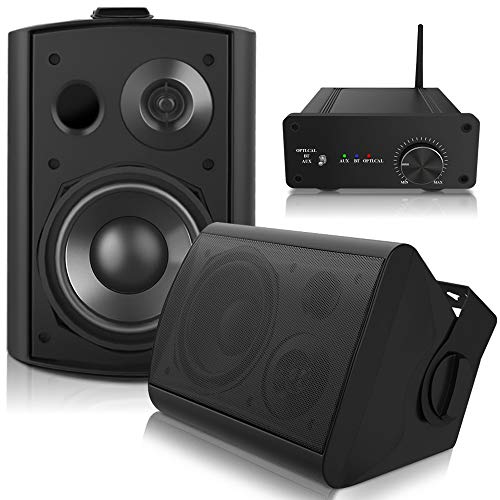
Running a wired digital optical connection from your cable box to a dedicated compact amplifier provides maximum reliability and eliminates wireless dropouts. Complete systems like the pohopa 5.25 Inch Outdoor Speakers with Bluetooth include a standalone Bluetooth 5.0 mini-amplifier equipped with a digital optical input, making direct hardware integration straightforward. This allows your cable audio to travel uncompressed into an external outdoor amplifier located inside or in a protected weatherproof cabinet.
Insert a standard TOSLink optical cable into the Optical Audio Out port on the Comcast box, ensuring the square-shaped connector snaps securely into place. Route the opposite end of the optical cable into the digital optical input of your outdoor amplifier. Because the pohopa amplifier system includes dedicated speaker terminals, you can run standard low-voltage speaker wire through an exterior wall plate out to the mounted patio speakers.
After physical connections are made, check the audio settings menu inside your Comcast box. Change the digital audio output setting from Dolby Digital 5.1 to PCM Stereo if your outdoor amplifier is a two-channel stereo unit. If the cable box attempts to send a multichannel surround bitstream to an amplifier that only decodes two-channel PCM, you may experience silence or digital clicking over your outdoor channels.
Method 3: Routing Sound Through an AV Receiver with Multi-Zone Outputs
Homeowners who already maintain an indoor home theater receiver can take advantage of multi-zone playback to power outdoor audio. In this configuration, the Comcast box connects to the AV receiver using a high-speed HDMI cable as a primary media input. The receiver then processes the audio signal, driving living room surround speakers on Zone 1 while sending a mirrored or independent audio stream to Zone 2 terminals.
Zone 2 speaker binding posts on the back of the receiver are designed to drive unpowered architectural speakers directly. Connecting heavy-duty passive outdoor sets, such as the Dual Waterproof Outdoor -Speaker System from Pyle, provides robust volume for large yards and pool decks. The Pyle PDWR50B features a 6.5-inch aluminum injection cone woofer, a 4-ohm impedance rating, and spring-loaded quick-connect terminals that handle standard multi-strand speaker wire effortlessly.
A multi-zone receiver allows you to regulate outdoor volume independently from the indoor television. Many modern receivers provide mobile app controls, enabling you to adjust patio levels from your phone while standing by the grill. Verify that your receiver supports digital audio pass-through to Zone 2, as some entry-level models only route analog inputs to secondary speaker zones.
Method 4: Using Your Television as an Audio Bridge
Connecting your Comcast box directly to your television via HDMI and then taking the audio output from the TV to your outdoor speakers is often the most practical route. Televisions act as convenient central audio switchers, passing sound from cable, connected game consoles, and smart TV streaming apps directly to an external output. This prevents you from losing outdoor sound if you switch from a cable broadcast to an integrated streaming app.
Most modern televisions provide either an optical audio output or a 3.5mm analog headphone jack. An active speaker pair, such as the Pyle Waterproof Wall Mount Speaker System (PDWR52BTBK), connects seamlessly to these television ports. The Pyle PDWR52BTBK includes a built-in power amplifier in the master active unit, gold-plated binding posts to feed its companion passive speaker, and a standard 3.5mm auxiliary input jack.
Running a shielded 3.5mm-to-RCA or 3.5mm-to-3.5mm audio cable from the television output to the active speaker’s Aux In port establishes a clean signal path. If your television audio output is set to variable, using your standard TV remote will adjust the sound level sent to the outdoor patio. Selecting fixed audio output keeps the signal steady, leaving volume control to the speaker’s physical controls or an inline volume knob.
Choosing Between Passive, Active, and Portable Outdoor Hardware
Evaluating your speaker hardware determines what accessories you need between the Comcast box and your outdoor listening zone. Passive speakers, exemplified by the Pyle PDWR50B pair, contain no internal power cords or amplifiers. They depend entirely on external wattage from a receiver or amplifier, making them ideal for permanent wall mounts where running electrical outlets outside is impractical.
Active speaker sets, like the Pyle PDWR52BTBK, house an internal 240-watt peak amplifier inside one master cabinet that powers the secondary passive unit. These systems require access to a standard electrical outlet on your patio, but they remove the need for bulky indoor amplifiers. They often feature built-in Bluetooth and auxiliary inputs, offering flexible playback options whether you stream from your cable box or a smartphone.
For listeners seeking zero permanent installation work, portable battery-powered units provide maximum mobility. Models such as the Sony SRS-XB31 Portable Wireless Bluetooth Speaker feature an IP67 waterproof and dustproof build alongside an internal rechargeable battery rated for up to 24 hours of playback. You can pair this portable unit directly to a Bluetooth-capable Comcast X1 box, place it on the patio table during the game, and bring it back inside when the broadcast concludes.
Comparing these design philosophies helps you balance installation effort against permanent convenience. While portable units offer flexibility, permanently mounted architectural speakers deliver broader, more uniform sound dispersion across an expansive backyard. Exploring dedicated stereo speakers reveals how driver sizing and cabinet acoustics shape clarity in open outdoor environments where walls do not reflect sound.
Troubleshooting Comcast Audio Delays and Connection Issues
Audio latency is the most common issue encountered when routing television sound to outdoor speakers. Bluetooth connections introduce slight wireless encoding delays, which can create a distracting lip-sync mismatch if you can see the indoor television screen through a window while listening outside. To minimize this, position Bluetooth receivers within clear line-of-sight of the source or use low-latency wired connections.
If you experience complete silence after connecting an optical audio cable, check the Comcast box output format immediately. Set the box audio format to stereo PCM rather than surround sound bitstreams, as many outdoor stereo amplifiers cannot decode raw Dolby Digital signals. In addition, confirm that the digital optical cable is seated firmly, as loose plastic connectors can prevent the light beam from reaching the sensor.
Ground loops frequently generate low-frequency humming or buzzing when using long analog auxiliary cables between indoor electronics and outdoor speakers. This occurs when the indoor television and outdoor active speaker share different electrical ground potentials. Installing an inexpensive ground loop isolator along the 3.5mm or RCA line immediately filters out this electrical hum, restoring clear dialogue.
When investigating broader wireless connection setups, looking into wireless Bluetooth speaker options can help clarify transmission standards and range expectations for exterior environments. Checking that your cable box firmware is fully updated ensures that its integrated Bluetooth audio menu remains stable and responsive during extended listening sessions.
Weatherproofing, Mounting, and Outdoor Cable Management
Permanent outdoor installations require careful attention to physical mounting and environmental exposure. Outdoor speakers featuring rustproof aluminum mesh grilles, like the Pyle PDWR50B, resist moisture corrosion from rain and heavy humidity. However, mounting speakers underneath roof eaves or covered patio rafters shields them from direct UV radiation and downpours, extending their operational lifespan.
Speaker wire passing through exterior walls must feature appropriate safety ratings. Always select CL2 or CL3 fire-rated in-wall speaker wire, and use direct-burial rated jackets if running lines underground to poolside posts. When drilling access holes through siding or brick, slope the drill path slightly downward toward the outside and seal the entry point with exterior-grade silicone caulk to prevent water ingress.
Forming a simple drip loop in the speaker wire just before it enters the terminal block prevents rainwater from trickling down the cable directly into the connections. Quick-connect spring terminals and gold-plated binding posts should be checked periodically for signs of oxidation or dirt buildup. Taking these basic physical precautions ensures that your Comcast audio system delivers reliable, crisp sound across every outdoor season.
Carefully evaluating your Comcast box model, selecting the appropriate wired or wireless bridge, and properly protecting your speaker connections makes expanding your home entertainment system simple. With your hardware securely mounted and matched, you can enjoy rich, synchronized audio across your patio, deck, or poolside retreat with complete confidence.




Write Your Review
No reviews yet. Be the first to share your experience!