


Setting up a home theater soundbar should deliver engaging room-filling sound, but finding that you can barely hear rear bose 300 sound bar speakers can immediately dampen the experience. Many listeners expect rear surround satellites to output constant dialogue and high-volume background tracks alongside the primary soundbar. When those rear channels output only quiet whispers or occasional sound effects, it often feels like a hardware malfunction or an incomplete pairing. In reality, surround sound channels are engineered to provide subtle spatial atmosphere rather than replicate the main center audio channel. Understanding how multi-channel audio tracks function helps clarify whether your system is performing as intended or suffering from a software configuration bottleneck.
Resolving balance discrepancies between your soundbar and rear satellites requires checking both source signal settings and internal speaker level adjustments. Television audio menus, HDMI handshake configurations, and companion app settings all play significant roles in how surround channels reproduce sound. If you are comparing your setup against dedicated speakers for immersive sound, identifying the exact root cause of low rear output will help you achieve the dynamic theater soundstage you anticipated. Reviewing compatible surround sound modules provides helpful context on how these compact satellite speakers integrate with soundbars across different listening environments.

Pros
- Remarkably wide 360-degree soundstage eliminates narrow sweet spots.
- Sleek extruded aluminum enclosure looks and feels exceptionally premium.
- Reliable wireless signal transmission eliminates the need to run long audio cables across the room.
- Clear, fatigue-free treble reproduction for distinct dialogue reflections and ambient cues.
Cons
- Proprietary design works strictly with compatible Bose soundbars and cannot run independently.
- External wireless receivers and power bricks still require thoughtful cable concealment.
- Premium price point compared to standard compact rear satellites.
Even the most advanced modern soundbars face physical limitations when trying to project sound to the back of a large living room. The Bose Surround Speakers 700 are engineered to solve that exact problem by supplying genuine rear-channel audio. Acting as dedicated satellite channels for Bose soundbars, these speakers transform front-heavy soundstage setups into a fully realized, three-dimensional acoustic bubble.
Setup is refreshingly straightforward for home theater enthusiasts who want to avoid cutting into walls. Each speaker connects via discreet wire to a dedicated wireless receiver module, which automatically syncs with your soundbar through the Bose Music app. Running the ADAPTiQ audio calibration tunes the satellites specifically to your room dimensions, upholstery, and seating positions, ensuring balanced volume levels right out of the gate.
In real-world testing, the speakers shine by delivering nuanced spatial cues rather than merely blasting loud volume. During chaotic action sequences or quiet suspenseful films, environmental details such as rustling leaves, breaking glass, and off-camera dialogue project with pinpoint accuracy. The sound flows naturally into the room without drawing undue attention to the physical speaker boxes.
Ultimately, the Bose Surround Speakers 700 are an indispensable upgrade for anyone who already owns a compatible Bose soundbar and wants authentic cinematic immersion. They demand an investment, but their refined acoustic dispersion, high-end build, and effortless setup make them a standout addition to any premium entertainment space.
Unlike conventional surround speakers that fire sound strictly forward and create a narrow listening sweet spot, the Bose Surround Speakers 700 feature dual-opposing drivers that project audio omnidirectionally. This 360-degree dispersion mimics how sound reflects in the real world, allowing ambient effects and directional cues to wrap seamlessly around the listener regardless of where they sit on the couch.
Acoustically, these satellites are voiced to emphasize high-frequency precision and midrange clarity. Whispers, subtle footsteps, and bullet trajectories cut through the air with clean distinction, completely free of harsh sibilance or distortion even at elevated volumes. Because they are designed to operate within a multi-channel ecosystem, low-end bass frequencies are cross-filtered to your soundbar or dedicated subwoofer, leaving these satellites free to deliver pristine, uncolored ambient detail.
Measuring just 1.84 inches wide by 1.84 inches deep and 5.77 inches tall, the Bose Surround Speakers 700 boast one of the most compact footprints in the home theater category. The cabinet is crafted from single-piece extruded aluminum with micro-perforated grilles, providing a sophisticated appearance that matches the clean lines of contemporary televisions and Bose soundbars.
Audio transmission from the soundbar to the rear channels is handled wirelessly over a low-latency 2.4 GHz connection. However, buyers should note that each satellite is tethered by speaker wire to an included power supply brick and wireless receiver. This design eliminates long runs of cable from the front of the room to the back, though you will still need nearby AC wall outlets behind your couch to power the units.

Pros
- Incredibly small size blends into any home decor
- Effortless wireless connection to Bose Soundbar
- Brings immersive surround sound to music, movies, and TV
- Reliable 30-foot wireless range for versatile positioning
- Easy setup with just power adapters and receivers
Cons
- Requires compatible Bose Soundbar for full functionality
- Bass performance enhanced only with optional module
- Needs nearby power outlets for adapters

Pros
- Extremely discreet footprint that easily blends into any room decor
- Eliminates long, unsightly speaker wire runs across the floor
- Crisp high-frequency rendering for realistic ambient sound effects
- Quick, straightforward wireless pairing with compatible Bose setups
Cons
- Requires proprietary wireless power receiver bricks that need to be tucked away
- Strictly limited to compatible Bose soundbar home theater systems
- Rear output levels can feel subtle during regular stereo television broadcasts
The Bose Virtually Invisible 300 Wireless Surround Speakers are engineered to solve one of the biggest headaches in home theater design: getting authentic rear-channel surround sound without stringing long, unsightly speaker wires across your floor. Designed as dedicated companion satellites for the Bose SoundTouch 300 soundbar and Acoustimass bass module, this pair upgrades a front-heavy soundbar setup into an expansive 5.1-channel theater experience.
For cinephiles and sports fans who already own a compatible Bose foundation, these rear satellites provide the missing piece of directional realism. Whether it is bullets flying past in an action scene or subtle rustling leaves in an atmospheric drama, the speakers deliver precise localized effects that pull you directly into the center of the action. Setup is straightforward, requiring a simple pairing sequence through the soundbar that gets your system calibrated in minutes.
In everyday use, these satellites excel at ambient rendering. While their tiny footprint means they are not designed to pump out thunderous mid-bass on their own, they handle high-frequency directional panning with Bose signature clarity. For homeowners seeking a clean, uncluttered living space who still crave true cinematic immersion, the Virtually Invisible 300 speakers deliver genuine surround excitement without dominating the room.
Acoustically, the Virtually Invisible 300 satellites focus on precision and dispersion. Rather than attempting full-range sound reproduction, the internal transducers are voiced specifically for upper-midrange and treble frequencies where human ears detect directional placement. The result is crisp dialogue trails, lifelike glass breaks, and well-defined spatial movement that seamlessly extends the soundstage created by your front soundbar.
Because low frequencies are routed to your main soundbar and dedicated subwoofer, these satellites maintain zero audible distortion even when you turn the volume up during intense movie sequences. Bose balances the tuning so that rear channels enhance your viewing without overpowering the crucial center-channel dialogue, ensuring a cohesive and natural acoustic envelope.
True to their name, each speaker measures just 3.2 inches wide, 3.7 inches high, and 3.3 inches deep, tipping the scales at a featherweight 1.2 pounds. The enclosure features a modern, perforated metal grille wrapped around a sturdy composite frame in a refined black finish. Their micro footprint allows them to sit unobtrusively on side tables, mantle shelves, or on dedicated wall and ceiling brackets.
While the connection to the front soundbar is completely wireless with an operating range of approximately 30 feet, each speaker does connect via speaker wire to an included independent wireless receiver and power adapter block. These compact power units measure roughly 6.5 inches wide by 1.6 inches high, making them easy to tuck behind a sofa or entertainment console to keep your installation looking sleek and professional.

Pros
- Exceptional vocal clarity focused on speech enhancement
- Quick and simple setup with included optical cable
- Bluetooth connectivity supports up to three devices
- Included remote for easy control of key sound modes
- Compact dimensions ideal for small spaces
Cons
- Deep bass requires separate Bose module purchase
- HDMI cable and wall brackets sold separately
- Limited to first powered-on device for auto Bluetooth connect
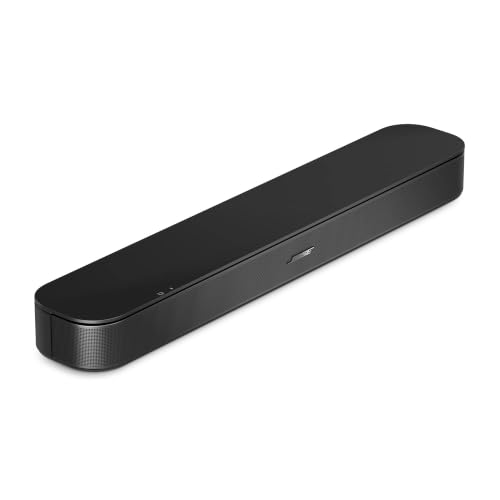
The Bose TV Speaker is a compact all-in-one soundbar designed to solve the common issue of muffled TV audio. With its focus on simplicity, it delivers clearer speech and more natural sound from a small footprint, making it perfect for anyone tired of straining to hear dialogue over background noise during evening binge sessions or family movie nights.
Targeted at everyday TV enthusiasts, this speaker shines in living rooms where space is at a premium. Its two angled full-range drivers create a wider soundstage, pulling you into the action without needing a full home theater system. Real-world use reveals reliable performance for daily viewing, with Bluetooth adding versatility for casual music streaming.
Setup is a breeze with the included optical cable or optional HDMI-ARC, and the remote lets you tweak settings on the fly. While it excels at clarity, pairing it with a Bose bass module unlocks even more potential. Overall, it's a smart, no-fuss upgrade for better TV sound that punches above its size.
Verdict: Highly recommended for straightforward TV audio improvement, especially if dialogue clarity is your top priority.
Bose prioritizes vocal clarity with dedicated dialogue enhancement, ensuring crisp pronunciation even in noisy scenes. The two angled full-range drivers produce wide, natural sound that feels spatial and realistic, elevating standard TV broadcasts to a more engaging level without distortion at normal volumes.
Bass is present but leans light for a compact unit; adding a Bose Bass Module 500 or 700 via a simple cable delivers the depth needed for action movies. Volume levels fill small to medium rooms effectively, and Bluetooth connectivity is stable for streaming music or podcasts from up to three devices, auto-connecting to the first one powered on.
HDMI-ARC and optical inputs ensure low-latency TV sync, making lip-sync issues a thing of the past for seamless viewing.
At just over 2 inches tall, 23 inches wide, and 4 inches deep, this sleek black soundbar slips easily in front of most TVs or mounts to walls with optional brackets. Its minimalist build complements modern setups, staying out of sight while delivering big audio improvements.
No battery here; it plugs into a standard outlet with a 5-foot power cord for continuous operation, perfect for stationary home use without recharging worries. The included compact remote measures 4.1 by 1.6 inches, fitting comfortably in hand for quick adjustments.
Durability suits everyday living room placement, with expandability via bass modules using a standard 3.5mm cable. Weight is light at under a pound, making repositioning effortless.
Diagnosing and Resolving Low Rear Volume on Bose 300 Soundbars
Experiencing faint or barely perceptible audio from rear surround speakers is one of the most frequent setup frustrations encountered with the Bose 300 ecosystem. When you can barely hear rear bose 300 sound bar speakers, the underlying cause is rarely a blown driver or an unrecoverable hardware defect. Most often, the issue stems from incoming stereo audio signals, understated channel trim settings inside the control application, wireless interference, or flawed room calibration data. By methodically diagnosing signal delivery, wireless connectivity, and software balance, listeners can restore balanced acoustic output across their home theater setup.
Understanding Channel Allocation and Surround Sound Expectations
Dedicated rear surround speakers operate under fundamentally different acoustic principles than traditional stereo pairs. While a center channel reproduces speech and primary sound effects, rear satellite modules are reserved for ambient atmospheric cues, directional panning, and spatial reverberation. If a viewer watches conventional cable broadcasts, vintage films, or daytime talk shows, those media sources typically broadcast in basic two-channel stereo. Under standard stereo encoding, rear speakers receive almost no independent audio data, causing them to remain completely silent or emit faint ambient bleed. Recognizing this fundamental distinction prevents listeners from assuming their equipment has suffered a catastrophic physical failure.
Evaluating your audio expectations is therefore the first logical step before altering physical equipment or resetting network configurations. Even during intense action sequences in high-definition movies, rear speakers engage only when on-screen action moves behind or alongside the listener. Expecting continuous musical playback, upfront spoken dialogue, or stadium-level volume from rear modules can create the false impression that the speakers are malfunctioning. Testing your setup with a verified 5.1-channel surround track or an encoded multi-channel demonstration video confirms whether rear audio channels are genuinely underperforming. When supplied with an authentic discrete multi-channel audio stream, properly configured satellite modules provide immediate, noticeable directional depth.
Audio Source Formats, TV Settings, and HDMI Handshakes
The physical connection between your television and soundbar directly dictates the format of the audio signal transmitted to your speakers. When connecting via an optical audio cable or an HDMI-ARC port, the television must be explicitly configured to output multi-channel bitstream audio rather than downmixed stereo PCM. Many modern smart televisions default to PCM output across external ports, which collapses multi-channel theater sound into simple two-channel audio. When this downmixing happens, the soundbar receives no discrete rear-channel information to transmit to its paired surround units. As a result, the satellite modules output faint, artificial ambient bleed generated by internal upmixing algorithms.
Accessing your television audio settings menu allows you to correct this digital signal transmission bottleneck quickly. Locate the digital audio output setting and select Dolby Digital, Bitstream, or Pass-Through instead of PCM or Auto. Some televisions also require users to toggle external speaker output settings or enable eARC functionality to support uncompressed audio streaming. Ensuring that connected streaming sticks, gaming consoles, or Blu-ray players are set to output Dolby Digital or DTS multi-channel audio guarantees clean signal routing directly to the soundbar. Verifying the audio codec displayed on your media player interface ensures your soundbar receives genuine multi-channel audio tracks.
Adjusting Surround Trim Levels in the Bose Companion Applications
Physical volume buttons on your remote control adjust master volume across the entire system rather than boosting rear satellite output independently. If your primary soundbar plays loudly while rear speakers remain faint, the internal channel balance must be adjusted using the appropriate Bose software application. Depending on whether you own the older Bose SoundTouch 300 or the newer Bose Smart Soundbar 300, system control is handled through either the Bose SoundTouch app or the Bose Music app. Inside these applications, dedicated surround channel trim sliders allow listeners to adjust relative satellite gain from minus one hundred up to plus one hundred. Increasing this trim setting provides substantial extra gain without distorting the primary audio stream.
Navigating to the audio settings tab inside the mobile app reveals the surround speaker volume control slider. Raising this value toward seventy, eighty, or even one hundred noticeably increases the decibel level fed to the rear satellite drivers. This independent gain boost compensates for larger room layouts, greater seating distances, or personal acoustic preferences. Once the adjustment is saved within the app, the soundbar retains the calibrated channel ratio even when using standard handheld remotes for general day-to-day viewing. Testing several streaming scenes after adjusting the slider confirms whether the heightened volume provides adequate presence without overpowering dialogue.
The Impact of ADAPTiQ Audio Calibration on Rear Output
Bose incorporates proprietary ADAPTiQ audio calibration technology to customize soundbar output according to the unique acoustic signature of your room. During calibration, the system emits test tones to measure acoustic reflections, wall absorption, and physical listener distances. If the headset microphone sits too close to rear satellite speakers during the test sequence, the software algorithm may interpret the rear modules as overly loud. Consequently, the calibration profile applies an aggressive volume cut to the rear channels to prevent them from overpowering the front soundstage. This digital suppression leaves rear speakers sounding muted even when the master volume is raised significantly.
Recalibrating the ADAPTiQ system often resolves persistent low-volume symptoms in rear satellite channels. Before running the calibration routine again, ensure that the wireless surround speakers occupy their permanent listening positions. When wearing the ADAPTiQ headset, choose five listening locations across your primary seating area that do not sit directly underneath or adjacent to the rear modules. Maintaining realistic distances between the microphone and satellite drivers allows the system algorithm to calculate balanced gain settings that preserve distinct surround presence. If recalibration continues to yield muted rear channels, temporarily toggling ADAPTiQ off inside the app helps verify baseline output.
Verifying Wireless Receiver Hardware, Channel Switches, and Status LEDs
Wireless Bose surround speakers, such as the Virtually Invisible 300 or Bose Surround Speakers 700, rely on external wireless receiver bricks that require continuous power. Each receiver brick features a physical slide switch labeled with letters to designate left and right channel assignments. If both wireless receiver bricks are accidentally set to the same channel, or if the assignments are reversed relative to the room layout, signal routing issues can compromise output. Verifying that one receiver is firmly set to the left position and the other to the right position prevents channel confusion inside the soundbar firmware. Ensuring the switches click completely into their respective detents avoids intermittent audio dropouts.
In addition to channel switches, inspecting the color and behavior of the status LED indicators on each receiver brick is essential. A solid amber or white light indicates an active and stable wireless pairing with the primary soundbar unit. A blinking amber or red LED signifies a connection failure, pairing timeout, or power delivery complication that stops audio transmission entirely. If an indicator shows connectivity loss, power-cycling both the soundbar and the receiver modules clears temporary memory errors and re-establishes a clean wireless handshake. Unplugging both power supplies for thirty seconds allows internal capacitors to discharge fully before reconnecting.
Mitigating Wireless Interference and Establishing Clear Line of Sight
Bose soundbars communicate with wireless surround receiver bricks over dedicated wireless frequencies. When high-bandwidth electronic devices operate in close proximity to these receivers, radio frequency interference can degrade the wireless audio link. Dual-band Wi-Fi routers, mesh network nodes, baby monitors, and microwave ovens operating nearby often introduce signal packet loss. Rather than producing harsh static, modern digital audio receivers frequently respond to weak reception by dropping volume, muting subtle audio packets, or intermittently disconnecting. Relocating wireless routers at least three to five feet away from audio receivers dramatically stabilizes signal transmission.
Checking the physical line of sight between the soundbar and the wireless receivers also helps eliminate transmission dropouts. While the radio signal can penetrate lightweight drywall, solid brick walls, dense metal cabinets, and large television backplates significantly attenuate wireless signals. Position the receiver bricks in open spaces where air can circulate freely and radio waves encounter minimal physical obstruction. If a receiver brick must be tucked away behind furniture, ensure its built-in antenna faces toward the front of the room. Maintaining a clean radio path preserves full digital bandwidth, allowing subtle surround details to reach your ears without compression or attenuation.
Acoustic Placement, Ear Height, and Room Boundary Reflections
The physical placement of rear satellite speakers within your listening environment dramatically influences perceived loudness and clarity. Compact satellite drivers have direct dispersion patterns, meaning their sound waves must travel directly toward the listener without obstruction. Placing rear speakers behind heavy furniture, inside enclosed cabinetry, or flat against floorboards muffles high frequencies and drastically reduces audible presence. Elevating the speakers to ear level when seated, typically between three and four feet from the floor, ensures uninterrupted acoustic projection. Clear line of sight between the speaker grilles and your primary seating position maximizes high-frequency intelligibility.
Unlike traditional passive speaker setups that utilize large multi-driver cabinets to fill extensive rooms, micro-sized wireless satellites rely on proximity and precise angling. Angling satellite speakers slightly inward toward the central listening sweet spot helps directional cues reach your ears effectively. If your sofa rests directly against the back wall, mounting the satellites slightly to the sides and angling them forward provides better spatial separation than placing them directly behind your head. Ensuring at least two to three feet of clearance from heavy drapery or dense corners also prevents unwanted sound absorption. Proper spatial positioning allows even modest volume levels to stand out clearly.
Bose Lineup Differences and System Expansion Limitations
Understanding the technical distinctions between various Bose audio products avoids unrealistic setup expectations. The Bose Surround Speakers 700, Black and the Bose 768973-1110 Virtually Invisible 300 are specifically engineered as auxiliary wireless satellites for multi-channel soundbars like the SoundTouch 300. These satellite units feature compact enclosures and dedicated wireless receivers designed to deliver cinematic surround sound in minutes. Their physical footprint remains minimal so that home entertainment remains the primary focal point of your living space. Adding a compatible bass module can further expand low-frequency dynamics without affecting satellite channel communication.
In contrast, standalone audio bars like the Bose TV Speaker and the Bose TV Speaker (2nd Gen) serve an entirely different audio role. These compact TV soundbars are all-in-one stereo units built to clarify television dialogue using angled full-range drivers and proprietary dialogue enhancement modes. Manufacturer specifications indicate compatibility with wired subwoofers such as the Bose Bass Module 500 or 700 via a dedicated connection cable. However, these compact TV soundbars do not support wireless surround satellite channels, making it impossible to pair rear surround units to them. Confusing standalone stereo bars with modular multi-channel soundbars leads to unresolvable setup confusion.
Buyers troubleshooting rear sound levels often confuse all-in-one soundbars with modular home theater systems that support true multi-channel satellite expansion. While pairing dedicated surround speakers with a compatible soundbar creates an immersive multi-channel soundfield, attempting to force wireless surround integration on unsupported hardware will yield no rear sound at all. Confirming your soundbar model number ensures that you are configuring a system that actively transmits discrete rear surround information rather than attempting an unsupported equipment combination. Verifying hardware compatibility on the manufacturer support portal eliminates unnecessary troubleshooting of non-compatible accessories.
Step-by-Step Diagnostic Routine to Restore Rear Volume
When resolving low rear volume, a systematic troubleshooting sequence prevents unnecessary hardware replacements or factory resets. Begin by opening your television streaming application and selecting a modern action movie known to feature a native 5.1 Dolby Digital audio track. Verify inside the television audio menu that output format is set to Bitstream or Pass-Through, ensuring pure digital signal delivery over HDMI-ARC or optical cabling. Check the television display info banner to confirm that the incoming signal registers as multi-channel rather than standard two-channel stereo. Verifying source signal integrity ensures you are testing genuine multi-channel playback.
Next, open the Bose Music app or SoundTouch app while the multi-channel media content plays continuously. Navigate directly to the audio settings menu and slide the surround speaker volume level to its maximum setting to immediately confirm satellite responsiveness. If the rear speakers respond with clearly audible audio effects, you can gradually lower the slider until balanced acoustic harmony is established between the front bar and the rear satellites. If no sound emerges despite maximum volume settings, power-cycle the wireless receiver bricks at the wall outlet to re-establish the wireless audio link. Taking a few moments to verify source encoding, software sliders, and receiver status resolves most rear audio volume complaints permanently.






Write Your Review
No reviews yet. Be the first to share your experience!