


Planning an immersive surround sound system often leads to major questions about where height effects should originate. If you are asking whether can atmos speakers be in the ceiling, the short answer is an absolute yes. In fact, true overhead physical placement is considered the gold standard by audio engineers for reproducing three-dimensional spatial sound. While upward-firing modules that bounce sound off drywall exist, installing flush overhead architectural drivers delivers the cleanest directional clarity for aircraft flyovers, rainfall, and vertical audio transitions.
Integrating overhead hardware requires understanding your room layout, receiver capabilities, and drywall clearance. While standard dedicated music speakers handle ear-level channels, in-ceiling Atmos drivers focus on broad sound dispersion across the listening area. Evaluating passive speaker specifications such as mounting depth, driver materials, and amplifier impedance helps prevent costly installation mistakes. Taking time to map out speaker locations before cutting holes ensures your home theater delivers compelling, immersive height effects without audio localization issues.

Pros
- Paintable magnetic grilles provide a near-invisible architectural profile
- Ultra-shallow 2.6-inch depth fits tight ceiling cavities and standard 2x4 walls
- Excellent midrange clarity for podcasts, acoustic music, and background audio
- Sturdy dog-ear mounting clamps make ceiling installation quick and reliable
Cons
- Passive design requires a separate amplifier or AV receiver to operate
- Compact 4-inch woofer cannot reproduce deep sub-bass frequencies without a separate subwoofer
- Requires manual drywall cutting and in-wall wire routing
The Herdio HCS418 4-inch in-ceiling and in-wall speaker pair is built for homeowners seeking clean, room-filling sound without cluttering floor or shelf space. Engineered as a passive two-way system, these flush-mount units install directly into drywall, making them an excellent choice for distributed background audio in kitchens, home offices, hallways, and living spaces.
In practical listening environments, the HCS418 delivers surprisingly articulate vocal performance and smooth acoustic highs. The lightweight polypropylene cone responds quickly to dynamic shifts in music, ensuring dialogue from radio shows and instruments from acoustic playlists remain crisp and intelligible throughout the room. While the 4-inch driver naturally trades deep low-end rumble for compact dimensions, it produces sufficient mid-bass warmth for enjoyable everyday listening.
Installing these speakers is straightforward for handy DIYers. The integrated dog-ear clamps grip the drywall firmly from the rear, preventing unwanted vibration against the ceiling studs. Once installed, the micro-perforated magnetic grille sits flat against the surface, concealing all mounting hardware for a modern, architectural look.
For anyone wanting to establish an affordable whole-home audio setup or augment their home theater with overhead ambient channels, the Herdio HCS418 offers exceptional value. When connected to a competent stereo amplifier or multi-zone receiver, these speakers disappear into your ceiling while providing consistent, high-clarity sound.
Acoustically, the Herdio HCS418 utilizes a two-way driver configuration that cleanly divides audio frequencies between the 4-inch woofer and the integrated high-frequency tweeter. The polypropylene cone is paired with a flexible rubber surround, providing solid transient response while maintaining low distortion across standard listening volumes. Vocals and acoustic guitars exhibit impressive separation, creating a broad, diffuse soundstage that spreads music evenly across medium-sized spaces.
With a combined peak power handling of 160 watts (80 watts per speaker), the HCS418 plays comfortably loud without harshness when driven by 20 to 50 watts of continuous RMS power. Because the drivers measure 4 inches across, physical acoustic boundaries limit low-frequency sub-bass output below 80Hz. For casual music and ambient sound, the baseline response is balanced and punchy; however, pairing this set with a powered subwoofer is recommended if you plan to use them as surround channels for movie soundtracks.
The Herdio HCS418 is engineered specifically to overcome tight clearance hurdles in residential construction. With an outer diameter of 6.4 inches and a required cutout diameter of 5.7 inches, the standout dimension is the shallow 2.6-inch total mounting depth. This ultra-slim profile enables installation into tight drop ceilings, shallow soffits, and standard interior partition walls framed with 2x4 studs where deeper in-wall speakers simply cannot fit.
Hardware functionality is highlighted by the heavy-duty mounting clamps featuring textured non-slip treads that bite securely into drywall panels. The speakers ship with round, stain-resistant steel grilles backed by powerful integrated magnets, allowing you to quickly attach or remove them without bending the metal edges. Standard spring-loaded push terminals on the rear accept standard 14 to 18-gauge speaker wire, making connection to your central AV receiver or multi-room amplifier clean and dependable.

Pros
- Powerful 200W handling for high-volume home theater use
- Balanced sound with strong midbass and clear treble
- Simple flush-mount design blends into any room
- Versatile 4-8 ohm impedance matches most amps
- Includes template for hassle-free installation
Cons
- Requires cutting wall or ceiling holes for mounting
- Wired setup needs external amplifier and receiver
- Indoor use only, not suited for outdoor environments
The Pyle PDIW65 is a pair of professional-grade two-way in-wall or in-ceiling speakers designed for seamless integration into home theaters, offices, or custom audio setups. With 6.5-inch midbass drivers and 1/2-inch polymer tweeters, they deliver robust stereo sound without taking up floor space, making them perfect for American homeowners wanting a clean, professional look.
Ideal for movie nights or background music in living rooms, these speakers excel in providing wide-range audio reproduction from 70Hz to 20kHz. The 200W peak power and 100W RMS rating ensure they handle demanding playback, while the 4-8 ohm impedance offers compatibility with standard amplifiers. Installation is straightforward with the included cut-out template, allowing flush mounting that hides wires and grilles for a sleek finish.
In real-world use, expect impressive bass response for indoor environments and clear vocals that enhance dialogue in films. Though passive, they pair well with AV receivers for whole-room immersion. Overall verdict: A budget-friendly choice for clutter-free, high-performing home audio that punches above its weight.
These speakers shine with a 70Hz-20kHz frequency response, delivering deep midbass from the 6.5-inch drivers that fills rooms with punchy lows suitable for action movies or rock tracks. The 1/2-inch polymer tweeters provide sharp, detailed highs, ensuring vocal clarity and instrument separation without harshness.
At 200W peak power, they reach high volumes with minimal distortion, thanks to the 4-8 ohm impedance and high-temperature voice coils built for extended play. Perfect for home theater systems, they create a surround-like stereo field when properly placed.
Stable wired connections via convenient terminals keep signal integrity strong, outperforming wireless options in reliability for dedicated setups.
The PDIW65 features a clean white flush-mount design that blends invisibly into walls or ceilings, with a cut-out template ensuring precise installation. Lightweight construction and paintable grilles allow customization to match any decor, ideal for modern US homes.
No battery required as these are passive speakers powered by your amplifier, enabling continuous operation without recharging worries. Durable build withstands long hours of use indoors.
Compact 6.5-inch size suits tight spaces, while the professional mounting system provides a secure, vibration-free hold for reliable performance over time.

Pros
- Carbon fiber woofer provides clean, articulate bass with minimal cone breakup
- Paintable, low-profile magnetic grilles ensure an invisible architectural presence
- High efficiency makes them easy to drive using standard home theater receivers
- Silk dome tweeter maintains natural clarity without harsh treble spikes
Cons
- Passive design requires running in-wall speaker wire to an external amplifier
- Low-frequency extension depends on ceiling cavity volume and insulation behind the speaker
- Fixed-angle drivers require careful placement relative to your main listening position
The Monoprice Alpha 6.5-Inch In-Ceiling Speakers provide an impressive balance of discreet aesthetics and robust acoustic performance. Built with carbon fiber drivers typically found in higher-tier architectural models, this pair provides a significant upgrade over entry-level builder-grade ceiling speakers. They allow music lovers and movie enthusiasts to enjoy expansive sound without giving up precious floor space to bulky speaker cabinets.
These speakers are tailored for homeowners and AV enthusiasts building a custom multi-channel home theater or a multi-zone background audio system. Thanks to their wide sound dispersion and natural vocal delivery, they serve seamlessly as overhead Dolby Atmos height speakers, side or rear surround channels, or as the acoustic backbone for open-concept kitchens and living areas.
In real-world listening, the Alpha speakers stand out for their midrange clarity and transient speed. Dialogue cuts through movie soundtracks with authority, and acoustic instruments sound open and natural. While they provide solid mid-bass punch, pairing them with a dedicated powered subwoofer in a home theater environment unlocks the ultimate full-range audio experience.
For anyone wanting clean sound integrated seamlessly into their living space, the Monoprice Alpha 6.5-inch pair delivers outstanding value. They combine durable, high-grade acoustic materials with an easy-to-install design that blends effortlessly into any modern home decor.
The sonic signature of the Monoprice Alpha ceiling speakers is defined by clarity, responsiveness, and balance. The 6.5-inch carbon fiber woofer provides superior stiffness relative to its mass, allowing it to move rapidly while resisting the flex that creates unwanted harmonic distortion. This results in tight, well-defined mid-bass and a neutral midrange where vocals sound lifelike and centered.
High frequencies are handled by a 1-inch silk dome tweeter that distributes smooth, shimmering top-end detail. Unlike budget metal dome tweeters that can produce brittle or fatiguing highs during loud action sequences, silk provides a mellow yet detailed response. Soundstage dispersion is wide and forgiving, creating an immersive overhead audio bubble ideal for immersive surround formats.
Constructed around a rigid ABS chassis, the Monoprice Alpha speakers are engineered for durability and rattle-free performance. Each speaker measures approximately 10.1 inches across with a mounting depth of 3.6 inches, fitting easily into standard residential ceiling joist bays. The integrated dog-ear mounting tabs rotate and clamp firmly against drywall for a fast, secure installation.
The front face features a slim-profile, bezel-free magnetic grille with no logos, keeping the visual footprint clean and modern. The metal grille can be easily painted to match your ceiling color. On the back, heavy-duty spring-loaded terminals accommodate bare speaker wire or pin connectors, ensuring a firm, low-resistance connection to your AV receiver or multi-channel power amplifier.
Pros
- Full-range frequency response from 40Hz-20kHz for balanced audio
- Simple spring-loaded wire connections speed up setup
- Durable ABS construction withstands everyday use
- High 95dB sensitivity maximizes output from any amp
- Compact 3.78-inch depth fits most ceilings
Cons
- Requires cutting precise 9.45-inch holes in ceiling
- Needs separate home receiver or amp for power
- Wired setup lacks wireless convenience
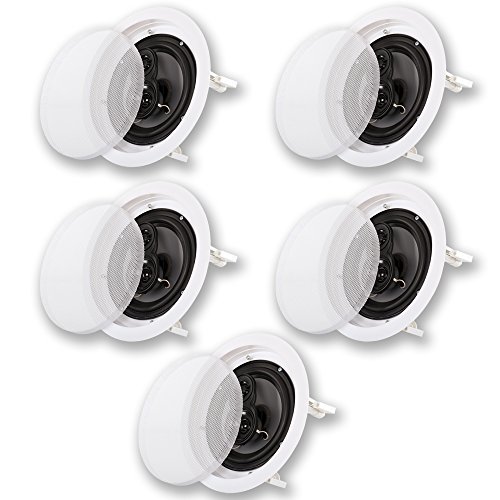
The Acoustic Audio CS-IC83 is a 5-pack of 8-inch 3-way in-ceiling speakers designed for seamless integration into home audio systems. With flush-mount design and pressure-lock mounting, they provide a clean, invisible look perfect for modern living rooms or dedicated theaters.
Ideal for homeowners or DIY enthusiasts upgrading to surround sound without bulky floorstanders, these speakers excel in whole-house audio or business installs. Their 8-inch poly cone woofers, poly mica midranges, and soft dome tweeters ensure detailed playback across genres.
In real-world use, they pair well with standard receivers, delivering wide dispersion that fills rooms evenly. The paintable grills allow customization to match decor, enhancing aesthetics.
Verdict: A solid choice for value-driven home theater builds, offering pro-level sound at an entry price point with straightforward installation.
Powered by 3-way passive crossovers, the CS-IC83 delivers deep bass down to 40Hz from the rigid 8-inch woofer, punchy mids via poly mica drivers, and crisp highs from 13mm tweeters up to 20kHz. This setup provides balanced, full-range audio for immersive movie watching or music listening.
At 95dB sensitivity and 8-ohm impedance, they handle 10-350W per channel with clarity and minimal distortion, reaching high volumes suitable for large rooms. Wide sound dispersion ensures even coverage without hot spots.
Performance shines when driven by a quality amp, offering fidelity rivaling pricier options for home setups.
Built with durable ABS housings and grills, these speakers feature a slim 3.78-inch mounting depth and 10.83-inch overall diameter, fitting standard 9.45-inch ceiling cutouts. Spring-loaded raw wire connections make wiring straightforward.
Pressure-lock clamps secure tightly to drywall, while removable, paintable grills allow perfect decor matching. No battery needed; they draw continuous power from your receiver or amp for unlimited playback.
Rugged construction suits permanent installs, with CL3-rated wire compatibility for safe in-wall runs. Lightweight design simplifies handling during setup.
Architectural Overhead Audio: The Complete Dolby Atmos Ceiling Guide
Installing physical speakers directly into the drywall overhead is not only permissible for Dolby Atmos, but it represents the exact method recommended by cinema sound engineers. Object-based audio formats rely on precise three-dimensional coordinates to place sound effects realistically above and around the audience. When sounds such as overflying helicopters, ambient birdsong, or rainstorms are reproduced by ceiling-mounted hardware, the human brain immediately recognizes the correct spatial origin. Knowing how to choose the right architectural drivers, position them accurately, and connect them safely makes the difference between muddy noise and breathtaking spatial immersion.
Why In-Ceiling Placement Is the Reference Standard for Dolby Atmos
Traditional surround sound systems produce audio primarily on a horizontal plane around your ears. Dolby Atmos expands this listening field by introducing discrete height channels, effectively transforming a flat surround soundfield into an enveloping three-dimensional dome. While some sound setups rely on portable hardware or wireless Bluetooth speakers for basic room listening, dedicated home theater immersion demands precise physical speaker locations. Overhead architectural drivers give the AV receiver dedicated physical channels to project directional cues without muddying the primary ear-level soundstage.
Upward-firing speaker modules are often marketed as an easy shortcut because they sit atop existing tower speakers and bounce sound off the ceiling. That reflective approach depends heavily on having a smooth, flat drywall ceiling between eight and twelve feet in height. Vaulted, angled, beamed, or acoustically treated ceilings scatter the reflected sound energy unpredictably and destroy the height illusion. Physical in-ceiling installation bypasses the room ceiling surface entirely by transmitting direct sound waves straight down to your seating area.
Direct radiation from above produces significantly sharper localization and higher dynamic impact than reflected audio ever could. Audio objects transition seamlessly from your front stage, through the overhead drivers, and into the rear surrounds without sudden drops in volume or tonal balance. Listeners notice this advantage immediately during complex action scenes where multiple atmospheric effects happen simultaneously. Direct overhead audio ensures that dialogue remains grounded while vertical sound effects retain their intended punch and acoustic clarity.
Recommended Angles and Physical Layout for Overhead Channels
Achieving convincing height effects depends far more on correct speaker angles than on simply placing drivers anywhere in the ceiling. A standard 5.1.2 setup uses two overhead speakers positioned slightly forward of the primary listening position at an elevation angle of roughly 65 to 80 degrees. When listeners expand to a 5.1.4 or 7.1.4 layout, the system incorporates four ceiling speakers arranged into front height and rear height pairs. In a four-speaker ceiling arrangement, the front overheads sit at roughly 45 to 55 degrees in front of the listener, while the rear overheads mirror that placement behind the seating row.
Ceiling speakers should also align with the left and right front speakers to maintain soundstage consistency. Placing the overhead drivers too close together near the center of the room narrows the overhead stage and causes sound effects to bunch together. Conversely, pushing them too close to the side walls causes boundary reflections that smear high-frequency audio cues. Matching the lateral spacing of your main front stereo pair provides a smooth vertical transition when sound pans from the floor to the ceiling.
Listening height relative to the ceiling also dictates final placement adjustments for optimal sound coverage. In rooms with exceptionally tall ceilings over ten feet, the sound pattern spreads out wider before reaching the seating area. In lower eight-foot ceilings, the sound coverage is much tighter, meaning speaker placement errors become far more noticeable to seated listeners. Taking careful physical measurements from your primary listening chair before cutting any ceiling drywall prevents acoustic dead zones and ensures balanced overhead audio.
Critical Architectural Factors Before Cutting Drywall
Before you select a drill bit or drywall saw, you must locate the structural framing hidden behind your ceiling plaster. Ceiling joists generally run parallel to one another at sixteen or twenty-four-inch intervals, which limits where flush-mounted speakers can sit. Utilizing a dependable stud finder helps identify framing timber, hidden HVAC metal ductwork, and structural cross-bracing. Discovering a wooden joist halfway through cutting a nine-inch hole creates an expensive drywall repair that ruins your installation timeline.
Mounting depth is another vital measurement that varies drastically across different ceiling speaker models. Compact architectural models such as the Herdio 4” HCS418 160 Watts 2 Way Flush Mount require only 2.6 inches of cavity depth, making them suitable for shallow ceiling spaces or drop-ceiling tiles. Larger speakers such as the Acoustic Audio by Goldwood CS-IC83 8” 3-Way require nearly 3.8 inches of clearance to accommodate beefier magnet structures and internal crossovers. Always verify that your ceiling cavity has sufficient vertical clearance and is completely free of electrical conduit or plumbing lines.
Sound transmission into the living spaces located above your home theater presents another practical challenge. When an open-back speaker sits flush in drywall, sound energy radiates upward into the subfloor and ceiling joist cavity just as readily as it radiates downward. Installing backer boxes or fire-rated acoustic enclosures behind the drivers helps contain unwanted sound bleed into upstairs bedrooms. In addition to dampening sound transfer, an enclosure provides a controlled air volume that tightens bass response and protects the speaker cone from loose attic insulation.
Driver Size, Dispersion, and Sonic Performance in Ceilings
Driver diameter plays a substantial role in how evenly an overhead speaker disperses audio across your seating area. Compact four-inch speakers offer broad, uniform sound dispersion that works wonderfully in smaller rooms or spaces with lower ceilings. Mid-sized 6.5-inch designs provide an ideal balance of bass extension, vocal clarity, and wide coverage for medium to large home theaters. Large eight-inch drivers deliver deeper low-frequency punch, but their larger cones naturally exhibit narrower high-frequency dispersion patterns unless paired with advanced multi-way crossover networks.
High-frequency tweeters demand special attention because high audio frequencies travel in directional beams. Many high-performance architectural speakers incorporate pivoting tweeters that allow installers to angle the treble directly toward the primary listening positions. The Monoprice Alpha 2-Way Ceiling Speakers feature a silk dome tweeter that softens harsh treble spikes while delivering detailed high-frequency performance. Aiming the tweeter toward the center seating position ensures that delicate sound cues remain clear without fatiguing the listener over long movie sessions.
Cone materials also influence how accurately ceiling speakers reproduce dynamic sound transients. Drivers built with rigid carbon fiber, like those in the Monoprice Alpha series, resist flexing under heavy audio loads to minimize distortion during loud action sequences. Other models use polypropylene cones with flexible butyl rubber surrounds, as seen on the Pyle Two Way Stereo Sound Speaker and Herdio designs, which offer excellent resistance to moisture and temperature fluctuations. Selecting robust, weather-resistant materials is especially valuable in basements or upper-level attic rooms where humidity and heat levels fluctuate throughout the seasons.
Receiver Matching, Power Handling, and System Impedance
Architectural ceiling speakers are almost universally passive devices that require dedicated amplification from an AV receiver or external power amp. Before buying hardware, verify that your surround receiver contains dedicated height channel speaker terminals or pre-outs labeled for Dolby Atmos. Home theater enthusiasts seeking innovative audio speaker designs often explore multi-channel configurations that push audio processing far beyond conventional 5.1 layouts. If your receiver only features seven total amplifier channels, you can run a 5.1.2 layout but cannot power a 5.1.4 system without upgrading your processing gear.
Power handling specifications must match receiver output capabilities to prevent voice coil damage and harsh clipping distortion. The Pyle Two Way Stereo Sound Speaker pair handles up to 100 watts RMS with 200 watts peak, providing plenty of headroom for modern digital soundtracks. Meanwhile, multi-speaker packages like the five-speaker Acoustic Audio by Goldwood CS-IC83 8” 3-Way system can handle amplification ranging from 10 watts up to 350 watts per channel. Delivering clean, undistorted amplifier power ensures that transient audio peaks remain crisp and transparent during demanding cinematic passages.
Impedance compatibility is another critical electrical metric that impacts receiver stability and thermal management. Most architectural ceiling drivers operate within an impedance rating of four to eight ohms, matching common home theater receiver capabilities. Running low-impedance four-ohm loads on an amplifier designed exclusively for eight-ohm speakers can cause thermal overload or trigger receiver protection shutdowns. Always consult your AV receiver manual to verify that its internal circuitry supports your chosen speaker impedance across all active channels.
Essential Wiring, Building Codes, and Signal Safety
Running speaker wire through walls and across ceiling spaces requires strict compliance with residential building codes. Standard clear plastic speaker cable should never be routed behind drywall because its outer insulation can release toxic fumes during a fire. You must select CL2 or CL3 rated in-wall speaker wire, which incorporates flame-retardant outer jackets engineered to meet residential fire codes. Investing in certified cabling protects your home and ensures that your installation complies with local safety inspections.
Wire gauge selection depends on the total distance running between your AV receiver rack and the ceiling speaker terminals. For short wire runs under fifty feet, standard 16 AWG oxygen-free copper wire delivers sufficient signal integrity with negligible resistance loss. Long runs exceeding fifty feet benefit from heavier 14 AWG or even 12 AWG cabling to prevent signal degradation and maintain tight amplifier damping factors. Quality copper conductors ensure that your overhead drivers receive uncolored audio signals across their entire frequency range.
Routing cables safely across the ceiling framework requires careful planning around existing household utilities. Never drape speaker cables across high-voltage AC electrical lines, as magnetic interference will induce noticeable hum and buzzing into your audio system. When crossing electrical conduit is unavoidable, cross the wires at a perpendicular ninety-degree angle to minimize electromagnetic coupling. Securing your speaker cables to ceiling joists with insulated cable staples keeps the lines organized and safe from accidental snags during future home projects.
Calibration, Crossover Settings, and Post-Installation Tuning
Physically securing your speakers in the ceiling is only half the battle; proper digital calibration brings the three-dimensional soundstage to life. Modern AV receivers feature automated room acoustic correction software, such as Audyssey, Dirac Live, or YPAO, to measure speaker distances and output levels. Placing the calibration microphone at ear level across your main seating area allows the receiver to calculate exact millisecond delays for overhead audio signals. Proper time-alignment ensures that height cues reach your ears in perfect synchronization with your front and surround speakers.
Managing bass crossovers is another critical configuration step in your AV receiver setup menu. In-ceiling speakers should almost never be configured as full-range or large speakers within your system settings. Setting the overhead speaker crossover between 80Hz and 100Hz directs demanding low-frequency bass to your dedicated powered subwoofer. Relieving ceiling drivers from producing heavy deep bass prevents ceiling drywall vibration, reduces harmonic distortion, and protects smaller speaker voice coils from thermal strain.
Fine-tuning channel volume levels manually with an SPL meter or sound meter app provides the finishing acoustic touch. Automated calibration routines occasionally set overhead levels too low, causing subtle environmental sounds to get lost beneath loud surround effects. Increasing height channel output by one or two decibels can bring out subtle atmospheric details without distracting from front-channel movie dialogue. Testing the calibrated setup with certified Dolby Atmos demo tracks confirms that sound objects move cleanly across the vertical soundstage.
Maintaining Ceiling Speakers and Aesthetic Blending
Once your ceiling speakers are installed, ensuring they blend seamlessly into your room decor preserves the visual appeal of your home theater. Most modern architectural speakers include paintable magnetic grilles that sit virtually flush against drywall surfaces. The Monoprice Alpha and Herdio lines feature rimless magnetic designs that allow homeowners to spray paint the metal mesh to match the exact ceiling paint code. Using light, multiple coats of spray paint rather than a roller prevents clogging the fine perforations that let sound escape.
Periodic maintenance for ceiling speakers is minimal but helps preserve performance over decades of home theater enjoyment. Dust and airborne particles can settle onto the exterior mesh grilles over time, especially in rooms with ceiling fans or HVAC returns nearby. Gently wiping the grilles with a microfiber cloth or using a low-suction vacuum attachment keeps the speaker face clean without displacing the internal driver cones. Removing the grilles every few years to check for loose mounting dog-legs or shifted attic insulation guarantees sustained acoustic clarity.
Upgrading or swapping ceiling speakers in the future also becomes significantly simpler when you choose standard circular cut-out dimensions. Standard cutout sizes ranging between six and nine inches make it straightforward to replace entry-level units with higher-end architectural speakers later on without major drywall patching. Keeping note of your ceiling joist spacing and cut-out templates in your home maintenance records saves valuable time when upgrading your audio gear. Proper planning ensures your in-ceiling Dolby Atmos installation remains a long-term asset to your home entertainment setup.
Properly planned in-ceiling Atmos speakers transform a conventional living room surround setup into an authentic cinematic audio environment. By selecting drivers with adequate dispersion, adhering to recommended elevation angles, and running code-compliant in-wall wiring, you create an overhead soundstage that performs reliably for years. Whether you install a pair of compact flush-mount speakers or configure a full four-channel height array, ceiling placement delivers the definitive spatial experience that modern sound designers intend. Taking the time to calibrate crossovers and align listening angles guarantees that every movie soundtrack sounds expansive, detailed, and utterly immersive.


Write Your Review
No reviews yet. Be the first to share your experience!