


Setting up a home audio station or refining a desktop workstation often introduces unfamiliar components, cables, and signal terms. Many listeners invest in dedicated converters hoping to upgrade audio clarity, but confusion quickly arises when trying to connect those units directly to speaker cabinets. Knowing whether can a dac power speakers requires understanding the physical difference between an audio signal and the electrical energy that moves speaker cones. While digital audio processors refine sound fidelity, they serve a completely different purpose than power amplifiers in an audio reproduction chain.
Listeners exploring modern Bluetooth computer speakers or classic stereo systems encounter both passive monitors and self-powered monitors. A dedicated digital converter refines incoming digital audio streams, yet driving traditional speaker drivers demands substantial electrical current. Determining how to integrate a converter depends entirely on whether your speakers carry internal amplification or require an external power stage. Examining the differences between line-level audio and speaker-level amplification reveals how each component functions within a balanced, high-fidelity setup.

Pros
- Exceptional HiFi clarity and dynamic 3D surround in a small package
- Stable Bluetooth 5.0 and USB DAC for versatile connectivity
- Customizable EQ with treble and bass controls
- Durable carbon fiber units with multi-layer voice coils
- Energy-efficient design meets EU standards
Cons
- Requires AC power outlet, not battery-powered for portability
- No companion app for advanced controls
- Best as a pair without built-in subwoofer option
The Sanyun SW208 is a pair of compact active bookshelf speakers designed for desktop use, delivering 60W of HiFi sound through carbon fiber drivers. Perfect for gamers, remote workers, and casual listeners setting up a PC or monitor audio solution without breaking the bank.
In real-world testing, these speakers excel in small to medium rooms, creating a rich stereo field with direct and reflective sound dispersion. The premium wood enclosure adds elegance to any home office or gaming rig, while controls on the main speaker allow quick tweaks for personalized audio.
Performance shines with Bluetooth 5.0 for easy pairing and USB DAC for pure digital input, minimizing signal loss. Whether blasting game soundtracks or video calls, the SW208 provides consistent power and clarity.
Verdict: A top pick for affordable HiFi on your desk, offering pro-level features in an everyday package that punches above its weight.
Bass is deep and powerful thanks to the 3-inch carbon fiber units with multi-layer voice coils, handling low-end rumble in games and tracks without muddiness. Mids come through warm and thick, making vocals and dialogue stand out clearly during calls or movies.
Highs are bright and detailed, enhanced by the dynamic 3D surround for immersive listening. Volume reaches room-filling levels at 60W total power, with no distortion even at high settings.
Bluetooth 5.0 ensures stable transmission up to 30 feet, while the 24bit DAC via USB delivers bit-perfect audio from computers, outperforming basic analog inputs.
Sleek white wood finish with premium build gives a modern, furniture-friendly look that fits seamlessly on desks or shelves. Compact size allows flexible placement for optimal stereo imaging.
No IP rating, but the sturdy carbon fiber drivers and enclosed design handle everyday desk use reliably. Multi-layer coils ensure long-term stability in home environments.
Energy-saving standby is whisper-quiet with noise elimination, drawing minimal power when idle and complying with EU ER2 standards. Plugs directly into AC for continuous play without battery concerns.

Pros
- Multiple high-res inputs including 24-bit USB-C DAC, optical, AUX, and Bluetooth 5.3
- Front-mounted physical dials make treble, bass, and volume tuning effortless
- Dedicated silk-dome tweeters deliver clean, fatigue-free vocal clarity
- Compact footprint fits neatly on small to medium workstation desks
Cons
- Powered via AC wall outlet, so it cannot be used as an outdoor portable unit
- Does not include an infrared remote control for across-the-room adjustments
- Lacks the sub-bass rumble found in systems with a standalone dedicated subwoofer
The IBALL·BOX H1 is a dedicated 2.0 powered desktop speaker system engineered to solve the problem of thin, muffled audio produced by modern computer monitors and laptops. Built for home office professionals, PC gamers, and students, this setup delivers a serious acoustic upgrade without commanding excessive desk real estate. Its clean matte black finish blends effortlessly into contemporary workstations, giving you a refined audio hub that looks right at home next to your display.
In daily use, the standout advantage is its plug-and-play versatility. Thanks to an integrated 24-bit USB-C DAC, connecting to a computer requires only a single cable for pristine digital decoding, bypassing noisy internal motherboard sound cards. In addition, optical and 3.5mm AUX inputs let you hook up consoles, streaming boxes, or secondary devices simultaneously, while modern Bluetooth 5.3 allows instant pairing with your smartphone when you want to switch from work tasks to casual listening.
Hands-on tone shaping is made simple through hardware knobs conveniently located on the front panel. Instead of digging through software menus or operating system equalizers, you can quickly trim the treble during harsh conference calls or boost the bass for gaming action and movie streaming. The system achieves a balanced frequency response from 40Hz to 20KHz, offering an articulate soundstage that makes vocals pop and sound effects hit with satisfying impact.
Ultimately, the IBALL·BOX H1 hits the sweet spot for everyday PC users seeking richer stereo performance without the clutter of bulky subwoofers or external amplifiers. With its robust wired connectivity, flexible wireless options, and dedicated driver pairing, this speaker stands out as a dependable, high-value addition to any modern desktop arrangement.
Performance on the IBALL·BOX H1 centers on a dedicated two-way driver configuration featuring dual 3-inch carbon-fiber woofers paired with dual 1-inch silk-dome tweeters. The silk-dome tweeters produce smooth, shimmering highs that reveal fine details in music and vocal recordings without introducing piercing sibilance. Dialogue in video calls, podcasts, and competitive gaming callouts remains clear and intelligible even at lower listening volumes.
On the low end, the carbon-fiber cones work in tandem with rear-firing bass reflex ports to deliver punchy, controlled mid-bass. While it does not recreate the floor-shaking rumble of a giant standalone subwoofer box, the low frequencies are tight, quick, and free from muddy resonance. With 60W of total output and a signal-to-noise ratio of at least 95dB, the speaker provides plenty of headroom to fill average-sized bedrooms and home offices with loud, undistorted audio.
Wireless connectivity is backed by Bluetooth 5.3, which ensures rapid pairing, minimal latency, and consistent audio streaming from smartphones, tablets, or laptops. You can step across the room without worrying about dropouts or choppy playback, making it just as practical for relaxed background music as it is for intense, wired desktop gaming sessions.
Measuring approximately 5.39 by 4.57 by 7.09 inches, the IBALL·BOX H1 speaker cabinets are engineered specifically for tight desktop spaces. The dense enclosure helps isolate vibrations, keeping your desk steady during high-volume playback. Its understated aesthetic avoids aggressive gaming styling, allowing it to integrate cleanly into professional corporate workstations, creative studios, and minimalist battlestations alike.
Because this system is an AC-powered desktop monitor pair, it does not rely on an internal rechargeable battery. This stationary power architecture means you never have to deal with battery drain, degradation over time, or charging downtime during marathon workdays and extended gaming nights. Simply connect the power cable to a wall outlet or surge protector for continuous, uninterrupted audio delivery.
While this unit is designed strictly for indoor desktop use rather than portable outdoor conditions with waterproof IP ratings, the sturdy build quality resists daily wear and tear. Tactile front dials for volume, bass, and treble provide immediate physical feedback, ensuring smooth operation and long-term durability on your desk.

Pros
- Seamless multi-source connectivity for phones, PCs, and turntables
- Vintage VU meter adds visual appeal and precise level monitoring
- User-friendly remote and customizable EQ for effortless control
- All-in-one DAC, preamp, and amp simplifies hi-fi setups
- Drives headphones and speakers with clean, detailed power
Cons
- Requires external bookshelf speakers to fully utilize
- Tube replacement needed over time for optimal performance
- Lacks built-in phono stage for direct turntable connection
The Fosi Audio MC331 is an all-in-one tube integrated amplifier with DAC, preamp, and headphone amp designed for home stereo enthusiasts. It combines vintage vacuum tube warmth with modern digital inputs, perfect for pairing with hi-fi bookshelf speakers in living rooms or dedicated listening spaces.
Ideal for audiophiles who crave a retro look and sound without complex setups, it supports Bluetooth streaming from phones, USB from computers, and traditional RCA from CD players or turntables with phono preamps. The remote makes source switching and tone adjustments simple, enhancing everyday listening.
In real-world use, it powers speakers up to 105W x2 at 4 ohms with clarity and depth, while the VU meter provides satisfying visual feedback. The replaceable tubes allow sound personalization, making it a flexible centerpiece for compact hi-fi systems.
Verdict: A compelling choice for US buyers building warm, engaging home audio rigs on a budget, blending nostalgia with convenience.
The MC331's 5725W tubes deliver a signature warm, soft sound that smooths highs and enriches mids, ideal for jazz, vocals, and classic rock through bookshelf speakers. Bass response is full yet controlled, with remote treble and bass tweaks for room-tuned performance.
Volume levels reach high without distortion, powering demanding loads effectively at 105W x2. Bluetooth connectivity is stable for wireless playback, while USB, optical, and coax inputs ensure bit-perfect digital audio from various sources.
Headphone output shines with detailed, tube-colored reproduction, making it versatile for private sessions. Overall, it excels in home environments where analog-like warmth meets digital precision.
Sporting a compact chassis with glowing tubes and a stylish VU meter, the MC331 blends retro aesthetics with modern functionality, fitting neatly on desks or shelves without dominating space.
No battery is needed as it's AC-powered for continuous home use, eliminating charging downtime. Build quality feels solid for desktop duty, though it's not ruggedized for portability or outdoor exposure.
Weight is light enough for easy repositioning, and the included remote enhances usability from across the room. Focus on enduring style and reliable plug-in operation suits stationary hi-fi lovers.
Pros
- Exceptional HiFi sound quality for the size with carbon fiber units
- Stable Bluetooth 5.0 and USB DAC for lossless audio
- Adjustable treble and bass for personalized listening
- Energy-saving standby with noise elimination
- Durable build handles daily desk use
Cons
- Requires AC power outlet, not battery-powered for portability
- Small size limits maximum bass depth in larger rooms
- No companion app for advanced EQ control
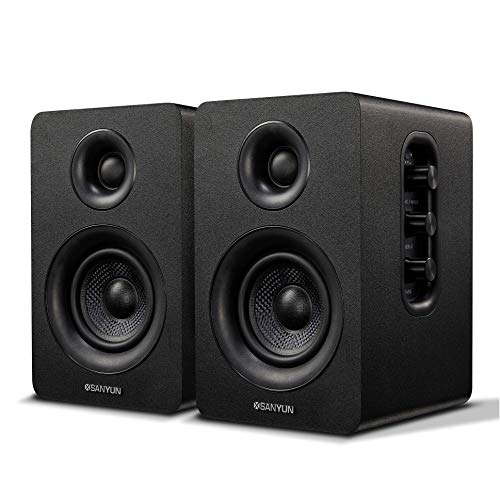
The Sanyun SW208 are compact active bookshelf speakers designed for HiFi audio on a budget, perfect for PC users, gamers, and home office setups. With 30W per channel from carbon fiber drivers, they punch above their weight in delivering detailed sound without distortion.
In real-world use, connect via Bluetooth 5.0 for wireless freedom or USB for DAC-enhanced purity, ideal for late-night gaming sessions or video calls where clear vocals shine. The side-mounted controls for volume, treble, and bass make on-the-fly tweaks simple, adapting to rock tracks or podcasts effortlessly.
Build quality feels solid with a direct/reflective system that creates wide stereo imaging on your desk. While not for massive rooms, they excel in small spaces, offering pro-level features at an entry price. Verdict: A top pick for anyone upgrading from basic PC audio.
Bass is deep and powerful for the compact size, thanks to multi-layer voice coil tech in the carbon fiber units, making action movie explosions and game soundtracks feel impactful on your desk.
Vocal clarity stands out with warm, thick mids and bright highs, ensuring dialogue cuts through in videos or calls. Volume reaches room-filling levels without muddiness, and the 3D surround adds immersion.
Bluetooth 5.0 provides stable connectivity up to 30 feet, while USB DAC input bypasses analog conversion for pristine digital sound straight from your computer.
Sleek black finish and small footprint make the SW208 easy to place on any desk or shelf, with a sturdy build that withstands daily handling. Side knobs for adjustments keep controls accessible without clutter.
No battery means plug-in power for unlimited playback, perfect for stationary desk use. Energy-saving design meets EU standards, drawing minimal power in quiet standby mode with built-in noise filtering.
At under 5 pounds per speaker, they are lightweight yet stable, focusing on desk-friendly portability rather than outdoor ruggedness.

Pros
- Powerful 16W output with just-right volume for desktop use
- Dedicated subwoofer delivers enhanced low-end punch
- Wooden construction ensures noise reduction and clear audio
- USB power makes it versatile beyond wall outlets
- Small footprint fits tight office or gaming setups
Cons
- Requires USB power source, limiting true wireless freedom
- No Bluetooth connectivity for cable-free streaming
- Bass-focused sound may lack emphasis on mids for vocals
The OROW S211 is a USB-powered 2.1 multimedia speaker system featuring a compact subwoofer and satellite speakers in a thick wooden enclosure. Designed for PC users, gamers on PS4, and TV watchers, it brings strong bass and clear sound to desks or entertainment setups without needing a dedicated AC outlet.
In real-world use, it excels at filling small rooms with balanced audio during late-night gaming sessions or movie marathons. The subwoofer spreads vibrations directly to the ground for deeper lows, while the wooden build keeps highs crisp and noise low. Setup is simple with 3.5mm inputs and USB power from any laptop or bank.
Best for budget-conscious Americans upgrading lackluster laptop speakers in home offices or dorms, it punches above its size. Verdict: A solid pick for everyday desktop audio that delivers value without complexity.
Bass performance stands out with the innovative subwoofer design that channels vibrations to the floor, creating deep, room-shaking lows ideal for action games or bass-heavy tracks. The 16W system provides ample power without distortion, ensuring steady output even at higher volumes.
Vocal clarity shines through clear treble from the stable wooden enclosure, reducing noise for dialogue in movies or calls. While wired via 3.5mm, connections are reliable for PC, PS4, or TV, with no dropouts in close-range desk use.
Overall, it offers a bass-forward signature great for immersive home setups, though mids take a backseat to lows.
The S211 boasts a rugged 9mm thick wooden box for each speaker, providing stability and a premium feel that minimizes vibrations and noise. The subwoofer is small enough to slide under desks or beds, and satellites save office space without dominating your setup.
USB-powered operation means no built-in battery, but it draws minimal power and liberates wall outlets, making it suitable for portable use with a laptop or power bank during camping or parties. No charging downtime; just plug in for instant play.
At under a pound total, it's lightweight for easy repositioning, focusing on desk-friendly durability over rugged outdoor portability.
Understanding DACs, Amplification, and Speaker Power Needs
A standalone digital-to-analog converter cannot directly drive passive speakers. In simple terms, a dedicated DAC functions solely as a signal translator, decoding digital binary bits into an analog audio waveform at standard line-level voltage. That analog signal carries microscopic current that works well for preamplifiers or powered speaker inputs, but completely lacks the wattage required to move physical speaker cones. To produce audible sound from passive drivers, an audio setup must include a dedicated power amplifier somewhere between the converter and the speaker terminals.
The Core Technical Difference Between Line-Level Signals and Speaker Power
Digital audio files stored on computers, phones, or gaming consoles exist purely as strings of binary numbers. A standalone DAC reads those numbers and reconstructs continuous electrical waves that mirror the original acoustic waveforms. However, this converted output is standard line level, which generally tops out around one to two volts with mere fractions of a milliamp. It represents the shape, frequency, and timing of the sound rather than the muscular energy needed for mechanical cone movement.
Speaker drivers require substantial mechanical force to push air molecules and create acoustic sound waves. Moving a woofer cone back and forth demands continuous wattage and high current flowing through a copper voice coil suspended inside a strong magnetic field. While a DAC line output provides only milliwatts of signal energy, passive desktop or bookshelf speakers typically need anywhere from ten to over one hundred watts to deliver realistic listening volumes. That vast gap between milliwatts and watts explains why conversion alone cannot create audible sound.
Attempting to bypass a power amplifier ignores the basic electrical physics of audio reproduction. A dedicated DAC has delicate output stages consisting of small operational amplifiers or discrete transistors configured for voltage stability rather than current delivery. Without an intervening amplifier stage to magnify that delicate signal into real driving wattage, passive speakers will remain completely silent or produce a faint, whisper-thin rattle.
How Active and Passive Speakers Interact with a DAC
Audio speakers fall broadly into two primary categories known as passive speakers and active speakers. Traditional passive speaker systems rely on bare speaker wire connecting directly to internal crossovers, woofers, and tweeters. Because passive cabinets possess no internal power supply or amplifier chips, they cannot do anything with the low-voltage output of a standalone DAC on their own.
Active or powered speakers, on the other hand, house their own custom amplifier modules directly inside the cabinet structure. Models such as the Sanyun SW208 3″ Active Bluetooth 5.0 Bookshelf speakers or the IBALL·BOX H1 Computer Speakers for Desktop PC integrate internal 60W stereo amplifiers. Because amplification is already present inside the cabinet, connecting an analog line-level signal from an external DAC into their RCA or 3.5mm auxiliary jacks works smoothly.
When pairing a DAC with powered speakers, the external converter handles the precision decoding while the internal amplifier powers the drivers. The user simply connects standard line-out cables from the DAC to the speaker line-in sockets. This setup provides clean volume levels, tonal accuracy, and balanced driver control without requiring a bulky external stereo amplifier on your desk.
All-in-One Integrated Amplifiers with Built-in DACs
The boundary between converters and amplifiers frequently blurs because manufacturers often bundle both technologies into a single metal chassis. A prime example is the Fosi Audio MC331 Tube Integrated Amplifier, which combines a digital-to-analog converter, a preamplifier with vacuum tubes and a vintage VU meter, and a stereo power amplifier. Devices in this category accept digital inputs directly while still powering traditional passive bookshelf speakers through rear binding posts.
In these integrated designs, the DAC chip handles digital decoding before passing the fresh analog stream directly to the internal power amplifier stage. The Fosi Audio MC331 delivers a maximum power output of 105W per channel into 4-ohm loads, providing ample juice to drive passive monitors with clarity. Casual listeners often assume the DAC is powering their speakers, but in reality, the dedicated power amplifier circuitry inside the box performs the heavy lifting.
Choosing an all-in-one integrated DAC and amplifier saves desk space and eliminates multiple interconnect cables. These versatile desktop units support USB, optical, coaxial, and RCA inputs, accommodating computers, televisions, and streaming players in one hub. If you plan to drive traditional passive speakers from digital sources, an integrated DAC amplifier represents the most direct, space-conscious solution available.
Powered Speakers with Onboard Digital Converters
Another increasingly popular approach integrates the digital converter directly inside active speaker enclosures. Modern desktop speakers like the Sanyun SW208 include a built-in 24-bit DAC accessible via direct USB connection. Plugging a USB cable from a computer into the master speaker bypasses noisy internal motherboard audio chips, allowing the speaker to receive a pure digital bitstream directly.
Similarly, the IBALL·BOX H1 Computer Speakers for Desktop PC provide a 24-bit USB-C DAC input alongside optical and 3.5mm analog connections. The internal circuitry receives digital packets, converts them to analog sound, and immediately sends that clean waveform to the dual 3-inch carbon-fiber woofers and silk-dome tweeters through its 60W powered amplifier. This integration eliminates the need for separate desktop boxes, bulky power bricks, or messy external patch cords.
Even compact multimedia speaker systems use dedicated internal routing to manage audio signals alongside incoming current. For example, the OR O R O W OROW S211 New USB-Powered 2.1 system draws operational power from a standard USB port while receiving audio through a 3.5mm analog connection. While this setup utilizes USB for electricity rather than digital decoding, it illustrates how varied desktop audio designs can be when separating signal paths from electrical power.
What Occurs If You Wire a Pure DAC to Passive Terminals
Connecting the line-out RCA or 3.5mm jack of a standalone DAC directly to the binding posts of a passive speaker creates severe electrical mismatches. DAC line outputs are engineered for high-impedance loads, typically expecting resistance between 10,000 ohms and 47,000 ohms. A passive speaker presents a nominal load of only 4 ohms or 8 ohms, which is essentially an electrical near-short to a sensitive line-level circuit.
Under such an extreme impedance mismatch, the tiny operational amplifier inside the DAC cannot supply the requested current. The output voltage immediately sags near zero, choking off almost the entire audio signal before it can reach the voice coils. If you lean in closely to the speaker tweeter, you might detect a faint, scratchy whisper, but normal acoustic listening volume is completely unattainable.
Furthermore, driving an ultra-low impedance load can cause delicate DAC output stages to run abnormally hot. While modern converters usually feature short-circuit protection, prolonged exposure to heavy loads can induce thermal throttling or premature component failure. Understanding this impedance barrier helps audio enthusiasts avoid damaging expensive converters while diagnosing why an unamplified speaker produces no usable sound.
Designing the Correct Audio Signal Chain for Your Setup
Building a reliable audio listening station requires mapping out every component in a logical sequence from source to driver. The primary rule is that every audio chain must contain a digital source, a digital-to-analog converter, a preamplifier for volume control, a power amplifier, and speaker drivers. Knowing where each stage lives in your chosen equipment determines the exact cables and interconnects you need to purchase.
If you own a standalone DAC and traditional passive speakers, you must insert an external stereo power amplifier or integrated amplifier between them. Running RCA cables from the DAC into the amplifier input, followed by standard speaker wire to the speaker terminals, achieves clean sound reproduction with full dynamic range. This modular approach allows listeners to upgrade individual components over time as their audio preferences evolve.
If you prefer a minimalist desk footprint, pairing a standalone DAC with active powered speakers streamlines the entire chain. In this configuration, the DAC connects directly to the powered monitors using analog RCA or 3.5mm interconnect cables. The active monitors handle all volume scaling and power amplification internally, saving desk space while preserving the high-resolution decoding benefits of your outboard converter.
For listeners who want zero external boxes, all-in-one powered speakers featuring internal USB-C or optical DACs provide the ultimate convenience. You simply run a single digital cable from your computer or television directly into the primary speaker cabinet. The speaker manages digital conversion, signal filtering, and amplification internally, giving you pristine audio clarity without the clutter of auxiliary converters.
Diagnostic Checks for Weak, Distorted, or Missing Sound
When an audio setup produces weak output or distorted sound, the issue usually stems from incorrect routing or mismatched signal settings rather than hardware failure. First, check your source device sound settings to confirm that the DAC is selected as the primary output device. Computers often reset their default sound card after system updates, inadvertently routing audio to built-in monitor speakers or muted auxiliary ports.
Next, inspect the format of the incoming digital audio stream to ensure compatibility with your converter. Most stereo DACs require a standard two-channel PCM signal and cannot decode multichannel Dolby Digital or DTS bitstreams from televisions or gaming consoles. Setting your television optical output to PCM format eliminates stuttering clicks, digital hissing, or complete silence across connected stereo gear.
Finally, verify the gain and volume stages across every connected device in your playback chain. If your DAC features a variable output mode, ensure its internal volume is set appropriately rather than turned down to zero. Check that active speakers or integrated amplifiers are switched to the correct input channel, and confirm that all analog RCA plugs and USB connectors are seated firmly in their respective sockets.
Equipment Selection and Practical Takeaways
Evaluating your personal audio priorities helps clarify whether you need a standalone converter, an integrated amplifier, or self-powered monitors. If your goal is upgrading a desktop workspace with minimal fuss, active speakers featuring built-in 24-bit USB DACs provide balanced sound without complex wiring. Systems with carbon-fiber drivers and silk-dome tweeters offer vibrant highs and articulate midrange vocals straight out of the box.
If you already own high-end passive bookshelf speakers, investing in an integrated amplifier with a built-in DAC delivers both decoding prowess and robust speaker power. Look for versatile units that offer physical tone knobs, remote control convenience, and flexible inputs like optical, USB, and Bluetooth. Having substantial wattage per channel ensures your passive drivers have enough headroom to reproduce deep bass notes and dynamic musical passages without clipping.
In summary, a standalone DAC cannot power speakers on its own, but it remains a vital link for extracting pristine fidelity from digital music libraries. By pairing your converter with either active powered speakers or a dedicated stereo power amplifier, you establish an optimized signal path. Taking time to match your components properly ensures effortless operation, dependable hardware protection, and immersive audio performance for everyday listening.





Write Your Review
No reviews yet. Be the first to share your experience!