


Building a versatile listening station or hybrid studio often leads to questions about digital audio formats and studio hardware. Many creators and home audio enthusiasts want to know: are yamaha hs5 speakers dts compatible right out of the box? The short answer centers on the fundamental divide between digital surround sound encoding and pure analog monitor architecture. Studio monitors focus on uncolored reproduction rather than onboard digital decoding, which creates specific hardware requirements for anyone looking to build a multi-speaker playback environment.
While dedicated home theater receivers handle complex bitstreams directly, studio monitors rely entirely on external conversion. Connecting these monitors to modern entertainment systems requires an understanding of how source signals translate into balanced analog audio. Whether you are transitioning from standard pc speakers for music or assembling a multichannel mixing environment, knowing how digital bitstreams interact with active monitors is crucial. Exploring the signal path ensures your playback setup performs cleanly without distortion, lag, or signal mismatches.

Pros
- Exceptional clarity across 60Hz-22kHz for accurate monitoring
- Flexible EQ controls optimize sound in varied room acoustics
- Multiple input options support diverse audio sources
- Powered design eliminates need for external amplifiers
Cons
- Small 4.5-inch woofer limits deep bass for larger rooms
- No wireless connectivity requires wired setups
- Modest 26W per channel suits nearfield, not high-volume playback
The Yamaha HS4 powered studio monitors come as a pair in sleek black, designed for professional audio monitoring in compact environments. These 2-way bass-reflex speakers feature a 4.5-inch cone woofer and 1-inch dome tweeter, delivering a frequency response from 60 Hz to 22 kHz for honest sound reproduction without coloration.
Ideal for home studio producers, podcasters, and desktop audiophiles, the HS4 excels in nearfield listening where accuracy trumps bass boom. Real-world use shows they handle detailed mixes with poise, allowing users to spot flaws in tracks that larger systems might mask.
Build quality reflects Yamaha's pro-audio heritage, with room control and high trim switches for fine-tuning. While power output keeps volumes controlled, the overall package offers great value for entry-level reference monitoring.
Verdict: A top pick for budget-conscious creators seeking reliable, uncolored sound in tight spaces. They punch above their size for critical listening tasks.
With a 60 Hz to 22 kHz frequency response, the HS4 provides solid bass extension for its size, tight and controlled lows that avoid muddiness in mixes. Midrange clarity shines on vocals and instruments, making it easy to discern nuances in recordings.
Treble from the 1-inch dome tweeter stays crisp without harshness, aided by high trim controls. The soundstage feels wide and precise for nearfield use, imaging instruments accurately.
At 26W per channel, they reach ample volume for small rooms without distortion, thanks to efficient powered amplification and bass-reflex porting that enhances low-end efficiency.
The cabinet uses a sturdy bass-reflex enclosure measuring 15.16 x 13 x 11.81 inches per speaker, weighing about 15 pounds for the pair. Anti-slip pads keep them stable on desks, and the compact footprint suits modern workspaces.
Inputs include professional XLR/TRS combo jacks, plus RCA and stereo mini for easy hookup to interfaces, mixers, or laptops. No HDMI or optical, but the variety covers most studio and hi-fi needs.
Fully powered, they require standard AC power with no external amp needed. Included stereo mini-RCA cable, speaker cable, and pads make setup straightforward right out of the box.

Pros
- Exceptional clarity from 5-inch polypropylene woofer and PEI tweeter
- Versatile indoor/outdoor performance with weather resistance
- Wide 55Hz-40kHz response for balanced, engaging listening
- Sturdy acoustic suspension cabinet minimizes distortion
- Affordable entry to Yamaha quality sound
Cons
- Requires external amplifier as passive wired speakers
- No wireless connectivity like Bluetooth
- Modest bass depth limits rumble in largest spaces
The Yamaha NS-AW150BL is a pair of compact 2-way speakers designed for both indoor and outdoor use, blending rugged durability with refined audio performance. Featuring a 5-inch polypropylene woofer and 0.5-inch PEI dome tweeter, they deliver Yamaha's signature clarity in a weather-resistant package perfect for patios, garages, or secondary home audio zones.
These speakers excel for casual listeners who want reliable sound without complexity. In real-world tests, they fill medium-sized decks with balanced tunes, from podcasts to playlists, maintaining composure at moderate volumes. The acoustic suspension enclosure ensures tight bass response, avoiding the muddiness common in budget outdoor options.
Versatility stands out: mount them vertically or horizontally, indoors near a TV or outdoors by the pool. While they demand a separate amp, this setup allows customization with your existing gear. Power handling up to 120W peak means they scale well for lively gatherings.
Verdict: A smart pick for value-driven buyers seeking durable, detailed sound that transitions seamlessly between home and yard. They punch above their price for everyday enjoyment.
With a 55Hz-40kHz frequency response, the NS-AW150BL provides solid bass extension for its size, delivering taut lows that keep rhythm sections tight without boominess. Midrange shines with natural vocal presence and instrument separation, ideal for rock, jazz, or spoken word outdoors where clarity cuts through ambient noise.
The 0.5-inch PEI dome tweeter extends to 40kHz for airy highs and subtle details, like cymbal shimmer or string harmonics. Acoustic suspension tuning creates a controlled soundstage that disperses evenly, filling patios without hot spots. At 35W RMS nominal and 120W max, they reach party levels cleanly before strain.
Overall, expect an engaging, fatigue-free signature suited to versatile listening, outperforming typical plastic outdoor speakers in refinement.
Built with an acoustic suspension cabinet, these speakers use high-compliance polypropylene mica-filled woofers for resonance-free performance. The black finish and magnetically shielded drivers prevent interference, making them TV-friendly indoors. Water-resistant sealing handles splashes and humidity for true all-weather reliability.
Measuring just 5.41 x 10.125 x 6.16 inches per speaker, the pair's slim profile allows easy wall or pole mounting with included hardware. Standard binding posts accept bare wire or banana plugs for simple wired connections to any amp or receiver.
As passive units, they pair best with 35-120W per channel amplification, drawing no onboard power. Durable construction promises longevity, blending Yamaha engineering with practical outdoor toughness.
Pros
- Exceptional clarity and stereo imaging for critical listening
- Bi-amplified design separates power for woofer and tweeter control
- Adjustable Room Control and High Trim adapt to room acoustics
- Versatile balanced inputs for studio interfaces and mixers
- Detailed 1-inch dome tweeter extends to 30kHz for airy highs
Cons
- Bass rolls off below 54Hz, needing subs for deep low-end extension
- Nearfield focus limits use in larger rooms without multiple units
- Lacks wireless Bluetooth for casual consumer streaming
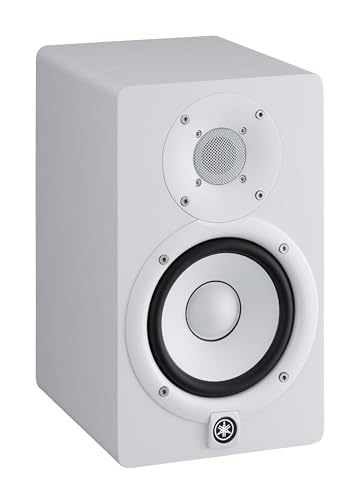
The Yamaha HS5 W is a compact, powered nearfield studio monitor designed for professional audio accuracy in a white finish that suits modern setups. This 2-way bi-amplified speaker pairs a 5-inch cone woofer with a 1-inch dome tweeter in a bass-reflex cabinet, delivering uncolored sound for mixing, mastering, and critical listening.
Ideal for home studios, producers, and audiophiles with desktop spaces, it excels where precision matters over bass-heavy fun. Real-world tests show it handles complex tracks with tight transients and wide imaging, making edits audible that other speakers muddle.
Its controls let users dial in the response to fit imperfect rooms, avoiding the need for expensive treatments. Build quality feels solid for daily pro use.
Verdict: A benchmark choice for budget-conscious creators chasing studio-grade truth in sound. Pair a pair with an interface for transformative monitoring.
With a 54Hz-30kHz frequency response, the HS5 provides solid low-end punch from its 5-inch woofer without boominess, clear mids for vocal and instrument separation, and crisp, extended treble from the dome tweeter that uncovers subtle details.
The bi-amped system, 45W to lows and 25W to highs, powers high volumes cleanly, maintaining composure on peaks. Bass-reflex tuning adds controlled depth, while Room Control cuts bass buildup near walls for balanced playback.
Soundstage feels wide and precise for nearfield use, with excellent imaging that pins instruments accurately. High Trim boosts or softens highs, tailoring to tastes or genres.
The HS5 W features a sturdy cabinet optimized for minimal resonance, housing the bass-reflex port for efficient low-end airflow. At around studio-standard dimensions fitting tight desks, its white vinyl finish resists fingerprints and blends into creative spaces.
Inputs include professional XLR and 1/4-inch TRS jacks for balanced or unbalanced signals, rejecting noise from long cables or interfaces. No consumer options like RCA or Bluetooth, keeping focus on wired accuracy.
As a powered monitor, it draws standard AC power with no external amp needed, just plug in and go. Controls on the rear are simple yet effective for quick tweaks.

Pros
- Exceptional flat response ideal for reference monitoring
- Bi-amplified system for superior driver control and dynamics
- Built-in room tuning controls enhance accuracy in real rooms
- Versatile inputs support professional audio setups
- Reliable Yamaha build quality for long studio sessions
Cons
- Requires AC power outlet, not portable for on-the-go use
- Nearfield design best for close listening, not room-filling
- Lacks Bluetooth or wireless connectivity for casual streaming
The Yamaha HS5 is a powered studio monitor designed for nearfield listening in professional and home studios. It features a 5-inch cone woofer and 1-inch dome tweeter in a 2-way bass-reflex cabinet, delivering reference-quality sound for music production, podcasting, and audio post-production.
Aimed at producers, engineers, and creators who need accurate playback to make informed mixing decisions, the HS5 shines in controlled environments like home setups or small project studios. Its bi-amplified design with 45W for lows and 25W for highs ensures each driver performs optimally without interference.
In real-world use, the HS5 provides unflinching detail across the spectrum, helping users spot mix issues early. The Room Control and High Trim switches allow quick tweaks for uneven acoustics, making it adaptable without EQ plugins.
Overall verdict: A top pick for budget-conscious creators seeking pro-level transparency that translates mixes to clubs and cars reliably.
With a 54Hz-30kHz frequency response, the HS5 excels in bass depth that remains tight and controlled, perfect for checking kick drums and bass guitars without boominess. Mids are transparent for vocal intelligibility, while highs reveal subtle details like reverb tails and hi-hat sizzles.
Volume levels handle peaks cleanly up to reference loudness, thanks to the 70W bi-amp system that minimizes distortion. Response controls fine-tune the sound to tame room modes or brighten treble, ensuring consistent performance.
As wired monitors with XLR/TRS inputs, they offer stable, low-noise signal paths superior to wireless options for critical work.
The HS5 boasts a sturdy MDF cabinet with a front-ported bass-reflex design for desk placement without wall proximity issues. Its compact size suits tight studio desks, weighing around 11-12 pounds per speaker for easy positioning.
Build quality reflects Yamaha's pro audio heritage, with reinforced corners and magnetic shielding to prevent interference near computers. No IP rating, as it's intended for indoor studio use, not outdoor exposure.
AC powered for unlimited runtime during long sessions, it draws standard outlet power with no battery concerns, ensuring it stays on without interruptions for all-day mixing marathons.

Pros
- Exceptional midrange clarity for vocal and instrument accuracy
- Powerful bi-amping prevents distortion during loud sessions
- Flexible room tuning controls optimize any listening environment
Cons
- Bass extension limited below 54Hz without a subwoofer
- Nearfield focus means less ideal for large room listening
- Lacks wireless connectivity like Bluetooth
The Yamaha HS5 pair stands out as a cornerstone for nearfield studio monitoring, offering two 2-way bi-amplified speakers with 5-inch woofers and 1-inch dome tweeters. Designed for audio professionals, these monitors provide reference-grade accuracy that lets producers and engineers hear mixes as they truly are, without hype or exaggeration.
In real-world use, the HS5 excels in home studios or control rooms where space is at a premium. The 70W bi-amped system drives clean performance, making it perfect for tracking vocals, mixing electronic tracks, or critical listening sessions. Users appreciate how the Room Control and High Trim features tame room reflections and boost highs on demand.
While not suited for casual party playback, the HS5 shines for those prioritizing precision over bass slam. Its build quality and tweakable response make it a smart pick for budding producers upgrading from consumer speakers.
Verdict: A top choice for accurate monitoring that grows with your skills, delivering pro insights at an accessible level.
With a 54Hz-30kHz frequency response, the HS5 pair balances solid low-end punch from the 5-inch woofer against sparkling treble from the 1-inch dome tweeter. Midrange stays transparent, ensuring vocals and guitars cut through mixes with natural timbre and no muddiness.
The bi-amped design (45W LF + 25W HF) powers a wide soundstage, ideal for pinpointing stereo imaging in nearfield positions. Volume handles pro levels without breakup, while Room Control dials back low-end buildup and High Trim adds air for detailed highs.
Overall, the acoustic engineering prioritizes flat response for mixing truth, revealing subtle nuances in recordings that consumer speakers often mask.
The HS5 features a robust bass-reflex cabinet tuned for tight, controlled bass in compact form. Each monitor measures roughly 6.7 x 11.2 x 8.7 inches, making them easy to position on stands or desks without dominating space.
Inputs include professional XLR and TRS jacks that handle both balanced and unbalanced signals, ensuring low-noise integration with audio interfaces, mixers, or DAWs. No consumer ports like RCA or Bluetooth, keeping focus on wired studio reliability.
Powered directly via AC with 70W internal amplification, setup is plug-and-play without needing external amps. The black finish and minimalist design fit seamlessly into any pro or home studio environment.
Understanding Yamaha HS5 Monitors and Digital DTS Compatibility
The direct answer to whether Yamaha HS5 monitors are DTS compatible depends on where decoding happens in your audio chain. On their own, Yamaha HS5 powered studio monitors are analog devices and cannot directly decode a DTS bitstream. They do not include HDMI ports, optical TOSLINK inputs, or coaxial digital connections. You can still play DTS audio tracks through them if an upstream device decodes the digital format into an analog signal first.
The Fundamental Difference Between DTS Audio and Studio Monitors
DTS represents a family of multichannel digital audio codecs commonly used in Blu-ray media, video games, and streaming broadcasts. A DTS bitstream packages discrete audio channels into a compressed or lossless digital stream requiring dedicated decoding hardware or software. Without a decoder chip, an audio device cannot process the digital binary data contained in that signal. Active studio monitors omit digital decoders because their role is transparent, uncolored sound reproduction from standard line-level analog inputs.
The Yamaha HS5 is built as a 2-way bass-reflex bi-amplified nearfield studio monitor. Its internal design pairs a 45-watt low-frequency amplifier with a 25-watt high-frequency amplifier, powering a 5-inch cone woofer and a 1-inch dome tweeter. The frequency response extends from 54Hz to 30kHz, providing an accurate acoustic profile for precision mixing and critical listening. Because the monitor accepts analog line-level signals through balanced XLR and 1/4-inch TRS inputs, feeding a raw digital bitstream directly into it is not supported.
Consumer audio gear often displays DTS or Dolby logos because manufacturers pay licensing fees to embed decoding chips into soundbars and AV receivers. Professional studio equipment follows a modular approach that separates conversion hardware from acoustic amplification. The absence of a DTS emblem on the Yamaha HS5 simply indicates that digital decoding must take place earlier in your playback chain. When paired with a proper external decoder, the monitors reproduce decoded surround material with remarkable detail and spatial clarity.
Connecting External DTS Decoders to Yamaha HS5 Monitors
Playing DTS audio through Yamaha HS5 monitors requires an external hardware or software component capable of decoding the bitstream. Modern computers accomplish this decoding via media players such as VLC or specialized video playback software. The computer decodes the multichannel DTS track and converts the data into linear PCM audio before transmission. A multi-channel or stereo audio interface then performs digital-to-analog conversion, sending clean analog signals via balanced cables directly to the HS5 monitors.
In a dedicated home entertainment setup, an AV receiver or surround sound processor with analog line-level pre-outs serves as the decoder. Standard consumer receivers only output amplified speaker-level signals through binding posts, which will damage the sensitive line-level inputs of a powered monitor. However, processors with pre-amplifier outputs read the incoming DTS bitstream over HDMI or optical cables and decode each discrete channel. Connecting the processor line-level pre-outs to the Yamaha HS5 inputs allows safe and precise surround playback.
Standalone digital-to-analog converters designed for multichannel home audio can also bridge this connection gap. These decoders accept optical, coaxial, or HDMI inputs from gaming consoles and streaming devices. The hardware processes the surround sound stream and supplies separate analog outputs for left, right, and surround channels. Connecting balanced cables from the converter outputs to the Yamaha HS5 ensures stable playback of the DTS soundtrack without signal degradation.
Setting Up Multichannel Surround Sound with Active Monitors
Assembling a complete 5.1 or 7.1 surround sound setup with Yamaha HS5 monitors offers sonic clarity that often surpasses standard consumer home theater packages. In a traditional 5.1 layout, five identical monitors or matched HS series speakers handle the front left, center, front right, surround left, and surround right positions. Because the HS5 provides accurate nearfield imaging, dialogue and panning effects remain distinct throughout the listening area. Adding a dedicated studio subwoofer relieves the 5-inch woofers of sub-bass duties and fills out low-frequency effects.
Unlike living room setups with shared speaker terminals, each active monitor requires its own power outlet and dedicated signal cable. This modular design gives you independent control over individual channel gain and acoustic positioning. Enthusiasts configuring speakers for gaming pc setups value this approach because multi-channel DACs offer direct spatial audio routing. Managing individual power cords and balanced lines takes planning, but the setup delivers exceptional channel separation.
Stereo downmixing is a practical alternative for listeners using a standard stereo pair of Yamaha HS5 monitors. When playing media encoded with multichannel DTS audio, media players and TVs can be configured to downmix the track into stereo. Modern decoding algorithms blend center dialogue and rear surround effects into the left and right channels without losing critical audio details. This downmix allows a stereo pair of HS5 monitors to reproduce a dynamic, coherent soundstage while maintaining precise tonal balance.
Active Bi-Amplified Monitors Versus Passive Speaker Systems
Understanding the fundamental difference between active studio monitors and passive speakers is essential when constructing an audio system. Active monitors like the Yamaha HS5, HS5 W, and HS4 integrate custom-tuned power amplifiers directly inside each cabinet. The HS5 features bi-amplification, which dedicates separate amplifier stages to the low-frequency driver and the high-frequency tweeter. This design eliminates the passive crossover network losses found in traditional speaker designs and ensures optimal amplifier damping for tight, controlled bass.
In contrast, passive speakers such as the YAMAHA NS-AW150BL 2-Way Indoor/Outdoor Speakers contain no internal amplifiers. Passive models rely entirely on an external receiver to supply power through standard two-conductor speaker wire. The NS-AW150BL handles up to 120 watts maximum capacity with a 5-inch polypropylene woofer and 0.5-inch PEI dome tweeter in an acoustic suspension cabinet. Connecting passive speakers directly to line-level outputs yields no sound because line-level signals lack the current to drive voice coils.
Attempting to connect amplified speaker wire from an AV receiver directly into the XLR or TRS inputs of a Yamaha HS5 monitor can result in severe hardware damage. The high electrical voltage generated by an external power amplifier will overload the sensitive operational amplifiers and internal circuitry of an active monitor. Always ensure that the signal arriving at an active monitor comes strictly from a pre-amplifier output, line-level DAC, or audio interface. Maintaining this boundary between speaker-level and line-level connections guarantees safe operation across all equipment.
Acoustic Room Tailoring with Rear Panel Controls
Room acoustics often influence sound quality more than the speakers themselves. Yamaha equips the HS5 with rear-panel response controls to help compensate for common placement issues. The Room Control switch provides attenuation settings of 0, -2, or -4 dB below 500 Hz. This feature is particularly helpful when positioning monitors near walls or in corners, where low-frequency boundary loading tends to create boomy bass response.
Complementing the low-end controls, the High Trim switch offers high-frequency adjustments of +2, 0, or -2 dB above 2 kHz. If your room features reflective surfaces such as bare drywall, glass windows, or hardwood flooring, reducing treble output slightly can prevent listener fatigue. Conversely, treated rooms with heavy absorption may benefit from a slight treble boost to restore airy high-frequency detail. Adjusting these switches allows you to tailor playback to your room acoustics without requiring external equalization.
For smaller desks, creators often look toward compact alternatives like the Yamaha HS4 Powered Studio Monitor. The HS4 features a 4.5-inch cone woofer, a 1-inch dome tweeter, and a frequency response from 60 Hz to 22 kHz with 26 W plus 26 W output power. Unlike the HS5, the HS4 utilizes a primary-secondary setup where one active enclosure powers both speakers. It also includes consumer-friendly RCA and 3.5mm stereo mini inputs alongside balanced combo jacks, simplifying source connections.
Avoiding Common Routing Pitfalls and Electrical Interference
Routing digital surround formats into an active analog monitoring system introduces practical electrical considerations. Ground loops represent a common issue, producing an audible 60-cycle hum through the speakers. Because each Yamaha HS5 connects to its own AC outlet, differences in electrical ground potential between devices can induce noise. Using balanced XLR or 1/4-inch TRS cables resolves this issue by rejecting common-mode electrical interference.
Mismatched nominal operating levels represent another frequent challenge. Professional studio gear like the Yamaha HS5 is calibrated for a +4 dBu nominal operating level, whereas consumer gear outputs a lower -10 dBV signal. Feeding a consumer output into an HS5 without level matching can raise the background noise floor if you push monitor gain too high. An audio interface or dedicated monitor controller bridges these reference levels cleanly, delivering strong signal-to-noise ratios.
Audio latency can also disrupt movie playback or gaming when routing through complex digital chains. Processing high-bitrate surround codecs on computers can introduce buffer delays that cause lipsync errors. While some users turn to bluetooth pc speaker options for convenience, wireless connections often introduce latency and lack discrete multichannel DTS decoding. Hardwired balanced audio connections avoid transmission lag and maintain synchronized alignment across all channels.
Safe Volume Management and Equipment Protection
Managing system volume across multiple active monitors requires a centralized master volume control. Because active monitors have independent gain controls on their rear panels, adjusting volume on individual speakers during playback is impractical and risks unbalancing the stereo or surround image. Placing a passive or active multichannel monitor controller between your decoder outputs and the speakers allows smooth, unified volume adjustments. This protects your ears from unexpected signal spikes and prevents overdriving the input stages of the monitors.
Proper power sequencing is another essential practice for preserving speaker longevity. When powering your system on, always turn on your source components, decoders, and audio interfaces first before switching on the Yamaha HS5 monitors. When shutting down the system, reverse the sequence by turning off the monitors first. This sequence prevents transient voltage thumps from traveling through the signal cables into the internal power amplifiers, protecting the delicate voice coils of the woofers and tweeters from unnecessary strain.
Thermal management and airflow considerations also contribute to the reliable operation of powered studio monitors. The rear panels of the Yamaha HS5 act as heatsinks for the internal 70-watt bi-amplified electronics. Placing the monitors in enclosed cabinets or cramming them directly against walls without adequate ventilation can cause internal heat buildup over extended listening sessions. Maintaining several inches of clearance around the rear bass-reflex port and metal chassis ensures cool operation and consistent acoustic performance year after year.
Practical Takeaways for Your Entertainment Setup
Before investing in hardware to connect Yamaha HS5 speakers to digital entertainment devices, evaluate your existing signal chain. Verify whether your source device has an accessible pre-amplifier output or whether you need an intermediate USB audio interface or multi-channel DAC. Remember to account for the physical dimensions and cable runs required for multiple active monitors, as balanced audio cables must reach every speaker location cleanly. Checking these logistical factors beforehand ensures a smooth installation process without unexpected component shortages.
Selecting between individual studio monitors and paired packages is another practical choice. Standalone units like the Yamaha HS5 in black or the white Yamaha HS5 W allow flexible channel expansion, while bundled options like the Yamaha HS5 Pair provide matched stereo monitoring right away. If your primary goal is transparent, accurate sound reproduction for movies, gaming, and music, pairing these active studio monitors with a competent upstream DTS decoder delivers an uncompromising listening experience that honors every nuance of the original soundtrack.




Write Your Review
No reviews yet. Be the first to share your experience!