


Replacing a damaged high-frequency driver or assembling a custom enclosure often leads builders to question how raw speaker parts are distributed. When shopping for replacement components, audio hobbyists frequently wonder if are tweeter and horn speakers sold individually or if manufacturers strictly bundle them into matched sets. While complete commercial speaker cabinets generally arrive in pairs, individual high-frequency drivers follow varying packaging conventions depending on whether they serve mobile audio, public address systems, or custom home listening projects. Clarifying driver packaging helps ensure you order the right quantity without paying for unneeded spare parts.
Finding the right driver package depends heavily on whether you need a single replacement for a blown unit or a matched set for stereo sound. Exploring different passive speaker configurations shows how dedicated high-frequency drivers must integrate seamlessly with woofers and crossover networks. Sourcing individual components requires careful attention to product listings, because buying an unintended multi-pack adds unnecessary expense, while accidentally ordering a single driver can delay a complete two-channel installation. Understanding how retailers catalog these specialized drivers simplifies your audio repair or upgrade project.

Pros
- Extremely loud and efficient, effortlessly cutting through deep subwoofer bass.
- Durable die-cast aluminum construction with an attractive polished finish.
- Impressive high-end extension reaching all the way to 25kHz.
- Exceptional price-to-performance value for custom pro-audio car doors.
Cons
- Can sound harsh or overly bright without an equalizer and proper high-pass tuning.
- Requires dedicated crossover protection or bass-blocking capacitors before operation.
- Relatively deep magnet structure demands adequate clearance behind the mounting panel.
The Pyle PDBT18 3.75-Inch Titanium Horn Tweeter pair is built specifically for car audio enthusiasts and DIY pro sound builders who need aggressive high-frequency reinforcement. When you run multi-subwoofer configurations pushing serious low-end pressure, standard factory tweeters quickly disappear beneath the rumble. The PDBT18 steps in with a bullet horn design tuned to blast crisp, forward treble directly to your ears, ensuring your soundstage stays balanced even at extreme volume levels.
In real-world applications, these super tweeters thrive in custom door pods, A-pillars, or rear deck installations. Because they are true pro audio bullet horns, integrating them requires pairing with appropriate high-pass filters or crossover capacitors to prevent lower frequencies from damaging the voice coil. Once crossed properly, they deliver an immediate injection of energy into any system, cleanly resolving the attack of snare drums, synthesizer leads, and hi-hats.
For audio enthusiasts seeking a smooth, laid-back studio monitor vibe, these horn tweeters may feel intense. However, when tuned with a quality head-unit equalizer to tame upper-mid brightness, the Pyle PDBT18 offers remarkable output for its footprint. It is an unapologetic, high-SPL performer that produces the clarity and projection necessary to keep up with demanding aftermarket setups.
Performance on the Pyle PDBT18 centers on high efficiency and directivity. Thanks to its horn-loaded titanium diaphragm and bullet phase plug, high frequencies are focused forward with remarkable speed. The rated 2kHz to 25kHz frequency response allows these tweeters to cover upper vocal ranges while extending well into the micro-detail spectrum of modern recordings, preventing your audio from ever sounding muffled.
With a 300-watt peak rating and a hefty 20 oz magnet, the motor structure offers outstanding dynamic range. Transients hit with authority, meaning rapid electronic transitions and acoustic guitar plucks maintain distinct separation rather than blurring together. While they lean toward a bright sound profile out of the box, they respond predictably to DSP adjustments and crossover tailoring to create an energetic, stadium-like atmosphere inside your vehicle.
The build quality of the PDBT18 emphasizes durability and thermal reliability. Encased in a rigid die-cast aluminum frame with a diamond chrome cutting finish, these tweeters reject unwanted physical resonance while adding a custom mechanical aesthetic to your interior. The internal 1-inch Kapton voice coil is engineered to resist heat buildup under sustained loads, prolonging component life during extended road trips or parking-lot demos.
Each tweeter features a 4-ohm nominal impedance, making them easy to wire in parallel or series configurations depending on your amplifier capabilities. Given their 3.75-inch outer diameter and substantial magnet depth, installers should plan for sufficient cutout space and rigid baffle support. Driven by a dedicated clean amplifier channel with active high-pass crossover points around 3.5kHz to 5kHz, this pair delivers reliable, high-output fidelity.
Pros
- Superior transient response for dynamic treble
- Minimal distortion even at peak volumes
- Easy mounting with 2.75-inch depth and versatile holes
- Precise 4kHz-20kHz response enhances clarity
- Affordable pack for full system improvements
Cons
- High-frequency focus only, pairs best with woofers
- Piezo material can sound bright without EQ tuning
- Requires separate amplifier for power
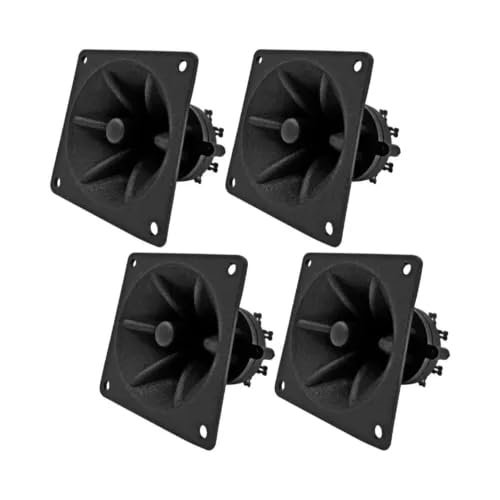
The UCCKEYI 4-pack of 3.25-inch square flush mount super horn tweeters brings pro-level treble to car and home audio systems. Designed as piezo horns, they specialize in high frequencies from 4kHz to 20kHz, making them perfect for DIY upgraders who want to sharpen vocals, cymbals, and effects without the muddiness of stock speakers.
Targeted at American car audio fans and home theater builders, these black square tweeters install easily in dashboards, doors, or shelves. Their low distortion and excellent transient response shine in real-world use, like blasting rock on highway drives or elevating movie soundtracks during family nights.
Performance stands out with clean highs that handle demanding tracks, though they pair best with mids and lows for full-range sound. Mounting is straightforward with 2.75-inch depth and screw holes spaced for standard cuts.
Verdict: A smart, budget-friendly choice for treble-focused upgrades that transform everyday listening into high-fidelity experiences.
These tweeters deliver razor-sharp highs in the 4kHz-20kHz range, with excellent transient response ensuring quick attacks on snares and hi-hats. Low distortion maintains clarity at high volumes, ideal for rock concerts or EDM in your car.
Vocal clarity pops during podcasts or vocals-heavy tracks, cutting through bass-heavy mixes without harshness. While no bass depth here, they excel where stock tweeters fail, providing detail that elevates overall system balance.
Power them via 4-8 ohm amps for stable performance across genres, from country roads to home parties.
Sleek black square design measures 3.25 x 3.25 inches overall, with a shallow 2.75-inch mounting depth that slips into tight car panels or home enclosures. Cutout needs a 2.85 to 3-inch round hole, and screw holes at 4-inch diagonal or 2.75-inch spacing ensure secure flush installs.
As passive speakers, no battery or charging required; they draw power directly from your amplifier for endless playtime on road trips or movie marathons. Rugged piezo construction handles vibration from daily drives.
Lightweight build keeps upgrades simple without adding bulk to doors or shelves.
Packaging Practices and Purchasing Considerations for High-Frequency Drivers
The short answer to whether high-frequency components are sold as solo units is yes, though availability depends heavily on the intended application and product category. In the raw speaker market, components are distributed as individual units, factory pairs, and multi-packs of four or more. Professional sound reinforcement gear and studio replacement drivers are almost universally sold as single units. Conversely, aftermarket car audio super tweeters and entry-level piezo horns often ship in pairs or quad packs to accommodate standard vehicle layouts.
Package Configurations Across Different Audio Sectors
Commercial audio markets divide high-frequency drivers according to user repair habits. In pro sound reinforcement, technicians frequently replace an isolated blown horn in a public address cabinet or stage monitor. Sound engineers rarely blow both drivers simultaneously, so compression drivers, horns, and replacement diaphragms are stocked and sold individually. This distribution model allows venue operators to complete cost-effective repairs without accumulating surplus hardware.
Car audio manufacturers take the opposite approach because vehicle cabins rely on balanced stereo pairs across opposing doors. Bullet tweeters and super horn drivers aimed at automotive enthusiasts frequently ship in matched pairs, as seen with models like the Pyle 3.75-inch titanium horn tweeter set. Packaging these heavy-duty bullet tweeters as pairs guarantees that both listening positions receive matching acoustic output and identical impedance loads. When shopping for vehicle audio, finding a single bullet tweeter from a mainstream brand can prove difficult because packaging targets two-channel installations.
Specialized component suppliers and budget piezo manufacturers often bundle drivers in sets of four or eight. The UCCKEYI 4-pack of square flush mount piezo horns illustrates how lightweight, high-efficiency horns are distributed for multi-driver arrays. These multi-packs cater to DIY builders who assemble sound columns or need distributed high-frequency sound across a workshop. In contrast, audiophile replacement tweeters for home stereo towers are sold through component distributors offering both single units and factory-matched pairs.
Why Single-Driver Availability Matters for Repairs and Custom Builds
Purchasing a single driver is the most practical route when restoring a loudspeaker with an isolated voice coil failure. High frequencies carry intense energy during clipping events, which often burns one voice coil while adjacent drivers stay completely functional. Purchasing an expensive pair to replace one damaged component feels like an unnecessary expense for hobbyists on a budget. Sourcing a solitary driver keeps repair costs manageable while restoring the cabinet to its original operational state.
Custom loudspeaker builders also seek individual high-frequency drivers when designing odd-numbered speaker arrangements. Home theater installations require single center-channel speakers that utilize distinct driver orientations and high-frequency dispersion patterns. Similarly, mono sound systems used in commercial paging systems and instrument monitor wedges demand only one horn driver. In these configurations, buying a paired package leaves an orphaned component that serves no immediate practical purpose.
Enthusiasts seeking high quality audio reproduction often examine individual driver specifications to tune specific frequency ranges. When an existing speaker cabinet lacks top-end sparkle, swapping in a single replacement horn can provide immediate acoustic feedback. Evaluating one component before committing to an entire speaker overhaul allows builders to verify sound characteristics without investing in multiple drivers prematurely. This experimental flexibility makes solo driver availability a vital resource for serious audio hobbyists.
When Buying Pairs or Multi-Packs Is the Better Strategy
While buying a single horn or tweeter offers cost savings for simple repairs, purchasing pairs is frequently the superior technical choice for stereo systems. Loudspeaker components age over time as voice coils experience heat cycles and suspension materials gradually soften. If you install a brand-new high-frequency driver on the left channel while leaving an aged driver on the right, you may notice subtle differences in sensitivity and tonal warmth. Replacing both high-frequency drivers simultaneously ensures consistent acoustic imaging across the entire stereo soundstage.
Manufacturing tolerances can also introduce minute variations between different production batches of speaker components. Drivers manufactured years apart might feature minor design alterations or revised diaphragm coatings that shift frequency response slightly. Buying a factory-matched pair ensures that both drivers share the same manufacturing batch, identical voice coil resistance, and uniform acoustic output. This balance is critical in listening environments where precise spatial positioning and clear stereo balance define the listening experience.
Multi-packs also offer distinct economic and practical benefits for installers undertaking complex multi-speaker projects. Multipack offerings, like a quad set of flush-mount horn tweeters, lower the per-unit cost significantly compared to purchasing individual drivers across separate transactions. Having identical spare drivers on hand provides peace of mind for live sound operators who push equipment to its operational limits. If a high-frequency driver fails during a performance, an identical backup can be swapped in quickly without altering system tuning.
Technical Matching Considerations When Replacing a Single Driver
Replacing only one high-frequency driver requires strict attention to electrical and acoustic specifications. The most critical specification to verify is nominal impedance, typically rated at 4 ohms or 8 ohms for dynamic drivers. If your original system was engineered for an 8-ohm load and you install a 4-ohm replacement, the crossover frequency shifts and the amplifier channel delivers unequal power. This mismatch results in uneven volume across channels while placing unintended stress on the amplifier.
Sensitivity rating is another vital parameter that determines how efficiently the driver converts power into volume. Horn tweeters are renowned for high sensitivity, often exceeding 95 to 105 decibels due to the acoustic amplification of the horn flare. If your replacement horn has higher sensitivity than the woofer it pairs with, the treble will sound harsh and detached. When replacing a single driver, matching the original sensitivity within one or two decibels is essential for balanced sound.
Frequency response range also dictates how well the new driver integrates with existing crossover points. A titanium bullet horn rated from 2 kHz to 25 kHz handles upper midrange and treble cleanly, but it cannot reproduce lower frequencies safely. Comparing the frequency specifications of your candidate driver against the crossover cutoff frequency of the cabinet ensures the driver operates within its intended linear band. Installing a driver with an inappropriate frequency response curve creates audible gaps or harsh peaks in the audio presentation.
The Critical Role of High-Pass Filters and Crossovers
Raw horn tweeters and super tweeters cannot be connected directly to a full-range audio signal without immediate risk of damage. High-frequency drivers utilize lightweight diaphragms and compact voice coils designed solely to move microscopic distances at rapid speeds. When low-frequency bass waves pass through a raw tweeter voice coil, excessive physical excursion quickly overheats the fine wire or tears the delicate suspension. A properly designed high-pass crossover network is mandatory to block low and midrange frequencies before they reach the driver terminals.
Many standalone horn tweeters, such as the Pyle titanium bullet models, work with passive crossover capacitors or two-way crossover boards. In vehicle audio systems, installers frequently incorporate high-pass capacitors directly in line with the positive speaker wire. These passive filters introduce a roll-off slope that shields the voice coil from destructive low-end energy while allowing crisp highs above 2 kHz to pass unimpeded. Before wiring any replacement driver, confirming the presence and health of the inline crossover capacitor is critical.
Piezoelectric horn tweeters behave differently from magnetic voice coil drivers regarding electrical loading and crossover requirements. A piezo element acts primarily as an electrical capacitor rather than a standard inductive voice coil, drawing negligible current across lower frequencies. While piezo tweeters can physically tolerate full-range signals without burning out as quickly as voice coil drivers, adding a protective resistor or crossover capacitor improves clarity. Understanding the specific crossover demands of your driver type preserves the component and guarantees clean sound delivery.
Physical Fit, Mounting Cutouts, and Enclosure Depth
Physical dimensions dictate whether a replacement horn tweeter will successfully drop into your existing enclosure or vehicle baffle. Horn assemblies feature rear magnet structures and flared front bell housings that require specific baffle cutouts. For instance, square flush-mount horns often require a round cutout hole between 2.85 inches and 3.00 inches, paired with diagonal screw spacing of roughly 4 inches. Purchasing a replacement without measuring the existing baffle hole risks tedious woodworking modifications or unsightly gaps.
Mounting depth is equally critical, especially when installing high-frequency horns in shallow vehicle door panels or compact bookshelf cabinets. Bullet tweeters equipped with 20-ounce magnet structures demand substantial internal clearance to accommodate the heavy motor assembly. If the mounting depth of the driver exceeds 2.75 inches, the rear magnet may collide with internal enclosure bracing or automotive window mechanisms. Measuring both front cutout diameter and rear depth clearance prevents frustrating installation surprises.
When retrofitting compact vehicle audio upgrades, mounting orientation and front flange design can make or break the installation. Flush-mount square housings allow drivers to sit cleanly against flat surfaces, while bullet horns often require specialized mounting rings or custom fabrication. Selecting a driver with an outer frame that matches your original mounting screw pattern ensures a secure, airtight seal against the cabinet wall. An airtight seal prevents air leaks that could degrade bass performance from an adjacent woofer inside the same enclosure.
Piezo Horn Tweeters Compared to Heavy-Magnet Compression Horns
Deciding between purchasing piezo horns and traditional magnetic compression horn tweeters depends on your budget, power requirements, and audio goals. Piezoelectric horn tweeters, such as the square flush-mount units common in multi-packs, utilize ceramic crystals that flex when exposed to electrical voltage. Because they lack heavy copper voice coils and bulky ceramic magnets, piezo horns are lightweight, highly affordable, and resilient against sudden power surges. They deliver snappy transient response, making them popular for budget PA speakers and multi-driver sound columns.
Magnetic compression horn tweeters, like bullet tweeters featuring titanium diaphragms and Kapton voice coils, occupy a higher tier of acoustic performance. These drivers utilize 20-ounce magnet structures and machined bullet phase plugs to guide sound waves smoothly into the listening area. Dynamic horn tweeters absorb substantial amplifier wattage while producing crystal-clear high-frequency output with low harmonic distortion. Their heavier build and complex motor assemblies make them more expensive to produce, which explains why they are rarely bundled in large budget packs.
Listening preferences and installation environments should guide your choice between these two distinct driver technologies. If you need an economical high-frequency supplement for a rugged outdoor enclosure or garage speaker, multi-pack piezo horns provide outstanding utility without complicated crossover networks. On the other hand, if you demand high-frequency resolution, high sound pressure levels, and smooth frequency response up to 25 kHz, investing in a robust titanium horn tweeter pair provides the dynamic headroom necessary for serious playback.
Practical Verification and Component Ordering Steps
Navigating retail listings for high-frequency drivers requires careful scrutiny of product titles, descriptions, and packaging quantities. Retailers often use confusing terminology, sometimes labeling a single driver with phrases like ‘pair replacement’ or displaying two items in photos while selling only one unit. Always examine the package contents section of the listing to confirm whether the product includes a single driver, a pair, or a multipack. Looking for explicit statements such as ‘package includes 1 piece’ or ‘sold as a pair’ prevents unexpected delays in your project.
Before placing an order, cross-reference both electrical specifications and physical dimensions against your existing speaker cabinet. Double-check your amplifier output capability and confirm that the driver impedance aligns with your system requirements to prevent overheating or amplifier shutdown. Inspect the existing crossover circuitry to verify that the high-pass filter frequency matches the safe operating range of the new horn tweeter. Taking five minutes to review these core parameters ensures your new driver will perform reliably without unexpected distortion.
Ultimately, whether you buy your tweeters individually, in pairs, or in multipacks should align with your specific audio project and long-term repair goals. Single drivers solve immediate component failures cleanly and affordably, while matched pairs protect stereo balance and acoustic symmetry across two-channel setups. By evaluating package quantities, matching electrical ratings, and verifying physical dimensions, you can confidently source the exact high-frequency components your loudspeaker system needs.


Write Your Review
No reviews yet. Be the first to share your experience!