


Setting up a responsive, well-balanced desktop or living room audio system often begins with choosing between complex multi-component setups and self-contained powered monitors. Many desktop listeners and home studio creators encounter issues with muddy mid-range frequencies, thin low-end response, or confusing connection schemes when trying to link computers and turntables to consumer audio gear. Understanding whether these accessible powered enclosures deliver sufficient acoustic accuracy is central to this Are Edifier Speakers Good Cluster 103 Guide. Active bookshelf monitors have become a widespread solution for spaces where bulky external amplifiers and complex cabling are impractical. Exploring how these acoustic designs handle dynamic frequency ranges helps clarify if they can meet specific personal listening demands.
Selecting reliable near-field monitors requires evaluating cabinet construction, driver composition, and practical input connectivity across varied source hardware. Listeners frequently compare compact powered designs against larger dedicated stereo loudspeakers to determine whether smaller enclosures can project balanced stereo staging across an entire room. Evaluating built-in amplification, digital signal processing, and direct sub-bass outputs provides clear answers for users balancing fidelity with desktop workspace constraints. Examining these acoustic attributes ensures that your audio investment aligns directly with your media playback, production, or gaming priorities.

Pros
- Natural sound reproduction from premium tweeter and driver
- Multiple input options for versatile connectivity
- Full remote and side controls for easy adjustments
- High-quality wooden enclosure for premium look and resonance
Cons
- No Bluetooth or wireless connectivity
- Requires AC power outlet, not portable
- Limited to wired AUX inputs only
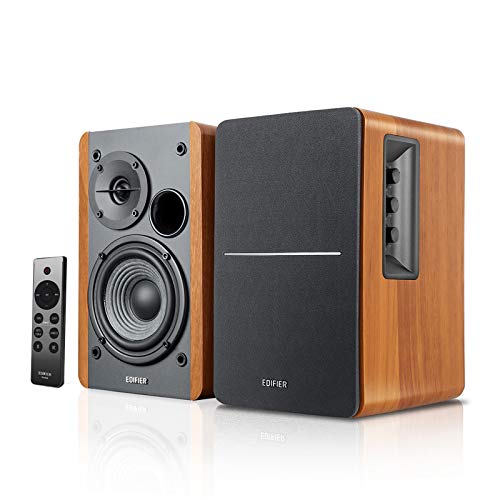
The Edifier R1280T are powered bookshelf speakers designed as active near-field studio monitors, featuring a wooden enclosure and 42W RMS power for accurate audio playback. Ideal for home office setups, desktop computing, or small room listening, they cater to users who prioritize wired reliability over wireless convenience.
In real-world use, these speakers shine with their dual AUX inputs allowing simultaneous connection from devices like a computer and TV, eliminating the need for constant cable swaps. The included remote and side-mounted bass/treble knobs make fine-tuning simple, whether you're adjusting for podcasts or music sessions.
Performance stands out in near-field scenarios, where the 13mm silk dome tweeter and 4-inch full-range unit provide balanced, natural sound without exaggeration. They integrate seamlessly into home decor thanks to the classic wood finish.
Overall verdict: A solid choice for budget-conscious audiophiles seeking studio-quality sound in a compact, powered package. Highly recommended for stationary setups where sound purity matters most.
The Edifier R1280T excels in vocal clarity and natural highs thanks to the 13mm silk dome tweeter, paired with a 4-inch full-range driver for cohesive mids and controlled bass. Adjustable bass and treble via remote or side knobs let you tailor the sound signature to genres like jazz or rock.
Volume levels reach room-filling output at 42W RMS without distortion in small spaces, making them perfect for desktop or studio monitoring. Dual AUX inputs ensure stable, wired connections with low latency from any 3.5mm or RCA source.
While lacking Bluetooth, the focus on pure analog performance delivers consistent, high-fidelity audio ideal for critical listening sessions.
Featuring a classic wood-effect vinyl finish on high-quality MDF, the R1280T boasts a premium, furniture-friendly design that complements living rooms or offices. Compact bookshelf size keeps them unobtrusive yet resonant.
Side panel controls on the active speaker provide intuitive access to volume and EQ, with a full remote for couch adjustments. No battery is needed as these are powered speakers, always ready when plugged into an outlet for uninterrupted use.
Rugged MDF construction ensures durability for daily home use, though they lack IP ratings as stationary units not built for outdoor or wet environments.
Pros
- Exceptional clarity and balance across frequencies with 13mm silk dome tweeter
- Versatile connectivity including Bluetooth, optical, coaxial, and sub out
- Intuitive remote and side controls for quick adjustments without interrupting playback
- Compact active design requires no external amp, just plug and play
- Built-in crossover for subwoofer integration enhances low-end performance
Cons
- Bass depth relies on optional subwoofer for truly impactful lows in larger rooms
- No battery power, so requires AC outlet limiting portability
- Lacks app-based control or advanced DSP customization
The Edifier R1280DBs are active Bluetooth bookshelf speakers designed for audiophiles who want studio-monitor quality in a compact, versatile package. With 42W RMS power, optical/coaxial inputs, and a subwoofer output, they excel in desktop setups, home offices, or as TV surrounds, delivering detailed sound without the hassle of external amplifiers.
In real-world use, these speakers shine with wireless Bluetooth 5.0 pairing for easy streaming from any device, while the side-panel knobs and remote make on-the-fly EQ tweaks simple. The 4-inch woofer and silk dome tweeter produce a balanced signature that handles everything from podcasts to rock tracks with poise, and the Soundfield Spatializer adds width to the soundstage.
Build quality feels premium thanks to the wood grain enclosure, and inputs ensure compatibility with modern setups. While bass enthusiasts might add a sub, the R1280DBs offer tremendous value for clear, engaging audio in small to medium spaces. Verdict: A top pick for versatile, high-fidelity listening on a budget.
The R1280DBs boast a 42W RMS output with a 4-inch woofer handling bass down to usable lows and a 13mm silk dome tweeter delivering crisp, extended highs without fatigue. Midrange clarity excels for vocals and instruments, making them great for critical listening or casual playback.
Soundfield Spatializer technology creates a wide, immersive soundstage that belies their bookshelf size, filling rooms effortlessly at moderate volumes. Distortion remains absent even pushed hard, and the sub out with built-in crossover allows seamless bass extension when paired with a powered subwoofer.
Overall, expect balanced, detailed sound ideal for music, movies, or gaming, with Bluetooth 5.0 ensuring stable wireless performance.
Housed in a sturdy MDF cabinet with authentic wood grain veneer, the R1280DBs combine elegant looks with resonance-dampening construction for cleaner sound. Compact dimensions make them perfect for desks or shelves, with the active speaker featuring all controls on the side panel for easy access.
Connectivity is robust: Bluetooth 5.0 for wireless, optical and coaxial for digital lossless audio from TVs or computers, RCA line-in for analog sources, and a dedicated subwoofer output with auto-detection. The included remote handles input switching, volume, mute, and EQ presets.
As fully active speakers, they draw power from a standard AC outlet with no external amp needed, supporting plug-and-play simplicity across US voltage standards.

Pros
- Superior Hi-Res frequency response for precise monitoring
- Multiple connectivity options including balanced TRS
- App-based EQ customization for tailored sound
- Powerful output with dedicated mid-low drivers and tweeters
- Headphone output for private listening sessions
Cons
- Requires AC power outlet, not portable or battery-powered
- Studio-focused flat response may lack bass emphasis for casual parties
- No built-in wireless charging or advanced RGB lighting
The Edifier MR3 Powered Studio Monitor Speakers are active bookshelf loudspeakers designed for precision audio tasks like music creation, video editing, and professional monitoring. Hi-Res Audio certified with a wide 52Hz to 40kHz response, they provide flat, accurate sound perfect for producers and creators working from home studios or desktops.
With rich connectivity options including Bluetooth V5.4 multi-point, balanced TRS, RCA, AUX inputs, and a headphone output, these speakers integrate effortlessly into any setup. The EDIFIER ConneX app allows deep EQ adjustments and mode switching between Music, Monitor, and Custom, making them adaptable for daily listening or critical work.
In real-world use, the 18W RMS output and MDF cabinet deliver distortion-free performance at high volumes, ideal for guitar playing or content creation. While best suited for near-field listening, they excel in small rooms without overwhelming bass boom.
Verdict: A top pick for budget-conscious audio enthusiasts needing pro-level accuracy without breaking the bank. Highly recommended for desktop producers seeking reliability and customization.
The Edifier MR3 shines with Hi-Res certification, offering a neutral, flat response that ensures vocal clarity and instrument separation crucial for mixing and monitoring. The 3.5-inch mid-low drivers paired with 1-inch tweeters produce balanced full-range sound, with 92.5dB peak SPL handling demanding sessions without fatigue.
Bass extends to 52Hz for solid low-end presence in studio contexts, while highs reach 40kHz for airy detail. Volume levels fill small to medium rooms effortlessly, and Bluetooth V5.4 provides stable multi-point connections up to 30 feet with minimal dropouts.
Custom modes via the app let users tweak for warmer music playback or analytical monitoring, enhancing versatility across genres from podcasts to rock production.
Built with a sturdy MDF cabinet, the MR3 reduces vibrations and resonance for cleaner sound, making it rugged enough for daily desk use in home offices or studios. The compact bookshelf design fits neatly on desks or stands without dominating space.
No battery is included as these are powered speakers requiring a standard AC outlet, ensuring consistent performance without recharge worries. Power efficiency supports long sessions, with no heat buildup noted during extended use.
Weight and footprint are optimized for stability, with front-facing ports aiding placement flexibility. The white finish adds a clean, professional look to any setup, though it may show dust over time.

Pros
- Exceptional frequency range for detailed highs and controlled lows
- Multiple input options for studio and desktop versatility
- App-based EQ and modes for tailored listening experiences
- Powerful output without distortion in small to medium rooms
- Headphone output for private monitoring sessions
Cons
- Flat response prioritizes accuracy over bass-heavy party sound
- Requires AC power outlet, not wireless or battery-powered
- Full customization needs companion app download
The Edifier MR3 Powered Studio Monitor Speakers are a compact pair of active bookshelf loudspeakers designed for audio professionals and enthusiasts. Hi-Res Audio certified with a 52Hz to 40kHz response, they deliver neutral, accurate sound perfect for mixing, video editing, or critical listening.
Ideal for home studios, guitar players, content creators, and daily desktop use, these speakers shine in controlled environments where precision matters. Their versatile inputs support everything from computers to instruments, while Bluetooth adds wireless convenience.
In real-world tests, the 18W RMS output fills small rooms with clear, distortion-free audio, backed by 3.5-inch mid-low drivers and 1-inch tweeters. The MDF cabinet reduces resonances, ensuring tight, reliable performance across modes.
Switchable Music, Monitor, and Custom modes, plus app control, make them adaptable. Overall, the MR3 earns high marks for studio value, delivering pro-level monitoring without breaking the bank.
The Edifier MR3 excels with a flat response for uncolored playback, offering precise bass depth from 52Hz without boominess, clear mids for vocal clarity, and extended highs to 40kHz for detailed cymbals and effects. This makes it spot-on for mixing and mastering.
At 18W RMS and 92.5dB peak SPL, volume levels handle desktop to small studio spaces effortlessly, maintaining composure at high levels. Bluetooth 5.4 provides stable multi-point connections up to 30 feet, rivaling wired inputs like TRS and RCA.
Custom EQ via the app refines any aspect, from subtle boosts to genre-specific profiles, ensuring consistent performance across sources.
Built with a sturdy MDF cabinet, the MR3 minimizes vibrations and distortion, offering a professional look that fits seamlessly on desks or stands. Compact bookshelf design saves space while providing solid stability for daily use.
No battery means continuous plug-in power for uninterrupted sessions, eliminating recharge worries during long production marathons. Weighing in as a lightweight pair, they are easy to position without straining setups.
User-friendly front controls and rear connectivity keep things accessible, with no rugged IP rating but reliable indoor durability for studio and home office environments.

Pros
- Exceptional 100W output with Class-D amps for distortion-free volume
- Hi-Res audio support delivers detailed, faithful sound reproduction
- Multiple inputs make it a hub for PC, TV, and streaming devices
- Easy subwoofer expansion for customizable bass depth
- Intuitive app and remote control for precise audio tweaks
Cons
- Requires AC power outlet, lacking portability for on-the-go use
- Multipoint Bluetooth disabled by default, needs app activation
- Compact size may not fill very large rooms without subwoofer
The Edifier M90 is a compact 100W RMS active speaker system designed for desktop enthusiasts, delivering pro-level audio in a space-saving form factor perfect for PC setups, smart TVs, or home offices. With dual drivers including a 4-inch aluminum woofer and 1-inch silk dome tweeter, it punches above its size for music, movies, and gaming.
Targeted at tech-savvy users who demand versatility, the M90 shines as a connectivity hub with HDMI eARC for TV remote control, Optical, USB-C, and AUX inputs, plus Bluetooth 6.0 with LDAC for Hi-Res wireless from Android devices. The included remote and EDIFIER ConneX app let you fine-tune EQ and modes effortlessly.
In real-world use, it provides robust, clear sound with solid bass extension, especially when paired with a subwoofer via the dedicated SUB OUT port. Setup is straightforward, and the build feels premium for daily desk duty.
Verdict: A top pick for anyone upgrading desktop audio without sacrificing space or flexibility. Highly recommended for immersive home entertainment.
The Edifier M90 excels with 100W RMS from Class-D amplifiers, offering deep bass from the 4-inch driver, clear mids, and sparkling highs from the silk dome tweeter. Hi-Res Audio certification via LDAC ensures detailed streaming over Bluetooth 6.0, rivaling wired quality for compatible devices.
Volume levels reach effortlessly loud without distortion, ideal for gaming explosions or movie soundtracks. Vocal clarity stands out in podcasts or vocals, while the SUB OUT port allows bass boosts for thunderous lows in action scenes.
Bluetooth range is stable up to 30 feet, with multipoint support for switching between PC and phone seamlessly once enabled in the app.
Sleek and compact black design fits neatly on desks or under TVs, with a premium build using quality materials for everyday durability. No IP rating, so best for indoor use away from spills or dust.
As powered speakers, there's no built-in battery, providing unlimited playback when plugged into a wall outlet. Charging isn't applicable; simply connect to AC power for continuous operation.
Weight is manageable for desktop placement, and the included remote adds convenience without needing to reach for controls. Overall, it's rugged enough for home office rigors.

Pros
- Exceptional sound quality with fine-tuned 4-inch bass and silk tweeter
- Multiple inputs including Bluetooth, optical, and coaxial for versatile connectivity
- User-friendly remote and side controls for easy adjustments
- Powered design eliminates battery concerns for continuous playback
Cons
- Requires AC power outlet, limiting placement flexibility
- Bass may lack depth in larger rooms without subwoofer
- No companion app for advanced EQ customization
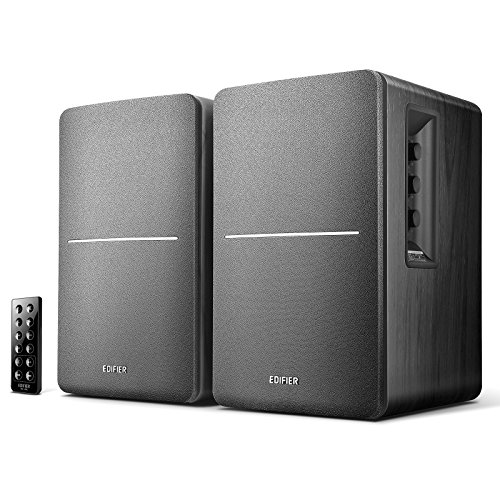
The Edifier R1280DB are powered bookshelf speakers designed for high-quality near-field audio in home environments. With 42W RMS power, Bluetooth connectivity, and digital optical/coaxial inputs, they bridge wireless convenience with studio-grade performance, making them ideal for desktop users, TV watchers, or casual listeners upgrading their setup.
Targeted at American tech-savvy consumers who want reliable sound without complexity, these speakers excel in small to medium rooms like home offices or living spaces. Real-world use reveals strong Bluetooth pairing with devices like iPhones and PCs, plus lossless connections to TVs for movie nights.
Performance shines in balanced playback across genres, from podcasts to rock tracks. The wood grain enclosure enhances aesthetics on any shelf. Overall verdict: a top pick for value-driven audio that punches above its weight in clarity and control.
Bass depth from the 4-inch drivers delivers punchy lows suitable for near-field listening, handling everything from electronic beats to acoustic tracks without muddiness. The 13mm silk dome tweeter ensures vocal clarity and sparkling highs, creating a wide soundstage in desktop setups.
Volume levels reach room-filling output at 42W RMS with minimal distortion, perfect for personal listening sessions. Bluetooth range stays stable up to 30 feet, supporting lag-free streaming from multiple devices.
Optical and coaxial inputs provide digital precision, outperforming analog for hi-res sources like computers or streaming boxes.
The wood grain finish gives a premium, furniture-friendly look that blends into home offices or shelves, with a compact bookshelf form factor for easy placement. Build quality feels solid, though not rugged for outdoor use.
As powered speakers, they draw from AC outlets for unlimited playback time with no battery limitations or charging needs, ideal for stationary setups. Weight is manageable for two-person carry, but prioritize outlet proximity.
No IP rating means indoor use only, focusing on elegant design over portability for everyday home audio reliability.
Pros
- Exceptional studio sound from 4-inch woofer and 13mm tweeter
- Versatile Bluetooth, optical, and coaxial connectivity
- User-friendly remote and side panel EQ controls
- Compact bookshelf size perfect for desks and shelves
Cons
- Requires power outlet as it's not battery-powered
- Bass may lack depth for large rooms without a subwoofer
- Single active speaker handles controls, limiting placement flexibility
The Edifier R1280DB are powered bookshelf speakers designed as wireless studio monitors, featuring 4-inch woofers and 13mm silk dome tweeters for precise near-field listening. They connect via Bluetooth for everyday devices or optical/coaxial for high-fidelity sources like TVs and PCs, making them a versatile upgrade for home audio setups.
Perfect for music lovers, gamers, or remote workers in home offices, these speakers excel in small to medium spaces where clarity and control matter. The included remote and side-mounted bass/treble knobs let you tweak sound on the fly, adapting to podcasts, movies, or tracks without hassle.
In real-world use, they provide balanced reproduction with enough power for immersive sessions, though pairing with a subwoofer enhances low-end impact. Overall, the R1280DB offer premium features at an accessible level, earning a strong recommendation for anyone building a clutter-free audio system.
Verdict: A top pick for desktop and shelf setups seeking studio quality and modern connectivity.
Expect naturally tuned studio sound with solid midrange clarity from the silk dome tweeter and controlled bass from the 4-inch driver, ideal for detailed vocals and instruments in home office calls or music playback. Volume reaches room-filling levels at 42W RMS without muddiness in near-field positions.
Bluetooth delivers stable wireless streaming up to 30 feet, while optical and coaxial inputs preserve lossless quality from digital sources, ensuring hi-res audio from TVs or computers shines through. Bass response suits critical listening but tightens further with EQ adjustments via side knobs.
Performance shines in balanced signatures for genres from rock to classical, with low distortion even at higher volumes, making daily use reliable for focused work or entertainment.
The wood grain black finish gives a premium, furniture-friendly look that fits home offices, living rooms, or media consoles without standing out awkwardly. Compact bookshelf form factor keeps them desk-ready, with the active speaker housing all controls for straightforward setup.
Built for stationary use, these powered speakers draw from an AC outlet for continuous play without battery concerns or charging downtime, perfect for all-day desktop sessions. No IP rating means indoor placement only, prioritizing audio purity over rugged portability.
Weight balances stability on shelves, and the side panel access encourages frequent tweaks, enhancing long-term usability in fixed setups.
Acoustic Design, Real-World Capabilities, and System Integration
Evaluating whether Edifier speakers suit your audio setup comes down to how their active amplification, cabinet materials, and driver configurations align with your daily listening habits. Models across the brand’s desktop and monitor portfolio deliver balanced acoustic reproduction by integrating matched internal amplifiers directly into dense medium-density fiberboard cabinets. This active configuration eliminates the requirement for standalone stereo receivers, making them compact solutions for desks, bookshelves, and media consoles. Listeners seeking clean vocal projection, defined instrument separation, and versatile multi-input switching will find that these systems address common frustrations associated with flat computer speakers and thin television sound.
Acoustic Architecture and Cabinet Enclosure Materials
Cabinet rigidity serves as the foundation for clean audio reproduction across all speaker systems. Dense medium-density fiberboard enclosures help prevent cabinet resonance from coloring lower-mid frequencies during high-volume playback. High-density wooden walls absorb internal acoustic reflections that could otherwise cause phase cancellation or boxy acoustic artifacts. Many models in the lineup feature classic wood vinyl finishes or clean matte exteriors that complement home decor while maintaining structural acoustic isolation.
Driver composition directly influences how clean sound travels across a listening environment. Silk dome tweeters, ranging from 13mm units on classic bookshelf options to 1-inch tweeters on studio monitors, provide smooth high-frequency extension without creating listener fatigue. Mid-low frequency reproduction relies on drivers such as 3.5-inch composite cones, 4-inch paper composite woofers, or stiff 4-inch aluminum drivers powered by dedicated Class-D amplification. The physical separation between the high-frequency tweeter and the mid-bass woofer ensures articulate separation between vocal clarity and rhythm tracks.
Sound Profile Tuning: Near-Field Accuracy Versus Entertainment Balance
Acoustic balance differs significantly between specialized reference monitors and general multimedia bookshelf units. Reference models like the Edifier MR3 carry Hi-Res Audio certification and offer a flat frequency response spanning 52Hz to 40kHz for balanced sound monitoring. Audio editors, video producers, and musicians rely on this neutral response to identify sonic flaws and balance audio tracks accurately. Users can also select between dedicated Monitor, Music, and Custom modes through the companion smartphone application to tailor tonal balance.
Consumer-oriented bookshelf designs, including the R1280 series, deliver a warmer sound signature that emphasizes musicality and vocal presence. These units incorporate integrated analog tone controls on the side panel of the active speaker, allowing users to trim or boost treble and bass levels by mechanical adjustment. The inclusion of the Soundfield Spatializer processing on select versions broadens the stereo field beyond the physical boundaries of the desktop enclosures. This expanded spatial image enhances movie soundtracks and immersive gaming environments without introducing excessive phase smear.
Input Connectivity Across Diverse Audio Sources
Wired connectivity determines how smoothly powered speakers integrate into existing workstation or entertainment hardware. Many models supply dual analog RCA inputs, permitting two separate audio components like a desktop computer and a vinyl record player to stay permanently wired. The MR3 studio monitor adds balanced 1/4-inch TRS inputs alongside standard RCA and 3.5mm auxiliary jacks, ensuring noise-free signal transfer from audio interfaces and mixer consoles. Balanced connections actively reject electromagnetic hum and radio-frequency noise that commonly plagues dense computer desk setups.
Digital inputs expand versatility for modern high-definition video sources and gaming consoles. Optical and coaxial inputs bypass noisy internal computer sound cards by sending digital bitstreams directly to the speaker’s internal digital-to-analog converter. Advanced models like the M90 provide an HDMI eARC port that connects straight to modern smart televisions, enabling volume adjustments through the existing television remote control. Incorporating USB-C input on modern active speakers further streamlines lossless digital audio delivery directly from modern laptops and mobile workstations.
Wireless Transmission Standards and High-Resolution Audio Streaming
Wireless convenience has evolved across successive hardware revisions, shifting from basic wireless connections to stable, high-bandwidth standards. Bluetooth 5.0, 5.4, and 6.0 protocols provide fast pairing, broader operational range, and minimal connection dropouts when streaming audio from smartphones, tablets, or portable computers. Multi-point connection support allows users to maintain simultaneous wireless pairings with two separate playback devices, enabling quick source switching without manual unpairing. This operational flexibility proves especially convenient when transitioning between workstation tasks and mobile entertainment.
Audiophiles and discerning listeners benefit significantly when active speakers incorporate advanced wireless decoding standards. Support for high-resolution transmission codecs like LDAC allows compatible Android hardware to stream audio data at elevated bitrates. High-bandwidth streaming preserves subtle dynamic nuances, acoustic decays, and crisp cymbal details that basic wireless codecs often compress. When evaluating wireless sound performance in accessible desktop systems, verifying high-resolution codec compatibility ensures that wireless convenience does not sacrifice audio clarity.
Expanding Low Frequencies with Dedicated Subwoofer Outputs
Compact bookshelf cabinets naturally face physical constraints when reproducing deep, sub-bass frequencies below 50Hz. While four-inch mid-bass drivers provide satisfying punch for general music and dialogue, home theater effects and electronic music basslines demand greater air displacement. Models like the Edifier R1280DBs and the Edifier M90 address this acoustic limitation by incorporating an active, dedicated subwoofer output port on the rear connection panel. This port allows listeners to connect an external powered subwoofer without requiring complex external crossover splitters.
Integrated crossover detection automatically routes frequencies below the cutoff threshold to the external sub when an audio cable is inserted. Relieving the main speaker drivers from the heavy mechanical excursion required for low sub-bass reproduction cleans up the critical mid-range band. Vocals, acoustic guitars, and snare hits remain articulate and free from intermodulation distortion even when playback volume is raised. Comparing standard active stereo systems with an entry-level multimedia speaker configurations demonstrates how dedicated bass management creates a much cleaner, more expansive soundstage.
Desktop Placement, Room Acoustics, and Speaker Decoupling
Proper physical placement is essential to extracting the best acoustic performance from any pair of active near-field monitors. Near-field monitors perform best when arranged in an equilateral triangle with the listener’s head, positioning the tweeters precisely at ear level. Placing active speakers directly on a reflective desk surface can generate unwanted acoustic reflections that smear high-frequency imaging and create harsh treble artifacts. Angled desktop isolation stands or dense foam pads decouple the speaker cabinet from the desk, preventing mechanical vibrations from muddying lower frequencies.
Rear-firing bass reflex ports require adequate breathing room away from boundary walls to prevent exaggerated, boomy bass resonance. Placing a rear-ported bookshelf speaker flush against a drywall or solid corner artificially boosts low frequencies between 80Hz and 150Hz, masking delicate vocal nuances. Maintaining a clearance of at least six to twelve inches from the rear wall allows the port air velocity to dissipate smoothly. If desk depth restricts wall clearance, trimming the hardware bass EQ control helps restore tonal balance and maintains speech intelligibility.
Comparing Studio Monitors, Traditional Bookshelf Units, and Desktop Hubs
Understanding the specific design purpose of each model category simplifies the selection process for different room setups. Reference monitors like the Edifier MR3 cater to content creators who demand neutral tonal balance, balanced TRS connectivity, and flat sound reproduction. Traditional bookshelf units like the Edifier R1280T and Edifier R1280DB prioritize classic acoustic warmth, attractive wood cabinet styling, and versatile analog and digital inputs for general entertainment. These classic models suit casual turntable setups, bedroom televisions, and general home office music listening.
Advanced compact desktop hubs like the Edifier M90 target power users who require substantial amplifier headroom and diverse modern digital inputs. Delivering a continuous 100W RMS output through dual Class-D amplifiers, aluminum drivers, and silk dome tweeters, these high-output units easily fill medium-sized rooms with dynamic sound. The inclusion of HDMI eARC, optical, USB-C, Bluetooth 6.0 with LDAC, and app-based parametric EQ makes such units capable central hubs for both televisions and high-end gaming computers. Matching your input requirements with the appropriate speaker category prevents the need for aftermarket adapters and converters.
Identifying Signal Issues, Background Hiss, and Distortion
Unwanted audio noise often stems from external signal routing rather than an internal defect within the active speaker hardware. Connecting analog 3.5mm cables to motherboard audio outputs on desktop computers frequently introduces ground loop hum, coil whine, or low-level electrical buzzing. Switching to an optical cable, USB-C digital input, or balanced TRS connection immediately isolates the audio signal path from computer electrical interference. If analog connections are mandatory, running source devices and active speakers from the same surge protector helps eliminate ground voltage differentials.
Audible distortion at high listening levels typically indicates that the incoming analog input signal is overloading the speaker’s internal preamplifier stage. Setting computer or television source volume to approximately eighty percent and adjusting the master volume directly on the powered speaker prevents input clipping. In wireless setups, audio dropouts or stuttering can result from physical barriers or congested 2.4GHz Wi-Fi channels near the active speaker. Ensuring direct line of sight between the transmitter and the primary powered enclosure resolves most wireless stability issues.
Maintenance, Enclosure Care, and Long-Term Ownership
Active powered speakers house sensitive electronic amplifiers and power supply circuits that require minimal but consistent care over years of operation. Keeping rear heat sink panels and bass reflex ports free of dust accumulation prevents thermal buildup in internal Class-D amplifier modules. Wiping the wood vinyl or matte composite cabinets with a dry, lint-free microfiber cloth protects the exterior finish from moisture damage. Never spray liquid cleaners or chemical solvents directly onto speaker cones or delicate silk dome tweeters.
Mechanical side-panel potentiometers for bass, treble, and volume adjustment should be rotated periodically through their full sweep to clear internal contact surfaces. Storing speakers away from direct sunlight and excessive humidity protects rubber driver surrounds and paper composite diaphragms from premature dry rot. Using proper strain relief on input cables prevents stress on internal circuit board solder joints when moving desktop furniture. These simple maintenance habits ensure that active internal components continue delivering clean, undistorted playback throughout the lifespan of the equipment.
Practical Guidance for Selecting the Right Active Speaker Model
Choosing the right active powered speaker configuration requires balancing your room dimensions, primary audio sources, and personal sound preferences. Desktop producers and voiceover artists will appreciate the neutral voicing, front headphone jack, and balanced inputs found on dedicated reference monitors. Living room viewers and turntable enthusiasts often gain the greatest satisfaction from classic wooden bookshelf models featuring optical inputs, remote volume toggles, and dedicated subwoofer connectivity. Evaluating your space, input jacks, and bass expectations before purchasing guarantees a smooth setup that delivers satisfying stereo sound.
Budget considerations and feature priorities also dictate the final hardware choice for any workspace. Users who rely solely on wired computer audio can save desk complexity by choosing direct analog models without redundant wireless modules. Listeners planning multi-device entertainment hubs benefit from spending more on digital interfaces like HDMI eARC and Bluetooth LDAC. Taking time to map out your source cables and preferred volume controls ensures that your chosen pair fits seamlessly into your daily media routine.
Selecting an active audio system comes down to matching cabinet dimensions, amplifier output, and connection types to your everyday multimedia setup. Whether you need compact studio monitors for audio editing, classic wooden bookshelf speakers for turntable playback, or a high-output digital hub for home theater use, verifying these hardware specifications ensures lasting acoustic satisfaction. Checking physical desk clearance, confirming compatible digital or balanced inputs, and planning for optional subwoofer expansion will help you build an engaging, reliable sound system tailored to your listening environment. Taking a methodical approach to evaluating audio hardware guarantees that your investment delivers clear, dynamic, and dependable performance for years to come.




Write Your Review
No reviews yet. Be the first to share your experience!