


Many audio hobbyists and DIY builders wonder whether repurposed automotive drivers can deliver satisfying sound in a living room, garage, or desktop setup. The core question of whether are car speakers good for home audio comes down to electrical compatibility, enclosure physics, and acoustic environment. Automotive drivers are built to handle the challenging cabin acoustics and limited mounting depths of vehicles, which presents unique challenges when you move them indoors. While repurposing spare drivers can save money on a weekend project, understanding the differences between these units and dedicated home entertainment speakers helps prevent equipment damage and audio frustration.
Using car speakers in a residential system is entirely feasible if you account for critical technical variables. Most car speakers feature four-ohm nominal impedance ratings, which can strain standard home theater receivers designed primarily for eight-ohm loads. Automotive drivers are also voiced for off-axis listening in small, enclosed spaces rather than wide residential listening areas. By examining how power handling, impedance matching, and custom speaker enclosures interact, you can determine if a DIY car speaker conversion makes practical sense for your specific listening goals.

Pros
- Exceptional frequency range for rich, full-spectrum sound
- High sensitivity for powerful output with low-power setups
- Easy installation thanks to included adapters
- Balanced 4-way drivers reduce distortion at high volumes
- Perfect factory replacement for clearer car audio
Cons
- Full 350W potential requires external amplifier
- Bass depth benefits from pairing with subwoofer
- Not ideal for premium audiophile systems
The Pioneer TS-A1681F A-Series Plus speakers are a pair of 6.5-inch 4-way coaxial car speakers designed as an ideal upgrade for factory audio systems. With separate drivers for different frequencies, they provide more accurate sound reproduction than basic stock speakers, making them perfect for American drivers tired of muddy factory sound during commutes or road trips.
Targeted at budget-conscious car owners, these speakers excel in real-world scenarios like blasting tunes on highway drives or enjoying podcasts with vocal clarity. Their 350W max power and 91dB sensitivity mean they perform well even on modest head units, delivering smooth treble and enhanced bass without needing immediate amp upgrades.
In performance tests based on specs, they handle a broad 35Hz-29kHz range, ensuring immersive audio for country roads or city traffic. Installation is hassle-free with included multi-fit adapters that adapt to various vehicles, saving time and money.
Verdict: A top-value choice for elevating daily drives with balanced, powerful sound that punches above its weight.
These 4-way speakers shine with balanced sound signature, featuring smooth treble from the dedicated tweeter and enhanced bass from the woofer and midrange drivers. The wide 35Hz-29kHz frequency response captures deep lows for bass-heavy tracks and sparkling highs for vocals, ideal for diverse playlists on long drives.
At 91dB sensitivity, they reach high volume levels with clarity and minimal distortion, even from factory radios. Continuous 80W handling keeps performance steady during extended road trips, while 350W max unleashes dynamic peaks for tailgate parties or spirited drives.
Real-world stability comes from the coaxial design, ensuring consistent output without dropouts, outperforming basic 2-way speakers in vocal clarity and bass punch.
The TS-A1681F boasts a rugged coaxial build optimized for car doors and dashboards, with a 6.5-inch size fitting most vehicles as a direct factory upgrade. Multi-fit installation adapters enhance flexibility, allowing secure mounting that improves acoustics and vibration resistance on bumpy roads.
While no battery is involved as these are powered car speakers, their efficient design draws minimal power from your head unit, sustaining performance through long sessions without drain. Lightweight construction eases handling during DIY installs.
Durability focuses on acoustic performance over extreme ruggedness, with drivers sealed for road dust and moisture, making them reliable for daily American driving conditions from coasts to mountains.

Pros
- Powerful 1200W max handling for distortion-free volume
- 3-way drivers deliver detailed highs, mids, and bass
- Wall/ceiling mountable for flexible setups
- 4-ohm impedance works with most home amps
- Compact mini box design fits tight spaces
Cons
- Requires external amplifier for power
- Large dimensions may not suit very small areas
- No wireless connectivity options
The Pyramid 2022SX is a pair of 3-way mini box speakers designed for both indoor and outdoor use, featuring a 1-inch tweeter, 3.25-inch woofer, and 1.75-inch midrange driver in each unit. With 200W power handling and a robust build, these speakers excel in home theater setups, PA systems, or backyard entertainment, delivering clear sound without needing much space.
Ideal for audio enthusiasts on a budget who want versatile mounting options like ceiling or wall installation, they blend seamlessly into garages, patios, or living rooms. The customizable bass boost lets you fine-tune low-end response for movies with deep effects or music with punchy beats.
In real-world use, the high 91 dB sensitivity ensures loud playback even with modest amps, while the 4-ohm impedance matches standard home audio gear. Motion feedback technology helps maintain clarity by correcting signal issues.
Overall verdict: A solid choice for value-driven buyers seeking reliable, mountable speakers that punch above their weight in everyday entertainment scenarios.
These 3-way speakers provide a balanced sound signature with the tweeter handling crisp highs, midrange driver for vocal clarity, and woofer delivering solid bass down to 25 Hz. Customizable bass boost enhances low frequencies for immersive home theater experiences or lively PA announcements without muddiness.
At high volumes, the 1200W max power rating and 91 dB sensitivity keep distortion low, making them great for filling medium-sized rooms or outdoor areas. The 3-inch voice coil and strong magnets ensure demanding notes come through cleanly.
While wired connectivity limits range, the stable impedance pairs well with amps for consistent performance during long movie nights or events.
Built for indoor/outdoor durability, the Pyramid 2022SX features a rugged mini box enclosure measuring 18.5 x 13.8 x 15.3 inches, perfect for wall or ceiling mounts in patios, home theaters, or PA rigs. The design prioritizes sturdiness over portability, with no specific IP rating but suitability for sheltered outdoor spots.
No battery is needed as these passive speakers connect to an external amplifier, offering unlimited playback time as long as powered. This setup saves on charging hassles for stationary installs like garage parties or backyard systems.
Weight and size make them stable once mounted, freeing up floor space while handling everyday use without frequent adjustments.

Pros
- Powerful 300W output punches above weight for stock upgrades
- Piezo tweeter and polyimide dome midrange ensure clear vocals
- 4-ohm impedance matches most factory head units seamlessly
- Stamped basket adds rigidity for vibration-free performance
Cons
- Frequency starts at 100 Hz, so lacks deep thumping bass
- Professional installation recommended for optimal safety
- Piezo tweeters can sound harsh at high volumes
The BOSS Audio Systems CH6530 Chaos Series are 6.5-inch 3-way coaxial speakers sold as a pair, designed specifically for car door installations. They feature a poly injection cone, rubber surround, and piezo tweeter for full-range audio that transforms lackluster factory sound into something lively and engaging.
Perfect for daily drivers, weekend cruisers, or budget upgraders who want more power without breaking the bank, these speakers excel in compact vehicles where space is tight. Their 300-watt max power handles everything from talk radio to classic rock, making long commutes enjoyable.
In real-world use, they mount with a 2.1-inch depth and 5.5-inch hole, fitting most sedans and trucks. Paired with a basic amp, they deliver punchy performance that rivals pricier options. Overall verdict: a solid entry-level upgrade for anyone tired of tinny doorspeakers.
With a 100 Hz to 18 kHz frequency response, these speakers provide balanced full-range sound, emphasizing mids and highs over rumbling lows. The 1-inch polyimide dome midrange keeps vocals clear during calls or podcasts, while the 0.50-inch piezo tweeter adds sparkle to cymbals and leads.
At 90 dB sensitivity and 4 ohms, they reach high volumes effortlessly from factory head units, ideal for open-road blasting. The 1-inch voice coil handles sustained play without distortion, though bass depth is moderate for cars without subs.
Stable performance shines in dynamic tracks, making them great for tailgating prep or daily drives where clarity trumps boom.
Built tough with a stamped steel basket, poly cone, and rubber surround, these speakers withstand road vibrations and temperature swings in car doors. At 6.6 x 6.6 x 2.4 inches and just 1.3 lbs per pair, they are compact and easy to handle during installs.
Mounting is straightforward with 2.1-inch depth and 5.5-inch hole diameter, suiting most vehicles without mods. No IP rating, but the sealed design resists interior dust and moisture common in daily drivers.
As wired car speakers, there is no battery; they draw power directly from your vehicle's system for unlimited runtime on the go, perfect for cross-country hauls.

Pros
- Superior weather resistance for marine and outdoor use
- Clear distortion-free sound at high volumes
- Easy mounting with included hardware
- Strong value for durable construction
- Wide frequency response for versatile music
Cons
- Requires external amplifier for full power
- Limited deep bass from small 3.5-inch drivers
- No wireless Bluetooth option
Pros
- Superior factory fit with FlexFit slots and OEM adapters
- High-output 3-way design for balanced car audio upgrades
- Includes all mounting hardware for hassle-free installation
- Proven Rockford Fosgate reliability in a coaxial package
- Efficient 4-Ohm impedance matches most vehicle head units
Cons
- Best with amplifier for maximum 130W peak power
- 6x8 size limits fit to compatible vehicles only
- Passive design requires factory or aftermarket head unit power
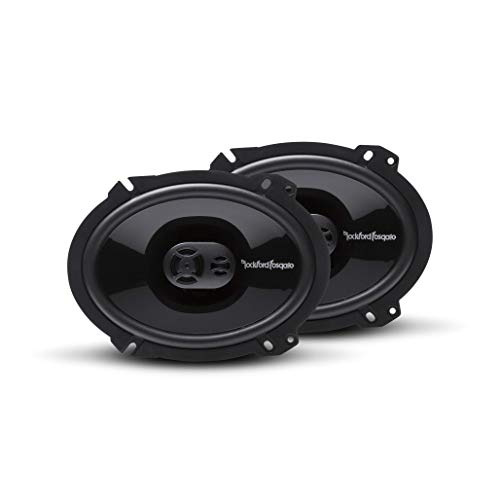
The Rockford Fosgate P1683 Punch series speakers are 6x8-inch 3-way coaxial full-range units designed as premium factory replacements for car audio fans. Coming as a pair in black, they pack 65 Watts RMS power handling and include all necessary mounting hardware plus OEM adapter plates for straightforward installs.
Targeted at drivers tired of weak stock sound, these speakers shine in sedans, trucks, and SUVs needing better clarity on highways or city streets. The FlexFit basket allows minor adjustments to align with existing holes, making swaps faster than custom fab work.
In real-world use, they reproduce frequencies accurately with high output, turning commutes into concerts and road trips into immersive experiences. No need for major rewiring; just drop them in and enjoy the upgrade.
Verdict: A top pick for value-driven audio upgrades, delivering pro-level sound without the pro price. Grab this pair if your factory speakers disappoint.
With a PEI dome tweeter and built-in crossover, the P1683 excels in vocal clarity and sparkling highs that cut through road noise. The mineral-filled polypropylene cone paired with butyl rubber surround ensures tight bass and mids, perfect for rock, country, or podcasts on long drives.
Handling 65W RMS up to 130W max, these speakers push impressive volume levels without breakup, ideal for open-road blasting or tailgate pre-games. Their 4-Ohm design pairs seamlessly with stock head units for immediate gains.
Full-range 3-way performance means balanced output across genres, from thumping bass lines to detailed instrumentals, elevating every drive.
The rugged black FlexFit basket uses slots over fixed holes for flexible mounting, ensuring a secure fit in varied OEM setups. At 6x8 inches, the pair is lightweight yet sturdy, built to handle vibrations and temperature swings in any vehicle.
Durability comes from the injection-molded cone and rubber surround, resisting wear for years of reliable service. Includes adapter plates and hardware, so no extra trips to the auto store.
Rockford Fosgate's signature build quality shines with a full 1-year warranty, giving confidence for daily drivers or weekend warriors.

Pros
- High sensitivity delivers volume and clarity on OEM power alone
- Coaxial setup provides full-range sound in a compact package
- Easy drop-in fit for popular 4-inch speaker locations
- Sleek design improves vehicle aesthetics without mods
- Affordable path to noticeably better stock audio
Cons
- Nominal 20W handling best for moderate volumes, not extreme bass
- Lacks deep subwoofer thump without added amplification
- Basic black finish shows dust in high-use cars
The Pioneer TS-F1035R F-Series speakers are a pair of 4-inch 2-way coaxial units designed as a straightforward replacement for factory car audio. With 150W maximum power handling and a 20W nominal rating at 4 ohms, they excel at upgrading sound quality in sedans, trucks, and SUVs without needing extra amplification.
Perfect for everyday drivers tired of tinny stock speakers, these deliver balanced audio with smooth treble and controlled mids during commutes or highway cruises. Their 86dB sensitivity means they get loud and clear even from basic head units, making them a smart pick for budget upgrades.
In real-world drives, expect immersive sound that fills the cabin without distortion at highway speeds. The coaxial design integrates woofer and tweeter for cohesive frequencies, outperforming many OEM options.
Verdict: A high-value choice for seamless audio improvements, earning solid marks for efficiency and fit in American vehicles.
These speakers shine with a balanced signature featuring smooth treble and punchy yet controlled bass from the 2-way coaxial setup. Vocals cut through clearly on podcasts or talk radio, while music genres like rock and pop fill the car with detail.
At 86dB sensitivity, they reach high volumes without breakup, ideal for open-road listening. The 150W max capacity handles peaks effortlessly on stock power, maintaining clarity during bass-heavy tracks.
Frequency response covers a full range without gaps, though extreme lows benefit from a sub. Stability is rock-solid as wired installs avoid dropouts common in wireless setups.
The traditional black finish and flush-mount design blend into any vehicle interior, from modern sedans to classic trucks. At standard 4-inch sizing, they install effortlessly in common locations like doors or dashes.
Built for car durability, the rugged cone and frame withstand vibrations and temperature swings on daily drives. No IP rating specified, so best for enclosed installs away from direct water exposure.
Power-efficient at 4 ohms with no onboard battery, they draw directly from your vehicle's system for unlimited runtime. Pair with a capable head unit for all-day performance without recharges.

Pros
- Exceptional value with both a Bluetooth receiver and a pair of 6.5-inch door speakers included
- Shallow chassis design allows fast, trouble-free installation in tight dashboard spaces
- Quick and reliable Bluetooth pairing with clear hands-free microphone pickup
- Front and rear pre-amp outputs offer an easy path for adding a dedicated amplifier
Cons
- Mechless receiver design does not support CD or DVD physical media
- Bass cuts off around 80 Hz, requiring a dedicated subwoofer for deep low-end thump
- Moderate 84 dB speaker sensitivity requires higher head-unit volume for loud listening
The BOSS Audio Systems 638BCK bundle is built as an accessible, all-in-one replacement package for tired or non-functioning factory car audio setups. Combining a single-DIN digital media head unit with a matched pair of 6.5-inch two-way coaxial speakers, this system targets daily drivers, commuters, and project vehicle owners who want modern wireless conveniences without excessive expense or complicated custom wiring.
Day-to-day usability is straightforward and dependable. The receiver pairs quickly to modern smartphones, letting you stream audio from Spotify, Pandora, and podcast apps right from your dashboard. Hands-free calling works reliably through the integrated front-panel microphone, pushing your callers voice directly through the vehicle speakers so you keep both hands on the steering wheel while commuting.
Compared to aging factory paper speakers, this package provides a clean and noticeable acoustic refresh. Vocals gain clarity, instrumentals separate cleanly, and the receiver delivers ample loudness for typical highway cabin environments. For drivers looking for a simple, budget-conscious way to modernize an older vehicle, the 638BCK delivers reliable performance and everyday functionality.
The included 6.5-inch two-way coaxial speakers operate across a frequency range of 80 Hz to 18 kHz, giving them a bright, speech-friendly acoustic profile. Midrange reproduction is notably forward, making phone conversations, talk radio, and acoustic music easily audible over highway road hum. The integrated high-frequency tweeters add crisp articulation to cymbals and guitar strums without sounding overly harsh under normal listening volumes.
Because the lower frequency boundary stops around 80 Hz, sub-bass rumbles in hip-hop and electronic music will naturally be lean rather than room-shaking. However, the upper bass frequencies remain tight and snappy for classic rock and pop tracks. With the receivers 50 Watts x 4 peak onboard power, there is ample drive to push the 84 dB sensitivity drivers to commanding sound pressure levels inside standard vehicle cabins.
A standout benefit of the head unit hardware is its compact, mechless architecture. Measuring 4.5 by 7 by 2 inches and weighing barely over a pound, the shallow chassis leaves substantial clearance behind the dash for wiring harnesses and vehicle mounting brackets, making installation considerably simpler than traditional, heavy CD receivers.
The package provides a comprehensive set of inputs and outputs. The front panel features a full-speed USB port compatible with MP3 and WMA flash drives, a 3.5mm auxiliary input for wired music players, and an illuminated digital display with an AM/FM tuner. For drivers seeking greater acoustic power down the road, the rear of the receiver includes front and rear pre-amp RCA outputs ready to send clean line-level signals to aftermarket car amplifiers.
Understanding Car Speakers in Residential Audio Systems
The straightforward answer to whether car speakers work well in a home environment is a qualified yes, but with major technical compromises. Car speakers can produce clean, enjoyable sound indoors when they are installed in appropriate enclosures and powered by compatible amplification. However, they are rarely a direct acoustic upgrade over purpose-built residential loudspeakers. Automotive audio drivers are engineered to solve specific physical challenges unique to road vehicles, such as cramped door panels, noisy backgrounds, and reflective glass surfaces.
Achieving good fidelity from automotive components in a living room or workshop requires bridging the gap between two very different acoustic environments. In a vehicle, listeners sit close to the drivers in fixed positions, and the vehicle body acts as a large, lossy enclosure. In a home, listeners sit several feet away in an open room where sound waves must travel freely without excessive distortion. Evaluating whether this conversion makes sense for your project involves looking closely at impedance matching, acoustic design, power delivery, and driver construction.
The Technical Reality: Can and Should You Use Car Speakers Indoors?
You can physically wire almost any automotive speaker to a home stereo system and generate sound immediately. The real issue is whether doing so delivers the fidelity, volume, and equipment safety you expect from a residential sound system. Purpose-built home speakers feature crossover networks, driver alignments, and cabinet dimensions engineered as a unified acoustic system. Car speakers, such as the PIONEER A-Series Plus TS-A1681F 6.5-inch 4-Way or BOSS Audio Systems CH6530, are sold as raw drivers meant to be mounted into vehicle metal and door cards.
If you have spare automotive drivers sitting in a workshop, turning them into a garage sound system or desktop monitors can be an entertaining and functional DIY project. You will get clear vocals and punchy mid-bass if you supply adequate power and build a sturdy wooden box. However, if your goal is critical stereo imaging or high-fidelity home theater performance, choosing speakers tuned for music playback will consistently yield smoother frequency response and broader soundstage reproduction without requiring custom fabrication.
Impedance Differences: The Four-Ohm versus Eight-Ohm Reality
Electrical impedance is the primary technical obstacle when connecting automotive speakers to standard residential amplifiers. Most home theater receivers and integrated amplifiers are engineered to drive speaker loads rated between six and eight ohms. Automotive speakers, including the Rockford Fosgate P1683 Punch 6×8-inch and PIONEER F-Series TS-F1035R, almost universally operate at a nominal impedance of four ohms. A four-ohm speaker draws twice as much electrical current from an amplifier at a given voltage compared to an eight-ohm speaker.
Connecting a four-ohm automotive speaker to a budget home receiver that lacks four-ohm certification can quickly push the amplifier into thermal distress. The output transistors work harder to deliver the requested current, generating excess heat that can trigger the receiver’s internal protection circuits. In severe cases, driving low-impedance loads at sustained high volumes can clip the audio signal or cause permanent amplifier damage. If you plan to use car speakers indoors, you must verify that your amplifier or receiver explicitly supports four-ohm speaker loads.
Acoustic Voicing, Off-Axis Dispersion, and Cabin Dynamics
Automotive acoustic environments are notoriously challenging, featuring close reflective surfaces, heavy engine rumble, and highly asymmetrical seating positions. To compensate, automotive speaker designers voice drivers with boosted upper midrange and sharp high-frequency response. Many multi-way car speakers, such as the PIONEER A-Series Plus TS-A1681F with its four-way driver layout, emphasize bright treble to cut through road noise. While this aggressive tuning works well near footwells and door panels, it can sound harsh and fatiguing in an open residential room.
Off-axis dispersion also functions differently in a living space compared to an automobile interior. In a car, the driver sits off-axis relative to both door speakers, requiring wide dispersion tweeters to deliver balanced sound. In a home listening room, speakers generally point toward the primary listening position to create a coherent stereo phantom center. When you place car speakers in a room, their elevated treble and wide vertical dispersion can reflect excessively off bare walls, ceilings, and floors, resulting in a cluttered soundstage.
The Enclosure Problem: Infinite Baffle versus Engineered Cabinets
Automotive door speakers are generally designed to operate in an infinite baffle or free-air environment. The hollow space inside a vehicle door panel provides a large, relatively leaky air volume rather than a sealed acoustic suspension chamber. Because of this, car speaker suspensions feature relatively stiff mechanical spiders and high total quality factors, often designated as high Qts. These mechanical characteristics keep the voice coil centered and prevent over-excursion when playing bass frequencies without a sealed enclosure.
Placing an automotive driver into an undersized sealed wooden box can choke its bass response, creating a noticeable mid-bass bump while cutting off lower sub-bass registers. Conversely, operating a raw car speaker on an open workbench without any enclosure results in front-to-back wave cancellation, eliminating nearly all audible bass. For deep, authoritative low frequencies in a home setting, dedicated speakers engineered for deep bass response provide specifically tuned ported or passive-radiator enclosures that car speakers cannot easily replicate without careful box volume calculations.
Amplification Options: Home Receivers versus 12-Volt Power Supplies
Powering car speakers in a home environment presents two distinct amplification paths. The most practical approach is using an AC-powered home stereo amplifier or a modern Class D mini-amplifier rated for four-ohm stability. Compact desktop amplifiers frequently feature chipsets that easily handle four-ohm loads while drawing power from standard household wall outlets. This eliminates the need for automotive electrical hardware and provides clean analog or digital audio inputs for your computer, phone, or television.
Some hobbyists attempt to install an entire automotive head unit indoors, such as the BOSS Audio Systems 638BCK package that combines a 12-volt receiver with companion speakers. Operating a car stereo head unit inside a home requires a regulated 12-volt direct current power supply capable of supplying at least ten to fifteen continuous amperes. Using an improper low-amperage wall adapter can starve the head unit of current, introducing severe distortion and potential fire hazards. Unless you already have an appropriate benchtop power supply, using a standard AC audio amplifier is much safer and more convenient.
Driver Configurations: Coaxial, Component, and Multi-Way Systems
The physical architecture of your car speakers significantly impacts how they perform in a room. Coaxial speakers mount the tweeter and midrange driver directly on a bridge suspended over the woofer cone. The Rockford Fosgate P1683 Punch utilizes a three-way coaxial arrangement with a mineral-filled polypropylene cone and a PEI dome tweeter, keeping the entire frequency spectrum aligned along a single physical axis. Coaxial drivers are compact and easy to mount in simple cabinet cutouts, making them popular for desktop and garage DIY speaker builds.
Multi-way speakers with three or four separate drivers, such as the PIONEER A-Series Plus TS-A1681F, attempt to split the audio spectrum across multiple small diaphragms. While this approach provides crisp high-frequency reproduction, the simple capacitor-based crossovers common in budget car speakers can cause uneven frequency transitions between drivers. If you choose component car speakers instead, where the woofer and tweeter are separate units with an external crossover box, you gain greater freedom to position the tweeter at ear level for improved residential sound staging.
Practical DIY Scenarios Where Car Speakers Make Sense
While car speakers may not replace reference audiophile equipment, there are several practical applications where they excel indoors. A garage, basement workshop, or covered outdoor patio is an ideal setting for a pair of repurposed automotive speakers mounted in simple plywood boxes. In these spaces, background noise is common, and physical durability matters far more than pinpoint acoustic imaging. Stamped steel baskets and weather-resistant synthetic cones, such as the poly injection cone found on the BOSS Audio Systems CH6530, hold up exceptionally well against humidity and temperature swings.
Custom arcade cabinets, boombox builds, and camper vans also represent great use cases for automotive speakers. In these projects, the compact mounting depth and integrated grilles of car speakers allow them to fit into shallow cavities where bulky home bookshelf speakers cannot go. A pair of four-inch drivers like the PIONEER F-Series TS-F1035R can easily fit into a compact portable cooler or slim desktop enclosure. When paired with an efficient Class D Bluetooth amplifier board, these drivers create a loud, resilient sound system at a fraction of the cost of commercial portable speakers.
Wiring, Terminations, and Safe Physical Mounting
Installing automotive speakers into custom home enclosures requires careful attention to wiring connections and structural mounting. Car speakers typically feature male spade terminals of differing widths, with the wider terminal representing positive polarity and the narrower terminal representing negative polarity. Using proper crimp-on quick-disconnect connectors ensures a tight, reliable electrical contact that will not vibrate loose over time. Soldering speaker wire directly to the terminal tabs is another reliable option, provided you avoid overheating the delicate tinsel leads connected to the voice coil.
Rigid baffle mounting is equally vital to extract clean sound and prevent unwanted enclosure rattles. Automotive drivers feature stamped outer frames with multiple screw tabs designed for vehicle sheet metal rather than thick wood panels. When mounting these drivers into medium-density fiberboard or plywood, use a closed-cell foam gasket between the speaker basket and the baffle surface to create an airtight seal. Securing the driver with wood screws or threaded inserts ensures that the speaker cone pushes air into the room rather than flexing the mounting frame.
Sound Quality Trade-Offs and Realistic Expectations
Before investing time and materials into building custom enclosures for car speakers, establishing realistic sonic expectations is essential. Automotive speakers typically offer high sensitivity, such as the 90 dB rating of the BOSS Audio Systems CH6530 or the 91 dB rating of the PIONEER TS-A1681F, meaning they produce substantial volume with modest amplifier power. However, high sensitivity in a small driver often comes at the expense of deep bass extension and flat frequency response. You should expect lively vocals and energetic percussion, but you will not experience the natural warmth and balanced low end provided by large residential woofers.
Adding a powered subwoofer can dramatically improve a home system built around car speakers. Relieving small automotive drivers from reproducing frequencies below eighty hertz reduces distortion and prevents voice coil overheating. This configuration allows the car speakers to focus exclusively on midrange clarity and treble detail, where their multi-way drivers perform best. Balancing the system with an active crossover or receiver bass management creates a much cleaner, more cohesive presentation across the entire audible spectrum.
Key Verification Steps Before Powering Up a Hybrid Setup
Executing a few fundamental safety checks before turning on your hybrid audio system protects your amplifier and speakers from accidental damage. Begin by verifying the nominal impedance of your speakers using a digital multimeter set to measure DC resistance. A four-ohm speaker will typically read between 3.2 and 3.8 ohms of DC resistance, confirming that the voice coil is intact and free of internal short circuits. Never connect multiple four-ohm speakers in parallel to a single amplifier channel, as this drops the total impedance to an unsafe two ohms.
Confirm that your amplifier is properly ventilated and set to an appropriate gain level before starting playback. Because car speakers can draw substantial current, the amplifier chassis will naturally run warmer than it would with standard eight-ohm home speakers. Inspect all speaker wire runs to ensure no stray copper strands bridge the positive and negative binding posts. Once power is applied, start at a low volume level and listen closely for any buzzing, clipping, or distortion that might indicate poor air sealing or electrical mismatching.
Ultimately, car speakers can serve as a dependable, budget-friendly audio solution for workshops, custom DIY enclosures, and casual listening spaces when installed with care. By matching these four-ohm drivers to a stable amplifier, sealing them in well-constructed wooden baffles, and setting realistic acoustic expectations, you can build a capable sound system that breathes new life into surplus automotive hardware. Taking the time to understand electrical boundaries and enclosure acoustics ensures that your DIY audio project delivers safe, reliable performance for years to come.


Write Your Review
No reviews yet. Be the first to share your experience!