


Upgrading factory vehicle audio often leads enthusiasts toward high-output aftermarket drivers that promise articulate vocals and robust thermal durability. Many car audio builders frequently ask are american bass sq series speakers any good when assembling multi-speaker sound stages designed to cut through engine noise and heavy subwoofer bass. American Bass has established a notable reputation for manufacturing pro-audio style midrange components, high-excursion subwoofers, and competition-ready hardware. Enthusiasts evaluating different aftermarket truck speaker configurations often encounter these robust drivers alongside mainstream coaxial units.
Determining whether an American Bass driver satisfies your listening expectations depends heavily on your amplification, crossover configuration, and overall audio goals. While traditional sound quality builds prioritize subtle acoustic nuances and flat frequency reproduction, American Bass drivers typically emphasize extreme efficiency, assertive vocal projection, and immense power handling. Examining specific engineering traits, such as high sensitivity ratings and large voice coil assemblies, helps clarify whether these dedicated midranges match your personal listening tastes.
Evaluating American Bass SQ and Pro Midrange Performance
Evaluating car audio speakers requires looking beyond brand prestige to analyze physical construction, technical parameters, and intended acoustic roles. Listeners wondering whether American Bass drivers deliver genuine fidelity must consider how pro-audio engineering differs from conventional factory replacements. A focused breakdown of driver specifications reveals how these components perform across distinct vehicle environments.
The Direct Answer: Defining Quality in American Bass Drivers
American Bass speakers earn strong praise in the automotive audio community, particularly for listeners prioritizing exceptional vocal clarity, immense volume, and rugged thermal endurance. The brand builds components tailored toward pro-audio vehicular systems, meaning their drivers excel at projecting forward, energetic sound capable of keeping pace with massive subwoofers. When properly powered and filtered, these speakers reproduce clean, articulate sound that remains distinct even at elevated volume levels. For enthusiasts who demand concert-like loudness without muddy distortion, these drivers consistently fulfill their design promise.
However, whether these drivers qualify as good depends entirely on how you define audio quality. Audiophiles seeking warm, understated acoustic textures or a laid-back classical presentation may find pro-audio midranges slightly aggressive in the upper vocal register. Conversely, listeners who want punchy instruments, intelligible dialogue, and concert-level output will discover that American Bass hardware performs exceptionally well within its intended design parameters. Knowing what you want from your vehicle sound system is the key to appreciating what these drivers offer.
Driver Architecture and Voice Coil Thermal Handling
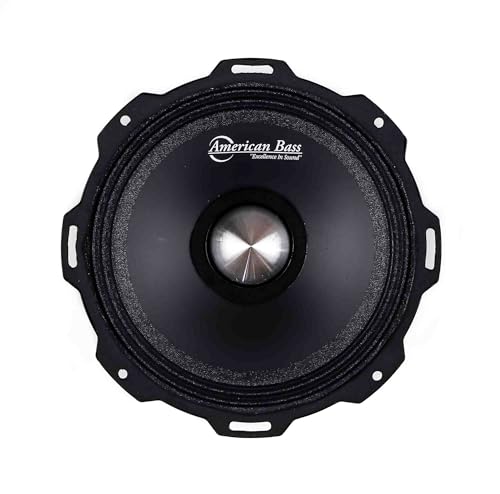
Physical construction dictates how well a speaker handles intense electrical current over prolonged listening sessions. The American Bass Godfather 6.5 Midrange Speaker, 600 showcases this approach with its oversized 2.5-inch high-temperature voice coil assembly. Standard factory replacement speakers generally rely on modest 1-inch or 1.2-inch voice coils that quickly build up heat under heavy amplification. A substantial 2.5-inch coil provides significantly more surface area, allowing heat to radiate away efficiently and preventing premature thermal compression.
Continuous power handling directly correlates with this heavy-duty motor structure. The manufacturer rates this 6.5-inch driver at 300 watts RMS with a peak ceiling of 600 watts, backed by a 4-ohm nominal impedance. These figures indicate an exceptionally robust electrical design capable of handling high-current aftermarket amplifiers without burning out delicate windings. The rigid cone material and durable surround further resist physical deformation during demanding musical transients, preserving mechanical stability under load.
Frequency Response Dynamics: Analyzing the 130 Hz to 8,000 Hz Bandwidth
Understanding the acoustic range of a dedicated midrange prevents common installation errors that can distort your sound stage. The Godfather driver operates across a stated frequency response range of 130 Hz to 8,000 Hz. Because the lower limit cuts off around 130 Hz, this speaker is not designed to produce sub-bass rumble or heavy midbass impact. Attempting to force full-range lower bass notes through this driver will cause mechanical strain, making proper crossover filtering mandatory.
At the upper boundary, the 8,000 Hz ceiling covers human speech, brass instruments, and guitar distortion with striking definition. However, upper harmonic air, delicate cymbal shimmer, and high-frequency overtones extend well beyond 10,000 Hz and up to 20,000 Hz. To construct a balanced acoustic spectrum, installers must pair these midranges with dedicated bullet tweeters or high-output silk dome drivers. Listening to structured reference songs to evaluate audio clarity quickly demonstrates why midranges require dedicated high-frequency support to complete complex musical arrangements.
When properly integrated between a dedicated subwoofer system and a set of tweeters, this driver occupies a critical sweet spot. Vocals cut through dense instrumentation with remarkable authority, preventing singers from sounding muffled behind heavy basslines. The controlled cone motion within this dedicated band ensures minimal intermodulation distortion, delivering snappy snare hits and prominent guitar riffs. Maintaining strict bandpass filtering remains the secret to extracting the cleanest performance from this frequency envelope.
High Sensitivity Benefits: The Impact of 96 dB Efficiency
Sensitivity ratings indicate how effectively a driver translates incoming electrical wattage into audible sound pressure. American Bass specifies an impressive 96 dB sensitivity rating for its 6.5-inch Godfather midrange driver. Most standard entry-level car speakers exhibit sensitivity figures ranging between 86 dB and 89 dB. Because an increase of 3 dB represents a doubling of acoustic output, a 96 dB driver produces dramatically louder sound while consuming less amplifier power than less sensitive competitors.
This high acoustic efficiency proves invaluable in demanding listening environments characterized by background interference. Highway wind, exhaust drone, and heavy road vibration easily mask sound from lower-efficiency speakers, forcing drivers to crank up their volume into harsh clipping territory. A high-sensitivity driver effortlessly projects clean sound well above ambient road noise without straining the amplifier. This dynamic headroom keeps complex musical passages coherent, clear, and distortion-free during spirited highway drives.
Amplification Requirements and Head Unit Limitations
Power matching represents one of the most critical aspects of setting up American Bass components. Factory head units and basic aftermarket receivers typically supply only 15 to 22 watts RMS per channel through their built-in microchips. Attempting to power a 300-watt RMS midrange driver directly from a factory dashboard receiver will yield underwhelming volume and dangerous signal distortion. Underpowered systems frequently induce amplifier clipping when pushed, generating harmful harmonic heat that can degrade speaker voice coils over time.
To realize the genuine performance potential of these drivers, pairing them with an external multi-channel amplifier is essential. An amplifier delivering between 150 and 300 watts RMS per channel into a 4-ohm load allows the driver to breathe and articulate dynamic peaks effortlessly. Proper gain staging with an oscilloscope or digital multimeter ensures that the input signal remains clean and free of square-wave distortion. Clean power keeps the voice coil operating in its linear excursion zone, ensuring transparent sound and extended product longevity.
Physical Fitment and Door Panel Installation Considerations
Installing high-performance 6.5-inch midranges involves more mechanical planning than dropping in basic factory replacements. The heavy magnet structure and 2.5-inch voice coil require substantial clearance behind the door mounting surface. Installers must carefully measure available mounting depth to prevent the speaker magnet from obstructing window tracks, lock linkages, or interior wiring harnesses. Wooden or composite mounting baffle rings often provide the necessary clearance while creating a rigid acoustic foundation.
Acoustic isolation within the vehicle door plays a decisive role in final playback fidelity. High-output midranges generate substantial acoustic pressure inside the door cavity, which can cause thin metal panels and plastic trim clips to rattle. Applying dense butyl sound-deadening mats directly to the inner door skin absorbs unwanted vibrations and seals acoustic back-waves away from the front cone. Installers seeking simpler, plug-and-play drop-in replacements might prefer standard compact coaxial speaker alternatives, which require far less custom fabrication and depth clearance.
Moisture protection is another crucial installation factor that vehicle owners frequently overlook. Car doors naturally channel rainwater past the exterior window gaskets toward lower drainage weep holes. Adding protective silicone speaker baffles with open rear ports shields the driver motor assembly from falling water drops while preserving proper acoustic breathing. Taking these structural precautions ensures that your aftermarket midranges remain mechanically sound and electrically reliable through diverse weather conditions.
Crossover Setup and Active Signal Processing
Configuring proper crossover filters safeguards your investment and optimizes overall sound dispersion. Because the Godfather driver specifies a lower frequency boundary of 130 Hz, your audio system must apply a high-pass filter (HPF) at or slightly above this point. Setting the high-pass crossover between 130 Hz and 160 Hz prevents low-frequency bass energy from driving the voice coil past its physical travel limits. Employing a steep crossover slope, such as 18 dB or 24 dB per octave, shields the speaker from out-of-band bass rumble.
Active digital signal processors (DSPs) unlock the highest level of performance from American Bass hardware. A dedicated DSP enables precise equalization adjustments to smooth out minor acoustic peaks caused by vehicle cabin reflections. It also allows installers to configure time alignment, ensuring that sound waves from all door speakers reach the listener ears simultaneously. Incorporating a low-pass filter (LPF) around 5,000 Hz to 7,000 Hz creates a smooth handover to your tweeters, eliminating overlapping acoustic interference in the upper midrange.
Sound Profile Evaluation: Pro Audio Vocal Projection Versus Classic SQ Warmth
Understanding the acoustic identity of American Bass midranges helps manage expectations before you purchase. These speakers feature stiff paper cones and accordion cloth surrounds, a design philosophy inherited directly from live concert sound reinforcement systems. This combination yields extremely fast transient attack, snappy percussion, and laser-focused vocal intelligibility. If you listen to hip-hop, electronic dance music, rock, or podcast commentary, the upfront energy of these drivers brings excitement and immediacy to every track.
Conversely, traditional sound quality purists who favor a buttery, laid-back presentation might find this energetic response somewhat prominent. Soft silk-dome component systems offer a smoother roll-off and a more relaxed sound stage, which some listeners prefer for extended, low-volume classical or acoustic jazz sessions. American Bass midranges do not attempt to produce a subdued sound stage; they are engineered to cut through heavy road rumble and explosive bass lines with razor-sharp authority. Matching the speaker sound signature to your musical preferences ensures long-term listening satisfaction.
Practical Verification and Pre-Purchase Decision Checklist
Before purchasing American Bass midranges, verifying your audio system readiness will save time and money. Confirm that you have an external amplifier ready to supply adequate RMS wattage, as well as an active head unit or DSP capable of high-pass filtering at 130 Hz. Verify that your vehicle door cavities provide sufficient mounting depth, or plan to construct custom spacer rings to accommodate the oversized magnet structure. You should also ensure that your budget accounts for dedicated tweeters and a subwoofer to cover the frequency ranges this midrange leaves behind.
When deployed within a balanced, multi-way audio architecture, American Bass drivers deliver outstanding performance, immense volume, and proven thermal durability. They represent a formidable choice for mobile audio enthusiasts who crave concert-like dynamics, crisp dialogue, and rock-solid build quality. Taking the time to properly mount, power, and tune these drivers guarantees a commanding listening experience that elevates your daily commute.






Write Your Review
No reviews yet. Be the first to share your experience!