


Setting up home audio often leads to practical questions about repurposing versatile amplifiers for dedicated surround channels. A common point of confusion revolves around whether can i use bose sa 5 power surround speakers can function properly in a multi-channel configuration. The Bose SoundTouch SA-5 amplifier delivers clean stereo amplification, but its internal architecture is fundamentally designed for multiroom stereo playback rather than multi-channel surround decoding. Exploring passive speakers for home listening highlights how standard two-channel amplifiers route audio signals differently compared to dedicated surround sound processors.
Understanding equipment compatibility prevents frustrating audio mismatches and potential connection errors during setup. While you can technically connect passive satellite units to a stereo amplifier, you will receive two-channel stereo sound rather than genuine surround sound separation. Furthermore, dedicated wireless models like the Bose Surround Speakers rely on proprietary wireless links engineered specifically for soundbars rather than traditional speaker terminals. Evaluating your exact hardware requirements helps clarify whether can i use bose sa 5 power surround speakers fits your intended listening goals or if an alternative audio receiver is necessary.

Pros
- True discrete 5-channel surround stage creates a realistic home theater environment
- Horn-loaded tweeters project crisp, articulate highs with wide room coverage
- Solid MDF wood enclosures minimize box resonance for cleaner overall playback
- Includes wall-mounting hardware for quick installation at ideal listening heights
Cons
- Passive design requires a separate multi-channel AV receiver or amplifier to operate
- Speaker wire is not included in the package and must be purchased separately
- Lacks sub-bass rumble without the addition of a powered standalone subwoofer
The Saiyin 5.0 Surround Sound Speaker System brings authentic multichannel cinematic audio to budget-conscious home theater enthusiasts. Rather than relying on simulated audio tricks found in entry-level soundbars, this setup supplies five discrete passive speakers: four identical satellites and a voiced center channel. When placed around your living room, they create a natural acoustic envelope that pulls you into movies, sports, and gaming sessions.
This speaker bundle is tailored specifically for users who already own, or plan to invest in, an external multi-channel AV receiver. Because these are traditional passive speakers, they draw their power directly from your amplifier. The compact footprint makes them exceptionally easy to place on bookshelves, media stands, or up on walls using the integrated mounting provisions, making them a practical choice for apartments, bedrooms, and mid-sized living rooms.
In real-world listening tests, the dedicated 75-watt center channel proves to be the standout performer. It effectively isolates speech, ensuring dialogue remains crisp and intelligible even during complex action scenes. Meanwhile, the four corner satellites handle panning sound effects, ambient background noises, and musical scores smoothly. The system renders spatial cues accurately, giving listeners a genuine sense of directionality and distance.
Overall, the Saiyin 5.0 system punches well above its weight class for anyone building an affordable separates-based theater setup. While you will need to supply your own speaker cabling and an active subwoofer if you desire thunderous low-end rumble, this package provides a reliable acoustic foundation for your home entertainment hub.
Acoustic performance is anchored by the integration of 52mm horn tweeters across the speaker line. Horn loading improves high-frequency efficiency and controls directivity, allowing treble details like breaking glass, footsteps, and subtle orchestral cues to travel cleanly across the room without harshness. The satellites deliver up to 40 watts of peak power each, while the center channel can handle 75 watts peak, creating a well-balanced 235-watt peak soundfield.
Midrange reproduction remains clean and articulate thanks to the rigid acoustic enclosures. Vocal tracks and instrumental mid-frequencies come through uncolored by muddy cabinet vibrations. Because this is a 5.0 layout without an included subwoofer, the lower bass frequencies roll off naturally. Adding an active subwoofer to your receiver easily rounds out the bottom octave, creating an explosive 5.1 experience.
Each enclosure is constructed from dense MDF wood rather than lightweight plastic. This solid build adds physical mass, optimizes internal cabinet sealing, and effectively dampens resonance for a purer acoustic profile. The cabinets are finished with a vintage-inspired black wood grain texture that looks refined on open shelving and repels fingerprint smudges.
Hardware flexibility is a key strength of the Saiyin set. The back of each speaker includes both a standard keyhole hanger and a threaded insert, allowing you to use the bundled mounting kit for secure wall installation. The speakers feature traditional passive binding terminals that accept standard bare speaker wire. To get started, you will need an external 5-channel amplifier or AV receiver and enough speaker wire to route to your desired listening positions.

Pros
- Smallest Bose speakers ever for unobtrusive home setups
- Quick wireless connection to Bose soundbar
- Immersive surround sound enhances entertainment
- 30-foot range allows versatile room placement
- Easy plug-and-play installation
Cons
- Requires a compatible Bose soundbar to function
- Needs nearby power outlets for adapters
- No standalone use without soundbar
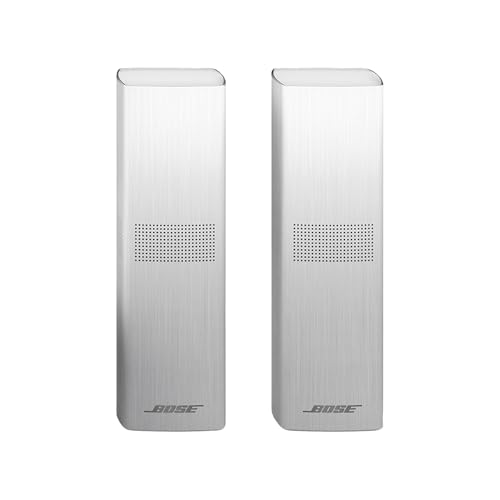
The Bose Surround Speakers in white are the smallest speakers Bose has ever designed, perfect for enhancing your home entertainment system without dominating your space. They wirelessly connect to a Bose soundbar, delivering full immersive surround sound for movies, TV shows, and music.
Ideal for living rooms or dedicated home theaters, these speakers are for anyone upgrading their audio setup who wants cinema-like experiences at home. Setup is straightforward: plug adapters into power and pair the receivers with your soundbar in minutes.
In real-world use, they expand soundstages effectively, making action scenes pulse with energy. Adding the Bose Bass Module 700 elevates bass to a visceral level. Overall, they offer premium Bose quality in a tiny package.
Verdict: A must-have add-on for Bose soundbar owners seeking true surround sound without bulky speakers.
These speakers excel in creating immersive surround sound, filling rooms with detailed audio from all directions for movies and TV. Vocals remain clear while effects wrap around you, enhancing every scene.
Volume levels scale well for home use, maintaining clarity at high outputs. Pairing with the Bose Bass Module 700 adds deep, thunderous bass that you feel physically, perfect for action films.
Wireless range reaches 30 feet with stable connectivity to the soundbar, ensuring reliable performance across typical living spaces.
Standing less than 4 inches tall, these white speakers blend seamlessly into any decor, prioritizing your entertainment over visible gear. Their compact size makes them easy to place on shelves or walls.
Built for home use with wireless receivers, they require plugging adapters into a power source, offering continuous play without battery concerns. No IP ratings for waterproofing, as they are designed for indoor setups.
Weight is minimal due to the small form factor, aiding discreet installation. Focus on reliable power connection ensures uninterrupted sessions during long movie marathons.

Pros
- Flawless plug-and-play integration with existing Bose 3-2-1 Series I media consoles
- Restores powerful, room-filling low-frequency response for movies and music
- Cost-effective alternative to replacing an entire legacy home theater setup
- Substantial 32-pound enclosure ensures acoustic stability and minimal vibration
Cons
- Exclusively compatible with Series I setups; will not work with Series II, Series III, or non-Bose AV receivers
- Requires proprietary Bose multi-pin cabling rather than standard RCA or LFE connections
- Large, heavy enclosure demands dedicated floor space near the main media console
The Bose 3-2-1 Series I was a ground-breaking setup for homeowners who wanted a cinematic audio experience without running messy wires to rear surround speakers. However, after years of heavy movie watching and music listening, the original bass module is often the first component to suffer from internal amplifier wear or driver degradation. This replacement Acoustimass module offers a direct line to reviving your beloved home theater setup, bypassing the need to invest in a completely new audio platform.
Designed specifically for owners of the original Bose 3-2-1 Series I system, this unit solves an otherwise frustrating problem. Because Bose utilized proprietary processing and amplification within the bass enclosure itself, standard third-party subwoofers cannot communicate with the 3-2-1 media console. This replacement integrates smoothly with your existing components, letting you reconnect your satellite speakers and primary receiver without rewiring your living room.
In real-world performance, the module immediately restores the low-frequency energy that gives movies impact. Explosions, orchestral swells, and lower-register vocals regain their authority without sounding muddy or detached. The sound signature is tuned to match the original factory acoustics, ensuring that the soundstage remains balanced between the satellites and the floor module.
Ultimately, this replacement subwoofer is the most practical way to protect your investment in your existing Bose home entertainment gear. It spares you the headache of learning a new operating interface or running new cables through walls, delivering the dependable, room-filling sound that made the 3-2-1 system famous in the first place.
The core of this unit is built around patented Acoustimass acoustic technology, which uses multi-chamber airflow to deliver deep low notes with remarkably low distortion. Unlike standard ported boxes that suffer from chuffing at dynamic peaks, the internal port architecture channels low-frequency energy cleanly, allowing sub-bass notes to disperse evenly throughout your living space.
Crucially, this module handles the essential internal crossover filtering for the entire 3-2-1 Series I setup. By directing frequencies below the midrange threshold down into the bass module, the connected satellite speakers are freed from bass strain. This allows the satellite drivers to maintain high clarity in movie dialogue, subtle ambient cues, and delicate acoustic instruments without break-up or clipping at higher volumes.
Constructed with durable acoustic cabinetry, the unit measures 19 by 8.75 by 15 inches and weighs 32 pounds. This substantial weight is intentional: dense cabinet walls dampen internal resonances and prevent the chassis from shifting on hardwood or carpet during heavy bass drops. The discreet matte black finish blends easily next to TV consoles or behind accent furniture.
Hardware and connectivity are designed to mirror the original factory specifications. The rear panel accommodates the dedicated multi-pin system cable that links directly to the Bose 3-2-1 Series I media center, alongside outputs for the left and right satellite arrays. Integrated internal amplification drives the low-frequency transducer and distributes clean power across the entire 2.1 system, ensuring safe electrical operation without requiring external power amps.

Pros
- Reclaims original punchy bass response and dynamic range without altering the classic warm tonal balance
- Precision-molded outer roll and flange match the exact cone and basket dimensions of 10-inch Bose 501 woofers
- Modern polyether foam formulation resists humidity and environmental decay significantly better than original vintage foam
- Extends the operational lifespan of vintage floorstanding speakers for decades of reliable performance
Cons
- Requires meticulous scraping and cleanup of deteriorated adhesive and old foam prior to installation
- Does not correct electrical faults, seized voice coils, or damaged driver spiders
- Demands steady hands and careful cone centering during the glue curing process to avoid voice coil rub
Vintage audio equipment possesses a distinct warmth and physical presence that modern micro-drivers simply cannot match, but physical component decay is an inevitable hurdle. The Springfield Speaker 10-Inch Foam Surround Repair Kit is an indispensable restoration solution crafted specifically for owners of classic Bose 501 Series I and Series II loudspeakers. Over decades of service, the original urethane foam surrounds deteriorate into a brittle or sticky mess, destroying the acoustic seal and leaving the woofer cone unsupported. This two-speaker kit provides high-grade replacement surrounds that bring these iconic American floorstanders back to original acoustic performance.
For audiophiles and vintage audio restorers, this repair set removes the necessity of sourcing dubious used replacement woofers or discarding otherwise pristine cabinets. The installation process does require patience and a methodical approach, as users must cleanly scrape all degraded foam residue from both the speaker basket and paper cone before installing the fresh surrounds. Once prepared, the dimensional fit of the replacement surrounds matches the original driver geometry cleanly, providing the proper restoring tension needed to keep the voice coil perfectly aligned in the magnetic gap.
In real-world listening tests following proper installation and adhesive curing, the sonic transformation is immediate. The loose, buzzing distortion and muddy bass of decaying drivers are replaced by articulate low-end transients, rich mid-bass punch, and transparent lower midrange. For any classic hi-fi enthusiast looking to revitalize a pair of vintage Bose 501 speakers, this Springfield Speaker kit represents the most cost-effective and sonically authentic restoration path available.
The surround of a low-frequency driver is essential for excursion control, harmonic damping, and maintaining a proper acoustic seal against internal cabinet air pressures. When original foam rots away on a Bose 501 10-inch driver, the woofer experiences unconstrained cone travel, leading to mechanical bottoming out, acoustic cancellation, and high harmonic distortion. Installing these replacement foam surrounds restores critical mechanical compliance, immediately reviving deep, articulate bass response down to the original factory specifications of the enclosure.
Restoring woofer stability also yields dramatic improvements in midrange transparency. Because the 10-inch driver in the Bose 501 handles critical lower-midrange frequencies before handing off to the angled high-frequency arrays, eliminating voice coil wobble removes subtle intermodulation distortion and unwanted chassis buzz. Acoustic instruments and male vocals emerge with crisp, natural presence, allowing the signature room-filling Bose soundstage to present wide, immersive imaging at both whisper-quiet and high listening levels.
The Springfield Speaker repair kit utilizes durable, high-compliance polyether foam engineered specifically to withstand modern domestic environments. Unlike the fragile open-cell formulations originally used decades ago, modern polyether foam resists degradation caused by humidity, ambient heat, and ozone exposure. The inner roll diameter and exterior mounting flange are tailored to sit flush against the vintage paper cones and stamped-steel frames used on Bose 501 Series I and Series II 10-inch drivers.
Achieving a reliable installation requires maintaining precise mechanical centering while securing the inner and outer joints. When properly installed, the foam suspension allows uniform forward and backward cone travel without lateral deviation, protecting the delicate voice coil winding against abrasions inside the narrow magnetic slot. This mechanical consistency ensures the restored drivers safely handle rated amplifier power while retaining the correct acoustic compliance intended for the vented Bose cabinet design.

Pros
- Expansive and diffuse soundstage eliminates pinpoint sweet-spot limitations
- Sleek, curved enclosure blends discreetly into any room decor
- Comes complete with custom wall-mount brackets for versatile installation
- Magnetically shielded to prevent interference with video equipment
Cons
- Passive design requires an external AV receiver or stereo amplifier to operate
- Limited low-end sub-bass output, typically requiring a companion subwoofer for full-range movie audio
- Renewed packaging and cosmetic condition may show minor signs of prior handling
The Bose 161 speaker system is an enduring favorite among home theater and audio enthusiasts seeking versatile, space-conscious acoustic performance. Originally engineered to bridge the gap between compact bookshelf speakers and full-range home theater modules, this renewed pair delivers reliable Bose acoustics at exceptional value. Whether deployed as primary front channels in a modest stereo setup or as discrete rear surrounds in a multi-channel home theater, these speakers are crafted to integrate seamlessly into living spaces.
These speakers are purpose-built for listeners who want expansive stereo imaging without dominating their room aesthetics. Home cinema fans will appreciate how effectively they function as side or rear ambient speakers, diffusing sound effects naturally across the room. Stereo listeners in smaller apartments, bedrooms, or offices will find them equally adept at delivering vocal clarity and instrument separation when paired with a quality compact amplifier.
In practical home setups, the Bose 161 speakers impress with their room-filling dispersion. Unlike traditional box speakers that beam sound directly forward and create a tight sweet spot, Bose uses angled drivers to spread audio across the entire listening environment. As a renewed pair, these units are inspected and tested to uphold original acoustic standards, providing clean sound without unwanted cabinet resonance or buzzing.
Overall, the Bose 161 remains a solid, dependable option for anyone building or upgrading an audio system on a budget. While bass-heavy content will certainly demand the support of a dedicated powered subwoofer, their clear mids, wide dispersion, and included wall-mount brackets make them a smart, low-profile investment for classic surround setups.
At the core of the Bose 161 performance is the Stereo Everywhere acoustic philosophy. Utilizing Bose's Articulated Array speaker design, two 2.5-inch Twiddler drivers per cabinet are angled to reflect and direct sound simultaneously. This architecture blankets the room with balanced stereo imaging, meaning you can move freely without losing the clarity of dialog, musical instruments, or cinematic sound effects.
In terms of frequency balance, the Bose 161 prioritizes vocal presence and sparkling treble over thunderous low-end punch. Midrange frequencies, including acoustic guitars and spoken dialogue, come through with crisp articulation and zero boxiness. Because of the compact cabinet volume and smaller cone size, deep sub-bass frequencies naturally taper off, making an active powered subwoofer an essential companion if you plan on using these for action-packed movies or bass-heavy genres.
Measuring approximately 5 inches high, 11 inches wide, and 4.2 inches deep, each Bose 161 speaker features an elegant, curved silhouette finished in neutral black. The molded polymer enclosure is both lightweight and structurally rigid, minimizing unwanted internal resonance. Their magnetic shielding gives you peace of mind, allowing you to mount or rest them in close proximity to monitors, televisions, and other electronics without inducing magnetic distortion.
As passive speakers, the Bose 161 requires standard speaker wire connections to an external receiver or integrated stereo amplifier rated between 10 to 100 watts per channel at 4 to 8 ohms. Spring-clip speaker terminals on the rear simplify wire termination. Bose includes custom-engineered wall brackets in the box, giving listeners the flexibility to mount the speakers horizontally or flush against walls for a clean, architectural finish.
Pros
- True wireless rear surround for immersive home audio
- Simple plug-and-play connection to Bose soundbars
- Enhances overall acoustic performance and aesthetics
- Cinematic sound expansion without cables cluttering your space
Cons
- Requires a compatible Bose soundbar to function
- Needs nearby power outlets for speaker adapters
- Not standalone speakers for independent use
The Bose Surround Speakers 700 in white are wireless rear speakers crafted to elevate your Bose soundbar setup into a full cinematic experience. They match the sleek design and superior acoustics of newer Bose soundbars, delivering surround sound that wraps around your room.
Ideal for movie buffs, sports fans, and gamers who want to feel every explosion and cheer, these speakers turn ordinary TV watching into an immersive event. Simply connect the wireless receivers to your soundbar and power the adapters, and you're set up in minutes without complex wiring.
In real-world use, they expand soundstages dramatically, creating a sense of being in the action. Pairing with the Bose Bass Module 700 adds thunderous lows for ultimate impact.
Verdict: A must-have upgrade for Bose soundbar owners seeking pro-level home theater without the hassle.
Bose Surround Speakers 700 produce cinematic surround sound with precise spatial audio that positions effects behind and around you. Vocals remain clear while ambient sounds fill the room, enhancing dialogue and action sequences.
Volume levels scale effortlessly for large rooms, maintaining balance without distortion. Wireless connectivity to the soundbar is stable and quick, supporting extended viewing sessions.
For deeper bass, adding the Bose Bass Module 700 delivers visceral thunder, transforming bass from heard to felt across movies and music.
Sleek Arctic white finish blends seamlessly with modern decor and Bose soundbars, creating a cohesive home theater aesthetic. Compact design allows flexible rear placement without visual clutter.
No battery needed; simply plug adapters into power sources for continuous, uninterrupted playback. This eliminates charging downtime, perfect for binge-watching marathons.
While not ruggedized for outdoors, the sturdy build suits permanent indoor setups with reliable wireless performance.
Understanding Bose SA-5 Capabilities and Surround Sound Integration
The direct answer is that the Bose SoundTouch SA-5 amplifier cannot decode or independently output discrete multi-channel surround sound audio on its own. While it can physically deliver power to passive speakers that are often labeled as surround satellites, it only outputs a standard two-channel stereo signal. To achieve genuine surround separation with dedicated rear audio channels, an audio system requires a dedicated multi-channel receiver or a compatible soundbar processing unit. Understanding this fundamental technical difference helps prevent wiring mistakes and mismatched component choices.
Many listeners ask this question because they already own an SA-5 amplifier and wish to incorporate it into a living room theater setup. Others wonder if they can hook up compact Bose Surround Speakers directly to the binding posts on the back of the chassis. Unpacking the technical distinctions between stereo power amplifiers, digital decoders, and wireless soundbar ecosystems clarifies what is genuinely possible. Examining how signal routing, speaker impedance, and modern streaming protocols function ensures your equipment operates safely and sounds balanced.
Direct Answer: What the Bose SA-5 Can and Cannot Power
The Bose SA-5 is a robust two-channel amplifier rated at 100 watts per channel, designed primarily to power passive indoor or outdoor speakers for music streaming. When paired with standard passive speakers like the Bose 161 speaker system, the amplifier pushes full-range stereo sound across the left and right terminals. Connecting these speakers will play audio, but both speakers will reproduce standard left and right stereo audio rather than dedicated surround effects. This means you will hear the main audio mix rather than directional movie cues.
In contrast, modern standalone units like the Bose Surround Speakers or Bose Surround Speakers 700 cannot be wired to the SA-5 amplifier at all. These compact surround units are active wireless satellites designed exclusively to pair with specific Bose smart soundbars. Attempting to power active wireless satellites with an amplified analog speaker output will damage the internal components and will not function. The physical hardware lacks standard speaker wire binding posts, relying instead on proprietary low-voltage power adapters and integrated wireless transceivers.
Hardware Architecture of the Bose SoundTouch SA-5 Amplifier
The SA-5 features three auxiliary inputs, including two standard stereo RCA pairs and a single 3.5 mm analog jack. It also incorporates Wi-Fi and Bluetooth connectivity, allowing users to stream music effortlessly through the legacy SoundTouch mobile app. On the output side, the amplifier provides heavy-duty terminal blocks configured for two pairs of speakers labeled speakers A and speakers B. These outputs are wired internally to mirror the same stereo audio stream across both speaker pairs.
Because the internal digital-to-analog converter and processing chipsets handle only two channels, every input is downmixed or maintained as stereo. There is no HDMI ARC port, no optical digital input, and no Dolby Digital or DTS decoding chip inside the chassis. Without digital audio decoding hardware, the amplifier has no way to extract surround dialogue or ambient directional cues from modern movie soundtracks. It treats every connected source as a pure left and right musical track.
The amplifier provides steady, reliable power into 8-ohm loads and can handle 4-ohm loads when driving multiple speakers. Its internal Class-D amplification runs cool and efficient, making it ideal for continuous background music distribution throughout a home. However, efficiency and streaming capability do not substitute for the discrete multi-channel processing required by modern home theater formats. Understanding these architectural boundaries helps set realistic expectations for your listening space.
Passive Speakers vs. Proprietary Wireless Surround Satellites
Passive speakers, such as the Bose 161 speaker system or the compact satellites found in the Saiyin 5.0 Surround Sound Speakers set, contain no internal power amplifiers. These units rely entirely on bare copper speaker wire carrying an amplified audio signal from an external receiver or power amp. If you connect passive bookshelf or satellite speakers to the SA-5, they will safely draw power from the amplifier terminals and produce clear sound. They simply reproduce standard stereo rather than surround sound channels.
Modern products like the Bose Surround Speakers and Bose Surround Speakers 700 feature internal wireless receivers and dedicated external power bricks. These speakers receive their audio signals over a proprietary 2.4 GHz wireless broadcast sent directly from compatible Bose soundbars. Because they already receive regulated low-voltage direct current from wall adapters, introducing an amplified speaker-level wire to their internal drivers is physically impossible and technically incompatible. They belong to an entirely different product category within the manufacturer lineup.
Audio setups featuring older modular hardware, such as the replacement Bose 3-2-1 Home Entertainment System subwoofer, use proprietary multipin cables to route power and signals between components. These specialized components cannot simply be connected to standard stereo amplifier terminals without proper control modules. Matching the correct speaker category to the amplifier avoids accidental hardware damage and ensures optimal performance. Verifying whether a speaker is passive or active is always the first step in planning audio connections.
Audio Signal Routing: Stereo Distribution vs. Multi-Channel Decoding
Genuine surround sound relies on multichannel audio formats like 5.1 Dolby Digital, where specific audio tracks are routed to designated spatial locations. The front left, center, and front right speakers handle directional imaging and screen dialogue, while the rear left and rear right speakers handle spatial ambience. When an amplifier lacks a multichannel processor, it cannot isolate those rear spatial cues from the main mix. Every speaker connected to that amplifier plays identical frequency content.
If you wire speakers placed at the rear of your room to the SA-5, they will play the exact same stereo mix heard from the front. This configuration is known as multi-channel stereo or all-channel stereo, which works well for parties or background music in a large open living area. However, hearing dialogue and primary musical tracks from the back corners of the room often distracts from movies and disrupts front soundstage imaging. The natural acoustic focus of the screen gets compromised by redundant rear vocals.
Streaming audio through Wi-Fi or Bluetooth can introduce minor processing delays between video playback and audio output. While dedicated home theater processors keep audio locked in perfect lip sync with television displays, standalone streaming amplifiers sometimes produce audible lag when processing external TV audio. Keeping these synchronization limitations in mind helps prevent frustrating audio-visual alignment issues during movie viewing. Video sources generally demand zero-latency wired connections through HDMI or optical pathways.
Using the SA-5 with AV Receiver Preamp Outputs for Rear Channels
Advanced audio-video receivers often include line-level RCA pre-outs for individual channels, such as surround left and surround right. In theory, an installer could run analog interconnect cables from the surround pre-outs on an AV receiver into an auxiliary input on the Bose SA-5. The SA-5 would then function strictly as a dedicated two-channel power amplifier driving passive rear surround speakers. In this specific scenario, the main AV receiver handles the decoding while the SA-5 provides raw wattage.
While this setup is technically possible with passive speakers, it creates operational headaches for everyday listening. The Bose SA-5 possesses its own independent digital volume control managed via network software or Bluetooth. Balancing the output level of the SA-5 to track smoothly with master volume changes on the main AV receiver requires constant calibration and volume memory management. If someone adjusts the SA-5 volume in the mobile app, the rear surround calibration is lost immediately.
Standard home theater power amplifiers automatically turn on and off via 12-volt trigger cables connected to the primary receiver. The Bose SA-5 lacks a standard 12-volt trigger input, meaning it must be powered on and set to the correct auxiliary input manually or via mobile software every time you watch a movie. For most homeowners, this level of complexity makes repurposing an SA-5 as a surround slave amplifier impractical compared to using standard multi-channel equipment. Dedicated power amps with auto-sensing circuits provide a much cleaner integration path.
Speaker Impedance and Wiring Configurations on the SA-5
Amplifiers must always be matched carefully with the nominal impedance of the connected speaker load to avoid thermal shutdown or distortion. The Bose SA-5 amplifier is designed to handle loads down to 4 ohms when operating normally. When connecting a single pair of speakers to the speaker A terminals, you can safely use models rated between 4 and 8 ohms. This provides broad flexibility when selecting compact satellite speakers or larger bookshelf monitors for everyday listening.
If you plan to connect two pairs of speakers using both the speaker A and speaker B terminals simultaneously, each speaker must have a nominal impedance of at least 8 ohms. Wiring two 4-ohm speakers in parallel on the same channel drops the effective load to 2 ohms, which can trigger the amplifier internal protective circuitry and shut down the output. Checking manufacturer specifications on compact satellite speakers ensures your setup stays safely within the amplifier operational envelope. Overloading an amplifier risks permanent circuit damage.
Utilizing appropriate speaker wire gauge preserves clean power transfer over longer distances, especially when routing cables through walls or across ceiling joists. For runs extending past thirty feet, 14-gauge or 12-gauge oxygen-free copper wire minimizes electrical resistance and maintains balanced acoustic output. Proper termination using clean wire stripping or compatible pin connectors prevents stray strands from causing short circuits between adjacent amplifier terminals. Taking time to wire cleanly protects both the amplifier and the connected speakers.
Ecosystem Differences: SoundTouch vs. Modern Bose Smart Family
The SoundTouch SA-5 amplifier belongs to the legacy Bose SoundTouch ecosystem, which operated on its own distinct multiroom streaming protocol. In recent years, Bose transitioned its smart home theater lineup to the Bose Music and Bose App ecosystem, which powers modern soundbars, bass modules, and surround satellites. These two platforms cannot share audio streams seamlessly or link wirelessly as paired surround components. Firmware barriers prevent cross-generation pairing between the older amplifier and newer smart speakers.
Many users purchase the Bose Surround Speakers assuming they can connect wirelessly to any Bose amplifier or streaming device. In reality, modern wireless surround satellites only pair with specific smart soundbars like the Smart Soundbar 300, 600, 700, or 900. The SA-5 does not contain the necessary wireless transmitter or firmware protocols to pair with modern wireless surround satellites. Attempting to group them in software will not yield a synchronized home theater surround array.
If your primary goal is desktop entertainment or compact gaming audio, exploring dedicated solutions like pc audio and gaming setups provides a much cleaner path to directional audio. Similarly, listeners who want simple room-filling sound without complex multi-channel wiring often benefit from evaluating compact wireless speakers designed specifically for localized playback. Matching the audio product to its intended operational ecosystem eliminates setup dead-ends and wasted effort. Cohesive systems save time and reduce configuration headaches.
Practical Alternatives for Achieving True Multi-Channel Surround Sound
When true cinematic surround sound is the objective, a dedicated audio-video receiver remains the gold standard for home entertainment. Modern receivers feature HDMI eARC connectivity, robust Dolby Atmos and DTS:X decoding, and discrete amplification for five to nine distinct audio channels. Pairing a modern receiver with a matched set like the Saiyin 5.0 Surround Sound Speakers guarantees that every dialogue track and ambient effect reaches the intended corner of the room. This configuration provides genuine spatial realism that two-channel amplifiers cannot match.
For living spaces where running speaker wire to rear corners is impractical, modern soundbar ecosystems offer a seamless alternative. A compatible Bose smart soundbar paired with dedicated Bose Surround Speakers delivers true multi-channel decoding without requiring speaker wires across the floor. The soundbar acts as the master processor and transmitter, routing discrete rear effects directly to the wireless satellites with minimal setup friction. This setup maintains a clean room aesthetic while preserving genuine multi-channel playback.
Rather than forcing the SA-5 into an awkward surround sound role, owners achieve the best performance by using it for its intended design. The amplifier excels at driving patio speakers, architectural ceiling speakers, or high-performance bookshelf pairs in secondary listening rooms. Keeping music streaming and home theater systems separate allows each piece of hardware to perform at its highest potential. Dedicated tools always produce superior results compared to mismatched workarounds.
Speaker Maintenance, Physical Surrounds, and Hardware Upkeep
When setting up older speakers, such as vintage Bose 501 cabinets, inspecting the physical driver condition is just as crucial as checking electrical compatibility. Over several years, the flexible foam ring surrounding the woofer cone naturally degrades and deteriorates through a process known as foam rot. Utilizing specialized restoration products like the Springfield Speaker 2 Speaker Foam Surround Repair kit restores proper cone compliance and prevents permanent voice coil damage. Maintaining physical surrounds keeps vintage drivers sounding tight and accurate.
If you connect passive speakers to an amplifier and hear buzzing, scratching, or sudden cutouts, inspect all physical connections before assuming a component has failed. Loose wire strands at the amplifier binding posts can cause intermittent short circuits that trip protection modes. Additionally, worn driver surrounds allow the voice coil to rub against the internal magnet gap, producing severe acoustic distortion during low-frequency playback. Catching physical deterioration early protects internal voice coils from burning out under heavy power.
Maintaining audio equipment involves keeping dust, moisture, and excess heat away from sensitive electronic chassis and speaker diaphragms. Amplifiers require adequate ventilation space above and around their heat sinks to prevent thermal throttling during extended listening sessions. Routine visual inspections and careful cable management ensure consistent sound quality and prolong the operational lifespan of your home audio investment. Clean installations also make future component upgrades straightforward and safe.
Practical Checklist Before Configuring Your Audio System
Before purchasing cables, brackets, or additional speakers, always verify the exact model numbers and signal requirements of every device in your chain. Confirm whether your speakers are passive units requiring raw wattage or active units requiring low-voltage line signals or wireless pairing. Taking time to cross-reference amplifier power ratings with speaker impedance ratings prevents costly equipment mismatches. Checking physical dimensions and mounting hardware also ensures smooth physical installation.
Room acoustic performance depends heavily on where speakers are placed relative to walls, corners, and primary seating positions. Positioning satellite speakers slightly above ear level and angling them toward the central listening spot creates a more cohesive audio presentation. Ensuring that all wiring runs avoid high-voltage power lines reduces the likelihood of introducing audible electromagnetic hum into your speaker lines. Small setup adjustments often yield noticeable improvements in vocal clarity and stereo imaging.
The Bose SA-5 remains an exceptional amplifier for high-power stereo distribution and whole-house music streaming. However, it cannot replace a dedicated multi-channel surround processor or drive proprietary wireless surround satellites. Aligning your audio expectations with the real-world capabilities of your hardware guarantees an enjoyable listening experience free from operational headaches. Choosing the proper audio receiver or soundbar ecosystem will deliver the immersive cinematic sound you desire.


Write Your Review
No reviews yet. Be the first to share your experience!