


Building a multi-channel living room audio setup often leads home theater owners to wonder how recent compact speakers integrate into a wider system. Upgrading television sound beyond the front soundbar requires dedicated rear channels to reproduce off-screen action, subtle environmental ambience, and musical panning. If you are evaluating modern options for your living room, you might specifically ask whether can sonos era 100 be used as surround speakers in a dedicated multi-channel configuration. The short answer is yes, but getting the best performance requires understanding system pairing rules, input trade-offs, and room positioning.
Unlike traditional wired setups using standard traditional stereo loudspeakers, modern wireless audio relies on software bonding over a local Wi-Fi network. The Sonos Era 100 hardware brings dual angled tweeters and a larger midwoofer to the table, creating a much broader soundstage than previous entry-level models. Before committing to this surround setup, listeners should examine soundbar pairing compatibility, available microphone controls, and the testing process with proper reference audio tracks to ensure seamless multi-channel playback.

Pros
- Exceptional stereo imaging and bass depth for its size
- Versatile connectivity including WiFi, Bluetooth, and line-in
- Trueplay technology ensures tailored, optimal sound in any space
- Rapid unboxing to playback with intuitive app setup
- Alexa integration for voice-controlled smart home audio
Cons
- Requires constant power outlet as it lacks a built-in battery
- Best performance within Sonos ecosystem, limiting standalone flexibility
- Line-in adapter sold separately for wired sources
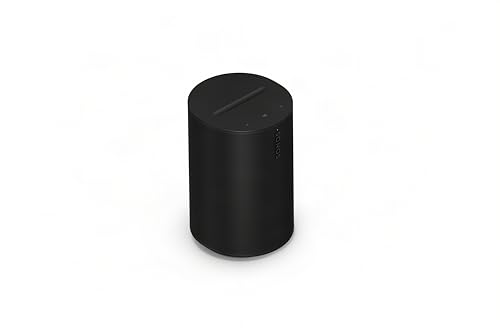
The Sonos Era 100 is a compact wireless smart speaker powered by a 47% faster processor, delivering next-gen audio in a sleek black design. It shines in home settings like kitchens, offices, or bedrooms, where its stereo architecture and bass-focused midwoofer create an immersive listening experience without needing multiple units.
Aimed at tech-savvy Americans who value high-quality sound and smart features, it streams effortlessly from services over WiFi, pairs with Bluetooth devices instantly, and supports line-in for vinyl or other sources. Setup is a breeze: plug in, connect via the Sonos app, and Trueplay tunes it to your room's acoustics for perfect playback every time.
In real-world use, it excels at filling small to medium spaces with clear, detailed sound, making it great for podcasts, music, or Alexa routines. While it thrives in the Sonos multi-room setup, its standalone versatility makes it a solid entry point for upgrading home audio.
Overall verdict: A top pick for those seeking premium smart speaker performance in everyday home spots, blending power, ease, and intelligence seamlessly.
With a dual-tweeter setup and 25% larger midwoofer, the Era 100 produces detailed stereo separation and noticeably deeper bass, ideal for genres from rock to classical. Vocals come through with clarity, thanks to the faster processor handling complex tracks without muddiness.
Volume levels reach room-filling heights without distortion, perfect for lively kitchen sessions or desk work focus. Bluetooth range stays stable up to 30 feet in open spaces, while WiFi ensures uninterrupted streaming from apps like Spotify or Apple Music.
Trueplay analyzes your room and fine-tunes EQ on the fly, elevating performance in varied acoustics like echoey living rooms or cozy nightstands.
The Era 100 boasts a compact, elegant black design that blends into any home decor, from bookshelves to countertops. Its small footprint ensures versatile placement without dominating space, emphasizing sleek, modern aesthetics over rugged portability.
Lacking an IP rating, it's best for indoor use away from moisture, prioritizing premium build quality for daily home reliability. Weight is light enough for easy repositioning between rooms.
As an AC-powered speaker, it delivers continuous play without battery limits, simply plug in for non-stop performance. No charging downtime means it's always ready for your playlists or voice commands.

Pros
- Zero listening microphones for complete privacy in sensitive living spaces
- Impressive stereo separation and low-end punch from a compact desktop footprint
- Supports both high-res WiFi streaming and universal Bluetooth connectivity
- Effortless multiroom synchronization with existing Sonos soundbars and speakers
Cons
- Requires a proprietary Sonos adapter (sold separately) for 3.5mm line-in connections
- No built-in voice assistant capabilities for smart home voice commands
- Must remain tethered to a wall outlet as it does not include a battery
The Sonos Era 100 SL carries forward the legacy of the beloved Sonos One SL, reimagined with next-generation acoustic architecture and modern connectivity. Designed intentionally without built-in microphones, this speaker caters to audiophiles and privacy-minded consumers who want Sonos ecosystem integration without ambient voice listening in private bedrooms, home offices, or dens. Its crisp white finish and modern silhouette effortlessly blend into high-end decor while delivering substantial sonic upgrades over previous generations.
Setup is virtually effortless via the Sonos app on iOS or Android. Within minutes of plugging in, the Era 100 SL joins your local network, unlocks seamless streaming via Apple AirPlay 2, Spotify Connect, and the Sonos app, and introduces direct Bluetooth pairing for guests. For existing Sonos system owners, incorporating the Era 100 SL into an existing multiroom setup or assigning two units as dedicated rear surround channels for a soundbar takes only a few taps.
In everyday use, the speaker shines across diverse environments. As a desktop companion, it provides non-fatiguing, wide-dispersion sound that stays engaging even at low, conversational volumes. When pushed harder during social gatherings, it easily fills mid-sized rooms without noticeable distortion or dynamic compression, handling complex musical passages with composed composure.
Ultimately, the Sonos Era 100 SL is a standout performer in the compact wireless speaker category. By stripping away voice microphones in exchange for peace of mind, while simultaneously upgrading the audio driver array, Sonos has produced an accessible, premium speaker that balances convenience, acoustic precision, and privacy.
Under the grille, the Sonos Era 100 SL features a major acoustic redesign. Unlike traditional single-tweeter mono speakers in this class, the Era 100 SL incorporates two angled tweeters coupled with custom waveguides. This layout physically directs high frequencies to the left and right, creating a convincingly wide stereo soundfield from a single cabinet. Highs sound airy and articulate, rendering cymbals, acoustic strings, and breathy vocals with crisp precision without tilting into harsh sibilance.
Handling the lower registers is an enlarged midwoofer powered by custom class-D digital amplifiers. The driver delivers rich, textured midrange reproduction and surprisingly deep, resonant bass. Kick drums hit with authoritative punch, and basslines remain clean and defined rather than turning into muddy low-end boom. Trueplay tuning uses your mobile device to measure room reflections, smoothing out standing waves and room nodes to ensure flat, accurate sound reproduction whether placed on an open shelf or tucked against a drywall corner.
The Era 100 SL features a sleek cylindrical form factor measuring 4.72 inches deep, 5.19 inches wide, and 7.22 inches high, weighing just under 4.5 pounds. The enclosure is constructed from premium matte-finish polycarbonate with micro-perforated acoustic grilles. The top surface houses intuitive capacitive touch controls for play, pause, track skipping, and volume sliding, keeping the interface clean and tactile without physical buttons or microphone toggles.
Connectivity options have been modernized beyond standard WiFi streaming. The speaker supports dual-band WiFi 6 alongside Bluetooth 5.0 for quick playback from any phone, tablet, or laptop. Around the rear, a multi-purpose USB-C port provides optional line-in capabilities when paired with the Sonos Line-In Adapter, allowing you to connect a turntable, preamp, or CD player directly to your Sonos wireless network. The unit operates on standard 100-240V AC power via a flush-fitting, detachable power cable.

Pros
- True stereo pairing provides an impressively wide and detailed soundstage.
- Seamless dual connectivity with both high-bandwidth WiFi streaming and direct Bluetooth pairing.
- Trueplay tuning effortlessly corrects awkward corner or shelf placement acoustic issues.
- Compact, modern cylindrical aesthetic blends into any home decor.
Cons
- Requires a separate Sonos Line-In USB-C adapter for analog turntable or 3.5mm inputs.
- Needs continuous AC wall power, meaning it cannot be used as a battery-powered portable speaker.
- Advanced Trueplay tuning options offer deeper customization on iOS compared to Android.
The Sonos Era 100 2-Pack represents a massive generational leap over its predecessor, engineered to upgrade casual listening spaces into immersive acoustic environments. Designed for music enthusiasts and smart home adopters alike, this stereo pair solves the common problem of one-dimensional sound from compact wireless speakers. With its updated dual-tweeter acoustic array and enlarged midwoofer, the Era 100 package provides genuine left-and-right channel separation that breathes life into complex arrangements, whether deployed in a single living room or distributed across multiple living zones.
In everyday use, the versatility of this dual bundle shines. Unboxing and setup take only a few minutes through the intuitive Sonos app, which guides you through pairing both units into a synchronous stereo soundfield. Streaming over home WiFi ensures uncompressed, uninterrupted playback, while the addition of Bluetooth gives guests immediate access to share their playlists. Integrated voice assistance via Amazon Alexa and Sonos Voice Control responds reliably from across the room, allowing you to queue tracks, adjust volume, and control connected devices completely hands-free.
Where the Era 100 truly excels is its environmental adaptability. Thanks to automatic Trueplay tuning, the speakers utilize their internal microphone array to read the acoustic reflections of your room, automatically compensating for boundary bass boost on bookshelves or hollow reflections on kitchen counters. The result is a consistent, highly balanced audio profile regardless of room geometry or placement quirks.
Ultimately, this two-speaker package offers tremendous value for those looking to build a high-fidelity multi-room setup or establish a minimalist desktop or living room hi-fi system. While analog enthusiasts will need to purchase an external adapter for turntable playback, the sonic punch, seamless software ecosystem, and refined design make the Sonos Era 100 pair one of the smartest investments in home audio today.
Acoustically, the Sonos Era 100 punches far above its compact weight class. Sonos re-engineered the acoustic core by incorporating two angled tweeters loaded with custom waveguides, paired with a midwoofer that is 25 percent larger than previous generations. This configuration outputs remarkably clean high frequencies and smooth, natural vocal mids while avoiding the harsh sibilance common in small smart speakers. When paired together, the two units create an expansive stereo soundstage that tracks panning instruments with pinpoint spatial accuracy.
The low-end response is punchy, tight, and unexpectedly deep. Basslines in electronic, hip-hop, and rock tracks exhibit substantial weight without bleeding into the lower midrange, ensuring vocal transparency remains uncompromised. Driven by individual class-D digital amplifiers tuned to each driver, the system maintains ultra-low harmonic distortion even at high volume thresholds, delivering room-filling audio that remains composure-rich and articulate whether background listening or hosting a lively gathering.
The Era 100 showcases an elegant, cylindrical silhouette wrapped in a smooth, matte white polycarbonate cabinet with precision micro-perforated grilles. Measuring approximately 7 inches tall and 5 inches wide per unit, each speaker occupies a modest footprint that fits effortlessly on nightstands, floating shelves, or kitchen countertops. The top panel features intuitive capacitive touch controls, including a tactile volume slider, dedicated track skipping, voice assistant mute toggles, and an intentional hardware mic-disconnect switch on the rear for absolute privacy.
On the connectivity side, each unit is powered by standard AC wall current and supports modern dual-band WiFi 6 along with Bluetooth 5.0 for low-latency wireless transmission. The rear features a multipurpose USB-C port that accommodates power-in and supports wired auxiliary inputs or Ethernet via optional Sonos adapters. While the omission of an out-of-the-box 3.5mm jack requires an accessory for analog turntable connection, the sleek industrial build and rock-solid internal components ensure long-lasting durability and premium tactile appeal.
Pros
- Hardware-level microphone exclusion provides guaranteed privacy for sensitive rooms.
- Dual-tweeter design delivers noticeably wider stereo dispersion than previous generations.
- Supports both high-res WiFi streaming and convenient Bluetooth connectivity.
- Compact footprint fits neatly on nightstands, bookshelves, and kitchen counters.
- Simple app-guided setup and integration into existing Sonos ecosystems.
Cons
- Requires constant AC wall power and does not contain an internal rechargeable battery.
- Connecting analog devices like turntables requires a separate USB-C line-in adapter.
- Lacks voice assistant capabilities due to the intentional absence of microphones.
The Sonos Era 100 SL reimagines compact wireless home audio by delivering the impressive acoustic architecture of the renowned Era lineup while deliberately eliminating internal microphones. Engineered for privacy-minded listeners, home offices, and bedroom suites, this speaker brings refined modern aesthetics and effortless multi-room audio integration without smart assistant listening devices in your private sanctuary.
Setting up the Era 100 SL takes only minutes through the intuitive Sonos app, which walks you through network connection and acoustic calibration. In daily listening, the speaker performs impeccably across genres. It reproduces delicate acoustic picking with crisp realism and fills small to mid-sized rooms with effortless presence. The addition of low-latency Bluetooth connectivity makes it easy for visiting guests to stream audio without needing access to your secure local WiFi network.
Beyond standalone operation, the Era 100 SL excels when integrated into a broader home theater or multi-room layout. Pairing two of these units with a Sonos soundbar creates an immersive rear surround array with exceptional spatial detail. For listeners seeking pristine sound quality, rock-solid wireless stability, and complete privacy, the Era 100 SL stands out as a superb domestic audio solution.
Acoustically, the Era 100 SL represents a significant evolutionary step over traditional single-driver wireless speakers. By angling two high-output tweeters in opposing directions and pairing them with custom waveguides, the speaker pushes highs smoothly across the listening area, creating an expansive stereo sweet spot that defies its small stature. Vocals remain centered, rich, and articulate, avoiding the boxy sound common in compact enclosures.
The low-frequency reproduction is anchored by an enlarged midwoofer powered by dedicated Class-D digital amplifiers. Bass response is remarkably authoritative, delivering tight kicks and warm basslines without buzzing or port chuffing. With Sonos Trueplay tuning enabled, the speaker actively measures room reflections and adjusts the frequency curve to ensure tight, balanced low-end performance whether positioned out in the open or right against a wall.
Measuring 4.72 by 5.19 by 7.22 inches, the Era 100 SL showcases a refined cylindrical silhouette wrapped in an acoustically transparent, non-resonant polycarbonate enclosure. The smooth matte black finish blends into contemporary home decor, while top-mounted capacitive touch controls offer immediate volume adjustments, playback scrubbing, and track navigation without requiring your smartphone.
Hardware interfaces include modern dual-band WiFi and Bluetooth capabilities for flexible wireless operation across multiple sources. On the back, a multi-purpose USB-C connection allows you to route analog turntables, CD players, or auxiliary equipment directly into your Sonos network via an optional line-in adapter. Because this speaker is engineered for consistent domestic performance, it draws continuous power from an included AC cable rather than a temporary battery pack.

Pros
- Dual angled tweeters deliver genuine stereo separation and vivid vocal clarity.
- Adds native Bluetooth and line-in capabilities previously missing from compact Sonos speakers.
- Fast, reliable Trueplay tuning tailors EQ profiles to any room layout in seconds.
- Intuitive touch controls with a dedicated capacitive volume slider on the top panel.
Cons
- Line-in adapter for connecting turntables or analog audio gear is sold separately.
- Requires continuous wall power and does not contain a rechargeable battery for on-the-go portability.
- Full advanced Trueplay acoustic tuning remains limited to Apple iOS devices.
The Sonos Era 100 represents a massive evolutionary leap forward for compact wireless home audio. Serving as the direct successor to the long-standing Sonos One, the Era 100 completely overhauls its internal acoustic architecture by incorporating dual angled tweeters and a substantially larger midwoofer. Driven by an upgraded processor, it transforms standard mono playback into an expansive stereo soundstage that punches far above its physical footprint. Designed specifically for listeners who demand pristine acoustic fidelity in medium-sized living spaces, it fits naturally on countertops, nightstands, and bookshelves.
In everyday use, the Era 100 proves just how versatile a modern connected speaker can be. Setting up the unit takes mere minutes using the Sonos app, which automatically detects the speaker and guides you through network pairing. The addition of standard Bluetooth streaming alongside rock-solid Wi-Fi eliminates past connectivity friction, allowing visiting guests to beam music directly to the speaker without joining your private wireless network. Built-in voice commands via Amazon Alexa and Sonos Voice Control execute smoothly, aided by an advanced beamforming microphone array that easily cuts through loud background noise.
Performance across a wide range of musical genres is refined and energetic. High frequencies sparkle with clear separation, mid-range vocals remain articulate, and the lower registers offer unexpected depth without vibrating desktop surfaces. While it requires dedicated wall power and auxiliary inputs require an optional proprietary adapter, the overall acoustic authority and smart integration make the Sonos Era 100 one of the most capable, future-proof wireless speakers on the market.
Acoustically re-engineered from the ground up, the Sonos Era 100 delivers a remarkably wide soundfield thanks to dual high-frequency tweeters angled precisely to the left and right. This architecture produces authentic stereo imaging and high-frequency sparkle that prevents complex instruments and vocal harmonies from sounding congested. Midrange frequencies maintain exceptional transparency, rendering acoustic instruments, spoken podcasts, and lead vocals with lifelike precision and balance.
The low-frequency performance benefits heavily from a 25 percent larger midwoofer powered by custom class-D digital amplifiers. Bass response is articulate, tight, and capable of reaching down to provide substantial punch on modern tracks without rattling cabinet surfaces. With Trueplay room calibration running through the Sonos app, the speaker analyzes physical room reflections and equalizes acoustic output in real time, guaranteeing balanced, distortion-free sound whether placed against an open wall or deep inside a corner bookshelf.
The Sonos Era 100 sports an elegant, cylindrical matte white cabinet that seamlessly blends into contemporary interior decor. Measuring approximately 7.22 inches tall and 5.1 inches wide, the speaker strikes an optimal balance between visual minimalism and internal acoustic volume. The top panel features intuitive capacitive touch controls, including an innovative capacitive volume slider, dedicated track controls, and a hardware microphone disconnect switch on the rear for total privacy control.
On the rear hardware panel, connectivity options are modernized with a multi-purpose USB-C port that supports wired line-in connections for turntables and external audio equipment via the optional Sonos Line-In Adapter. Wireless protocols include high-bandwidth Wi-Fi 6 for ultra-stable, high-resolution home streaming and Bluetooth 5.0 for quick local device pairing. The speaker is mains-powered via a standard detachable power cable, engineered strictly as an uninterrupted stationary audio hub rather than a battery-operated portable device.
Everything You Need to Know About Sonos Era 100 Surround Sound
Sonos engineered its modern speaker lineup to offer flexible deployment options across different listening environments and home audio configurations. You can use the hardware as a standalone room speaker, combine two units for stereo playback, or bind them to a compatible soundbar as dedicated rear surround channels. When configured properly in the companion mobile app, a pair of these compact units delivers spatial sound effects, background ambience, and multi-channel film soundtracks directly behind your seating area.
Primary Sonos Soundbars and Amps Compatible with Era 100 Surrounds
A pair of Era 100 units cannot produce surround sound independently because it requires a primary home theater master device to decode the television audio signal. Compatible soundbars include the flagship Sonos Arc, the Arc Ultra, both generations of the Sonos Beam, and the compact Sonos Ray. If you run a custom installation with passive front speakers, the current Sonos Amp can also act as the primary master device while bonding with Era 100 rear surrounds.
Connecting these satellites to older legacy hardware requires careful attention to software platforms. The Era generation operates exclusively on the modern Sonos S2 software platform and cannot connect to legacy hardware limited to the older S1 platform. While older soundbars like the Sonos Playbar and Playbase can run on S2 software, their optical audio inputs restrict playback to standard Dolby Digital 5.1 rather than modern high-bandwidth streams.
Matching your primary soundbar to room dimensions ensures balanced volume across all listening positions. Pairing high-output rear surrounds with an entry-level soundbar like the Ray can occasionally overpower spoken dialogue unless you manually balance channel levels in the software. Conversely, combining these satellites with a Beam Gen 2 or an Arc creates an expansive front-to-back audio field that handles dynamic home theater mixes with ease.
The Two-Speaker Pairing Rule and Model Matching
Creating an authentic surround configuration requires two physical speakers to handle discrete left rear and right rear audio channels. You cannot bind a single speaker to serve as a consolidated or mono surround channel behind your couch. The home theater software strictly enforces this two-speaker requirement so that directional sound effects pan accurately across the rear acoustic space.
Hardware matching rules are equally strict within the Sonos wireless ecosystem. You must use two identical speaker models to form a surround pair, meaning two standard Era 100 units or two Era 100 SL units. You cannot pair an Era 100 with an older Sonos One, a One SL, or a Play:1 speaker as surround channels, nor can you mix an Era 100 with an Era 300.
Purchasing speakers as an official factory two-pack or as separate individual boxes makes no difference to your final configuration. The individual retail boxes contain the exact same hardware, internal components, and firmware capabilities as those sold in bundled pairs. Once unboxed, each unit registers independently during setup before you bind them together into the designated room group.
Disabled Satellite Features: Bluetooth and Line-In Behavior
One of the most important operational changes occurs immediately after you bond these speakers as surround channels. In standalone mode, the Era series offers versatile direct playback via Bluetooth pairing and an optional USB-C analog line-in adapter. However, once bonded as rear home theater satellites, the software automatically disables both the Bluetooth receiver and the physical line-in connection on both rear speakers.
This limitation exists because the speakers must maintain an ultra-low latency wireless connection directly with the primary soundbar over a dedicated five-gigahertz Wi-Fi link. Permitting an external Bluetooth stream or an analog line-in signal to enter the satellite speakers would introduce clock-drift and latency conflicts with television audio. If you need to connect an external turntable or auxiliary audio source, you must route that signal through an independent Sonos component or a standalone speaker elsewhere in your home.
Microphone functionality also changes when the standard voice-enabled version is bonded to a soundbar. If your front soundbar already features active microphones, such as an Arc or Beam, voice control commands are processed through that primary soundbar rather than the rear satellites. In setups where a microphone-free soundbar like the Ray is used, the microphones on the rear satellites are deactivated during surround operation, making the microphone hardware redundant in home theater mode.
Driver Architecture and Acoustic Sound Dispersion
The internal driver architecture of the Era 100 represents a major evolutionary step over previous generations of compact home speakers. Instead of using a single monophonic tweeter, each unit contains two angled high-frequency tweeters paired with custom waveguides. This acoustic layout produces distinct left and right high-frequency dispersion patterns from a single physical cabinet, creating a remarkably wide sonic footprint behind the listener.
Low frequencies are anchored by an enlarged midwoofer housed inside an acoustically sealed enclosure. The expanded driver displacement provides deeper bass extension, allowing the surrounds to reproduce cinematic impact, engine rumbles, and musical basslines without straining. Because the midwoofer handles lower midrange cues cleanly, off-screen dialogue and environmental Foley effects retain their natural body and weight.
When evaluating your setup against standalone wireless speakers, the difference in directional audio handling becomes immediately apparent. General portable audio devices focus primarily on casual omnidirectional output for personal listening. In contrast, the precision waveguides on these home theater satellites direct directional cues across your room to build a cohesive soundstage that mirrors what is happening on screen.
Step-by-Step Sonos App Configuration and Bonding
Setting up your surround system begins by connecting each speaker individually to your home Wi-Fi network using the mobile application. Plug each unit into standard wall power, open the app, and allow the system to discover the new hardware nearby. Give each speaker a temporary distinct name, such as Left Surround and Right Surround, to simplify the pairing process during the next step.
Once both speakers appear active in your system overview, navigate to the settings menu and select the room containing your primary soundbar. Tap the option labeled Set Up Surrounds and follow the on-screen prompts to begin the wireless bonding process. The application will play a musical chime from one speaker and prompt you to confirm whether the sound originated from the left or right side of your seating area.
Confirming the chime assigns the correct audio channels to each physical speaker cabinet. The system then downloads any required firmware patches to align processing schedules across all bonded speakers. Once the app completes the configuration, the two individual surround icons disappear from your main room list and merge directly under the soundbar room profile.
Physical Placement, Speaker Height, and Room Acoustics
Placing your rear speakers correctly within the room dramatically alters how immersive your surround sound experience feels. Ideally, you should position the speakers just behind or slightly to the sides of your primary couch or seating location. Angling the front grilles inward toward the main listening sweet spot helps focus high-frequency details directly at ear level.
Mounting height is another critical variable when planning your physical layout. If possible, place the top of the speakers roughly at ear level when seated, or slightly higher to prevent listeners sitting on the edges of the sofa from blocking the sound. Positioning them too close to walls or corners can occasionally cause boundary bass reflections, which makes ambient room audio sound boomy or unnatural.
Physical placement options include dedicated floor stands, bookshelf surfaces, or secure wall mounts. Dedicated floor stands position the cabinets at the ideal seated ear height while hiding power cables inside hollow support columns. If you choose wall-mounting brackets, ensure they allow for adequate swivel adjustment so you can tilt the angled tweeters toward your seating area.
Tuning Surround Performance with Trueplay and EQ Controls
Every room presents unique acoustic challenges based on wall materials, glass windows, hard floors, and soft furniture. Sonos addresses these acoustic anomalies through its proprietary Trueplay tuning technology, which measures how audio reflections bounce around your room. Running Trueplay recalibrates the frequency response of both the soundbar and the surround satellites to deliver balanced sound.
Android device users can use Quick Tuning, which utilizes the built-in microphones on the speakers to calculate acoustic reflections. Users with supported iOS devices can take advantage of Advanced Tuning, which uses the smartphone microphone as you walk slowly around the listening area. Advanced Tuning typically produces a more refined calibration curve, smoothing out harsh treble peaks and taming uneven low-end room modes.
After completing Trueplay tuning, you can manually fine-tune your surround experience inside the sound settings tab. The app provides independent sliders for TV Level and Music Level, letting you boost rear volume if you prefer stronger action effects. You can also toggle between Ambient mode, which keeps music subtly in the background, and Full mode, which turns the rear units into full stereo speakers when streaming music tracks.
Era 100 vs. Era 100 SL: Choosing the Best Version for Surrounds
Buyers choosing rear satellites frequently encounter both the standard Era 100 and the Era 100 SL variant. From an acoustic standpoint, both models share the exact same internal driver layout, dual angled tweeters, midwoofer dimensions, and internal amplifier specifications. This means that audio performance, frequency response, and surround dispersion are identical between the two models.
The primary difference between the versions lies in the microphone hardware and voice assistant capabilities. The standard model includes integrated microphone arrays for Amazon Alexa and Sonos Voice Control, along with a physical privacy kill-switch on the rear casing. The SL variant omits internal microphones entirely, making it an appealing option for buyers who prioritize strict hardware privacy in their living rooms.
Because rear surround channels rarely utilize voice control features, the Era 100 SL often represents a smarter, more cost-effective choice for home theater duty. Choosing the SL version avoids paying for unused microphone components while delivering the exact same surround sound performance. If the microphone-free version is readily available in your market, it functions as an ideal drop-in replacement for any surround setup.
Surround Format Handling and Dolby Atmos Capabilities
Understanding how audio formats translate through your home theater system prevents unrealistic expectations during movie playback. When connected to a compatible soundbar receiving a Dolby Digital 5.1 or DTS signal, the Era 100 satellites reproduce discrete rear surround effects accurately. The dual tweeters distribute ambient sounds, passing vehicles, and background musical scores across the back of the room with excellent clarity.
When streaming Dolby Atmos content through an Arc or Beam Gen 2, these speakers handle the rear surround bed channels. However, it is essential to understand that the Era 100 does not contain upward-firing drivers for dedicated height effects. The speaker processes horizontal surround cues, leaving ceiling and height channel reproduction entirely to the upward-angled or virtualized drivers on the front soundbar.
Listeners who demand dedicated physical upward-firing height channels behind the couch must consider larger spatial audio options like the Era 300. The Era 300 features dedicated top-mounted and side-mounted drivers specifically designed to bounce Atmos height audio off the ceiling. For standard living rooms and traditional surround sound mixing, however, the dual-tweeter architecture of the Era 100 provides more than enough immersion for most viewers.
Diagnosing Connection Drops and System Troubleshooting
While the wireless pairing process is generally straightforward, network congestion or interference can occasionally cause setup errors. A common issue occurs when the mobile application fails to locate the second speaker during the surround configuration wizard. This problem often stems from dual-band routers attempting to steer one speaker to a 2.4 GHz channel while the other connects to 5 GHz.
If your rear speakers frequently drop audio or cut out during action movies, local wireless interference is the most probable cause. The primary soundbar communicates with the rear satellites over a direct ad-hoc wireless bridge. Placing high-powered Wi-Fi routers, cordless telephone bases, or heavy metal objects directly between the soundbar and the surrounds can disrupt this audio stream.
Resolving these connectivity issues usually requires safe, reversible network adjustments. Power cycle your router, soundbar, and rear speakers by unplugging them from the wall for thirty seconds before rebooting. Checking your television settings to ensure digital audio output is set to Pass-Through or Bitstream can also eliminate unexpected audio processing lag between the screen and the speakers.
Deploying a pair of Era 100 or Era 100 SL speakers as rear satellites offers an effective, modern way to complete a multi-channel home theater system. They provide substantial acoustic dispersion and clean bass reinforcement without demanding complex speaker wire routing across your floors. By verifying soundbar compatibility, honoring the two-speaker pairing rule, and running Trueplay calibration, you can enjoy a balanced and immersive cinematic audio experience right at home.


Write Your Review
No reviews yet. Be the first to share your experience!