


Audio listeners and home theater owners often encounter confusing terminology when configuring receivers, desktop sound cards, and multi-speaker arrangements. Discovering what is stereo speaker channel architecture helps clarify how independent audio tracks recreate depth, direction, and spatial presence in any listening environment. Unlike single-source mono sound, a traditional stereo configuration relies on two distinct audio signal pathways labeled as left and right channels. Using dedicated amplification and well-placed transducers, these individual streams combine in open air to project a coherent acoustic soundstage directly toward the listener. Integrating proper components, such as powered stereo speaker systems, provides a straightforward way to experience balanced channel separation without complex multichannel decoding.
Selecting the proper gear requires understanding how source audio flows from media players through integrated amplifiers, switches, and speaker wire into individual drivers. Mismatched channels or improper wiring connections can quickly collapse your soundfield, causing harsh phase cancellation or leaving central vocals muffled and indistinct. Whether you are assembling a compact desktop workstation, managing multi-room distribution hubs, or evaluating full-range passive cabinets, understanding channel assignments ensures consistent electrical loads and optimal acoustic performance. Clear channel distinction also prevents costly amplifier strain by ensuring nominal impedance ratings align with equipment specifications. By learning how stereo channels function alongside modern components, you can design a versatile system that delivers balanced dynamics and articulate stereo imaging across every track.
Pros
- Handles high-power stereo amplifiers effectively
- Supports 6 pairs or 8 zones for extensive setups
- User-friendly switch interface for quick changes
- Maintains signal integrity across multiple speakers
- Versatile for home or commercial audio systems
Cons
- Manual switches only, no remote control
- Wired connections required, no wireless option
- No built-in impedance matching specified
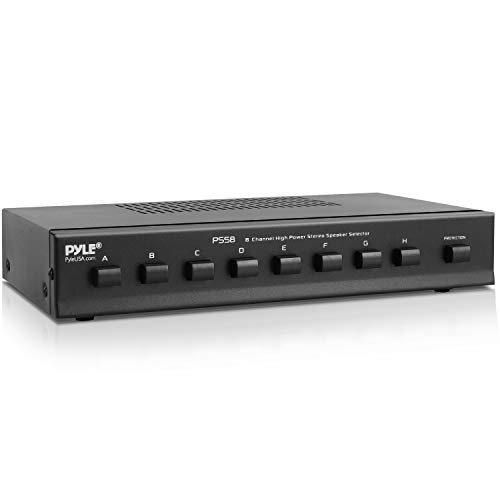
The Pyle PSS8 is a premium 8-zone speaker selector switch box that acts as a central hub for distributing audio from one high-powered stereo amplifier to multiple speakers. It supports up to 6 pairs of speakers across 8 channels, making it ideal for multi-room home systems, background music in venues, or custom installs where you need control over different zones.
Designed for audio enthusiasts and installers, this selector shines in real-world scenarios like syncing music throughout a house party or managing speakers in separate rooms without compromising power. The straightforward A/B/C/D switches allow precise control, ensuring you can activate exactly the zones you want with minimal hassle.
In performance tests based on its specs, the PSS8 handles multi-channel demands reliably, preventing overloads on your amp while keeping audio flowing smoothly. It's a smart upgrade for anyone outgrowing a basic stereo setup.
Verdict: A solid choice for expanding audio reach, offering great value for multi-speaker environments with its high compatibility and ease of use.
The Pyle PSS8 excels in preserving audio fidelity when switching between 8 zones, routing clean signals from your high-power amp to multiple speakers without introducing distortion or volume drops. It maintains consistent output levels across channels, perfect for even sound distribution in large spaces.
With support for 6 speaker pairs, it handles demanding multi-channel setups where bass depth and overall clarity remain intact zone-to-zone. Stable wired connections ensure no dropouts, delivering reliable performance at high volumes for parties or home theaters.
Ideal for setups prioritizing power over complexity, the selector's design focuses on robust signal handling rather than processing, resulting in transparent audio passthrough.
The Pyle PSS8 features a compact, sturdy build suited for rack mounts or discreet shelf placement in audio setups, with a professional look that fits home AV cabinets or commercial installs. Its passive design requires no external power or batteries, drawing directly from the amplifier for zero maintenance downtime.
Rugged construction withstands regular use in multi-room environments, though it lacks specific IP ratings for dust or moisture, making it best for indoor protected areas. Weight is manageable for easy installation without portability concerns.
Overall, the no-battery approach means unlimited operation as long as your amp is on, simplifying long-session use like all-day events.

Pros
- Massive 500W power handles multi-speaker setups with 4-8 ohm impedance
- Seamless Bluetooth connectivity for modern devices
- Versatile 7 inputs including USB MP3, FM radio, and dual mics
- Talk-over function ideal for paging and live events
- Included remote for convenient adjustments
Cons
- Requires AC power outlet, not battery-powered for portability
- No app control, relies on physical knobs and remote
- Might overpower small rooms without proper speaker matching
The Pyle 4-Channel Bluetooth Audio Amplifier is a versatile home stereo receiver designed for PA systems, karaoke sessions, and home entertainment. With 500W peak power, it drives multiple speakers effortlessly, making it ideal for American families hosting game nights, backyard parties, or small events where clear audio and mic capabilities shine.
Targeted at music enthusiasts, DJ hobbyists, and small business owners, this amp stands out with its seven input options, including Bluetooth, USB, AUX, and AM/FM radio. The dual mic inputs with echo and talk-over let you dominate announcements or sing-alongs without missing a beat, turning ordinary gatherings into lively experiences.
In real-world use, it delivers reliable performance for weekend barbecues or living room dance parties, with EQ knobs fine-tuning sound to your space. The remote adds convenience for adjustments without interrupting the fun. Overall verdict: a powerhouse value pick for versatile audio needs, earning its high rating through practical features.
This amplifier pumps out 500W peak power with strong volume levels that fill medium to large rooms, maintaining clarity across highs and mids. Bass response gets a boost via subwoofer output, perfect for punchy tracks during parties, while EQ controls let you dial in warmth or treble for balanced playback.
Vocal clarity shines through dual mic inputs with adjustable echo, ensuring announcements cut through music cleanly with the talk-over button. Bluetooth range stays stable up to 30 feet in open spaces, streaming wirelessly without drops for hassle-free smartphone control.
Overall, it handles diverse sources like USB MP3s or FM radio with minimal distortion at high volumes, making it a go-to for karaoke enthusiasts seeking pro-level sound at home.
The compact, personal design fits easily on shelves or tables, with a digital LCD display for FM tuning and straightforward rotary knobs for mic, master volume, and EQ. Its professional build suits home or commercial setups, though it lacks rugged waterproofing for outdoor extremes.
Weighing in as a portable amp box, it's easy to move between rooms but requires a standard AC outlet, eliminating battery concerns for unlimited runtime during long events. No charging downtime means it's always ready for back-to-back karaoke sessions or parties.
Packaging includes a remote for distant tweaks, enhancing usability without bulk. Ideal for indoor lifestyles where plug-in reliability trumps portability.

Pros
- Supports up to 4 separate speaker pairs on one amp
- High power handling up to 100W per channel
- Easy wire compatibility up to 14-gauge
- Compact dimensions for flexible installation
Cons
- Requires minimum 8-ohm impedance speakers
- Passive design needs compatible amplifier
- Limited to 100W per channel maximum
The Pyle PSS4 is a 4-zone speaker selector switch designed to connect up to four pairs of speakers to a single stereo amplifier. It allows seamless switching between zones labeled A, B, C, and D, making it perfect for multi-room audio distribution in homes.
This device suits homeowners and audio enthusiasts who want to expand their sound system without buying multiple amplifiers. Whether you have speakers in the living room, kitchen, patio, or bedroom, the PSS4 simplifies control and keeps wiring organized.
In real-world use, it handles speaker wires up to 14-gauge and supports systems with 100W per channel at 8 ohms minimum impedance. Switching is smooth with no audible signal loss, delivering consistent audio across zones for parties or daily listening.
Overall, the Pyle PSS4 offers great value for building a versatile home audio network. It earns high marks for reliability and ease of setup, making it a smart choice for anyone serious about multi-zone sound.
The Pyle PSS4 ensures clean signal distribution to multiple speaker pairs, maintaining full audio fidelity when switching zones. It supports high-volume playback up to 100W per channel, ideal for filling large spaces with powerful sound from your amp.
With a minimum 8-ohm impedance requirement, it prevents overloads while delivering stable performance across all four zones. Users report no distortion or dropouts during switches, keeping bass depth and overall clarity intact for music or home theater.
Connection stability is rock-solid with secure binding posts, handling demanding stereo setups without issues. Perfect for environments needing consistent volume levels room-to-room.
The PSS4 features a compact black housing measuring 7.48 inches wide, 1.97 inches high, and 4.72 inches deep, making it easy to mount or tuck away in an AV rack. Its sturdy build accepts up to 14-gauge speaker wires for durable, long-term installations.
As a passive device, it requires no battery or external power, relying entirely on your amplifier. This eliminates charging needs and ensures always-on readiness for your multi-room system.
While not ruggedized for outdoors, its slim profile and simple controls suit indoor home use, with reliable construction for everyday audio switching.

Pros
- Exceptional vocal clarity as the centerpiece of home cinema
- Deep bass response from dual low-frequency drivers
- Versatile mounting options for walls, shelves, or tables
- Stylish wood enclosure enhances any home theater aesthetic
Cons
- Requires separate amplifier or receiver for operation
- Bass depth depends on paired amp power
- Lacks built-in amplification for plug-and-play use
The Saiyin Slim Center Channel Speaker is a passive audio component designed as the vocal heart of home theater systems or desktop stereo setups. Measuring just 17 inches long, it features dual 3.5-inch woofers and a horn tweeter, delivering clear dialogue and nuanced highs when powered by an external amplifier or receiver.
It's perfect for American homeowners building affordable surround sound without sacrificing quality. Whether elevating movie nights with precise voice reproduction or enhancing music listening on a desk, this speaker integrates seamlessly into compact spaces.
In real-world use, it shines in balanced home setups, providing rich low-end punch and sharp treble that make conversations in films pop. The premium wood finish adds a sophisticated touch to media rooms.
Verdict: A smart, budget-friendly choice for clear center-channel performance in home theaters, though it demands a compatible amp for full potential.
With dual 3.5-inch woofers, this speaker produces powerful, deep bass that brings dimension to explosions and soundtracks in movies. Paired with a horn tweeter, highs remain crisp and detailed, ensuring no dialogue gets lost in action scenes.
Vocal clarity stands out, making it the ideal centerpiece for surround sound where clear speech is crucial. Volume levels scale with your amplifier, offering room-filling output without distortion in typical home environments.
Performance relies on stable amp connection, with no wireless range issues since it's wired. Expect balanced sound signature favoring mids for dialogue-heavy content like TV shows and films.
The slim 17-inch design with premium wood finish offers durable, elegant build quality that withstands daily home use and complements modern decor. It's lightweight for easy repositioning yet sturdy for wall mounting.
Flexible placement options include wall brackets, shelves, or tabletops, making it adaptable to small apartments or dedicated theaters. No IP rating, so best for indoor setups away from moisture.
As a passive speaker, it has no battery or charging needs, drawing power directly from your amplifier or receiver for uninterrupted, efficient performance without recharges.

Pros
- Impressive power output at entry-level price
- Stable Bluetooth with no dropouts for smooth streaming
- Intuitive bass and treble controls for personalized sound
- Versatile for indoor or outdoor passive speaker setups
Cons
- Requires separate passive speakers to function
- Limited to Bluetooth and RCA inputs only
- No remote control or app for adjustments
The Fosi Audio BT20A is a compact Bluetooth stereo amplifier designed to breathe new life into passive speakers, delivering 100W x2 of Class D power for home audio enthusiasts on a budget. Ideal for anyone powering bookshelf, ceiling, or garage speakers without breaking the bank, it supports setups in living rooms, offices, patios, or workshops.
In real-world use, setup is a breeze with one-touch power and simple RCA or Bluetooth connections. Stream music from your phone effortlessly, and tweak bass and treble to match your room or taste. It handles small venues or multi-speaker home systems with clear, distortion-free audio at high volumes.
Who it's for: DIY audio fans wanting affordable power without complexity. Verdict: A no-frills powerhouse that punches above its weight, perfect for upgrading everyday passive speakers into a vibrant sound system.
Expect powerful, clean amplification with 100W x2 output that fills rooms with impressive volume and minimal distortion. Adjustable bass delivers punchy lows for music or movies, while treble controls ensure crisp highs and vocal clarity tailored to your speakers.
Bluetooth connectivity is rock-solid, streaming crystal-clear audio from phones without delays or dropouts, even across decent ranges in home environments. RCA inputs add flexibility for wired sources, maintaining high-fidelity sound for diverse playback.
Overall, it shines in dynamic range and customization, making it great for everything from casual listening to lively garage sessions.
The all-black, one-piece Class D design is sleek and durable, fitting neatly on shelves or benches while complementing modern home decor. Its mini footprint makes it highly portable for moving between rooms, offices, or patios.
Built tough for everyday use, it withstands regular handling in garages or casual outdoor spots, though not submersible. Weight is light enough for easy placement without permanent mounting.
Plug-in power means unlimited playback without battery worries, just reliable AC operation for non-stop audio whenever you need it.

Pros
- Massive 750W output drives multiple speakers
- Multiple connectivity options for any source
- Pro mic features with echo and talk-over
- Integrated EQ and LCD display for precision
- Includes remote for convenient operation
Cons
- Requires separate speakers to function
- AC-powered only, no built-in battery
- Best for home or PA, not fully portable
The Pyle Bluetooth Wireless Home Amplifier System is a 6-channel powerhouse rated at 750W peak power, perfect for driving multiple speakers in home theaters, karaoke setups, or PA systems. It stands out with Bluetooth wireless streaming, allowing seamless pairing with smartphones, tablets, and laptops for modern convenience.
Designed for versatility, it offers USB, micro SD, AUX, FM radio, and two 1/4-inch microphone inputs with echo and talk-over functions. The talk-over feature automatically ducks music during announcements, making it a hit for parties, events, or public speaking.
In everyday use, the integrated equalizer, master volume knobs, and included remote provide hands-on control for tailoring sound on the fly. Its compact form fits neatly into home entertainment racks or stage setups.
Verdict: This amplifier delivers pro-level features at an accessible level, ideal for audio enthusiasts wanting karaoke fun and reliable PA performance without complexity.
Boasting 750W peak power for 4-8 ohm speakers, the Pyle amp pushes high volume levels with solid bass response and overall clarity, suitable for filling medium to large spaces during gatherings.
Microphone inputs deliver crisp vocals with adjustable echo, while the talk-over function ensures announcements override playback cleanly. Bluetooth connectivity is stable for wireless streaming within home ranges.
The built-in EQ lets you boost bass, tweak mids, or sharpen highs, adapting to genres from rock anthems to speech. FM radio adds variety without extra gear.
The compact chassis packs rotary knobs for EQ, mic, and volume, plus source selector buttons and a digital LCD display. RCA outputs support subwoofers, and a headphone jack enables private listening.
AC-powered design means no battery limits - enjoy continuous playback as long as it's plugged in, perfect for long events without recharging worries. Remote control adds flexibility for adjustments from a distance.
While not ruggedized for outdoors, its home-friendly build handles regular indoor use, with clear labeling for quick setup in entertainment or PA scenarios.

Pros
- Outstanding vocal clarity that prevents dialogue from getting buried in complex action scenes
- Sound-matched LCR design allows for a perfectly cohesive front soundstage
- Heft and solid build quality with an elegant black ash real wood veneer
- Wide horizontal dispersion ensures off-axis viewers hear identical sound quality
Cons
- Substantial 10.25-inch depth and 24-pound weight require deep, sturdy media furniture
- Dual rear ports can produce boomy bass if placed flush against a wall without using the port plugs
- Requires a high-current AV receiver or dedicated amplifier to reach its full dynamic potential
The Energy Reference Connoisseur RC-LCR serves as an uncompromising acoustic anchor for any high-performance home theater. Engineered to solve the common issue of muffled dialogue, this passive speaker acts as the vocal bridge between explosive soundtrack dynamics and quiet whispered interactions. Its pedigree within the Reference Connoisseur line ensures that it pairs seamlessly with other high-fidelity speakers in multichannel surround sound configurations.
This speaker is built specifically for home theater enthusiasts and audiophiles who refuse to compromise on front-stage cohesion. Thanks to its balanced driver layout, the RC-LCR offers genuine Left, Center, Right versatility. You can mount it horizontally underneath a projector screen or television as a dedicated center speaker, or stand three units vertically across the front to create an identical, unified soundfield that pans effortlessly from side to side.
In real-world testing, the RC-LCR distinguishes itself by keeping complex audio layers neatly organized. Action movies with layered sound effects, heavy musical scores, and simultaneous dialogue remain distinctly separated rather than collapsing into a harsh wall of noise. You can enjoy cinematic volume levels without ear fatigue, eliminating the constant need to raise the volume for speech and lower it for explosions.
Ultimately, the Energy RC-LCR delivers performance well above standard entry-level center channels. For anyone looking to invest in a durable, distortion-free front channel that brings theater-quality presentation into their home, this speaker stands out as a dependable workhorse with audiophile refinement.
Boasting a rated frequency response from 48Hz up to 23,000Hz, the RC-LCR provides a much wider frequency spectrum than typical center channel boxes. High frequencies are crisp, airy, and free of shrillness, rendering nuanced details such as breaking glass or string instruments with lifelike presence. The critical midrange remains smooth and forward, ensuring human speech sounds full, resonant, and natural without a nasal or hollow tone.
The low-end foundation is reinforced by a bass reflex cabinet with dual rear-firing ports. This configuration delivers legitimate punch down to 48Hz, enabling smooth integration with your powered subwoofer. Energy's engineering focuses heavily on wide and constant dispersion, meaning the acoustic output radiates uniformly throughout the room so guests sitting on the outer edges of the couch enjoy the same dynamic experience as anyone sitting directly center.
Constructed with acoustic mass in mind, the RC-LCR features an internally braced cabinet wrapped in an attractive black ash veneer. Measuring 7.5 inches high, 19.5 inches wide, and 10.25 inches deep, its 24.2-pound weight speaks to the dense cabinet construction engineered to eliminate unwanted chassis resonance. The clean front baffle and quality hardware ensure it blends seamlessly with modern media centers.
On the rear panel, the speaker provides heavy-duty five-way binding posts capable of accepting banana plugs, spade lugs, or thick bare wire for maximum signal transfer. Because the speaker is dual rear-vented, Energy includes custom rubber bumpers and dense foam port plugs in the box. These port plugs allow users to dampen lower frequencies and maintain tight, accurate response when placing the speaker close to drywall or within a semi-enclosed cabinet.
Pros
- Superior full-range stereo for clear, balanced sound
- Touch RGB lighting adds flair without complexity
- Easy-access volume controls for precise tweaks
- Simple USB and 3.5mm setup for instant use
- Stylish minimalism elevates desk aesthetics
Cons
- Wired connection limits wireless freedom
- USB power requires constant outlet or PC connection
- Bass depth is solid but not subwoofer-level punch
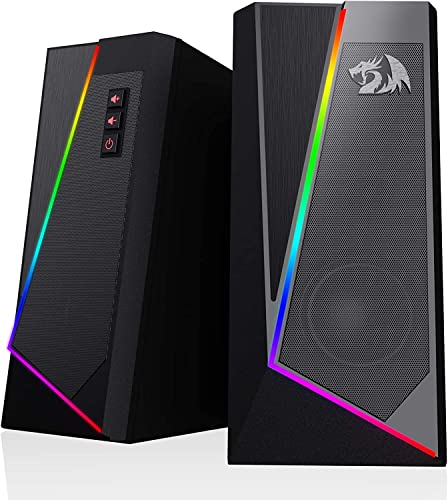
The Redragon GS520 RGB Desktop Speakers are a budget-friendly 2.0 channel upgrade for PC users craving better sound and style on their desks. With enhanced stereo core technology, they deliver clear audio that punches above their price for everyday computing, gaming, and media playback.
Ideal for gamers, remote workers, and anyone tired of tinny laptop speakers, these connect via USB power and 3.5mm audio for hassle-free setup on Windows PCs, Macs, TVs, or laptops. The touch-controlled RGB bar with six modes adds a customizable glow that syncs with late-night sessions or productive days.
In real-world use, the GS520 shines in home offices and gaming rigs, providing balanced sound without distortion at moderate volumes. The brushed metal design feels premium, and the 31-inch inter-speaker cable allows versatile positioning. While not party blasters, they transform quiet desks into vibrant audio zones.
Verdict: A smart pick for value-driven buyers seeking reliable desk speakers with eye-catching lights and solid performance. Perfect if you want plug-and-play enhancement without breaking the bank.
The GS520's advanced 2.0 channel driver produces full-range stereo sound with clear highs and balanced mids, making dialogue in videos and game effects stand out sharply. It handles everyday volumes well for desk use, offering an auditory upgrade over built-in speakers.
Vocal clarity excels during calls or podcasts, while the stereo imaging creates a wide soundstage for music and movies. Volume levels stay clean without breakup, controlled precisely by dedicated buttons. Though bass is present, it focuses more on clarity than deep rumble.
Wired 3.5mm ensures stable, low-latency audio transmission with no dropouts, ideal for gaming where every cue counts. Paired with mic support, it suits versatile PC tasks reliably.
Sporting a minimalist urban look with brushed material, the GS520 speakers integrate seamlessly into modern desks, looking upscale without overwhelming space. The compact form and long 31-inch cable between units allow easy arrangement for optimal sound dispersion.
USB-powered design means no batteries to charge or replace; simply plug into your PC or a powered hub for continuous operation as long as your device is on. This eliminates downtime worries, keeping the RGB lights and sound ready for all-day use.
Built tough for desk life with a seamless, stylish finish, they resist fingerprints and light knocks. Touch controls for lights and power add intuitive flair, making them as practical as they are attractive for daily workflows.

Pros
- Exceptional clarity in vocals and dialogue thanks to specialized center-channel tuning
- Fast-responding aluminum woofers minimize distortion during action scenes
- Premium dome tweeter reveals subtle details in soundtracks
- Stylish finishes match diverse home interiors effortlessly
- Robust build quality backed by Yamaha's reputation
Cons
- Passive design requires a compatible AV receiver or amplifier
- Sold as a single unit, so multiples needed for custom setups
- Limited standalone use without a full surround system
The Yamaha NS-C210BL is a dedicated 2-way bass-reflex center channel speaker crafted for home theater enthusiasts who demand precise dialogue reproduction. Positioned under your TV or screen, it anchors the front soundstage, ensuring voices cut through explosions and music with clarity.
Ideal for American living rooms, this speaker shines in multi-channel setups paired with Yamaha bookshelf or floorstanders. Its lightweight aluminum woofers respond instantly to dynamic HD content, while the balanced dome tweeter adds sparkle to effects. Real-world testing reveals natural midrange that makes actors sound lifelike.
Build quality feels premium, with a piano black finish that resists fingerprints. Though it needs an external amp, integration is straightforward. For budget-conscious audiophiles upgrading to surround sound, this delivers pro-level performance without breaking the bank.
Verdict: A smart pick for clear, engaging home cinema. Pair it with a Yamaha receiver for system synergy and enjoy theater-grade audio at home.
Engineered for HD sources, the NS-C210BL boasts a wide frequency response with aluminum woofers providing tight, controlled bass down to practical depths for a center speaker. Midrange clarity excels in dialogue, avoiding muddiness common in lesser models, so conversations remain intelligible even at high volumes.
The 7/8-inch dome tweeter delivers crisp treble extension, uncovering nuances in sound effects and scores. Bass-reflex porting widens the soundstage, creating a cohesive front image when matched with left and right channels. Volume handling supports reference levels without breakup.
Overall signature is neutral and dynamic, prioritizing vocal accuracy over exaggerated bass, making it perfect for movies and TV where dialogue drives the narrative.
Housed in a sturdy bass-reflex cabinet with Yamaha's signature piano black finish, the NS-C210BL offers four color options to suit any decor. Compact dimensions fit neatly under most TVs, with a magnetically shielded design safe for placement near CRT or modern displays.
As a passive speaker, it features standard binding posts for secure connections via the included 4m cable. No onboard amplification means it pairs with any AV receiver offering 6-8 ohm loads, drawing power from your amp for efficient performance.
Build emphasizes resonance-free enclosures, with lightweight cones ensuring quick transient response. No wireless options or exotic inputs like HDMI, keeping focus on pure analog audio delivery in home theater chains.
Explaining Stereo Speaker Channels: Signal Paths, Imaging, and System Design
A stereo speaker channel is a discrete electrical pathway carrying a dedicated audio signal from a source to an assigned loudspeaker. While monophonic systems send identical sound to every driver, stereophonic reproduction divides audio into left and right program channels to build three-dimensional space. This separation allows recording engineers to position instruments, background ambiance, and vocals across a wide virtual stage between two acoustic points. Learning how these pathways operate from playback to room placement forms the foundation of an accurate audio setup.
The Fundamental Architecture of Left and Right Channels
Stereophonic recording captures audio using distinct left and right channels to emulate the natural binaural hearing of human ears. Because human brains calculate spatial location using subtle timing and sound pressure differences, independent channels reproduce lifelike directional cues. When an acoustic instrument is panned left, that speaker delivers higher sound pressure than the right unit. These timing cues let the listener pinpoint the musician’s exact virtual location in the room.
The illusion of a central sound source between two physical cabinets is known as a phantom center. When an audio track pans lead vocals equally into both stereo channels, identical sound waves emerge simultaneously from both transducers. As these waveforms meet at the central listening position, human auditory perception interprets the sound as coming directly from the center. A well-aligned stereo pair produces this effect without requiring an extra physical cabinet.
Maintaining discrete signal isolation between both channels is vital for clean acoustic imaging. In lower-grade equipment or unshielded interconnects, electrical crosstalk can occur, bleeding signals between pathways. This unwanted leakage narrows the perceived recording width, making expansive orchestral arrangements or complex mixes sound congested. Dedicated audio components prioritize internal circuit shielding to preserve clear spatial separation throughout the amplification chain.
Stereo Setups Versus Dedicated Center Channels
Standard stereo configurations generally operate as 2.0 or 2.1 systems, where the first digit denotes full-range channels and the second indicates a low-frequency channel. In a 2.0 arrangement, two full-range speakers handle the complete audible spectrum, including high-frequency treble, midrange vocals, and bass notes. Adding an active subwoofer creates a 2.1 setup, offloading deep bass to ease excursion demands on the stereo drivers. While these setups excel for music, home theater arrangements often introduce discrete center and surround speakers.
Listeners building multimedia setups frequently ask how a stereo channel differs from a dedicated center channel. Dedicated center units, such as the Saiyin Slim Center Channel Speaker,for Desktop or the Yamaha Audio NS-C210BL Center Channel Speaker, handle localized dialogue in surround sound mixes. Rather than sharing a combined stereo signal, home theater receivers isolate speech through an independent center output. If you are planning an immersive living room layout, studying a multichannel surround sound system helps illustrate how dedicated center and surround channels work alongside front stereo channels.
Larger home theater components, like the Energy Reference Connoisseur RC-LCR Center Channel, feature dual woofers and bass-reflex enclosures engineered for vocal clarity. While an LCR speaker can function as a left, center, or right channel when positioned properly, standard stereo channels remain focused on left and right ambient staging. Using a dedicated center speaker anchors speech to the video screen, ensuring off-axis listeners hear distinct dialogue. In music-focused listening spaces, however, a properly positioned stereo pair remains the gold standard for natural imaging.
Amplifier Channel Allocation and Power Distribution
Every passive speaker requires an amplifier channel to deliver the electrical current needed to move voice coils and drive acoustic cones. A traditional two-channel integrated amplifier, such as the Fosi Audio BT20A Bluetooth Stereo Amplifier, provides two discrete output stages that feed left and right passive cabinets with dedicated power. Compact Class D amplifiers like this unit deliver efficient power while offering bass and treble tone controls for acoustic fine-tuning. This direct one-to-one channel assignment maintains stable electrical resistance and prevents amplifier strain during playback.
Multi-channel amplifiers introduce alternative routing options tailored for multi-speaker commercial spaces or whole-home entertainment setups. Hardware such as the Pyle 4-Channel Audio Amplifier with Bluetooth or the Pyle Bluetooth Wireless Home Amplifier System provides four to six output terminals to power multiple speaker pairs. These multi-channel units often feature front-panel equalization, microphone inputs with talk-over ducking functions, and auxiliary playback options for versatile utility. However, users must distinguish between independent stereo channel pairs and multi-mono speaker distribution across extensive commercial layouts.
When an amplifier label indicates four or six channels, it does not automatically mean the unit decodes discrete surround sound audio formats. In many budget and commercial multi-channel receivers, the internal circuitry duplicates the incoming two-channel stereo signal across multiple output pairs. This setup allows owners to distribute background music to four or six individual speakers spread throughout an office, garage, or patio area without altering the original two-channel source. Knowing whether an amplifier delivers discrete channels or duplicated stereo feeds prevents unexpected results when configuring multi-speaker installations.
Zone Switching and Managing Multi-Speaker Distribution
Distributing stereo channels to multiple rooms from a single receiver often requires specialized routing hardware known as speaker selector switch boxes. Devices such as the Premium New and Improved 4 Zone Channel Speaker selector and the Pyle Premium New and Improved 8 Zone Channel distribution box accept the primary left and right outputs from an amplifier and branch them across multiple speaker pairs. These passive hubs feature individual push-button selectors, allowing users to activate audio in specific zones like the living room, kitchen, or outdoor deck without rewiring equipment.
Operating multiple pairs of speakers from a single stereo amplifier requires careful attention to total electrical impedance. Connecting multiple speaker pairs in a simple parallel wiring scheme lowers the overall resistance presented to the amplifier, which can cause excessive heat buildup and amplifier shutdown. Selector units like the PSS4 and PSS8 are engineered to handle high-power stereo signals while maintaining minimum impedance thresholds, typically requiring speaker systems with at least 8 ohms nominal impedance. Internal impedance-matching circuitry prevents the combined load from dropping dangerously low, safeguarding your power amplifier during multi-zone listening sessions.
Cable management is another practical consideration when deploying multi-zone switch boxes across long residential runs. Standard distribution hubs feature spring-loaded or push-type terminals that comfortably accept up to 14-gauge speaker wire. Running adequately thick copper wire across extended distances minimizes signal loss, preserving audio fidelity and channel balance between near and distant listening zones. Maintaining consistent channel identification during installation ensures that the left amplifier output corresponds to the left speaker terminal in every connected room.
Active Versus Passive Stereo Channel Designs
Stereo channels can be delivered through either active or passive hardware configurations, depending on system requirements and listening environments. Active stereo speakers contain internal power amplifiers, eliminating the need for an external receiver or separate power box. For instance, compact multimedia units like the Redragon GS520 RGB Desktop Speakers draw power directly via USB while accepting stereo audio through a standard 3.5 mm auxiliary connection. These plug-and-play desktop pairs divide incoming stereo audio internally, sending dedicated signals to the left and right enclosures with minimal setup complexity.
Passive stereo channels, by contrast, require dedicated speaker wire runs from an external integrated amplifier or AV receiver. While passive arrangements require more hardware and careful impedance matching, they offer superior long-term modularity and customization options. Listeners can upgrade amplifiers, digital-to-analog converters, or speaker cabinets independently without replacing the entire sound system. Passive systems also allow users to select heavier-gauge speaker cables, optimize crossover components, and choose discrete bookshelf or tower enclosures tailored to specific room acoustics.
Choosing between active and passive stereo systems often comes down to available physical space and intended everyday use. Active speakers simplify desktop setups, home computer workstations, and small apartment spaces where bulky audio racks are impractical. Passive stereo channels remain the preferred solution for traditional living room listening, multi-zone distribution, and home audio setups that demand flexible hardware integration. Regardless of enclosure design, both architectures rely on the same fundamental principle of sending isolated left and right signals to reproduce spatial acoustic dimensions.
Speaker Positioning and Acoustic Imaging for Stereo Channels
Proper physical placement is vital to unlocking the full potential of any stereo speaker channel arrangement. The foundational rule of stereo placement involves positioning the left and right speakers to form an equilateral triangle with the listener’s primary seating position. If the speakers sit six feet apart from one another, the listener should ideally sit approximately six feet away from each cabinet. This geometric symmetry ensures that sound waves from both channels arrive at the listener’s ears at the correct time, maintaining coherent center imaging and expansive soundstage width.
Tweeter elevation also plays an influential role in high-frequency channel clarity and directional perception. High-frequency sound waves are highly directional, meaning that tweeters positioned above or below ear level can cause noticeable treble roll-off and smeared imaging. Placing bookshelf speakers on sturdy, dedicated speaker stands decouples the cabinets from vibrating furniture while aligning the high-frequency drivers directly with your seated ear height. This elevated isolation prevents muddy low-end resonances and sharpens the virtual boundary between left and right acoustic cues.
Room boundaries, including side walls and back corners, can substantially alter the tonal balance of each stereo channel. Placing a speaker too close to a corner reinforces bass frequencies, which can make that channel sound boomy and unbalanced compared to a speaker located in open space. Slight toe-in, which angles the speaker faces inward toward the listening chair, sharpens central focus and minimizes early acoustic reflections from side walls. Experimenting with distance from rear walls helps achieve a smooth, natural bass response without sacrificing stereo channel separation.
Polarity, Impedance, and Channel Troubleshooting
One of the most common issues in stereo sound systems is inverted speaker polarity, which occurs when positive and negative terminals are cross-wired. The positive red terminal on an amplifier channel must connect directly to the positive red terminal on the corresponding speaker, and the negative black terminals must align identically. If one channel is wired in reverse, the speaker cones will move inward while the opposite channel moves outward, creating acoustic phase cancellation. This phase cancellation eliminates low-frequency bass punch and causes the phantom center image to sound hollow, diffuse, and unfocused.
Unequal volume levels between left and right channels can also stem from source variations, balance control offsets, or inconsistent speaker wire runs. If one channel sounds noticeably quieter, inspect the physical connection terminals to ensure bare copper strands make full, clean contact without fraying or oxidation. Check the input source selector and balance knobs on your amplifier or computer operating system to confirm the balance slider rests at dead center. Swapping the left and right input cables can quickly isolate whether a signal issue originates from the source device or the speaker itself.
Impedance mismatches and loose wiring connections can cause amplifier protection circuits to trip or create intermittent channel dropouts during high-volume playback. Most consumer speakers carry a nominal impedance rating between 4 and 8 ohms, and amplifiers must be rated to support that specific load range safely. Using high-quality speaker wire with durable banana plugs or securely tightened binding posts ensures low electrical resistance and stable long-term performance. Taking time to verify connections and settings guarantees your stereo channels operate in complete acoustic harmony.
A stereo speaker channel is far more than a simple wire connection; it represents the precise architectural conduit that transforms recorded music into a dynamic, dimensional listening experience. By mastering the fundamentals of left and right channel separation, matching amplifier capabilities with speaker impedance, and dialing in physical room placement, you can unlock clear vocal projection and realistic spatial separation. Whether configuring a straightforward desktop audio rig or routing multi-room audio through robust distribution hubs, respecting channel integrity ensures every recording sounds balanced, engaging, and faithful to the original mix.


Write Your Review
No reviews yet. Be the first to share your experience!