


Audio drops, unexpected distortion, or complete silence can turn an enjoyable listening session into an exercise in frustration. Knowing how to fix sony speakers begins with isolating whether the fault lies in the hardware, the wireless signal, or the audio source settings. Many audio issues stem from minor connection mismatches or temporary digital glitches rather than permanent hardware failure. Pinpointing the exact problem saves time and keeps listeners from replacing functional equipment prematurely.
Different models present distinct diagnostic paths, ranging from resetting a portable unit to rewiring a multi-driver home theater tower. Whether you are dealing with portable units evaluated in our guide to Bluetooth speaker troubleshooting or larger multi-channel setups, a structured process helps restore proper sound quickly. Examining physical speaker cables, digital receiver settings, and firmware updates will resolve most audio errors safely. Understanding how each audio component communicates ensures your sound system operates smoothly for movies, music, and gaming.

Pros
- Unrivaled, room-filling spatial soundstage without running speaker wires across the floor.
- Full support for high-end formats including Dolby Atmos, DTS:X, IMAX Enhanced, and 4K120 gaming.
- Effortless automated room calibration via the BRAVIA Connect smartphone app.
- Ultra-slim, modern fabric design mounts flush against walls or sits on discrete stands.
Cons
- Subwoofer is sold separately, leaving deep cinematic sub-bass somewhat lean out of the box.
- Each of the four wireless speakers still requires access to a nearby AC power outlet.
- Acoustic Center Sync and on-screen TV controls require a compatible Sony BRAVIA television.
The Sony BRAVIA Theater Quad (HT-A9M2) is an ambitious re-imagining of modern surround sound, acting as the flagship successor to the acclaimed HT-A9. Instead of forcing you to string bulky copper cables through walls or clutter your floor with towering floorstanders, Sony utilizes four ultra-slim, wireless active speakers that communicate seamlessly with a compact central control box. It is meticulously engineered for movie buffs, audiophiles, and discerning living-room decorators who demand uncompromised cinema audio without the aesthetic chaos of traditional multi-channel systems.
In real-world use, the system completely transforms the home theater experience. Sony's proprietary 360 Spatial Sound Mapping technology synthesizes up to 16 phantom speakers across your listening area, delivering acoustic height and depth that conventional soundbars simply cannot match. Whether you are watching a chaotic sci-fi dogfight or enjoying an intimate acoustic recording, panning effects glide across the room with pinpoint precision. Voice clarity remains razor-sharp even during thunderous action sequences, and the BRAVIA Connect app makes automated room calibration effortless.
While each unit connects wirelessly for audio transmission, keep in mind that each individual speaker requires proximity to an AC power outlet. Additionally, while the internal woofer drivers deliver respectable low-end presence for their slim profile, true bass enthusiasts will want to budget for one of Sony's optional wireless subwoofers to reproduce earth-shaking subsonic rumble. For luxury living rooms, open-concept spaces, and high-end gaming stations, the BRAVIA Theater Quad stands as one of the most innovative and immersive turnkey spatial audio solutions currently available.
Acoustic performance on the BRAVIA Theater Quad is anchored by 16 distinct drivers spread evenly across the four speaker modules. Each enclosure houses a three-way speaker configuration alongside an upward-firing driver designed specifically to bounce overhead Dolby Atmos and DTS:X height cues off your ceiling. The high-frequency response is airy and articulate, reproducing subtle environmental nuances like falling rain or distant echoes without harshness or sibilance. The midrange is warm and natural, ensuring that dialogue remains intelligible even against dense orchestral film scores.
Where the system truly shines is its holographic soundstage. Rather than forcing you into a tight sweet spot, the Sound Field Optimization software actively maps your room boundaries to ensure sound envelope coverage remains uniform across multiple seating positions. Low-frequency output from the built-in drivers is surprisingly punchy and well-controlled for music, though it intentionally tapers off before hitting sub-bass frequencies below 50Hz. Adding an optional Sony wireless sub provides the missing physical impact, completing an otherwise reference-tier spatial audio soundscape.
Sony engineered the Quad speakers to blend naturally into upscale interior decor. Ditching the cylindrical shape of its predecessor, the HT-A9M2 adopts an elegant, ultra-flat square profile wrapped in neutral, acoustically transparent fabric. Each speaker features a versatile dual-purpose stand that functions either as a low-profile desktop base or as a bracket for clean, flush wall-mounting. At just a few inches deep, they sit gracefully on either side of modern ultra-thin OLED screens without protruding awkwardly into your living space.
Hardware connectivity is managed by a standalone central transceiver hub that feeds signals wirelessly to all four satellites with near-zero latency. The hub boasts cutting-edge HDMI 2.1 passthrough, providing native support for 4K at 120Hz, 8K HDR, Variable Refresh Rate (VRR), and Auto Low Latency Mode (ALLM), making it a dream companion for modern gaming consoles. Additional ports include HDMI eARC/ARC, an Acoustic Center Sync output jack for matching Sony TVs, and robust Wi-Fi and Bluetooth wireless streaming protocols.


Pros
- Clear, undistorted full-range sound from 3.94-inch drivers
- Versatile wall-mounting and compact form factor
- Seamless compatibility with Sony home theater systems
Cons
- Requires compatible Sony AV receiver for power and integration
- Small drivers limit deep bass response
- Best used as height channel add-ons, not standalone mains
The Sony SS-CSEM2 speakers are a pair of Dolby Atmos enabled upfiring height speakers from the 2025 CS series, designed to add vertical sound dimensions to your home theater. With 3.94-inch full-range drivers and reinforced cellular cones, they bounce audio off the ceiling for realistic overhead effects like rain or helicopters in movies.
These are perfect for audio enthusiasts upgrading to immersive Dolby Atmos systems, especially those with Sony AV receivers and matching CS speakers like the SSCS5M2 or SSCS3M2. Their compact, versatile build allows easy placement above your main speakers or on walls, enhancing surround sound without cluttering your space.
In real-world use, they deliver precise height information with minimal distortion, making action scenes and music more engaging. Setup is straightforward with Sony gear, though they rely on your receiver for amplification.
Overall verdict: A smart choice for Sony loyalists building a future-proof home cinema, offering premium sound elevation at a focused price point.
The SS-CSEM2 excels in height channel duties, using upfiring drivers to reflect Dolby Atmos sound accurately from above. The full-range 3.94-inch speakers provide clear vocals and effects with good separation, while the reinforced cellular cone maintains undistorted audio even at moderate volumes.
Bass is light as expected from compact height speakers, focusing instead on midrange clarity and precise spatial imaging for immersive overhead audio. Volume levels scale well within home theater contexts, pairing best with Sony receivers for stable, wired performance without Bluetooth dropouts.
Ideal for movies and gaming where height cues matter, they enhance the soundstage without overpowering mains.
Compact and wall-mountable, the SS-CSEM2 pair measures small enough for discreet placement, with versatile options to angle toward your listening area. Premium componentry gives a sturdy, professional feel suited for permanent home setups.
No battery is needed as these passive speakers draw power from your AV receiver, ensuring reliable, always-on performance without charging concerns. Their lightweight design simplifies installation above doorways or shelves.
Rugged enough for indoor use, they prioritize clean aesthetics and easy integration over portability.
Pros
- Exceptional high-frequency extension to 50kHz
- Powerful peak handling for loud, distortion-free playback
- Sturdy build enhances acoustic performance
- Versatile 3-way design suits music and movies
Cons
- Requires external amplifier or receiver
- Large floorstanding size needs ample space
- No built-in wireless connectivity
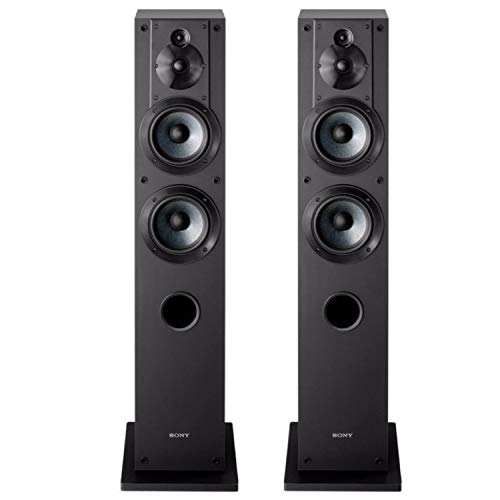
The Sony SS-CS3 is a pair of 3-way floorstanding speakers featuring four drivers, including a 1-inch polyester main tweeter and a 3/4-inch super tweeter. Designed for home audio enthusiasts, they excel in delivering high-resolution sound up to 50kHz, making them perfect for those upgrading their living room stereo or home theater system.
In real-world use, these speakers produce rich acoustics thanks to their robust cabinet and 145W peak power handling. Paired with a quality receiver, they fill medium to large rooms with clear, detailed sound ideal for music listening or movie nights.
Targeted at US buyers seeking wired hi-fi performance without portability needs, the SS-CS3 stands out for its value in immersive home setups. Overall verdict: A solid choice for balanced, high-fidelity audio that punches above its weight.
The 3-way design ensures deep bass from the woofer, clear mids, and extended highs up to 50kHz from the dual tweeters, creating a wide soundstage with excellent vocal clarity and instrument separation.
With 145W peak power and 6 Ohm impedance, these speakers handle high volumes without distortion, performing best with powerful amps for rock concerts or action films at home.
Stable wired connectivity via standard speaker terminals delivers reliable performance, outperforming budget bookshelf options in room-filling dynamics.
The strong cabinet design reduces resonances for purer sound, while the floorstanding form provides a stable base with a sleek black finish that blends into modern US living rooms.
At 6 Ohms, they match most home receivers easily, with no battery required as passive speakers draw power from your amp for unlimited playback.
Large footprint suits dedicated audio spaces but may overwhelm small apartments; rugged build promises longevity in home environments.

Comprehensive Diagnostic and Repair Guide for Sony Speakers
Restoring proper sound from an audio system requires identifying the exact failure point before attempting any invasive repair. Audio playback depends on a chain of components, including the media source, physical or wireless connections, internal amplification, and physical speaker drivers. When one element in this signal chain fails, the entire speaker system can produce distorted audio, unexpected buzzing, or total silence. By working through a logical troubleshooting checklist, you can resolve the most common issues without risking damage to delicate electronics.
Initial Audio Triage and Source Verification
The fastest way to diagnose an unresponsive speaker is to isolate the playback source from the speaker hardware. Modern televisions, smartphones, and AV receivers frequently update their audio output routing, which can unintentionally mute or disconnect external speakers. Connecting a secondary audio source, such as a different smartphone or an analog auxiliary cable, immediately confirms whether the speaker itself can produce sound. If the speaker operates normally on an alternate device, the original source settings or software permissions require adjustment rather than the speaker hardware.
Volume levels across multiple devices often cause confusion during initial testing. Many portable and active home speakers maintain an independent volume control that works alongside the source volume. If the source device volume is set low while the speaker volume is high, the resulting sound may exhibit excessive background hiss or sound muffled. Raising the source volume to a moderate level and then adjusting the speaker volume directly helps establish a clean, distortion-free signal.
Digital format mismatches represent another common cause of sudden audio silence in home theater environments. When an audio source sends an unsupported multichannel bitstream to a stereo-only setup, the processing hardware may fail to decode the incoming stream. Switching the source device output settings from bitstream or advanced surround codecs to standard PCM audio often restores immediate sound output. This simple menu adjustment prevents unnecessary physical disassembly when the underlying issue is purely digital.
Troubleshooting Sony Bluetooth and Portable Wireless Speakers
Portable models like the Sony SRS-XB23 combine rechargeable lithium-ion batteries, Bluetooth receivers, and internal amplification into a compact enclosure. When a portable unit refuses to turn on or abruptly shuts down, the battery management system may have entered a protective state due to low charge or thermal conditions. Connecting the unit to a verified USB Type-C power adapter and allowing it to charge undisturbed for at least one hour can revive a deeply discharged battery. Verifying that the charging indicator light illuminates confirms that power reaches the internal charging circuitry properly.
Persistent pairing failures or audio stuttering often require a hard reboot or a full factory reset. Most portable models allow a reset by pressing and holding the power button or combining specific button presses, such as volume down and power, for several seconds. A factory reset clears stored Bluetooth pairings and resets internal equalization profiles to their original defaults. After resetting, removing the speaker from your smartphone or tablet Bluetooth menu allows you to initiate a clean pairing sequence.
Bluetooth interference from nearby wireless routers, microwave ovens, or dense metal furniture can degrade wireless streaming stability. Moving the speaker within direct line of sight of the playback device eliminates packet drops and audio latency. For listeners comparing sound expectations across compact hardware, reviewing portable Bluetooth speaker sound quality provides realistic context on output capabilities and connection behavior. Ensuring that both the speaker and streaming source maintain unobstructed signal paths preserves clear wireless audio.
Addressing Wireless Pairing and Multiroom System Drops
Advanced multichannel home audio systems, such as the Sony BRAVIA Theater Quad, rely on high-bandwidth wireless communication between the main control hub and individual satellite speakers. If a satellite speaker suddenly loses audio or disconnects, the system status indicator typically blinks to signal an RF communication dropout. Power cycling both the main control box and the disconnected satellite speaker forces the system to renegotiate the wireless link. Keeping each speaker within the manufacturer-recommended operating distance prevents intermittent drops during intensive movie playback.
Local network congestion on the 5 GHz band can occasionally disrupt wireless audio transmission between satellite units. Modern home theater hubs allow users to switch RF transmission channels or enable an RF frequency hopping mode within the system settings. Exploring innovative audio speaker configurations highlights how proper spatial placement and wireless channel management protect multi-speaker setups from household interference. Placing wireless routers at least several feet away from the audio hub significantly reduces the likelihood of signal collisions.
When automatic reconnection fails, manually re-linking satellite speakers through the on-screen setup menu restores system coherence. The manual linking procedure involves pressing the dedicated link button on the rear of each speaker while the main unit searches for available units. Acoustic Center Sync features, which integrate television speakers into the center channel role, also require steady HDMI eARC communication to remain synchronized. Re-seating the HDMI cable between the television and audio hub guarantees that synchronization signals transmit without latency.
Diagnosing Wired Home Theater and Passive Floorstanding Speakers
Passive loudspeakers, including the Sony SS-CS3 floorstanding towers and SS-CSEM2 Atmos height modules, rely entirely on an external AV receiver or amplifier for power. When a passive speaker produces no sound, the physical connection between the receiver binding posts and speaker terminals is the primary inspection point. Speaker wire can slip out of spring clips or loosen beneath threaded binding posts over time due to vibrations. Disconnecting and reconnecting each speaker lead ensures that clean copper makes firm contact with the gold-plated or nickel terminals.
Stray wire strands bridging the positive and negative terminals represent a severe hazard for both speakers and amplifiers. A single loose strand can create a short circuit that immediately trips the amplifier internal protection mode, shutting down sound output to protect delicate output transistors. Inspecting speaker wire ends and trimming frayed copper before inserting the wire into binding posts prevents intermittent amplifier shutdowns. Using banana plugs or spade connectors provides a tidy, secure connection that minimizes the risk of accidental terminal bridging.
Matching receiver impedance settings to the speaker electrical load protects the system from thermal overload during prolonged listening. Floorstanding towers like the SS-CS3 operate with a nominal 6 Ohm impedance rating, which requires adequate amplifier headroom. If an amplifier is set strictly for higher impedance loads, driving demanding speakers at elevated volume can cause the amplifier to clip or enter thermal protection. Adjusting the receiver speaker setup menu to accommodate 6 Ohm loads allows smooth current delivery without distortion or safety shutdowns.
Correcting Distortion, Buzzing, and Physical Driver Rattles
Audio distortion often manifests as a harsh raspy sound during bass-heavy passages or a distinct metallic buzz during vocal reproduction. Before assuming a driver is permanently damaged, check whether loose decorative grilles, mounting screws, or nearby cabinet surfaces are vibrating sympathetically. Gently pressing against the speaker grille or cabinet frame during playback quickly reveals whether the buzz originates from an external mechanical vibration. Tightening driver mounting screws evenly with a manual screwdriver dampens unwanted cabinet resonance without stripping the enclosure material.
Internal driver damage requires a more careful physical inspection to evaluate repair feasibility. When an audio signal is driven past amplifier clean output limits, square-wave clipping can overheat voice coils and warp the delicate internal wire windings. With the audio system completely powered off, gently pressing the center of a woofer cone with even pressure should feel smooth and completely silent. If you feel a gritty resistance or hear a scraping noise, the voice coil has rubbed against the magnet assembly, indicating a blown driver that requires replacement.
Dust cap denting or tweeter dome deformation also alters high-frequency sound dispersion. Soft polyester main tweeters or super tweeters can occasionally be pulled back into shape using gentle suction or specialized low-tack tape. Never use excessive force or sharp metal tools, as puncturing the diaphragm permanently degrades treble response and destroys the acoustic seal. If a tweeter dome remains creased or cracked, replacing the individual high-frequency driver assembly restores proper acoustic balance across the soundstage.
Resolving Vehicle Speaker Wiring and Power Output Faults
Installing aftermarket coaxial speakers, such as the Sony XS-GTF1639 6.5-inch 3-way units, introduces unique installation and acoustic challenges. If a vehicle speaker sounds hollow, thin, or completely devoid of bass, the speaker terminals are likely wired out of phase. When one door speaker has its positive and negative leads reversed relative to the opposite door, the sound waves cancel each other out in the cabin. Swapping the positive and negative leads on one speaker immediately restores full bass response and creates a coherent stereo image.
Intermittent cutting out while driving over rough roads typically points to pinched wiring inside the door jamb boot. Vehicle door wiring experiences constant flexing and moisture exposure, which can degrade factory wire insulation and cause grounding shorts against the vehicle chassis. Inspecting the wiring harness with a multimeter allows you to test for continuous continuity and confirm there are no ground faults. Protecting exposed wire runs with heat-shrink tubing and routing cables away from window regulator mechanisms prevents future wiring failure.
Proper mounting depth and basket clearance are equally essential for vehicle audio longevity. If a speaker basket is forced against a curved metal door panel, the frame can twist slightly, misaligning the voice coil within the magnetic gap. Using rigid adapter brackets and foam baffle rings ensures the speaker sits flat and creates a proper front-to-back acoustic seal. This physical isolation protects the moving components from water intrusion inside the door cavity while maximizing dynamic power handling.
Firmware Updates and Companion App Calibration
Modern connected audio equipment relies heavily on internal software to control equalization, digital signal processing, and room correction algorithms. Applications such as Sony BRAVIA Connect and Sony Music Center provide direct access to diagnostics, speaker volume calibration, and firmware installation. When a smart speaker or audio bar experiences sudden audio muting or menu lockups, checking for a pending firmware update is a critical troubleshooting step. Installing the latest software patch resolves known bugs, improves wireless stability, and ensures compatibility with updated streaming protocols.
Advanced acoustic features like Sound Field Optimization calibrate audio output to room dimensions by emitting test tones. If the calibration routine fails or produces an unbalanced sound profile, reflective surfaces, background noise, or microphone obstruction may be the cause. Running the calibration process in a quiet room with doors and windows closed ensures the internal processors capture accurate acoustic reflections. Proper calibration balances output levels across all channels, ensuring dialogue clarity and seamless surround effects.
Network connectivity drops during a firmware update can leave a speaker in an unresponsive state. If a wireless update stalls, connecting the audio hub or speaker to your home network via an Ethernet cable provides a rock-solid data connection. Allowing the device to finish its installation cycle without disconnecting power prevents permanent firmware corruption. Once the update finishes, performing a quick power cycle reloads the operating system and restores full app control.
Practical Component Assessment and Professional Service
Distinguishing between an easily fixable setup error and a catastrophic component failure saves unnecessary repair expense. Simple wiring mistakes, incorrect source settings, and wireless interference can be resolved safely at home with basic tools and patience. Conversely, damaged crossover circuit boards, swollen capacitors, and blown power supply modules require specialized electrical repair tools. Attempting to solder internal circuitry without proper electronics knowledge can worsen the damage and create electrical hazards.
When a specific passive speaker driver fails, sourcing an exact manufacturer replacement maintains the original acoustic voicing of the cabinet. Replacing a blown woofer with a generic driver of mismatched impedance alters crossover frequencies and degrades sound quality. Verifying the exact model number, such as replacement drivers for the SS-CS series, ensures seamless integration with existing tweeters and crossover networks. Careful component matching preserves high-resolution audio capability and maintains accurate stereo imaging across your listening space.
Following a methodical diagnostic sequence prevents hasty conclusions and restores your audio equipment to optimal performance. Always verify source signals, inspect physical connections, test software settings, and evaluate wireless stability before seeking professional repair. Taking time to understand the operational requirements of your specific speaker model ensures lasting reliability and rich, immersive sound. Routine maintenance, secure cable management, and proper amplifier matching will keep your sound system delivering clear audio for years to come.





Write Your Review
No reviews yet. Be the first to share your experience!