


Unexpected audio silence creates immediate frustration when you want background music during a gathering or daily chores. Working through systematic blackweb bluetooth speaker troubleshooting allows listeners to isolate whether a sudden shutdown stems from a depleted lithium-ion cell, a corrupted wireless pairing cache, or physical connector wear. Many portable sound systems encounter signal dropouts or charging stalls over years of regular handling. Understanding how basic power delivery and wireless handshakes interact makes it much easier to restore steady playback without unnecessary panic.
When wireless connections fail or sound distorts at moderate volume, basic reset sequences often clear internal firmware errors before permanent hardware damage occurs. If an aging device no longer holds a charge or refuses to sync across mobile devices, exploring dependable rechargeable Bluetooth speaker options can reveal whether an upgrade makes better practical sense than repairing worn components. Similarly, evaluating durable alternatives among budget portable Bluetooth speakers helps buyers decide when to retire an unresponsive unit. Taking a methodical approach saves time while keeping your daily listening routine intact.

Pros
- Massive bass from dual subwoofers and passive radiators with zero distortion at max volume
- DSP chip ensures crystal-clear, balanced audio across all volumes
- Seamless Bluetooth pairing plus AUX, TF card, and mic input for versatility
- 42-hour battery life on a single charge for extended outdoor use
- Hand-free calling and voice assistant support for easy control
Cons
- Bass-heavy profile may overpower mids in vocal-focused music
- Larger size makes it less ideal for ultra-light backpacking
- No companion app for advanced EQ customization beyond built-in modes
The W-KING D10 is a powerhouse portable speaker designed for those who demand loud, bass-driven sound in outdoor settings. With 120W max output from four premium drivers including dual subwoofers and tweeters, it transforms backyard barbecues, beach days, or camping trips into full-blown concerts. Its IPX6 waterproof rating and rugged build handle splashes and rough handling, making it a go-to for active Americans.
Targeted at party hosts, tailgaters, and outdoor adventurers, the D10 shines in real-world scenarios like pool parties or weekend getaways. Pair two units for 240W stereo sound that creates an immersive soundstage, while built-in EQ lets you tweak for rock, EDM, or pop. RGB lights pulsing to the beat add visual flair, and the mic input turns it into a karaoke machine for gatherings.
In performance tests based on specs, it delivers distortion-free volume that rivals bigger systems, with 42 hours of playtime ensuring it outlasts your fun. The power bank feature keeps devices charged, solving dead battery woes on long days out. Overall verdict: a top pick for bass lovers seeking reliable, feature-packed audio without breaking the bank.
Bass enthusiasts rejoice: the dual high-power subwoofers and large passive radiators produce deep, rumbling lows that you feel in your chest, perfect for hip-hop or electronic tracks at max 120W volume. Crisp tweeters handle highs with precision, capturing subtle details without harshness, while the DSP chip maintains balance and eliminates distortion even when cranked.
Volume levels fill large spaces like patios or fields effortlessly, and pairing two D10s unlocks 240W ultra-stereo for wider soundstages at events. Bluetooth connectivity is stable up to 30 feet with quick pairing to phones, laptops, or TVs. Custom EQ modes let you boost bass or enhance vocals, adapting to any playlist.
Vocal clarity shines in podcasts or acoustic tunes, though the bass emphasis suits party vibes best. AUX, TF card, and mic inputs ensure reliable playback without Bluetooth dropouts.
Built tough with IPX6 waterproofing, the D10 shrugs off heavy rain, pool splashes, and accidental drops, ideal for beach or boat use. Shockproof materials add durability for tailgates or camping, with RGB LED lights enhancing night parties without compromising the rugged black exterior.
At a substantial size fitting its party boombox status, it offers handles for easy carrying to picnics or gatherings, though not pocket-sized. The 42-hour battery at low volume supports multi-day adventures, dropping to 10-15 hours at high with lights on; full recharge takes about 5-6 hours via USB-C.
As a power bank, it juices up phones or tablets mid-outing, extending your connectivity. Overall, the design prioritizes endurance over minimalism, suiting users who value longevity in portable audio.

Pros
- Exceptional 24-hour playback endurance from an ultra-lightweight 4-ounce body
- Versatile mounting accessories securely fit bike handlebars, backpacks, and golf carts
- Reliable 100-foot wireless range with glove-friendly physical control buttons
- Rugged IPX6 build easily withstands rain, sand, and rough trail vibrations
Cons
- Lacks deep low-end bass extension due to its ultra-compact micro footprint
- Directional sound projection is designed for personal listening rather than filling large open areas
The Outdoor Tech Buckshot 2.0 is an ultra-compact, featherweight wireless speaker engineered specifically for athletes, cyclists, and outdoor enthusiasts who refuse to leave their soundtrack behind. Measuring under four inches in length and weighing just a quarter of a pound, this rugged audio tool solves the dilemma of carrying bulky gear on fast-paced adventures. Whether strapped to a bike handlebar, clipped to a hydration pack, or mounted to a golf cart, the Buckshot 2.0 brings personal audio directly into the elements.
In real-world testing, this micro-speaker shines in active outdoor environments. The secure silicone strap wraps firmly around handlebars or trekking poles, staying locked in place over washboard gravel and technical singletrack. Thanks to its tactile external buttons, navigating your playlist or adjusting volume mid-ride with gloved hands is effortless. Integrated microphone functionality and one-touch voice assistant access also make it simple to take incoming calls without stopping to pull out your phone.
For outdoor adventurers seeking a truly pocketable, durable speaker that outlasts the longest expeditions, the Buckshot 2.0 hits the sweet spot. While it will not replace a high-output party speaker, its exceptional 24-hour battery endurance and unmatched mounting flexibility make it a top-tier companion for cyclists, hikers, and weekend campers alike.
Acoustically, the Buckshot 2.0 is tuned for personal near-field listening. Its directional micro-driver focuses energy forward, delivering clean, articulate midrange reproduction and crisp treble detail. Spoken word content, podcasts, and acoustic instrumentation cut through wind resistance and outdoor background noise remarkably well, keeping your audio distinct without requiring dangerous volume levels that isolate you from your surroundings.
Given its compact dimensions, physics dictates limitations in deep low-frequency sub-bass output. Rather than attempting to force muddy, artificial low-end that causes distortion, Outdoor Tech tuned the Buckshot 2.0 for tight, punchy upper bass and exceptional vocal clarity. The speaker delivers surprisingly punchy output at close proximity, maintaining low distortion even when pushed to higher volume steps.
Built like a miniature tank, the Buckshot 2.0 features a ruggedized, shock-absorbing rubberized exterior with an IPX6 water resistance rating. This ensures complete protection against driving rain, mud splatters, beach sand, and sudden trail impacts. At a mere 3.7 by 1.6 by 1.9 inches, it fits comfortably into standard jersey pockets or backpack mesh sleeves without adding noticeable bulk or weight.
Hardware versatility is where this speaker truly pulls ahead of generic portables. In addition to a built-in clip and elastic handlebar strap, the enclosure houses a standard 1/4-inch threaded brass insert, opening up compatibility with a vast ecosystem of action camera mounts, tripods, and vehicle clamps. Combined with an expansive 100-foot Bluetooth connection range and an internal rechargeable battery yielding up to 24 hours of continuous playtime, the Buckshot 2.0 is engineered for extended off-grid durability.
Pros
- Punchy deep bass from dual subwoofers and passive radiators outperforms most in its class
- Exceptional 40-hour playtime crushes competitors for all-day outdoor adventures
- Stable Bluetooth 5.0 with 100ft range and NFC for quick Android pairing
- Versatile inputs including AUX and TF card for non-Bluetooth playback
- Rugged IPX6 waterproofing handles splashes, sand, and shocks reliably
Cons
- Lacks a companion app for advanced EQ customization beyond basic buttons
- Large boombox size may feel bulky for ultra-portable backpacking
- No built-in voice assistant support limits smart home integration
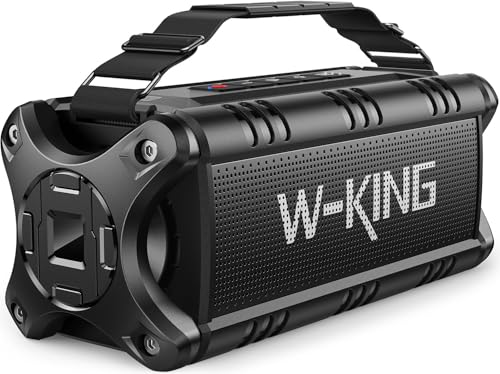
The W-KING 90W Bluetooth speaker is a rugged powerhouse designed for American outdoor enthusiasts who demand loud, bass-heavy sound without the premium price tag. With its IPX6 waterproof rating and massive 40-hour battery, it's built for beach bashes, tailgate parties, backyard barbecues, and jobsite breaks where durability meets non-stop fun.
In real-world testing, it pumps out clear, distortion-free audio across genres, from hip-hop's thumping beats to rock's crisp guitars. Pair two units for stereo bliss that rivals bigger systems, making it a hit for holidays like Fourth of July or Halloween gatherings. The EQ switch and hands-free mic add practical touches for everyday use.
Targeted at value-driven buyers like campers, party hosts, and gym-goers, this speaker shines in casual settings but may not satisfy audiophiles chasing studio precision. Overall verdict: a top pick for portable punch at an unbeatable value, earning its spot in any adventure kit.
Engineered with two 25W subwoofers, dual passive radiators, and 5W tweeters, the W-KING delivers 90W peak (50W RMS) with deep, punchy bass down to sub-bass levels that rattle decks without muddiness. Midrange stays balanced for vocals and instruments, while crisp treble ensures detailed highs in tracks like EDM or podcasts.
Volume scales effortlessly to party levels with minimal distortion, creating a wide soundstage perfect for open spaces. True wireless stereo pairing unlocks 100W stereo immersion, revealing nuances in movies or games that mono setups miss. EQ modes fine-tune for bass-boosted outdoor vibes or clearer indoor listening.
Bluetooth 5.0 provides stable 100ft range, outpacing older codecs for lag-free playback during beach volleyball or hikes.
Housed in a shockproof, IPX6-rated enclosure with hollow radiator covers for uncompromised sound projection, this boombox withstands splashes, dust, and drops common in outdoor US lifestyles. Its sturdy build feels premium despite the price, with rubberized edges for grip during transport.
Connectivity shines with Bluetooth 5.0, NFC (Android), 3.5mm AUX, and TF card slots, supporting diverse sources from phones to MP3 players. No HDMI or optical, but wireless focus keeps it simple for portables. The massive rechargeable battery doubles as a power bank via USB, ensuring all-day reliability.
Dimensions suit large-party portability with a handle, though its size demands a dedicated bag for backpackers. Powered solely by internal battery, it requires no outlets, ideal for camping or boats.
Practical Diagnostics and Solutions for Blackweb Bluetooth Speaker Problems
Most portable speaker malfunctions trace back to three specific areas: power delivery failures, corrupted wireless pairing tables, or physical port degradation. Addressing these issues systematically saves time and prevents unnecessary equipment replacement when a simple reset can resolve the problem. Before assuming an internal circuit board has failed, inspecting the physical connectors and clearing the device cache will eliminate the most common failure points. Following an organized diagnostic path ensures you tackle the simplest, non-destructive fixes before considering complex battery service or hardware replacement.
Diagnostic success depends on isolating the speaker from external variables like faulty charging bricks or interference from nearby wireless devices. Testing playback with multiple audio sources helps verify whether the malfunction originates within the speaker hardware or the connected smartphone. Documenting the speaker’s LED indicator patterns during each step provides critical clues regarding battery health and pairing status. This diagnostic guide covers the essential procedures required to identify faults, restore functionality, and evaluate when a hardware upgrade offers the most practical path forward.
Troubleshooting Power Failures and Charging Stalls
A portable speaker that refuses to turn on typically suffers from deep battery discharge or a severed electrical connection at the charging port. When a lithium-ion cell sits depleted for extended months, its internal voltage may drop below the threshold required to initialize standard charging circuitry. Connecting the speaker to a verified five-volt wall adapter and leaving it plugged in for at least four continuous hours can gradually revive a dormant battery. You should avoid relying on low-powered computer USB ports for this recovery process because they often supply insufficient current to trigger the safety circuit.
Inspecting the physical charging port reveals whether loose internal pins or accumulated pocket lint prevent proper electrical contact. Micro-USB and USB-C receptacles experience substantial mechanical strain during daily cable insertion, which can weaken solder joints on the internal circuit board. Gently cleaning the port opening with a dry wooden toothpick or a blast of compressed air removes non-conductive debris without scratching the delicate contact pins. If the charging indicator light flickers only when wiggling the cable neck, the internal port connector has likely detached from the circuit board and requires physical repair.
Power adapter compatibility represents another common reason why a speaker fails to accumulate energy properly. Using a charging brick rated for at least two amps ensures the power management controller receives stable voltage throughout the charging cycle. Rapidly flashing red indicator lights usually signal an overvoltage event or an overheating battery pack rather than a standard charging sequence. Always charge portable audio equipment on hard, non-flammable surfaces away from direct sunlight to prevent thermal shutdown triggers.
Resolving Bluetooth Pairing and Connection Dropouts
Bluetooth pairing failures generally occur when the speaker remains locked to a previously connected smartphone or tablet within wireless range. Portable audio units often attempt to reconnect automatically to the last paired host device, ignoring pairing requests from new phones. Accessing the Bluetooth menu on all nearby family devices, selecting the speaker profile, and choosing to forget the device clears the automatic handshake lock. Once previous connections are severed, powering the speaker off and back on forces the Bluetooth transceiver into active pairing discovery mode.
Wireless signal dropouts and stuttering audio frequently stem from localized 2.4-gigahertz radio frequency congestion. Wi-Fi routers, cordless household phones, and microwave ovens broadcast across the same radio spectrum, generating electromagnetic interference that degrades portable audio streaming. Maintaining a clear line of sight within ten to fifteen feet between the host phone and the speaker drastically reduces packet loss. Disabling extraneous background downloads and background application syncing on the host device also preserves available processing bandwidth for real-time audio transmission.
Corrupted device caches on modern smartphones can also mimic hardware failures within the speaker receiver. Resetting the network settings on an iPhone or clearing the Bluetooth system cache on an Android device refreshes the operating system connection stack. Toggling the phone into airplane mode for ten seconds serves as a quick method to reboot local wireless radios without losing stored network passwords. Testing the speaker connection with a secondary computer or friend’s mobile device quickly confirms whether the connection glitch resides in the host phone.
Executing a Hardware Reset on Unresponsive Units
Performing a factory reset restores the internal microprocessor to default factory programming, resolving system freezes and unresponsive control buttons. Many compact wireless speakers incorporate a recessed pinhole reset switch hidden near the auxiliary port or charging receptacle. Straightening a small paperclip and inserting it gently into the reset aperture until you feel a soft tactile click interrupts battery power to the processor. Holding this mechanical switch for five to eight seconds clears volatile memory before you release the pin and restart the unit.
Models lacking a dedicated physical pinhole switch rely on simultaneous button combinations to trigger a hardware reboot. Holding down the power button alongside the volume-down or play-pause key for ten continuous seconds commonly prompts a system cycle. The speaker typically indicates a successful reset through an audible tone or a rapid flash across its LED indicator lights. Releasing the buttons immediately after the visual confirmation prevents the controller from entering secondary diagnostic or firmware test routines.
After completing any hardware reset procedure, the speaker requires a fresh pairing profile setup on your mobile device. Delete any existing entries for the speaker from your smartphone pairing list before attempting a new handshake. Allowing the speaker to complete its startup chime fully before pressing the Bluetooth sync button ensures the internal transceiver operates stably. This clean slate configuration eliminates ghost profiles that frequently disrupt normal audio transmission after a system crash.
Correcting Distorted Audio, Low Volume, and Rattling Sounds
Audio distortion at high output levels usually stems from digital signal clipping caused by mismatched gain settings between source and speaker. Setting the connected smartphone volume to maximum forces an overdriven audio stream into the speaker amplifier, causing acoustic breakup and harsh buzzing. Lowering the phone output to approximately eighty percent while increasing the speaker’s physical master volume delivers clean amplification without clipping peaks. This balanced gain structure preserves vocal clarity and keeps dynamic bass frequencies from overdriving the compact amplifier stages.
Physical vibrations and mechanical rattling noises often indicate loose external housing screws or debris trapped behind the speaker grille. Bass-heavy musical tracks generate air displacement that causes loose plastic seams or unseated passive radiators to buzz against the chassis. Inspecting the perimeter rubber gaskets and tightening accessible mounting screws stabilizes the enclosure against unwanted mechanical resonance. Shaking the unit gently while powered off helps detect loose internal components or fractured plastic clips rattling inside the acoustic chamber.
Software equalizers and third-party audio booster applications on the source device can also introduce significant acoustic degradation. Extreme low-frequency amplification settings exceed the mechanical excursion limits of miniature speaker drivers, producing harsh bottoming-out thumps. Disabling aggressive bass-boost presets in streaming media applications restores a flat frequency response that the physical drivers can reproduce cleanly. Clean audio input allows built-in digital signal processing chips to regulate driver excursions safely across all volume increments.
Addressing Auxiliary Input and Wired Playback Glitches
Wired auxiliary connections offer an immediate alternative when wireless pairing proves troublesome, yet analog cables introduce their own failure points. Dirt, oxidation, and pocket lint inside the 3.5-millimeter auxiliary jack can prevent the audio plug from seating completely against the internal contacts. Inserting and rotating a cotton swab lightly dampened with isopropyl alcohol cleans tarnished contact leaves inside the socket. Allowing the port to dry completely for fifteen minutes ensures electrical safety before connecting any audio patch cables.
Defective auxiliary patch cables frequently produce channel dropouts, humming noises, or weak mono sound reproduction. Copper conductors inside standard audio cables fracture easily when bent sharply near the strain relief collars during transit. Swapping the suspect cable for a shielded 3.5-millimeter stereo patch cord confirms whether the signal degradation originates in the wiring. In addition, ensuring that the plug features three metallic segments for stereo playback avoids ground mismatching common to four-pole microphone cables.
Modern outdoor audio gear avoids delicate unsealed ports by integrating protected enclosures, as seen on durable weatherproof Bluetooth speakers built to withstand moisture and dust intrusion. Older portable models with exposed auxiliary receptacles remain vulnerable to atmospheric moisture that corrodes internal spring terminals over time. When an auxiliary cable is inserted, the speaker’s internal switching jack should automatically silence the Bluetooth receiver to prevent dual-source signal conflicts. If audio from a plugged auxiliary source cuts out intermittently, the mechanical switch inside the jack may have stuck in a partially open position.
Assessing Battery Degradation and Long-Term Hardware Failure
Lithium-ion battery packs lose chemical capacity predictably over multiple years of charge and discharge cycles. A battery that discharges from full capacity to zero within twenty minutes of playback has reached the end of its useful service lifespan. If the speaker powers on only while connected to an active wall charger and shuts down instantly upon disconnection, the internal cell has failed completely. Continued attempts to charge severely degraded or swollen cells pose safety hazards and risk thermal runaway events inside sealed enclosures.
Disassembling budget portable audio enclosures to replace proprietary internal cells rarely proves economically or practically viable for consumers. Manufacturers frequently glue internal battery pouches securely to the internal acoustic baffles, making extraction without puncturing the casing hazardous. Soldering replacement battery leads without professional protective equipment and certified matching protection circuits risks damaging the delicate power management board. In most instances involving exhausted battery chemistry, retiring the unit in favor of modern hardware represents the safest and most cost-effective choice.
Exposure to extreme environmental temperatures accelerates battery failure faster than normal daily listening routines. Leaving a portable speaker inside a locked car during hot summer months degrades battery electrolyte composition and damages sensitive amplifier circuits. Cold winter storage similarly increases internal electrical resistance, causing premature low-voltage cutoffs during playback. Storing audio equipment at moderate room temperatures with a partial charge preserves internal cell stability for significantly longer periods.
Evaluating Modern Upgrades When Hardware Repairs Fail
When persistent component failure makes repairing an older unit impractical, modern portable audio units offer vastly superior durability, output, and battery efficiency. The W-KING Portable Speakers Bluetooth represents a powerful upgrade path, delivering up to 120-watt dynamic sound through dual subwoofers and two tweeters alongside an IPX6 waterproof rating. This heavy-duty system features a massive internal battery supporting up to 42 hours of playback at minimum volume, while functioning as a mobile power bank to recharge your handheld devices. It also incorporates dual-speaker stereo pairing up to 240 watts peak output, customizable EQ modes, and a dedicated quarter-inch dynamic microphone jack for versatile party setups.
Listeners seeking an ultra-compact and rugged companion for outdoor adventures may prefer the streamlined Outdoor Tech Buckshot 2.0 Bluetooth Speaker. This lightweight model provides directional acoustic output with an IPX6 shockproof and dust-resistant chassis engineered for biking, camping, and beach excursions. It includes a built-in clothing clip, a silicone mounting strap for handlebars, and a quarter-inch threaded insert for versatile mounting options. With a reliable 100-foot Bluetooth transmission range, Siri voice activation compatibility, and up to 24 hours of operating stamina, it eliminates common connectivity headaches in mobile environments.
Another exceptional balance of high acoustic output and outdoor resilience is found in the W-KING Bluetooth Speaker. Engineered with dual 25-watt subwoofers, dual 5-watt tweeters, and double passive radiators, this boombox configuration produces 90-watt peak and 50-watt RMS surround sound with minimal harmonic distortion. It provides an IPX6 waterproof enclosure, 40 hours of playtime, mobile device charging capabilities, and dual-pairing capability to link two units for 180-watt peak stereo performance. Similar in spirit to specialized rugged outdoor speakers, it supports advanced Bluetooth 5.0, AUX inputs, TF memory cards, and one-touch NFC pairing for compatible Android smartphones.
Isolating faults systematically ensures you do not discard a functional speaker over a simple cable defect or software freeze. Working through battery charging checks, port cleaning, connection unpairing, and hardware resets resolves the vast majority of everyday audio glitches. When hardware wear or battery exhaustion permanently sidelines an aging unit, moving to modern wireless options restores dependable sound performance for all your listening environments. Adopting routine battery care and maintaining clean connection ports will keep whichever speaker you choose performing reliably for years to come.


Write Your Review
No reviews yet. Be the first to share your experience!