
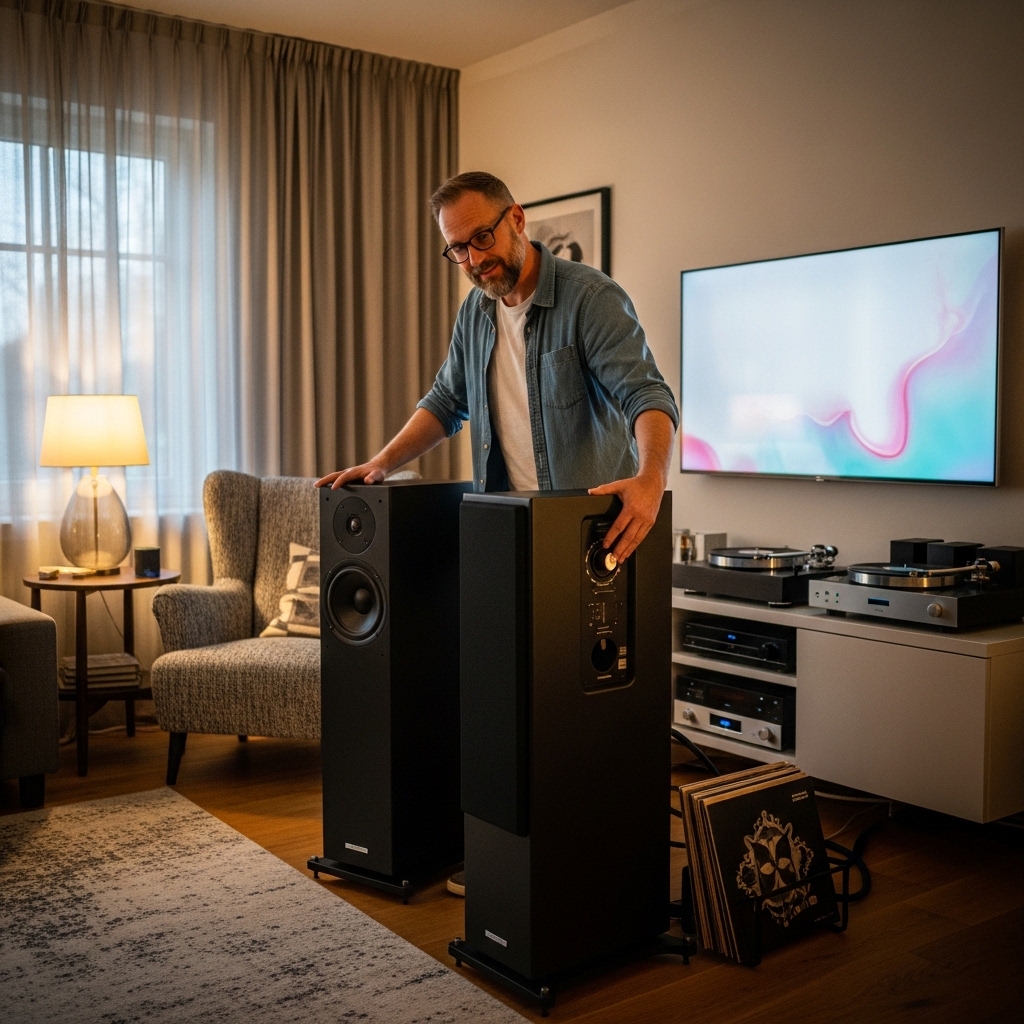

Cleaning Up Desktop Resonance and Monitor Angles
Unwanted desk resonance can blur audio playback, making accurate mixing or casual listening frustrating when speakers sit directly on hard furniture. Mechanical vibrations transfer straight into your workstation surface, creating muddy low frequencies and rattling desktop gear. Placing your monitors on the best speaker isolation pads decouples the speaker cabinet from your desk to maintain clearer low-end response and reduce acoustic smear. If you run a compact studio setup, using Sound Addicted – Studio Monitor Isolation Pads creates an effective mechanical buffer while letting you tilt your tweeters directly toward ear level.
Desktop audio clarity involves more than just driver capability because physical placement and surface reflection dictate how direct sound reaches your ears. Much like positioning components in home theater speakers setups for balanced room acoustics, desktop monitors require stable decoupling to prevent exaggerated bass buildup. The manufacturer specifications for high-density foam like the Sound Addicted SMPad 5 indicate a 50kg/m^3 density rating engineered to hold up to 24 pounds per pad. This rating ensures that popular five-inch studio monitors stay secure in flat or tilted orientations without crushing the foam over time.

Pros
- Noticeably tightens boomy bass and stops annoying desktop vibrations immediately.
- Two-piece wedge design allows effortless tilt adjustments for optimal ear alignment.
- Dense 50kg/m³ foam holds heavy studio monitors securely without deforming.
- Outstanding performance upgrade per dollar spent for home and project studios.
Cons
- Slightly too wide for ultra-compact 3-inch or 4-inch desktop speakers.
- Lacks a rigid metal top plate, requiring careful speaker centering to prevent uneven tilting.
- May produce a mild foam packaging odor that takes a day or two to air out.
The Sound Addicted SMPad 5 studio monitor isolation pads are an essential acoustic accessory designed to solve a fundamental monitoring problem: desk resonance. When nearfield studio monitors sit directly on a wooden, composite, or glass desktop, acoustic vibrations transfer straight into the furniture. This turns the entire desk into a secondary resonator that colors your sound. The SMPad 5 decouples the speaker cabinet with dense 50kg/m³ acoustic foam, isolating mechanical energy before it can distort what you hear.
Targeted squarely at music producers, mixing engineers, video editors, and desktop audiophiles, these pads are tailored to fit standard 5-inch monitors such as the Yamaha HS5, KRK Rokit RP5, Mackie MR5, and JBL 305P. In practical use, the transformation is immediate and obvious. The lower midrange and bass frequencies stop vibrating through your desk, clearing away false low-end buildup and making it far easier to set accurate levels and EQ curves in your mixes.
Ergonomics are another major strength of the SMPad 5. Each pad consists of a base and an angled wedge insert, allowing you to angle your speakers flat, tilted upwards, or tilted downwards. This makes it simple to aim high-frequency tweeters directly at ear level, drastically improving high-end clarity and phase alignment. For any desktop setup lacking dedicated floor stands, the Sound Addicted SMPad 5 is an indispensable and budget-friendly upgrade that instantly elevates acoustic accuracy.
While isolation pads do not emit sound themselves, the SMPad 5 significantly alters the perceived acoustic output of your monitors for the better. By eliminating vibrational coupling between the monitor enclosure and your workstation, the pads clean up the 60 Hz to 250 Hz frequency band. Bass guitars, kick drums, and synthetic sub-bass notes retain tight transient punch and distinct pitch definition rather than blurring into a muddy, smeared rumble.
Midrange and high-frequency performance also benefit substantially. Hard surface reflections directly below speaker cabinets often cause comb filtering, which creates unnatural peaks and dips in your frequency response. Elevating the speakers and tilting them directly toward your ears restores high-frequency transient detail, tightens center imaging, and creates a wider, more three-dimensional soundstage where individual instruments can be easily placed across the stereo field.
The SMPad 5 is engineered from premium acoustic polyurethane foam featuring a high-density rating of 50kg/m³. This dense composition gives the pads structural firmness capable of supporting speaker weights up to 24 pounds per side without bottoming out or losing shape over time. Measuring 11 inches deep, 7.48 inches wide, and 1.57 inches tall, each pad provides an expansive, non-slip base for nearly all 5-inch monitor enclosures.
The modular two-piece hardware design consists of a lower base pad and an adjustable wedge. By simply reversing or removing the wedge, you can achieve multiple resting angles to match your ear height whether your monitors sit low on a desk or elevated on a monitor shelf. The stealthy matte black finish integrates seamlessly with studio gear and speaker stands, providing a clean, professional aesthetic for any creative workspace.
Frequently Asked Questions
How do speaker isolation pads improve audio quality?
Isolation pads physically decouple speaker cabinets from hard surfaces like desks or floor stands. When speaker cones move, they transfer kinetic energy into furniture, causing sympathetic vibrations that muddy the bass and lower midrange. High-density acoustic foam absorbs these enclosure vibrations so the furniture does not resonate. This results in tighter bass perception and clearer instrumental separation in your listening space.
What size studio monitors fit 5-inch isolation pads?
These pads measure 7.5 inches wide by 11 inches deep, which matches standard five-inch active studio monitors. The manufacturer lists compatibility with popular models such as the Yamaha HS5, JBL 305PMKII LSR305, KRK Rokit RP5, and Mackie MR5. If you use larger cabinets or smaller units like those covered in our best sounding BT speaker guide, check your cabinet base dimensions before purchasing.
Can speaker isolation pads provide an angled tilt?
Yes, multi-piece wedge designs allow you to configure the foam pads flat or at an upward or downward angle. Tilting your speakers helps align the high-frequency tweeters directly with your ears at your normal seating height. This directional alignment lets you hear clean high-end detail without needing dedicated metal monitor stands.
What weight capacity should you look for in acoustic foam pads?
Acoustic foam with a 50kg/m^3 density rating is typically specified to support up to 24 pounds without losing shape. Most active five-inch studio monitors weigh between 10 and 18 pounds, fitting comfortably within that load limit. Verifying that your monitor weight remains below the stated limit prevents permanent sagging and preserves vibration damping.
Do you need isolation pads if your monitors already have rubber feet?
Built-in rubber feet offer minimal vibration damping and primarily protect furniture finishes from scuffs. In contrast, thick acoustic foam covers the entire footprint of the cabinet, isolating heavy low-frequency energy that thin rubber pads cannot absorb. Investing in the best speaker isolation pads in 2026 gives you comprehensive surface decoupling along with flexible tilt adjustment.


Write Your Review
No reviews yet. Be the first to share your experience!