


Setting up a smart home audio environment often starts with pairing a compact voice assistant to an enclosure with superior acoustic range. While Amazon voice hardware provides responsive voice recognition and home automation controls, its internal acoustic driver can leave music enthusiasts wanting more volume and detail. Learning how to connect echo dot to bose bluetooth speaker hardware bridges that gap by letting your voice commands drive premium audio performance across your living space. Whether you stream playlists across your kitchen or broadcast background audio to Bluetooth speakers designed for large spaces, establishing this wireless link delivers rich sound without requiring bulky receiver towers.
Modern wireless hardware simplifies this integration through reliable Bluetooth pairing protocols and multi-device connection switching. You can accomplish this pairing through simple voice commands or by navigating the mobile interface within the Amazon Alexa application. Bose hardware models like the Bose SoundLink Revolve+ (Series II) and portable units like the Bose SoundLink Revolve (Series II) even include voice prompts that confirm connection status instantly. For older standalone systems lacking wireless antennas, pairing an accessory such as the Bose Bluetooth Audio Adapter brings identical voice assistant functionality to legacy gear.
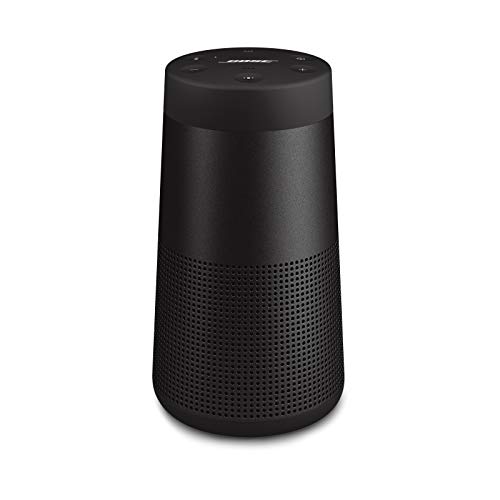
Pros
- Consistent, omnidirectional sound profile ensures great audio from every angle in the room
- Durable seamless aluminum chassis with soft protective bumpers survives accidental drops
- Fast voice-guided Bluetooth pairing and reliable Bose Connect app integration
- Punchy low-end response and articulate dialogue despite its small footprint
Cons
- Relies on an older Micro-B USB port for charging rather than modern USB-C
- Water resistance protects against splashes but is not rated for full submersion
- Companion app does not include an adjustable multi-band graphic equalizer
The Bose SoundLink Revolve (Series II) stands out in the crowded portable audio landscape by solving one of the most common issues with compact speakers: directional beaming. Instead of funneling music straight ahead, this cylindrical powerhouse disperses audio in an expansive, uniform 360-degree circle. Whether placed dead-center on a picnic table or set against a living room wall to reflect sound, it delivers an expansive acoustic presence that defies its modest physical footprint.
Designed for versatile everyday listening, the Revolve II excels in both casual home settings and outdoor environments. Setup is guided by straightforward voice prompts, and the multi-connect feature lets you link two smartphones at once so friends can alternate playing DJ. With an integrated microphone, taking hands-free conference calls or invoking your phone's native digital assistant requires just a quick press of the multi-function button.
Ecosystem functionality is another strong asset. Through the Bose Connect app, users can easily engage Party Mode to pair two Revolve units for twice the volume, or switch to Stereo Mode for discrete left and right channel separation. Furthermore, Bose SimpleSync technology allows the speaker to mirror audio from compatible Bose smart soundbars, making it effortless to carry your music from the living room into the kitchen without skipping a beat.
Ultimately, this renewed edition presents a compelling balance of refined audio performance, rugged reliability, and sophisticated aesthetics. For listeners wanting premium sound wrapped in a portable, splash-ready design, the SoundLink Revolve II remains one of the top choices in its class.
Acoustic performance in the SoundLink Revolve II centers around a downward-firing, full-range transducer paired with an omnidirectional acoustic deflector. This proprietary architecture spreads balanced frequencies evenly across 360 degrees, completely eliminating directional sweet spots. Low frequencies are handled by dual-passive radiators, which work in tandem to minimize vibration while pumping out surprisingly deep, musical bass that anchors acoustic tracks and pop rhythms alike.
In the midrange, vocals and solo instruments come through clean and prominent, steering clear of the muddy distortion that often plagues small wireless speakers. Treble response remains smooth and controlled, avoiding harsh sibilance even when pushed to higher output levels. While it naturally cannot replace a dedicated multi-driver stereo rig for deep sub-bass impact, its output level and clarity are more than sufficient to fill standard bedrooms, open kitchens, and back patio spaces with full-bodied sound.
Crafted with premium materials, the SoundLink Revolve II features a seamless aluminum chassis devoid of visible joints or seams. The top control deck and bottom base are capped with soft-touch silicone bumpers, offering shock absorption against everyday bumps, knocks, and small falls. Tipping the scales at roughly 1.46 pounds, the speaker is exceptionally easy to pick up, pack in a day bag, and move around the house.
Physical connectivity options include an auxiliary 3.5mm input for hardwired analog playback alongside standard wireless Bluetooth streaming. The internal lithium-ion battery provides up to 13 hours of runtime per charge, ensuring plenty of endurance for all-day listening sessions. Charging is handled via a standard Micro-B USB cable, and the speaker is fully compatible with an optional Bose charging cradle for convenient drop-and-go power.

Pros
- Expansive 360-degree audio distribution eliminates listener sweet spots
- Impressive bass depth and volume output for a compact cylindrical form factor
- Convenient carry handle and premium, shock-absorbing aluminum construction
- Generous 17-hour battery life suitable for full-day travel or outdoor gatherings
Cons
- Relies on an older Micro-B USB port rather than modern USB-C charging
- IP55 rating shields against splashes and dust but cannot survive full water submersion
- Lacks a customizable multi-band graphic EQ in the companion app
The Bose SoundLink Revolve+ Series II stands out as one of the most capable and refined portable Bluetooth speakers on the market. Engineered around proprietary omnidirectional acoustic architecture, this speaker is built for listeners who want expansive, room-filling sound without having to position themselves in a narrow sweet spot. Whether placed in the center of an outdoor picnic table or resting on a living room shelf, it delivers immersive audio that reaches every listener evenly.
Designed primarily for active music lovers and home entertainers, this upgraded Series II model brings critical enhancements to battery longevity and weather protection. The integrated, soft-touch fabric handle emphasizes true portability, turning a high-performance home audio device into a grab-and-go companion for tailgates, weekend trips, and poolside afternoons. Its seamless aluminum enclosure feels solidly premium while offering resilient bumper protection against accidental knocks and scrapes.
In everyday use, wireless setup is refreshingly intuitive thanks to voice prompts and multi-connect capability, allowing two smartphones to stay paired concurrently. The built-in microphone functions smoothly for hands-free speakerphone duties and activates connected voice assistants with impressive vocal pickup. As a renewed model, it provides an accessible entry point to premium Bose engineering with inspected, reliable performance.
Ultimately, the Bose SoundLink Revolve+ II strikes an enviable balance between acoustic fidelity, ruggedness, and everyday utility. While power users may miss modern USB-C fast charging, its powerful output, extended 17-hour playback, and cohesive 360-degree presentation make it an outstanding choice for anyone seeking high-end portable audio.
Acoustically, the SoundLink Revolve+ Series II punches well above its physical dimensions. At its core sits a downward-firing full-range transducer paired with an acoustic deflector that radiates energy evenly in every direction. Dual opposing passive radiators harness cabinet vibrations to maximize low-frequency response while canceling out unwanted chassis rattle. The result is a robust, satisfying bass response that stays tight and controlled rather than muddy.
The midrange tuning highlights vocals and acoustic instrumentation with signature Bose warmth, ensuring podcasts and vocal-heavy genres sound articulate and lifelike. Treble frequencies remain smooth and fatigue-free, avoiding the harsh sibilance that frequently plagues compact portable units at higher volumes. Even when pushed to elevate a lively outdoor party, intelligent digital signal processing prevents harsh clipping, maintaining a balanced audio profile throughout the dynamic spectrum.
Crafted with a seamless extruded aluminum body, the Revolve+ II measures 4.13 by 4.13 inches at the base and stands 7.25 inches tall, tipping the scale at a manageable 3.06 pounds. Soft elastomer bumpers cap the top and bottom edges, providing robust shock absorption against inadvertent drops or tabletop knocks. An IP55 rating certifies that the speaker easily resists dust accumulation and direct water splashes, making it well-suited for kitchen counters or patio tables.
Hardware connectivity includes a standard 3.5mm auxiliary input alongside a Micro-B USB port for charging. While the absence of USB-C is a slight inconvenience for modern cable setups, the massive built-in rechargeable lithium-ion battery compensates by delivering up to 17 hours of non-stop playback on a single charge. The top panel features responsive, sealed buttons for power, volume, Bluetooth pairing, and multi-function track playback control.

Pros
- Effortless switching between up to three active Bluetooth sources
- Clean, noise-free output preserves original speaker sound quality
- Compact form factor blends seamlessly into any entertainment console
- Quick and rock-solid pairing memory for up to eight devices
Cons
- Does not support high-resolution codecs like aptX HD or LDAC
- Requires continuous connection to a wall outlet with no internal battery
- No on-device volume buttons or dedicated mobile companion app
The Bose Bluetooth Audio Adapter serves as the ultimate bridge between timeless analog audio components and modern digital convenience. Thousands of music enthusiasts own high-performance stereo receivers, powered studio monitors, or classic Bose Wave systems that sound spectacular but lack built-in wireless capability. Rather than replacing these premium investments with compromised all-in-one wireless speakers, this adapter adds clean, reliable Bluetooth streaming in seconds.
In everyday use, the adapter excels at what matters most: effortless connectivity. Setup is entirely hardware-based, freeing you from tedious software installations or complex network setups. With memory for eight paired devices and the ability to hold three active connections simultaneously, household members can easily take turns playing DJ without disconnecting and re-pairing each time.
The listening experience is smooth and consistent across a variety of audio sources. Connection strength remains reliable across standard living rooms, ensuring uninterrupted playback whether streaming high-bitrate tracks from a smartphone or routing audio from a laptop during movie night. It effectively eliminates the clutter of running long aux cables across your living space.
Overall, the Bose Bluetooth Audio Adapter is an essential, high-value addition for anyone looking to extend the lifespan of their favorite sound system. It delivers the signature plug-and-play dependability Bose is famous for, modernizing legacy hardware with zero fuss.
When choosing an audio receiver, signal purity is paramount, and the Bose Bluetooth Audio Adapter delivers remarkably transparent sound. The internal digital-to-analog conversion preserves the full frequency response of your connected speakers, maintaining punchy, controlled bass depth, articulate midrange presence, and crisp, open highs without unwanted coloring or signal roll-off.
A critical advantage of this adapter is its exceptionally quiet noise floor. Inferior wireless receivers frequently introduce faint ground hums or audible buzzing during quiet passages, but this unit maintains clean background silence even at elevated listening levels. Your speakers reproduce every dynamic shift and subtle detail cleanly, just as an analog wired connection would.
While optimized for standard Bluetooth SBC and AAC audio profiles rather than uncompressed audiophile codecs, the processing produces a spacious soundstage with excellent instrument separation. Latency is kept impressively low, making it practical not only for album listening, but also for casual video playback on tablets and laptops without noticeable audio-video sync delays.
Engineered for complete discretion, the Bose Bluetooth Audio Adapter features a minimalist, low-profile black enclosure measuring just over two inches across. Its featherlight build and tiny footprint allow it to tuck easily behind an amplifier, sit flush atop a stereo receiver, or hide away neatly on an entertainment console shelf.
The back panel provides flexible routing options to interface with virtually any audio system on the market. It includes both a standard 3.5mm analog auxiliary output and an optical digital port, ensuring full compatibility with classic RCA inputs via included cables as well as modern digital home theater gear. A dedicated pairing button on top makes adding new devices instantaneous.
Power is supplied via an included AC wall adapter, ensuring constant signal strength and eliminating the frustration of depleted internal batteries. Built with durable matte plastics and clean lines, the hardware emphasizes long-term reliability and seamless integration into any home audio environment.
Complete Walkthrough: Connecting an Echo Dot to a Bose Bluetooth Speaker
Connecting an Amazon Echo Dot to a Bose Bluetooth speaker requires placing the speaker into pairing mode, finding it inside the Amazon Alexa application, and confirming the wireless handshake. This routing directs your streaming music, audiobooks, and timers through the superior acoustic drivers of your external speaker. Once connected, your Echo Dot acts as the dedicated voice input station while the Bose speaker reproduces room-filling audio. Both devices store the pairing profile in memory, allowing seamless automatic reconnection whenever both remain powered.
You can establish this connection either through the mobile Alexa interface or by speaking automated discovery commands once initial pairing is registered. If your speaker supports multi-point pairing, it can maintain concurrent links with your mobile phone and your Amazon assistant. Understanding how these wireless profiles interact prevents playback drops and ensures consistent streaming throughout your home.
Preparing Your Bose Speaker for Discovery Mode
Before scanning within the Alexa app, your Bose speaker must actively broadcast its Bluetooth discovery signal. On portable models like the Bose SoundLink Revolve+ (Series II) and the Bose SoundLink Revolve (Series II), you activate discovery by pressing and holding the Bluetooth button on the top control pad. The speaker delivers a voice prompt confirming that it is ready to pair while the status indicator flashes blue. Leaving the unit in this open state signals nearby audio sources that a connection is welcome.
If your speaker was previously linked to several smartphones or laptops, its internal memory might prioritize those established devices. You can clear this stored memory by holding the Bluetooth button for ten seconds until you hear a clear confirmation tone. Clearing the memory prevents unwanted phones from intercepting the signal while your Echo Dot attempts to pair. Once cleared, the indicator returns to a flashing blue state to indicate a fresh discovery window.
Maintaining steady power during initial configuration prevents unexpected signal drops during setup. Plug your portable Bose unit into its Micro-B USB cable if the battery indicator shows an amber or low charge. While the SoundLink Revolve+ II provides up to 17 hours of battery life and the SoundLink Revolve II offers up to 13 hours, low battery levels can trigger power-saving behaviors. Supplying steady wall power ensures the internal Bluetooth radio operates at full signal capacity throughout the pairing sequence.
Step-by-Step Pairing via the Amazon Alexa Application
The standard method for linking these devices uses the official Amazon Alexa application on your smartphone. Make sure your mobile device connects to the same local Wi-Fi network that hosts your Echo Dot. From the home screen, tap the Devices tab on the bottom menu and select your Echo Dot from the hardware list. This screen displays all current settings, sound preferences, and peripheral connections associated with that smart assistant.
Within the Echo Dot menu, tap the Device Settings gear icon and select Bluetooth Connections. Tapping the Pair a New Device option instructs your Echo Dot to begin scanning local frequencies for broadcasting Bluetooth accessories. Keep your Bose speaker within three to ten feet during this discovery phase to avoid signal interference. The Alexa application refreshes its scan list within a few moments to reveal nearby compatible audio targets.
When the name of your Bose speaker appears on the list, tap it once to initiate the digital pairing handshake. Your Bose speaker will emit a voice prompt announcing connection to your Echo Dot, and the flashing blue indicator turns solid white. Simultaneously, the Alexa interface updates to show the speaker under its active paired device inventory. Any subsequent music, podcast, or voice response will now route through the Bose driver array immediately.
Reconnecting and Managing Audio with Voice Commands
After completing initial app configuration, you do not need to open your smartphone to re-establish the connection later. Simply speak the phrase, Alexa, connect my speaker, while standing within normal vocal range of your Echo Dot. The smart assistant searches for previously recognized Bluetooth profiles, establishes communication, and confirms the active link with an audible chime. This hands-free command makes everyday listening straightforward when entering the room.
When you want to stop routing sound through your external speaker and return playback to the Echo Dot, voice commands handle the transition cleanly. Speaking the command, Alexa, disconnect, prompts the assistant to unhook the wireless stream without deleting the stored pairing profile. The Bose speaker returns to standby mode, while subsequent voice responses emerge from the internal Echo Dot speaker. This approach lets you conserve speaker battery life when you only need basic alarm or weather notifications.
Understanding how microphones operate during Bluetooth playback avoids common operational confusion. Both the SoundLink Revolve II and SoundLink Revolve+ II feature built-in microphones designed for speakerphone functionality and phone voice assistant access. However, when paired as a Bluetooth output for an Echo Dot, the Echo Dot continues using its own far-field microphone array to interpret wake words. You must direct all spoken commands toward the Echo Dot rather than speaking into the Bose speaker housing.
Connecting Legacy Bose Audio Systems via External Adapters
Older Bose audio hardware, such as classic Wave music systems or wired desktop monitors, often lacks native wireless receivers. Adding an accessory like the Bose Bluetooth Audio Adapter solves this limitation by bridging analog inputs with digital wireless streams. The adapter connects directly to the auxiliary 3.5 mm jack or dual RCA input ports on your legacy stereo. This setup transforms traditional stationary sound systems into modern, voice-activated smart playback hubs.
Pairing this hardware adapter follows a very similar procedure to the portable speaker setup. Press the pairing button located on the top surface of the adapter housing to enter discovery mode. Open the Alexa application, navigate to your Echo Dot settings, and select the adapter from the available Bluetooth devices. Once paired, the adapter stays powered via its wall transformer, providing a continuous receiver link that never suffers from battery depletion.
The external adapter stores up to eight paired devices and allows smooth switching across three active Bluetooth sources. This capability allows you to keep an Echo Dot, a home computer, and a mobile phone linked to the same stereo without manual re-pairing. When evaluating Bose sound quality on vintage or legacy acoustic systems, utilizing an uncompressed analog path preserves full harmonic richness. The result is modern voice-driven convenience layered over well-engineered acoustic cabinets.
Troubleshooting Disconnections and Interference Issues
Wireless audio dropouts and pairing failures usually stem from local radio frequency congestion or distance limitations between the devices. Both Bluetooth technology and standard Wi-Fi networks communicate across the 2.4 GHz frequency spectrum, which can lead to signal collisions in busy households. Placing your Echo Dot and Bose speaker too close to Wi-Fi routers, microwave ovens, or baby monitors can cause stuttering playback. Keeping the two devices between five and fifteen feet apart typically provides an optimal balance of wireless strength and physical convenience.
If the Alexa application displays an error message stating that the device cannot be found, power cycling both units often resolves the handshake failure. Unplug the Echo Dot from its power adapter for ten seconds, restart your Bose speaker, and temporarily disable Bluetooth on nearby smartphones. This clearing prevents unintended third-party devices from intercepting the open Bluetooth channel. Once both devices reboot, reopen the Alexa app and retry the search sequence under the Bluetooth Connections menu.
Another frequent cause of sudden disconnection is the automatic power-down feature built into portable Bose speakers. By default, models like the SoundLink Revolve II automatically power off after twenty minutes of silence to conserve their internal lithium-ion battery. When the speaker shuts off, the Echo Dot naturally loses its audio link and defaults back to its internal speaker. You can disable or lengthen this auto-off timer using the Bose Connect application on your phone, or simply keep the speaker connected to USB power.
Multi-Speaker Linking and Grouping Capabilities
Home audio listeners often wonder whether they can broadcast audio to multiple Bluetooth speakers simultaneously from a single Echo Dot. Amazon Echo devices natively support multi-room playback only when streaming over home Wi-Fi networks to other registered Echo units. When streaming via Bluetooth, the Echo Dot connects directly to a single audio receiver profile at a time. However, Bose hardware bridges this gap by offering built-in multi-speaker grouping modes directly through its own internal processing.
Using the Bose Connect app, you can link two compatible SoundLink speakers together in Party Mode or Stereo Mode. After the Echo Dot connects via Bluetooth to the primary SoundLink speaker, opening the app allows you to link a secondary unit wirelessly. Party Mode duplicates identical mono audio across both enclosures, expanding coverage across larger patios or multiple adjacent rooms. Stereo Mode separates the left and right acoustic channels, providing a genuine stereo soundstage that significantly enhances musical imaging.
Bose also includes SimpleSync technology on select smart soundbars and home speakers, enabling synchronized grouping between stationary and portable hardware. Pairing an Echo Dot to a primary speaker and linking additional units lets you fill expansive living areas without purchasing specialized transmitter switches. When pairing voice systems with Bluetooth speakers known for deep bass, dual-speaker arrangements dramatically improve low-end presence and dynamic headroom across large spaces.
Placement Strategies and Audio Optimization
Acoustic performance depends heavily on the physical placement of your speaker relative to room boundaries and the listening area. Cylindrical enclosures like the SoundLink Revolve II and Revolve+ II utilize dual-opposing passive radiators and an acoustic deflector to disperse audio uniformly in a 360-degree pattern. Placing the speaker near the center of a gathering space distributes sound evenly in all directions without creating dead spots. Alternatively, setting the speaker near an interior room corner leverages boundary loading to naturally enhance lower bass frequencies.
Maintaining adequate physical separation between the Echo Dot and the Bose speaker is critical for reliable voice control. If you position the Echo Dot directly adjacent to the speaker driver, loud music playback will drown out the microphone array, making wake-word detection difficult. Maintaining a separation distance of at least three to six feet allows the far-field microphones to filter out background audio effectively. This spacing ensures Alexa responds reliably to your voice even when music plays at elevated volume levels.
Volume staging between the two devices also impacts sound fidelity and dynamic range. For the cleanest acoustic output, set your Bose speaker hardware volume to approximately seventy to eighty percent of its maximum capacity. Afterward, regulate daily listening levels using Alexa voice commands, requesting volume levels from one to ten as needed. This gain structure prevents premature digital clipping while maintaining a healthy signal-to-noise ratio during quiet listening passages.
Daily Maintenance and Operational Reliability
Maintaining continuous connection reliability requires basic attention to battery health and periodic software maintenance. If you plan to leave a portable Bose speaker plugged into wall power continuously next to your Echo Dot, the integrated battery management system will regulate voltage safely. However, performing an occasional unpowered discharge cycle down to twenty percent helps maintain battery chemistry longevity over multiple years of use. Follow manufacturer guidelines regarding charging temperatures, avoiding hot window sills or direct heat sources.
Regular firmware updates ensure your hardware retains compatibility with evolving Bluetooth standards and smartphone operating systems. Connecting your Bose speaker periodically to the Bose Connect app on your mobile device automatically checks for available firmware patches. Similarly, the Amazon Alexa app updates cloud-side protocols automatically, ensuring speech processing algorithms remain stable. Keeping device software up to date minimizes unexpected handshaking drops and improves multi-connect device switching speed.
Verifying your connection setup takes only a few seconds each morning and ensures seamless day-to-day smart home enjoyment. A single voice command confirms whether the link is active, allowing you to stream podcasts, ambient tracks, or audiobooks across high-quality transducers effortlessly. By properly setting up discovery mode, understanding app navigation, and managing acoustic placement, you unlock a balanced combination of responsive voice convenience and rich audio fidelity.


Write Your Review
No reviews yet. Be the first to share your experience!