


Cruising down the highway on an open trike creates an exhilarating experience, yet open-cockpit wind turbulence often overwhelms standard fairing audio. Riders seeking clear navigation prompts, phone communication, and uninterrupted music need an effective can am spyder f3 2017 bluetooth helmet speakers guide that delivers crisp sound straight into the helmet. While some riders experiment with compact vehicle audio speakers on the handlebars, in-helmet sound remains the most practical way to isolate road roar without blasting audio to nearby traffic. Selecting the right setup requires balancing physical driver comfort, wireless stability, and battery stamina for extended road trips.
Modern riders on a 2017 Can-Am Spyder F3 often prefer streamlined, wire-free setups that eliminate bulky exterior intercom boxes and snagged interior cables. Modern true wireless helmet systems utilize Bluetooth 5.3 connectivity, compact earpieces that slide into factory helmet recesses, and dedicated charging cases to maintain performance across multi-day tours. Understanding how acoustic drivers sit relative to the ear canal helps prevent pressure points and volume dropouts at highway speeds. Evaluating noise cancellation features, handlebar remote ergonomics, and helmet shell compatibility ensures your audio gear performs smoothly across every riding season.
Pros
- Completely wireless TWS speaker layout avoids internal helmet wire pinches
- Generous 1900mAh charging case with clear LED battery percentage readout
- Large, tactile controls operate reliably with thick riding gloves
- Bluetooth 5.3 ensures instant pairing and minimal audio latency
Cons
- Continuous single-session battery life tops out at around 5.5 hours before requiring the case
- Lacks long-range mesh intercom capability for multi-rider group communication
- Speaker thickness may require spacious helmet ear pockets for optimal comfort
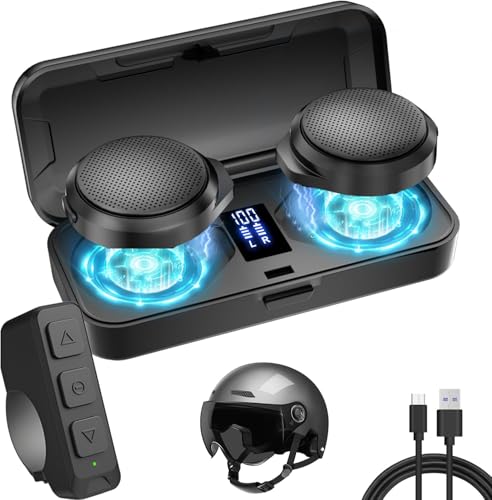
The OBEST True Wireless Helmet Headset solves one of the most persistent gripes riders face with aftermarket helmet audio: routing delicate wires behind EPS foam liners. Built on true wireless stereo (TWS) architecture, this system consists of two independent acoustic units that dock directly into helmet ear recesses. It is purpose-built for motorcycle commuters, touring riders, and winter athletes who desire top-tier convenience, audio streaming, and phone integration without having to dismantle their helmet padding.
Installation is straightforward thanks to the included high-adhesion hook-and-loop pads. Riders can position each speaker directly into audio-ready pockets found in most modern street, dirt, and ski helmets. Because each speaker communicates wirelessly, there is zero risk of cable snagging or wire pinching along the neck roll. Pairing to iOS and Android smartphones is instantaneous, automatically establishing a link the moment the units are pulled from their case.
Out on the open asphalt and mountain trails, the OBEST system demonstrates impressive practical usability. The oversized remote control is a standout feature, engineered with raised tactile buttons that provide definitive click feedback through heavy leather riding gloves or insulated ski mittens. An integrated microphone backed by active wind-reduction circuitry does an admirable job isolating voice frequencies, ensuring your callers and voice assistants can understand you even at highway cruising speeds.
Ultimately, the OBEST helmet audio system stands out as a dependable, cable-free personal listening solution. While it does not function as an open-channel group mesh intercom, it excels at providing crystal-clear GPS turn-by-turn alerts, podcast streaming, and phone communication at a fraction of the complexity associated with traditional helmet rigs.
Acoustically, helmet speakers face a challenging environment dominated by engine drone, exhaust rumble, and aerodynamic buffeting. OBEST tackles this by voicing their internal micro-drivers with a distinct emphasis on midrange clarity and crisp upper frequencies. This EQ curve allows spoken navigation directions and vocal-heavy musical passages to punch cleanly through ambient road rush without forcing the listener into uncomfortably elevated output levels.
While ultra-deep sub-bass is naturally attenuated due to the air gap inherent in helmet ear cutouts, the low-end punch remains punchy and tight for rock, pop, and electronic tracks. High frequencies are smooth and avoid harsh sibilance, an important factor during extended cross-country highway stretches where high-frequency fatigue can quickly set in.
Volume output is sufficiently robust to overcome standard cruising noise behind a windscreen or full-face shield. Combined with digital noise suppression on the microphone input, the hardware ensures both incoming and outgoing audio clarity remains consistent across diverse weather conditions and riding velocities.
The OBEST system is built with durability and weather-resistant outdoor use at the forefront. The speaker enclosures feature a low-profile disc form factor wrapped in rugged composite plastics that resist moisture, sweat, and temperature swings. The slim depth allows them to fit flush inside most audio-ready motorcycle and snow helmets without exerting painful pressure against the rider's ears.
Under the hood, the system is driven by a Bluetooth 5.3 chip, offering reliable signal integrity within a 33-foot perimeter, reduced power draw, and negligible latency. The controls are thoughtfully executed with enlarged multi-function buttons, eliminating the frustration of hunting for tiny micro-switches while maintaining focus on the road or ski slope.
Power performance is managed by a dual-stage system. Each speaker provides up to 5.5 hours of continuous talk and playback per charge. The companion 1900mAh carrying case acts as a portable power station, capable of replenishing the speakers multiple times for up to 50 hours of total operational uptime. A bright digital LED display on the front of the case provides exact real-time battery status, eliminating guesswork before you gear up.

Pros
- Seamless auto-pairing with Bluetooth 5.3 for instant connectivity
- Exceptional wind noise reduction keeps audio crystal clear at speed
- Extended battery life banishes recharge anxiety on long trips
- Simple Velcro installation works in most full-face helmets
- Remote control enables easy operation even with thick gloves
Cons
- Battery working time varies based on volume and usage intensity
- Requires helmets with sufficient interior space for comfortable fit
- No dedicated companion app for advanced sound customization
The 3T6B helmet Bluetooth speaker is a game-changer for riders and skiers who demand reliable hands-free audio. This true wireless headset slips into your helmet via simple Velcro, delivering music, calls, and navigation without the hassle of wires. It's built for action-packed lifestyles, from highway cruises to backcountry skiing, with features like a remote control for glove-friendly operation.
In real-world use, it shines on long rides where stable Bluetooth 5.3 keeps the connection drop-free even over rough terrain. The ANC technology effectively tamps down wind noise, ensuring you hear every detail of your playlist or incoming calls. Riders report feeling more connected and safer, as the large buttons allow quick adjustments without diverting attention from the road.
Overall, this speaker earns top marks for practicality and endurance, making it a must-have for American adventure seekers. Its 1900mAh case means fewer stops for charging, letting you focus on the thrill. Verdict: Highly recommended for anyone prioritizing audio freedom in extreme conditions.
Expect high-fidelity audio from the 3T6B speaker, powered by premium drivers that punch out clear vocals and balanced tones even at highway speeds. The ANC noise reduction excels at minimizing wind interference, creating a focused listening bubble ideal for calls with riding buddies or streaming podcasts on snowy slopes.
Bluetooth 5.3 delivers fast pairing and a robust 10-meter range, handling interference from gear or environments without skips. Volume levels fill the helmet effectively without distortion, while single-ear mode maintains situational awareness. It's tailored for dynamic outdoor use, where stability trumps studio perfection.
Performance holds up across music genres, with solid midrange clarity for lyrics and enough low-end thump for upbeat tracks during group rides.
The 3T6B boasts a sleek, low-profile design that mounts securely inside most audio-ready helmets using included Velcro. Its compact earpieces and wireless remote avoid clutter, making it lightweight and unobtrusive for all-day wear. Rugged construction withstands vibrations from motorcycles and skis, with easy disassembly for cleaning or helmet swaps.
Battery life is a standout: earpieces offer 5.5 hours of continuous use, backed by the 1900mAh case for up to 50 hours standby. Real-world tests show it powering through full-day outings with recharges only at day's end, far outlasting basic headsets. Quick charging gets you back in action fast.
While no specific IP rating is listed, the sealed build handles sweat and light moisture from active use, prioritizing helmet integration over standalone portability.
Comprehensive Guide to Helmet Audio for Can-Am Spyder F3 Riders
Riding a three-wheeled roadster like the 2017 Can-Am Spyder F3 presents a unique acoustic environment compared to traditional touring motorcycles or enclosed automobiles. Without a towering windshield on standard F3 trims, high-speed wind buffeting creates significant acoustic interference that quickly degrades high-frequency audio clarity. A dedicated can am spyder f3 2017 bluetooth helmet speakers guide helps riders bypass exterior wind shear by positioning high-output drivers directly adjacent to the ear canal. Balancing acoustic isolation with environmental awareness ensures you can enjoy navigation alerts and high-tempo playlists without missing vital road cues.
Understanding Helmet Audio Dynamics on an Open Roadster
Road turbulence around a three-wheeler moves differently than airflow around a conventional motorcycle due to the wider front stance and distinct aerodynamic profile of the chassis. At highway velocities, low-frequency rumble generated by passing air and tire contact can mask midrange vocal frequencies and delicate instrument details. Standard motorcycle earbuds often slip out of place when putting on a tight full-face or modular helmet, causing uncomfortable pressure points against the cartilage. In-helmet speaker modules solve this issue by anchoring securely inside the helmet shell lining, maintaining fixed acoustic geometry throughout the journey.
Achieving crisp sound quality in high-decibel environments requires more than sheer amplification. Pushing small drivers beyond their intended power limits results in harsh harmonic distortion that causes listener fatigue over several hours of riding. Modern helmet speaker systems counteract ambient turbulence by combining efficient driver diaphragms with active or passive noise management. Placing the acoustic center directly over the auditory canal ensures that sound waves transfer directly to the eardrum, minimizing the volume level necessary to overpower rushing wind.
Integrating Bluetooth Audio with the 2017 Can-Am Spyder Cockpit
The 2017 edition of the Can-Am Spyder F3 provides an aggressive riding stance and a minimalist digital gauge cluster, but baseline configurations lack the fully integrated stereo consoles found on luxury touring models. Many owners mount a dedicated smartphone or motorcycle GPS unit on the central handlebar clamp to handle navigation and media playback. Pairing a Bluetooth-equipped helmet audio system directly to your mobile device provides seamless turn-by-turn prompts and voice calls without requiring complex vehicle wiring harnesses. This direct wireless signal path eliminates ground loop humming and alternator whine that sometimes plague hardwired auxiliary motorcycle audio setups.
Signal fidelity also depends on how the transmitter manages wireless bandwidth across dynamic outdoor environments. While some riders contrast helmet audio with standalone Bluetooth audio options carried in luggage or mounted externally, helmet speakers keep audio private and intelligible at all speeds. Modern wireless protocols maintain rock-solid data streaming between the handlebar-mounted smartphone and the receiver modules inside the helmet. This direct connection ensures low-latency playback so spoken GPS prompts align accurately with real-time road exits and lane merges.
Evaluating Driver Profile and Helmet Ear Pocket Fit
Helmets engineered for powersports touring frequently include recessed circular pockets beneath the comfort liner specifically designed to house audio speakers. If a speaker module exceeds the depth of this factory pocket, it presses firmly against the rider’s ear, causing severe discomfort in less than an hour. Low-profile wireless speaker capsules such as those from OBEST and 3T6B are engineered to rest flush within standard audio-ready helmet cutouts. Confirming that your helmet liner features dedicated ear recesses is an essential first step before attempting installation.
Alignment within the ear pocket dictates both bass response and speech clarity. Shifting a speaker just half an inch off-center can result in an apparent volume loss of up to fifty percent, prompting riders to dangerously maximize audio gain. Using spacer pads behind the Velcro backing brings the driver surface closer to the ear without pinching the pinna. Taking the time to test-fit the helmet and verify driver placement ensures rich audio reproduction and long-lasting touring comfort.
Managing Wind Turbulence and Ambient Engine Noise
Exhaust tone from the Rotax triple-cylinder engine combines with aerodynamic buffeting to create a persistent noise floor at cruising speeds. Passive noise reduction begins with a well-fitted helmet neck roll and a properly sealed visor that deflects incoming drafts. Beyond mechanical isolation, modern helmet headsets utilize active noise reduction (ANC) technology and tuned microphones to filter ambient hiss during phone conversations. Filtering out repetitive acoustic frequencies allows spoken words to emerge clearly, making calls intelligible to callers on the other end of the line.
Wind management is equally crucial for high-fidelity music playback during extended tours. Drivers that emphasize balanced midrange and vocal frequencies perform significantly better against road roar than units attempting exaggerated, muddy sub-bass. Clear high-frequency response ensures that cymbals, guitar notes, and navigation chimes cut through ambient mechanical hum. Selecting a headset designed specifically to suppress wind interference protects audio fidelity without isolating the rider from surrounding sirens, horns, or sudden traffic changes.
Battery Management and Long-Distance Ride Endurance
Touring on a Can-Am Spyder often involves long stretches of highway where recharging electronic accessories is inconvenient. Traditional helmet headsets rely on built-in internal cells that require plugging the entire helmet into a wall outlet once the charge depletes. In contrast, modern true wireless systems like the OBEST and 3T6B kits introduce portable 1900 mAh charging storage cases that recharge the earbuds between riding sessions. A fully charged earphone capsule delivers approximately 5.5 hours of continuous communication, while the high-capacity case provides multiple recharges for a combined standby life reaching up to 50 hours.
Managing power reserves effectively involves understanding how volume levels and continuous streaming impact operating runtime. Running drivers at maximum volume against headwind depletes compact earpiece batteries faster than moderate-volume listening around suburban routes. Taking short rest breaks at scenic overlooks or fuel stations offers an ideal window to pop the capsules back into the portable charging dock. This modular charging routine eliminates battery anxiety and ensures your communication system remains operational from sunrise through evening arrival.
Glove-Friendly Controls and Remote Handlebar Accessibility
Manipulating microscopic switches on the side of a moving helmet while wearing heavy motorcycle gloves presents a substantial safety hazard. Bulky leather or textile gloves degrade tactile feedback, making it easy to accidentally disconnect a call or skip an important navigation alert. Helmet speaker kits that incorporate oversized multi-function buttons allow riders to reliably trigger media controls without fumbling. Responsive mechanical buttons provide distinct physical clicks that confirm command inputs even through insulated winter riding gloves.
Dedicated wireless remote controls take rider convenience and safety a step further. Both the OBEST and 3T6B systems include wireless remote controls designed with prominent buttons that can be mounted within easy thumb reach. Positioning controls adjacent to your left handlebar grip allows you to adjust volume, pause tracks, or accept incoming calls without lifting your hand away from the controls. Keeping your hands anchored on the handlebars maintains positive steering control of the three-wheeler across irregular asphalt surfaces.
Step-by-Step Helmet Installation and Speaker Alignment
Installing helmet speakers begins with carefully releasing the cheek pads and comfort liner from the internal EPS foam shell. Inspect the molded ear recesses to remove any dust or manufacturing debris before applying adhesive hardware. Clean the plastic or foam surface thoroughly with an alcohol prep pad to guarantee that the self-adhesive hook-and-loop pads bond securely. Allowing the adhesive backing to cure for several hours prevents the speaker pads from loosening when subjected to summer cockpit heat.
Once the mounting base is secured, attach the speaker capsules firmly against the Velcro landing patches. Route any thin connecting wires smoothly beneath the interior lining seams, avoiding pinch points around helmet strap anchors or neck roll clips. Put the helmet on and check for any uncomfortable pressure points against the outer ear. If the drivers feel misaligned, pull them off the Velcro, adjust the vertical positioning by a few millimeters, and test the fit again until the speakers sit directly over your ear canals.
Bluetooth 5.3 Stability, Pairing Sequences, and Smartphone Linking
Wireless audio reliability on the open road depends heavily on the underlying Bluetooth protocol. The integration of Bluetooth 5.3 chips in modern helmet systems offers accelerated pairing speeds, reduced latency, and enhanced anti-interference capabilities compared to older wireless generations. This modern chipset maintains a stable connection across a 10-meter range, preventing audio stuttering even when your phone is stored deep within a tank bag, glove compartment, or riding jacket pocket. Rapid pairing protocols automatically re-establish the connection the moment you power the modules on.
Setting up the wireless connection requires a simple, repeatable pairing sequence. Power on the headset modules, activate Bluetooth searching on your smartphone or dedicated GPS navigator, and select the device name from the available hardware list. If you ride in groups, maintaining a clean pairing list on your phone prevents unexpected connection drops to nearby mobile devices at traffic stops. Reliable Bluetooth performance ensures your audio feed remains clean, whether streaming music or relying on clear sounding speakers to deliver turn warnings through intricate highway interchanges.
Practical Comparison of True Wireless Helmet Audio Systems
The OBEST Motorcycle Bluetooth Headset with Charging and the 3T6B Motorcycle Bluetooth Headset with Charging share a common technological foundation focused on true wireless simplicity. Both systems abandon the tangled wiring harnesses typical of conventional motorcycle intercoms in favor of standalone TWS capsules. Each model is equipped with a 1900 mAh mobile charging case that yields around 5.5 hours of continuous talk time per individual earbud charge and up to 50 hours of total standby time. Both products also feature Bluetooth 5.3 connectivity, active noise reduction technology, and generous wireless signal stability up to 10 meters.
Subtle differences between these units center primarily on cosmetic design, display elements, and remote control ergonomics. The OBEST variant integrates an intuitive LED display on its battery case, allowing riders to check remaining cell percentage at a glance before setting out on the road. The 3T6B counterpart provides an equally capable wireless remote control designed specifically for tactile responsiveness while operating with gloved fingers. Both designs excel in audio-ready full-face and modular helmets, giving Can-Am Spyder owners a clean, wire-free alternative to bulky external clamp-on communicators.
Maintenance, Moisture Resistance, and Helmet Care
Riding in variable weather conditions exposes helmet electronics to road spray, humid downpours, and intense sun exposure. While helmet shells deflect the majority of direct moisture, damp air and perspiration can seep into interior cheek pads over extended rides. Periodically removing the audio capsules to air out the comfort liner prevents moisture buildup around sensitive electrical contact points. Wipe down the charging contacts on the earpieces and the interior docks of the 1900 mAh case with a dry microfiber cloth to prevent corrosion.
Storing your helmet equipment properly preserves both the EPS protective liner and the electronic battery cells. Avoid leaving the helmet inside an unventilated vehicle trunk or top case during sweltering summer afternoons, as excessive heat can degrade lithium-ion battery capacity over time. Keep the portable charging case charged to roughly fifty percent if storing the equipment during the winter off-season. Inspecting the Velcro pads and cable paths at the start of each riding season ensures your audio gear remains fully road-ready.
Practical Takeaways for Road-Ready Helmet Sound
Equipping your 2017 Can-Am Spyder F3 with a high-performing helmet audio system transforms long highway cruises into immersive, connected adventures. True wireless systems remove the frustration of snagged cords while providing modern Bluetooth 5.3 reliability and convenient battery management via portable charging cases. Prioritizing accurate speaker alignment within your helmet’s ear recesses maximizes acoustic efficiency without requiring excessive volume that leads to ear fatigue. Taking the time to configure handlebar controls, verify snug helmet fit, and secure your wireless pairing establishes a reliable soundstage for every journey ahead.




Write Your Review
No reviews yet. Be the first to share your experience!