


Many homeowners appreciate the clean visual look of architectural audio, yet they often find that flush-mount drivers struggle to produce low-end punch. When planning an upgrade, a common question arises: can you add a sonos sub to in ceiling speakers? In-ceiling drivers sit flush against drywall or wood, which frequently limits their acoustic enclosure volume and bass extension compared to bulky standalone cabinets. Pairing an external subwoofer can instantly bridge that sonic gap by handling the heavy low-frequency demands.
Connecting these components requires understanding how wireless streaming gear interacts with passive architectural hardware. Because standard ceiling speakers lack internal amplification, integrating them into a multiroom ecosystem depends on a compatible hardware hub like the Sonos Amp. Exploring how these systems communicate allows listeners to balance discreet design with full, room-filling sound, much like configuring dedicated speakers for music in a focused listening area. Knowing the exact setup requirements ensures reliable performance and prevents costly wiring mistakes.

Pros
- Zero cabinet rattle or distortion even at high volumes due to force-canceling drivers
- Flexible placement allows upright display or stealth horizontal positioning under couches
- Instant, reliable Wi-Fi integration with existing Sonos soundbars and multi-room setups
- Sleek, updated matte finish seamlessly complements modern living room decor
Cons
- Requires an existing Sonos soundbar or amplified speaker ecosystem to function
- Weighs over 26 pounds, making frequent relocation around the home cumbersome
- Requires constant wall AC power with no portable battery or direct Bluetooth streaming option
The Sonos Sub 4 represents the next evolution of home cinema low-frequency performance, engineered specifically for entertainment enthusiasts who demand immersive, visceral sound. Built to integrate seamlessly with the Sonos Arc Ultra, Arc, and Beam, this wireless subwoofer relieves your primary soundbar from handling demanding low frequencies, thereby freeing up dialogue clarity and midrange definition across your entire audio setup.
In practical real-world testing, the Sub 4 elevates movies, gaming, and high-fidelity streaming from ordinary listening into an authentic theater-grade experience. Explosions, orchestral scores, and bass-heavy tracks hit with immediate physical presence while remaining tightly controlled. Because it connects over your home Wi-Fi network rather than lossy compression channels, the low-end timing stays locked in perfect phase with your front stage audio without lag or synchronization hiccups.
While casual listeners might question adding a dedicated bass module, serious movie buffs and music fans will notice the dramatic difference immediately. The setup takes mere minutes using the Sonos companion app, which automatically tunes the output to match your room acoustics. For anyone seeking to transform their home media space into a high-octane screening room, the Sonos Sub 4 is a premier, set-it-and-forget-it audio investment.
At the heart of the Sonos Sub 4 are dual custom-engineered drivers positioned face-to-face in a force-canceling configuration. This mechanical design neutralizes internal cabinet energy, ensuring that pure, distortion-free low frequencies fill your space without annoying buzzes, rattles, or wall vibrations. A precisely tuned central port enhances air displacement, generating deep sub-bass response that you feel in your chest during action movie sequences and live concert tracks.
Connecting via robust dual-band Wi-Fi rather than standard Bluetooth, this speaker maintains a rock-solid, ultra-low-latency link with your primary Sonos soundbar. The expansive frequency separation permits higher overall volume ceilings without harsh clipping, keeping dialogue crystal clear while the subwoofer independently manages the heaviest bass drops. For expansive living areas, you can even pair two Sub 4 units together to completely eliminate acoustic dead spots and create uniform low-end coverage.
The Sonos Sub 4 maintains the brand iconic sculptural silhouette while introducing a modern, refined matte finish that resists dust and fingerprints. Weighing in at 26.46 pounds with dimensions of 6.22 by 15.31 by 15.83 inches, the speaker feels remarkably solid and dense. Its physical versatility is a standout benefit: you can display it prominently standing upright or slide it horizontally flat beneath a couch or media console without degrading acoustic output.
Engineered strictly as a dedicated, high-output stationary home theater speaker, the Sub 4 does not feature an internal battery or portable waterproof ratings. Instead, it relies on a single discrete AC power cable plugged directly into a standard wall outlet. This continuous corded power delivery eliminates battery degradation concerns and runtime limitations, providing perpetual, uninterrupted high-current power for endless movie marathons and listening sessions.

Pros
- Zero cabinet vibration even at high volume levels due to force-canceling drivers
- Sleek and compact cylindrical footprint blends easily into modern home decor
- Significantly clears up midrange and vocal clarity on paired Sonos soundbars
- Rock-solid wireless connectivity with effortless app-guided calibration
Cons
- Trueplay digital room tuning requires an Apple iOS device to calibrate
- Operates exclusively with Sonos hardware and cannot pair with third-party receivers
- Requires a continuous AC wall outlet connection with no portable battery function
The Sonos Sub Mini is a purpose-built wireless home theater speaker engineered to inject substantial low-frequency power into your entertainment setup without overwhelming your living space. Designed specifically to complement smaller soundbars like the Sonos Beam and Ray, or stereo pairs like the Era 100, this compact subwoofer takes over heavy low-end duties so your primary speakers can focus entirely on crisp dialogue and expansive mid frequencies.
In real-world living rooms and apartments, the Sub Mini shines by delivering tactile, cinematic impact without the structural buzzing often associated with budget subwoofers. Whether you are immersed in high-octane action movies, streaming bass-heavy playlists, or playing competitive video games, explosions and kick drums feel visceral and centered. The bass blends naturally into the mix rather than booming artificially, creating a theater-grade soundstage in small to medium-sized rooms.
Living with the Sub Mini is exceptionally seamless. Setup takes only a few minutes through the companion mobile app, which uses high-speed Wi-Fi to sync volume changes effortlessly with your soundbar or TV remote. You never have to tinker with separate volume dials or crossover knobs once it is integrated into your system.
For owners of compact Sonos sound systems who want cinematic depth without dominating their floor plan, the Sub Mini hits the ideal sweet spot. It delivers impressive dynamic range, refined low frequencies, and the reliable ease of use that defines modern multi-room audio.
Sound performance on the Sonos Sub Mini is anchored by dual custom-engineered woofers positioned directly opposite each other inside a sealed cabinet. By facing inward, the drivers create an active force-canceling effect that eliminates unwanted cabinet vibrations. This means the low-end frequencies stay remarkably clean, punchy, and articulate even during high-decibel movie climaxes.
Acoustic performance is further elevated by Sonos Trueplay tuning software, which utilizes your iOS device microphone to analyze room boundaries, furniture reflections, and speaker placement. The processing automatically corrects standing waves and boomy room modes, ensuring clean bass output whether the unit is positioned out in the open or tucked close to a wall corner. The result is warm, musical bass that enriches movie dialogue clarity and instrument separation across your entire audio setup.
Sporting a minimalist cylindrical design with a matte black finish, the Sonos Sub Mini stands under 12 inches tall and weighs just under 14 pounds. The central cutout showcases the inward-facing drivers, giving it an architectural, sculptural look that fits right into contemporary living room decor. Its modest footprint makes it remarkably easy to tuck behind a lounge chair, next to an entertainment credenza, or beneath a console table.
Because the Sub Mini is designed strictly as a permanent, high-performance home audio component, it operates via a standard AC power cord and contains no internal battery. This corded design ensures reliable, uncompressed acoustic output at all times without the need to monitor battery levels or manage recharge cycles. For modern smart homes seeking sleek aesthetics and dependable stationary performance, its physical build is both functional and discreet.

Pros
- Seamless Trueplay room calibration unlocks tailored sound through the Sonos Amp
- Remarkably wide dispersion pattern fills entire rooms without localized audio hotspots
- Discreet, paintable magnetic grilles provide a clean and upscale architectural finish
- Impressive bass extension down to 36 Hz with integrated Sonos digital signal processing
Cons
- Requires a Sonos Amp to access Trueplay tuning and optimized DSP profiles
- Passive in-ceiling design requires running in-wall speaker wire and cutting drywall
- Alternative square grilles are sold separately rather than included in the box
The Sonos in-Ceiling by Sonance represents a premier partnership between one of the most recognized names in wireless multi-room audio and a pioneer of custom architectural sound. Built from the ground up to integrate into the modern smart home, these in-ceiling speakers eliminate the visual footprint of traditional box speakers while maintaining the sonic refinement audiophiles expect. Whether you are outfitting a newly built kitchen or retrofitting an existing living room, these speakers deliver high-end audio directly from above.
Targeted at homeowners, designers, and AV enthusiasts who demand clean living spaces, these speakers solve the age-old dilemma of bulky audio equipment versus sound quality. Because they are fully passive, they wire back to a central amplifier, making them ideal for multi-room background audio or as height and surround channels in a Sonos-powered home theater configuration alongside a Sonos Arc or Beam soundbar.
In real-world testing, the true magic occurs when pairing these speakers with the Sonos Amp. This unlocks Sonos Trueplay tuning, which utilizes the microphone on an iOS device to measure how sound reflects off walls, hardwood floors, and furniture. The system automatically corrects acoustic anomalies, turning what is usually a compromised ceiling setup into a remarkably balanced, full-bodied listening experience. Vocals stay intelligible, instruments maintain separation, and ambient music feels completely immersive.
For anyone wanting an uncluttered home audio system without forfeiting the convenience of streaming services and whole-home grouping, the Sonos in-Ceiling speakers are a standout choice. Their blend of Sonance acoustic engineering and Sonos software intelligence makes them an outstanding long-term investment in your home entertainment setup.
Acoustically engineered by Sonance, each speaker features a 6.5-inch (165 mm) polypropylene woofer coupled with a high-performance 1-inch (25 mm) polyurethane dome tweeter. Together with the active digital signal processing inside the Sonos Amp, the system delivers an extended frequency response ranging from 36 Hz up to 20 kHz (plus or minus 3 dB). Low-end bass notes are warm, punchy, and surprisingly deep for a flush-mount speaker, meaning casual listening sessions rarely require an immediate subwoofer pairing.
Ceiling speakers often suffer from an unwanted spotlighting effect, where the listener must stand directly underneath the speaker to hear full treble clarity. Sonance solves this with a wide 90-degree nominal coverage angle. The soundstage spreads out broadly across the room, providing consistent frequency response and even volume levels regardless of where you are seated or standing. Midrange frequencies, specifically male and female vocals, remain crisp and forward without becoming abrasive at higher output levels.
Each Sonos in-Ceiling speaker measures 9.13 inches across with an installation depth requirement of 4.76 inches (120 mm), ensuring compatibility with standard residential ceiling joists and drop ceilings. The build incorporates durable, non-resonant polymer frames with heavy-duty mounting doglegs that secure firmly against ceiling drywall. Each speaker weighs approximately 5 pounds, giving it a reassuringly dense, rattle-resistant construction.
From a visual perspective, these speakers disappear into your architecture. They come standard with round micro-perforated steel grilles that attach magnetically to the rim. Both the grille and frame flange can be spray-painted to match any custom ceiling color or texture. Underneath the grille, robust spring-loaded terminal connectors easily accommodate standard 14-gauge or 16-gauge in-wall speaker wire. While compatible with third-party amplification, these 8-ohm speakers are specifically optimized for the Sonos Amp, which allows up to three pairs to be safely wired in parallel to a single amplifier unit.
Pros
- Robust bass and natural sound signature for engaging listening
- Simple installation on drywall or wood with secure mounting tabs
- Elegant, low-profile design that's paintable to match walls
- Wide 40Hz-20kHz response covers full audio spectrum
- Versatile for indoor rooms and covered patios
Cons
- Requires an external amplifier or receiver for power
- Involves cutting a 9.4-inch ceiling hole for installation
- Best for covered outdoor use, not fully exposed to weather
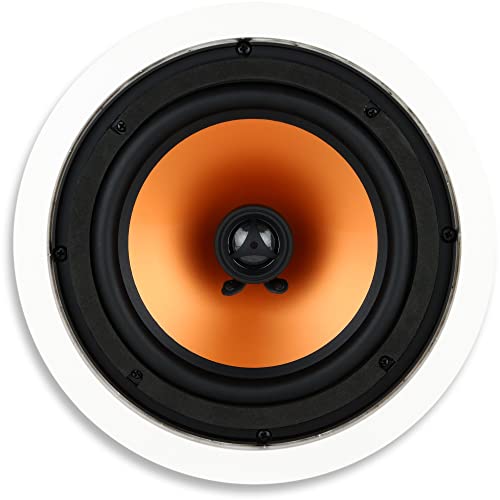
The Micca M-8C is a 2-way in-ceiling speaker designed for seamless integration into home audio systems, featuring an 8-inch poly woofer and a 1-inch pivoting silk dome tweeter. It's perfect for homeowners building whole-house audio or enhancing home theaters without visible speakers cluttering the space.
In real-world use, it shines in multi-room setups like living rooms, kitchens, bedrooms, and bathrooms, delivering smooth, natural sound with punchy bass that fills spaces effortlessly. The 6dB crossover ensures seamless transitions for clear vocals and detailed highs, making movies and music come alive.
Installation is straightforward with built-in tabs that grip drywall securely, and the paintable grille makes it disappear into ceilings. While it needs an AV receiver, its 90dB sensitivity and 100W power handling provide reliable performance for daily enjoyment.
Verdict: A top pick for clean, powerful ceiling audio that elevates everyday listening and entertainment without compromise.
The M-8C's 8-inch high-excursion woofer plunges to 40Hz for deep, robust bass that anchors music and movie effects, while the pivoting silk dome tweeter delivers crisp, airy highs up to 20kHz. The precise 6dB crossover blends them smoothly, ensuring vocal clarity and a wide soundstage even off-axis.
With 90dB sensitivity and 100W power handling, it reaches high volumes without distortion, ideal for dynamic home theater scenes or background music across rooms. Paired with a quality amp, it maintains stability and coherence for hours of fatigue-free listening.
Users appreciate its natural signature for everything from podcasts to rock concerts, outperforming basic ceiling speakers in bass depth and detail.
The M-8C's modern rimmed grille protrudes just minimally at 10.7 inches diameter, blending unobtrusively into ceilings. Paint it to match your walls for a virtually invisible look that saves floor and shelf space in any room.
Built tough with durable materials, it handles family rooms, kitchens, bathrooms, and covered porches reliably over years. At 3.5 inches mounting depth, it fits standard joists easily without bulk.
No battery means endless playback powered by your AV system, with 100W handling for all-day sessions. Its 8-ohm impedance pairs perfectly with most receivers for efficient, heat-free operation.

Pros
- Significantly more bass depth and warm midrange authority than standard 6.5-inch ceiling speakers
- Pivoting tweeter design resolves off-axis listening issues typical of overhead placement
- Trimless, paintable magnetic grilles provide a truly flush, minimalist aesthetic
- Seamless integration with Sonos ecosystem and Trueplay software when paired with the Sonos Amp
Cons
- Requires separate amplification and in-wall speaker wire runs as these are passive speakers
- Larger 8-inch cutout dimensions require adequate ceiling joist clearance and pre-planning
- Trueplay acoustic calibration features require an iOS device
The Sonos 8-inch In-Ceiling Speakers by Sonance represent a premier acoustic collaboration designed to bring robust, high-performance sound into modern living spaces. Combining Sonance architectural expertise with Sonos smart-audio versatility, these passive speakers disappear into your ceiling while projecting an immersive, wide-dispersion soundfield. They are an ideal solution for homeowners and design-conscious audiophiles who want audiophile-grade fidelity without giving up floor or shelf space to bulky cabinet speakers.
In real-world installations, the 8-inch format delivers an immediate performance advantage over standard in-ceiling models. The larger cone area moves significantly more air, resulting in rich, full-bodied musical playback and crisp dialogue clarity that does not sound thin or hollow. Connecting the speakers to a Sonos Amp unlocks advanced DSP profiles and Sonos Trueplay calibration, which uses an iOS device to measure how sound waves reflect off walls and furniture, tailoring the output for clean, balanced playback in any architectural environment.
While standard ceiling speakers often struggle with directional imaging, the pivoting tweeter assembly allows you to point high frequencies toward primary listening spots, such as a dining table, kitchen island, or sofa. This thoughtful acoustic feature produces realistic stereo separation and crisp vocal presence for ambient background playlists and high-energy gatherings alike. For anyone investing in high-end, discreet architectural audio, this pair offers an exceptional balance of acoustic depth and subtle design.
Acoustic performance is anchored by the 8-inch custom-engineered polypropylene woofer, which delivers surprisingly authoritative low-frequency impact. Bass drops with satisfying punch and control, handling complex low-end lines in modern music and cinematic soundtracks with ease. The expanded cone displacement minimizes cone breakup, ensuring that the midrange remains transparent and open even during bass-heavy sequences.
High frequencies are handled by a precision-engineered 1-inch polyurethane dome tweeter housed in an adjustable, pivoting mount. This directional design ensures treble details, acoustic string plucks, and vocal consonants remain clear rather than muffled overhead. With a robust power capacity of 225 watts into 8 ohms, these speakers offer wide dynamic range, effortlessly handling sudden volume transitions with clean articulation and zero harshness.
Architectural elegance is central to the design of the Sonos INCL8WW1. The speakers feature a bezel-less, micro-perforated steel grille that attaches magnetically to the outer rim, creating a smooth transition to the ceiling surface. The factory matte white finish looks clean out of the box, but the grilles can also be spray-painted with standard ceiling paint to blend invisibly into any color scheme.
As passive architectural speakers, they require in-wall rated speaker wire connected to external power. While compatible with any third-party stereo receiver or multichannel amplifier supporting 8-ohm loads, they are engineered to deliver their full potential when driven by the Sonos Amp. Installers should note that the 8-inch woofer necessitates a larger ceiling cutout and approximately 5.5 inches of mounting depth, requiring careful verification of joist spacing and overhead ductwork before installation.
How to Integrate and Configure a Sonos Sub with In-Ceiling Speakers
You can add a Sonos Sub to in-ceiling speakers, but you cannot connect them directly to each other without an intermediary amplifier. Architectural ceiling speakers are passive devices requiring physical speaker wire, whereas a Sonos Sub is an active wireless component designed to pair with powered Sonos hardware. The standard solution is to wire the ceiling speakers into a Sonos Amp, which then creates a wireless digital link to the subwoofer through the Sonos app.
Why the Sonos Amp Is Essential for Architectural Audio
Passive in-ceiling speakers contain no internal amplifiers, streaming chips, or wireless network radios. They rely completely on an external amplifier to deliver power and audio signals over copper speaker wire. The Sonos Amp fills this role by supplying up to 125 watts per channel into an 8-ohm load, providing ample power to drive clean audio across residential spaces.
Beyond raw amplification, the Amp functions as the digital network brain of the setup. It connects to your home Wi-Fi network, streams music from digital sources, and broadcasts a private wireless channel to accessory components. When you introduce a Sonos Sub to the system, the Amp pairs directly with it, managing synchronization so bass pulses align cleanly with mid-range and treble notes.
Without a Sonos Amp or a legacy Connect:Amp, pairing a wireless Sonos Sub to bare ceiling speaker wire is impossible. The subwoofer lacks analog speaker wire terminals, high-level inputs, and conventional line-level RCA ports. Investing in the proper host amplifier is therefore the foundational requirement for building this hybrid architectural system.
Comparing Subwoofer Choices: Sonos Sub 4 vs Sonos Sub Mini
Sonos offers two primary subwoofer models that can pair with your amplified ceiling speakers. The flagship Sonos Sub 4 – Wireless Subwoofer – Black features dual Sonos-engineered drivers positioned inside a ported enclosure. Its force-canceling acoustic architecture places the drivers face-to-face, which virtually eliminates mechanical cabinet vibration, buzzing, and rattles against floorboards.
This design allows the Sub 4 to deliver deep, dynamic bass in open-concept living rooms, large basements, or high-ceiling spaces. The enclosure can stand upright as an aesthetic statement piece or lay flat on its side, making it possible to tuck under a sofa or low-profile entertainment console. Its updated matte finish and robust processing hardware allow it to handle demanding movie soundtracks and complex musical basslines effortlessly.
For smaller listening environments, the Sonos Sub Mini – Black – Compact provides an attractive alternative with its acoustically sealed cylindrical cabinet and dual inward-facing custom woofers. It is particularly well suited for bedrooms, home offices, and secondary zones where space is limited but listeners still desire dramatic depth. While the Sub Mini fills modest spaces with articulate, balanced bass, the Sub 4 provides the higher acoustic output needed to match expansive rooms. Both units pair seamlessly to a Sonos Amp using the same app interface, giving homeowners complete flexibility when tailoring sound.
Ceiling Speaker Options: Sonos Architectural vs Third-Party Models
When selecting in-ceiling speakers to accompany your subwoofer, you can choose between dedicated Sonos Architectural models and third-party passive drivers. The Sonos in-Ceiling by Sonance, INCLGWW1 features a 165 mm woofer paired with a 25 mm tweeter, delivering a frequency response from 36 Hz to 20 kHz with digital signal processing. These 6.5-inch speakers provide a wide 90-degree nominal coverage angle and an installation depth of 120 mm, allowing them to disperse sound evenly throughout a room.
For listeners who want greater power handling and bass presence from above, the Sonos in-Ceiling Speakers 8″ by Sonance, White offer 225 watts of power capability and a trimless magnetic grille design. A major advantage of choosing Sonos by Sonance architectural models is that the Sonos Amp recognizes them specifically. This hardware detection unlocks Trueplay software tuning and allows a single Amp to safely power up to three pairs of speakers simultaneously.
Third-party in-ceiling speakers can also connect to the Sonos Amp with excellent results. For example, the Micca M-8C 2-Way in-Ceiling Round Speaker uses a high-excursion 8-inch poly woofer and a pivoting 1-inch silk dome tweeter with an 8-ohm nominal impedance and 90dB sensitivity. While third-party models do not unlock proprietary Trueplay software through the Amp, they provide high value and solid audio performance. The Sonos Amp treats third-party passive speakers as standard stereo channels, routing the sub-bass frequencies to the wireless subwoofer just as effectively.
Speaker Cabling and In-Wall Installation Standards
Proper physical wiring establishes the foundation for clean audio and long-term safety. Because the speaker wire travels through ceiling cavities and wall studs back to the Sonos Amp, building codes generally require CL2 or CL3 rated speaker cable. These jackets are specifically engineered to resist flame spread and produce less toxic smoke in the event of a fire.
Wire gauge selection should match the total length of the cable run from the amplifier to the ceiling locations. For runs under 50 feet, 16-gauge oxygen-free copper wire is generally adequate for 8-ohm speakers. For longer runs extending up to 100 feet or more, stepping up to 14-gauge wire reduces electrical resistance, preserving amplifier damping factor and preventing high-frequency loss.
Maintaining proper acoustic polarity during connection is critical for overall sound balance. Always connect the positive amplifier terminal to the positive speaker terminal, and repeat the same process for negative leads. Reversing polarity on one ceiling speaker causes acoustic phase cancellation, thinning out mid-bass frequencies even before the subwoofer is engaged.
Step-by-Step Wireless Subwoofer Pairing in the Sonos App
Once your in-ceiling speakers are wired to the Sonos Amp and functioning, adding the wireless subwoofer takes only a few minutes. Begin by plugging the Sonos Sub 4 or Sub Mini into an electrical outlet within the same room. Open the Sonos mobile app on your smartphone or tablet, ensuring your mobile device connects to the same local Wi-Fi network as your audio components.
The app will often display a pop-up banner detecting a new device nearby. If this prompt does not appear automatically, navigate to the Settings tab, select System, and tap on the room name assigned to your Sonos Amp. Choose the option labeled Connect Sub, then follow the straightforward graphical instructions displayed on your screen.
During setup, the app will ask you to press the join button on the side or rear of the subwoofer. An audible chime confirms the digital handshake between the components. The Amp and Sub then establish a direct low-latency wireless communication link, ensuring that audio playback remains tightly synchronized across all channels.
Automatic Crossover Management and Frequency Distribution
One of the greatest benefits of pairing a Sonos Sub with amplified ceiling speakers is automated crossover management. When the Sub is added to the Amp, the Sonos software automatically inserts a high-pass filter into the ceiling speaker signal path. This filter cuts off the lowest bass frequencies, typically around 80 Hz, preventing the in-ceiling woofers from attempting to reproduce deep rumble.
Simultaneously, the system routes those low-frequency audio tracks directly to the subwoofer via a complementary low-pass filter. Relieving in-ceiling speakers of intense bass excursion dramatically lowers distortion in the mid-range and vocal registers. Small woofers installed in open drywall cavities no longer vibrate ceiling joists or strain to push deep low-end air.
This dynamic frequency division creates significantly more headroom for the Sonos Amp and your speakers. Because the Amp no longer consumes energy amplifying taxing sub-bass notes for the ceiling channels, the entire system can play louder with greater clarity. Vocals become cleaner, acoustic instruments gain separation, and the overall soundstage opens up dramatically.
Room Acoustics and Physical Subwoofer Placement
In-ceiling speakers project sound downward from fixed positions overhead, creating a broad dispersion pattern across the room. Subwoofers, however, behave differently because low-frequency bass waves are largely omnidirectional. While human ears struggle to pinpoint the exact physical origin of deep bass, the physical boundaries of the room heavily influence bass quality.
Placing the Sonos Sub near a wall or in a corner produces boundary loading, which naturally amplifies the perceived bass energy in the space. While corner placement increases overall output, it can occasionally exaggerate specific resonant frequencies, leading to boomy or muddy bass. Setting the subwoofer along a flat wall often produces a tighter, more musical presentation that integrates naturally with overhead sound.
Understanding how room boundaries influence low frequencies is just as vital here as it is when evaluating the sound profile of component speakers inside tighter acoustic spaces. Experimenting with different floor positions before settling on a permanent spot ensures smooth acoustic blending. Because the connection is wireless, you have the flexibility to place the subwoofer wherever it sounds best without running signal cables across the floor.
Ambient Background Music vs Surround Sound Applications
Integrating a Sonos Sub with ceiling speakers generally serves one of two distinct purposes: whole-house ambient music or home theater surround sound. For ambient music in open living areas, dining spaces, or kitchens, the ceiling speakers provide comfortable stereo or dual-mono sound from above. Adding a subwoofer transforms background listening into a rich, full-bodied musical experience with deep warmth.
In home theater applications, the configuration functions slightly differently. When an Amp powers in-ceiling speakers designated as rear surround channels, it bonds wirelessly to a primary front soundbar such as the Sonos Arc or Beam. In this layout, the Sonos Sub pairs to the home theater room group rather than just the ceiling channels, anchoring explosive cinematic effects while the overhead speakers deliver atmospheric cues.
Using in-ceiling speakers as front left, center, and right channels for television audio is generally less ideal due to the high acoustic elevation. Voices can sound as though they originate from the ceiling rather than the screen. For music playback, however, downward dispersion paired with a floor-level subwoofer creates an immersive listening environment that fills the entire room uniformly.
Trueplay Tuning and Manual Acoustic Calibration
Room geometry, glass windows, hardwood floors, and furnishings all introduce acoustic reflections that alter how you hear sound. Sonos addresses these variations through its proprietary Trueplay tuning technology. When you pair a Sonos Sub with Sonos by Sonance architectural speakers on a Sonos Amp, Trueplay uses the microphone on a supported iOS device to map acoustic reflections.
The software measures how test tones interact with your room boundaries, automatically adjusting EQ curves to smooth out harsh peaks and fill acoustic nulls. This calibration ensures that the transition between the subwoofer and the ceiling speakers is seamless, preventing bass bloat near walls. If you move furniture or reposition the subwoofer, running Trueplay again recalibrates the sound profile for your updated layout.
If you use third-party in-ceiling speakers like the Micca M-8C, Trueplay is not accessible through the Amp. However, the Sonos app provides comprehensive manual controls that let you dial in the sound. You can fine-tune bass and treble sliders, enable loudness compensation for low-volume listening, and adjust dedicated Sub Level controls to balance low-end impact with vocal clarity.
Troubleshooting Audio Drops, Phase Mismatches, and Setup Errors
Although the Sonos ecosystem is widely known for reliability, network hiccups or acoustic conflicts can sometimes arise during setup. If your Sonos Sub experiences intermittent audio drops, the issue usually stems from Wi-Fi interference or weak signal coverage. Connecting the Sonos Amp to your main router using an Ethernet cable creates a dedicated wireless mesh network, which stabilizes communication between all bonded devices.
Another potential issue is weak or hollow bass caused by acoustic phase cancellation. In the Sonos app under Sub Audio settings, you will find a Sub Phase toggle that switches between 0 degrees and 180 degrees. If the bass sounds weak when you stand in your primary listening area, toggling this setting reverses the acoustic polarity of the subwoofer, often restoring rich, punchy low frequencies instantly.
Always inspect physical speaker wire connections if you notice crackling or silence from one of the ceiling channels. Loose copper strands at the Amp binding posts or ceiling speaker push pins can trigger short-circuit protection circuits inside the amplifier. Making sure every wire is cleanly stripped, tightly clamped, and free from stray wire strands keeps the entire system operating safely.
Daily Listening and Practical System Verification
After completing the physical installation, app pairing, and acoustic adjustments, validating your setup with familiar audio tracks confirms everything works properly. Play dynamic music tracks that feature prominent basslines, clean acoustic guitars, and central vocals. The sound should feel unified, with bass frequencies blending invisibly into the room rather than drawing your attention to the floor.
Keep in mind that high-performance audio systems require adequate ventilation around the amplifier. The Sonos Amp uses passive convection cooling, so placing it in an unventilated closet or tightly enclosed cabinet can cause thermal throttling during high-volume sessions. Much like organizing cables and hardware in desktop speaker connections, leaving adequate space around the Amp ensures long-term reliability and peak performance.
Adding a Sonos Sub 4 or Sub Mini to in-ceiling speakers successfully bridges the gap between architectural elegance and high-fidelity sound. By routing low-frequency energy away from the ceiling and onto the floor, you protect your ceiling drywall from vibrations while unlocking incredible dynamic range. With the right hardware combination and proper calibration, this hybrid setup delivers rich, immersive sound that enhances any living space.






Write Your Review
No reviews yet. Be the first to share your experience!