


Setting up an immersive home theater audio system often begins with confusion about where satellite units belong and how audio signals travel between channels. Learning %how to surround sound speakers% integrate into a living space can transform a flat movie soundtrack into a wide, spatial acoustic experience. Many listeners transition from basic television speakers or traditional stereo loudspeakers toward multi-channel environments to achieve clearer dialogue and convincing directional sound effects. Understanding the distinction between front channels, side surrounds, and low-frequency subwoofers prevents unbalanced sound and frustrating installation headaches.
Modern multi-channel hardware ranges from modular component arrays using traditional speaker wire to streamlined soundbar systems featuring wireless satellite modules. Choosing the right configuration requires balancing room acoustics, physical cable routing, and source compatibility across modern television connections. Whether you are dealing with passive bookshelf units powered by an external amplifier or active wireless satellite speakers, proper alignment ensures seamless transitions as sound travels across your listening area. Taking time to map out your layout before mounting hardware creates an engaging audio profile tailored to your seating position.

Pros
- Incredibly small size blends into any home decor
- Effortless wireless connection to Bose Soundbar
- Brings immersive surround sound to music, movies, and TV
- Reliable 30-foot wireless range for versatile positioning
- Easy setup with just power adapters and receivers
Cons
- Requires compatible Bose Soundbar for full functionality
- Bass performance enhanced only with optional module
- Needs nearby power outlets for adapters

Pros
- Bundled dual wireless microphones turn your living room into an effortless karaoke hub.
- Dedicated 5.5-inch subwoofer yields noticeably deeper, more impactful bass than standalone TV speakers.
- HDMI ARC and Bluetooth 5.3 ensure quick setup with minimal audio delay.
- Dialogue-enhancing equalizer presets improve speech clarity in movies and news broadcasts.
Cons
- The subwoofer connects to the soundbar via an audio cable, which restricts placement flexibility compared to wireless subs.
- Peak 240W rating represents momentary maximum output, making it best suited for small to medium-sized rooms.
- Lacks advanced spatial audio codecs such as Dolby Atmos or DTS:X.
The SunTrok 2.1-channel soundbar system occupies a uniquely fun niche in the home audio market, blending cinematic TV sound with party-ready karaoke capabilities. Designed specifically for households that want to replace tinny television speakers without committing to bulky AV receivers, this compact system comes packaged with an external subwoofer and two rechargeable wireless microphones. It delivers a comprehensive entertainment package ready for family gatherings, casual gaming, and movie marathons right out of the box.
During typical everyday watching, the soundbar makes a strong case for itself through vocal clarity and midrange separation. Spoken dialogue in dramas, podcasts, and sports matches projects forward cleanly, eliminating the muffled character common to rear-firing TV drivers. When action films or party playlists take center stage, the wired 5.5-inch subwoofer delivers respectable low-end weight, giving impacts and basslines a tactile presence that enriches the entire listening space.
The centerpiece feature for casual entertainers is undoubtedly the pair of 2.4GHz wireless microphones. With pre-paired connectivity, customizable echo levels, and onboard volume adjustments, setting up impromptu karaoke sessions is completely frictionless. Vocals pass through the system with minimal latency, and the integrated noise reduction keeps feedback manageable even in modest room configurations.
Overall, the SunTrok soundbar represents a practical, high-value audio solution for apartments, dens, and living rooms. While it does not claim audiophile-grade high-resolution decoding, it executes its primary mission admirably by offering clear speech, spirited bass, and an instant social party experience in a single purchase.
Acoustically, the SunTrok system is built around dual 2.5-inch full-range drivers housed within the soundbar bar chassis, crossed over to a standalone 5.5-inch bass driver in the subwoofer cabinet. Covering a stated frequency spectrum from 20Hz to 20kHz, the acoustic tuning leans toward a punchy V-shaped signature that emphasizes vibrant low-end rumble and clear upper-register vocal presence. The subwoofer handles low-frequency sweeps smoothly, avoiding the hollow, boxy distortion that frequently plagues ultra-slim soundbars.
Capable of hitting 240W peak power, the system produces more than enough acoustic volume to fill standard residential spaces without harsh clipping at moderate-to-high volumes. Integrated digital signal processing provides dedicated presets for Movie, Music, and News listening. Movie mode broadens the virtual soundstage for better atmospheric immersion, while News mode tightens the low-end to place absolute focus on spoken-word intelligibility.
Crafted with a clean, low-profile dark chassis, the soundbar measures roughly 32 inches across and under 3 inches in height. This slim profile ensures it sits comfortably beneath most television bezels without encroaching on screen real estate or obstructing infrared remote receivers. For wall-mounted displays, the package includes dedicated mounting screws and foam pads, allowing for an uncluttered floating installation.
Connectivity options are well-rounded and straightforward. The rear panel accommodates HDMI ARC, digital Optical, 3.5mm AUX, and USB inputs, guaranteeing plug-and-play capability with both modern smart TVs and older media players. Wireless audio transmission is handled by efficient Bluetooth 5.3, providing low power consumption and a dependable 50-foot wireless range, while the microphones recharge via standard USB to keep you untethered during performances.

Pros
- Lifelike Dolby Atmos height channels with precise vertical sound imaging
- Powerful subwoofer and surrounds deliver room-filling bass and effects
- Lossless eARC and app-based EQ for tailored, high-fidelity audio
- Stable Bluetooth 5.4 with fast pairing and interference resistance
- OTA updates keep features fresh via intuitive app control
Cons
- Not compatible with DTS formats
- Requires setup space for rear surrounds and subwoofer
- App control essential for full customization
The ULTIMEA Skywave F40 is a complete 5.1.2-channel soundbar system designed for home theater enthusiasts who crave Dolby Atmos immersion without breaking the bank. It includes a main soundbar with up-firing drivers, two wireless rear surrounds, and a robust subwoofer, transforming your living room into a cinematic paradise. Ideal for smart TV owners, gamers, and movie buffs, this 2025 model excels in delivering sound that moves around and above you.
In real-world use, the system shines during action films where helicopters whirl overhead or rain patters from the sky, thanks to its advanced spatial algorithms. Bluetooth 5.4 handles music streaming smoothly, while HDMI eARC ensures no detail is lost from your 4K TV. Setup is straightforward with CEC auto-sync, though placing the surrounds optimally enhances the experience.
Overall, the Skywave F40 punches above its weight with pro-level features like app-based EQ and OTA updates. It's a top pick for anyone upgrading from basic TV speakers to true surround sound, offering exceptional value for immersive home entertainment.
Bass from the dedicated subwoofer rumbles deeply, anchoring explosions and soundtracks with authority, while up-firing drivers add precise height channels for Atmos effects. Vocal clarity stays sharp across dialogues, and the 360° SurroundX creates a wide, natural soundstage that fills medium to large rooms without hot spots.
Volume levels reach theater-like peaks with minimal distortion, perfect for blockbuster nights. Bluetooth 5.4 delivers stable connections up to 30 feet with low latency for gaming, outperforming older versions in crowded Wi-Fi environments. Lossless eARC maximizes detail from Dolby Atmos sources, ensuring every raindrop or footstep feels real.
The sleek soundbar and compact surrounds blend into modern home setups, with a premium build using neodymium cores for durable performance. At around 20-30 lbs total, it's manageable for placement but stationary, requiring wall outlets for continuous power rather than batteries.
No IP rating means it's optimized for indoor use, protected from home dust but not outdoor elements. Power draw is efficient for all-day sessions, with no charging downtime; just plug in and enjoy endless playback during family movie marathons or gaming marathons.

Pros
- Exceptional virtual surround immersion with 99.99% detail accuracy
- Versatile app with 10-band EQ and 6 preset modes for any content
- Powerful 330W output handles action movies without distortion
- Wireless rear speaker pairing reduces cable clutter
- Multiple wired/wireless options for flexible home setups
Cons
- Some wired connections required for front surrounds, adding minor cable management
- Initial rear speaker pairing may need remote troubleshooting
- Lacks fully wireless setup for ultimate cable-free look
The ULTIMEA Aura A40 is a 7.1-channel soundbar system designed for TVs, complete with a subwoofer and four surround speakers to create a virtual surround soundfield right in your living room. It uses SurroundX technology for precise audio placement, making explosions rumble from behind and dialogue crisp from the front. This setup is perfect for American families who want to upgrade their smart TV audio without complex installations or sky-high prices.
In real-world use, it shines during movie marathons or sports viewing, with AI fine-tuning that coordinates all speakers for natural sound movement. Connect via optical, AUX, or Bluetooth, and control everything through the Ultimea app for custom EQ tweaks. The 13 adjustable surround levels let you dial in the perfect immersion based on your room size.
While setup involves some wiring for front speakers and pairing for rears, it's straightforward with included instructions. Overall, this soundbar punches above its weight, delivering home theater thrills for casual viewers and audio enthusiasts alike. Verdict: A top pick for budget-conscious cinephiles seeking big sound.
Bass hits deep and controlled thanks to the included subwoofer, paired with 3 main channels for clear vocals that cut through action scenes. The 7.1 virtual surround uses four speakers for spatial audio, replicating overhead effects and side panning with 99.99% accuracy via SurroundX tech.
At 330W peak power, it fills medium rooms effortlessly, maintaining clarity at high volumes. The app offers 121 preset EQ matrices across bass, pop, classical, and rock, plus a 10-band customizer and modes like Movie, Game, and Night for optimized playback. Bluetooth range stays stable up to 30 feet indoors.
AI processing enhances dialogue and effects, making sports cheers feel stadium-like and games more responsive. No distortion noted in demos, ideal for immersive TV sessions.
Sleek, low-profile soundbar design mounts easily under your TV, with four compact surround speakers that adjust across 13 levels for optimal positioning. Front surrounds wire directly, while rears pair wirelessly to minimize cables and maximize space in your setup.
Built for home use with durable construction, it handles daily family room action without wear. No IP rating, but sturdy enough for living room placement away from spills.
AC-powered for continuous play with no battery limits, always ready for binge sessions. Power adapter is compact, and app OTA updates ensure long-term reliability without recharging hassles.

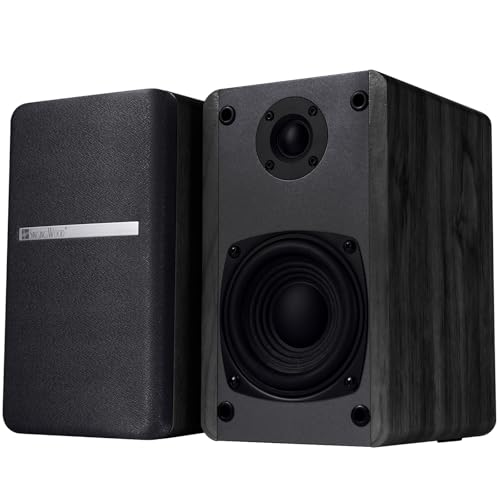
Pros
- Compact size packs powerful full-range sound without dominating space
- Effortless wall-mounting with adjustable brackets for perfect surround angles
- Waterproof sealing option enables reliable indoor-outdoor versatility
- Dual bass ports deliver deeper bass than typical bookshelf speakers this size
- Shockproof design minimizes vibrations for cleaner audio playback
Cons
- Requires separate amplifier or receiver to operate, no built-in power
- Speaker wires not included, adding to setup cost
- Bass depth limited by small size compared to larger floorstanders

Pros
- Immersive 7.1 surround with 99.99% detail accuracy
- VoiceMX boosts vocals 120Hz-6kHz for sharp clarity
- BassMX subwoofer delivers controlled deep lows
- Stable Bluetooth 6.0 resists interference
- App offers 10-band EQ and surround adjustments
Cons
- Hybrid wired/wireless rears need some cable management
- Larger footprint suits bigger rooms best
- Full features require app download
The ULTIMEA Aura A40 Pro is a 7.1-channel surround sound system designed for smart TVs, featuring a soundbar, subwoofer, and four adjustable surround speakers. It transforms ordinary TV viewing into a home theater experience with technologies like SurroundX for precise audio immersion and VocalMatrix for accurate voice placement across channels.
Ideal for families, gamers, and movie buffs who want cinema-quality sound without breaking the bank, this setup excels in living rooms where space allows for rear speakers. Real-world performance shines in action films and music, with ambient sounds wrapping around you while dialogue stays front and center.
Setup involves connecting front speakers directly and using the hybrid rear design to minimize wires. The Ultimea app adds personalization, making it adaptable to your space. Overall verdict: a powerful upgrade for immersive home entertainment that punches above its weight.
BassMX technology in the subwoofer pushes lows to 45Hz with an 18mm driver and 6.1L cabinet, delivering tight, impactful bass for explosions and beats without muddiness. Volume peaks at 330W, filling medium to large rooms effortlessly.
VoiceMX enhances 120Hz-6kHz vocals in real-time, ensuring clear dialogue even in noisy scenes. VocalMatrix redistributes voices dynamically across 7.1 channels for natural positioning amid immersive surround effects.
Bluetooth 6.0 provides stable, low-latency streaming superior to 5.3, perfect for movies, music, and gaming with minimal dropouts or interference.
The Aura A40 Pro boasts a sleek soundbar with two wired front surrounds and hybrid rear speakers: one wireless to the bar, the other wired to its pair, cutting cable clutter while ensuring precise projection. The subwoofer's tuned cabinet expands the soundstage for a wider, more physical feel.
Built for stationary home use, it lacks portability but offers durable components like high-density magnets. No IP rating, so keep it indoors away from moisture.
AC-powered for unlimited runtime without battery life worries or charging downtimes, it stays ready for marathon sessions via wall outlet.

Pros
- Genuine rear satellite speakers provide authentic directional surround cues
- Dedicated center channel delivers exceptionally clear dialogue for movies and shows
- Extensive audio personalization via the 10-band EQ in the companion app
- Wireless rear-module connection eliminates the need for long cables across the room
Cons
- Front satellite speakers require direct wired connections to the main soundbar
- Compact subwoofer rolls off before reaching subterranean bass frequencies
- Rear satellite pairing occasionally requires manual button reset during initial setup
The ULTIMEA Aura A40 7.1-channel soundbar system delivers an expansive home audio upgrade designed to bridge the gap between basic all-in-one soundbars and complex multi-channel AV receiver setups. Combining a compact central soundbar, a dedicated subwoofer, two front satellite speakers, and two rear satellite speakers, this system utilizes proprietary SurroundX acoustic processing to simulate a full theater soundstage without overwhelming your living room.
In real-world testing, the Aura A40 caters directly to apartment dwellers and budget-conscious movie buffs who demand genuine rear surround cues without running wires from the front of the room to the back. Setting up the hybrid architecture is straightforward: the rear module receives audio wirelessly from the main soundbar, while the individual satellites draw power via short wired connections. This smart compromise keeps living room walkways completely cable-free.
Day-to-day usability is elevated through the Ultimea companion app, giving users granular control over sound dynamics and frequency curves that few systems in this class offer. While it will not replace a high-end discrete component system in a dedicated basement cinema, the Aura A40 is a versatile, high-value audio solution that transforms everyday television viewing into a cinematic event.
Acoustically, the Aura A40 emphasizes vocal clarity and spacious sound dispersion. The central soundbar features dedicated channels specifically tuned for dialogue, ensuring that whispering actors and quiet narrative lines remain crisp and distinct without needing to constantly ride the volume control. Meanwhile, the four satellite speakers project ambient effects and background scores wide into the room, creating genuine sound motion across the horizontal axis.
Low frequencies are handled by the dedicated subwoofer, which delivers punchy mid-bass impacts suitable for explosive movie sequences and modern pop tracks. While the sub lacks the visceral sub-bass depth required for ultra-low frequencies below 40Hz, the app provides 121 EQ matrices and a responsive 10-band equalizer to fine-tune the low-end punch. The treble remains clean without introducing harsh sibilance, making dialogue-heavy dramas and fast-paced video games equally enjoyable at moderate to high listening levels.
The Aura A40 sports a sleek, low-profile black enclosure designed to sit neatly under most modern flat-screen televisions without obstructing the lower screen edge or IR sensors. The main bar measures approximately 41 inches wide, complemented by compact satellite speakers that blend discreetly onto bookshelves, side tables, or entertainment consoles. The overall build is lightweight yet structurally rigid, minimizing cabinet vibration during high-volume playback.
Connectivity is built around modern convenience, supporting seamless pairing to smart TVs alongside wireless streaming options for mobile devices. The hybrid speaker wiring layout is the hardware highlight: front satellites connect directly to the soundbar via dedicated FR and FL cables, while the rear satellites link together and pair wirelessly to the soundbar over a reliable wireless connection. With responsive remote control integration and over-the-air firmware update support through the Ultimea App, the hardware package is thoughtfully engineered for long-term usability.
The Complete Technical Guide to Surround Sound Speaker Systems
Surround sound speaker arrangements create a cohesive listening space by dividing audio tracks across discrete acoustic channels positioned around the listener. Understanding %how to surround sound speakers% operate begins with matching each speaker enclosure to its designated audio role within your listening room. A well-planned system balances directional cues, clear vocal reproduction, and deep low-frequency effects into a unified three-dimensional soundstage.
Channel Configurations and Discrete Speaker Roles
Channel terminology describes how audio information is split across distinct listening zones in a home theater setup. A standard 5.1-channel setup incorporates three front speakers, two surround speakers positioned to the sides or slightly behind, and a dedicated low-frequency channel. Expanded layouts such as 7.1-channel systems add two dedicated rear surround enclosures to bridge the acoustic gap directly behind the primary seating area. Understanding these designations ensures that each audio track sends ambient noises, musical scores, and spoken dialogue to the proper enclosure.
The center channel speaker serves as the acoustic anchor for movies and television programs. It handles the vast majority of spoken dialogue and on-screen action, keeping voices locked to the visual display. Left and right front speakers produce the primary stereo imaging and widen the perceived acoustic stage across the front wall. When panning effects move across the screen, balanced front channels ensure smooth acoustic transitions without sudden volume drops.
Surround channels supply atmospheric ambience, reverberation cues, and off-screen directional effects. In systems featuring height channels, such as a 5.1.2 Dolby Atmos arrangement, upward-firing or ceiling-mounted drivers project sound vertically to simulate overhead action. Multi-channel soundbars like the ULTIMEA Skywave F40 utilize dedicated up-firing drivers with neodymium magnets to reflect sound off the ceiling. This vertical dimension introduces realistic depth, making environmental elements such as raindrops or passing aircraft feel tangible.
Passive Component Audio vs Powered Integrated Systems
A fundamental choice in surround audio involves deciding between traditional passive speakers and powered soundbar ecosystems. Passive satellite speakers, such as the Saiyin Passive Bookshelf Speakers, contain no internal amplification circuitry and require a separate audio-video receiver or power amplifier. These modular systems require dedicated speaker wiring to deliver both audio signals and electrical driving power from the central receiver. While passive setups require more planning, they allow individual components to be upgraded or replaced over time.
Active and integrated systems incorporate power amplifiers directly inside the main enclosure or dedicated receiver modules. Packages based around a central soundbar often combine front stereo and center channels inside one physical housing, simplifying placement near the television. Satellite speakers in these setups frequently connect through specialized multi-channel bridges or wireless receiver adapters. For instance, the Bose Surround Sound System utilizes wireless receiver boxes that connect wirelessly to compatible Bose soundbars while drawing power from standard wall outlets.
Soundbar systems with multi-channel satellites strike an attractive balance between installation convenience and cinematic immersion. Hybrid architectures, such as the ULTIMEA Aura A40, route wired connections from the soundbar to front satellites while sending a wireless signal across the room to a rear receiver hub. This architecture eliminates the need to run long cables across the floor while maintaining stable multichannel distribution. Evaluating your willingness to manage speaker cables versus power outlets helps narrow down the right format for your space.
Calculating Distance, Height, and Placement Angles
Accurate speaker positioning forms the foundation of realistic sound reproduction and spatial imaging. Front left and right speakers should form an equilateral triangle with the primary listening position, angled slightly inward toward the listener’s ears. Placing front speakers too close together compresses the stereo image, while spacing them too far apart creates an unnatural acoustic hole in the center. Ideally, tweeters should sit at roughly ear level when you are seated in your primary listening chair.
Surround speaker placement depends heavily on whether your layout uses a 5.1 or a 7.1 channel design. In a 5.1 configuration, the two surround speakers belong just behind the listener at an angle of roughly 90 to 110 degrees from the front center line. In a 7.1 system, side surrounds remain directly to the sides while dedicated rear surrounds sit behind the seating area at approximately 135 to 150 degrees. Raising surround satellite speakers two to three feet above seated ear level often helps disperse ambient effects and prevents harsh, localized sound.
Subwoofer placement requires careful experimentation because room boundaries significantly affect low-frequency performance. Placing a bass module directly into a room corner reinforces overall bass output through boundary loading, but it can introduce muddy, boomy acoustic resonances. Pulling the subwoofer a few feet away from corners often produces tighter, more articulate low frequencies across a wider seating area. Running a quick listening crawl helps identify room locations that avoid acoustic nulls where bass frequencies cancel out.
Managing Wiring, Connectors, and Wireless Module Pairing
Reliable physical connections prevent signal distortion, intermittent channel dropouts, and amplifier damage. When wiring passive speakers, maintaining proper electrical polarity between positive and negative terminals is essential. Connecting positive to negative out of phase causes bass cancellation, making the entire audio system sound thin and hollow. Using quality wire with clear polarity markings ensures that every driver moves in unison during dynamic audio passages.
Wireless surround speakers eliminate the hassle of running audio cables from the front of the room to the back, though they still require electrical power. Systems with wireless rear hubs require an initial pairing sequence to synchronize transmission frequencies with the primary soundbar. For example, systems like the ULTIMEA Aura A40 Pro use hybrid wireless links where the primary rear speaker pairs with the main unit before branching to the second rear enclosure. If communication fails, performing a manual button reset according to the manufacturer sequence restores channel synchronization.
Wall-mounting brackets provide secure elevated positioning for small satellite speakers while freeing up valuable floor space. The Saiyin Passive Bookshelf Speakers include dedicated mounting brackets capable of 170 degrees of horizontal and vertical adjustment for precise acoustic targeting. Integrated vibration isolation pads help prevent physical speaker rattles from transferring into drywall surfaces. Ensuring that wall anchors match the wall construction prevents hardware from pulling loose under dynamic vibration.
Audio Input Standards: HDMI eARC, Optical, and Digital Formats
Modern surround sound processing relies on high-bandwidth digital connections to transmit multi-channel soundtracks without compression. HDMI eARC, or Enhanced Audio Return Channel, represents the gold standard for connecting a smart television to a soundbar or receiver. Unlike older connection standards, HDMI eARC provides up to 37 Mbps of bandwidth, accommodating uncompressed multi-channel PCM and high-bitrate object-based formats like Dolby Atmos. This allows full dynamic range without downmixing spatial cues into basic stereo.
Standard optical Toslink connections provide a dependable digital alternative for legacy televisions and audio components. Optical cables transmit multi-channel bitstreams such as Dolby Digital and DTS 5.1 using pulses of light, which completely avoids electrical ground loop interference. However, optical interfaces lack the necessary digital bandwidth to pass uncompressed multi-channel audio or modern 3D spatial formats. If your equipment supports HDMI eARC, using an HDMI interface ensures access to full multi-channel features.
Wireless Bluetooth streaming offers everyday convenience for listening to music from mobile devices, but it serves a different purpose than television surround links. Recent iterations like Bluetooth 5.4 and Bluetooth 6.0 improve connection stability, range, and latency across compatible sources. While Bluetooth works well for casual audio streaming or compact wireless audio setups, it does not replace the dedicated digital pipeline required for true multi-channel home theater playback. Keep high-bitrate sources wired directly to your display or receiver for optimal spatial effects.
Software Tuning, Room Equalization, and App Adjustments
Digital signal processing allows modern surround systems to compensate for irregular room dimensions and acoustic reflections. Many contemporary soundbars offer dedicated mobile application control to fine-tune sound characteristics without navigating complex television menus. Through the Ultimea App, listeners can access multi-band graphic equalizers and select from customized sound presets tailored for movies, dialogue, or gaming. Adjusting individual channel gain levels ensures that surround speakers do not overpower front dialogue or disappear beneath heavy musical scores.
Vocal clarity processing resolves one of the most frequent complaints in home theater audio: muffled dialogue during loud action scenes. Proprietary DSP algorithms, such as VoiceMX or dedicated center dialogue enhancement modes, isolate human speech frequencies between 120 Hz and 6 kHz. Raising speech clarity without elevating total master volume keeps whispers audible while preventing explosions from rattling the room. This targeted equalization proves especially valuable in living rooms lacking professional acoustic treatments.
Firmware updates delivered over the air ensure your audio processor remains compatible with evolving television operating systems and streaming standards. Keeping your audio device updated prevents software bugs that can cause audio dropouts, volume synchronization delays, or HDMI handshake failures. Setting up periodic checks through the companion app helps maintain peak processing efficiency. Always allow firmware updates to complete fully before disconnecting power or altering system settings.
Troubleshooting Channel Imbalance and Audio Dropouts
Sudden channel silence or weak audio output usually stems from incorrect source settings rather than physical component failure. Streaming applications and television audio menus often default to stereo PCM output instead of multi-channel bitstream passthrough. When the source sends a two-channel stereo signal, rear surround speakers remain silent unless an artificial virtual upmixing mode is engaged. Verifying that your television digital audio output is set to Passthrough or Auto enables the surround processor to decode authentic multi-channel audio.
Lip-sync errors and audio delay occur when television video processing takes longer than audio signal decoding. Because modern displays perform extensive image smoothing and upscaling, the picture may lag slightly behind the sound. Most modern soundbars and AV receivers feature an adjustable audio delay or AV sync setting to align speech with on-screen actors. Adjusting the delay in small millisecond increments restores natural synchronization.
Intermittent wireless satellite cutouts often result from local 2.4 GHz radio frequency interference in crowded living spaces. Placing wireless rear receivers away from Wi-Fi routers, cordless phones, and large metal appliances minimizes transmission packet loss. If dropouts persist, re-pairing the satellite modules or power cycling the main unit clears congested channel frequencies. Consistent power delivery and clear line of sight between wireless transmitters improve reliable signal flow.
Verification Procedures and Soundstage Alignment
Performing a dedicated listening test confirms that each speaker channel is operating at balanced volume and proper phase. Built-in receiver test tones send pink noise to individual speakers in sequence, allowing you to calibrate volume levels from your primary seating position. Using testing audio tracks for speaker evaluation provides a practical way to assess stereo width, vocal clarity, and rear surround integration. Listening closely to familiar recordings highlights any uneven volume spikes or missing acoustic cues.
Multi-channel acoustic immersion requires realistic balance rather than excessive rear speaker volume. While it can be tempting to turn surround channels up high to hear them constantly, ambient effects should blend naturally into the overall environment. Surrounds should draw your attention into the movie scene without revealing their exact physical cabinet positions. Subtle rain effects, wind reverberation, and background traffic cues should feel organic rather than distracting.
Taking time to adjust speaker angles, balance channel volumes, and verify digital passthrough settings ensures an engaging soundstage for years of entertainment. Regularly inspecting physical wire connections and mounting hardware prevents vibration-induced loosening over time. Whether you choose modular passive components or an integrated multi-channel soundbar system, adhering to sound acoustic layout principles guarantees an authentic cinematic experience right in your living room.




Write Your Review
No reviews yet. Be the first to share your experience!