


Building a balanced stereo system or upgrading vehicle audio often leads to confusion about component terminology. Many listeners upgrading car door panels or home sound stages ask: are tweeters speakers, or are they merely supplementary accessories? In technical audio terms, tweeters are indeed dedicated speakers specifically engineered to reproduce the upper boundary of human hearing. When paired alongside midrange drivers or woofers found in coaxial car audio hardware, these specialized transducers ensure instruments like cymbals, acoustic guitar strings, and vocal harmonics remain crisp rather than muffled.
Audio systems rely on dividing frequency ranges across distinct drivers because no single cone can handle deep bass and crystalline treble simultaneously with equal fidelity. Without high-frequency transducers handling the top end, music often sounds muddy, dark, and flat. Upgrading to standalone bullet or dome drivers can revitalize dull soundstages across custom installations or multi-driver enclosures like dedicated stereo audio systems. Understanding driver functions, power considerations, and mounting limitations helps listeners choose the right hardware to achieve balanced sound without damaging sensitive components.

Pros
- Remarkably shallow 1.32-inch mounting depth simplifies tight custom installations
- Piercing volume and clarity easily balance out high-powered subwoofer setups
- Durable cast aluminum housing provides lasting build quality and heat resistance
- High motor sensitivity produces extreme loudness on moderate amplifier power
Cons
- Titanium diaphragms can sound overly bright if not properly tuned with an equalizer
- Requires custom fabrication or pods when upgrading standard factory locations
- Must be paired with proper high-pass crossovers to prevent low-frequency driver damage
Car audio enthusiasts striving for pro-audio SPL volume frequently run into a physical limitation: depth. Standard bullet super tweeters are notoriously deep and bulky, making clean custom door builds or pillar installations a logistical headache. The PRV Audio TW350Ti-4 Slim solves this dilemma by packing the ferocious output of a pro-grade 3.5-inch titanium bullet tweeter into an ultra-shallow chassis measuring just 1.32 inches deep.
Designed specifically for mobile audio builders, chime-and-bass builds, and daily drivers with robust aftermarket subwoofers, this tweeter pair supplies the high-frequency extension needed to balance out intense bass systems. If your midbass and subwoofers drown out the vocals, cymbals, and upper details, these PRV drivers act as the missing link, injecting massive acoustic presence into the front soundstage.
In practical installation, the shallow footprint saves hours of fiberglass and door card fabrication. Once wired to a dedicated amplifier channel with proper high-pass filtering, the TW350Ti-4 Slim drivers produce startlingly clear, assertive highs. Percussion, brass, and synthetic high notes cut right through heavy road noise and rumbling subwoofers, delivering sound pressure levels that stay clean without early breakup.
Ultimately, the PRV Audio TW350Ti-4 Slim super tweeter pair delivers an outstanding balance of raw acoustic power, compact packaging, and pro-audio reliability. For any builder facing restricted mounting depth who refuses to compromise on treble output, these bullet tweeters offer exceptional value and sonic impact.
The TW350Ti-4 Slim centers around a high-grade titanium diaphragm suspended on a Kapton voice coil former. This lightweight moving assembly delivers an exceptionally fast transient response, rendering ultra-crisp highs and expansive upper-midrange sparkle. Even in tracks with complex synthesizer layers or rapid hi-hat sequences, these tweeters maintain sharp distinction rather than smearing notes together.
Engineered for extreme efficiency, these 4-ohm tweeters project sound far into the cabin and beyond, making them an excellent choice for custom door builds and outdoor open-door demos. The aluminum bullet phase plug guides sound dispersal evenly, creating a focused, high-energy soundstage that effortlessly overcomes the low-end rumble of high-excursion subwoofers without requiring thousands of watts of amplification.
PRV Audio engineered the TW350Ti-4 Slim with longevity and space conservation at the forefront. Featuring a rugged cast aluminum faceplate and housing, the unit weighs only 1.14 pounds per speaker while resisting vibration and physical wear. Its defining achievement is the ultra-compact 1.32-inch mounting depth and 3.21-inch cutout diameter, allowing it to drop into tight door cards and compact fiberglass pods where ordinary compression drivers simply cannot fit.
Rated to handle up to 240 watts peak power per pair at a 4-ohm nominal impedance, these tweeters are straightforward to integrate into modern multichannel car amplifiers. Because bullet tweeters are highly sensitive and specialized for top-end reproduction, pairing them with an external active crossover or passive high-pass capacitors is mandatory to protect the titanium voice coil from damaging low-frequency signals.

Pros
- Significantly enhances treble detail and vocal intelligibility compared to stock paper-cone door speakers.
- Compact footprint allows flexible surface mounting in tight cabin spaces.
- Includes both adhesive pads and screws for simple, tool-friendly installation.
- Standard 4-ohm impedance works with virtually any car receiver or amplifier.
Cons
- Peak wattage rating is ambitious; requires high-pass filtering to avoid distortion under high power.
- ABS plastic housing lacks the premium feel of metallic or composite enclosures.
- Treble can sound bright or sharp without mild EQ adjustment on your head unit.
Factory vehicle audio systems frequently suffer from flat, recessed treble because automobile manufacturers rely on basic full-range paper cone speakers placed low in the door panels. The salbsever 4-piece dome tweeter kit targets this exact shortcoming, offering a direct route to crisp high-frequency reproduction without requiring a complete overhaul of your sound system.
By placing these compact tweeters higher inside the cabin, such as on the A-pillars or the upper corners of the dashboard, you immediately lift the soundstage. Dialogue, percussion, and acoustic details that were once buried beneath dashboard and footwell surfaces are brought forward, delivering a much more engaging listening environment for daily commutes.
In real-world listening, the neodymium magnet assembly provides snappy transient response and clear vocal separation. While these are entry-level audio components, they excel at restoring top-end energy. For optimal performance, pairing them with an inline capacitor or high-pass crossover keeps stray midrange frequencies from stressing the voice coils, ensuring cleaner reproduction at highway cruising volumes.
Ultimately, this 4-piece tweeter set is a cost-effective audio upgrade for DIY car owners looking to eliminate muddy sound. It delivers clear treble, hassle-free installation options, and enough acoustic energy to transform factory car audio on a modest budget.
The salbsever dome tweeters focus specifically on the upper registers of the audio spectrum, injecting much-needed sparkle and precision into the cabin. Cymbals, guitar harmonics, and upper vocal frequencies gain crisp articulation, effectively cutting through low-frequency road rumble and engine noise.
The dome design helps disperse high frequencies over a wide angle rather than beaming them in a tight, fatiguing line. This wide dispersion pattern ensures that both the driver and the passenger enjoy a cohesive acoustic image across the entire dashboard.
While the advertised 500-watt peak rating is an extreme ceiling, these tweeters are highly sensitive and match standard 12V car head units exceptionally well. Even at modest input power levels, they supply ample volume without requiring external amplification, though adding an inline high-pass filter will keep the highs sounding sweet and clean under harder driving.
Measuring a compact 1.5 by 1.5 inches with a slim 0.73-inch mounting depth, these tweeters fit discreetly into tight automotive spaces. The housing is crafted from durable ABS plastic, providing the heat resistance and structural toughness needed to withstand direct sunlight and cabin temperature swings.
Under the hood, neodymium magnet motors drive the dome assemblies, providing dependable magnetic flux in a lightweight housing. The drivers feature a standard 4-ohm impedance, making them compatible with virtually any factory wiring harness or aftermarket head unit on the market.
Installation is straightforward thanks to the included mounting accessories. Whether you choose to mount them with the provided screws or use the heavy-duty double-sided adhesive pads for a non-destructive install, you can position all four tweeters in under an hour.
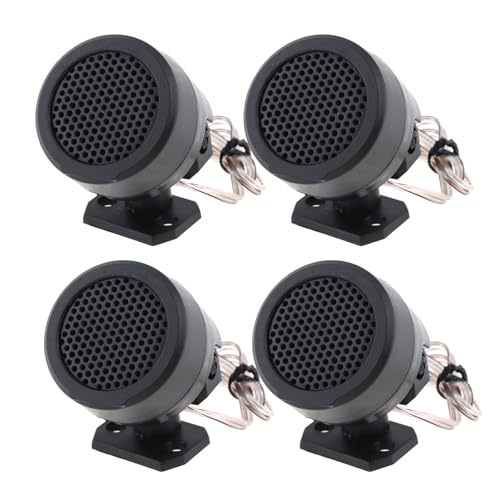
Pros
- Sturdy ABS material resists wear for durable car use
- Clear and delicate playback across music genres
- Simple screw-mount installation anywhere with 12V power
Cons
- Focuses on highs only, pair with subs for full-range sound
- Requires 12V DC power source, not plug-and-play for home AC
- Mini size limits output in very large vehicle interiors alone
The DriSentri TP-006A dome tweeters are a set of four mini speakers designed to boost high frequencies in car audio systems. Powered by 12V DC, they handle up to 500W for efficient, high-output performance without compromising clarity. Ideal for American car owners and truck enthusiasts looking to upgrade factory stereos on a budget.
These tweeters shine in real-world drives, delivering delicate highs that make pop tracks sparkle and rock guitars cut through. Their professional build with single or double buzzer options ensures versatile sound tuning. Easy to mount in doors, dashboards, or A-pillars, they integrate seamlessly into most vehicles.
While not a full-range solution, they excel at enhancing treble for immersive listening during commutes or road trips. The non-destructive sound quality preserves music fidelity across genres. Overall verdict: A smart, affordable pick for DIY audio upgrades that punches above its price.
Expect precise high-frequency reproduction with clear, detailed treble from the dome design. Single and double buzzer configurations allow tweaking for sharper or fuller highs, perfect for vocals and cymbals in cars. The 500W efficiency handles high volumes without breakup, maintaining delicacy even on demanding tracks.
Playback suits pop, classical, and rock, providing lossless quality in 12V setups. Wired connection ensures stable performance without dropouts, outperforming wireless in consistent power delivery. Pair with mids and subs for balanced car soundstages that fill cabins on highways.
Built from rugged ABS material, these tweeters resist daily wear, vibrations, and temperature swings in vehicles. Compact mini size measures just right for tight installs, weighing little for hassle-free mounting with supplied screws. No moving parts beyond the dome mean low maintenance.
Powered directly by 12V DC, they run continuously without battery drain issues, ideal for long drives. No charging needed; plug into car systems for instant, endless playback. This eliminates runtime worries, focusing energy on pure audio output.
Versatile placement in cars, garages, rooms, or living areas makes them multi-use. The sturdy construction supports home audio tweaks too, blending durability with everyday portability.

Pros
- Noticeable improvement in vocal articulation, podcast dialogue, and cymbal clarity over stock paper speakers
- Four-piece package provides complete cabin audio coverage in one purchase
- Compact footprint allows seamless installation into dash corners, A-pillars, or door sail panels
- Pre-installed capacitors eliminate the need for bulky external crossover boxes
Cons
- Advertised 800W reflects peak output rather than sustained continuous RMS power
- Can sound overly bright on treble-heavy tracks without minor EQ adjustments on your stereo
- Included lead wires are short and typically require extra automotive wire for longer runs
Factory vehicle sound systems frequently suffer from dull, recessed high frequencies caused by basic full-range paper cone speakers buried deep in the lower door panels. The DriSentri T-120 4-piece dome car tweeter system directly targets this common automotive issue by providing an accessible, highly practical high-frequency upgrade. With four dedicated treble units in the box, car owners can overhaul both the front and rear soundstages simultaneously without rewiring an entire vehicle.
In practical listening, these dome tweeters immediately inject energy into your car stereo. Podcasters and vocalists sound distinctly clearer, while acoustic guitars, snares, and cymbals gain a sharp presence that easily cuts through cabin road noise and highway wind. For daily commuters seeking vocal intelligibility and sharper instrumentation, the sonic lift is readily noticeable from the moment they are powered on.
Installation is straightforward even for novice DIY mechanics. The package includes double-sided adhesive pads, circular mounting housings, and screws, giving you the flexibility to surface-mount the tweeters directly atop the dashboard or secure them into door sail panels. With integrated audio capacitors already wired in place, there is no need to configure complex outboard crossover boxes before tapping into existing speaker wires.
Ultimately, the DriSentri T-120 set is a high-value acoustic enhancement for drivers wanting immediate clarity without investing in costly multi-channel amplifiers or complete component speaker replacements. While audiophiles seeking ultra-warm ribbon tweeter fidelity will want to look higher up the price ladder, this set delivers dependable everyday treble performance for the price.
The DriSentri T-120 tweeters focus entirely on high-frequency reproduction, delivering an energetic sound signature that highlights crisp transients. The dome design encourages wide acoustic dispersion, which is essential inside a car cabin where tweeters are often positioned off-axis relative to the driver. By mounting these units higher up on the A-pillar or dashboard, sound instantly moves upward away from the footwells, resulting in a significantly more engaging stereo image.
To maintain signal purity and protect the voice coils, each unit utilizes built-in filtering capacitance. This high-pass filter blocks mid-bass and sub-bass frequencies from entering the tweeter, preventing premature blowout and lowering audible distortion during high-volume playback. At moderate to high highway listening volumes, the tweeters retain good clarity without immediate thermal compression.
Because these tweeters have an inherently bright presentation, listeners who play compressed streaming audio or bright rock tracks may notice sharp sibilance on certain vocal tracks. Fortunately, a slight high-frequency cut on a standard head-unit equalizer quickly softens any harshness, producing a clean, balanced audio profile that complements existing stock door woofers.
Engineered for compact vehicle integration, each DriSentri T-120 tweeter features a lightweight synthetic metal PE housing. This dense material protects the internal diaphragm from dust, vibration, and temperature swings typical of automotive windshields under direct sunlight. The black exterior finish and clean front mesh allow the tweeters to blend subtly into dark vehicle plastics and modern car interiors.
The package is designed with universal compatibility in mind, operating seamlessly with standard 12-volt automotive audio systems. Whether paired with an aftermarket head unit or a modest factory stereo, the efficient driver design allows these tweeters to reach ample volume levels without demanding an external power amplifier. Pure copper connection pigtails are pre-attached for reliable conductivity, though adding standard automotive primary wire is recommended for routing behind dash trim panels.
Each kit contains four dome tweeters, four angled surface-mount rings, four mounting screws, and four circular adhesive strips. This versatile hardware bundle allows car, truck, or SUV owners to choose between permanent screw installations or reversible adhesive tape mounting, making it equally suitable for leased vehicles and project cars alike.

Pros
- Exceptional high-frequency sensitivity that easily cuts through loud road noise and deep subwoofer bass
- Ultra-shallow mounting profile makes custom pillar and door installations much easier
- Heavy-duty cast aluminum housing provides lasting structural durability
- Phenomenal output volume and value for pro-audio style automotive builds
Cons
- Requires inline capacitors or active high-pass crossovers to prevent low-frequency damage
- Aggressive sound signature may require equalization adjustments for listeners sensitive to sharp treble
- Not a direct factory replacement and typically requires custom hole fabrication
The PRV Audio TW350Ti-4 bullet tweeters are engineered specifically for car audio enthusiasts who want high-SPL, pro-audio sound clarity without remodeling their entire vehicle interior. Designed to cut clean treble through earth-shaking bass setups, these titanium super tweeters serve as the top-end powerhouse for custom automotive audio builds. Whether you are running high-output midbass drivers or multiple heavy subwoofers, these units bring missing sparkle and balance back into the acoustic mix.
In practical listening environments, the TW350Ti-4 pair delivers intense acoustic energy. Unlike standard silk-dome tweeters that can sound muffled when pushed to competing decibel levels, the titanium diaphragm produces crisp, articulate transients. Percussive cymbal crashes, brass overtones, and vocal harmonics slice through highway road noise effortlessly. However, because they are tailored for extreme sensitivity, proper crossover filtering and equalization are essential to prevent high-frequency fatigue during extended listening sessions.
Ultimately, the PRV Audio TW350Ti-4 provides an uncompromising combination of pro-audio loudness, compact engineering, and value. For enthusiasts building custom door panels or A-pillar speaker pods who refuse to let their highs get swallowed by booming subwoofers, this pair delivers the definition and forward presentation required to round out a high-energy car sound system.
Acoustically, the TW350Ti-4 thrives on ultra-fast transient response and expansive dispersion. The integrated bullet phase plug ensures precise directional projection, dispersing bright high-frequency energy throughout the vehicle cabin. Its titanium diaphragm produces an articulate, airy top end that makes complex percussion, synthesized leads, and vocal sibilance instantly legible even at deafening overall volume levels.
Efficiency is the core strength of these super tweeters. Running on a versatile 4-Ohm impedance with up to 240 Watts peak capacity, they produce exceptional decibel output with modest amplifier power. When paired with high-pass crossovers to shield the voice coils from low midrange frequencies, distortion remains exceptionally low across the upper treble spectrum, maintaining crystal-clear fidelity when driven hard.
Built to withstand the physical demands of high-vibration automotive installations, the TW350Ti-4 features a heavy-duty cast aluminum frame finished in sleek black. Despite measuring 3.5 by 3.5 inches at the faceplate, PRV Audio engineered this unit with a remarkably shallow mounting depth of just 1.93 inches. This compact profile drastically reduces clearance issues in cramped door panels or custom fiberglass pillars.
Operating at a standard 4-Ohm load, these tweeters seamlessly integrate with aftermarket amplifiers and standard multi-channel car audio processors. The rugged terminals ensure solid wiring integrity, preventing loose connections from heavy road vibrations. For optimal longevity and pristine sound, installers should pair them with proper high-pass filters or inline capacitors to safeguard the delicate titanium voice coil assemblies.
Understanding Tweeters and Their Role in Audio Reproduction
Tweeters are specialized electroacoustic loudspeakers engineered specifically to convert electrical audio signals into high-frequency sound waves. While full-range drivers handle a broad acoustic spectrum, a dedicated tweeter reproduces upper frequencies, typically spanning from two thousand to twenty thousand hertz. By taking on rapid mechanical oscillations, these compact units prevent larger cones from struggling with treble detail. Understanding how these transducers function helps listeners configure their audio systems for optimal clarity, balance, and hardware longevity.
The Technical Definition of a Loudspeaker Transducer
Every loudspeaker operates on the principle of electroacoustic transduction, converting electrical energy into mechanical movement that creates pressure waves. A tweeter relies on the same core architecture as a full-range driver, featuring a voice coil, permanent magnet, suspension, and vibrating diaphragm. The primary difference lies in the scale, mass, and mechanical excursion of its moving assembly. Because treble reproduction requires rapid vibrations rather than long physical strokes, tweeters utilize small, lightweight diaphragms that respond instantly to incoming signals.
Classifying tweeters as standalone speakers clarifies how multi-way audio systems function across home stereo, vehicle, and studio setups. An individual driver in a multi-speaker cabinet is an independent transducer, even when sharing an enclosure with larger woofers. When installed separately on a vehicle dashboard or door pillar, a tweeter performs the role of an independent high-frequency speaker. Treating it as a true speaker reinforces the importance of impedance matching, proper power allocation, and dedicated signal filtering during installation.
Why Audio Systems Split Frequencies Across Specialized Drivers
Human hearing covers a broad acoustic range extending roughly from twenty hertz up to twenty thousand hertz. No single physical cone or dome can reproduce this entire frequency span with consistent accuracy and dispersion. Large speaker cones possess too much mechanical mass to vibrate tens of thousands of times per second without severe cone breakup and distortion. Conversely, tiny diaphragms lack the surface area and physical travel needed to displace the air volume required for deep bass.
Dividing the audio spectrum among dedicated woofers, midrange drivers, and tweeters allows each component to operate within its ideal mechanical range. Woofers move over longer distances to reproduce bass, while tweeters oscillate rapidly over minute distances to capture crisp treble. This division of labor creates an articulate soundstage where vocals remain clear and percussion hits retain their sharp attack. Even modern compact systems and portable Bluetooth speaker designs frequently incorporate dedicated tweeters alongside bass radiators to preserve high-frequency sparkle without sacrificing low-end impact.
When an audio setup relies solely on a single cone, the highest musical overtones often roll off prematurely. Instruments like cymbals, acoustic guitars, and high synth notes lose their crispness, leaving the overall mix sounding distant or muffled. Adding a dedicated high-frequency driver restores these subtle harmonics, creating a sense of spatial air and instrument separation. Listeners frequently perceive this acoustic enhancement as an immediate upgrade in sound clarity, even if amplifier power remains unchanged.
The Essential Function of Crossover Networks and Capacitors
Because tweeters feature compact voice coils wound with fine wire, sending unfiltered full-range audio signals into them causes rapid thermal destruction. Deep bass frequencies demand large electrical currents and substantial excursion that a tweeter’s delicate suspension cannot physically handle. Without protection, low-frequency electrical energy quickly overheats the voice coil wire or forces the diaphragm past mechanical limits. A protective audio filter known as a crossover network is necessary to block dangerous low frequencies before they reach the driver.
Crossover filters fall into passive and active categories depending on where signal separation occurs along the audio signal chain. Passive crossovers use capacitors and inductors placed between the amplifier output and individual drivers to divide incoming electrical power. A simple high-pass capacitor wired in series with the positive terminal acts as a basic passive filter, allowing high frequencies to pass while attenuating lower tones. Compact dome sets like DriSentri dome tweeters often feature integrated protective capacitors, making them straightforward to wire directly into existing twelve-volt circuits.
Active crossovers process audio signals at line level before amplification occurs, delivering dedicated frequency bands to separate amplifier channels. This approach provides precise control over cutoff slopes, reducing intermodulation distortion across the entire system. High-output audio configurations benefit significantly from steep electronic cutoff filters, ensuring that high-efficiency compression drivers never receive energy below their design thresholds. Proper crossover frequency selection protects delicate voice coils while ensuring a smooth acoustic transition between midrange drivers and tweeters.
Dome Tweeters Versus Bullet Super Tweeters
Tweeters come in several distinct design architectures, with dome tweeters and bullet super tweeters representing two of the most popular configurations. Dome tweeters feature a convex or inverted diaphragm made from soft textiles like silk or synthetic plastics such as ABS and polyester. Models like the salbsever dome tweeters utilize lightweight diaphragms paired with compact neodymium magnets to provide smooth, natural frequency extension. Their broad acoustic dispersion ensures that high frequencies spread evenly throughout the listening space, creating a wide sweet spot.
Bullet super tweeters utilize horn loading combined with a central phase plug resembling a bullet. High-output units like the PRV AUDIO TW350Ti-4 bullet tweeters employ rigid titanium diaphragms mounted to lightweight Kapton formers and cast aluminum frames. The horn flare concentrates acoustic energy forward, significantly increasing acoustic efficiency and output volume per watt of electrical input. This directional focusing makes bullet tweeters exceptionally loud, making them common in pro sound systems, open-air setups, and high-SPL vehicle builds.
Choosing between dome and bullet designs depends on the specific listening environment and overall sound goals. Dome tweeters deliver a balanced, smooth sound profile that integrates seamlessly into automotive cabins and home stereo setups without causing listener fatigue. Bullet tweeters excel when high sound-pressure levels are required to cut through heavy road rumble or loud multi-subwoofer bass. While bullet tweeters provide remarkable clarity at high volumes, their narrower dispersion pattern requires careful directional aiming toward listener ears to maintain balanced response.
Understanding Power Ratings, Impedance, and Amplifier Matching
Evaluating power specifications for compact tweeters requires distinguishing between continuous thermal power handling and momentary peak marketing numbers. Inexpensive multi-piece tweeter packages often advertise high numbers like five hundred or eight hundred watts, but these figures represent momentary peak ratings rather than continuous RMS capability. In practice, a small dome voice coil typically dissipates ten to thirty watts of true continuous thermal energy before failing. Relying on inflated peak numbers without understanding thermal limits often results in burned voice coils when paired with high-output aftermarket amplifiers.
Bullet compression drivers like the PRV TW350Ti-4 SLIM carry robust construction designed to handle higher real-world power levels, supported by heat-resistant Kapton formers and heavy cast frames. Even with rugged materials, high-frequency drivers rarely receive more than a fraction of an amplifier’s total wattage in a properly balanced music signal. Most musical acoustic energy resides below one thousand hertz, meaning treble frequencies account for only ten to fifteen percent of overall electrical power demand. Setting amplifier gains conservatively prevents sending clipped waveforms that generate destructive heat inside delicate high-frequency components.
Impedance matching represents another vital factor when connecting additional tweeters into an existing speaker circuit. Most vehicle tweeters carry a nominal four-ohm impedance rating, which must be factored into the overall load presented to the amplifier or head unit. Wiring a four-ohm tweeter directly in parallel with a four-ohm door speaker without an isolating capacitor cuts total circuit resistance down to two ohms. Running an amplifier below its rated minimum impedance can trigger thermal protection circuits or cause permanent amplifier damage.
Acoustic Placement, Directionality, and Mounting Considerations
High-frequency sound waves travel in tight, directional beams, unlike low bass frequencies that radiate omnidirectionally throughout an enclosure or vehicle cabin. Obstacles like upholstery, vehicle dashboards, and seat backs readily absorb or reflect treble energy before it reaches the listener’s ears. Consequently, the physical location and directional orientation of tweeters exert a dramatic influence on overall soundstage width and tonal clarity. Placing tweeters down in lower door footwells often results in muted treble, while mounting them higher along dash corners or A-pillars creates an elevated soundstage.
Mounting depth and physical clearance dictate where tweeters can be safely installed within restricted spaces. Vehicles often have shallow cavities behind door panels and trim covers, making low-profile drivers essential for clean installations. Super shallow drivers like the PRV AUDIO TW350Ti-4 SLIM feature a mounting depth of 1.32 inches, fitting into tight door structures where deeper bullet drivers hit window mechanisms. In home listening environments, high-frequency orientation plays a similarly critical role when setting up on-wall speaker enclosures to ensure tweeters sit at approximate ear level for seated listeners.
Surface mounting and flush mounting offer two practical installation approaches depending on available tools and desired aesthetics. Compact dome packages like DriSentri dome tweeters often include adhesive tape pads and angled mounting pods, enabling quick surface installation on dashboards without cutting permanent holes. Flush mounting requires cutting a circular cutout into door trim panels, providing an integrated look that sits flush with interior upholstery. Regardless of the mounting method chosen, secure mechanical fastening prevents rattling vibrations that can degrade sound clarity during loud playback.
Diagnosing Common High-Frequency Audio Problems
When a sound system suffers from audio issues, isolating whether the problem originates in the tweeter or upstream electronics requires systematic troubleshooting. If a tweeter suddenly stops producing sound, the underlying cause is frequently a burned voice coil caused by amplifier clipping. When an amplifier is driven past its clean output capacity, it clips the audio waveform, generating excessive harmonic distortion and thermal energy that quickly destroys delicate voice coil windings. Testing driver terminals with a multimeter provides immediate confirmation; an infinite resistance reading indicates a broken internal circuit.
Harsh, screeching, or grating treble is another frequent complaint that can stem from incorrect crossover settings or severe harmonic distortion. If an in-line capacitor fails or carries an unsuitable capacitance value, lower midrange frequencies will leak into the tweeter, creating noticeable distortion at moderate volume levels. Inspecting wiring connections ensures that polarity remains consistent across both channels, as inverted positive and negative leads can cause phase cancellation that hollows out high-frequency imaging. Adjusting head unit treble equalizers downward can also tame harshness caused by reflective vehicle glass or aggressive compression drivers.
Intermittent crackling or buzzing sounds during playback usually point toward loose wiring connections or physical debris caught inside the driver housing. Synthetic metal PE covers or protective grilles help prevent foreign particles from contacting the delicate diaphragm, but extreme vibration can loosen screw terminals or solder joints. Checking the pure copper wiring ports and tightening terminal screws often resolves crackling without requiring driver replacement. If the buzzing persists at all volume levels even when gentle pressure is applied to the frame, the voice coil may have suffered mechanical misalignment.
Practical Verification Steps Before Adding Tweeters
Before purchasing and mounting additional tweeters, evaluating your current system layout prevents unnecessary expenses and electrical conflicts. Determine whether your existing speakers are full-range coaxial units with built-in center tweeters or separate component drivers running off dedicated crossovers. Adding supplemental bullet or dome tweeters to a system that already features bright coaxial speakers can produce an overly harsh, treble-heavy tonal balance. Verifying your current acoustic signature helps determine whether your setup genuinely lacks high frequencies or simply requires equalization adjustment.
Checking electrical compatibility and physical dimensions ensures a smooth installation process from start to finish. Confirm that your head unit or amplifier can handle the combined impedance of your proposed speaker arrangement, especially if wiring drivers in parallel. Measure available mounting depth behind trim panels to ensure adequate clearance for magnet assemblies and wiring terminals without contacting moving parts like vehicle window regulators. Having suitable mounting hardware, heat-shrink tubing, and appropriate in-line protection capacitors ready before beginning the job streamlines the entire process.
Finally, verify the proper signal routing and crossover protection before powering on the audio system for the first time. Double-check that positive and negative speaker leads match manufacturer markings, as proper phase alignment ensures an open, focused stereo image across the listening area. Start listening tests at low volume levels, gradually increasing output while monitoring for signs of strain, crackling, or harsh distortion. Taking these careful verification steps protects your audio investment, ensuring your high-frequency drivers deliver clean, sparkling sound for years to come.




Write Your Review
No reviews yet. Be the first to share your experience!