


Audiophiles and custom audio builders frequently debate whether eliminating the traditional speaker cabinet creates a purer listening experience. When listeners ask are open baffle speakers any good, they usually want to know if the lack of box coloration outweighs the inherent acoustic challenges of dipole radiation. Traditional box enclosures trap internal pressure waves, which can cause cabinet resonances and delayed sound reflections that muddy vocal clarity. Mounting drivers on an unenclosed board lets sound project freely forward and backward, delivering an exceptionally natural and spacious presentation for acoustic music.
This free-air approach brings distinct mechanical trade-offs that every listener must evaluate before building or buying a system. Bass frequencies naturally wrap around the baffle edges and cancel out, requiring specialized woofer configurations, digital signal processing, or careful room boundary placement. In specialized car audio and custom speaker installations, selecting components like the Install Bay Speaker Baffle 5 Inch to 5 1/4 Inch allows installers to protect door-mounted drivers while deciding whether an open or sealed rear cavity delivers the cleanest midbass response. Comparing these designs against dedicated music speakers clarifies whether an unenclosed dipole setup fits your room layout and sonic preferences.

Pros
- Reliable moisture barrier significantly extends aftermarket car speaker lifespan
- Noticeably tightens mid-bass punch and cleans up vocal clarity in door installations
- Flexible foam acts as a natural gasket to seal air leaks and stop door panel rattles
- Easy to modify with a utility knife for deep baskets or custom venting
Cons
- Fully sealed enclosure can restrict lower sub-bass output unless vented at the bottom
- May require trimming in tight door panels with shallow window regulator clearance
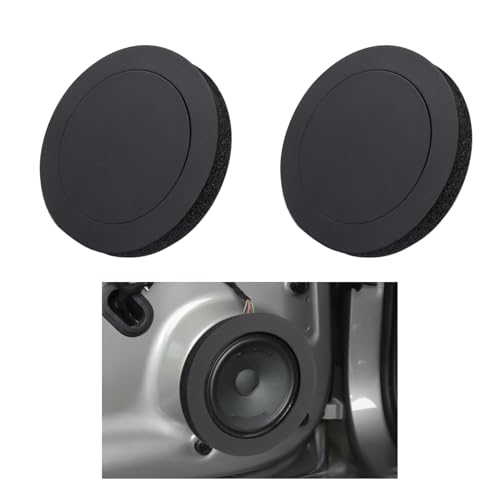
Upgrading factory car speakers is one of the most rewarding audio improvements you can make, but the hostile environment inside a vehicle door often compromises both sound quality and speaker lifespan. The Install Bay VXT55 Speaker Baffles are engineered to solve this dilemma. Specifically designed to cradle 5-inch to 5.25-inch round aftermarket drivers, these protective enclosures serve as both a defensive shield against moisture and an acoustic tuning device for cleaner audio delivery.
In practical installations, road spray, window condensation, and dirt regularly seep down the inside of vehicle door skins, directly threatening unprotected speaker cones and voice coils. The VXT55 acts as a reliable barrier, preventing water intrusion from causing voice coil corrosion or cone degradation. For DIY enthusiasts and professional installers alike, adding these baffles during a speaker upgrade is an inexpensive insurance policy that significantly prolongs speaker health.
From an acoustic standpoint, mounting a speaker into a hollow steel door cavity without baffling often leads to hollow midrange response and unwanted cancellation between front and rear sound waves. Installing these baffles isolates the driver, helping to clean up muddiness across vocal ranges and tightening up mid-bass punch. For audiophiles looking to maximize investment in component or coaxial upgrades, this physical isolation brings out the subtleties that bare door cavities swallow up.
Overall, the Install Bay VXT55 delivers solid value for anyone seeking to optimize their mobile audio setup. While they may require quick customization depending on basket depth, their dual benefits of physical protection and acoustic control make them an indispensable addition to any 5.25-inch speaker install.
The primary acoustic function of the Install Bay VXT55 is mitigating acoustic phase cancellation. By sealing off the rear wave of a 5.25-inch driver, these baffles prevent the back wave from immediately canceling out the forward sound wave. The result is a noticeably punchier, more controlled mid-bass response and a cleaner vocal presence that cuts through highway road noise without needing excessive equalization.
Because standard automotive door panels often act as resonant chambers, unbaffled speakers frequently cause unwanted buzzing and frequency smearing. The dense yet pliable foam material of the VXT55 dampens these stray resonances, tightening transient response across kick drums and bass guitars. Audiophiles desiring maximum low-frequency excursion can easily slice an opening in the bottom half of the baffle to create an acoustic port, maintaining moisture protection from above while retaining deep, uncompressed low-end response.
Constructed from resilient closed-cell foam, the Install Bay VXT55 pair is molded to accommodate standard 5-inch and 5.25-inch round speaker baskets. The flexible flange compresses neatly between the speaker basket and the door mounting bracket, acting as an integrated gasket that eliminates air leaks and mechanical vibration between metal surfaces.
With a depth engineered to accommodate standard aftermarket coaxial and component drivers, the baffles fit cleanly inside most door cavities. The pliable material allows installers to quickly trim the rear for deep-magnet assemblies or make clearance cuts for nearby window tracks and lock linkages, ensuring a clean and secure fit without rattling.
Understanding Open Baffle Speaker Performance and System Design
Open baffle speakers deliver exceptional sound quality when paired with appropriate listening spaces and realistic acoustic expectations. The answer to whether open baffle speakers are worthwhile is an enthusiastic yes for listeners who value natural tonality and holographic imaging over thunderous cabinet bass. Eliminating the traditional wooden box removes internal air reflections and structural resonances that often smear subtle sonic details. Understanding the physics, room interactions, and component demands behind this design will help you determine whether an open dipole system fits your audio goals.
The Physics of Dipole Radiation and Acoustic Clarity
Traditional speaker cabinets exist primarily to solve an acoustic dilemma: isolating the front cone wave from the rear wave. When a cone moves forward, it compresses air in front while creating a low-pressure area behind it, generating two signals with opposite polarity. In an open baffle speaker, the driver sits on a flat panel without an enclosed box, letting both signals disperse freely. This arrangement produces a dipole radiation pattern, projecting sound forward and backward while creating nulls at the sides.
The lateral null created by dipole radiation minimizes early reflections from side walls. Because less sound energy strikes side surfaces, the listener hears mostly direct sound combined with delayed rear reflections. This pattern prevents room interactions from smearing instrument separation and vocal localization. Listeners often describe the presentation as completely detached from the physical speakers, creating an expansive soundstage.
Eliminating the cabinet also removes internal air spring compression and panel resonance. In a sealed or ported box, trapped air acts like a stiff spring that resists cone motion, altering driver damping. High internal sound pressure can also vibrate cabinet walls, radiating unwanted secondary frequencies. Open baffle drivers operate in free air without opposing internal pressures, yielding fast transient response and effortless midrange realism.
The Acoustic Short Circuit and Low-Frequency Reproduction
While open baffle architecture excels across midrange and high frequencies, low-frequency reproduction represents the primary engineering challenge. Bass frequencies have long physical wavelengths that easily wrap around the edges of a flat panel. When the out-of-phase rear sound wave meets the front wave, destructive interference occurs, causing an acoustic short circuit. This cancellation rolls off low frequencies at roughly six decibels per octave below the baffle cutoff frequency.
The frequency where cancellation begins depends directly on the path length between the front and rear surfaces of the cone. A wider panel increases the physical distance the rear wave must travel, extending bass response lower into the audible spectrum. However, building an enormous baffle to reproduce deep bass would require panels several feet wide, creating visual challenges in standard living rooms. Practical designs balance baffle width against room aesthetics by using subtle wings or active equalization.
To overcome acoustic cancellation without requiring giant panels, designers employ specialized woofers featuring substantial cone area and long excursion. Moving larger air volumes compensates for the energy lost to phase cancellation at lower octaves. Many modern open dipole systems incorporate dual fifteen-inch woofers dedicated entirely to handling frequencies below two hundred hertz. When properly configured, dipole bass sounds tight, articulately textured, and remarkably free from cabinet boominess.
Critical Placement and Room Acoustic Requirements
Open baffle speakers are sensitive to their location relative to boundary walls. Because dipole speakers project an identical out-of-phase wave behind them, placing them too close to a back wall causes immediate acoustic degradation. If the rear sound wave bounces off a wall and returns to the listener too quickly, it creates comb filtering that hollows out vocal clarity. Maintaining at least three to five feet of clearance between the speakers and the rear wall allows the reflected wave to enhance the soundstage.
Side wall proximity is far less critical than back wall clearance due to the dipole figure-eight dispersion pattern. Since minimal acoustic energy exits the baffle sides, you can place open designs closer to side walls without generating harsh flutter echoes. This dispersion characteristic makes them particularly effective in long, narrow rooms where side reflections normally destroy imaging accuracy. Angling the speakers with slight toe-in toward the central listening position further stabilizes center imaging.
Room acoustic treatments behind an open baffle setup should lean toward diffusion rather than heavy absorption. Placing quadratic residue diffusers or open bookcases along the front wall scatters rear-firing energy evenly across the listening space. Diffused rear reflections create an immersive acoustic envelope that mimics the natural ambience of a live performance hall. Excessive dampening behind the speakers absorbs too much energy, stripping away the airy spaciousness that makes open dipole listening so engaging.
Driver Parameters and System Design Differences
Not every standard speaker driver performs properly on an open panel. In typical cabinet designs, engineers select woofers with low total quality factors, known as Qts, because the enclosed air volume adds acoustic stiffness. On an open baffle with no internal air spring to control cone movement, low Qts drivers suffer from premature bass roll-off. Successful open baffle woofers generally feature higher Qts ratings, compliant suspensions, and large voice coils capable of dissipating heat during sustained low-frequency output.
Full-range single drivers represent another popular approach in open baffle audio setups. These drivers cover the critical vocal and instrumental frequencies from roughly one hundred hertz to beyond fifteen kilohertz without utilizing passive electrical crossover networks. Eliminating capacitors and inductors directly in the signal path preserves phase coherence and microscopic musical details. However, full-range drivers mounted on open boards inevitably require low-frequency reinforcement from dedicated bass drivers to achieve balanced reproduction.
Multi-way open baffle systems often incorporate active digital crossovers alongside multi-channel power amplification. Active digital signal processing allows audio enthusiasts to apply steep crossover slopes and precise parametric equalization curves without introducing passive component losses. Applying a shelving low-frequency boost counteracts the dipole cancellation slope cleanly before the audio signal reaches the power amplifiers. This active methodology ensures that each driver operates strictly within its linear excursion limits.
Comparing Open Baffles to Enclosed Speaker Boxes
Contrasting open baffle speakers against enclosed designs highlights fundamental differences in acoustic philosophy. When examining traditional enclosed speaker box designs, the enclosure acts as an acoustic barrier that contains rear driver radiation while reinforcing low-end efficiency through tuned ports or sealed acoustic suspension. Enclosed cabinets excel at generating high sound pressure levels and visceral sub-bass impact from relatively compact footprints. For listeners who demand chest-thumping bass in electronic music or cinema tracks, well-braced box speakers maintain physical advantages.
The primary compromise of boxed enclosures is the presence of internal standing waves and panel energy storage. Even heavily damped cabinets exhibit subtle coloration where wooden panels vibrate slightly out of time with the original musical transient. These resonances can obscure subtle ambient cues, such as the natural decay of a piano chord or the breathing pattern of a vocalist. Open baffle speakers bypass this energy storage completely, delivering an unconstrained transparency that sounds startlingly close to live acoustic instruments.
Dynamic compression also differs substantially between open and boxed enclosures during high-volume listening sessions. As a woofer cone moves vigorously within a sealed enclosure, the internal air temperature rises and the changing chamber pressure creates non-linear resistance against the cone. Open baffle drivers encounter constant atmospheric pressure on both sides of the diaphragm regardless of excursion level. This lack of air spring compression produces effortless dynamic swings during orchestral crescendos and complex percussive passages.
Practical Baffle Applications in Custom and Vehicle Audio
Acoustic baffle concepts extend beyond living room panels into custom mobile and architectural audio systems. In vehicle doors, speakers typically mount into metal sheet framing that acts as an infinite baffle separating front sound waves from the door cavity. Installers frequently use protective accessories like the Install Bay Speaker Baffle 5 Inch to 5 1/4 Inch to shield delicate driver assemblies from moisture, dust, and window condensation. These round baffles provide physical protection, but using them requires careful acoustic consideration.
Sealing a car door speaker tightly inside a compact foam or silicone cup essentially turns the mounting location into a miniature sealed enclosure. Because the internal air volume is extremely restrictive, trapped air dampens cone motion, often choking midbass frequencies between eighty and two hundred hertz. Audio installers frequently modify these protective cups by trimming away the bottom half or cutting rear vents. This technique protects the speaker cone from top moisture while preserving an open airflow path into the larger door cavity.
Maintaining free airflow behind the cone allows vehicle drivers to achieve proper excursion and natural vocal warmth. Whether outfitting a car door or building a bespoke multi-driver architectural audio setup, controlling how the rear sound wave interacts with surrounding cavities determines overall tonal balance. Proper mounting and baffle venting ensure that drivers reproduce clean midbass without acoustic strangulation. Exploring innovative speaker engineering concepts demonstrates how custom enclosures and baffle configurations transform basic drivers into high-performing acoustic transducers.
Amplification Requirements and System Matching
Amplifier matching for open baffle systems depends heavily on whether the configuration utilizes passive crossovers or active equalization. When driven with passive crossovers alone, high-efficiency full-range dipole speakers can sound dynamic with modest amplifier power, including low-wattage tube amplifiers. The absence of heavy crossover inductors and enclosed air resistance allows modest power to produce impressive transient speed. Midrange instruments and acoustic guitars shine under this simple, purist amplification chain.
Conversely, when active digital equalization boosts low-end bass response, amplifier power demands rise exponentially. Counteracting a dipole cancellation curve of six decibels per octave requires substantial electrical headroom from the amplifier. A low-frequency shelving boost of twelve decibels demands sixteen times more amplifier power at forty hertz than at one hundred hertz. Solid-state amplifiers with high damping factors provide the necessary control to prevent woofer voice coils from overheating during intense bass passages.
Bi-amplification offers a practical solution by separating high-frequency demands from low-frequency equalization workloads. Using a refined Class A or tube amplifier for the midrange and tweeter drivers preserves tonal nuance and harmonic warmth. Simultaneously, a dedicated high-power Class D amplifier can drive the large open bass woofers with relentless authority and control. This split configuration isolates electrical back-electromotive force generated by heavy bass excursions from modulating delicate high-frequency signals.
Deciding If Open Baffle Speakers Match Your Listening Style
Determining whether open baffle speakers are the right choice depends on your listening room layout, musical taste, and setup flexibility. If you possess a dedicated room where speakers can sit several feet away from walls, open baffles offer an acoustic experience that few boxed systems can match. Fans of vocal jazz, classical symphonies, and acoustic folk will find the natural timbre and realistic instrument separation deeply rewarding. Voices sound lifelike and immediate because the absence of a box eliminates nasal resonances.
However, open baffle systems are not universal solutions for every household or audio scenario. In small bedrooms or shared living spaces where speakers must be pushed flat against a wall or placed inside entertainment centers, open dipole designs struggle. Furthermore, listeners who prioritize maximum volume for parties or explosive home theater surround tracks will likely miss the pressurized impact of heavy ported subwoofers. Selecting an audio architecture requires realistic alignment between physical room boundaries, practical aesthetics, and personal sonic priorities.
Carefully evaluating your spatial constraints, amplification gear, and preferred musical genres will guide your path toward the ideal audio system. For those willing to accommodate their placement demands and low-frequency physics, open baffle speakers provide a breathtakingly unconstrained window into recorded music. They strip away the mechanical artifacts of traditional cabinet construction, leaving behind pure, open sound that brings artists directly into your listening space.




Write Your Review
No reviews yet. Be the first to share your experience!