


Setting up a home audio system often brings immediate confusion when deciding how and where to route audio cables. Knowing exactly where do you connect bookshelf speakers depends primarily on whether your cabinets contain internal amplification or require external power from an AV receiver. Connecting a pair incorrectly can lead to weak sound, distorted playback, or even damaged voice coils. Investing in a modern active bookshelf speaker system simplifies this process significantly because the amplifiers are already built into the cabinets.
Passive speaker designs demand a direct link to dedicated amplifier terminals using standard two-conductor speaker wire. In contrast, powered models receive audio signals straight from television optical ports, turntable preamps, or computer audio jacks. Elevating your cabinets on dedicated speaker stands ensures proper ear-level alignment and protects against acoustic desk resonance. Taking time to map your audio source to the correct terminal type guarantees clean stereo separation and prevents electrical short circuits.

Pros
- Exceptional vocal clarity and instrument resonance from premium drivers
- Durable MDF construction prevents cabinet vibrations
- Wall-mount brackets included for flexible placement
- Compact bookshelf design fits small spaces perfectly
- Three-year warranty with responsive support
Cons
- Requires separate amplifier or receiver to power
- Speaker wires not included in package
- Performance fully depends on quality of connected amp
The RIOWOIS passive bookshelf speakers are designed for audiophiles building a high-fidelity home audio system. Featuring a 4-inch woofer and silk dome horn tweeter, they pair perfectly with turntables, PCs, TVs, or receivers to deliver rich, detailed sound without needing built-in amplification.
Ideal for music lovers who crave an intimate listening experience, these speakers excel in small to medium rooms, turning everyday setups into immersive zones. The classic wood grain finish and rounded corners add a sophisticated touch to your living space.
In real-world use, they shine with vinyl playback, bringing out vocal nuances and instrument textures that make you feel front-row at a concert. Wall mounting is a breeze with included brackets, enabling surround sound configurations.
Overall verdict: A smart, affordable choice for amp owners seeking superior bookshelf performance backed by a three-year warranty.
At the heart of these speakers is a 4-inch woofer that produces crystal-clear vocals with an extraordinary sense of intimacy, making singers feel like they are right there with you. The silk dome horn tweeter handles highs with finesse, revealing subtle notes and resonances in music from delicate piano to passionate rock.
Paired with a quality amplifier, they create an impressive soundscape across genres, from jazz to orchestral pieces. Volume levels scale well without distortion thanks to the rigid MDF cabinet, though output depends on your receiver's power.
Best for wired home setups like turntables or PCs, they offer stable, latency-free performance focused on emotional depth rather than bass-heavy thumps.
The classic bookshelf design features a compact footprint with handcrafted rounded corners and a wood grain finish that complements any home decor, from modern apartments to cozy studies. The reinforced MDF cabinet ensures durability and zero rattles during playback.
Wall mounting is simple with included brackets, allowing versatile placement for optimal sound dispersion in surround systems. Weighing in at a manageable size, they are easy to position on shelves or walls without dominating space.
As passive speakers, there is no battery; they draw power directly from your amplifier or receiver, eliminating charging needs and enabling continuous play as long as your amp is on.

Pros
- Bluetooth 5.0 for stable wireless connection up to 30 feet
- High-quality MDF wooden enclosure minimizes vibrations for cleaner sound
- Convenient remote and side controls for quick adjustments
- Versatile inputs support modern and legacy devices alike
- Near-field monitors provide accurate soundstaging for critical listening
Cons
- Requires AC power outlet, not suitable for portable use
- 2.0 stereo setup lacks dedicated subwoofer for deepest bass
- Best for near-field listening, less ideal for large rooms
The Edifier R1700BT are active Bluetooth bookshelf speakers designed as near-field studio monitors, delivering 66W RMS in a compact 2.0 powered setup. Built with a wooden enclosure, they prioritize accurate sound reproduction for professional and casual listening alike.
Targeted at home office workers, budding music producers, and audiophiles on a budget, these speakers excel in desktop or small room setups where precise audio matters. Bluetooth connectivity makes them versatile for wireless streaming, while dual AUX inputs handle wired sources effortlessly.
In real-world use, they produce a neutral sound signature with controlled bass and articulate mids, making them great for mixing tracks or enjoying podcasts. The remote control adds convenience for everyday operation.
Overall, the R1700BT stand out for their build quality and value, earning a strong recommendation for anyone seeking studio monitors with modern wireless features.
With 66W RMS power split across dual drivers, the R1700BT deliver punchy bass, clear vocals, and sparkling highs in a balanced profile perfect for near-field monitoring. EQ adjustments via side knobs allow fine-tuning for brighter rooms or warmer preferences.
Bluetooth connection is reliable with minimal latency, supporting high-quality codec streaming from iOS or Android devices. Volume reaches loud levels without distortion, ideal for focused listening up to 10-15 feet away.
AUX inputs provide stable, low-noise wired performance, making these speakers a solid choice for critical tasks like editing audio or video.
The classic walnut wood finish on high-quality MDF enclosures not only looks premium but also reduces cabinet resonance for purer sound. Side panel controls keep adjustments accessible without reaching for a remote every time.
These mains-powered speakers offer unlimited playback without battery concerns, perfect for stationary home or office use. Compact bookshelf size fits easily on desks or shelves without dominating space.
While not rugged or portable, the sturdy build ensures longevity in controlled environments, complemented by the included remote for hassle-free control.
Pros
- Highly adjustable swiveling and mounting for optimal sound aiming
- Compact size perfect for space-limited environments
- Shielded design prevents interference near electronics
- Includes all mounting hardware for quick installation
- Durable build with metal grilles and rubber surrounds
Cons
- Small 2.5-inch drivers limit deep bass response
- Passive design requires external amplifier
- Wired connectivity only, no wireless option
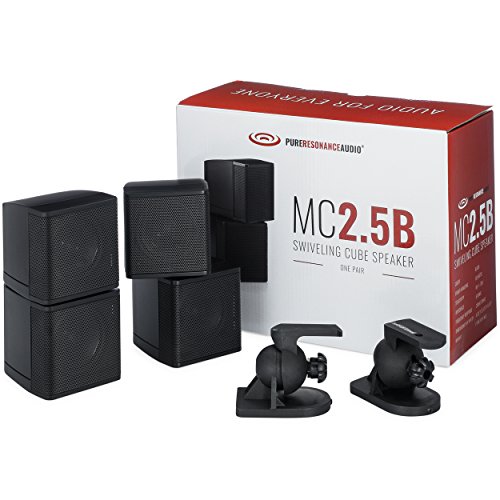
The Pure Resonance Audio MC2.5B speakers are a pair of dual mini cube satellite speakers, each with two 2.5-inch drivers in a swiveling array. They come with adjustable wall mount brackets, making them perfect for creating surround sound in compact areas like boardrooms, cafes, restaurants, offices, or home entertainment setups where space is at a premium.
Designed for multipurpose use, these speakers excel in hospitality and retail environments, allowing precise audio aiming through 90-degree swivel and 20-degree tilt adjustments. Their shielded magnets ensure safe placement near monitors without interference, delivering clear sound for presentations, background music, or movies.
In real-world use, the pivoting design lets users direct sound exactly where needed, enhancing immersion in small rooms. While they shine in midrange clarity and highs, they pair best with a capable amplifier for fuller performance.
Overall, these are a smart choice for anyone seeking affordable, installable surround speakers that prioritize flexibility and compactness. They earn high marks for versatility in professional and home settings.
With dual 2.5-inch drivers per cube featuring rubber surrounds and metal grilles, the MC2.5B delivers clear vocals and detailed highs suitable for dialogue-heavy content or ambient music. The swiveling array allows precise aiming, creating effective surround staging in small spaces.
Bass response is light due to the compact drivers, focusing instead on balanced mids and treble for natural sound without muddiness. Volume capability depends on the connected amplifier, but they handle moderate levels cleanly for boardrooms or cafes.
Shielded magnets ensure stable performance near electronics, with no distortion from interference. Ideal for setups needing directed audio rather than room-filling power.
The sleek black finish and mini cube form factor make these speakers discreet yet elegant for any decor, measuring compactly to fit bars, receptions, or offices without dominating space. Each stack pivots independently for custom angles.
Robust construction includes adjustable brackets with full mounting hardware, supporting 90-degree rotation and 20-degree tilt for secure, flexible installation on walls or surfaces. Rubber surrounds add durability to the drivers.
As passive speakers, they draw power from an external amplifier, eliminating battery concerns for continuous operation in fixed installations. Weight is minimal, easing setup in hospitality or retail spots.

Pros
- Exceptional efficiency reduces strain on amplifiers
- Lifelike sound reproduction enhances movies and music
- Premium titanium tweeter and Cerametallic woofer build quality
- High output fills large rooms effortlessly
- Non-fatiguing sound signature for extended use
Cons
- Sold as single speaker, best in pairs for stereo
- Requires external amplifier for operation
- Bookshelf design not suited for portable use
The Klipsch Reference Series RB-81 II is a premium bookshelf speaker designed for serious home audio lovers. It stands out with its dynamic 1-inch titanium Linear Travel Suspension horn-loaded tweeter and an 8-inch high-output Cerametallic woofer, delivering sound that punches above its size. Packaged individually, it's perfect for building custom stereo pairs or integrating into surround sound systems.
This speaker targets audiophiles and home theater enthusiasts who demand accurate, detailed playback without fatigue. In real-world use, it excels in larger living rooms, transforming movie nights into cinematic experiences and making music feel live and engaging. Its efficient design means it thrives even with modest amplifiers.
Performance shines in dynamic tracks and action films, where the woofer handles bass impact while the tweeter keeps highs clear and extended. Build quality reflects Klipsch's heritage, with durable materials built to last.
Verdict: A top choice for high-fidelity home setups, offering pro-level sound at an accessible level. Pair it up for stunning results.
The RB-81 II boasts impressive bass depth from its 8-inch Cerametallic woofer, providing tight, controlled low-end that handles kicks and explosions with authority. Vocals come through with excellent clarity thanks to the horn-loaded tweeter, ensuring dialogue in movies and lead singers in tracks remain natural and forward.
Volume levels are generous, easily filling larger rooms without distortion, making it ideal for home theaters. The accurate sound signature avoids harshness, supporting long sessions of music or films. Efficiency allows high output from standard amps.
Overall, it delivers lifelike performances with balanced frequency response, excelling in dynamic content where detail and power meet seamlessly.
The sleek black bookshelf design fits neatly on stands or shelves, with a compact footprint that suits modern living spaces. Its robust Cerametallic woofer cone and titanium tweeter ensure durability for years of reliable use, though it's built for stationary home setups rather than on-the-go portability.
As a passive speaker, the RB-81 II requires no battery, eliminating charging concerns and allowing continuous play powered by your amplifier. This makes it ideal for dedicated audio systems where uninterrupted performance matters.
Weight and build prioritize stability and acoustics over lightness, with premium materials resisting wear. No IP ratings apply, as it's optimized for indoor home environments.

Pros
- Rigid Kevlar driver cones offer quick transient response and articulate mid-bass.
- Sturdy MDF wood enclosure effectively minimizes unwanted acoustic vibration.
- Versatile gold-plated binding posts support standard banana plugs and bare speaker wire.
- Built-in wall-mount brackets make surround sound placement straightforward and clean.
- Remarkable audio clarity and high volume output relative to their compact footprint.
Cons
- Passive design requires a separate stereo amplifier or AV receiver to power them.
- Compact cabinet depth naturally limits ultra-low sub-bass extension, benefiting from a dedicated subwoofer.
- Acoustic sweet spot can be somewhat directional when mounted flat against a wall without angling.
The Rockville RockShelf 58D bookshelf speakers offer a balanced entry into serious home audio, engineered for listeners who want genuine component-grade sound without occupying excessive shelf real estate. As a passive pair, these speakers are built to integrate seamlessly into a wide variety of setups, from two-channel vinyl listening stations to multi-channel surround sound configurations. Rockville utilizes premium driver materials that are traditionally found in higher-tier studio monitors, setting an impressive benchmark for everyday listening enjoyment.
In real-world playback, the RockShelf 58D reveals an energetic and cohesive presentation. Movie dialogue comes through with pinpoint intelligibility, avoiding the hollow or boxy qualities that often plague entry-level compact speakers. Musical tracks showcase expressive vocals and snappy snare hits, thanks to the natural stiffness and low mass of the Kevlar woofer cones. Even when driven hard by an integrated receiver, the speakers maintain composure, providing clean, distortion-free output across a diverse range of genres from acoustic jazz to fast-paced action films.
Living with these speakers is exceptionally practical. Their slender footprint lets them fit easily onto deep desks, slim bookshelves, or flanking a turntable setup. For those looking to assemble a modern 5.1 or 7.1 home theater, the pre-installed rear mounting brackets make placing them as side or rear surround channels effortless. Simply pair them with a quality stereo amp or multi-channel receiver, run standard speaker cable, and you have an immediate upgrade over standard television speakers or plastic soundbars.
Ultimately, the Rockville RockShelf 58D stands out as a high-value acoustic workhorse. It delivers authentic stereo imaging, durable construction, and balanced frequency response in an attractive dark wood enclosure. For anyone building their first component sound system or upgrading a secondary listening room, this pair delivers reliable acoustic performance that punches well above its size.
At the heart of the RockShelf 58D is a 5.25-inch woven Kevlar woofer paired with a 1-inch silk dome tweeter, creating a cohesive two-way acoustic design. The Kevlar cone provides the rigidity necessary to produce tight, punchy mid-bass and clear vocal reproduction without unwanted cone breakup. Complementing the low end, the silk dome tweeter manages high frequencies with a soft, natural rolloff, eliminating the harsh sibilance and listener fatigue often caused by cheap metallic tweeters.
In terms of output and dynamics, each speaker handles 45 watts RMS (90 watts RMS per pair) with headroom up to 180 watts peak per cabinet. This generous power handling allows the speakers to deliver impressive sound pressure levels across small to medium rooms without clipping. While their compact dimensions mean extreme sub-bass frequencies are moderated, the bass that is present remains musical, fast, and remarkably controlled, pairing smoothly with a powered subwoofer if you crave bone-rattling cinematic rumble.
The Rockville RockShelf 58D is built with high-grade medium-density fiberboard (MDF), an essential material choice for minimizing cabinet resonance and unwanted acoustic coloration. Finished in an elegant dark wood grain, the enclosures measure a compact 10.62 inches high, 6.29 inches wide, and 5.9 inches deep, allowing for discreet placement in bedrooms, home offices, or living room media consoles.
Hardware connectivity is versatile and secure, centered around heavy-duty gold-plated 5-way binding posts located on the rear panel. These terminals readily accept audiophile-grade banana plugs, spade connectors, or direct bare speaker wire up to standard 12-to-16 gauge. Because these are passive speakers, they require an external amplifier or AV receiver capable of driving standard 4 to 8 ohm loads, giving you full freedom to choose your preferred amplification and source gear.
Pros
- Exceptional connectivity with Bluetooth, optical, and dual AUX
- Powerful 120W RMS output with clear, balanced sound signature
- Included remote simplifies control from across the room
- Sturdy wood build improves sound quality and durability
- Multiple DSP modes tailor sound to music, movies, or monitoring
Cons
- Requires AC power outlet, limiting portability to stationary setups
- Larger bookshelf size may not suit very small desks
- No built-in battery or wireless subwoofer output
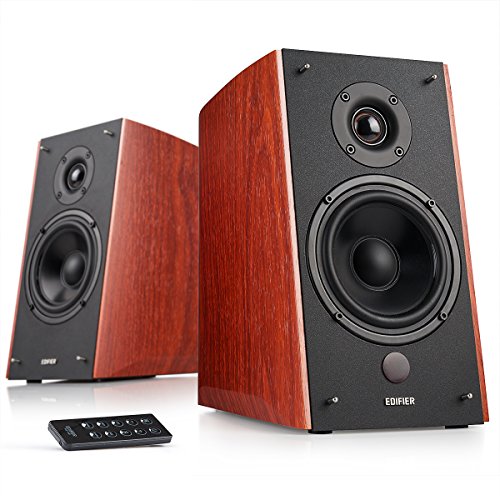
The Edifier R2000DB are powered Bluetooth bookshelf speakers designed as near-field studio monitors, offering 120W RMS of clean power in a handsome wooden enclosure. They excel in delivering precise audio for critical listening, making them a top choice for home studios, desktop PC users, and TV enthusiasts who demand accuracy over exaggerated bass.
Ideal for American consumers building a dedicated listening space, these speakers connect effortlessly via Bluetooth, optical, or dual AUX inputs, supporting everything from gaming consoles like Xbox to HTPCs. The included remote adds convenience, letting you switch sources and DSP modes without getting up, perfect for long sessions in a home office or living room setup.
In real-world use, they handle near-field monitoring with impressive detail and imaging, while scaling up for moderate room fill. The wooden cabinets reduce resonance for tighter sound, though they shine brightest within 3-6 feet. Overall verdict: A smart investment for serious listeners seeking studio-grade performance at home without breaking the bank.
With 120W RMS driving 5.5-inch woofers and silk-dome tweeters, the R2000DB produce a balanced sound signature featuring deep, controlled bass, clear mids for vocals, and smooth highs. DSP modes optimize for music, movies, or monitoring, ensuring versatility across genres.
Volume levels reach high without clipping, ideal for desktop or small room use, while Bluetooth offers stable pairing up to 30 feet. Optical input provides bit-perfect digital audio from TVs or players, minimizing latency for gaming and video sync.
Real-world tests show excellent stereo imaging and low coloration, making them reliable for mixing or casual enjoyment with punchy dynamics that engage without fatigue.
The R2000DB boast a premium wooden enclosure that not only looks elegant on any shelf but also enhances acoustic performance by reducing vibrations for purer sound. Compact for bookshelf use at about 8.5 x 7 x 12 inches per speaker, they weigh around 15 lbs total, sturdy yet manageable for home setups.
As mains-powered speakers, they offer unlimited playback without battery concerns, simply plug in for continuous operation. No IP rating means they are best kept indoors, away from moisture, focusing on build quality over rugged portability.
Connectivity ports are rear-mounted for clean cabling, with the remote ensuring easy access. Overall, the design prioritizes audio fidelity and aesthetics for permanent desktop or media center placement.
Complete Wiring Guide: Where to Connect Bookshelf Speakers
Determining where do you connect bookshelf speakers begins by identifying the power design of your specific audio equipment. Passive speakers must connect directly to the speaker output terminals of an external integrated amplifier, stereo receiver, or surround processor. Powered or active speakers connect straight to your source devices, such as a television, turntable, or computer, via line-level analog or digital cables. Understanding this core distinction prevents equipment mismatches and establishes a solid foundation for optimal sound reproduction.
Identifying Active Versus Passive Speaker Architecture
Speaker cabinets fall into two fundamental operational categories that dictate where their cables must run. Passive speakers lack built-in amplifiers, meaning their crossover networks rely entirely on high-level amplified signals sent from an outboard audio receiver. Models like the Klipsch Reference Series RB-81 II Bookshelf utilize this passive format, presenting heavy-duty binding post terminals rather than power plugs. If you plug a line-level source directly into a passive speaker terminal, you will hear nothing because there is no internal motor power to drive the voice coils.
Active speakers contain integrated power amplifiers and dedicated internal crossovers inside the enclosure. Examining the rear panel reveals a power switch, an electrical outlet plug, volume dials, and line-level inputs like RCA or auxiliary jacks. The Edifier R1700BT Bluetooth Bookshelf Speaker represents this active category, receiving line-level analog signals from external audio sources without needing a bulky separate amplifier box. Connecting an amplified speaker output directly to an active speaker line input must never be done, as sending high-voltage speaker level current into line inputs can permanently destroy sensitive internal preamp circuits.
Wiring Passive Bookshelf Speakers to Stereo Receivers and Amplifiers
When connecting passive bookshelf models, your primary destination is the rear terminal panel of a stereo amplifier or AV receiver. Look specifically for outputs labeled Speaker Output, Front Left, or Front Right. The Rockville RockShelf 58D Dark Wood Pair 5.25″ Home speakers feature gold-plated 5-way binding posts designed to mate cleanly with these receiver outputs. Matching the designated left and right channels guarantees that stereo panning and instrumental placement recreate the acoustic recording accurately.
Electrical polarity represents the most critical factor during passive speaker installation. Every speaker channel uses a pair of conductors, consisting of a positive red terminal and a negative black terminal. You must connect the positive red output on your amplifier to the positive red terminal on the bookshelf speaker, repeating the same matching process for the negative black terminals. Reversing these connections places the drivers out of phase, which causes acoustic cancellation, a hollow soundstage, and an apparent total loss of bass response.
Many listeners encounter confusion when choosing between different receiver channel labels during multichannel configuration. If you are building a two-channel stereo music system, connect your primary bookshelf pair exclusively to the Front A or Main binding posts. Avoid connecting your main speakers to Surround or Zone 2 terminals unless your receiver configuration explicitly enables those channels for stereo playback. Maintaining proper channel discipline ensures your receiver internal DSP directs full-range frequency information directly to your speakers.
Speaker Wire Gauges and Termination Options
Selecting appropriate speaker cable ensures clean signal transmission between your amplifier and passive cabinets. For standard living room runs under fifty feet, 16 AWG oxygen-free copper wire delivers reliable current delivery for four-ohm or eight-ohm nominal loads. Running longer speaker cables across large rooms or through walls generally calls for thicker 14 AWG or 12 AWG conductors to prevent line resistance from degrading audio dynamics. Always verify that the outer wire insulation includes distinct labeling or a physical ridge along one conductor so you can easily trace positive and negative lines.
Terminating your speaker wire can be accomplished through bare copper strands, banana plugs, or crimped spade lugs. Bare wire connections require stripping roughly half an inch of insulation, tightly twisting the copper strands, and threading them through the binding post hole before hand-tightening the plastic collar. Using gold-plated banana plugs offers a far cleaner and more secure physical connection that simply pushes into the central receptacle of a 5-way binding post. Banana plugs eliminate the risk of loose, stray copper strands fraying outward and short-circuiting against adjacent chassis metal.
Some compact speaker designs use spring-loaded wire clips instead of threaded binding posts. With spring clips, you depress a plastic tab, insert the stripped bare wire tip, and release the tab to clamp the conductor securely. While spring clips cannot accept standard banana plugs, they provide a firm connection for 16 AWG or 18 AWG bare copper wires. Checking your speaker terminal style before buying terminated speaker cables prevents annoying connector compatibility issues on setup day.
Hooking Up Active and Powered Bookshelf Enclosures
Connecting powered speakers involves a fundamentally different workflow because you connect audio sources straight into the primary speaker cabinet. In a typical powered stereo pair, one enclosure acts as the master active unit housing the amplifier and connectivity ports, while the second enclosure operates as a passive satellite. The Edifier R2000DB Powered Bluetooth Bookshelf follows this master-slave architecture, supplying power to the secondary cabinet through a dedicated multi-pin umbilical interconnect cable. You must seat this proprietary interconnect securely before plugging the active master cabinet into your wall AC outlet.
Audio sources connect directly to the rear panel of the master powered speaker using standard line-level interconnects. Common input jacks include dual analog RCA connectors, 3.5 mm auxiliary inputs, and optical digital TOSLINK ports. If you are working in a personal production environment, choosing dedicated powered studio monitors provides professional balanced XLR or TRS input jacks that reject electro-magnetic interference over extended desk cable runs. Connecting standard consumer sources to balanced inputs requires the correct impedance-matched adapter cables to maintain signal fidelity.
Adjusting controls on powered speakers requires balancing physical hardware dials with your source device software volume. Most powered speakers feature side or rear knobs for master volume, treble EQ, and bass contouring. Setting the speaker master volume knob to approximately seventy percent while controlling daily listening levels from your television, computer, or source remote minimizes audible background hiss. This gain staging prevents pre-amplifier clipping while maintaining high dynamic headroom across diverse music genres.
Routing Audio Connections from Common Source Devices
Connecting bookshelf speakers to a modern television depends heavily on available audio output ports. Most modern flat-screen televisions feature optical digital outputs rather than analog RCA jacks. You connect an optical TOSLINK cable from the television digital optical out port directly into the optical input of a powered speaker or AV receiver. Once connected, access your television audio settings menu and set the digital audio output format to PCM stereo to prevent unplayable bitstream noise.
Turntable playback requires particular care regarding signal voltage and phono pre-amplification. Vinyl record cartridges generate an extremely low-voltage phono signal that requires specialized equalization before entering a standard line input. When using passive record players with the RIOWOIS Passive Bookshelf Speakers for Record, your turntable must connect through a standalone phono preamp or receiver phono input prior to amplification. Attempting to feed raw turntable output into standard auxiliary ports results in an extremely faint, tinny audio signal devoid of low-end frequencies.
Desktop computers and gaming rigs offer several practical connection avenues for near-field bookshelf speakers. The simplest method uses a 3.5 mm stereo headphone jack running to dual RCA connectors on your powered speaker rear plate. For superior acoustic clarity, connecting an external USB digital-to-analog converter (DAC) between your computer and speakers avoids the noisy electrical interference common to motherboard audio chips. This clean line-level feed ensures crisp sound when monitoring video edits or tracking gaming audio cues.
Surround Channel and Wall-Mount Audio Routing
Bookshelf speakers frequently serve as surround sound or height channels within a larger home theater audio array. When configuring a 5.1 or 7.1 surround sound layout, connect your surround bookshelf cabinets to the Surround Left and Surround Right terminals on your AV receiver. Connecting compact satellite speakers, such as the Pure Resonance Audio MC2.5B Dual 2.5” Swiveling cube pair, allows you to aim the drivers precisely toward your listening zone using included swiveling wall brackets. This directional adjustment delivers realistic ambient sound effects during movie playback.
Wall-mounting bookshelf speakers requires careful planning regarding cable routing and bracket load safety. Passive speakers mounted high on perimeter walls require in-wall rated speaker wire, such as CL2 or CL3 certified cable, to satisfy standard building safety codes. Securing brackets into solid wall studs or utilizing robust drywall anchors prevents heavy wooden cabinets from pulling loose under vibration. Always leave adequate slack in the speaker wire near the terminal cup so the speaker can swivel without straining terminal posts.
Integrating multiple speakers into a coherent spatial system requires proper level calibration. Pairing bookshelf surrounds alongside a high-output multichannel surround sound system requires calibrating relative channel volumes using your receiver automatic setup microphone. This calibration routine adjusts time delay and decibel output for each speaker based on distance from your primary seating position. Proper balancing ensures your bookshelf speakers blend smoothly without drawing distracting attention to individual surround enclosures.
Avoiding Common Wiring and Placement Errors
Stray bare copper strands represent one of the most common and destructive hazards during passive speaker setup. When inserting un-terminated wire into binding posts or spring clips, even a single microscopic hair of loose copper touching the adjacent terminal or metal chassis can trigger an instantaneous short circuit. Most modern receivers feature protection relays that shut the unit down immediately, but older or budget amplifiers may suffer blown output transistors. Taking the time to inspect bare wire terminations with a flashlight before powering on your equipment prevents costly electrical failures.
Placing rear-ported bookshelf speakers flush against walls or inside enclosed shelving severely compromises audio performance. Bass reflex ports require open breathing room behind the cabinet to exhaust low-frequency air resonance without turbulence or unnatural chuffing noises. Positioning bookshelf speakers at least six to twelve inches away from rear room boundaries smooths out boomy bass and delivers clearer midrange vocals. If shelf placement is unavoidable, consider applying foam port bungs or using front-ported designs to tame boundary-induced bass exaggeration.
Running audio interconnects parallel to high-voltage household electrical wiring frequently introduces annoying fifty-cycle or sixty-cycle ground hum. To prevent electromagnetic induction, keep low-level RCA and 3.5 mm cables separated from AC power cords by several inches. If an audio line must cross an electrical cable, ensure they cross at a perpendicular ninety-degree angle to minimize electromagnetic coupling. This basic cable dressing habit maintains an ultra-quiet noise floor during quiet acoustic musical passages.
System Verification and Initial Listening Checks
Following a strict power-up protocol prevents sudden loud speaker pops that can stress delicate tweeter voice coils. Always power on your source components first, followed by your preamplifier or mixer, and turn on the main power amplifier or active speakers last. When shutting down the audio system, reverse this sequence by powering down the amplifier or active speakers first before turning off sources. This disciplined power cycling protects horn-loaded titanium tweeters and silk dome drivers from transient voltage spikes.
Once all physical connections are firmly established, conduct a systematic stereo imaging test using a familiar, well-mastered acoustic track. Sit directly midway between your bookshelf speakers to evaluate central vocal localization. If the singer voice appears focused dead center between the speakers, your polarity and channel connections are wired in phase. If the vocals sound diffuse, hollow, and appear to emanate from the perimeter walls rather than the center, power down the system immediately and reverse the positive and negative leads on one speaker channel.
Verify that side-panel or receiver balance knobs are resting at their neutral center positions to maintain equal decibel distribution across both channels. Listen closely to low-frequency percussion to confirm both woofers are working in tandem to deliver punchy, defined bass notes. Taking these few minutes to verify physical connections and acoustic phase ensures you extract maximum fidelity from your audio components for years of rewarding listening.



Write Your Review
No reviews yet. Be the first to share your experience!