


Setting up sound across an entire living space often exposes the inconvenience of walking over to an audio cabinet just to adjust volume or skip tracks. Understanding what are remote speakers helps listeners select equipment that delivers clear playback in secondary zones while offering convenient distance control. In modern home audio, the phrase describes both secondary zone loudspeakers placed away from the primary entertainment rack and active systems operated by dedicated handheld controllers. Whether placing compact audio hardware in a home office or expanding sound to an outdoor deck, choosing the right combination of wireless links and physical controls prevents playback frustration.
Many listeners pair powered desk units with bookshelf speaker stands to decouple enclosures from surfaces while keeping infrared sensors angled toward the couch. Everyday audio setups frequently balance wireless streaming convenience against the reliability of physical buttons. In this practical guide, we break down how remote systems function, examine options like replacement controllers from ZdalaMit alongside portable boomboxes from TOMPROAD, and outline key factors for configuring dependable sound across your home.

Pros
- Balanced sound with impressive bass for small rooms
- Reliable Bluetooth 4.0 connection up to 30 feet
- Premium wood build looks great in any home
- Versatile inputs handle multiple audio sources
- Responsive remote enhances user-friendly control
Cons
- Requires AC power outlet, not portable
- No EQ app for sound customization
- Bass can overpower mids at max volume
The Edifier R1280DB powered bookshelf speakers combine Bluetooth convenience with classic hi-fi performance, making them a go-to for American homes. With 21W RMS per channel driving 4-inch woofers and silk tweeters, they handle Bluetooth streaming, optical TV audio, or vinyl via RCA inputs seamlessly.
Perfect for home office workers needing clear calls and podcasts, or weekend warriors enjoying Spotify playlists in the living room, these speakers shine in compact spaces up to 250 square feet. The RC10E-compatible remote lets you tweak bass, treble, and inputs without getting up.
In everyday use, they deliver detailed vocals and controlled bass that outperforms most desk speakers in this price range. No distortion creeps in during lively tracks, and setup takes minutes.
Verdict: Excellent entry into quality audio. Grab the replacement remote if yours goes missing for uninterrupted control.
Bass depth punches through with authority from the ported 4-inch drivers, ideal for genres like rock or hip-hop without muddiness. Vocal clarity stays natural, with silk tweeters handling highs smoothly up to 20kHz.
Volume reaches loud levels for parties in small rooms, maintaining composure without clipping. Bluetooth 4.0 offers stable streaming over 30 feet indoors, perfect for kitchen-to-living-room control.
Overall signature is warm and engaging, suiting long Netflix binges or focused work sessions.
Sleek walnut wood finish adds sophistication to desks or shelves, with compact dimensions of 5.75 x 9.5 x 7.7 inches per speaker. Pair weighs around 10 pounds for sturdy placement without wobble.
Indoor-focused build lacks waterproofing but excels in dust-free home environments. No portability issues since AC power means endless playback for all-day use, no recharging downtime.
Remote runs on standard batteries for reliable couch command, pairing perfectly with the speakers out of the box.
Pros
- Powerful 11W output with dedicated subwoofer and tweeters for immersive stereo
- Quick Bluetooth 5.0 pairing with 33ft range and multiple input options
- Vibrant LED lights and remote control enhance party atmosphere
- Portable design with handle and stand for travel and convenience
Cons
- No waterproof rating, so avoid poolside or rainy conditions
- Battery life listed vaguely as several hours, untested in real-world extremes
- Bass-heavy sound may overpower mids in quieter settings
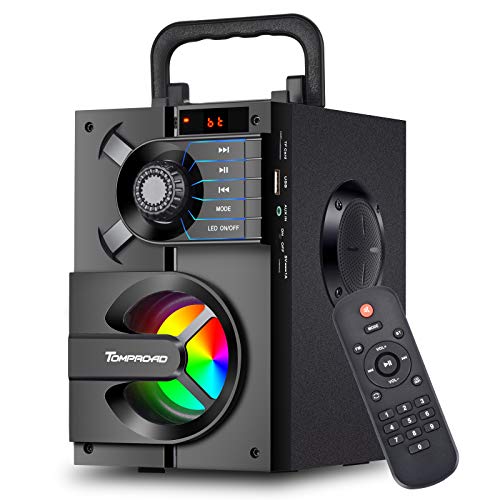
The TOMPROAD S39 is a feature-packed portable speaker designed for party enthusiasts and outdoor adventurers seeking big sound on a budget. With its 11W power, subwoofer, dual tweeters, and rear bass tube, it delivers stereo audio that's surprisingly robust for its size, making it a go-to for tailgating, camping, or home gatherings.
It's built for versatility, supporting Bluetooth 5.0, FM radio, TF card, USB, and AUX inputs, plus a remote control for easy operation. The RGB LED lights pulse with the beat, turning any event into a visual spectacle, while the handle and phone stand add practical portability.
In real-world use, it shines at outdoor parties where bass-driven tracks thrive, filling open spaces without distortion at high volumes. Though lacking waterproofing, its multi-functionality makes it a solid pick for dry-weather fun.
Verdict: Great value for casual listeners wanting lights, remote, and bass without breaking the bank. Perfect if you prioritize fun features over rugged durability.
The S39 excels with its bass-forward signature, thanks to the dedicated subwoofer and rear bass guide tube, delivering deep, thumping lows that cut through outdoor noise at barbecues or beach parties. Dual tweeters handle highs crisply, creating a wide stereo soundstage for immersive listening.
At max volume, it pushes room-filling levels without noticeable distortion, ideal for groups. Bluetooth 5.0 ensures stable connectivity up to 33 feet, with quick pairing to phones or tablets, and AUX/TF/USB options provide reliable backups for uninterrupted play.
FM radio auto-scans stations effortlessly via remote, adding variety for road trips. Overall, it's tuned for energetic playback where bass rules, though mids may take a backseat in acoustic tracks.
Compact and lightweight with a top handle for easy portability, the S39 includes a fold-out stand to prop up phones or tablets, perfect for hands-free video calls or recipes at picnics. The digital display and front LED button make controls intuitive.
No IP rating means it's not built for water exposure, so stick to dry environments like patios or campsites. RGB lights are customizable via a dedicated switch, enhancing aesthetics without complexity.
The rechargeable battery powers several hours of continuous play after a full charge, supporting all-day parties or weekend getaways. Charging time keeps it practical for on-the-go recharges, though exact figures depend on volume and features used.
Understanding Remote Speakers, Wireless Multiroom Audio, and Hardware Controls
The term what are remote speakers refers to two distinct audio concepts that share the common benefit of distance-based listening and control. In multiroom and home theater audio, remote speakers are secondary enclosures positioned in another room or outdoor patio to extend coverage beyond the main listening area. In active and portable audio, remote speakers describe powered monitors or self-contained sound systems managed through handheld infrared or wireless controllers. Clarifying these two definitions ensures you invest in the right gear, whether you need secondary zone sound reinforcement or simple couch-side volume adjustments.
The Dual Definitions of Remote Audio Systems
Audio terminology often blends functional placement with control mechanisms. For decades, home stereo receivers labeled secondary outputs as speaker B or remote, directing amplified audio signals to distant rooms or outdoor porches. Today, powered digital monitors and all-in-one sound hubs have expanded that concept to include active speakers that feature handheld controllers for input switching and volume tuning. Recognizing which setup matches your listening goals prevents buying the wrong hardware.
Traditional remote zone speakers typically require running long speaker cables through walls from a central audio receiver to distant ceiling or patio brackets. Conversely, modern active remote units integrate internal amplifiers and receive audio signals through wireless streams or auxiliary cords while responding to handheld controllers. Both configurations aim to eliminate the hassle of hovering near the amplifier cabinet just to tweak sound levels or adjust audio balance. Choosing between them comes down to whether you want multi-room sound distribution or simple desk-side control.
Secondary Zone and Multiroom Architectures
Setting up secondary audio zones allows homeowners to pipe background music into dining areas, basements, or outdoor patios without duplicating audio sources. When using multi-zone receivers, remote speakers reproduce audio sent from a primary media player while operating on an independent volume dial. This setup keeps movie dialogue centered in the primary home theater while allowing guests on the patio to enjoy continuous music playback. It provides a cohesive soundscape across distinct architectural spaces without requiring separate audio players in each room.
Wireless streaming ecosystems have simplified distributed speaker architectures by using local networks rather than in-wall copper lines. Modern wireless satellites receive synchronized digital audio packets, giving listeners total control through smartphone applications or dedicated remotes. Listeners exploring multichannel speaker systems often encounter these secondary zone features when managing surround channels alongside auxiliary room outputs. This integration allows flexible expansion whenever you want to add audio coverage to another living space.
Dedicated Handheld Controllers for Powered Bookshelf Speakers
Powered bookshelf speakers combine internal amplification, digital converters, and multiple audio inputs inside a single enclosure. Because these active units often sit on media consoles, desks, or wall brackets, manufacturers include handheld infrared controllers to operate them from across the room. These remotes let listeners toggle between optical connections, RCA line inputs, and wireless Bluetooth pairings without touching the rear cabinet dials. Having direct remote access makes switching between a television source and a phone stream fast and effortless.
Infrared controllers typically manage master volume, audio muting, input source selection, and power states from a distance. Some active speakers also provide remote bass and treble adjustments, enabling listeners to tune room acoustics directly from their preferred listening seat. Without a functioning remote, accessing recessed rear-panel controls on heavy bookshelf enclosures quickly becomes tedious during casual listening sessions. A responsive handheld remote preserves daily convenience and prevents unnecessary handling of the speaker cabinets.
Restoring Control with Replacement Hardware
Handheld infrared controllers are small accessories that frequently get misplaced, dropped, or damaged in busy living spaces. When a controller goes missing, active speakers like the Edifier R1280DB lose much of their convenience, forcing owners to manually reach behind the cabinet to adjust basic listening levels. Dedicated replacement accessories such as the ZdalaMit RC10E replacement remote control restore full wireless functionality to compatible Edifier bookshelf monitors. Regaining remote control access ensures seamless volume adjustment and input switching without disrupting your audio setup.
Replacement controllers designed for specific speaker models require no complex code programming or manual pairing procedures before use. Inserting fresh batteries allows the infrared transmitter to send factory-matched command pulses directly to the speaker front-facing sensor. Verifying model compatibility before purchase is vital, because differing revision boards or distinct product series may utilize unique infrared codes that prevent communication. Checking the original speaker model number printed on the back panel guarantees the replacement transmitter operates all intended functions properly.
Portable Multifunction Speakers with Handheld Remotes
Portable party speakers take remote-controlled audio outside the traditional living room or studio workspace. Self-contained units such as the TOMPROAD S39 portable Bluetooth speaker integrate amplification, dynamic drivers, digital media players, and remote control support into a rugged carrying chassis. These systems give users direct control over playback modes, volume levels, and radio presets from up to dozens of feet away. Handheld remotes make these all-in-one boomboxes particularly convenient during backyard barbecues, workshop tasks, or beach outings.
The TOMPROAD S39 speaker features an eleven-watt rated power output delivered through a three-loudspeaker array that includes a dedicated bass driver, two tweeters, and a rear bass guide tube. Its built-in control system allows users to switch between Bluetooth 5.0 wireless streaming, auxiliary inputs, USB drive playback, and TF memory card tracks. Using the handheld remote control, listeners can also enter specific radio station numbers directly onto the digital display without cycling through every broadcast frequency. The top handle and integrated phone stand bracket provide extra physical convenience when managing playlists outdoors.
Evaluating Infrared Versus Radio Frequency and Bluetooth Controls
Handheld speaker controllers operate across several wireless transmission protocols, each with distinct practical advantages and physical limitations. Infrared technology remains the most widespread method for bookshelf monitors and media hubs due to its low power consumption and instantaneous signal response. However, infrared requires an unobstructed line of sight between the transmitter lens and the speaker sensor to register commands. Obstacles such as solid furniture, books, or dense speaker grilles can block the beam and prevent the unit from responding.
Radio frequency remotes and Bluetooth controls eliminate line-of-sight constraints, allowing signals to pass through cabinet doors, furniture, and light room partitions. Bluetooth controllers often link directly with the speaker chipset to provide two-way communication, such as reflecting volume levels on a synchronized screen. While RF and Bluetooth provide greater freedom of movement, infrared remotes benefit from prolonged battery life and immediate connection without pairing delays. Selecting the right control format depends on whether your audio gear sits out in the open or behind closed entertainment center doors.
Active Versus Passive Remote Speaker Hardware
Deciding between active and passive speaker hardware directly impacts system wiring, amplification requirements, and total setup cost. Active remote speakers house their own built-in amplifier modules, requiring only a wall power outlet and an incoming line-level or wireless audio signal. This self-contained architecture makes active monitors exceptionally convenient for bedrooms, home offices, and compact apartments where bulky audio components are undesirable. Handheld remotes pair naturally with active systems because the volume and input circuitry reside directly inside the primary speaker cabinet.
Passive remote speakers contain no internal power circuits and rely entirely on external amplification supplied by an audio receiver or multi-channel power amp. While running speaker wire to passive monitors demands more installation labor, it allows owners to easily replace amplifiers or add external zone selector boxes over time. Understanding this distinction prevents buyers from connecting passive speaker terminals directly into unamplified line outputs, which produces zero acoustic output. Passive designs excel in whole-home architectural installations where speakers remain permanently mounted in ceilings or walls.
Signal Connections Beyond Wireless Bluetooth Streaming
While Bluetooth wireless connectivity offers quick pairing with mobile phones and tablets, versatile remote speakers include multiple physical input options. The TOMPROAD portable unit pairs its Bluetooth 5.0 receiver with a 3.5 millimeter auxiliary input line, a USB flash drive port, and a micro TF memory card slot. These hardwired options ensure continuous music playback even when streaming devices run out of battery or wander out of wireless range. Having offline playback choices protects your listening session against weak wireless reception or dropped streaming connections.
Active home bookshelf speakers regularly feature optical digital connections and dual RCA line inputs alongside wireless links. Optical cables deliver clean digital audio from modern smart televisions, while RCA connectors link smoothly with turntables containing built-in preamps or external CD players. Having an infrared remote makes toggling between these diverse hardware sources effortless without needing to swap physical cables on the rear panel. This multi-source flexibility transforms a pair of compact bookshelf units into a central sound hub for all your home media.
Acoustic Placement and Boundary Loading for Remote Setups
Placing a remote speaker properly within a room has a direct acoustic impact on vocal clarity and bass balance. When speakers sit flat against a rear wall or tucked deep into a room corner, low-frequency boundary loading artificially boosts bass output, which can muddy dialogue and acoustic instruments. Positioning monitors at least a few inches away from boundary walls allows bass-reflex ports, like the rear guide tube on the TOMPROAD S39, to breathe without turbulent air choking. Giving the enclosure adequate clearance results in tighter bass notes and cleaner midrange reproduction across the listening area.
Elevating speakers to ear level ensures that high-frequency tweeters direct sound cleanly toward listeners rather than scattering off tabletops. Desktops and unpadded shelves create immediate acoustic reflections that interfere with direct sound waves, reducing overall sonic detail. For listeners evaluating high-output portable speakers, testing different indoor and outdoor surface placements quickly demonstrates how ground reflections reinforce low-end response. Proper positioning remains one of the simplest and most effective ways to upgrade the listening experience of any speaker system.
Troubleshooting Remote Speaker Interference and Range Problems
Wireless remote speakers occasionally suffer from dropped signals, unresponsive controls, or unexpected playback stutter. When an infrared controller fails to trigger adjustments, check for dirty emitter lenses, depleted coin or alkaline batteries, or physical barriers blocking the receiver window on the speaker grille. Bright sunlight or certain fluorescent light fixtures can also saturate infrared receiver diodes, causing momentary unresponsiveness until the angle is adjusted. Keeping the front panel of your active speakers clean and unobstructed resolves the vast majority of infrared remote issues.
Bluetooth audio streams typically maintain stability up to thirty-three feet in open air, but indoor obstacles like concrete walls and metal lath degrade signal strength rapidly. Interference from household Wi-Fi routers or cordless appliances operating on the 2.4 gigahertz band can induce micro-dropouts in portable audio playback. Moving the source device closer to the speaker chassis or switching to a physical auxiliary cable resolves persistent connection instability. Routine troubleshooting usually restores smooth audio playback without requiring equipment replacement.
Key Selection Criteria for Remote Speaker Systems
Choosing the ideal remote speaker configuration depends heavily on how and where you plan to listen to your media collection. If your goal is high-fidelity desktop sound or enhancing television dialogue in a dedicated listening room, active bookshelf monitors with precision optical inputs and ergonomic infrared remotes provide superior performance. Look for sturdy cabinet construction, distinct tweeter and woofer components, and simple remote input selection. These features guarantee balanced frequency delivery and dependable daily convenience for living room media centers.
For outdoor gatherings, camping, and flexible entertaining, look for portable multifunction speakers that incorporate rechargeable batteries, carrying handles, and integrated device stands. Units equipped with colorful LED lighting, FM radio tuners, and numerical keypad remotes provide versatile entertainment without requiring an active internet connection. Assessing battery runtime, enclosure portability, and physical input variety guarantees the equipment fits your daily lifestyle. Prioritizing your primary listening environment ensures that you choose the most practical balance of acoustic power and remote versatility.
Practical Steps to Verify and Maintain Remote Audio Gear
Once your remote speaker setup is assembled, running a series of quick operational checks ensures trouble-free listening for months to come. Test all remote control buttons from your primary seated position to confirm that volume, muting, and input toggling respond instantly without lag. If using battery-operated remotes, store spare cells nearby so an unexpected dead battery never cuts off your sound control unexpectedly. Taking time to verify these simple controls early avoids awkward interruptions during movie nights or parties.
Periodic cleaning of speaker grilles and controller buttons prevents dust build-up from degrading optical lenses or mechanical contacts over time. Avoid exposing indoor active monitors or replacement remotes to excess moisture, and follow manufacturer guidelines regarding charging cycles on portable battery units. Keeping equipment well maintained ensures consistent sound clarity and responsive command execution whenever you sit down to enjoy music. Thoughtful placement and routine care will keep your remote audio system delivering satisfying performance across every listening session.




Write Your Review
No reviews yet. Be the first to share your experience!