


Excessive low-end rumble frequently overwhelms vehicle doors and creates muddy, distorted audio inside the cabin. Learning how do i reduce the bass in my car speakers allows listeners to protect factory drivers, eliminate annoying door vibrations, and restore vocal clarity across every music genre. Standard door speakers often struggle when forced to reproduce heavy sub-bass notes alongside delicate midrange instruments. Installing balanced full-range drivers or comparing them with dedicated bass speaker designs demonstrates how separating deep sub-bass from primary full-range hardware cleans up acoustic output.
Most in-cabin audio distortion stems from mismatched equalization curves or pushing standard door cones past their physical excursion limits. Adjusting head unit tone controls, enabling digital high-pass crossovers, or inserting hardware frequency limiters can instantly resolve dirty low-end response. Applying simple calibration steps ensures that mid-bass drivers focus entirely on crisp vocals and instruments rather than straining under deep sub-bass signals. Understanding these basic car audio principles helps drivers achieve clean, articulate sound without overworking factory hardware.

Pros
- Effectively filters out harmful low frequencies to protect 6.5-inch drivers from bottoming out.
- Pre-wired leads with color-coded jackets make splicing into factory speaker wire quick and simple.
- Noticeably cleans up midrange vocals and eliminates speaker buzzing during loud playback.
- Handles up to 50 watts of continuous audio power without overheating or degrading audio quality.
Cons
- Requires manual wire splicing or soldering inside the vehicle door panel for installation.
- Cuts off low-end bass below 600 Hz at 4 ohms, requiring a dedicated subwoofer for sub-bass reproduction.
- Limited to 50 watts of power handling, making it unsuitable for high-output competition amplifiers.
The RECOIL BB-65 Bass Blocks are specialized passive high-pass crossover filters engineered to shield 6.5-inch car speakers from damaging low-frequency signals. Standard door speakers often struggle when pushed with deep sub-bass frequencies, resulting in muddy sound, audible cone distortion, and premature speaker failure. Designed specifically for car audio enthusiasts, daily commuters, and DIY installers, these inline blockers filter out frequencies between 0 to 600 Hz at 4 ohms (or 0 to 300 Hz at 8 ohms), allowing your speaker drivers to focus exclusively on clean mid-bass and crisp vocal reproduction.
In real-world driving environments, the difference in audio reproduction is immediately apparent. Highway wind and tire noise often force drivers to crank up the volume, which quickly causes small factory or aftermarket door speakers to clip on heavy bass lines. By installing the BB-65 inline on the positive speaker lead, those power-hungry low frequencies are filtered away before reaching the voice coil. The speaker cone moves with tighter control, enabling you to push system volume substantially higher without experiencing crackling, buzzing, or bottoming out.
Ultimately, the RECOIL BB-65 delivers an inexpensive yet high-impact upgrade for anyone seeking cleaner sound and longer lifespan from their car sound system. With 50 watts of reliable power handling and color-coded leads that simplify in-door installation, it acts as an essential line of defense for door speakers. When paired with a dedicated subwoofer to handle the low end, these bass blockers transform muddy factory setups into clear, balanced, and dynamic soundstages.
By stripping away demanding sub-bass frequencies that 6.5-inch speaker cones cannot reproduce efficiently, the RECOIL BB-65 dramatically elevates midrange vocal clarity and instrument separation. Podcasts, acoustic tracks, and rock vocals step forward in the soundstage with newfound presence, no longer drowned out by sloppy bass resonance. While sub-bass depth is intentionally filtered at the door speaker level, this cutoff prevents acoustic masking and creates a seamless handoff for a separate powered subwoofer.
The BB-65 maintains exceptional signal integrity up to its 50-watt power handling threshold. Because your amplifier or head unit no longer expends wasted energy pushing deep low-end waves into midrange drivers, your speaker can achieve significantly louder volume levels before entering distortion. The inline filtering preserves the clean flow of audio from your receiver, delivering distortion-free playback even during high-output listening sessions on the open highway.
Built to endure the harsh physical environment inside automobile door panels, the RECOIL BB-65 features durable protective heat-shrink encapsulation around the internal capacitor. Weighing under two ounces, this compact component introduces zero mechanical strain to factory wiring harnesses and easily fits inside cramped speaker baffles. The outer casing resists ambient automotive moisture, vehicle vibration, and cabin temperature swings, ensuring consistent performance through scorching summer commutes and freezing winter mornings.
Because the BB-65 operates as a completely passive audio component, it requires zero battery recharging and features infinite playback runtime without any charging downtime. By eliminating low-frequency impedance drops that stress factory head units, it optimizes the electrical efficiency of your car sound system and reduces strain on your vehicle battery. Installation is straightforward thanks to the pre-stripped green color-coded wire leads, letting you secure a dependable connection that lasts for years of road travel.
Effective Ways to Reduce Bass in Car Speakers
Unwanted bass distortion usually happens when small door drivers attempt to reproduce frequencies far below their physical capabilities. Car doors provide an imperfect acoustic enclosure, meaning heavy low frequencies cause severe rattling, cone distortion, and muffled vocals. Resolving this issue requires a systematic approach that begins with electronic head unit adjustments and extends to passive crossover filters and physical door dampening. Implementing the right balance ensures your system produces crisp audio without damaging factory or aftermarket door speakers.
Adjusting Head Unit Equalizer and Tone Controls
The fastest way to manage overwhelming low frequencies is through the native tone controls on the car receiver. Most modern factory and aftermarket stereo systems offer dedicated bass, midrange, and treble sliders, or multi-band graphic equalizers. Lowering the primary bass slider by two to four decibels immediately relieves strain on factory door speakers. This quick reduction prevents cone over-excursion during tracks featuring aggressive synthetic bass notes or deep kick drums.
Advanced head units often provide graphic or parametric equalizers with specific frequency adjustment bands. Lowering output in the 60 Hz, 80 Hz, and 100 Hz bands directly targets heavy bass rumble without hollowing out essential vocal presence. In contrast, leaving the 200 Hz to 500 Hz range neutral maintains the warmth of guitars and lower male speech. Taking time to fine-tune each individual frequency band delivers far more precise audio balance than slashing the broad master bass slider.
Another critical head unit setting to inspect is the loudness contour or dynamic bass boost feature. While loudness settings aim to boost bass at low listening volumes, they frequently introduce harsh distortion when volume levels increase. Disabling loudness functions, bass enhancements, and artificial surround modes instantly flattens frequency delivery. Similar to balancing channel output with multi speaker routing hardware in complex multi-room setups, maintaining a clean input signal preserves headroom across car audio channels.
Activating Receiver High-Pass Crossover Filters
A dedicated electronic high-pass filter, commonly abbreviated as HPF, serves as the most effective digital tool for removing sub-bass from door speakers. When enabled on a receiver or amplifier, an HPF blocks frequencies below a selected cutoff point while allowing higher frequencies to pass through untouched. Setting the high-pass filter to 80 Hz or 100 Hz prevents standard door drivers from attempting to recreate sub-audible notes. This single adjustment eliminates the muddy bottom end while keeping punchy upper-bass and clear vocals intact.
Many aftermarket stereos allow users to customize both the crossover cutoff frequency and the filter slope. Crossover slopes are typically measured in decibels per octave, such as 12 dB or 24 dB per octave curves. A steeper 24 dB slope rolls off low frequencies much faster below the selected cutoff frequency, creating a sharper barrier against bass bleed. A gentler 12 dB slope produces a smoother transition between frequencies, which some listeners prefer for acoustic or jazz genres.
Vehicles equipped with standalone subwoofers benefit enormously from active crossover separation. Directing sub-80 Hz signals exclusively to a subwoofer while routing frequencies above 80 Hz to door speakers maximizes power efficiency across the entire vehicle. Door speakers gain substantial volume headroom because their voice coils no longer dissipate energy on low-frequency reproduction. This clear acoustic division prevents distortion, preserves amplifier efficiency, and produces significantly tighter musical imaging.
Installing Passive In-Line Bass Blockers
Factory head units frequently lack sophisticated digital equalizers or adjustable high-pass crossover menus. In these installations, passive in-line bass blockers provide an affordable hardware solution to filter out destructive bass frequencies. Products like the RECOIL BB-65 Bass Blocks Designed to Protect Car audio 6.5 inch speakers act as passive analog high-pass filters wired directly to the speaker leads. These compact devices utilize internal capacitors to attenuate low-frequency energy before it ever reaches the driver voice coil.
The technical performance of passive blockers depends entirely on the nominal electrical impedance of the connected speaker driver. The RECOIL BB-65 design blocks frequencies from 0 to 600 Hz when paired with a 4-ohm speaker, or 0 to 300 Hz when wired to an 8-ohm speaker. This frequency attenuation protects 6.5-inch coaxial drivers and separates delicate midrange vocals from aggressive bass impacts. The unit easily handles input power levels up to 50 watts, making it suitable for standard factory head units and moderate aftermarket amplification.
Installation of these passive filters is straightforward due to pre-attached, color-coded wiring. The RECOIL BB-65 features green color-coded leads for rapid identification and is encased with wire leads for convenient inline splicing on the positive speaker lead. Splicing the blocker into the positive speaker wire creates a permanent low-frequency barrier without modifying factory stereo software. Much like tuning acoustic balance with powered studio monitor systems in a desktop space, adding dedicated hardware filtering gives listeners predictable frequency control.
Calibrating Amplifier Gain Staging and Bass Boost
Improper amplifier gain staging represents one of the most frequent causes of bloated, distorted bass in upgraded car systems. Many vehicle owners mistakenly treat the amplifier gain knob as an auxiliary volume dial, turning it up to maximum output. An excessively high gain setting forces the amplifier to clip incoming audio signals, injecting harsh square waves and artificial low-end distortion into door drivers. Proper gain calibration requires matching the amplifier input sensitivity precisely to the pre-out voltage generated by the head unit.
Amplifier bass boost switches and parametric dials introduce additional distortion risks that destroy acoustic clarity. Engaging a built-in bass boost often applies a sharp 6 dB to 12 dB spike centered around 45 Hz. Door speakers cannot handle that concentrated burst of electrical energy without reaching extreme physical excursion limits. Leaving the bass boost dial set completely to zero decibels keeps the signal clean, dynamic, and free from artificial bloat.
Verifying amplifier settings also involves checking any onboard crossover switches on multi-channel amplifiers. Most four-channel amplifiers include independent crossover toggles labeled Flat, Low-Pass, and High-Pass. Setting front and rear door channels to High-Pass mode allows the amplifier hardware to divert power away from low notes. This adjustment ensures the amplifier channels run cooler while delivering clean, effortless power to midrange cones and tweeters.
Eliminating Door Cavity Rattles and Resonance
Acoustic rattles inside vehicle door assemblies frequently fool listeners into thinking their audio system produces too much muddy bass. Thin sheet metal door skins and loose plastic interior door cards vibrate aggressively when subjected to mid-bass sound waves. These mechanical vibrations generate buzzing noises that mimic sloppy, distorted low-end response. Applying butyl-based sound deadening mats directly to the interior door metal dampens resonance and eliminates unwanted structural buzzes.
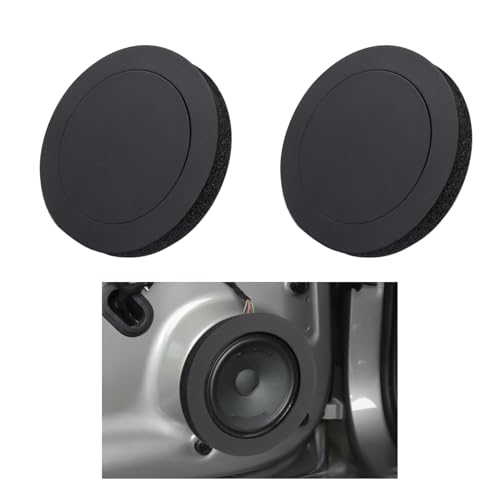
Decoupling the speaker frame from the metal door frame provides another essential acoustic improvement. When a speaker basket mounts directly against bare sheet metal without a gasket, mechanical vibrations transfer straight into the vehicle chassis. Placing closed-cell foam or silicone speaker rings between the speaker basket and mounting bracket isolates physical vibrations. This simple mounting barrier cleans up mid-bass articulation and stops door hardware from vibrating loose over time.
Sealing access holes in the inner door frame also transforms the door cavity into a more stable speaker enclosure. Factory vehicle doors contain numerous stamped holes used during vehicle assembly, which allow front and rear sound waves to interact. When rear sound waves cancel out front sound waves, listeners frequently raise the bass volume to compensate, accelerating distortion. Sealing these voids stabilizes internal air pressure, enabling the speaker cone to control its motion with greater mechanical precision.
Managing Mobile Device EQ and Streaming Quality
Smartphones and media streaming platforms often contain hidden equalization curves that artificially inflate low frequencies before the audio reaches the car receiver. Streaming services frequently enable bass boost audio presets or automatic sound normalization features by default. When an exaggerated mobile EQ curve combines with vehicle head unit tone controls, the cumulative bass output heavily distorts. Setting the mobile device equalizer to Flat or turning it off entirely provides a neutral foundation for system tuning.
Output volume levels on connected mobile devices also influence the clarity of audio entering the car stereo. Transmitting audio via a 3.5 mm auxiliary cable with the smartphone volume set to maximum can overdrive the receiver aux input. Overdriving input stages produces pre-amplification clipping that sounds identical to blown speaker cones. Keeping smartphone output volume around 80 to 90 percent allows the vehicle head unit to perform clean amplification without input distortion.
Wireless streaming protocols like Bluetooth introduce dynamic compression variables that alter frequency balance during playback. Highly compressed wireless streams sometimes present muddy lower frequencies due to bandwidth limitations and lossy audio codecs. Using high-bitrate streaming settings within your media applications ensures full frequency separation between bass notes and delicate vocal lines. A clean, high-resolution source file prevents muddy acoustic buildup across all playback channels.
Correcting Speaker Wiring Polarity and Phase Issues
Incorrect speaker wiring polarity creates bizarre acoustic anomalies that listeners often misinterpret as unnatural or muddy bass response. Every speaker possesses positive and negative electrical terminals that must match corresponding receiver or amplifier output terminals. When one door speaker is wired in reverse polarity, its cone moves backward while the opposite speaker cone moves forward. This out-of-phase condition causes destructive acoustic cancellation, eliminating punch while producing a hollow, disoriented soundstage.
Drivers frequently attempt to correct this hollow, diffuse sound by increasing the bass slider on their head unit, which severely overloads the drivers. Over-amplifying an out-of-phase signal forces speaker voice coils to dissipate massive wattage without delivering clear musical impact. Checking speaker wiring with a simple 9-volt battery test or visual polarity inspection confirms that all driver cones move outward in uniform unison. Restoring proper phase alignment restores natural acoustic response, rendering excessive bass compensation completely unnecessary.
Installing passive crossover hardware like the RECOIL BB-65 requires careful attention to polarity continuity. Because passive bass blockers feature designated lead wires, splicing them onto the correct positive conductor ensures proper electrical operation. Maintaining consistent polarity across both left and right audio channels preserves stereo imaging and transient response. Clean phase coherence allows each instrument to sit naturally in the acoustic mix without muddy interference.
Selecting Appropriate Frequency Limits for 6.5-Inch Drivers
Standard 6.5-inch car speakers excel at delivering articulate midrange vocals, guitars, and snappy mid-bass percussion notes. However, their physical cone area and excursion capabilities cannot reproduce genuine sub-bass frequencies below 60 Hz with acceptable authority. Forcing a standard door speaker to vibrate at 30 Hz or 40 Hz causes the voice coil to overheat and rock within the magnetic gap. Establishing clear operating boundaries safeguards the speaker structure while dramatically elevating sound quality.
Determining whether to use electronic receiver crossovers or passive in-line filters depends largely on your system complexity and budget. Electronic head unit crossovers offer the flexibility of adjusting cutoff frequencies on the fly to match specific musical tastes. Passive in-line blockers, on the other hand, provide an unchanging, foolproof hardware defense that prevents low-frequency damage even if stereo settings are reset. Combining both methods offers dual-layer protection, shielding speakers from unexpected equalization spikes or accidental setting changes.
Listeners who desire rich, deep bass should always allocate those sub-80 Hz frequencies to a dedicated, enclosed subwoofer. Relying on specialized drivers for low frequencies allows door speakers to function as true high-efficiency mid-range transducers. This balanced system architecture eliminates door panel vibration, prevents thermal speaker failure, and keeps dialogue intelligible at highway speeds. A well-filtered car audio setup ensures enjoyable listening without audio fatigue or mechanical distortion.
Taming excessive low-end energy in vehicle speakers transforms a muddy, fatiguing sound system into an articulate audio environment. Lowering head unit equalization bands, activating electronic high-pass crossovers, or installing passive blocking components like the RECOIL BB-65 preserves speaker longevity. Taking time to eliminate door rattles, verify polarity, and normalize mobile source files ensures balanced musical reproduction across every seat in the cabin.


Write Your Review
No reviews yet. Be the first to share your experience!